Irrational fears threaten bats and trees

The Secret Lives of Bats is appropriately named because our knowledge of bats is limited by the fact that they are active at night while we sleep and their activities are shrouded by darkness.  The author of this engaging little book, Merlin Tuttle, devoted his life, from the time he was a teenager, to the study and conservation of bats.  Although he learned a great deal about bats in the 60 years he has studied them, it is his accomplishments in bat conservation that are most inspiring and impressive.

A few bat facts
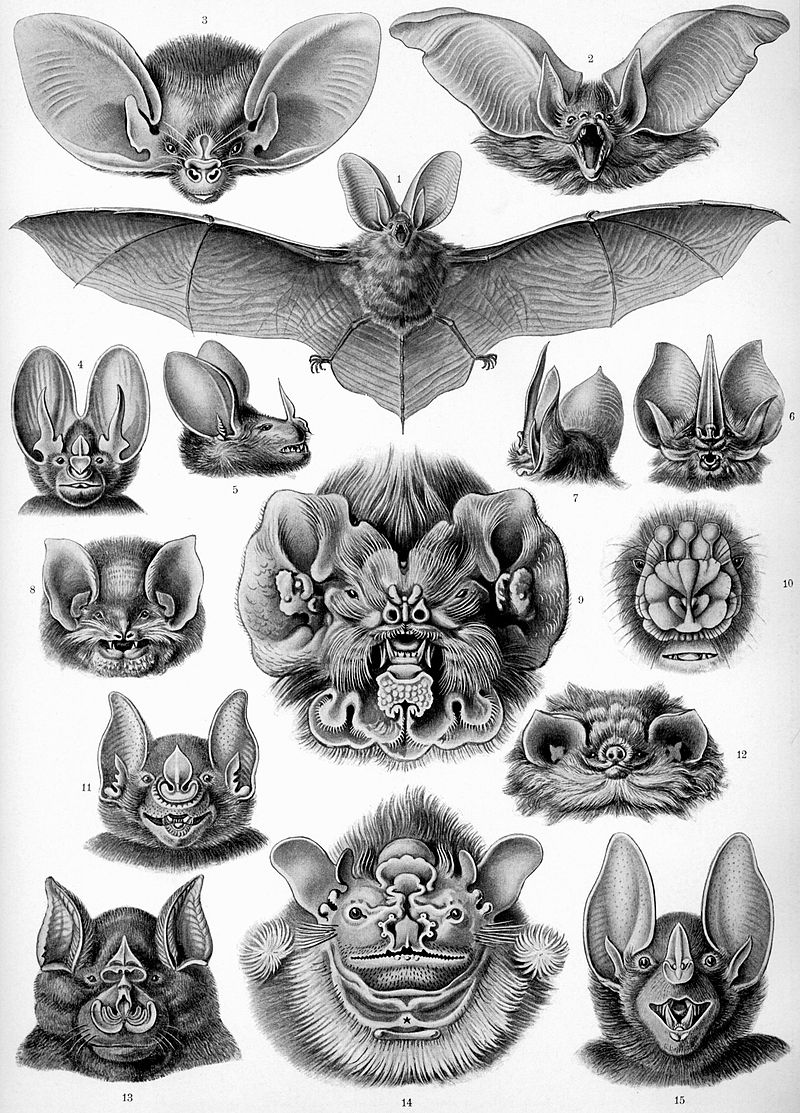
"Chiroptera" from Ernst Haeckel's Kunstformen der Natur, 1904
“Chiroptera” from Ernst Haeckel’s Kunstformen der Natur, 1904

There are nearly 1,300 species of bats and they are distributed all over the world, with the exception of Polar Regions.  We can’t describe the entire range of variation in the characteristics of such a diverse order (Chiroptera), so we will describe them only in general terms:

  • Bats are the only flying mammal. Their pups are born live and are generally fed breast milk by their mothers.
  • Many bat species live in caves and migrate from cold caves where they hibernate in winter to warmer caves where their pups are born.
  • Seventy percent of bat species eat insects. Bats in the US are insectivores.  Most remaining bat species eat fruit and live in tropical regions.  There are three bat species, called vampire bats that eat exclusively blood.   There are also a few species of carnivorous bats such as those that eat fish or frogs.
  • Many bat species live 20 to 30 years.
  • Most bat species use echolocation to find their prey in the darkness. See a video of a bat finding a moth, using echolocation HERE.

Local bat facts

There are 17 bat species in coastal California.  A study of foraging bats in 22 of San Francisco’s municipal parks found 4 species of insectivore bats.  The amount of forest edge and distance to water were the factors best explaining species richness and foraging activity.  The study found no correlation between bat foraging and the percent of native of plants, implying that there is no correlation between insect populations and native plants.

Why are bats important?

Insect-eating bats reduce insect populations, which reduces agricultural pests and disease-carrying mosquito populations.  A study in Arizona and New Mexico found that crop pests made up to two-thirds of free-tailed bats’ diets.  Another study found free-tailed bats feasting on migrating moths in Texas thousands of feet aboveground.  Tuttle estimates that “a single bat easily can consume more than 20 moths in a night, each carrying 500 to 1,000 eggs that otherwise would be laid on crops.  A density of 5,000 to 10,000 caterpillars per acre of cotton exceeds the threshold for pesticides.  Yet 20 moths can lay from 10,000 to 20,000 eggs.  If even half hatched to become caterpillars, they still could force a farmer to spray an acre of crop.”  (1)  Reduced populations of crop pests means fewer pesticides, which reduces farmers’ costs and toxicity exposure to consumers.
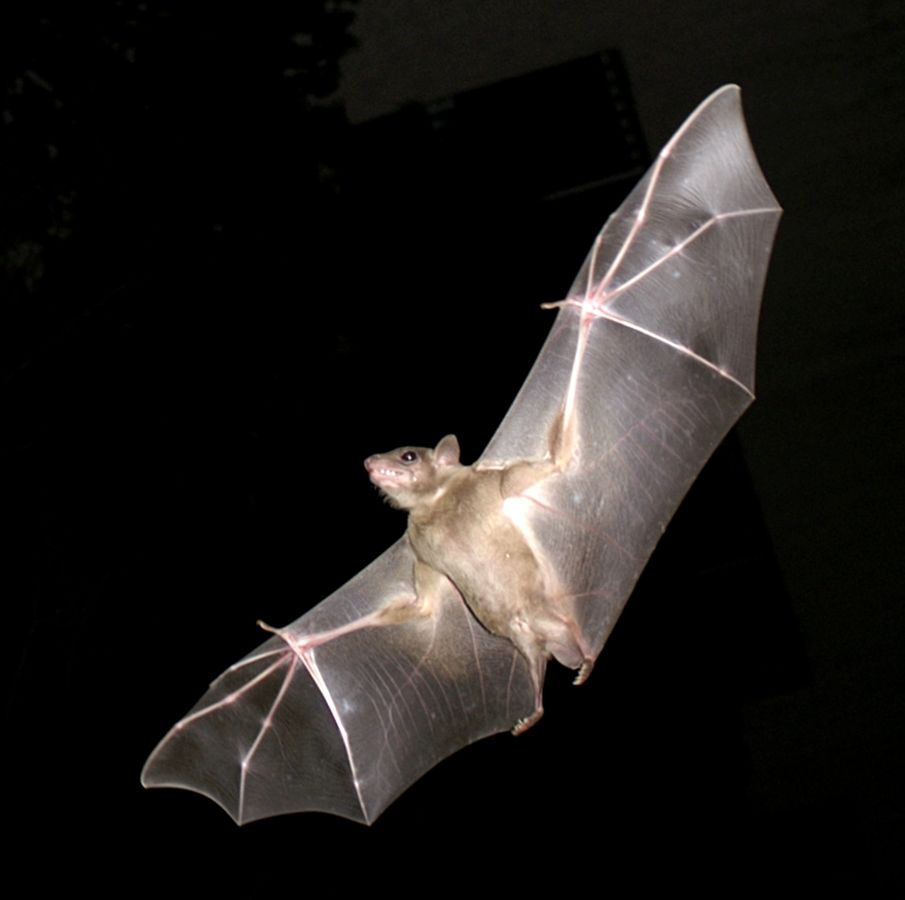
Common fruit bat. This photo makes it clear that the wings of a bat are also its hands. Creative Commons

Fruit-eating bats are important pollinators and dispersers of seeds.  There are some species of plants that can only be pollinated by bats because of the shape of the flower and the fact that it blooms only at night.

Although birds are also dispersers of seeds, the germination success of the seeds they disperse is probably less than those dispersed by bats because most bird species poop while perched, unlike bats that usually poop while flying.  Seeds deposited on open ground are more likely to germinate than seeds deposited in the shade of tree canopy.  Therefore, bats probably play a vital role in the reforestation of fallow agricultural land.

Bad raps about bats

So, as useful as bats are, why are their colonies often threatened with destruction?
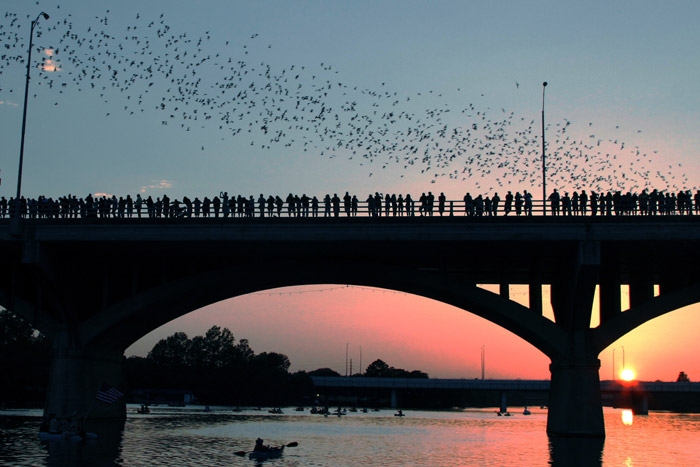
Bats departing from Congress Ave Bridge, Austin Texac
Bats departing from Congress Ave Bridge, Austin Texas

In the past, ignorance of the valuable functions performed by bats was the usual reason why their colonies are destroyed. The fact that the lives of bats are largely unseen contributes to that ignorance.  The colony of Brazilian free-tailed bats in Austin, Texas is a case in point.  In 1984, 1.5 million Brazilian free-tailed bats took up residence under a bridge in Austin, Texas.  “Newspaper headlines screamed, ‘Bat colonies sink teeth into city.’  They claimed that hundreds of thousands of rabid bats were invading and attacking the citizens of Austin.”  (1)

Tuttle was the curator of mammals at the Milwaukee Public Museum in Wisconsin at the time.  He had recently founded Bat Conservation International.  He quit his job and moved his fledging enterprise to Austin, where he was not warmly received.  But Tuttle is an engaging fellow and his knowledge of and fondness for bats is contagious.  Tuttle is equally modest, so he gives the bats full credit for convincing the public that bats need not be feared.  Within two months of his arrival, he turned the media coverage around.

The colony of Brazilian free-tailed bats in Austin is now internationally famous and a major tourist attraction.  Every evening at dusk, crowds form to witness the departure of the bats to forage for the evening.  My family has witnessed this moving event.  It is, indeed, a spectacle, on par with watching and listening to the raucous honking of huge flocks of Aleutian geese departing at dawn from their roosts for agricultural fields in Humboldt County.  Nature makes the best performance art.

Our federal Centers for Disease Control and Prevention informs us that we have little to fear from rabid bats:  “Most bats don’t have rabies. For example, even among bats submitted for rabies testing because they could be captured, were obviously weak or sick, or had been captured by a cat, only about 6% had rabies.”

Anthropogenic problems and bad solutions

There are only three species of vampire bats in tropical regions, but only one is considered a problem because it has a preference for mammals.  The population of this species of bat has grown because of the introduction of large herds of domesticated cattle.  The bats deplete the blood of the cattle and can spread diseases.  Reluctantly, Tuttle admits that these bat populations must be controlled.

So, his mission where vampire bats are causing problems for ranchers was to educate the ranchers about how to identify and find the bats.  There are other species of bats living in these areas that are performing valuable functions and unfortunately they roost in big colonies that are easy for the ranchers to find.  The ranchers were dynamiting or destroying these colonies because they were unable to distinguish them from the bats that were causing their problems.  Unfortunately, the vampire bats roost independently, hiding in trees.  So, they are more difficult for the ranchers to find.  With Tuttle’s help, tactics were devised to find the individually roosting vampire bats in order to reduce their populations.

New challenges for bats

Tuttle and his compatriots have accomplished a great deal in the past 60 years to increase our knowledge of bats and the important roles they play in nature.  He has convinced many people that it is not in their interests to destroy bat colonies on their properties.  However, he closes his book with two new challenges to bats:

  • Wind turbines are killing as many bats as they are birds. We must carefully study the design and placement of wind turbines to reduce this threat to our winged neighbors.
  • White-nosed syndrome is a fungus that has killed tens of thousands of bats in caves, particularly in the North East of the US. The fungus seems to live in a fairly narrow temperature range, so we are hopeful that it will not continue to spread rampantly.

The danger of misinformation

Millions of bats needlessly lost their lives because people were afraid of them.  Much progress has been made to inform the public of the value of bats.  Is this starting to sound familiar?  It should.  Millions of eucalyptus trees have been destroyed because people were needlessly afraid of them.  Please help us spread the word about the value of our trees.


(1) Merlin Tuttle, The Secret Lives of Bats, Houghton Mifflin Harcourt, 2015.  A favorable review of this book is also available in the New Yorker.
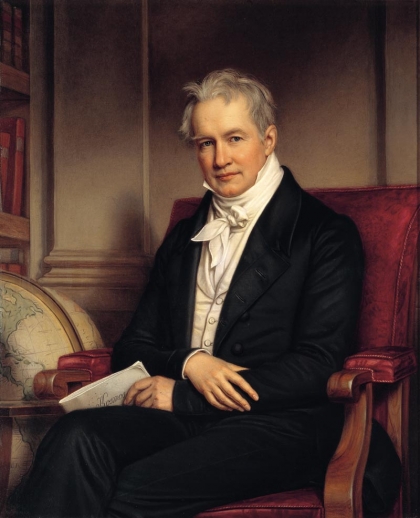
Alexander von Humboldt: “The Invention of Nature”

Portrait of Alexander von Humboldt by Joseph Stieler, 1843

Alexander von Humboldt made so many contributions to science that we cannot do him justice here.  We will therefore focus on his study of nature and put his accomplishments in that area into the context of historical events and his personal views of those events.  We draw from Andrea Wulf’s The Invention of Nature in this article. (2)

Humboldt is considered the originator of the scientific concept of biogeography, “the study of the distribution of species and ecosystems in geographic space and through (geological) time.” (1)  In other words, biogeography attempts to explain why species are where they are.  It is therefore relevant to the mission of Million Trees, which is to make the case that species belong wherever they persist without human management and without regard to how they got there.

The journey begins

Alexander von Humboldt was born in 1769 in what was then Prussia and is now Germany.  Under the thumb of a domineering mother, he was required to spend most of his twenties as a mining inspector.  In that capacity, he mastered the science of geology that he put to good use throughout his long life.

At the age of 27, he was freed from his obligations to his mother by her death.  With the help of his inheritance he began his travels to satisfy his intense curiosity about the world.  He brought along on his journeys the tools of measurement that existed at that time.  He made detailed recordings of his measurements wherever he went and they were the basis of comparing the many places he visited.

His journey began in the mountains of Europe and they became the baseline of his comparisons throughout his journeys.  But his movements in Europe were hampered by the political situation.  Revolutionary France was expanding its empire with a series of wars in Europe that prevented him from visiting many places of interest to him.  After several failed attempts to join voyages to other places, the King of Spain granted Humboldt a passport to the Spanish colonies in South America to collect the flora and fauna of the New World.

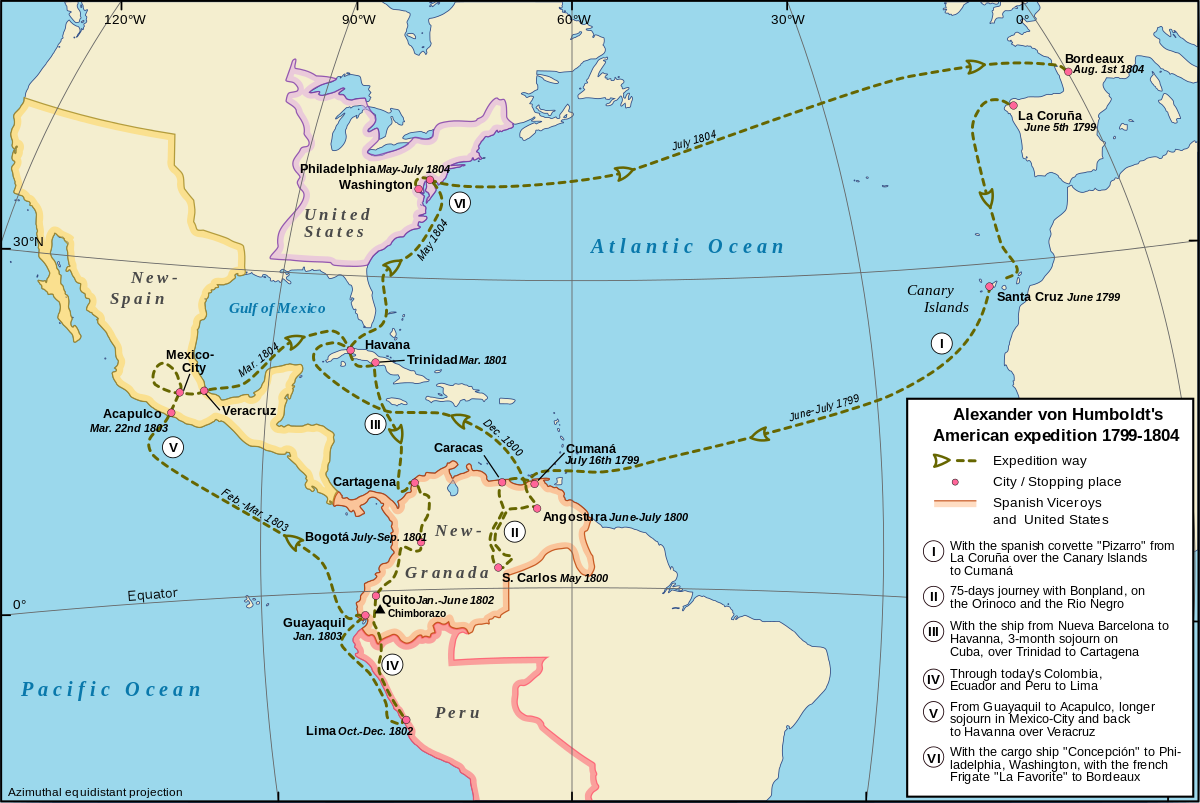
Humboldt set sail from Spain in June 1799, along with “a great collection of the latest instruments, ranging from telescopes and microscopes to a large pendulum clock and compasses—forty-two instruments in all, individually packed with protective velvet-lined boxes—along with vials for storing seeds and soil samples, reams of paper, scales and countless tools.” (2)

Journey of Alexander von Humboldt in the New World, 1799-1804. Creative Commons - Share Alike
Journey of Alexander von Humboldt in the New World, 1799-1804. Creative Commons – Share Alike

Finding unity in nature

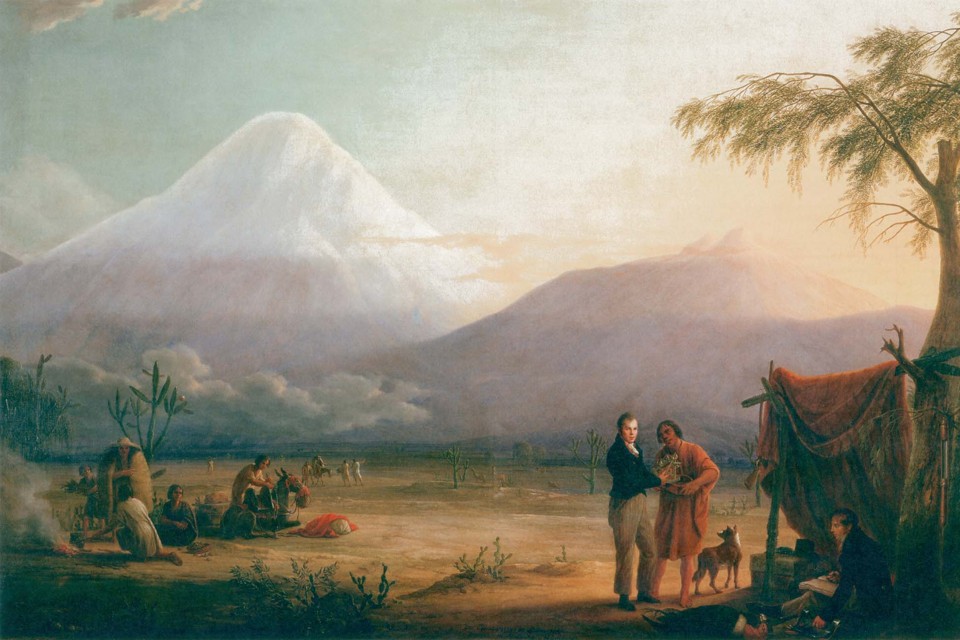
Alexander von Humboldt collecting plants at the foot of Chimborazo. Painting by Friedrich George Weitsch

Humboldt and his companions climbed every mountain they encountered, taking precise measurements of altitude, temperature, and samples of soil and plants as they gained altitude.  As he accumulated data from each climb he began to see a pattern in what he encountered.  Humboldt’s new, revolutionary idea of nature fell into place for him as he climbed Chimborazo in Ecuador to an unprecedented height of 19,413 feet, about 1,000 feet shy of the summit:  “Nature, Humboldt realized, was a web of life and a global force…Humboldt was struck by this ‘resemblance which we trace in climates the most distant from each other.’ (2)

Humboldt's Naturegemälde
Humboldt’s Naturegemälde

Humboldt called the graphic depiction of his theory Naturegemälde which means roughly “painting of nature.”  His drawing shows that plants are distributed according to their altitudes and latitudes, from subterranean mushroom species to the lichens that grow below the snow line.  In similar latitudes, palms grow in the tropical zone at the foot of the mountain.  Oaks and shrubs prefer the temperate climate above the tropical zone.  Naturegemälde illustrated for the first time that “nature is a global force with corresponding climate zones across continents.” (2)

Addendum:  In 2012 – 210 years after Humboldt climbed Chimborazo – a scientific expedition surveyed the vegetation on Chimborazo and compared that survey to Humboldt’s survey in 1802.  They found that the vegetation has moved to higher altitudes on average 500 meters.   This movement of plants to higher elevations (and latitudes in other examples) is a response to climate change, which requires plant and animal species to move in order to survive.  It is one of many examples of why the concept of “native plants” is meaningless at a time of rapid climate change. (3)

Humboldt’s theory of the unity of nature, connected in a global web of life, required an interdisciplinary approach of which few of his contemporaries were capable.  He drew equally from his fund of knowledge about astronomy, botany, geology, and meteorology.  Sadly, as human knowledge has expanded exponentially in over 300 years, an interdisciplinary approach to science has become unattainable.  Scientific inquiry has become increasingly narrowly specialized, preventing the global view that informed Humboldt’s studies.  The “big picture” is lost in the compartmentalization of science into isolated, specialized scientific disciplines.

Socio-political context of Humboldt’s travels

We cannot fully appreciate Humboldt’s scientific accomplishments without mentioning his interest in and concern for the human realm.  Humboldt was 20 years old when the French Revolution occurred in 1789.  He was thrilled and delighted by the prospect of liberty and equality for the French people.  His admiration for the French made Paris his home for much of his life.  He believed that science would thrive in such an atmosphere of freedom of thought and action.

As Humboldt travelled in the New World, he brought this standard of freedom and liberty along with him.  New Spain was lacking in that regard.  He believed that the cultural accomplishments of the indigenous people were sadly devalued.  He was disgusted by the oppression of the indigenous people and the lack of basic human rights of the colonists.  He observed the consequences of this oppression in the colonial landscape.  Mineral riches were ravaged and forests were razed for the cash crops that impoverished the settlers.  The colonial government required them to grow monocultures such as indigo (blue dye), in lieu of the crops needed to feed the population.

Humboldt was one of the first scientists to observe the destructive consequences of deforestation.  Forests were cleared for agricultural fields.  Wood was the fuel of the time, providing heat and light.  Later forests would fuel ships, trains and industrial steam engines.  Where forests were cleared, the land quickly dried out because trees recycle water into the atmosphere.  Erosion and desertification are the eventual consequences of deforestation.

For the same reason that Humboldt admired the French Revolution, he also admired the new American republic that had only recently gained its independence from Britain and was founded on democratic principles.  He went far out of his way to visit the United States to consult with the young democracy.

Thomas Jefferson was the President at the time and they spent much valuable time together.  The Spanish jealously guarded all useful information about New Spain because the United States was clearly a rival in the New World.  Humboldt brought the Americans much useful information about their competitor because he not only wished to be helpful to their young enterprise, he firmly believed in universal access to information.

However, there was one horrible blot on the reputation of the United States that made Humboldt queasy.  He abhorred slavery in his own country as well as in the United States.  As much as he enjoyed the company of Thomas Jefferson and respected his intelligence, he was scandalized by the scale of enslavement on Jefferson’s Virginia plantation.

Humboldt’s concern for the welfare of humans extended to all races, ethnicities, and classes.  Just as he embraced all nature as worthy of his attention, his view of humanity was equally generous and inclusive.  We venture to guess that he would be as mystified by the pointless distinction between “native” and “non-native” plants and animals as we are.

Humboldt’s legacy

When Humboldt returned to Europe in 1804 at the age of 35, his reputation as an important scientist was already established by the correspondence in which he had engaged during the 5-year voyage.  He returned with the detailed record of his travels, including specimens:

“[He] returned with trunks filled with dozens of notebooks, hundreds of sketches and tens of thousands of astronomical, geological and meteorological observations.  He brought back some 60,000 plant specimens, 6,000 species of which almost 2,000 were new to European botanists—a staggering figure, considering that there were only 6,000 known species by the end of the eighteenth century.” (2)

He spent 21 years publishing over 30 volumes about his 5-year journey in the New World.  Not only were these books widely read, they influenced many of the greatest scientists and thinkers who succeeded him:

  • Charles Darwin’s correspondence with Humboldt and many references to Humboldt’s publications in his own work are evidence of Humboldt’s influence on Darwin’s work. Just as Humboldt’s journey inspired his theory of the unity of nature, Darwin’s journey around the globe was the inspiration for his theory of evolution.  Readers of Darwin’s early work observed the similarity of his writing style with that of Humboldt.
  • Humboldt was equally influential in the writings of Henry David Thoreau. Thoreau published an unsuccessful book shortly after his two-year reclusive experience on Walden Pond.  Then he learned from Humboldt’s books to observe and record the workings of nature, which eventually transformed his writings into the nature writing that made him famous.  The records he kept of the climate on Walden Pond are still used as a reference point for the climate change that has occurred in the past 150 years.
  • George Perkins Marsh is considered the first American environmentalist. His book Man and Nature was the first to express alarm in 1864 about American deforestation.  The writings of Humboldt were the first to alert Marsh to this issue and as they did for Humboldt this issue was brought into focus by extensive travels.  Marsh could see America’s future in Egypt where thousands of years of intensive agriculture left the land bare and unproductive.

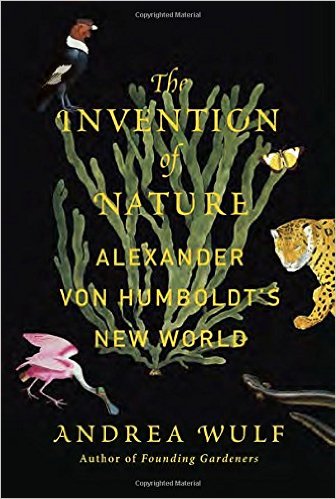
Invention of NatureThis is but a short list of important scientists all over the world who were influenced and inspired by the writings of Alexander von Humboldt long after his death in 1859 at the age of 89.  We encourage our readers to read Andrea Wulf’s The Invention of Nature:  Alexander von Humboldt’s New World for the full story.  We have reported on other books by Andrea Wulf—The Brother Gardeners and The Founding GardenersMs. Wulf turns botanical history into a gripping story.

What is Humboldt’s message to Million Trees?

Alexander von Humboldt delivers a powerful message that fits well with our mission.  He saw the world and its inhabitants as fitting together in a harmonious and comprehensible manner.  He was always looking for the connections between seemingly disparate elements in nature and finding them wherever he looked.  His egalitarian hopes for humanity fit perfectly with his perception of nature as working together to make a web of life with humans as a part of that web.

We would like to think that Million Trees shares the Humboldtian viewpoint and we hope that our readers agree.  We hope that the New Year will bring more harmony to nature and those who live within it.


(1) Wikipedia https://en.wikipedia.org/wiki/Biogeography

(2) Andrea Wulf, The Invention of Nature:  Alexander von Humboldt’s New World, Alfred A. Knopf, New York, 2015

(3) Morueta-Holme N, Engemann K, Sandoval-Acuña P, Jonas JD, Segnitz RM, Svenning JC, “Strong upslope shifts in Chimborazo’s vegetation over two centuries since Humboldt,”  Proc Natl Acad Sci U S A. 2015 Oct 13;112(41):12741-5.  Available HERE.


2015 Annual Report (prepared by WordPress)

The WordPress.com stats helper monkeys prepared a 2015 annual report for this blog.

Here’s an excerpt:

The concert hall at the Sydney Opera House holds 2,700 people. This blog was viewed about 52,000 times in 2015. If it were a concert at Sydney Opera House, it would take about 19 sold-out performances for that many people to see it.

Click here to see the complete report.