I attended my first Beyond Pesticides forum in 2014 in Portland, Oregon. I have been a member of and donor to Beyond Pesticides ever since. And I have purchased only organic food since attending that forum, because of a field trip to a community of farm workers that convinced me that growing our food without using pesticides benefits both consumers and producers of America’s food.
In a recent letter to the National Invasive Species Council, Beyond Pesticides describes their organization and mission:
“Founded in 1981 as a national, grassroots, membership organization that represents community-based organizations and a range of people seeking to bridge the interests of consumers, farmers and farmworkers, Beyond Pesticides advances improved protections from pesticides and alternative pest management strategies that reduce or eliminate a reliance on pesticides.” (The letter is available HERE: Beyond Pesticides – ISAC Comment )
I receive emails from Beyond Pesticides at least once a week, alerting me to opportunities to influence the laws and policies that regulate pesticide use in America. As you might expect, the frequency of those alerts has accelerated a great deal in the past year, as the federal government is actively engaged in the process of dismantling many federal regulations, including those that regulate pesticides.
The National Invasive Species Council recently invited the public to submit public comments in answer to a few specific questions, in preparation for the next meeting of the Invasive Species Advisory Council. Today I am publishing an excerpt of the letter of Beyond Pesticides in answer to those questions (some emphasis added). I am doing so because I consider this letter a wise and informed critique of the entire concept of “invasive species” and the pesticides used to eradicate them.
“The National Invasive Species Council (NISC) posed four questions for public input to the forthcoming meeting of the Invasive Species Advisory Council (ISAC). We find it most helpful to begin with the fourth: “How can NISC foster the development and application of innovative tools and technologies to enable the prevention, eradication, and control of invasive species in a more timely and effective manner?”
In order to address this question, NISC and ISAC need to first address the question, “What is an ‘invasive species’?”
‘Invasive species’ have frequently provided a reason for dispersing toxic chemicals in the environment, often with a sense of urgency and an assumed indisputable benefit. This unsupported (and sometimes unstated) assertion of benefit is a claim to virtue that allows environmental harm instead of preventing it.
In the context of other federal, state, and local laws, the regulatory definition of ‘invasive species’ gives broad authority to agencies to use all means at their disposal to rid the jurisdiction of non-native organisms causing economic harm, as well as harm to health and the environment. Many local ordinances that ban or restrict pesticide use make an exception for ‘invasive species,’ presumably under the mistaken assumption that in doing so they are protecting the environment. Instead, they are allowing environmental harm through the spread of toxic substances.
The use of the term ‘invasive species’ as a claim to virtue that is used to promote any and every attempt to exterminate any unwanted organisms is very disturbing. It is important to understand the problems that lead to the use of toxic chemicals, beginning with the cause. In the case of situations involving so-called ‘invasive species,’ we find that few, if any, involve species that are truly ecologically invasive—that is, capable of invading and persisting in intact ecosystems. Instead, such situations usually involve species that can take advantage of disturbed habitats (‘weeds’ or ‘weedy species’). As such, the emphasis should be placed on healing the disturbance (to which end, so-called ‘invasives’ may sometimes be helpful), rather than killing the opportunist colonizer.
We do not take the position that such opportunist colonizers should never be removed or managed. We do believe that the decision concerning whether such action should be taken should be based on the situation at hand and not on a claim to virtue that makes extermination of non-natives a righteous cause.
Redefining ‘invasive species’ to be limited to those species that can invade and damage intact ecological communities will directly ‘foster the development and application of innovative tools and technologies to enable the prevention, eradication, and control of invasive species in a more timely and effective manner’ (NISC) because resources will be directed only at those species that truly present an ecological threat. It will prevent those resources from being squandered in ways that are ecologically destructive.
The sharper focus that this redefinition will bring to the NISC and ASIC will enable them to explore approaches such as those that Beyond Pesticides has used in working with National Parks, local governments, and tribes to manage ecological problems in a way that is truly protective of biodiversity.”
Terry Shistar, Ph.D.
Board of Directors
Beyond Pesticides
Beyond Pesticides will soon hold its annual forum in Irvine, California, April 13-14, 2018. As usual, the forum will include highly qualified speakers who are knowledgeable about so-called “invasive species,” and the evolutionary principles that raise questions about the necessity and futility of trying to eradicate them. Two of the speakers are important to our local effort to stop the use of pesticides to eradicate non-native plant species: Dr. Scott Carroll and Professor Tyrone Hayes.
Dr. Scott Carroll is an evolutionary biologist affiliated with UC Davis. He has published several influential studies about the speed of adaptation and evolution that enables introduced plants to join native ecosystems without long-term negative consequences of their introduction. He has coined the concept of “Conciliation Biology,” which advocates that we turn from efforts to eradicate non-native species in favor of a new approach which manages the co-existence of native and non-native species.
Professor Tyrone Hayes (UC Berkeley) is best known for his criticism of the herbicide, atrazine, which is harmful to the frogs that he studies. Unfortunately, Professor Hayes’ opposition to atrazine does not extend to the pesticides being used in the San Francisco Bay Area to eradicate non-native trees and prevent them from resprouting. Professor Hayes accepts the premise that eucalyptus trees are detrimental to native plants, which justifies the use of herbicides to destroy them, in his opinion. The herbicide that is used for that purpose (Garlon with active ingredient triclopyr) is just as toxic as atrazine. Both are organochlorine products that bioaccumulate, persist in the environment for decades, and are endocrine disruptors.
The Beyond Pesticides forum is likely to generate some lively discussion of the issues that are relevant in the San Francisco Bay Area. Details about the conference are available HERE. Beyond Pesticides makes every effort to make these forums affordable for activists. I have attended two of these conferences. They were excellent opportunities to learn more about pesticides, to meet other activists, and to get ideas about how to advocate more effectively for more responsible pesticide use in our community.
I am very grateful to Beyond Pesticides for their leadership in the effort to reduce pesticide use in the United States. They are a reliable source of information about pesticides and their activism is an inspiration to those who are engaged in this effort on a local level.
This photo generated some discussion among the readers of Million Trees about nativism in the natural world. Is it related to nativism in the human realm? This is a timely question because American politics are presently consumed by anti-immigration sentiment, AKA “nativism.” As members of our communities are unceremoniously rounded up in immigration raids and deported from America, this is an association that is getting more attention.
We are pleased to publish a guest post by Professor Art Shapiro (UC Davis) in answer to this question. Although Professor Shapiro is a renowned expert on the butterflies of California, he is knowledgeable on a wide range of subjects, including philosophy and history.
Professor Shapiro offers us a nuanced answer to the question at hand. This is an example of a general principle about such debates: the more we know, the more complicated every issue becomes. I have had the pleasure of a few long conversations with Professor Shapiro that were similar experiences. Professor Shapiro teaches us that we must examine issues from every angle, considering the pros and the cons. More often than not, we can’t reach a definitive conclusion that does the issue justice.
But I will demur on the issue of nativism. I will venture my opinion that nativism in the natural world is ultimately as pernicious as nativism in the human realm. They both do more harm than good. They are both fundamentally unjust. However, I do NOT generalize about the motivation of native plant advocates. I doubt that the majority are appropriately called “native-plant Nazis.”
I remain grateful to Professor Shapiro for sharing his knowledge and wisdom with me and with the readers of Million Trees.
Million Trees
Various observers have noted similarities in the rhetoric used by native-plant activists and that used by xenophobes. The comparison has generated a derisive term, “native-plant Nazis,” to describe the most strident of those opposed to the use of non-native plants in gardens. But were the real Nazis “native-plant Nazis?” The answers are rather complex and in some ways surprising.
The German Romantic Movement stressed the “organic unity” of the German people and their landscapes. In 1818 the artist Friedrich Ludwig von Sckell in his book Beitraege zur bildenden Gartenkunst (“Contributions to Instructive Garden Art”) prescribed the planting of “patriotic species” to create landscapes of “patriotic character.” The great explorer-naturalist-geographer Alexander von Humboldt referred in 1806 to vaterlaendische Pflanzengestalten (plant character reflecting the Fatherland) and stressed that “the natural character of different regions of the earth is most intimately connected with the history and culture of the human race,” a notion that persists today, as witness the excellent book Landscape and Memory, by the historian Simon Schama, and is not in itself reflective of xenophobia.
During the Romantic period the intense longing for the unification of the fragmented German polity bred not only intense patriotic feeling but a concomitant disdain for the alien. Thus Fichte argued that the Germans’ “natural disposition to freedom dates back to prehistoric times, when they had been a pure and untainted race…before the influence of foreigners and the introduction of class division.” After the establishment of the First Reich in 1871, all things German were ever more aggressively touted as superior to all else, and this included landscapes. The writer Willy Pastor and the art historian Josef Strzygowski enthusiastically promoted these ideas in the early 20th Century. Pastor invoked the Ice Age as the crucible in which the German national character was forged; the glaciers “not only influenced the racial breed of humans, but also selected trees and plants….the European primeval forest, which finally evolved as the strongest out of this severe school, was no less of Germanic, Nordic race than the people…”
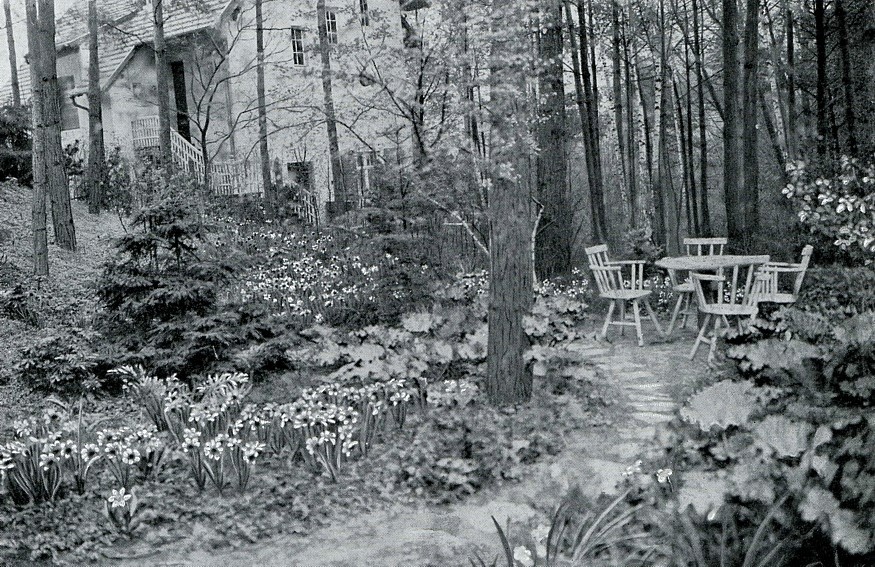
Nature garden designed by Willy Lange
The quintessential embodiment of such ideas was the work of the landscape architect Willy Lange. Lange and Pastor were friends and shared their nationalistic vision. Pastor published a collection of essays entitled Lichtungen (clearings) and a book The Earth in the Time of Man, in which he argued that the natural habitat of the true Teuton is a clearing in the forest. Lange translated that view into a prescription for garden design: he utterly repudiated the formalism of most European gardens and argued instead that the ideal form of garden was a well-designed, visually pleasing simulacrum of a natural forest clearing, employing whenever possible (but not exclusively) native plants characteristic of the natural landscape. His ideas were taken up by Alwin Seifert, who rose after the Nazis came to power to be the ultimate arbiter of garden design. In 1939 Hans Hasler’s book Deutsche Gartenkunst (German Garden Art) spelled out the essential unity of the German national soul and the surrounding environment. Heinrich Friedrich Wiepking, who held the landscape design chair at the College of Agriculture in Berlin during the war, taught this doctrine as the rationale for gardening and invoked ancient Teutonic artifacts, burial mounds, and such as proof of this essential “organic unity.” Wiepking’s student Werner Lendholt “proved” that Germans already had a refined sense of landscape unity in the Bronze Age.
The idea of the “nature garden” arose repeatedly as a byproduct of romanticism, not only in Germany but throughout Europe and even in America; it can be seen as a reaction against formalism, with its rigidity and symmetry. But only in the Reich did it become so tightly fused with nationalism. There is nothing inherently political in Lange’s definition of his philosophy as “the derivation of ideas from nature and their translation in an artistic manner into garden design.”
Lange and his successors drew inspiration from the earlier work of the Irish garden writer William Robinson, who in turn was influenced by Gertrude Jekyll. And they in turn were influenced by William Thompson, who promoted the idea of the semi-natural “English flower garden” as early as 1852. The Austrian Robert Gemboeck, beginning in the 1880s, advocated “the reproduction of nature in the garden,” and was quite influential; he gave detailed prescriptions for how to create a simulacrum of wilderness—what kind of wilderness being dependent on the soil type available.
But none of this meant that the German garden had to be composed exclusively of native plants!
The era of both Robinson and Lange was the era of the “grand tour,” and both men traveled widely and assimilated their observations into their concepts of the natural garden. Lange’s disciple Hasler wrote that the master developed his art “as a result of his experiences and knowledge he gained on a north-south tour of Europe and North Africa.” After 1907 he explicitly advocated the introduction and naturalization of plants he regarded as esthetically in harmony with the true Teutonic landscape. During the 1930s the Nazi regime, primarily under the guidance of Heinrich Himmler, sponsored a series of famous expeditions to the Himalaya. There were several reasons for doing so. Himmler was entranced by the crackpot Welt-Eis Lehre (world ice theory) of Hanns Hoerbiger, which amplified the Romantic notion of the Ice Age as the crucible of German character. Himmler was interested in learning as much as possible about the Ice Age by studying what he viewed as the people living most like the ancient Teutons: the Tibetans, whom he imagined to be a pure and unadulterated race. But a subsidiary objective of the expeditions was to collect living material of Himalayan plants deemed suitable for naturalization in the Fatherland. In a sense, this represented an attempt to restore an imagined Edenic past.
Only those non-native plants judged to be inconsistent with the German landscape-character nexus, as largely defined by Alwin Seifert, were to be excluded. Seifert’s official title was Reichslandschaftsanwalt, or national landscape advocate. When he first received the title he presented two proposals to his superior, Fritz Todt: one embraced the use of non-native plants while the other did not. Seifert is a complex and problematic figure. He was anti-Semitic but never a really enthusiastic Nazi and he had a strong independent streak which often led him into trouble. He was a passionate advocate of organic gardening and sympathetic to anthroposophy, the cultish philosophy of Rudolf Steiner (today best known for the Waldorf School movement). His many contradictions led his biographer Thomas Zeller to call him “The Nazis’ environmental court jester and Cassandra, rolled into one.” His attitude on non-native plants hardened somewhat late in his tenure, when he took to calling Colorado blue spruce “public enemy #1.”
There was much in German garden philosophy and design to be admired, if one strips out the pugnacious racial and nationalistic rhetoric. There is really little difference from the natural-garden traditions developed elsewhere. Nazi Germany, early in its history, enacted what would today be characterized as the most progressive legislation in the world dealing with conservation, esthetics, and environmental health. Hence we have such books as The Green and the Brown and How Green Were the Nazis? that explore the contradiction between those facts and everything else we know about the regime. The contradiction becomes less bizarre when we remember the roots of Nazism in the Romantic movement.
At any rate, the real Nazis were never thoroughgoing “native-plant Nazis!”
Arthur M. Shapiro
Further Reading:
Bruggemeier, F.-J. and M. Cioc. 2005. How Green Were the Nazis? Nature, Environment and Nation in the Third Reich. Ohio University Press.
Uekoetter, F. 2006. The Green and the Brown: A History of Conservation in Nazi Germany. Cambridge University Press.
Wolschke-Bulmahn, J. 1992. The ‘wild garden’ and the ‘nature garden’ – aspects of the garden ideology of William Robinson and Willy Lange. Journal of Garden History 12: 183-206.
Wolschke-Bulmahn, J. 1997. Nature and Ideology: Natural Garden Design in the Twentieth Century. Dumbarton Oaks collection on the history of landscape architecture, vol. 18.
I am pleased to publish the following report of one of our readers who attended the conference of the California Native Plant Society in Los Angeles at the beginning of February 2018.
Million Trees
I attended the last conference of the California Native Plant Society in San Jose in January 2015. It was interesting to note a few significant new themes in the recent conference in 2018. Both fire and climate change were much more prominent themes in the recent conference. While both are relevant to the future of native plants, neither seemed to have any effect on the “restoration” goals of the native plant movement. For example, there were several presentations about massive die offs of native oak trees, resulting from higher temperatures, drought, and disease. These presentations ended with urgent pleas to plant more oaks. That seemed a fundamental contradiction and a denial of the reality of climate change. When the climate changes, the landscape changes, but native plant advocates are not willing to acknowledge that. In fact, the greater the threats to native plants, the greater the commitment to their preservation and “restoration.”
Beautiful pictures support nativist ideology
The conference began on a low point for me, but a high point for most attendees of the conference. The keynote speaker was Doug Tallamy. He was introduced as a “rock star” of the native plant movement, and indeed he is. His presentation was very effective in delivering his message, which is that most insects are “specialists” with mutually exclusive relationships with native plants that evolved over “tens of thousands of years.” If you believe that claim, you also believe that the absence of native plants will result in the absence of insects and ultimately the collapse of the entire food web.
Most native plant advocates believe that gloomy scenario, but few scientists still do, which creates a tension within this community of native plant advocates composed predominantly of amateur “botanists” and a smattering of academic ecologists. For example, one of the first presentations after Tallamy’s keynote was an academic ecologist from UC Berkeley who advocated for accommodating the movement of plants outside of historical native ranges to accommodate climate change. (1) He said that restoring only with local natives is “maladaptive” and that a bioregional perspective is needed to create sustainable landscapes. Allowing Monterey pines to grow in the San Francisco Bay Area, where they have grown in the past and are presently deemed “native” just 150 miles away, seems a good example of such a broader definition of “native.” An amateur nativist, parroting Tallamy, asked this hostile question: “But if we move the plants how will wildlife survive?” The academic delivered this tart dose of reality: “There are few mutually exclusive relationships in nature. Wildlife will also move and will adapt to changes in vegetation.”
Science debunks a myth about eucalyptus
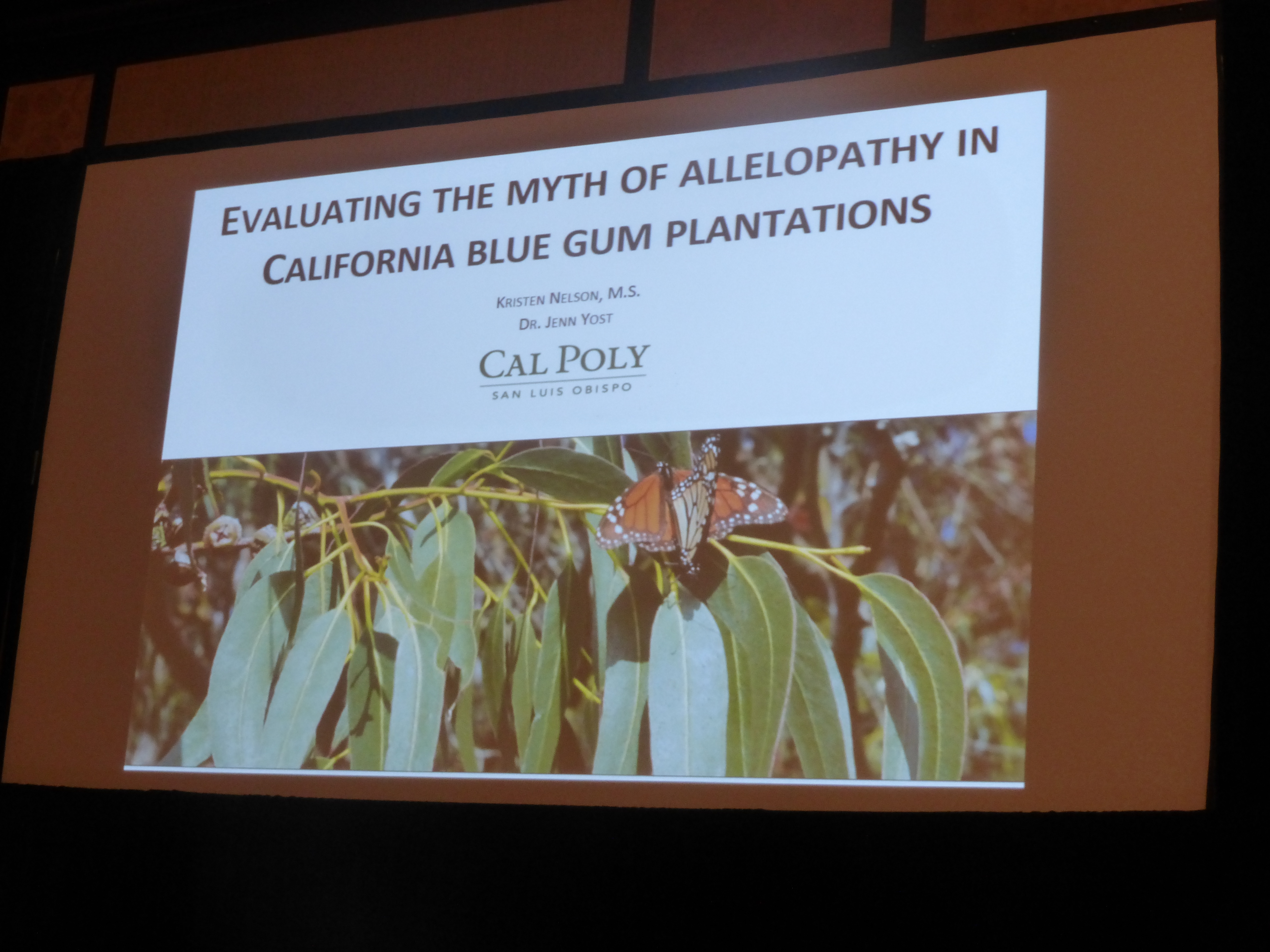
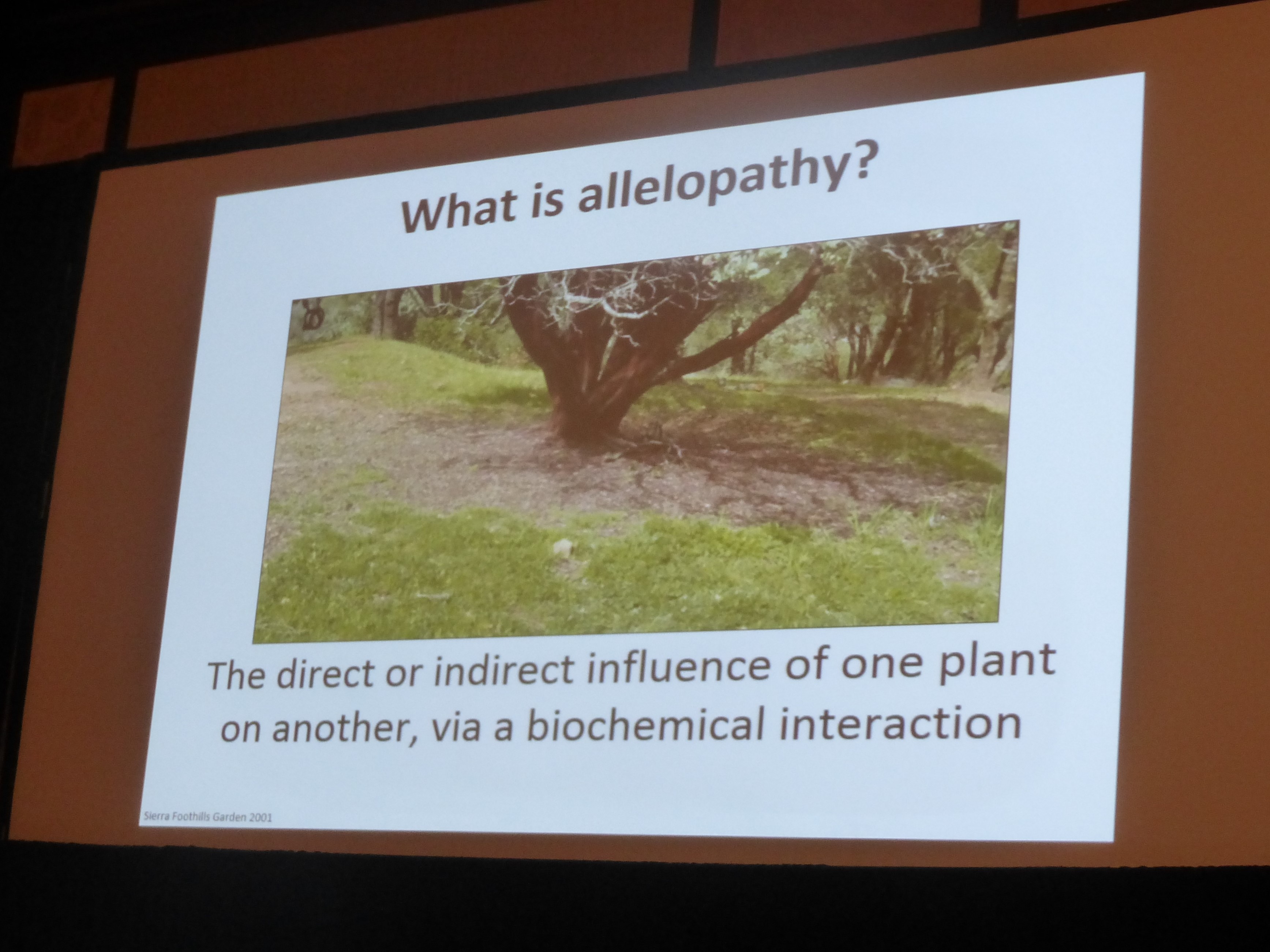
The high point of the conference for me was a presentation by Jennifer Yost, Assistant Professor at Cal Poly, San Luis Obispo. She and her graduate student studied the claim that nothing grows under blue gum eucalyptus trees because of allelopathic chemicals emitted by eucalyptus that suppress the germination of other species of plants. Two studies of this hypothesis were done in the 1960s, but the analytical methods used by those studies were misleading.
CNPS Conference 2018
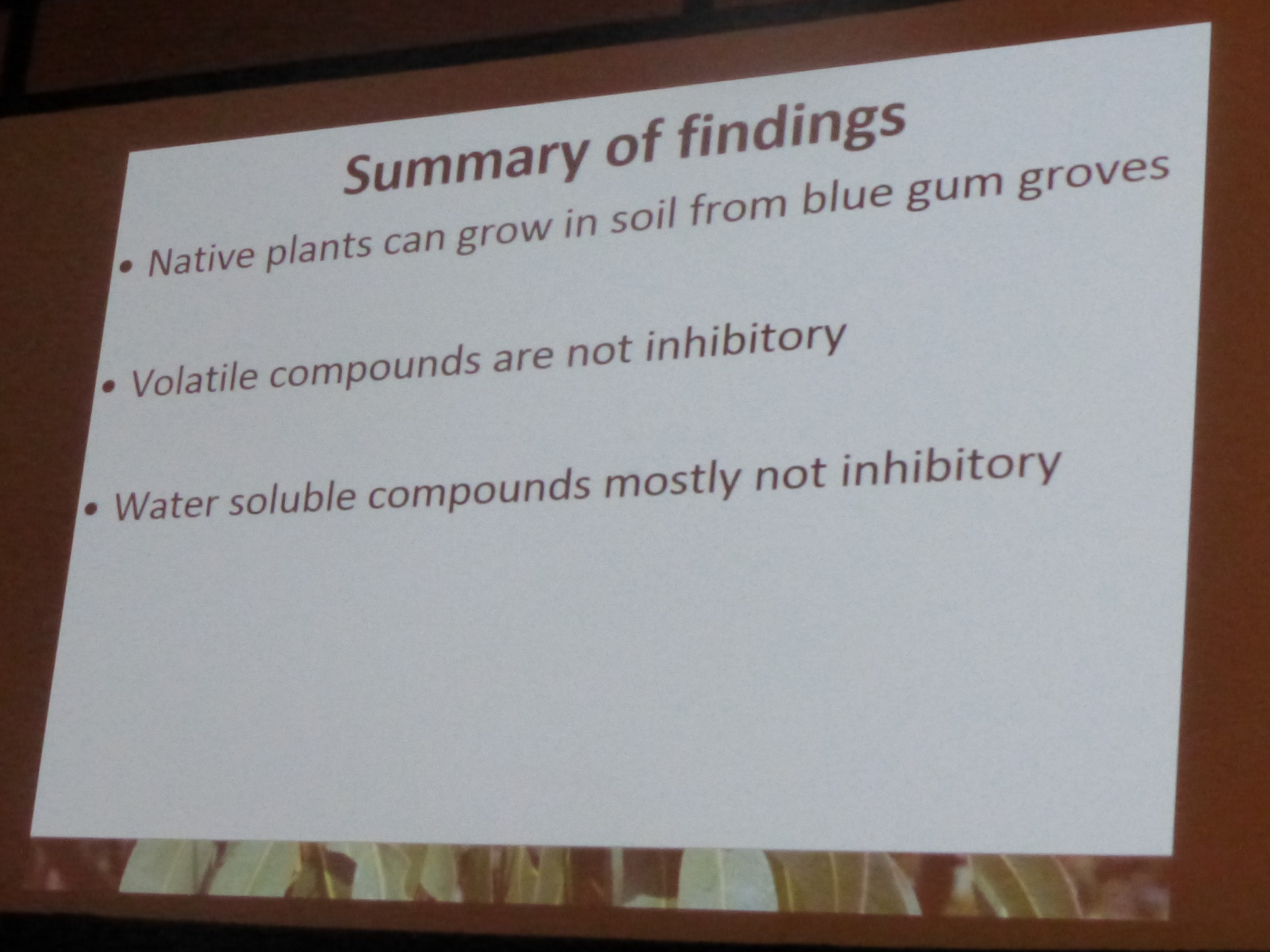
Rigorous methods used by Yost’s team included planting seeds of 5 native plant species in the soil of eucalyptus forests and comparing germination rates of seeds planted in the soil of oak woodlands. They also tested the effect of blue gum volatile leaf extracts, and water-soluble leaf extracts on germination and early seedling growth.
They concluded, “In these experiments, we found that germination and seedling growth of the species tested were not inhibited by chemical extracts of blue gum foliage, either at naturally-occurring or artificially concentrated levels.” (2)
CNPS Conference 2018
Yost observed that the lack of allelopathic effects of blue gum on the soil implies that blue gum forests theoretically can be successfully planted with native plants after removal of the trees. However, she cautioned that those who destroy the blue gums should carefully consider what will replace them. Will an aggressive non-native weed quickly colonize the bare ground? If so, what is the benefit of destroying the blue gums?
Nativism dies hard because of lack of scientific studies
There appeared to be three distinct groups of people in the crowd of about 900 conferees. There was a large contingent of grey-haired volunteers who are the backbone of every native plant “restoration.” They are the dedicated weed pullers. There is an equally large contingent of young people who are making their living writing the “restoration” plans and directing the activities of the volunteers. The smallest contingent is a few academic scientists who study the underlying issues in their ivory tower. The goals and conclusions of these three groups are increasingly divergent as scientific studies disprove the assumptions of the citizen “scientists.”
The tension between science and the citizenry is as evident within the native plant movement as it is in American politics at the present time. The general public rejects scientific evidence at its peril. The rejection of science will not end well. In the case of uninformed nativism in the natural world, the result will be a barren, poisoned landscape.
“Climate change and open space conservation: Lessons from TBC3’s researcher-land manager partnerships in the San Francisco Bay Area,” David Ackerly1, Naia Morueta-Holme5, Sam Veloz3, Lisa Micheli2, Nicole Heller4 1University of California, Berkeley, Berkeley, CA, USA, 2Pepperwood, Santa Rosa, CA, USA, 3Point Blue Conservation Science, Petaluma, CA, USA, 4Peninsula Open Space Trust, Palo Alto, CA, USA, 5University of Copenhagen, Copenhagen, Denmark
Matt Chew has written another guest post for Million Trees about the International Compassionate Conservation Conference that recently took place in Australia, where he gave a presentation. Dr. Chew is a faculty member of Arizona State University’s Center for Biology and Society and an instructor in the ASU School of Life Sciences. He has written two popular posts for the Million Trees blog about the “restoration” industry and about the controversial projects that are eradicating tamarisk trees.
Arian Wallach, Dingo for Biodiversity Project
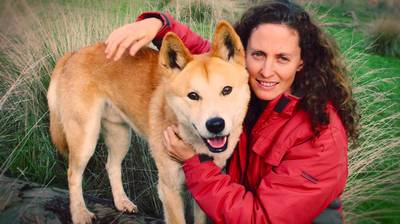
I was introduced to compassionate conservation by one of its proponents, Arian Wallach. Dr. Wallach is the Project Director of the Dingo for Biodiversity Project in Australia. Dingoes were the top predators of smaller animals in Australia for about 5,000 years until Europeans introduced new predators in the 19th century. Colonists to Australia have been killing dingoes since they arrived because dingoes are also predators of their sheep.
Eradicating top predators has serious consequences for the entire ecosystem. In the case of dingoes, smaller predators introduced by colonists have taken that role and are now the target of poisonous campaigns to eradicate them. For example, Australia recently made a commitment to kill 5 million cats with poison. Killing dingoes has put Australia on the killing treadmill.
We have examples in the United States of similar cascading effects of killing top predators. When wolves and bears were killed in some of our national parks, populations of grazing animals such as deer and elk exploded. Vegetation was browsed to death and ultimately the grazing animals were without sufficient food.
Dr. Chew tells us that defending top predators is one of several tenets of compassionate conservation. Two important themes emerge from his description of the conference:
Traditional conservation tends to focus on the preservation of a species, sometimes at the expense of individual members of that species. Compassionate conservation invites us to re-evaluate that emphasis, to also take the lives of individual animals into consideration. In an extremely individualistic society such as America, this would seem an entirely appropriate approach to conservation.
Modern methods of conservation tend to focus primarily on rare animals, sometimes at the expense of common animals. Common animals are often blamed for the fate of rare animals. Shooting barred owls based on the belief that endangered spotted owls will benefit is an example of such projects.
These are ethical questions that deserve our thoughtful consideration and Dr. Chew’s guest post invites us to think deeply about them.
Million Trees
The third International Compassionate Conservation Conference took place in Australia last November. Over 100 pre-registrants represented thirteen countries of current residence. Every occupied continent and a few archipelagoes were accounted for. Nearly half of the roster bore “Doctor” or “Professor” credentials. About two-thirds were Australian, one-sixth from the USA, and the remainder distributed in single digits. The final tally, including walk-in registrants, has not been compiled.
Some Background
Traditional resource conservationists and animal welfare advocates celebrate separate histories and espouse distinct philosophies. In a given circumstance their views may coincide, but they more often conflict. Sometimes it’s a mix of both. Professionals in either discipline are more attuned and (perhaps) committed to the distinctions than are members of the general public. Some advocates on both sides are more confrontational than others. Given all that, it may be unsurprising that the concept of compassionate conservation arose in the unique context of a British charity organized by the starring actors of the 1966 film Born Free. The predicament of Elsa the lioness they helped publicize provided a unique nexus of predator conservation and captive animal welfare to build on. Their Born Free Foundation , which at one point actually trademarked the term “Compassionate Conservation” has helped underwrite three meetings: a symposium in Oxford, U.K. (2010); a conference in Vancouver, British Columbia (2015), and the most recent conference in Leura, New South Wales.
Leura, Australia
The latter two events were co-sponsored and organized by the Centre for Compassionate Conservation (Centre) at the University of Technology in Sydney (UTS). The Centre was founded in 2013 by UTS conservation biologist Dr. Daniel Ramp, who continues as its Director. His unusual goal, succinctly (indeed, laconically) stated, is “to better conserve nature by protecting the welfare of individual animals in captivity and in the wild.” The Centre currently lists a core management team of five, plus six affiliated researchers. Five conference attendees identified themselves as Centre Ph.D. candidates, and another as an unspecified Centre student. Before organizing the Centre, Daniel and most of his present colleagues comprised something called THINKK, focused more narrowly on ethical kangaroo conservation. Coincidentally, a documentary film emerging from that effort just opened in selected U.S. theaters.
Alloying animal welfare advocates and conservationists this way requires effort. Alloying them into a fully coherent interest group is unlikely. Conservationists, including conservation biologists, are rarely concerned with the comfort or fates of individual organisms. For example, the Society for Conservation Biology is “dedicated to advancing the science and practice of conserving Earth’s biological diversity”. It emphasizes populations, species, biotic communities and other aggregations rather than individual organisms. This view accommodates Darwinian natural selection and economic sustainability of recreational and commercial exploitation, including so-called ecosystem services. Except where the population of some species is approaching zero and every extant individual contributes substantially to its genetic diversity, whether any of them are particularly well off beyond their ability to breed or produce gametes for propagation purposes is a subsidiary concern.By contrast, animal welfare begins with sentient organisms and recognizes fewer aggregate or emergent properties. Strictly speaking, to welfare advocates, preserving a species or population is secondary to protecting individuals from experiencing pain or suffering, especially that related to human actions or influences.
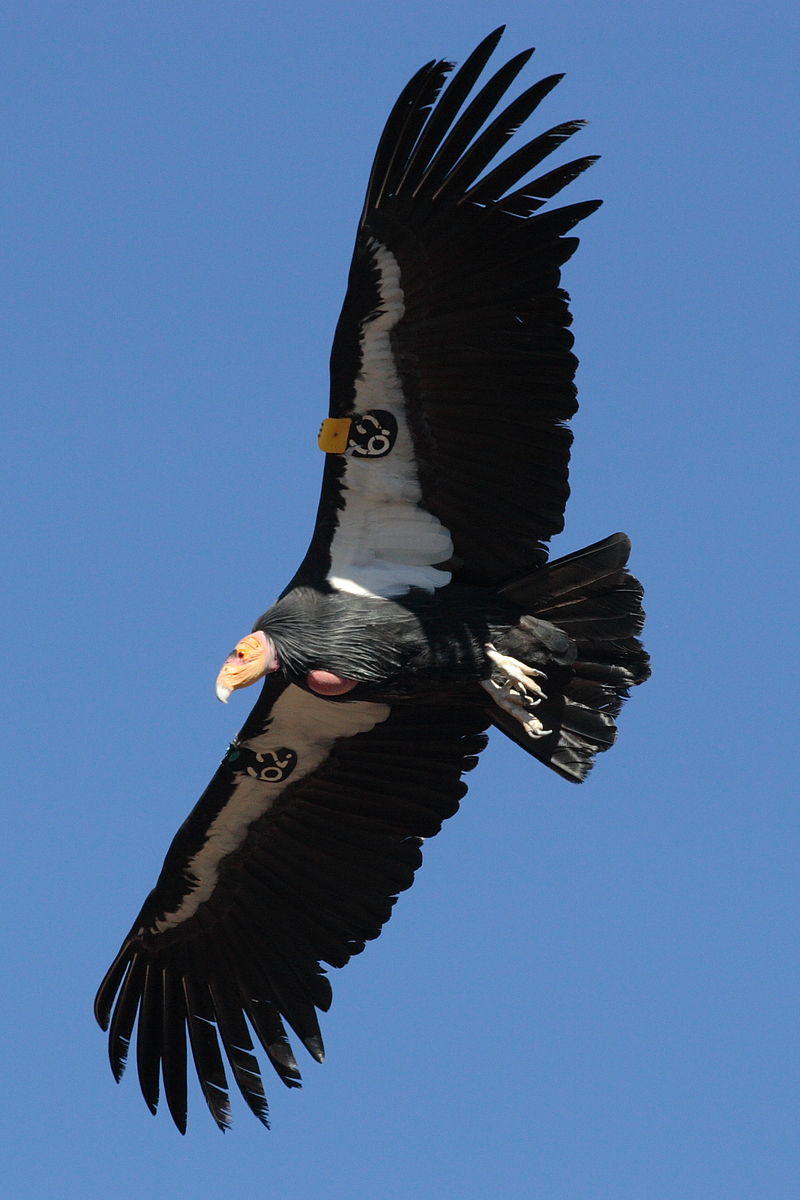
California Condor with tracking tags on wings
Logically extended, the difference between conservation and compassion can be illustrated by the California condor recovery effort. Condors incapable of breeding are useless to conservation biologists other than for public relations purposes. Any “display” animal is subject to the particular dangers inherent in repeated transportation and public contact. Presented as an example or representative of the taxon Gymnogyps californianus it nevertheless becomes a named or nicknamed individual entity in the minds of the people who “meet” it. Once transferred permanently for display to (e.g.) a zoo, the welfare of a named, non-breeding condor takes on a significance that it never had before. Should it fall ill, hundreds or thousands of people will fret. Should it die unexpectedly, they will mourn and hold its keepers responsible. Meanwhile, potential breeding condors may be released to cope with hazards of “wild” survival their captive counterparts never face. The processes of breeding contribute further stresses and risks. The value of a display condor is tallied in goodwill and monetary contributions. The value of a breeder is tallied in viable offspring, much as the value of a laying hen is tallied in eggs produced. The contentment of a named bird is judged differently from that of a numbered one. Should “recovery” succeed, individual condors will someday become as anonymous as turkey vultures, their welfare officially unmonitored. With all that in mind, a compassionate conservation conference is necessarily a coalition exercise. A stable, hybrid entity like the UTS Centre remains exceptional.
In the Event
The three-day Leura schedule included ten presentation sessions, a poster session and six workshops. Each presentation session opened with a half-hour keynote talk from an invited speaker followed by a series of shorter contributions.
Presentations:
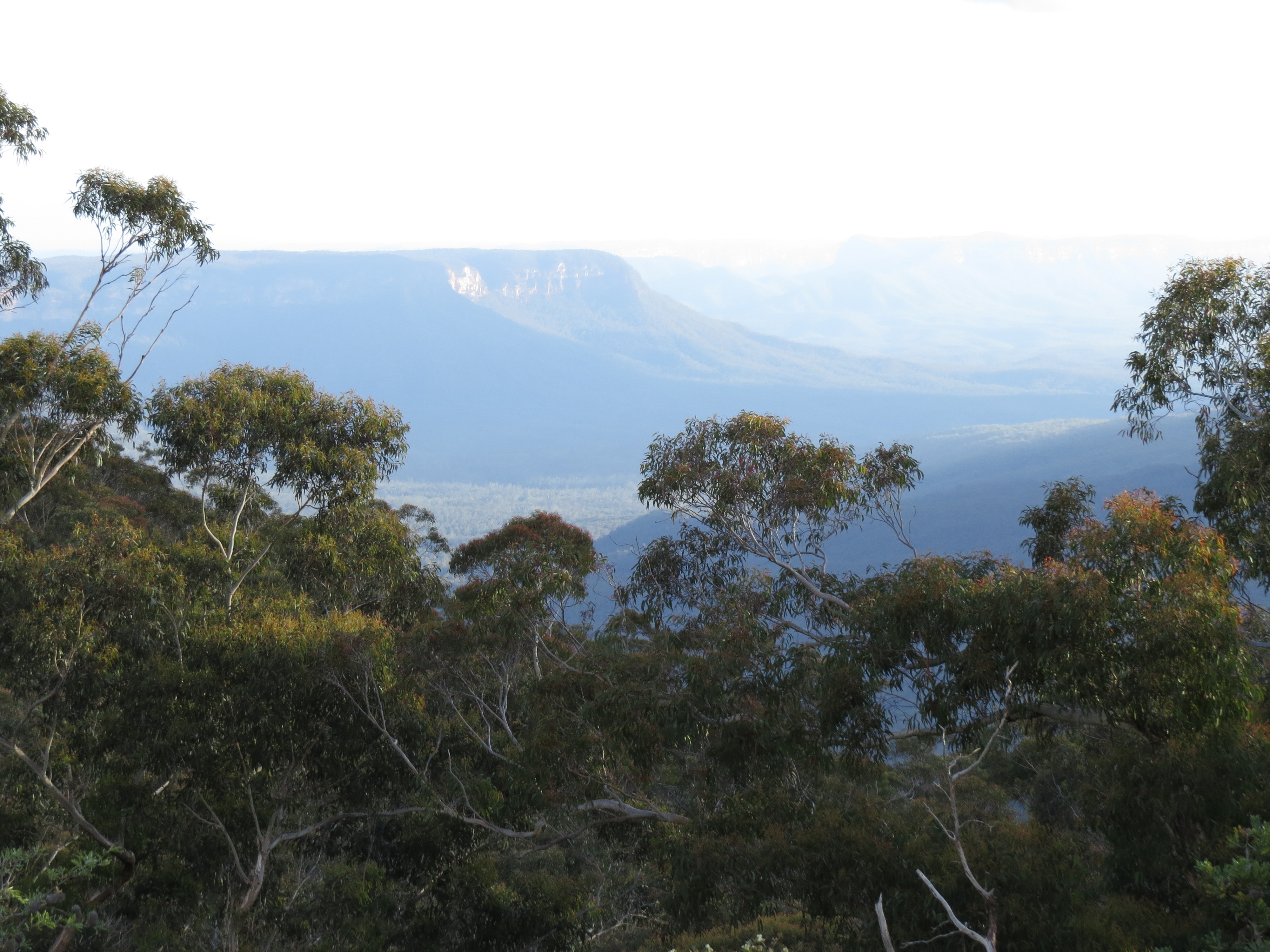
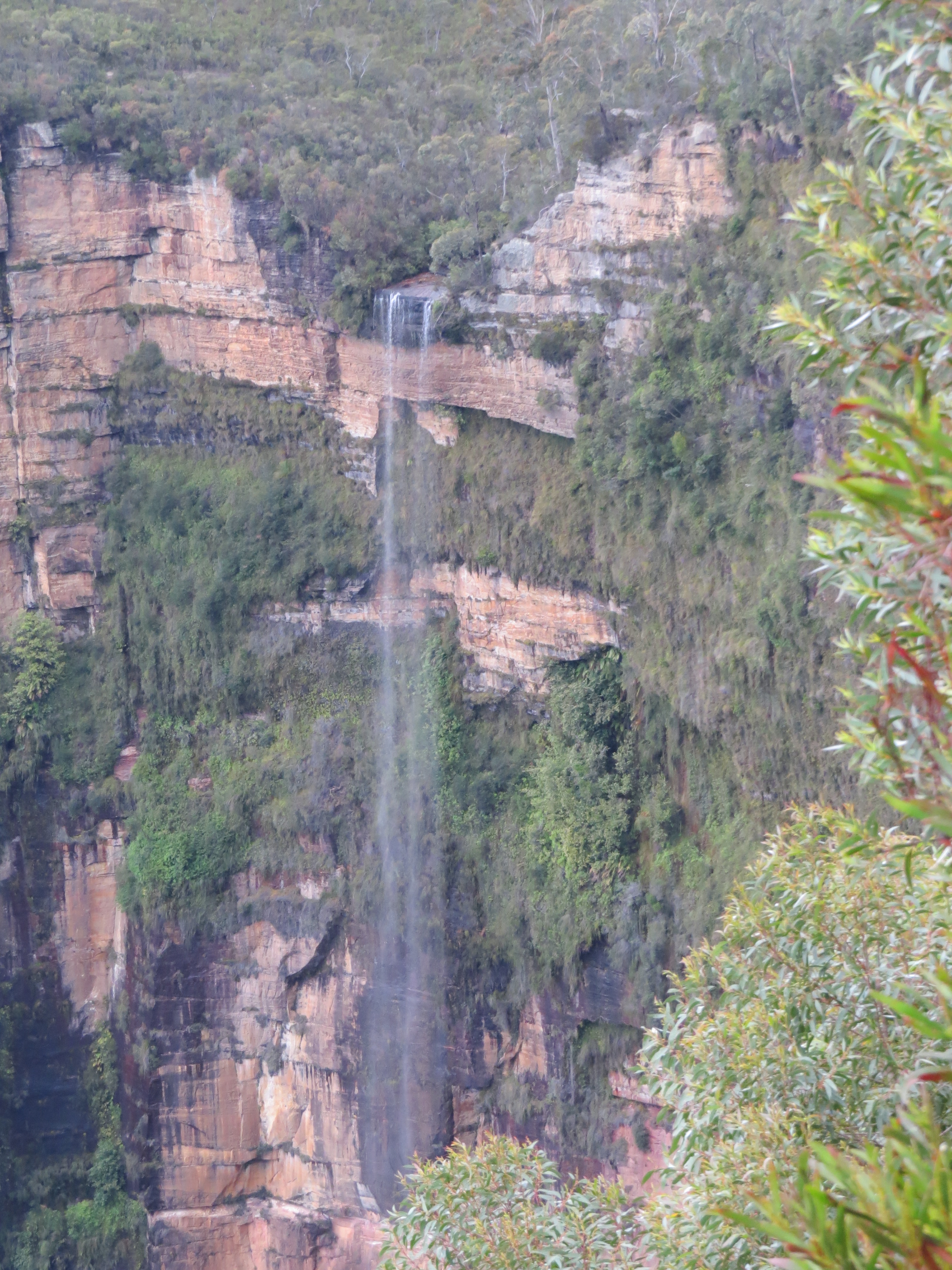
Australian waterfall
Presentation sessions were organized around conservation ethics (2); novel ecosystems (2); animal welfare science and issues (2); laws and policies; agriculture and wildlife, predator-friendly ranching and finally “cultivating compassion”. Keynote speakers (six men, four women) came from the USA (5), Australia (3), Malaysia (1) and the UK (1). Nine are university faculty or affiliates; two represent independent conservation NGOs (yes, we turned it up to 11). Few of us can comfortably label ourselves without hyphenating. Our credentials include (alphabetically) Animal Science, Conservation Biology, Ecology, English, Environmental Ethics, Environmental Science, Ethnography, Evolutionary Biology, History, Humanities, Law, Natural Resources, Philosophy, Wildlife Biology, and Zoology and doubtless some that I overlooked. Our keynote talks ranged from practical legal and management case studies to aspirational exhortations. That may not be a defensible continuum, but it will have to do.
A conference program with abstracts is available for download here. Since there were about sixty presentations over two and a half days, I can hardly even list them, much less say anything pithy about more than a few. Their diversity made for an intense, eclectic, even exhausting experience. The general quality of presentations struck me as higher than the average at many more traditional, disciplinary conferences. Perhaps it takes “more” of something or another to survive the rigors of interdisciplinary or multidisciplinary work.
What I can do is highlight a couple of impressive research projects of particular interest to Million Trees followers in the western U.S. In his keynote address, Conservation as creative diplomacy: Raven and tortoise futures in the Mojave Desert, University of New South Wales Associate Professor of Environmental Humanities Thom van Dooren looked at “new technology” attempts to dissuade the big black birds from preying on juvenile, endangered reptiles. Artificial tortoises conceived as the equivalent to exploding, joke cigars featured heavily in this thought-provoking and entertaining analysis. Understanding introduced megafauna in the Anthropocene: Wild donkeys as ecosystem engineers in the Sonoran Desert by Arizona State University graduate turned Centre Ph.D. candidate Erick Lundgren showed how “feral” burros in western Arizona create water sources used by “native” wildlife by digging down to shallow aquifers in dry washes. Photos and infrared video made the case for this completely new and gratifying application of the term “ass holes” and discussion of the demonstrable positive effects of “alien” animals. An early presentation of Erick’s findings can be viewed here.
Posters:
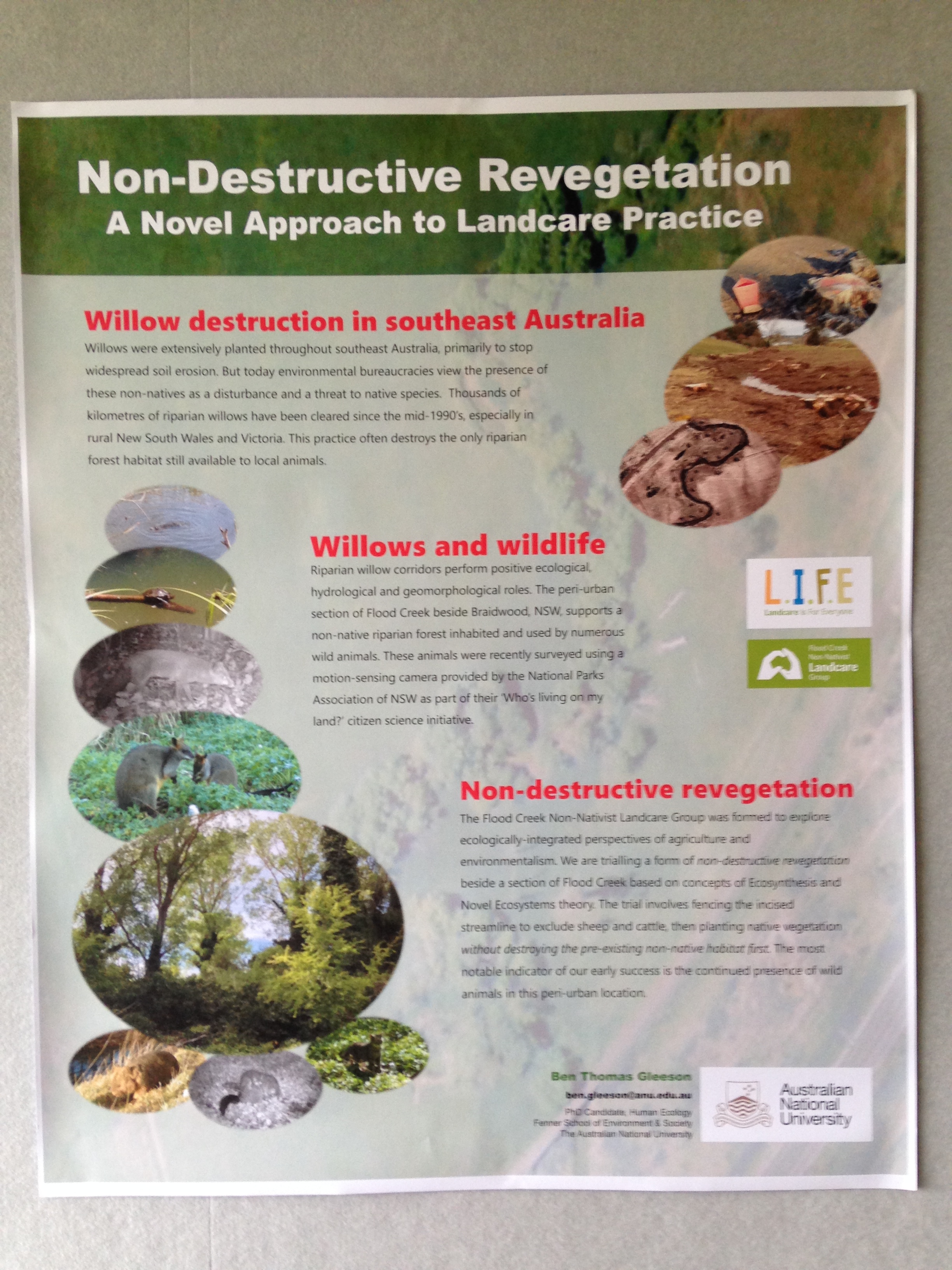
Poster of Non-Nativist Landcare
For readers unfamiliar with poster sessions, the basic idea is to summarize a project, argument or proposal in the minimum necessary words and graphics to convey the important ideas. Posters can be perused at the convenience of conference-goers, and (as in this case) can be strategically hung in proximity to coffee and snacks; but a period is usually specified for poster authors to literally stand by their work and answer questions. What constitutes a poster is evolving rapidly. Mechanically pasted-up arrangements have been superseded by single, large format prints, which in turn may soon give way to looped or even user-navigable videos on flat screen displays. Only a handful of posters were presented at Leura. One included a description of low-disturbance riparian revegetation techniques; another explained a new proposal to legally protect captive whales, porpoises and dolphins in the U.S.A.; a third took data-driven issue with Argentina’s official over(?)-emphasis on lethally suppressing European rabbit populations; and the fourth combined a poster with a video loop to demonstrate the surprising calmness of red foxes living in proximity to dingoes, their only wild predators.
Workshops:
Befitting a gaggle of academics, three of the six workshops initiated collaborations meant to produce papers for peer-reviewed publication. “Welfare in the wild” focuses on the challenges of assessing the condition of free-living wild animals, a necessity for practical compassionate conservation. “The Australian Wildcat Project” seeks to reframe feral cats as wild animals and find “compassionate and effective solutions” that supersede traditional (and ineffectual) lethal culling. “Transforming wildlife management policies” envisions a compassionate alternative to the present Australian Pest Animal Strategy.
For attendees not leashed to the “publish or perish” treadmill, “A framework for human-wildlife health and coexistence in Asia” built on the related presentation session to propose guidelines for further research and development. “Predator friendly ranching skills and technologies” demonstrated an array of time-tested, new and proposed methods for keeping livestock without resorting to lethal predator control. “Bringing ethics into conservation with argument analysis” offered an introduction to rhetorical and logical analysis of the claims underlying conservation decision-making.
Reflections
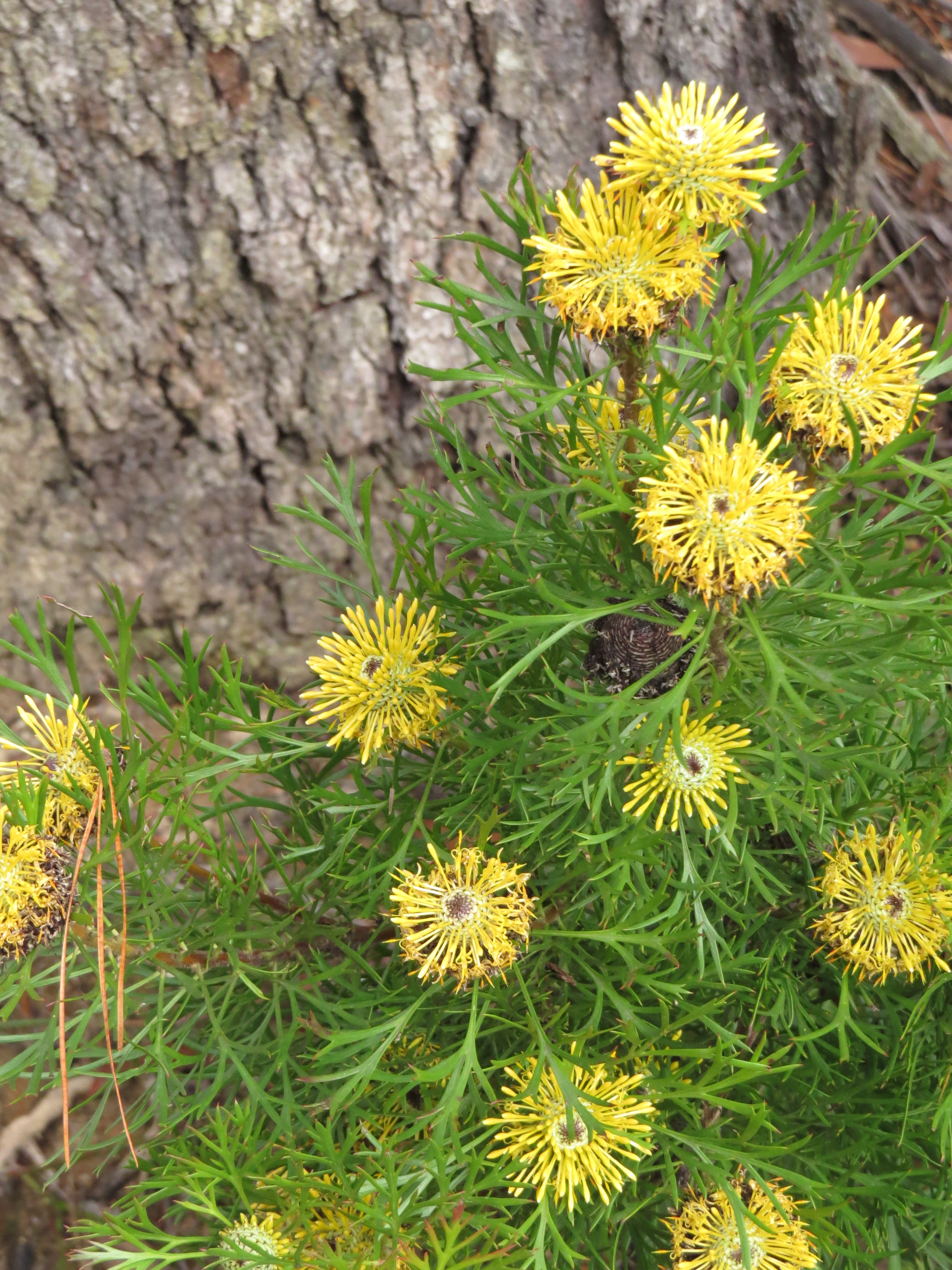
Banksia in Australia
On July 31, 1947, Aldo Leopold finalized a paragraph that appeared about seven eighths of the way through his introduction to a proposed book of essays. It began “One of the penalties of an ecological education is that one lives alone in a world of wounds.” There, Leopold styled himself as “the doctor who sees the marks of death in a community that believes itself well, and does not want to be told otherwise”. Perhaps ironically, less than nine months later (at age 61) he succumbed to heart failure aggravated by the exertion of fighting a grass fire, leaving the still unpublished anthology in other hands. Nearly two decades on, editors transplanted the paragraph into the much-revised text of a Leopold essay titled “The Round River” for re-publication by Oxford University Press, where his overwrought sentiment blossomed into a gnostic axiom of conservation biology.
Practically anyone could recognize an injured animal. Only Leopold, selected colleagues and their presumptive heirs could diagnose the arcane injuries of populations, species, communities or ecosystems. The welfare of an organism didn’t “amount to a hill of beans” next to the integrity of the greater collective. It was a more than convenient fit into the value system of academic biology, where individuals are traditionally considered mere examples of taxa, available for collection, experimentation, or “scientific” interference pretty much at will.
As a group, biologists have likely devised more (and more esoteric) ways than anyone else to kill, injure or discomfit organisms. Way back in 1865, physiologist Claude Bernard, fountainhead of the indispensable idea of homeostasis, reflected, “the science of life…is a superb and dazzlingly lighted hall which may be reached only by passing through a long and ghastly kitchen.” Recipes beyond his darkest dreams have since been tested there. In that regard, conservation biology is unexceptional. Conservation biology in practice consists largely of subsidizing the (Darwinian) fitness of too-rare species by forcibly taxing that of too-common ones. The move from culinary to macroeconomic metaphors indicates only that we are now cooking on a vast, institutional scale. Both figuratively and literally, conservation biologists break a lot of eggs in service of making too-rare species more common and supposedly too-common ones more rare. Consistent with basic economic wisdom, individuals of scarce species are more highly valued than those of common species. But much of biology is still concerned with examining formerly living objects to find out what experimenting on them accomplished. The drafters of laws like the U.S. Endangered Species Act made “experimental, nonessential” individuals or populations available for scientific “take”. At best, such exceptions allow for research that might stave of extinction. At worst, they provide cover for otherwise anathema activities like “scientific whaling.”
What will become of compassionate conservation? I can’t answer that question. Its advent represents an interesting cross-pollination among otherwise ramifying points of view. I’m sympathetic to the basic aims of its proponents. My own work wasn’t really conceived to abet them; but if it does, I say “well and good.” There’s more than enough casually rationalized cruelty in the world already.




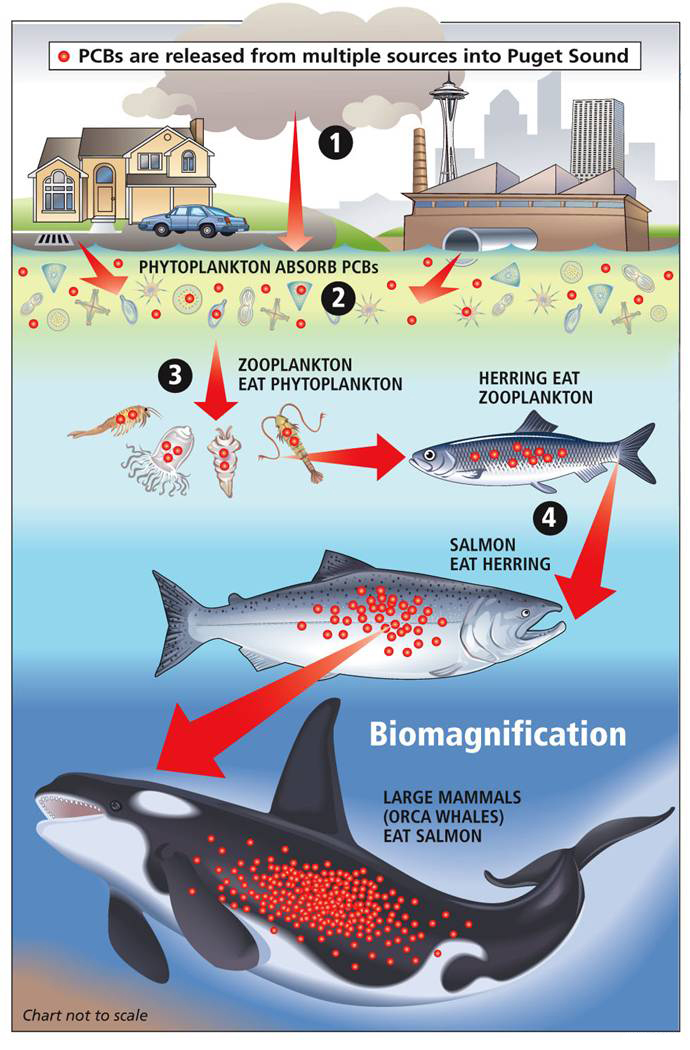 Professor Tyrone Hayes (UC Berkeley) is best known for his criticism of the herbicide, atrazine, which is harmful to the frogs that he studies. Unfortunately, Professor Hayes’ opposition to atrazine does not extend to the pesticides being used in the San Francisco Bay Area to eradicate non-native trees and prevent them from resprouting. Professor Hayes accepts the premise that eucalyptus trees are detrimental to native plants, which justifies the use of herbicides to destroy them, in his opinion. The herbicide that is used for that purpose (Garlon with active ingredient triclopyr) is just as toxic as atrazine. Both are organochlorine products that bioaccumulate, persist in the environment for decades, and are endocrine disruptors.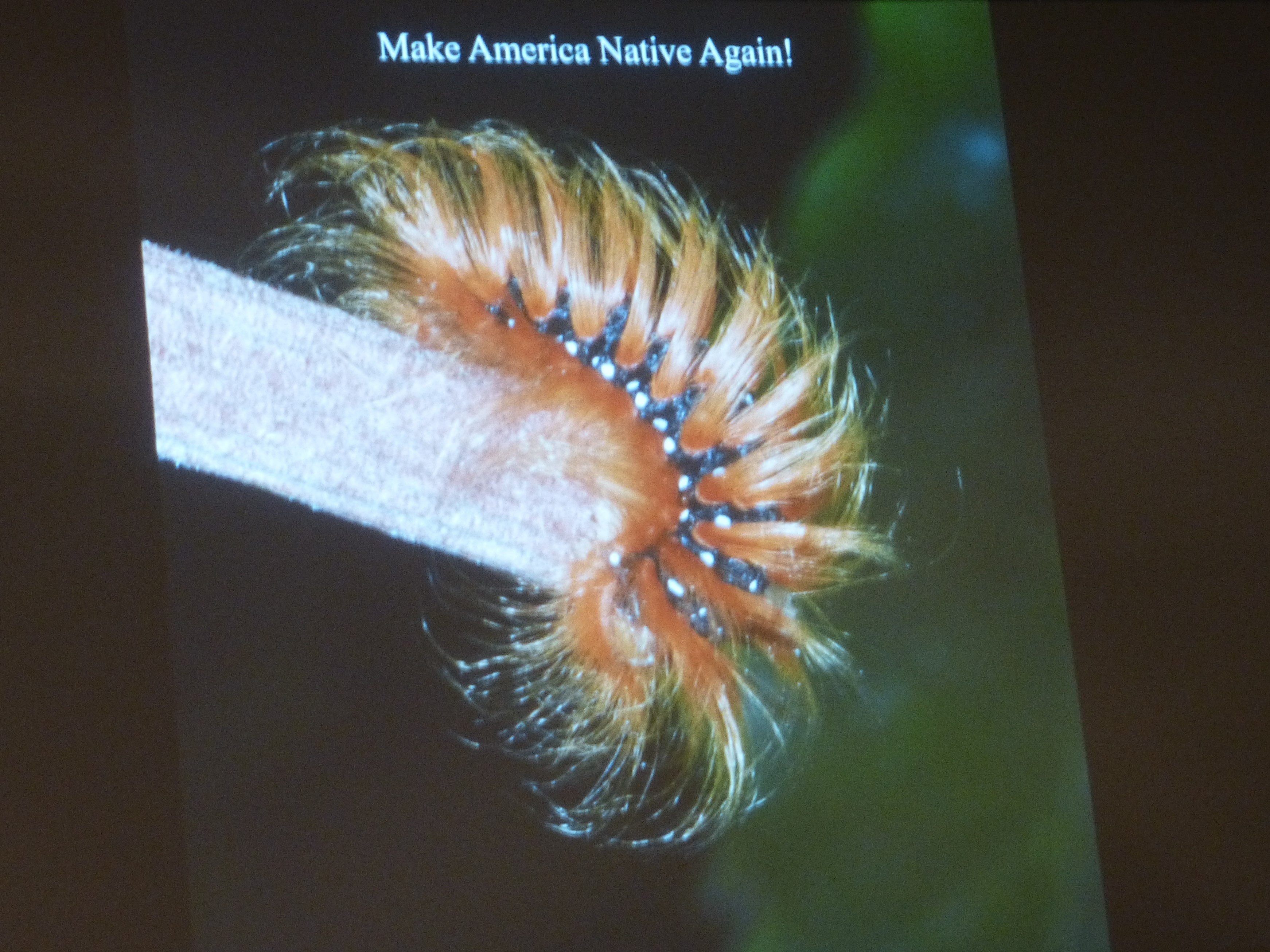
 Conservation Sense and Nonsense