This is a story of the influence of interest groups on the process of making new laws. When Assembly Bill 1573 was introduced in February 2023, it seemed to be primarily a water-saving measure that would “eliminate the use of irrigation of nonfunctional turf” (turf that is not a recreational area or community space with foot traffic). AB1573 also mandated that all new or renovated nonresidential areas install not less than 25% local native plants by 2026, 50% local native plants by 2030, and 75% local native plants by 2035. It defined local native plants as “California indigenous plants to an area that have evolved and occur naturally in the Jepson Region associated with a specific California location.”
As AB1573 passed through legislative committees in the Assembly and the Senate it was amended six times (legislative history of AB1573 is available HERE.). California Native Plant Society and its many allies pulled out all the stops to influence the legislation and ensure its passage. Members of these advocacy organizations were asked at each juncture to contact their elected representative to urge them to pass this legal mandate requiring public and commercial properties to plant native plants.
The final revision of AB1573 occurred on September 1st, after consideration by the Senate Appropriations Committee. The final revision made two significant changes:
- The requirement for native plants in new and renovated landscapes on non-residential properties was lowered to 10%.
- However, the definition of native plant was revised to include: “a plant that is nonnative and noninvasive that provides pollinator benefits, and that is a low-water use plant, as determined by the Department of Water Resources and the Natural Resources Agency” In other words, the final revision considers many non-native plants the functional equivalent of native plants.
On September 7, 2023, the authors of AB1573 asked that the bill be moved to the “inactive file.” They have given up. Their bill has been so emasculated that they don’t see the point of continuing to try to pass it.
Why did this attempt to legally mandate native plants fail?
There are probably many aspects of this story that I don’t know. There were probably many private meetings and written communications that I’m not aware of. I could probably learn about some of them by making a public records request, but I think I know enough of the story to relate it to my readers. If you know more about the process than I do, please share it with us.
The first visible sign that AB1573 was in trouble was in June 2023, when the Associate Director of Plant California Alliance published an editorial about AB1573 in an agricultural newsletter, available HERE. Plant California Alliance represents “California’s nursery industry. Our membership includes farmers, growers, urban agriculturists, wholesalers, retail garden centers, landscapers, garden suppliers, horticulturalists, as well as educators and researchers.” This is an organization with horticultural knowledge and practical experience growing plants in California. The editorial explained why the goals of AB1573 are unrealistic and based on mistaken assumptions about California native plants:
- There aren’t enough native plants available for sale to meet such a requirement. California Native Plant Society claims nursery sales are about 6% native, but two large wholesale nurseries estimate their stock is not more than 1% native.
- “…there is also the fundamental question of why a native plant mandate is included in a water conservation bill at all. Not all native plants are low water plants…Sometimes a non-native plant is a better choice when designing a drought resilient, low water garden.” California Water Service recommends: “Plants that are adapted to long, dry summers and short, rainy winters are called “Mediterranean-zone” plants. These include plants that are native to California, as well as those that originated in southern Europe, South America, and other “Mediterranean” climates. These plants don’t need much water in the summer and have thrived in water-scarce conditions for thousands of years.”
- “And, what about native plants’ impacts on fire? Unfortunately, some California native plants are not considered fire-resistant, and some are even considered fire prone. For example, FireSafe Marin has several California native plants on their list of fire-prone plants, including manzanita (Arctostaphylos), coyote brush (Baccharis spp.), California buckwheat (Erigonum fasciculatum), and California bay (Umbellularia californica).” Most wildfires in California occur in native chaparral and native conifer forests. When wildfires occur in residential neighborhoods, the homes themselves are the primary fuel for the fire. Everything burns in wind-driven fires, regardless of the native origins of plants.

In August, tree advocacy organizations finally woke up to the implications of AB1573 for California’s urban forests when they realized that the definition of “native plant” also included native trees. California Releaf and California Urban Forests Council asked their members to contact the Senate Appropriations Committee to ask that trees be explicitly exempted from the requirement for native plants on non-residential properties in California.

Only 9% of California’s urban forests are native to California. (1) Pre-settlement San Francisco was virtually treeless. One-third of San Francisco was barren sand dunes on its western edge. San Francisco’s urban forest is now predominantly non-native and much of it is being destroyed to accommodate native plant restorations that require full sun.
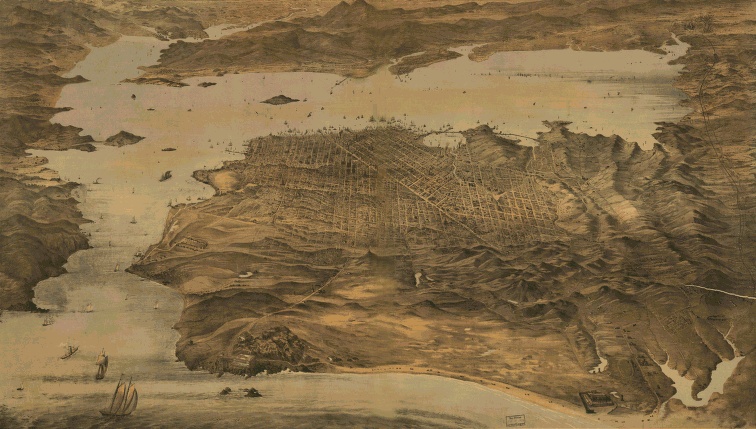
Non-native trees were planted in Oakland in the 19th century because there were few native trees: “Vegetation before urbanization in Oakland was dominated by grass, shrub, and marshlands that occupied approximately 98% of the area.” (2) Non-native tree species in the East Bay are adapted to soil and microclimate conditions that are not suitable for native species. Non-native annual grasses will replace Oakland’s urban forest in the hills, not native trees, if native plant advocates get the Vegetation Management Plan they have been fighting for for nearly 8 years.
A Learning Experience?
I would like to think that California’s policy makers learned something from the process of considering AB1573. Do they have a better understanding of what grew in California in the past and therefore what is capable of growing in the future?
Probably not
Ironically, on the same day that AB1573 was withdrawn by its authors, the San Francisco Examiner published this article about a new initiative to plant more greenery in San Francisco, led by the California Academy of Sciences. It’s an excellent idea, except that the leaders of this initiative equate greenery with native plants: “He’s looking to introduce more native plants in The City, which will in turn attract more native insects and more native birds throughout San Francisco.” Nature is not synonymous with native plants. The scientific definition of biodiversity includes both native and non-native plants. In fact, San Francisco’s Open Space Element of the General Plan also defines biodiversity as including both native and non-native plants.
As much as I would like to hope that Californians have a more realistic goal for the future of California’s landscapes after watching the failure of AB1573, I don’t think I can.
- Matt Ritter, A Californian’s Guide to the Trees Among Us, Heydey Books, 2016.
- David Nowak, “Historical vegetation change in Oakland and its implications for urban forest management,” Journal of Arboriculture, September 1993
 Conservation Sense and Nonsense