The Argentine ant is one of a gazillion non-native species that have been labeled “invasive species.” Like most non-native species, they are considered aggressive competitors of native ants. The usual tools are employed to eradicate them, e.g., pesticides.
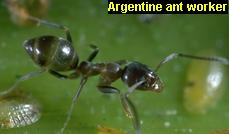
Argentine ant. UC Davis
But wait! Now scientists are suddenly noticing that the Argentine ant is disappearing from some of their colonial haunts.Scientists in New Zealand have recently reported the disappearance of the Argentine ant from 40% of sites they populated in the past and their populations have shrunk significantly where they are still found. Native ants have “reinvaded” the areas vacated by the Argentine ant. The scientists reporting this finding “concluded the species naturally collapses after 10 to 20 years.”
The scientists in New Zealand don’t claim to know why the populations of Argentine ant have disappeared. They speculate that a virus is to blame. They don’t claim “pest control” deserves credit for the disappearance which is estimated to have cost $53 million (NZ$68) per year since the Argentine ant was originally found there in 1990. That’s right, New Zealand spent approximately $53 million per year trying to eradicate the Argentine ant, which apparently is disappearing on its own.
This is apparently not an isolated phenomenon. An entomologist at UC Davis reports that the Argentine ant has been declining in California as well. How much pesticide was poured on Argentine ants before they showed the good grace to just disappear?
The Africanized Bee: Another scary story that didn’t materialize
Another example of an “invasion” that seems to have resolved itself is the Africanized bee. Do you remember about 15 years ago when the media created a panic about the Africanized bee? We were told that it was spreading rapidly from Latin America, headed our way and that it was so dangerous that it was capable of swarming people and animals and stinging them to death!
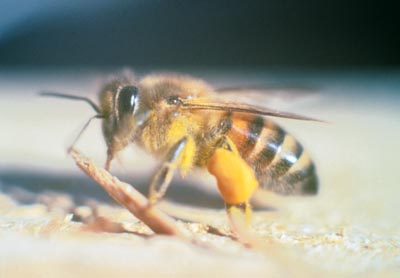
Africanized honeybee USDA
What happened to that particular “alien invasion” story? Professor Gordon Frankie (UC Berkeley), our local expert about bees, was asked that question in a lecture he was giving to Cal Alumni in October 2011. He said that the Africanized bee didn’t turn out to be as aggressive as it was originally thought to be and that it didn’t spread as far or as fast as predicted.
Does “Invasion Biology” make more problems than it solves?
Some months ago we created a Google alert for “invasive species.” Now we are treated to a daily barrage of scary “alien invasion” stories from all over the world. We wonder how many of these “invasions” will eventually prove to be benign. We wonder how much money will be spent, how many animals will be killed, how much pesticide will be poured on our public lands, before we figure out that we need not be afraid of everything that is new in the environment. We wonder how many people are making their living on these eradication efforts and what role they play in frightening the public into funding their projects and tolerating the destruction they inflict on the environment.
Native plant advocates use a variety of strategies to motivate public policy makers to invest in their “restorations.” One of their rhetorical tools is the claim that “invasive alien species” cause economic harm. They refer to a controversial study (1) that claims the economic impact of alien plant and animal species in the US is over $120 billion per year. Since this figure always struck us as rather fantastic we weren’t surprised by this critique of it in a recent scientific publication: “The study has been roundly criticized for ignoring major economic benefits [of non-native plants and animals] and for including the cost of controlling species that may not need controlling, as well as factoring in events of questionable relevance, such as bird deaths caused by domestic cats.”(2) Since most of what is being done in native plant “restorations” seems unnecessary to us, we have always assumed these cost estimates are more a reflection of money wasted than a report of actual economic harm. For example, if tons of herbicide are used to kill plants just because they aren’t native, the harm is more in the herbicide use, than in the money wasted on it, in our view. In any case, the waste of money is not being caused by the non-native plants, but rather by the ideologues who choose to destroy them.
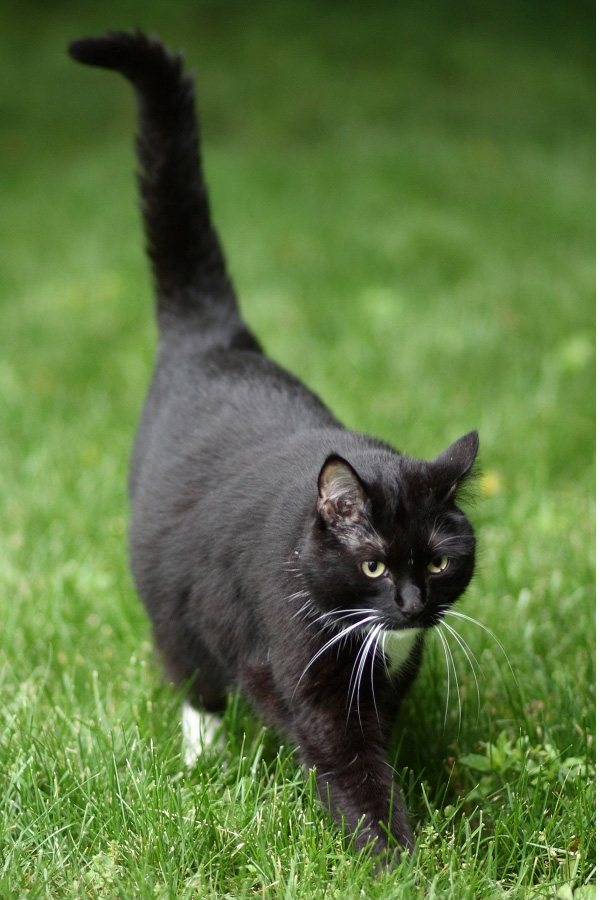
Wikimedia Commons, photo by Sage Ross
We were inspired to drill down into these estimates of alleged economic harm by non-native plants and animals by a recent “study” about feral cats by the University of Nebraska Extension which claims that feral cats cause $17 billion of economic damage every year. This guesstimate is based on these assumptions:
Feral cats kill an estimated 480 million birds per year, based on an assumption that there are 60 million feral cats and that each cat is estimated to kill 8 birds per year.
The “value” of each bird is $30, based on an assumption that each bird is worth $.40 to a bird watcher, $216 to a hunter, and $800 to someone who raises birds.
[Addendum: One of our readers has alerted us to the fact that the estimate of economic impact doesn’t compute. See below*]
The estimate of the number of birds each feral cat kills is based on one study (3) done in Australia in 1996. As native plant advocates are quick to tell you when they are advocating for the destruction of eucalyptus (which are native to Australia), Australia is a very different place. Many questions would have to be asked and answered before we could assume that feral cats kill the same number of birds in Australia and the US. For example: (1) Is the ratio of birds to cats the same in Australia and the US? (2) Are there the same percentages of ground-dwelling and nesting birds in both countries? (3) Are there similar quantities of alternate food sources available to cats in both countries? Etc. In fact, since the answers to these questions also vary within the US, we don’t think it is justifiable to use the same “bird-kill-rates” for all locations within the US, let alone from another country.
We also turn to A. Starker Leopold’s book about the California quail (4) for a more benign view of the feral cat:
“Hubbs (1951) analyzed the stomach contents of 219 feral cats taken in the Sacramento Valley and recorded one California quail. Feral cats, like bob-cats, prey mostly on rodents.” Page 142
“Feline pets that are fed regularly are not dependent upon catching birds for a living, but rather they hunt for pleasure and avocation. They can afford to spend many happy hours stalking…birds around the yard, and hence they are much more dangerous predators than truly feral cats that must hunt for a living and therefore seek small mammals almost exclusively (wild living cats rarely catch birds).” Page 212
The method used to assign a $30 “value” to each theoretical bird killed by a feral cat seems fanciful to us:
In what sense does it cost a birder $.40 for each bird that is theoretically missing? The birder is unaware that a bird is absent. Is the birder’s experience materially different whether he sees 25 birds or 24 birds on a walk in the forest? It seems a philosophical question akin to “If a tree falls in the forest and there is no one there to hear it, does it make a sound?”
It seems even more absurd to assign a “value” of $216 to a hunter for each bird killed by a cat. Since the hunter plans to kill the bird, how does it save $216 to prevent the bird from being killed by a cat? A dead bird is a dead bird.
As for a bird breeder who spends $800 raising each bird, one must ask how a feral cat could gain access to birds which we assume are kept in cages.
In other words, valuing birds theoretically killed by feral cats seems a rhetorical, not a scientific undertaking; that is, a method of advocating for the extermination of feral cats. And, as we would expect, that is exactly what the “study” published by the University of Nebraska Extension does. It advocates for a variety of methods of eradicating feral cats, including shooting them from a distance with a rifle or trapping them in a trap that kills the animal instantly.
This publication makes the usual meaningless distinction between feral cats and cats that are pets. It is a meaningless distinction because when cats are roaming free it is impossible to determine which it is. The Nebraska project suggests protecting the pet cat by having it micro chipped for identification. Even in the unlikely event that all owners of cats would have them micro chipped, one wonders how someone shooting a cat from a distance would be in a position to determine that the cat is micro chipped. Nor would an “instant-death” trap be capable of identifying a micro chipped cat before it enters the death chamber.
And as with all eradication efforts of both plants and animals, there are unintended consequences of exterminating feral cats.
“Only once conservationists had eliminated feral cats from Macquarie Island in the south-west Pacific did they realize that these non-native predators had become a vital link in the local food web. Since the last cat was killed in 2000, exploding rabbit populations have eaten much of the island’s unique flora bare.”(5)
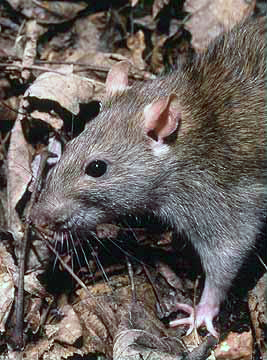
Brown (Norway) Rat, Wikimedia Commons
Cats are well-known predators of rats. The University of Nebraska publication acknowledges this and proposes that increased use of rodenticides will compensate for the loss of cats and consequent increases in rat populations. Ironically, rodenticides are known to kill birds of prey. The East Bay Regional Park District used 1,509 pounds of rodenticide in 2008, so this is not an insignificant problem. From the standpoint of the bird, or the birder, or the hunter, does it matter if the bird is killed by a cat or by rodenticide? Another philosophical conundrum.
Finally, we must evaluate the credentials of the authors of the publication of the University of Nebraska. The publication credits 22 undergraduate students of the University of Nebraska for “providing the preliminary information, photos, and resources used in developing this Neb-Guide.” And the authors of the publication describe themselves as “technicians, coordinators, or specialists.” Although the publication claims to be “peer reviewed,” if the peers were people with similar credentials, we can’t consider this a scientific study. Rather it is typical of the hobbyist credentials of most native plant advocates. A spokesman for the Veterinary Information Net said the report “…almost looks like a senior level wildlife and fishery sciences or ag science book report.” When we drill down into the hype, we often find that information is manufactured by native plant advocates and their allies to support their mission, in this case exterminating feral cats. In particular, we conclude that:
Estimates of the “economic damage” caused by feral cats are propaganda not science.
Although we would not support extermination efforts in any case, the unintended consequences of eradicating feral cats should be scientifically evaluated before any policy decision regarding feral cats could be considered.
*60 million cats times 8 birds per year equals 480 million birds killed. However, 480 million birds times $30 per bird equals $14.4 billion NOT $17 billion. Jeez, they can’t even do the math and we’re embarrassed to admit that we didn’t catch this. Thanks to our readers for keeping their eyes on the ball.
(1) Pimentel, David, “Update on the environmental and economic costs associated with alien-invasive species in the United States,” Ecological Economics, 52:273-288, 2005
(2) Hamilton, Garry, The New Scientist, January 20, 2011. N.B. The article actually says that economic impact is estimated at $137 billion/year, but we are using the lower figure for which we can provide a reference.
(3) McKay, G.M., “Feral cats: origins and impacts: Unwanted Aliens?” Nature Conservation Council of New South Wales, Australia, 1996
(4) Leopold, A. Starker, The California Quail, University of California Press, 1977
 Conservation Sense and Nonsense