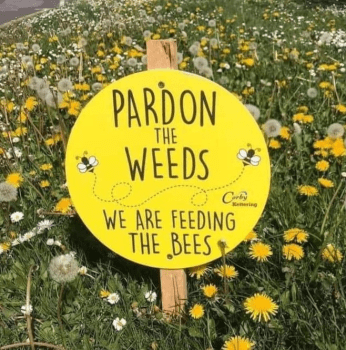
Conservation Sense and Nonsense spends an inordinate amount of time and energy responding to Doug Tallamy’s claim that insects are solely dependent on native plants because his publications are extremely influential with home gardeners and public land managers. A preference for native plants is not in itself a problem. The problem is that the preference results in massive efforts to eradicate non-native plants on public land, using herbicides, which poison the soil, killing life in the soil and making it difficult to grow anything.
When Tallamy’s first book, Bringing Nature Home, was published in 2007, he said that the absence of native plants would ultimately result in “ecological collapse” because insects are essential members of the food web. At the same time, Tallamy freely admitted that his theory was based on his anecdotal observations in his own garden, not on scientific evidence: “How do we know the actual extent to which our native insect generalists are eating alien plants? We don’t until we go into the field and see exactly what is eating what. Unfortunately, this important but simple task has been all but ignored so far.”
So began his research program, which was designed to prove his theory. In 2011, he reported the results of a study by a graduate student under his direction, which compared the amount of insect predation in six gardens with predominantly ornamental plants to six gardens with predominantly native plants. In a chapter in The New American Landscape he said of that study, “the most important result, however, was that there was no statistical difference in the amount of damage on either landscape type.” The graduate student found no evidence that insects ate more native plants than non-native plants. Yet, in the same book in which he reports the study of his graduate student, Professor Tallamy repeats his mantra: “…our wholesale replacement of native plant communities with disparate collections of plants from other parts of the world is pushing our local animals to the brink of extinction—and the ecosystems that sustain human societies to the edge of collapse.”
Today, Conservation Sense and Nonsense publishes an article by Nathan Lambstrom, which reports another example of how Tallamy’s publications obscure the value of non-native plants to insects and entire ecosystems: “Ignoring the contributions that introduced plants make towards supporting imperiled pollinators not only skews our perception of these plants, leading to the commonly held assumption that native plants are the only plants that support pollinators, it causes us to potentially ignore and possibly interfere with the positive contributions that many of these plants, even those labelled invasive, can make,” Nathan Lambstrom.
Nathan Lambstrom is a plant ecologist, horticulturist, and plant science educator living in Southern Rhode Island. He has a BA in Environmental Studies from the University of North Carolina and an MS in Plant Biology and Conservation from Northwestern University. In addition to teaching landscape professionals, members of the public, and undergraduate students, he is the owner of an ecological landcare company, Lambstrom Garden Ecology. His favorite plant today is bearberry.
Conservation Sense and Nonsense
Counting the Contributions of Non-Native Plants
Deciding what to plant is challenging at every scale, whether working in a home garden or creating a restoration plan. In addition to ensuring that the chosen species will thrive in the given environment, there is now a crisis facing pollinating insects and we should aim to include plants that will provide a high level of support to those insects in terms of food and habitat. The importance of native plants in providing that support is well-understood, but the contributions of introduced (non-native, naturalized) plants to supporting pollinating insects is significant, and we should not discount it.
One subgroup of pollinating insects, lepidopterans (butterflies and moths), often have specific needs: their larvae can often only consume a narrow subset of plant1. These insects have co-evolved with these plants over the course of millennia and adapted to break down any toxic or anti-herbivory substances the plants may produce. This means that if the egg of a butterfly or moth hatches in an area absent of plants that it can use as a food source (or larval host plant), it will starve.
Fortunately for us (and the insects) primary research has given us better data to help inform these decisions, and also a better understanding of exactly how restricted some host preferences are.
Insects are often not confined to a single native plant species
There is some good news: most of the lepidopterans that need a specific group of plants to survive are limited not to a single species, but to a single genus, a few genera (the plural of genus), or an entire plant family. A good example of this is the Black Swallowtail Butterfly (Papilio polyxenes) native to much of eastern North America. The larvae of the Black Swallowtail feed almost exclusively on plants in family Apiaceae, the dill family2. Historically this included mostly native perennials of wet meadows.
Following European invasion of the Americas and widespread introduction of plants from the Old World, intentional or otherwise, the most commonly encountered Apiaceae in most parts of the Black Swallowtail’s range are non-native garden herbs or naturalized plants (e.g. dill, parsley, fennel, and Queen Anne’s lace). Black Swallowtail larvae are able to recognize these plants as food because they are chemically similar to the native plants within Apiaceae that were their historic food source.
Those introduced (non-native, naturalized) plants have become so common they are now the primary host plants for Black Swallowtail larvae. In fact, in Massachusetts there have been no confirmed sightings of Black Swallowtail larvae feeding on native species in the Apiaceae family since 2007 (Stitcher 2013). This may sound like ecological catastrophe, but the abundance of introduced Apiaceae plants is actually good news for the butterfly and causes no harm to the native plants since they do not rely on larval feeding to set seed and reproduce. Information like this is important for gardeners and land managers to keep in mind when making decisions about what plants to keep or remove. Wholesale eradication of naturalized plants like fennel or Queen Anne’s lace could, counterproductively, have a detrimental impact on Black Swallowtail populations.
Which plants can feed the most insects?
The other bit of good news is that we now have access to more information than ever before about how many species of lepidopteran larvae these plants are capable of supporting. The most well-known papers on this subject come from entomologist Dr. Doug Tallamy, who has introduced the idea of pollinator gardening with native plants to a wide audience.
One of his earlier papers demonstrating the ecological value of native versus introduced plants is a meta-analysis that was published in the journal of Conservation Biology in 2009 titled “Ranking Lepidopteran Use of Native Versus Introduced Plants.” Tallamy and a colleague analyzed thousands of available records of preferred food sources of lepidopteran larvae and concluded that native plants in eastern North America, and particularly native woody plants, support more native lepidopteran species on average than introduced plants or herbaceous plants generally.
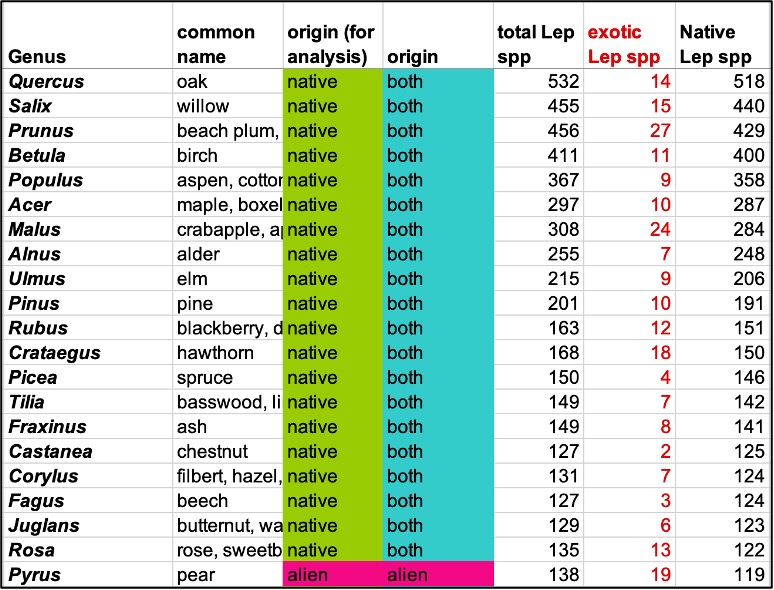
We are fortunate to have access to this data, which allows us to make more informed selections and specifically choose those plants that are known to support the most native lepidopterans. The aforementioned paper has an associated dataset (available online), ranking how many native and introduced lepidopteran species use each genus as a host plant. I use this dataset frequently to guide plant selection decisions and encourage others to do so as well. It shows that many of our beloved woody species can support an amazing diversity of native insects: some genera like our oaks (Quercus), birches (Betula), and maples (Acer) support larvae of hundreds of species of butterflies and moths (Fig. 1).
A closer look at the data
In addition to the tremendous ecological support these plants can offer, there are two things of note in this table. First is that an introduced genus, Pyrus (pear), which has no native species in the region, supports over 100 native lepidopterans—more than some native genera.
Second, the data analysis used in the Tallamy paper may be obscuring the value of non-native plants. Since the data were collected only at the genus level (not the species level), it is impossible from this dataset to determine, for example, whether a native or introduced birch is supporting lepidopteran species, or whether there’s a difference between the two.
In the dataset, plant genera are categorized by origin. If a genus has only native species in the region, it is labeled “native;” if it has only introduced species, it is labeled “alien.” Genera that contain both native and introduced species (oaks, maples, birches, willows, and hundreds of others) are categorized as “both.” Many plant genera in our region include both native and introduced species, and many species that we consider invasive have very close native relatives.
For statistical analysis in the Tallamy paper, however, all genera with “both” native and introduced species were re-classified as “native” only (see the “origin for analysis” column in Fig. 1). The reasoning behind this is not clearly explained in the paper, but it does have significant implications for our interpretation of the findings.
What does this mean in practice?
Consider the barberries (genus Berberis), one of the most common plants labelled invasive on the east coast. This genus includes two introduced species which are quite common on forest edges in disturbed environments (B. thunbergii, B. vulgaris) and one rare native species that is restricted to southwest Virginia (B. canadensis) (Fig. 2).
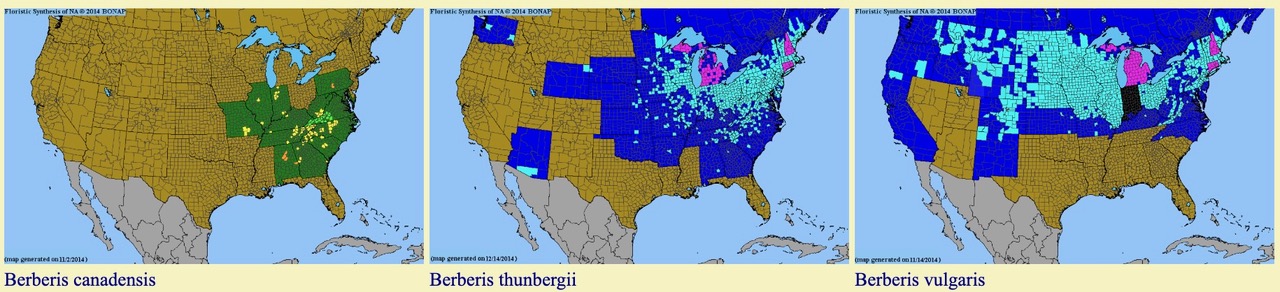
When native lepidopteran larvae feed on non-native, naturalized barberry species (and 11 of them are known to do so), these observations get counted as “native” because the genus also contains a native species. The contribution of the introduced barberry to lepidopterans becomes invisible in the analysis (Fig. 3).
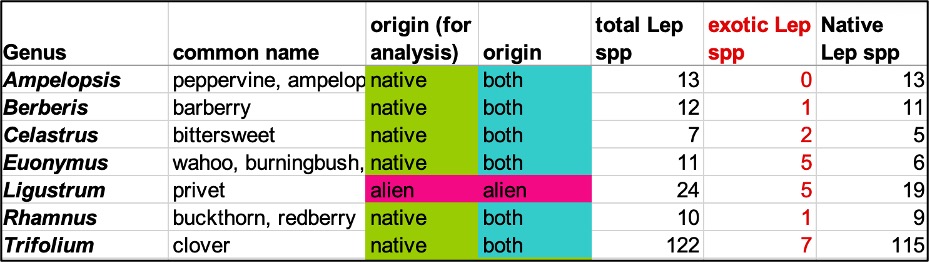
Another example, clovers (genus Trifolium), are known to support 115 native lepidopteran species. There are over a dozen non-native, naturalized clovers throughout the region (quite common in lawns and post-agricultural environments) and two uncommon native ones restricted to the southeast. Treating clovers (and any other genus that contains both native and introduced species) as native effectively erases the ecological contributions of introduced species to lepidopterans. For the purposes of the Tallamy paper, any time an insect uses an introduced plant from a genus that also contains native species, that positive interaction is credited solely to native plants.
A different story
When we separate out the data by actual plant origin, a more nuanced picture emerges (Fig. 4):
- Native woody plants still perform better on average, supporting 64 lepidopteran species (61 native) compared to introduced woody plants supporting 49 species (46 native). The advantage exists, but it’s much smaller than the 14-fold difference reported in the original analysis.
- For herbaceous plants, the native advantage disappears entirely. In fact, introduced herbaceous plants support more lepidopteran species on average: 6 species (5 native) for introduced plants versus 5 species (4 native) for native plants.
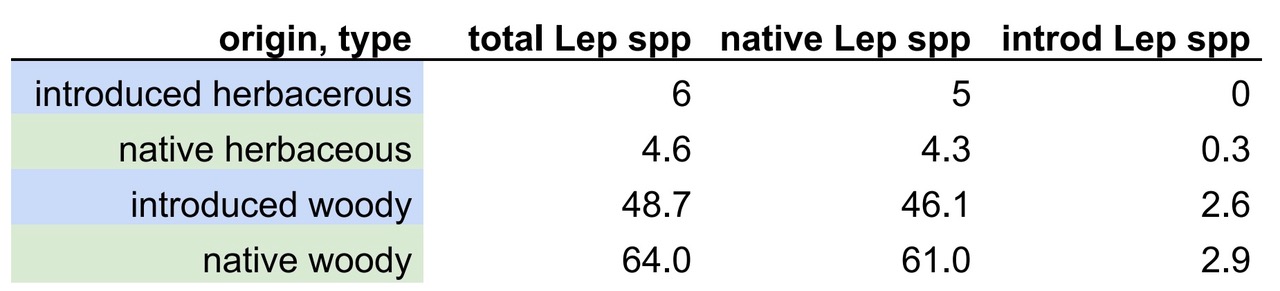
The widespread belief that native plants are always dramatically superior to introduced plants is not a reflection of ecological reality. By treating mixed origin genera as entirely native, the ecological value of thousands of introduced plant species is misattributed to native plants, concealing the introduced species’ actual contributions to pollinator support.
Land managers and gardeners using this research to guide their decisions may be removing introduced plants that are, in reality, providing significant support to native insects. When we aim to eradicate naturalized plants based on the assumption that only native plants matter, we may be eliminating valuable resources that insects have already incorporated into their life cycles.
Introduced plants are active participants in ecosystems
Ignoring the contributions that introduced plants make towards supporting imperiled pollinators not only skews our perception of these plants, leading to the commonly held assumption that native plants are the only plants that support pollinators, it causes us to potentially ignore and possibly interfere with the positive contributions that many of these plants, even those labelled invasive, can make.
Primary research has shown us many times that introduced plants, whether in a garden or naturalized in a landscape, can provide food in the form of nectar, pollen, and larval host plants to many of our native bees, wasps, butterflies, and moths (Sax et al. 2022). Not to mention the ecological value they can provide in terms of habitat, erosion control, carbon sequestration, bioremediation, etc.
We know that introduced clovers (Trifolium), in addition to their value as lepidopteran hosts, can serve as a valuable food source for native bumblebees (Harris and Ratnieks 2022). Common buckthorn (Rhamnus) is now the primary food source for an endangered butterfly, Henry’s Elfin (Cech and Tudor 2005). Many of the species that are considered some of the worst “invasives” in eastern North American are themselves able to host the larvae of many native lepidopteran species (see again Fig. 3). We ignore this at our peril in a changing climate.
Native plants are still important
These assertions should not be interpreted to mean that native plants do not matter. Whenever I teach on this subject, I always take pains to point out that native plants are extremely important. We should conserve them, plant them, propagate them, and appreciate them.
But the importance of native plants does not mean that introduced plants have no ecological value. Native plants are extremely important, and introduced plants have ecological value, too. While I find all of this information extremely useful, and use it to make plant selections, I am opposed, to some degree, to a utilitarian ranking of plants based solely on the number of insect species they can support. The natural world is incredibly nuanced and complex. Any overly binary system of understanding will never capture all of its beautiful, messy reality.
I believe every plant has value in its own right, and I still plant and appreciate plants, native or otherwise, that support few or no lepidopteran larvae. Many of our grasses (Bouteloua, Sporobolus, Koeleria), wildflowers (Chrysogonum, Eurybia, Vernonia), and even some of our woody trees and shrubs (Cladrastis, Eubotrys, Itea) support a whopping 0 species of lepidopteran larvae, either native or introduced.
I do not think that means those plants, or any other plant that supports very few pollinators, have no value or that we should ignore them entirely. But I do think we can use information like this to re-evaluate how plants that are often vilified are actually integrating into our ecosystems.
Do not judge plants solely by their origins
This is a deeply fascinating and thorny topic, and the more we are able to view plant behavior with an eye towards their effects rather than their origins, we will be better stewards of the ecosystems that are under our care. I am hopeful that with more information and context we will all be able to make more informed decisions about the management of wild plants, and have a deeper appreciation of the complex, chaotic interplay of plants and animals that is always around us, native or introduced, but wild nonetheless.
Nathan Lambstrom, MS
nathan@gardenecology.us
References:
Cech, R., & Tudor, G. (2005). Butterflies of the East Coast: an observer’s guide. Princeton University Press.
Harris, C., & Ratnieks, F. L. (2022). Clover in agriculture: combined benefits for bees, environment, and farmer. Journal of Insect Conservation, 26(3), 339-357.
Sax, D. F., Schlaepfer, M. A., & Olden, J. D. (2022). Valuing the contributions of non-native species to people and nature. Trends in Ecology & Evolution, 37(12), 1058-1066.
Stitcher, S. (2013). Black Swallowtail Butterfly. The Butterflies of Massachusetts. https://www.butterfliesofmassachusetts.net/black-swallowtail.htm
Tallamy, D. W., & Shropshire, K. J. (2009). Ranking lepidopteran use of native versus introduced plants. Conservation Biology, 23(4), 941-947.
Addenda by Professor Emeritus Arthur M. Shapiro (UC Davis)
- “Leps are hardly unique among insect groups in their degree of host specialization. Coleoptera (beetles) in particular have a great many host-plant specialists (Chrysomelidae and Cerambycidae in particular). Even Orthoptera have their share of host specialists:– the Post Oak Locust (Dendrotettix quercus) of the NJ Pine Barrens is a splendid example; it feeds only on Post Oak (Quercus stellata).”
- “The Black Swallowtail is not confined to Apiaceous hosts. It also feeds on the chemically-similar Rue family (Rutaceae), including garden rue (Ruta graveolens) and in warm climates, members of the genus Citrus. I personally raised it on Ruta when I lived back east. Many tropical and subtropical members of the lineage feed on Citrus almost or exclusively, including the Papilio thoas-cresphontes group in the Americas and P. demoleus and P. demodocus in the Old World. Feeding on herbaceous Apiaceae is probably a fairly recent host range expansion for swallowtails (Miocene or Pliocene?).”
 Conservation Sense and Nonsense