Escalating pesticide use by the unnatural Natural Areas Program

Webmaster: We are grateful to Save Mount Sutro Forest for their research on pesticide use by San Francisco’s misnamed Natural Areas Program and for giving us permission to reprint this update on NAP’s pesticide use in 2011.

********************************************

We spent a couple of hours, the other day, in the beautiful McLaren Lodge, leafing through a thick binder of pesticide reports for the San Francisco Rec and Park Department. It was so thick in part because it contained a lot of nil reports… supervisors of various sections writing in to say things like “No Roundup used in this complex.

The monthly reports from the Natural Areas weren’t nil. Far from it.

Some months ago, we wrote that the pesticide use in the Natural Areas seemed to have increased sharply in 2010 compared with 2009. Oh, said a critic, don’t focus on an individual year. It might go back down next year, it might just be a blip.

If so, we’re not blip-free yet. According to our preliminary figures (which we will update if we get better information) pesticide applications in 2011 were up 20% from 2010.

The NAP continues to use glyphosate regularly (38 39 times in 2011). It’s mostly switched from Roundup to a different formulation, Aquamaster. This alternative provides better control over the adjuvant, the stuff that the pesticide is mixed with. It still contains glyphosate, with its attendant risks.

GLYPHOSATE IS STILL TOXIC

Part of the reason for switching to Aquamaster is that POEA, the adjuvant in Roundup, is actually toxic instead of being inert. But it’s not just the POEA. Glyphosate itself has problems, particularly in terms of pregnancy problems and birth defects. A 2005 article published in the journal of the National Institutes of Health noted that glyphosate was toxic to placental cells (and Roundup was even more so):

“… glyphosate is toxic to human placental JEG3 cells within 18 hr with concentrations lower than those found with agricultural use, and this effect increases with concentration and time or in the presence of Roundup adjuvants.”

In addition, it’s an endocrine disruptor. French scientists published an article in the journal Toxicology titled, “Glyphosate-based herbicides are toxic and endocrine disruptors in human cell lines.”

According the the guidelines from San Francisco’s Department of the Environment, Aquamaster is to be used “Only as a last resort when other management practices are ineffective.” Since this last resort occurs some 40 times in a year, we suggest the DoE consider reclassifying Aquamaster as Tier I to reflect the latest research on glyphosate.

FROM THE FIRE INTO THE FRYING PAN

The big change this year was the move from Garlon (triclopyr) to Polaris or Habitat (imazapyr). According to the record, Garlon was only used thrice in 2011, while imazapyr was used 40 times.

This is somewhat of an improvement in that Garlon is a very toxic chemical, classified as Tier I; imazapyr is less toxic and classified as Tier II.

Unfortunately, it’s possible that the best thing about imazapyr is that it isn’t as bad as Garlon. It is very persistent, and doesn’t degrade easily. It moves around, being exuded by the roots of the plants it’s meant to poison. And its break-down product is a neurotoxin – it poisons the nervous system. It’s banned in the European Union.

The NAP also used Milestone four times. (That does sound like a last resort.) Fortunately. Milestone is an extraordinarily persistent chemical that has been withdrawn from sale in the UK, and is rightly classified as Tier I, Most Hazardous.

MORE VIOLATIONS OF POLICY

The NAP also continued to violate pesticide guidelines. In August 2011, they used Aquamaster against ludwigia (water primrose) in Lake Merced — a lake that is considered red-legged frog habitat. The guidelines ask for a 60-foot buffer zone. Since the water primrose is in the water (and so, we presume is the frog), this buffer zone’s not happening.

Some readers will remember this post about the dateless sign threatening pretty much all the vegetation near the Twin Peaks reservoir with Garlon and Aquamaster. We never got to the bottom of that. The pesticide records don’t mention it.

[Edited to Add (22 Jan 2012): One of our readers asked about this Glen Canyon notice, too, listing the use of Glyphosate and Imazapyr against ivy and acacia.

Again, we don’t know what happened but it’s not in the pesticide records.]

MORE MONEY FOR SHELTERBELT

Shelterbelt Builders, the contractor the Natural Areas uses for pesticide application, earned more fees from Rec & Park as pesticide applications increased:

  • In fiscal 2009-10 (year ending June 30), it earned $51 thousand;
  • In fiscal 2010-11, it was paid $78 thousand;
  • In fiscal 2011-12, it’s been paid (or is owed) a total of $84 thousand, and the fiscal year is only half-finished.

[Edited to Add: This is public information from the SF Controller’s website. You can see it here. ETA2: The report on the SF Controller’s website has been changed. Here is the new link. Also, the picture here can be enlarged by clicking on it until it’s readable.]

On Mount Sutro, though the Sutro Stewards’ volunteers have been gutting the understory and destroying habitat, we are glad to say there is still no use of herbicides. Again, our thanks to UCSF for preserving possibly the last pesticide-free wildland in San Francisco. Even if only temporarily.

DOES SAN FRANCISCO HATE ITS TREES?

It’s not a good time to be a plant or a tree in San Francisco. The San Francisco Chronicle reports that the city is handing off 23,000 street trees to homeowners to care for. It estimates it will save $300 thousand. The kind of comments people made on the article don’t bode well for the future of those trees. Meanwhile, it seems to be able to find funding to destroy trees in Natural areas across the city, trash habitat needed by the city’s wildlife, and take out quirky old trees that give some of these wild areas their character.
The Globalization of Ecology by Humans

Humans have had a profound impact on our planet wherever they have lived.  Since the industrial age man’s impact on the environment has even extended beyond where he lives as atmospheric changes impact remote places such as the polar regions. Humans are a particularly restless species of animal, forever fleeing whatever conditions threaten existence or seeking a better life ahead.  Because we are an adaptable species with the capacity to alter conditions, we have a wider range of movement than other animals. 

Wherever humans have gone they have taken with them the seeds of plants, at first unwittingly and then purposefully after the advent of agriculture.  Edward Salisbury, a 19th Century British horticulturalist, reported raising 300 plants of 80 different species from the debris in his trouser cuffs despite wearing spats.(1)

The impact of Native Americans on the landscape

Native Americans arrived in North America about 13,000 years ago and slowly migrated to South America.   The megafauna that Native Americans found when they arrived disappeared soon after they arrived.  Although not all scientists agree, there is strong evidence that the megafauna, such as enormous buffalo and mastodons were hunted to extinction by the first human inhabitants of the New World.  The loss of these huge herbivores was a factor in the development of grasslands that were not adapted to heavy grazing.(2)

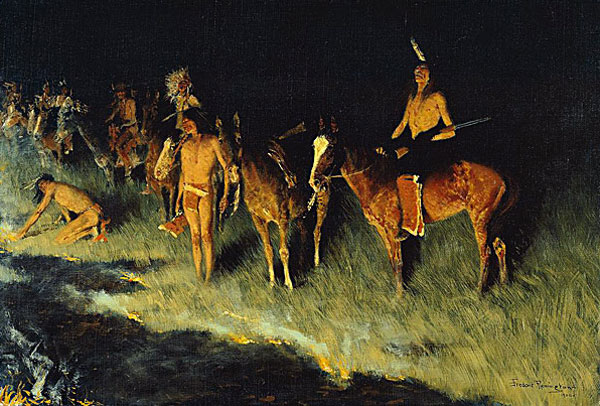
Native Americans setting grass fire, painting by Frederic Remington, 1908

The most profound alteration of the ecology of the New World by Native Americans was their use of fire to assist their hunting and gathering activities.  Burning grassland to the ground encourages the growth of new sprouts that improve grazing and attract the animals the Native Americans hunted.  And burning grassland funneled the animals into the hunt.  These frequent burns prevented the succession of grassland to shrubs and forest, maintaining prairies that were essentially manmade. 

The arrival of Europeans in the New World

This process of transplanting plants around the globe was greatly accelerated by the age of exploration which began in earnest in the 15th century.  When Columbus arrived in the New World in 1492, he found a land that had already been radically altered by Native Americans, though he had no way of knowing that. 

The Europeans that eventually settled the New World were ignorant of the impact of Native Americans on their new home until the advent of archaeology in the 20th century.  Their ignorance was based on their mistaken perception that the Native American population was small.(3) 

In fact, the population of Native Americans was decimated by the time the Europeans settled the New World nearly 200 years after the early explorers arrived at the end of the 15th century.  The early explorers introduced European diseases to which they were immune, but the Native Americans were not.  From just a few localized contacts with Europeans these diseases–such as measles, smallpox, and syphilis–spread quickly through Native American communities, sometimes reducing the population by as much as 90%.  These deadly epidemics were largely unwitnessed by the tiny population of early explorers.

Alfred Crosby speculates in Ecological Imperialism that Native Americans were particularly vulnerable to these diseases because they had virtually no domesticated animals.  He gives us a fascinating explanation of how Europeans developed their immunities by living in close proximity with animals for centuries.

The history of Native Americans was initially recorded by the European settlers who arrived in numbers nearly 200 years after initial contact in the 15th century.  Their perception that they found a pristine wilderness, largely untouched by human hands, has persisted to this day in the public’s mind.   It is that perception that has led native plant advocates to the conclusion that the pre-European landscape should be the goal of restorations.

The impact of Europeans on the landscape

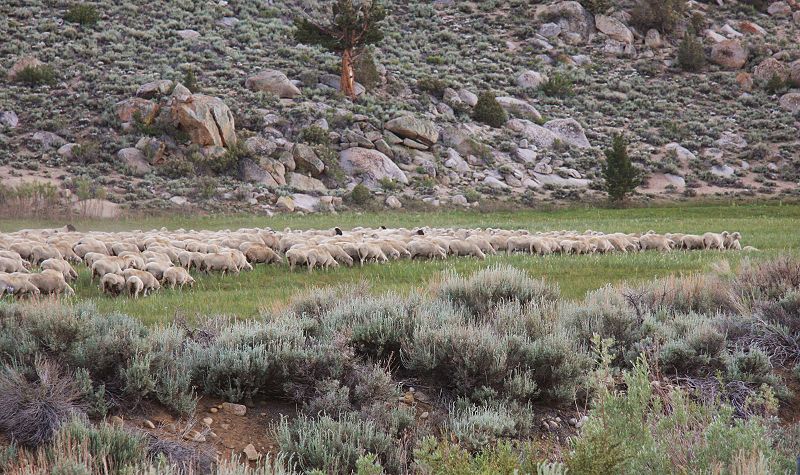
As much impact as Native Americans had on our landscape it pales in comparison to that of Europeans.  The importation of domesticated animals—such as cattle, pigs, horses, and sheep—changed the ecology of the New World quickly.  Because the population of early settlers was small and the grazing resources vast, these animals quickly became huge herds of feral animals, roaming places such as the pampas of Argentina and the prairies of the mid-west of North America.  The native grasses were quickly replaced by the non-native grasses spread by these wandering herds. (4)

Herd of sheep, Mono County, CA. Creative Commons

Likewise, the agricultural practices of European settlers have introduced virtually everything we eat today in North America.  Nearly all of our fruits, vegetables, and cereals are not native to North America.  If non-native food were to be banished from California, we would be reduced to a diet of game, acorn mush and a few species of nuts and berries.   The diet of Europeans would be equally impoverished if they lost the potatoes, corn, tomatoes, etc. that came to them from the New World.

USDA photo

The Anthropocene:  The geologic age of humans

The Earth’s ecology is in a constant state of change.  Humans are not the source of much of that change.  The continents shift.  The climate oscillates.  Plants are moved by the wind and tide.  Animals move without the assistance of humans, often taking plants with them.  But change has been accelerated by the restless movements and activities of humans. 

Scientists have recently begun to advocate for the naming of a new geologic era, the Anthropocene.   The Anthropocene would officially acknowledge that the environment has been altered by humans.  Although the beginning of this era is still being debated by scientists, Erle Ellis (University of Maryland, Baltimore) believes that an appropriate beginning would be about 6,000 years ago, when humans domesticated animals. 

Why are we suddenly afraid of change?

Changes in the ecology of North America resulting from the movement of humans have been going on for thousands of years and have greatly accelerated in the last 500 years.  Until very recently, these changes were broadly perceived as improvements.  We enjoy a more varied diet than our ancestors and we are shielded from famine by our access to food from anywhere in the world.  We find the products of the New World useful in other ways, such as the rubber that is essential to transportation.

Suddenly, for little apparent reason, we are afraid of everything new in our environment.  The media is full of panic-stricken reports of alien “invasions.”  Most of these panic attacks eventually prove to be baseless.  The newcomers are eventually absorbed into the landscape or they disappear without a trace.  Or scientists eventually explain that the newcomers are better adapted than their predecessors to the climate, water, and soil conditions created by the activities of man. 

We asked a scientist who advises us occasionally this question:  Since new species of plants and animals have been introduced to our landscape for hundreds, if not thousands of years, why the sudden panic?  His reply was:  “It’s trendy. It’s ‘cutting edge.’ It’s ‘hot.’ It’s…fundable.”   

In the service of a scientific fad that has spread into the popular culture, introduced species of plants and animals are being needlessly destroyed.  Many of these new species are better adapted to present conditions than their predecessors.  Many are essential to our way of life and the animals with which we share the planet. 


(1) Richard Mabey, Weeds:  In Defense of Nature’s Most Unloved Plants, Harper-Collins, 2011

(2) Alfred Crosby, Ecological Imperialism. Cambridge University Press, 2004

(3) Charles Mann, 1491, Random House, 2005

(4) Crosby

A novel definition of “wilderness”

As our readers know, we troll the websites of supporters of the native plant movement, looking for clues about the basis for belief in that ideology.  We hope that our understanding will enable us to provide the scientific information to our readers that will reveal the fallacies of nativism. 

The following comment on the San Francisco Forest Alliance website alerted us to a new theme in this debate:  native plant advocates seem to believe that we can and should return our urban parks to “wilderness.”

“It is interesting that your post shows the trail side covered with English ivy, and possibly a fallen eucalyptus or two. Each of these is a non-native element. Any and all exotic species present in the canyon destroy the wilderness aspect of Glen Canyon Park.

Please note the term “wilderness”. It implies natural, native flora and fauna; the wild plants and the bird and animal populations that support one another. That is what we want to have if we want a wild retreat. A morass of garden escapes and foreign invasive species is to be deplored. Let’s progress toward returning the area to a REAL wilderness. Do not let the concept that a plant’s becoming established in an area is a sign of its becoming native to the area. It remains an invasive element, a weed. It disrupts and destroys the normal habitat of native plants, animals, and insects in its surroundings.

It will be a huge and long term task, but we can restore the entire canyon to a truly wilderness state. Lets get started!”

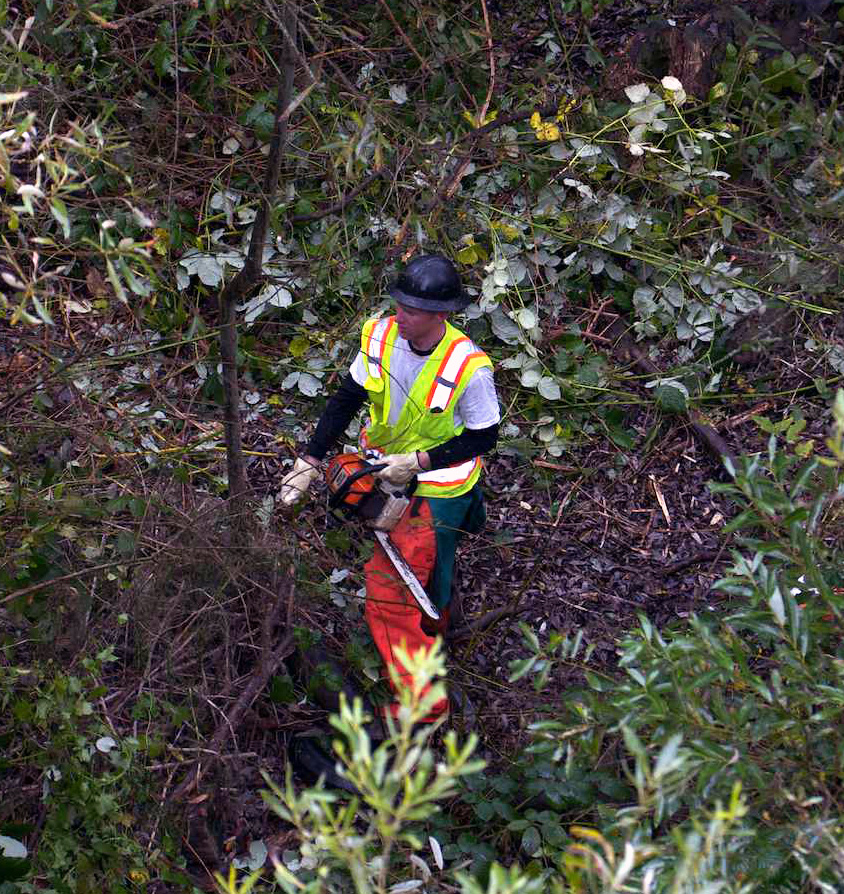
Chainsaw massacre in Glen Canyon, November 2011

In this particular native plant advocate’s view, wilderness is composed exclusively of native plants.  Everything else must be eradicated.  If chainsaws and pesticides must be used repeatedly in perpetuity, so be it.  All this destruction is justified by the glorious goal of “wilderness.”  This wilderness is apparently not disturbed by chainsaws and pesticides.  Presumably they must be ignored to achieve the glorious goal.

We rarely indulge in sarcasm on Million Trees.  We hope our readers recognize it when they see it.

Conservation Refugees: The misanthropy of ecological “restorations”

Hawaiians protest confiscation of public lands

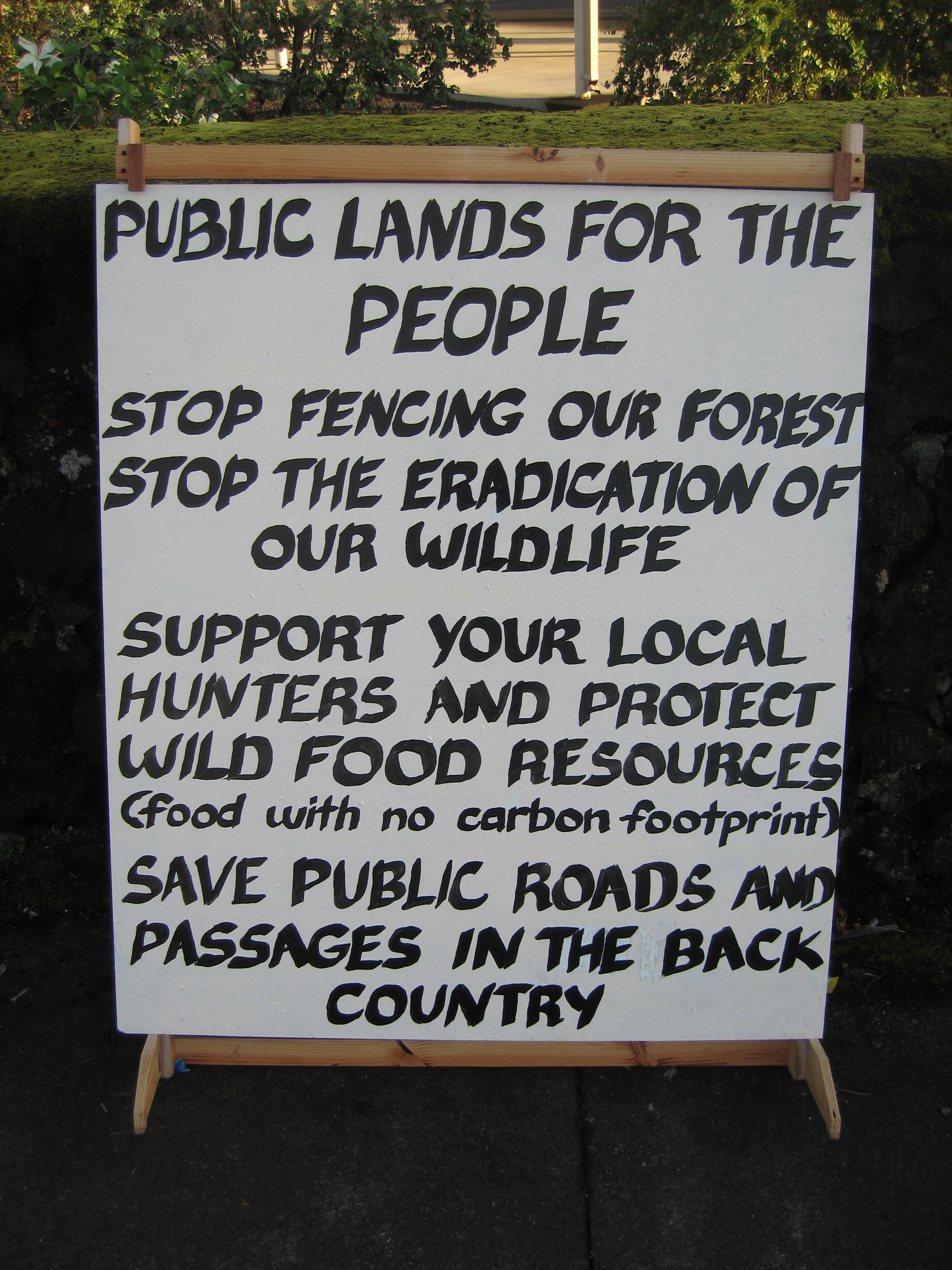
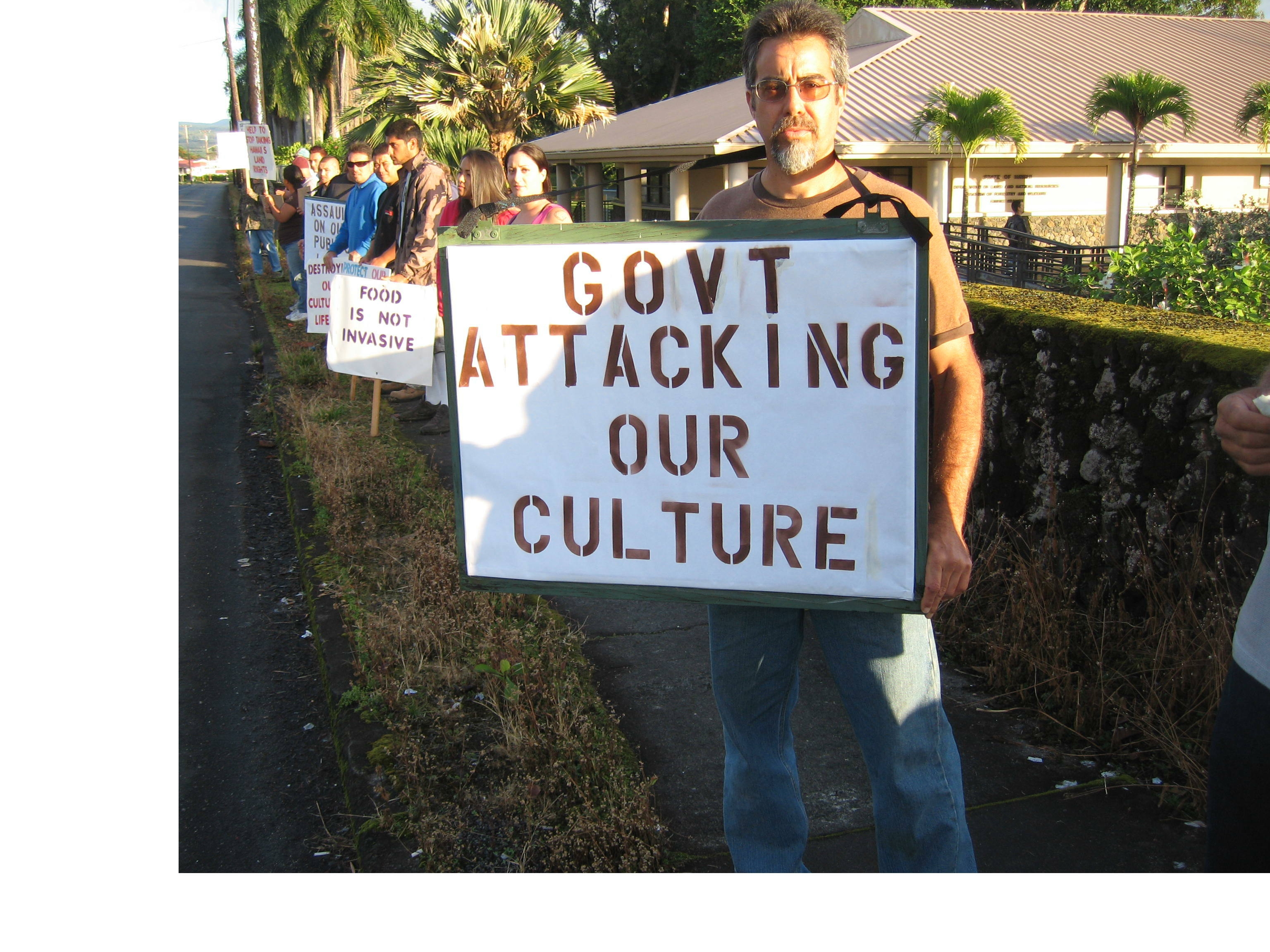
We recently told our readers about the controversial “restoration” projects in Hawaii.  Now our colleagues in Hawaii have sent us photographs of a public protest in Hawaii and The Hawaii Reporter tells us why they are protesting.  Hawaii’s Department of Land and Natural Resources (DLNR) is fencing the public out of another 17 square miles of prime forest on the Big Island.  All the non-native animals—sheep, goats, pigs—will be exterminated and all their non-native food—strawberry guava, passion fruit, etc—will be eradicated in that fenced enclosure.   The people who hunted the animals and gathered fruit in the forest are protesting the loss of this source of food. 

In addition to the loss of food, the protestors also object to the loss of an activity that is central to the Hawaiian culture of foraging and hunting for food.   DLNR’s response to that particular complaint is that the historical record indicates that Hawaiians didn’t hunt prior to the arrival of Europeans because they raised animals as their own. 

In other words, not only does DLNR wish to stop the biological clock, they also wish to freeze-frame the Hawaiian culture to a pre-European standard.  They don’t seem to have considered that the Europeans essentially confiscated the land of the Hawaiians when they arrived, which deprived the Hawaiians of the land needed to raise animals.  That’s too bad.  The Hawaiians are not allowed to hunt now because they didn’t hunt 250 years ago.   As absurd as creating botanical museums seems to us, the suggestion that culture must also be prevented from evolving strikes us as utterly ridiculous.

Hawaiians protest loss of access to public lands

Conservation Refugees

Hawaii’s cost of living has always been one of the highest in the country because virtually all of its food must be imported.   And now Hawaiians are being deprived of an important source of food by the confiscation of public lands.  Will these Hawaiians join the ranks of the millions of conservation refugees all over the world who have been displaced in the name of conservation?

We were introduced to conservation refugees by Mark Dowie in 2004.  He told us that the belief that wilderness is not compatible with human community originated with John Muir, who demanded that Native Americans living in Yosemite be removed from the valley.  Native Americans were also removed from Yellowstone when the National Park was created.  These Native Americans were the first conservation refugees, but not the last.

Dowie told us that the worldwide official protected areas—parks, reserves, wildlife sanctuaries, biodiversity corridors—had expanded from 1,000 in 1962 to 108,000 in 2004.  The total number of indigenous people displaced by the creation of these protected areas is not known because most countries make no attempt to quantify the impact.  In Chad an estimated 600,000 indigenous people became conservation refugees when the amount of protected areas increased from 0.1 to 9.1 percent of total national land in the 1990s.  India admits to creating 1.6 million conservation refugees as a result of creating new protected areas and the Indian government estimates that 2 or 3 million more will be displaced in this decade.

Dowie visited some of the communities that have been displaced by the confiscation of their ancestral land.  The loss of their land is also the loss of their way of life.  Hunters/gatherers are deprived of their source of food.  Likewise, farmers lose their croplands.  They wander into shanty towns where they lack the skills to survive in the modern world.  They create shabby squatter camps on the perimeter of their homeland where they live without sanitation or water.  The fabric of their communities is shattered.

Emma Marris* observes the irony of these evictions of traditional cultures which have tended these remnants of the wilderness for generations.  These places were targets for conservation because they had been preserved by traditional cultures that had learned to co-exist with nature.  This is how they are rewarded for their stewardship of the land.

What is accomplished?

What is gained when Hawaiians are thrown out of their public lands, depriving them of a source of food?  Are these projects successful?  Are the plants and animals that existed in Hawaii several hundred years ago returning to the fenced reserves that have been created for them?

Emma Marris visited one of these projects in Hawaii.  A small test plot was cleared of all non-native plants, requiring the removal of about half of all the vegetation.  That process took about a week per thousand square feet and then “epic bouts of weeding thereafter.”

 The theory was that the removal of all the non-natives would enable the natives to thrive without the competition for sunlight and water.  Five years later, there is little evidence that native plants have benefited from the eradication of all non-native plants:

“Disappointingly, the mature native trees had grown very little.  As [the project directors] put it, ‘The native trees may either be responding to the treatments very slowly and still undetectably, or they may be unable to respond at all.’”

The directors of this project also told Marris, “I think that people that are interested in protecting Hawaii’s flora and fauna have resigned themselves to it being in postage-stamp sized reserves.”   Apparently Hawaii’s Department of Land and Natural Resources hasn’t gotten this message.  They are now creating another 17 square mile reserve with the intention of eradicating everything non-native in it.  Nothing is likely to be accomplished by all that death and destruction and some Hawaiians will also go hungry.

The slippery slope of nativism

Perhaps we should be grateful that the “restoration” projects in the San Francisco Bay Area aren’t depriving us of our homes and our livelihoods.  We are just being fenced out of our public parks.  We are just losing our trees.  Our public parks are just being poisoned with pesticides.

But we watch these projects all over the world and we listen to the demands of local native plant advocates and we wonder where this is headed.  In San Francisco, for example, native plant advocates are demanding that all of the public lands in the city be managed as “natural areas.”  In addition to destroying the trees in our parks, would we lose the trees on all our public properties?  We also know that native plant advocates want plant nurseries to quit selling to the public the approximately 200 plants that they have categorized as “invasive.”  Will we lose the right to plant what we want in our own backyards?  Given what we see happening around the world, it doesn’t seem farfetched. 


* Emma Marris, Rambunctious Garden, Bloomsbury Publishing, 2011