
When the cure is worse than the disease: Incompetent pesticide use

One of our readers sent us a link to an article about a “restoration” project gone awry in his neighborhood. Mount Baldhead is a city-owned park in Saugatuck, Michigan. US Fish & Wildlife funded a $700,000 federal grant to eradicate non-native plants on Mount Baldhead and several other municipal parks in the area. The grant was used to hire “certified applicators” to spray the non-native plants with imazapyr. Mount Baldhead was sprayed in summer 2010 and again in fall 2011. In spring 2012, the native oaks and maples, under which the non-native plants had grown and were sprayed, began to show signs of damage. Now a significant portion of the native forest is leafless and barren.
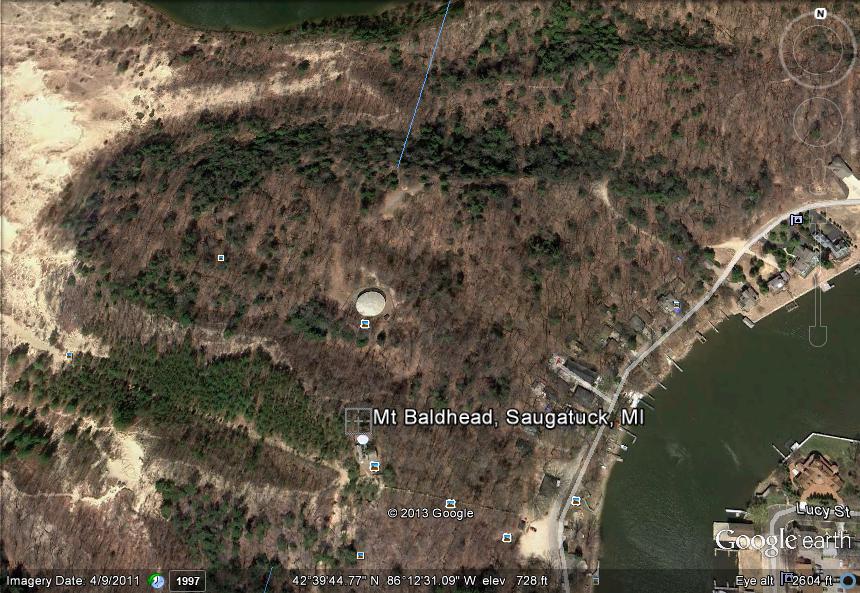
Mount Baldhead, Saugatuck, Michigan.  A clearer view of the damage is available in the article to which we provide a link.  We were denied permission to publish that picture.
Mount Baldhead, Saugatuck, Michigan. A clearer view of the damage is available in the article to which we provide a link above. We were denied permission to publish that picture.

The soil on Mount Baldhead is being studied to determine how far the pesticide has seeped into areas where it was not sprayed. This information may predict the extent of the eventual damage to the native forest. The ultimate fate of the trees that have been damaged is not known. There is no antidote to the pesticide. Will the trees survive? We don’t know yet.

What does it mean to be a “certified applicator” of pesticides?

This story is of interest to us because imazapyr is being widely used in the San Francisco Bay Area and its use has increased substantially in the past year.

Because imazapyr is being used heavily, we have read the manufacturer’s label for the formulated products (Habitat and Polaris) and the federally mandated Material Safety Data Sheet.

Therefore, we know that imazapyr should not be sprayed under trees you do not want to kill. This is a product that is mobile in the soil. It is capable of traveling from the roots of the plant on which it is sprayed into the roots of adjacent plants on which it has not been sprayed, killing or damaging plants that were not the intended targets of the spraying.

In December 2011, we witnessed imazapyr being used in San Francisco’s public parks for the first time. It was being sprayed on cape ivy under native willow trees. We doubt that the willows were the intended targets of the spraying since they are native. We wonder if the willows will survive in the long run.

These incidents make us ask what, if anything, it means to be a “certified applicator” of pesticides. Does the certification require the applicator to read the manufacturer’s label? If so, does the certification require the applicator to actually follow the directions on the manufacturer’s label? Clearly, this isn’t happening and there don’t seem to be any consequences for the “certified applicator” who kills plants and trees that he/she wasn’t hired to destroy. So, we conclude that such certification is meaningless.

The Million Trees mantra

Native plant advocates believe their projects benefit the environment. We do not see the benefit they claim. This is what we see:

• Increasing use of toxic pesticides is required to kill non-native vegetation. These pesticides are inherently hazardous and their incompetent use makes them even more hazardous.
• The wildlife that lives in our open spaces is being poisoned by these pesticides and they are losing their homes and their sources of food.
• The results of these projects do not justify these dangerous practices. The projects often look more dead than alive.
American law prevents Canadians from reducing pesticide use

Here is a letter to the editor of the New York Review of Books, February 7, 2013:

“Dear Editor,

Tim Flannery in his review of the Biography of Rachel Carson makes one mistake and that concerns pesticide use reductions in Canada [“A Heroine in Defense of Nature,” NYR, November 22, 2012].  The first Canadian province to ban the ‘cosmetic’ use of specified pesticides and herbicides—i.e., for gardens and flowers, and not for commercial crops—was not Ontario (2009) but Quebec (2006).

This was the result of grassroots activity at the local, municipal level and it was backed by a national organization, the Campaign for Pesticide Reductions (CPR!), of which a leading sponsor (surprisingly perhaps) was the Canadian Labour Congress.  The ban was backed by the Canadian Cancer Society, the first of many moves in the direction of cancer prevention, versus cancer treatment and research.  Quebec’s move to ban the sale as well as the use of these products was a violation of the federal authority over commerce and it resulted in a challenge under the North American Trade Agreement (NAFTA, Chapter 13).

Some of Rachel Carson’s aims over pesticide use reduction could be achieved by a statute requiring the practice of Integrated Pest Management (IPM), which properly interpreted results in the avoidance, or use reduction, of synthetic organic chemical pesticides wherever possible.  Canada, like most countries has not done this:  pesticide registration or licensing is easy to get and once a pesticide is on the market, it is very difficult to prevent its proliferation or remove it from the environment.  But unlike many Canadian environmental measures, the bans so far on the cosmetic use of pesticides are truly progressive.”

David Bennett

Former Director

Health, Safety and Environment

Canadian Labour Congress

Ottawa, Canada

The North American Trade Agreement is a free trade agreement between the United States, Canada, and Mexico.  If you want to do business with the United States, you apparently are not allowed to ban the sale and use of pesticides. 

San Francisco’s misnamed Integrated Pest Management policy

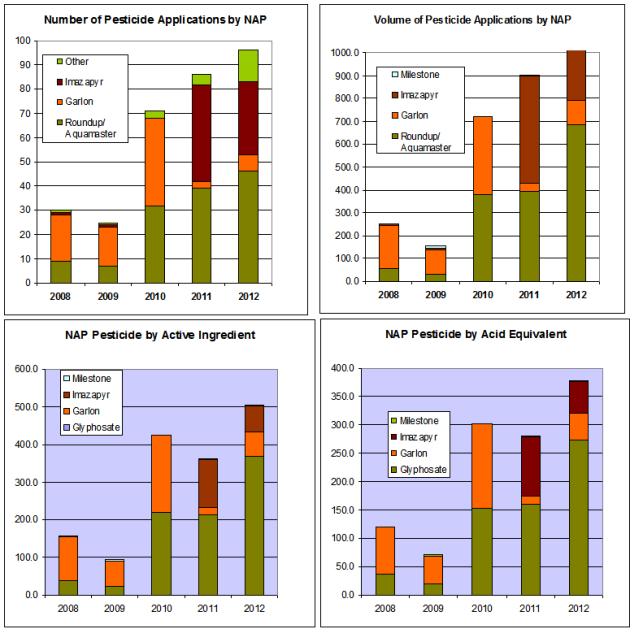
This seems a timely reminder of the difficulty of changing public policy regarding pesticide use.  For the third year in a row, San Franciscans recently attended the annual hearing at which the city’s pesticide policy is renewed by the Environment Commission.  Citizens reported the escalating use of toxic pesticides in San Francisco’s public parks by the so-called  Natural Areas Program.  They also repeated their annual request that pesticides considered “Most Hazardous” (Tier I) and “More Hazardous” (Tier II), not be sprayed in public parks.

Volume of pesticide use by San Francisco's "Natural Areas Program."  Courtesy San Francisco Forest Alliance
Volume of pesticide use by San Francisco’s “Natural Areas Program.” Courtesy San Francisco Forest Alliance

Once again, the public’s request fell on deaf ears.  In fact, the only changes to the city’s pesticide policy liberalized the use of pesticides by the Natural Areas Program.  Milestone which had been rated “Most Hazardous” in the past has now been downgraded to Tier II.  This is the pesticide that is mobile in the soil and persists in the soil for a long time.  It is banned by the state of New York for sale or use because of concerns about the potential of poisoning ground water.  Yet it is used in San Francisco in the watershed to Islais Creek.

Also, Garlon (Tier I) can now be sprayed without the applicator wearing a respirator, which will make it easier and more likely to be used in the future.

However, these two revisions of the city’s pesticide policy pale in comparison to the recent decision of the Recreation and Park Department with respect to promoting the use of pesticides in the city’s parks.  The Recreation and Park Department recently announced that the person in charge of the Natural Areas Program is now also in charge of the Department’s pesticide use.  This inappropriate decision effectively removes all pretenses that the Natural Areas Program’s use of pesticides is being monitored or supervised.  The Natural Areas Program is now free to use pesticides wherever and whenever they wish.

Mr. Bennett makes a mistake in his letter to the editor.  He assumes that an Integrated Pest Management policy would avoid or at least reduce pesticide use.  San Francisco calls its pesticide policy an Integrated Pest Management program.  That policy has obviously not reduced pesticide use in San Francisco’s parks.  In fact, it seems to facilitate the use of pesticides.  Pesticide use by any name is still pesticide use.