The WordPress.com stats helper monkeys prepared a 2014 annual report for this blog.
Here's an excerpt:
The concert hall at the Sydney Opera House holds 2,700 people. This blog was viewed about 32,000 times in 2014. If it were a concert at Sydney Opera House, it would take about 12 sold-out performances for that many people to see it.
Our last post of 2014 will summarize wins and losses in our effort to save our urban forest and preview the local issues that remain unresolved. 2014 has been a year of many accomplishments, but there have been disappointments as well.
2014 Accomplishments
Good news always comes first! We are most grateful for the hard work of the San Francisco team with whom we collaborate. After herculean effort, they completed most of the presentations to the members of the Board of Supervisors about the forthcoming approval process for the Environmental Impact Review of San Francisco’s Natural Areas Program, which has been in the works for eight years…and still counting. We are advocating for the Planning Commission and the Board of Supervisors to approve the “environmentally superior” Maintenance Alternative, which would enable the Natural Areas Program to maintain the native gardens they have created in the past 15 years, but would prohibit expansion of those gardens. The Maintenance Alternative could save about18,500 healthy non-native trees from being needlessly destroyed and significantly decrease herbicide use in our parks.
Because native plant advocates have succeeded in convincing many politicians that their projects are “science-based,” the San Francisco team was particularly glad to have three lectures at the Commonwealth Club by academic scientists, which challenged the unfounded assumptions of the native plant ideology:
These presentations were very well attended, including by native plant advocates. They were entirely successful from our standpoint, though they seem to have had little influence on the opinions of native plant advocates, many of whom seemed not to understand the scientific information being presented.
The dense and healthy Sutro Forest
In March 2014, UCSF announced that they have put their plans to destroy most trees on Mount Sutro on indefinite hold. This decision was made in response to the public’s overwhelming opposition to these plans during the public comment period for the Draft Environmental Impact Report in March 2013. However, UCSF has destroyed about 1,200 trees during the past 18 months which they claimed would mitigate immediate hazards. UCSF has also made a commitment to not using herbicides on Mount Sutro. UCSF has provided no estimated time frame for announcing a new plan. Please visit Save Mount Sutro Forest for a more detailed description of that announcement. We consider this a “holding pattern” because we know that UCSF is under constant pressure from those who want the Sutro Forest to be destroyed.
Invasion biology is being revised by academic scientists who inform us that empirical studies do not support the hypotheses of invasion biology. Here are a few of the highlights from the scientific literature:
Likewise, mainstream media has become more even-handed in its coverage of invasion biology and native plant “restorations.” Here are a few specific examples:
The publication of the final Environmental Impact Statement for FEMA projects in the East Bay Hills was the biggest disappointment of 2014. There were over 13,000 public comments on the draft and they were overwhelmingly opposed to the proposed projects. Yet, the projects are fundamentally unchanged by the final EIS, which will be officially approved by a “Decision of Record” on January 5, 2015. We are grateful to the Hills Conservation Network for their continuing opposition to these projects and we urge our readers to support their effort.
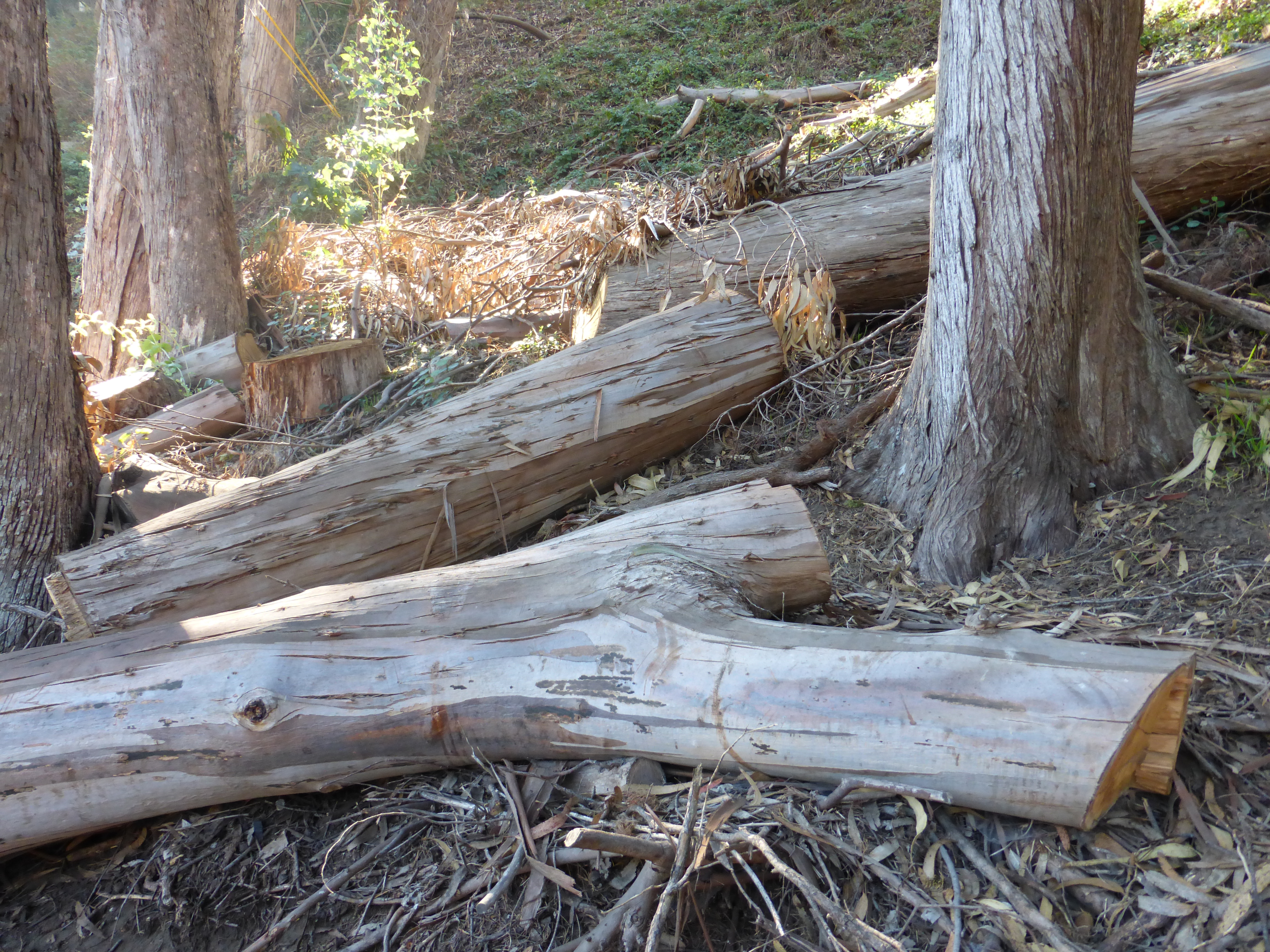
Some of the hundreds of trees destroyed by UC Berkeley in August 2014
In San Francisco, our biggest disappointment of 2014 was the approval of the revised Recreation and Open Space Element (ROSE) of the city’s General Plan, which has committed the city to managing all open space as “natural areas.” The ROSE defines “natural areas” so broadly that it includes not only areas that currently contain existing remnants of SF’s pre-settlement habitat, but also areas that could support native plants if they were planted there, or, in other words, nearly all open space in SF, including people’s back yards.This policy commits the city to managing nearly ALL open space in San Francisco, including that in private hands, the same way as the Natural Areas Program manages its lands. As disappointing as that decision was, it was also instrumental in producing one of the biggest accomplishments of 2014. We were successful in convincing the State of California to decline to fund a grant application which would have implemented the plans to convert all open space in San Francisco to native plant gardens. That so-called “biodiversity program” continues, but is presumably handicapped by the loss of that fund source.
Looking forward in 2015
In the past six months, the San Francisco team has devoted a great deal of time and effort to influencing the city’s Urban Forestry Council (UFC) to adopt “best management practices” that would discourage the destruction of healthy trees. The UFC has hosted a “listening series” of presentations by those who advocate for the eradication of eucalyptus forests as well as those who are opposed to that destruction. Native plant advocates have introduced new justifications for destroying the eucalyptus forests:
They claim that eucalyptus forests are dying of disease, drought, old-age, etc. We have sought the advice of many professional arborists and academic ecologists who assure us these claims are inaccurate.
They claim that the health of the eucalyptus forests would be improved by radical “thinning.” The scientific literature informs us that mature forests do not benefit from thinning because mature trees are unable to respond positively to increased light and wind. Thinning is only beneficial to young trees and even then, the disturbance can damage the trees that remain. Radical thinning of the mature eucalyptus forest is likely to destroy the few trees that will remain.
The UFC has completed its listening series and will probably reach its conclusions in 2015. Based on the meetings we have attended and the conversations we have had with members of the UFC, we are not hopeful about the outcome. They seem to be sympathetic to the demands of those who want the non-native forests of San Francisco to be destroyed. In that case, their “best management practices” could be specifically supportive of the plans of the Natural Areas Program to destroy 18,500 trees in San Francisco and Pacifica. If you would like to express your opinion to the Urban Forestry Council, you can write to them here: SFUrbanForestCouncil@sfgov.org.
We also expect the final Environmental Impact Report for San Francisco’s Natural Areas Program to be published in 2015. We will make our best effort to convince the Planning Commission and the Board of Supervisors to approve the Maintenance Alternative. However, we should all understand that the lack of an approved EIR does not seem to have prevented the Natural Areas Program from destroying trees whenever and wherever they wish. Many trees (perhaps a few hundred) in Glen Canyon Park, McLaren Park and Pine Lake in Stern Grove have been destroyed without an approved Environmental Impact Report. In other words, the Environmental Impact Report seems increasingly irrelevant to what is actually being done in our parks.
A few of the trees destroyed recently in Pine Lake “natural area”
The President of the San Francisco Forest Alliance, Carolyn Johnston, ran for a seat on the Executive Committee of the San Francisco Group of the Sierra Club. If you follow the controversy about the Natural Areas Program in San Francisco, you may be aware of the Sierra Club’s role in supporting the nativist agenda (HERE is an example of their role). Carolyn lost by only 6 votes. If everyone in San Francisco who abandoned the Sierra Club because of its support for turning urban parks into native plant gardens, would renew their membership, maybe we could win a seat next year. We are grateful to Carolyn for running.
Science is rapidly revising the unfounded assumptions of invasion biology and climate change is making the concept of “native” meaningless. But these realities are having no apparent influence on public policy, which seems to be immune to such facts. Popular culture always lags behind science.
Million Trees is changing its emphasis in response to these political realities. In 2015, we will focus on the science that is revising invasion biology because that’s where progress is being made. This type of research is both difficult and time-consuming for us because we do the background reading to understand the scientific literature and produce accurate reports that are accessible to the layperson. We therefore expect to publish new articles only once each month in 2015. As always, we invite guest authors to step forward with news of new developments that we are not covering.
Thank you for your readership in 2014 and for any help you gave us in 2014 on our various initiatives. We wish you all a Happy New Year in 2015.
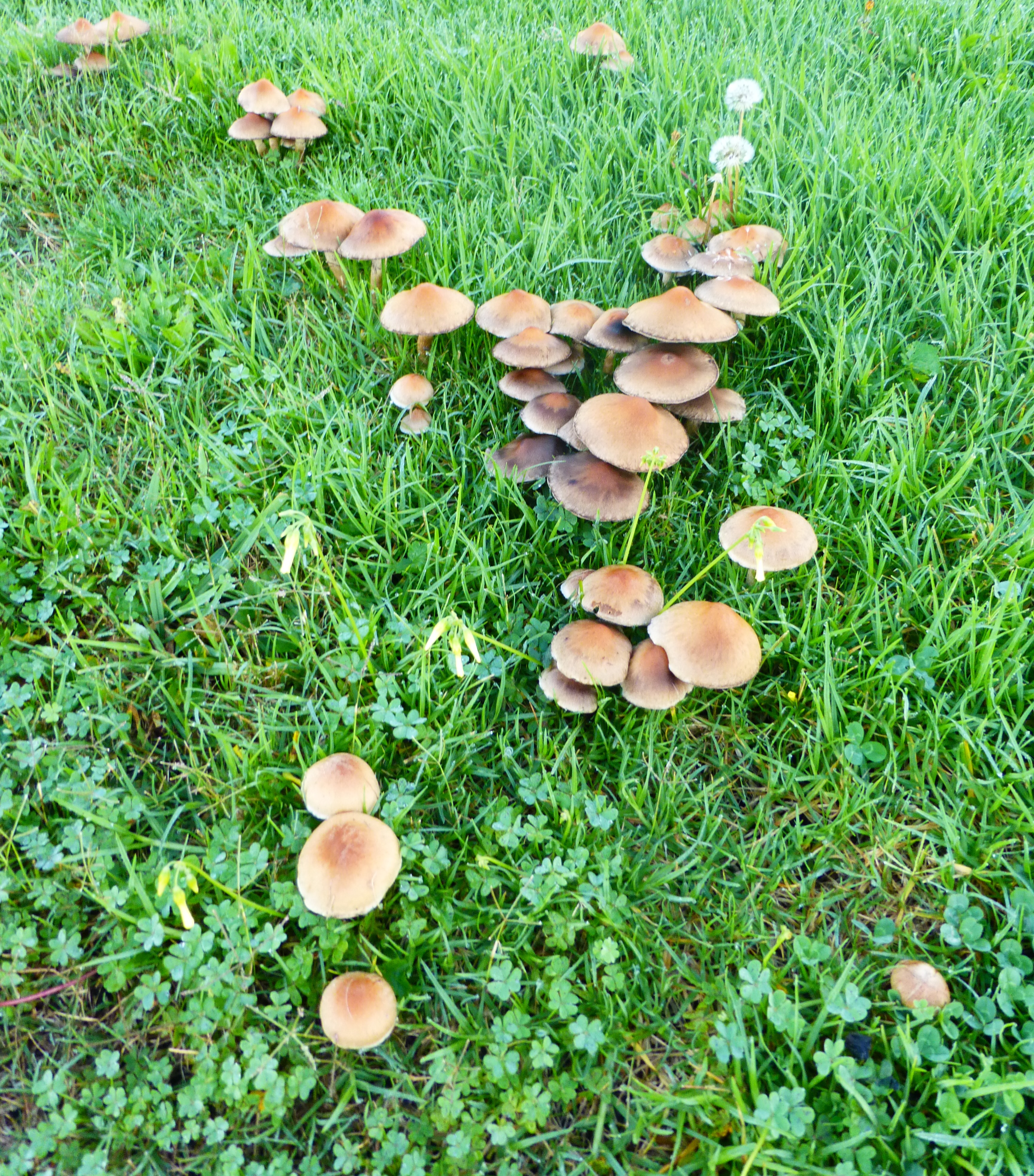
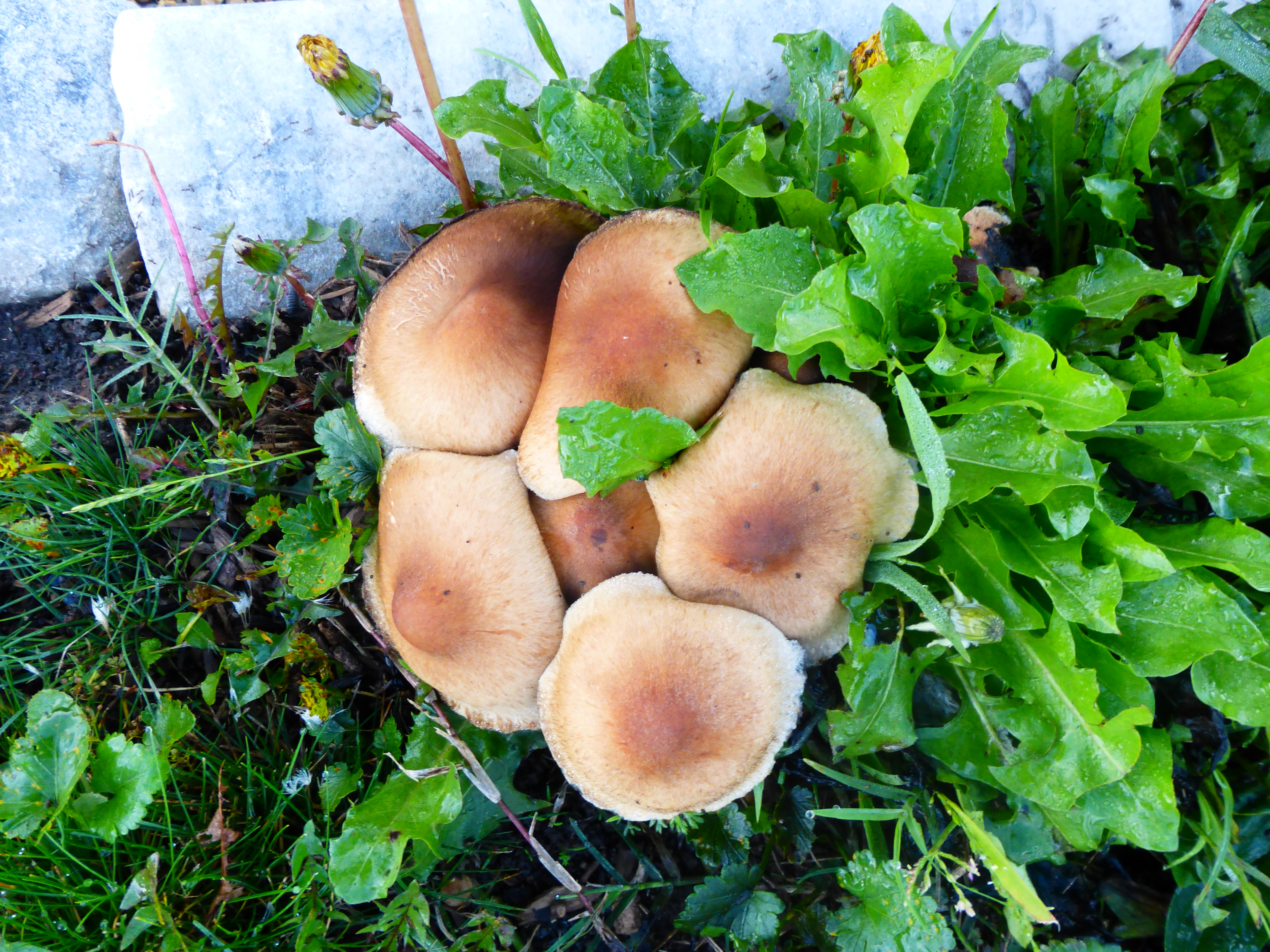
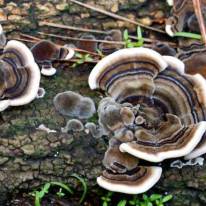
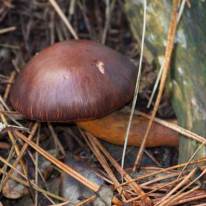
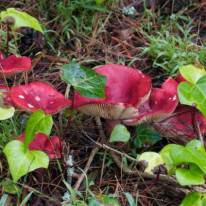
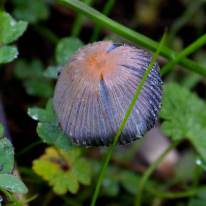
Let’s take a break for the holidays from the often unpleasant chore of debunking invasion biology and reporting on the destructive projects it spawns. We will share some photos of the mushrooms in our neighborhood. There is a bumper crop this year because of the heavy rains after several years of dry weather. They don’t last long, so let’s enjoy them while they’re here.
We know next to nothing about mushrooms and in the spirit of a holiday break we haven’t done any research in preparation for this post. If there is someone amongst our readers who knows something about mushrooms, we invite you to correct anything we’re saying or add any information that might interest others. And in the interest of public safety, our readers should understand that we assume none of the mushrooms we have photographed are edible.
Mushrooms are the “fruiting bodies” of the fungi that live underground. They emerge briefly to distribute the spores that will disperse fungi farther afield. In other words, mushrooms are sort of analogous to the flowers and fruits of plants, where reproduction occurs.
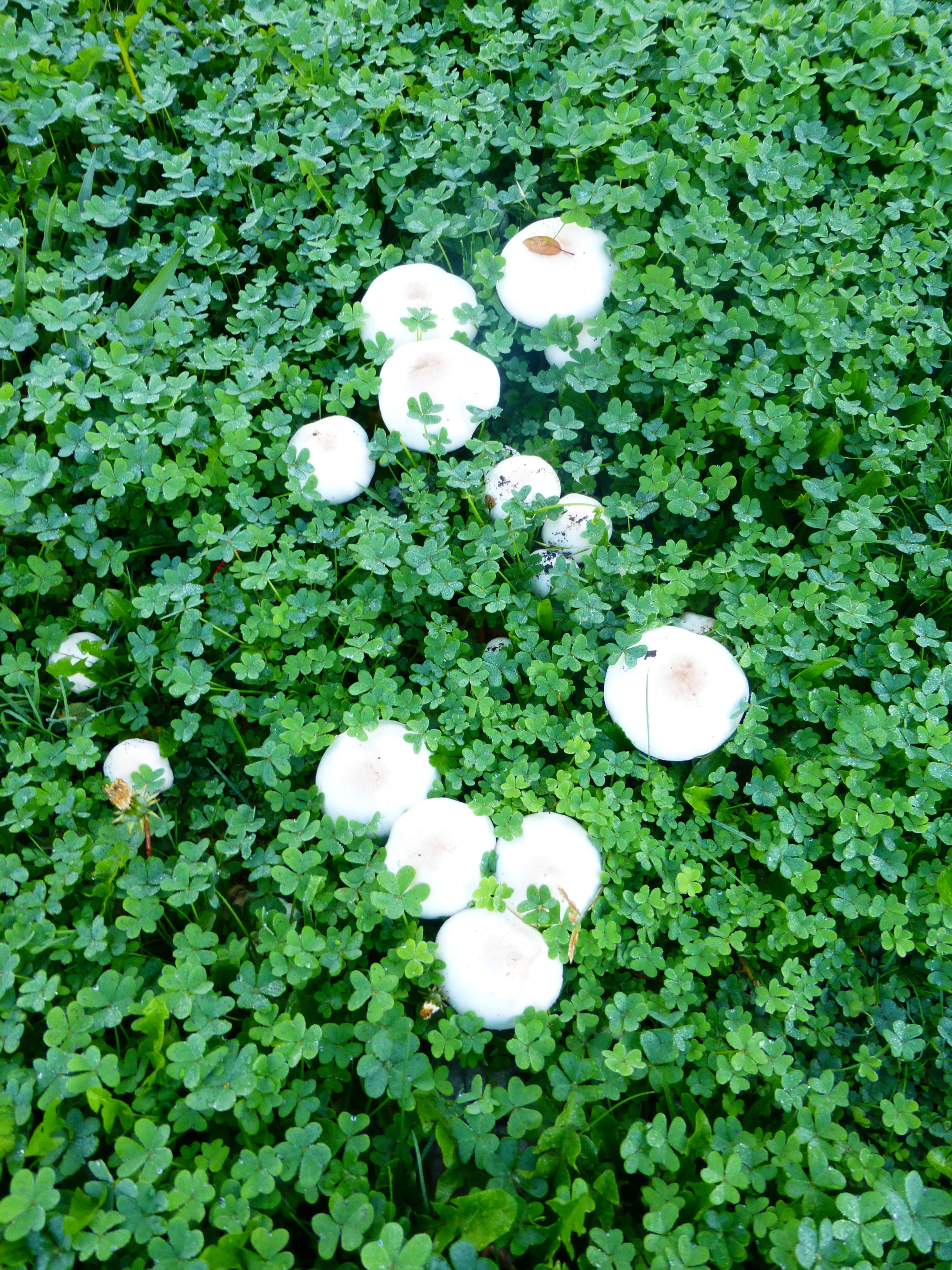
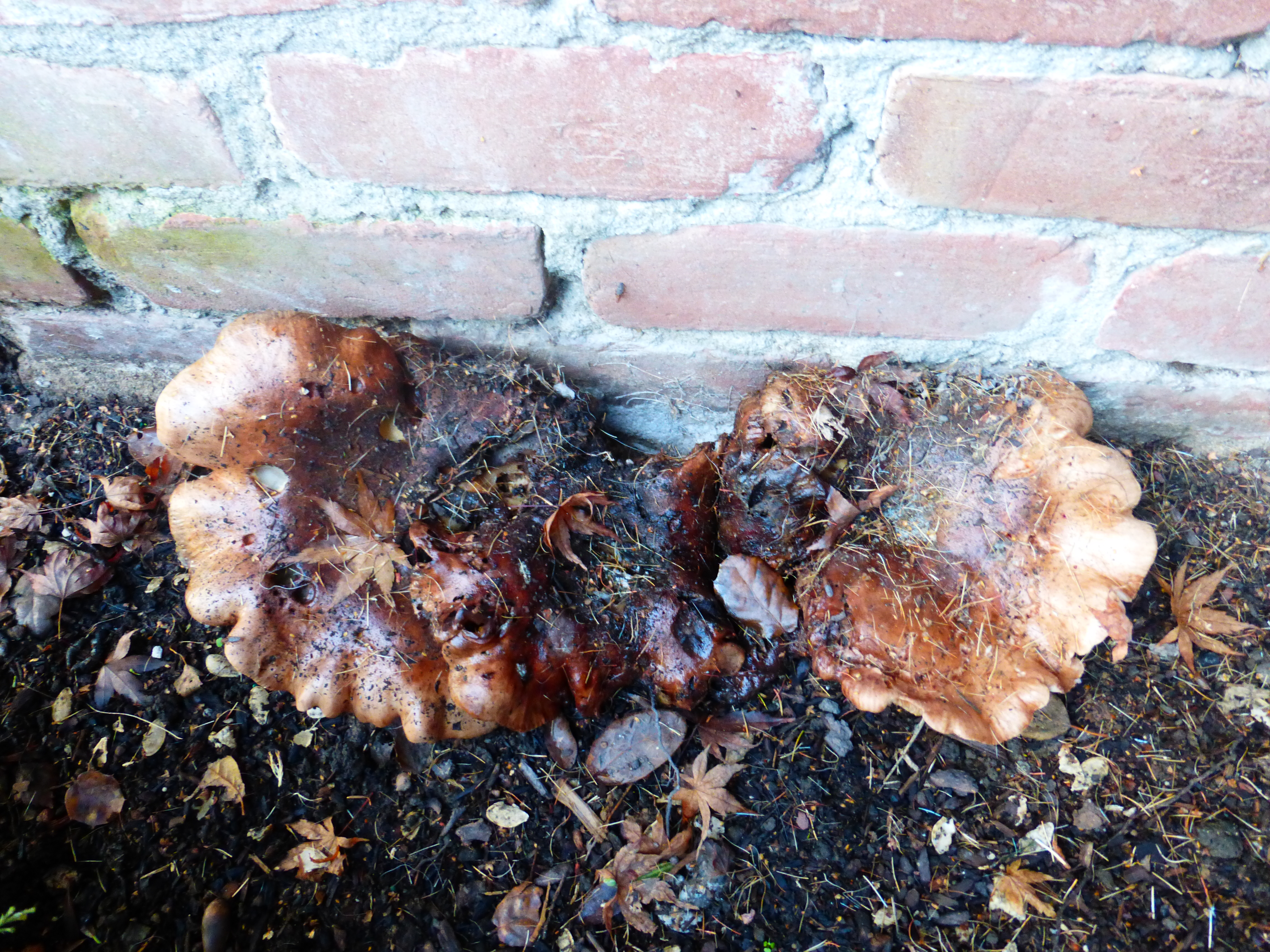
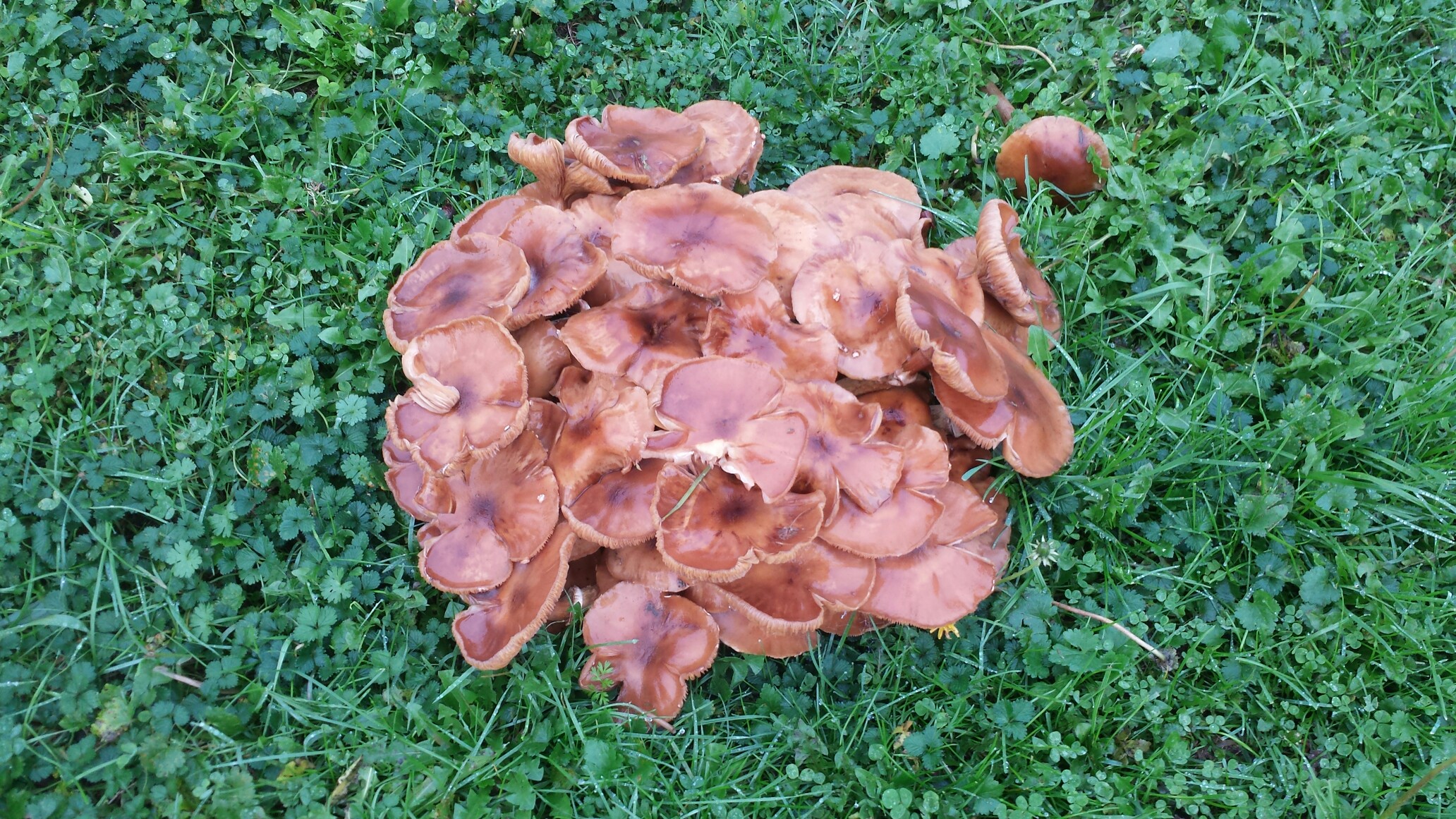
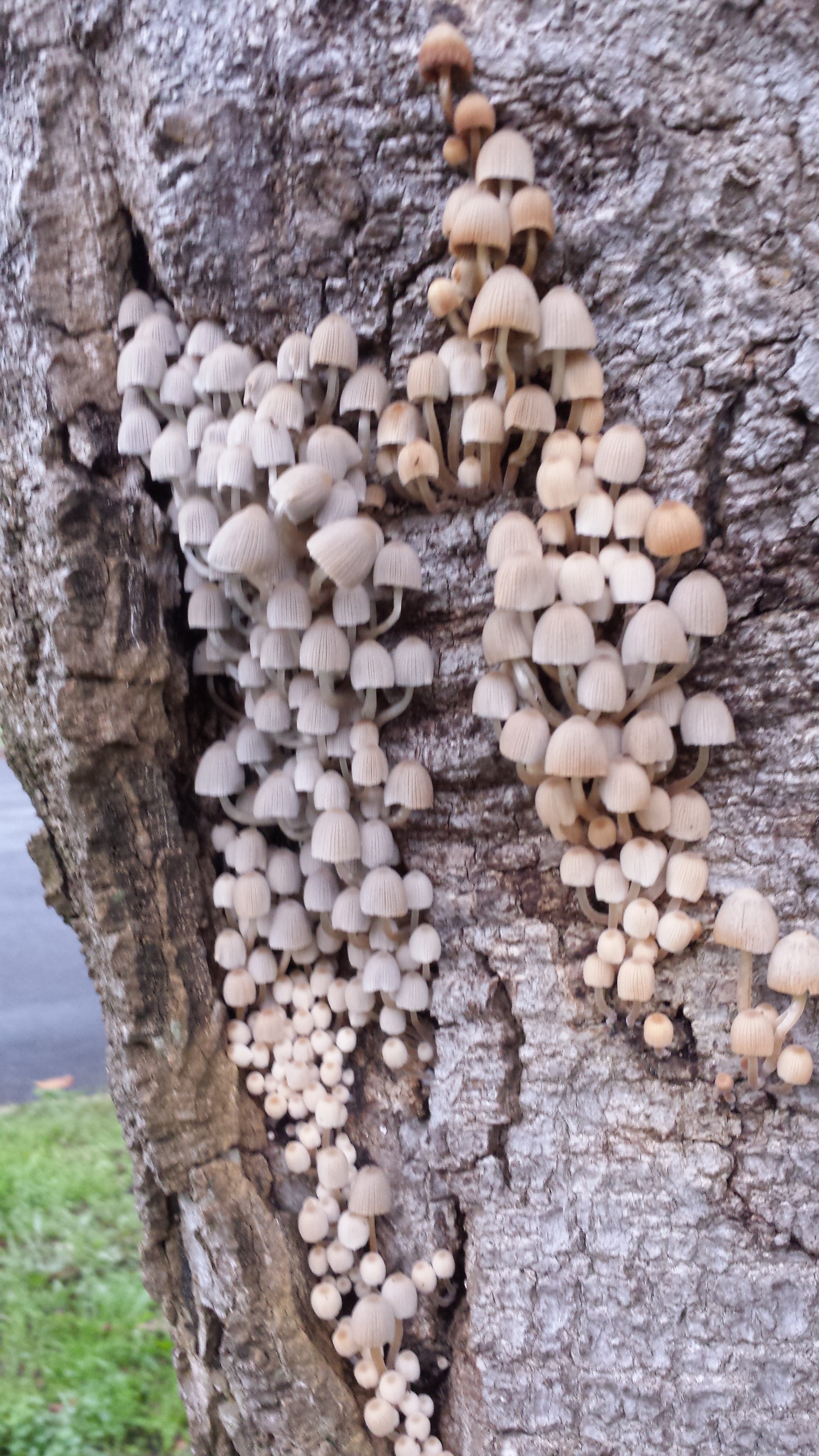
Here are a few mushrooms now blooming in our neighborhood:
mushrooms nestled in dandelionsmushrooms nestled in oxalisNot the prettiest mushroom, but one of the biggest. This one was over 12 inches wide.This colony of mushrooms was even bigger!Hundreds of tiny mushrooms growing out of the trunk of a big magnolia tree.
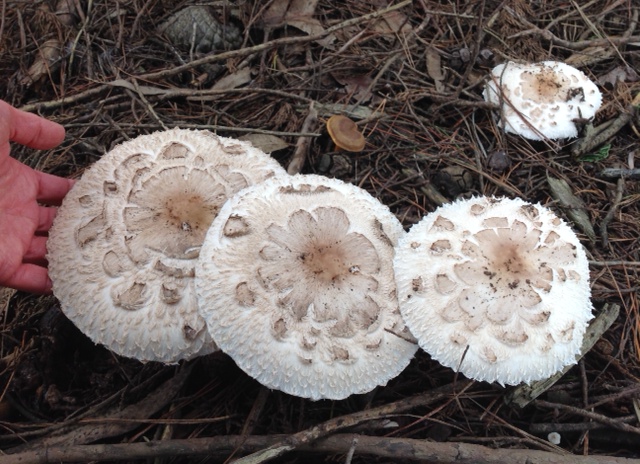
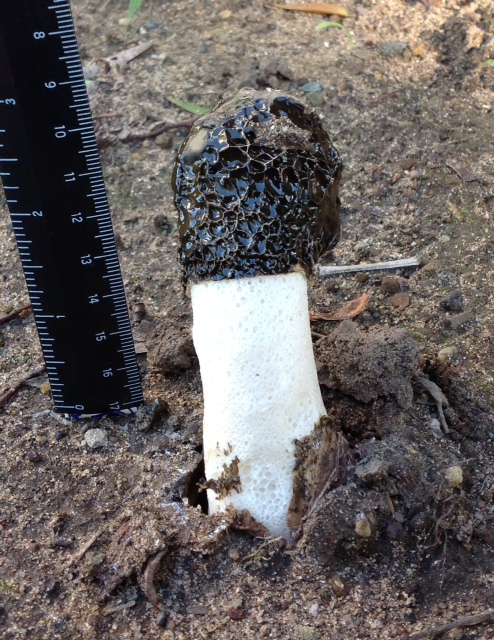
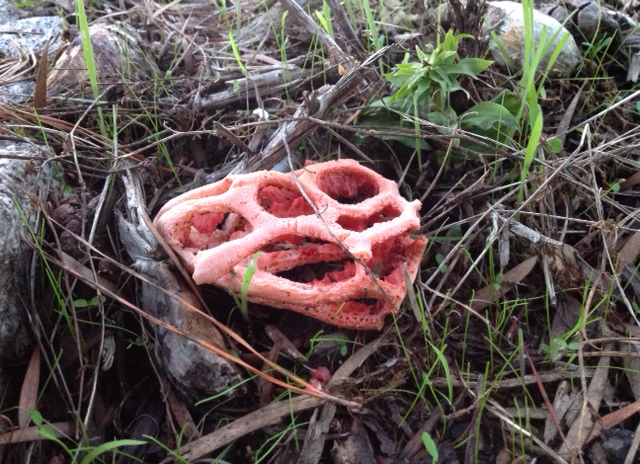
Addendum: One of our readers has sent us pictures of mushrooms taken recently in her neighborhood in San Francisco. She has identified these mushrooms.
Mature Parasols – note hand for size comparisonStinkhornCage fungus. The odor will attract flies into the cage.
On December 1, 2014, FEMA published the final Environmental Impact Statement (EIS) for the projects in the East Bay Hills which propose to destroy hundreds of thousands of non-native trees. FEMA’s email announcement of the publication of the EIS implied that the projects had been revised. Two of the agencies applying for FEMA grants—UC Berkeley and City of Oakland—had originally proposed to destroy all non-native trees on their properties. The third agency –East Bay Regional Parks District—had proposed to thin non-native trees in most areas and destroy all in a few areas. FEMA’s email announcement of the final EIS implied that both UC Berkeley and City of Oakland would be required to use the same “thinning” strategy as East Bay Regional Parks District.
After reading the final EIS, the Hills Conservation Network (HCN) is reporting that FEMA’s email announcement was rather misleading. In fact, both UC Berkeley and City of Oakland will be allowed to destroy all non-native trees on their properties. In a small sub-section (28.5 acres) of their total project acres (406.2 acres), UC Berkeley and City of Oakland are being asked by FEMA to destroy the trees more slowly than originally planned. However, they will all be destroyed by the end of the 10 year project period.
HCN has analyzed the EIS and consulted legal counsel. The following is HCN’s assessment of the EIS and their plans to respond to FEMA. We publish HCN’s assessment with their permission. Note that HCN is asking the public to send comments to FEMA and they are raising funds to prepare for a potential legal suit.
“After having reviewed the Final EIS in depth and having consulted with various stakeholders, HCN has concluded that the Final EIS, in spite of FEMA’s efforts to improve it from the Draft version, remains unacceptable.
While FEMA has made some modifications to portions of the EIS in response to the enormous number of comments submitted last year [more than 13,000], the fact remains that if implemented in their current form, these projects would remove essentially all of the eucalyptus, pines, and acacias from the subject area. While for portions of the area FEMA is now proposing that there be a phased removal of these species, the fact remains that the objective is ultimately to convert the current moist and verdant ecosystem into one dominated by grasses, shrubs, and some smaller trees. This will forever alter the character of these hills that so many of us have grown up with, know and love.
But worse than that, these projects would actually increase fire risk, destabilize hillsides, cause immense loss of habitat, release significant amounts of sequestered greenhouse gases, and require the use of extraordinary amounts of herbicides over a large area for at least a decade.
For these reasons, HCN will be submitting a comment letter to FEMA asking that the EIS be pulled back, reworked, and recirculated….at a minimum. Additionally, we are currently exploring legal options should the EIS be finally released on January 5, 2015 in its current form. One way or another, we are committed to ensuring that the will of a small number of influential people doesn’t result in the loss of a treasured resource to the vast majority of us (both human and other).
We ask your support in sending additional comment letters to FEMA [ebh-eis@fema.dhs.gov] and most importantly that you consider making a tax-deductible contribution to HCN. While we wish we did not have to do this, the fact is that the only way we can have a shot at preventing this irreparable harm from happening is by hiring lawyers, and that is what we will do. This takes money, so please do what you can either by sending a check to HCN at P.O. Box 5426, Berkeley, CA 94705 or by making a donation through our website at http://hillsconservationnetwork.org/HillsConservation3/Support_HCN.html.”
The Editor of an academic journal, Diversity and Distribution, wrote and published a defense of invasion biology (which he prefers to call “invasion science”) entitled, “Misleading criticisms of invasion science: a field guide.” (1) We recently critiqued a similar defense by other invasion biologists, so we’ll “cherry-pick” a few issues from this publication which weren’t covered in our earlier critique.
“Costs and Benefits?”
The authors begin by describing their academic discipline: “Invasion science is the study of the causes and consequences of the introduction of organisms to the areas outside their native ranges. It concerns all aspects relating to the transport, establishment, and spread of organisms in a new target region…and the costs and benefits of invasion with reference to human value systems.” However, the publication makes no mention of any benefits of non-native species nor does it mention the costs to the environment associated with the attempts to eradicate non-native species, such as herbicide use. Non-native species are said to be “far more likely to cause substantial ecological and socio-ecological damage” than to benefit ecosystems and, in any case, if there are any benefits they are said to be “transient.”
Zebra mussels, open underwater with siphons out. Creative Commons
Actually, there is empirical evidence that the negative impacts of non-native species are transient. For example, the population of zebra mussels in the Great Lakes began to decrease significantly within three years when the population of migrating ducks discovered them and altered their migratory route to take advantage of that new food source. And the negative effects of garlic mustard on forest regeneration were significantly decreased within 50 years of its arrival in North American forests.
Monarch butterflies roosting in eucalyptus tree.
Evidence of the benefits of non-native species is too voluminous to enumerate, so we will just offer our local example of the services to wildlife provided by eucalyptus in California. It is one of the few sources of nectar in the winter and is therefore essential to the survival of honeybees and hummingbirds. Eucalyptus is the over-wintering roost of 75% of monarch butterflies in the California migration. It is the preferred nesting habitat for raptors.
We see no evidence in this publication that “costs and benefits” of non-native species have been considered.
Are most “invasions” benign?
The authors respond to the defenders of non-native species who say that most non-native species are benign:
“The impacts of most invasions have not been studied, and so important effects may remain undetected,
Invaders that are apparently innocuous in one region can be disruptive in other regions,
Subtle impacts that may be unrecognizable without careful technical study can produce enormous ecosystem changes over time, and
Many non-native species that currently appear innocuous may become damaging many years later—when it is no longer feasible to eradicate them.” (1)
Here’s how we paraphrase this defense: “We may not have much evidence that non-native species are doing any harm, but we are sure they are doing harm and even if they aren’t doing any harm, we’re sure they will eventually do a great deal of harm.” Does this seem an adequate defense of projects that are eradicating all non-native plants on thousands of acres of public land, using harmful methods such as herbicides and prescribed burns? We think a higher standard of proof is needed to justify such damage to our public lands.
Invasion biologists chastise critics
Invasion biologists are angry that their academic turf is being challenged by other academic scientists:
“In our view, the escalation of cavalier bashing of the discipline is undermining systematic science-based efforts to improve the efficiency of management of problematic non-native species and invaded ecosystems.” (1)
We have seen no “cavalier bashing” of invasion biology. What we have seen, and provided to readers of Million Trees, are many scientific studies which show that the hypotheses of invasion biology are often not supported by evidence from the field. Most of the papers don’t even mention “invasion biology,” they just present their evidence in scientific journals.
We wish it were true that these studies were “undermining management” of non-native species. Unfortunately, we see no evidence that criticisms of invasion biology by academic scientists have any impact on public policy. Every project in the San Francisco Bay Area which is eradicating or proposing to eradicate all non-native species on our public lands is moving inexorably forward. There is no apparent connection between the revision of the hypotheses of invasion biology by academic scientists and the practical application of those out-dated hypotheses by managers of public lands. If the primary goal of invasion biologists is to eradicate non-native species rather than to defend their academic discipline, they seem to have nothing to fear. They would be wise to shut up and let the destruction continue quietly under the public’s radar.
A new round of criticism of invasion biology
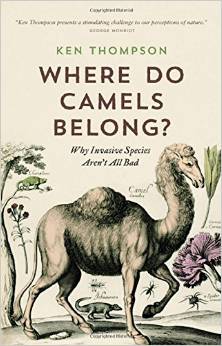
Meanwhile, the angry reaction of invasion biologists to criticism of their discipline has not stopped that criticism. Hardly a day goes by without the publication of new critiques of invasion biology by other scientists. Where do camels belong? by Ken Thompson was published in September 2014. It is a full frontal assault on the unfounded assumptions of invasion biology. It is a hard-hitting, often amusing summary of the flaws in the reasoning on which invasion biology was constructed. Although Mr. Thompson is a British academic scientist, his book is written for the general public, drawing on the scientific studies of his colleagues who share his opinion of the fallacies of invasion biology. The book is also unique in mentioning the damage that is done by the fruitless attempts to eradicate firmly entrenched non-native species.
“He also cautions that our efforts to control or eliminate invasive species can be tremendously expensive, are rarely successful, and often have damaging unintended consequences. For example, the herbicides used to try to eliminate invasive plants often have devastating impact on vulnerable native species. The cure, in some of these cases, is worse than the disease, he says. Professor Thompson says the invasive species we might worry about most is actually us. Humans have spread to every corner of the globe, and altered a huge amount of the planet. ‘We’ve chopped down forests, built dams and turned the whole world into a giant cattle pasture, and then we’re surprised that some species quite like what we’ve done. We shouldn’t be surprised.’”
The publication of Where do camels belong? is one of the few bright spots in 2014, a year full of disappointments for those who value our urban forest in the San Francisco Bay Area. We recommend it to our readers. It may cheer you up as it did us.
Update: Professor Richardson recently published (February 11, 2015) an article in Ensia, an on-line science blog, which was written in response to an earlier article(January 21, 2015) in Ensia by Daniel Simberloff. Professor Simberloff’s article defended “invasion biology” and criticized any acceptance of “novel ecosystems.” Professor Richardson’s response seems to defend “novel ecosystems.” It seems that Professor Richardson has altered his views regarding novel ecosystems since writing his article two years ago about “Misleading criticism of invasion science.” Welcome to reality, Professor Richardson. Updated 4/8/15
David Richardson and Anthony Ricciardi, “Misleading criticisms of invasion science: a field guide,” Diversity and Distribution, 19: 1461-1467, 2013
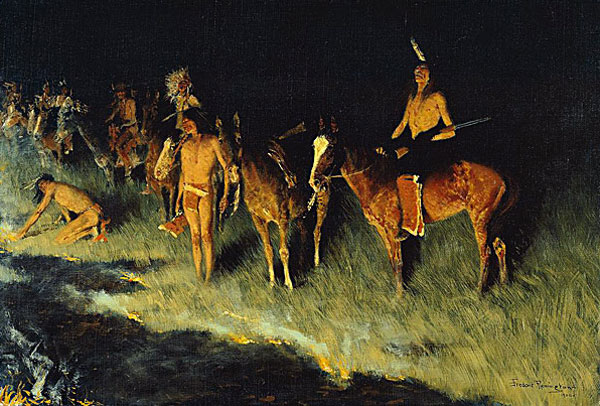
In the not-so-distant past, the goal of ecological “restoration” was usually described as the re-creation of an historical landscape that was believed to have been undamaged by humans, presumed to be “in balance” and therefore sustainable after “restoration” without further human management. In North America, the pre-European landscape is usually selected as the ideal landscape to be replicated, based on the assumption it had not been radically altered by Native Americans. New knowledge has overturned this model:
Native Americans setting grass fire, painting by Frederic Remington, 1908
Science has rejected the concept of “balance” in nature. Nature is now considered dynamic, constantly changing, often in random, unpredictable ways in response to major ecological events such as earthquakes, wildfires, tsunamis, floods, etc.
Oddly, many invasion biologists accept these new understandings of ecological science without changing their deep commitment to eradicating all non-native plants and animals. Daniel Simberloff published an article about the current status of the concept of “balance of nature” simultaneously with the publication of his defense of invasion biology. He described the current thinking about this concept: “…a widespread rejection of the idea of balance of nature by academic ecologists, who focus rather on a dynamic, often chaotic nature buffeted by constant disturbances.”
Invasion biologists have therefore revised their goal for ecological “restorations” to accommodate their new understanding of the dynamic nature of ecosystems.
The revised goal of ecological “restorations”
If the return to an equilibrium state is no longer the goal of ecological “restorations,” what is the new goal? This is how invasion biologists writing in defense of their discipline described their goal: “…we should seek to reestablish – or emulate, insofar as possible – the historical trajectory of ecosystems, before they were deflected by human activity, and to allow the restored system to continue responding to various environmental changes…” (1)
In this post we will deconstruct this new definition of the goal of ecological “restorations.” Our first problem with this new definition is that we don’t know the “historical trajectory” of a landscape because it is fundamentally unknowable. We would have to reconstruct all the events and changes in the environment in the Bay Area in the past 250 years in the imagined absence of any Europeans. Even if we knew what would have happened without our presence, we cannot then ensure the continuation of that imagined environment because, the fact is, WE ARE HERE AND WE AREN’T GOING AWAY!
Because we cannot reconstruct an imagined environment that has not been “deflected by human activity,” restorationists—who are the practitioners of invasion biology–focus on the one element in the environment of which there is sufficient historical knowledge, i.e., plants. Most local restoration projects eradicate all non-native plants and trees, usually using herbicides to accomplish that task. They rarely plant anything after this eradication attempt because they don’t have the resources to do so. Those few projects that re-plant after non-natives are eradicated usually irrigate the new landscape for several years. Here is an incomplete list of everything these projects do not do to replicate an historical landscape:
Soils are not restored for many reasons:
We have no way of knowing the composition of soil 250 years ago.
Soils have been altered by the plants that have been growing in them and by the herbicides used to kill those plants.
Urban soils have high nitrogen levels resulting from exposure to fossil fuel exhaust.
The atmosphere is not restored:
There are much higher levels of ozone and carbon dioxide than there were 250 years ago.
The climate is not restored:
The temperature is higher than it was 250 years ago.
The timing of seasons has therefore changed.
Precipitation and fog have changed in known and unknown ways.
The disturbance events that sustained historical landscapes or set them on another evolutionary course are not restored:
We cannot set fire to urban landscapes annually without polluting our air and endangering our lives.
We cannot allow our creeks and rivers to overflow in urban areas without damaging our properties.
Most occupants of the historical landscape are not reintroduced:
The grazing animals that helped to sustain grassland are gone and cannot be returned to urban landscapes.
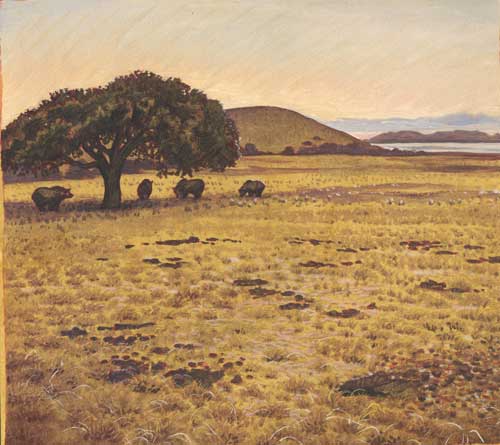
The top predators such as bears and wolves that kept grazing and other animals in balance with available resources cannot be returned without threatening our safety in an urban setting.
Many insects that lived in these historical landscapes are unknown to us and some are extinct.
Bears roamed the grasslands in the Bay Area, preventing over-population of grazing animals. The El Cerrito Plaza with the Albany Hill in the background, centuries ago. Oil painting by Laura Cunningham, with permission
In other words, destroying plants will not “restore” an historical landscape. Nor will it return that landscape to its “historical trajectory” even if that trajectory were known or knowable. Plants live in complex communities in which they are interacting with everything in the environment. Local “restoration” projects do not “restore” an historical landscape because they do not and cannot change anything other than the plants that occupy the space. Because most environmental variables have not been altered by these projects, the landscape will quickly return to its unrestored state unless it is intensively gardened. In that case, the landscape will be continuously “deflected by human activity,” which violates the original goal of invasion biologists.
Misanthropic premise of invasion biology
The revised goal of invasion biology is unattainable because the absence of humans is a prerequisite for its attainment. We cannot know and we cannot replicate a theoretical historical trajectory for ecosystems in which humans were not present. And when we modify ecosystems in an attempt to do so, human activities will determine their future trajectory. The premise of invasion biology is that success of ecological “restorations” depends upon the absence of humans. Therefore, invasion biology has no practical application in the real world.
Carolina Murcia, James Aronson, Gustavo Kattan, David Moreno-Mateos, Kingsley Dixon, Daniel Simberloff, “A critique of the ‘novel ecosystem’ concept,”Trends in Ecology and Evolution, October 2014, Vol. 29, No. 10
Readers of Million Trees will recall some of the most controversial projects in the San Francisco Bay Area which propose to destroy hundreds of thousands of trees in the East Bay Hills. The owners of these properties—UC Berkeley, City of Oakland, and East Bay Regional Park District—applied for grants from the Federal Emergency Management Agency (FEMA) to fund these projects, based on the claim that fire hazards would be reduced by the projects. Detailed descriptions of the proposed projects as originally planned are available HERE.
The public comment period on the Draft Environmental Impact Statement closed in June 2013. FEMA has announced the publication of the final Environmental Impact Statement (EIS), which is available HERE. FEMA now reports that it received more than 13,000 public comments and informs us that the final EIS reflects the concerns expressed in the public comments as well as the analysis of “subject matter experts.” We haven’t read either the public comments or the final EIS yet, so we are only quoting excerpts directly from FEMA’s announcement so that you have this information as soon as possible. If you read these documents, we welcome your reaction to them.
Here are excerpts from FEMA’s announcement of the final EIS (emphasis added):
“One of the major revisions to the draft EIS influenced by information gathered during the public process is that FEMA will not fund the proposed methodology of eradicating designated tree species without a phased approach. The originally proposed eradication methodology to completely and immediately remove the “overstory” was deemed not to satisfy the purpose and need for the grant of fire reduction, and therefore did not meet hazard mitigation program eligibility requirements.
Identifying and analyzing implementation options is another required element of the National Environmental Policy Act (NEPA) decision-making process that must be explored before federal funding can be awarded. Based on input and issues raised during the public comment process, and in consultation with the grantee, sub applicants, and cooperating federal agencies, FEMA revised the vegetation management methodology for two of the three sub applicants – City of Oakland and UC Berkeley. The revisions align the majority of proposed projects with a thinning alternative, the approach originally proposed by East Bay Regional Parks District as described in the Draft EIS.
The thinning approach has been scientifically validated by subject matter experts to effectively reduce fire risk. The revised vegetation management methodology will result in fewer trees being removed in any single year in certain areas, with the same total fuel reduction accomplished by the conclusion of the project. The EIS considers the overall impacts to the environment based on the amount of land treated and consequent impacts to resources. Each grant applicant is responsible for their ongoing land management practices and determination for how much vegetation will be removed to accomplish their fire reduction goals within the scope of the vegetation management approach defined in the EIS. Clear-cutting, a logging practice, is not part of the methodology considered in the EIS for any of the projects.”





 Conservation Sense and Nonsense