 This article is our Christmas present to our readers. We celebrate the holidays with good news about the birds living in cities all over the world.
Subirdia was written by John Marzluff, an academic ornithologist at University of Washington. (1) He reports many years of his research and that of his graduate students about the birds that live in urban and suburban Seattle as well as surrounding forest reserves. He also reports on countless studies of bird populations in similar settings all over the world. All of those studies reach remarkably similar conclusions.
It took me a long time to read this book because its introduction was off-putting. Virtually every plant and animal was preceded by the qualifier of “native” or “non-native.” The implication of the introduction was that the most important feature of every plant and animal is whether or not it is native. As our readers know, we consider the nativity of plant and animal species largely irrelevant. All plants and animals are at home in our ideal nature.
When I finally got around to reading Subirdia I was pleasantly surprised. Although the author has a preference for native plants and animals, in fact, his research and that of others does not justify his obsession. Where birds are actually found in the greatest numbers is where the habitat is most diverse, not necessarily exclusively native.
Suburbia is very birdy
The conventional wisdom is that cities are inhospitable places for birds and other wildlife. After all, haven’t we paved over much of their habitat, interrupted their movements by fragmenting their habitat, and drained or covered water resources? In fact, bird populations in urban areas all over the world are both plentiful and diverse.
After years of counting numerous bird species in his hometown of Seattle, the author of Subirdia wondered if Seattle might be unique because it is heavily forested. After conducting similar surveys in 10 cities around the world, Marzluff is convinced that birds are successfully adapting to rapid urbanization of human society. The urban centers of cities in North and Central America, New Zealand and Europe support an average of 23 bird species. He found the least number of bird species (11) in Auckland, New Zealand and the greatest number (31) in St. Andrews, Scotland.
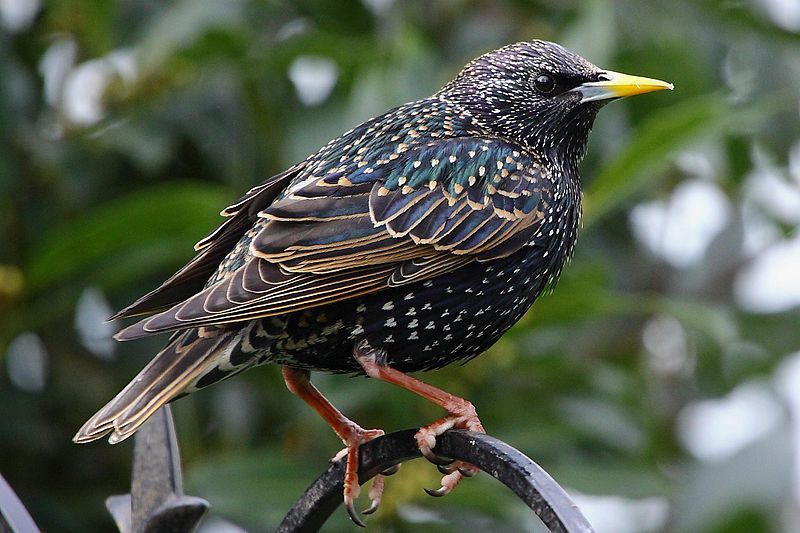
Another popular myth about the loss of bird diversity in the Anthropocene is that the globalization of human civilization produces “homogenized” nature. That is, many people believe that bird populations may not be in decline, but there are a few hardy species that dominate everywhere. Again, Marzluff’s studies do not corroborate that belief. Five bird species are found in cities all over the world (house sparrows, starlings, Canadian geese, mallard ducks, and rock pigeons). However, these ubiquitous species are not the predominant bird species he found in cities. Of the 151 different bird species he found in the 10 cities he visited, 75% of them were unique to each of the cities. “Homogenization is barely perceptible.” (1)
Comparing bird populations in cities with nature reserves
Marzluff also compared bird populations in cities with undeveloped nature preserves. Once again, cities still look like good homes for birds. He finds twice as many bird species in Ketchikan, Alaska as in the nearby wildlands along the Naha River, “a remote wilderness fifty miles away…that required powerboat, kayak, and hiking to attain.” (1)
He also visited Yellowstone National Park, a 2.2 million acre protected area within an undeveloped ecosystem of nearly 20 million acres, where he counted 26 bird species in four days. From there, he flew to New York City where he counted 31 bird species in Central Park in only three days. Historical records of bird surveys in Central Park and Yellowstone National Park indicate that about 200 bird species have been found in both parks since the late 19th century. “From a bird’s perspective, a large park created by human hands or by nature is not all that different.” (1)
Accommodating birds in cities
Marzluff’s concluding chapters advise city dwellers how to encourage and support birds. His “ten commandments” for accommodating birds make no mention of planting native plants or eradicating non-native plants:
- “Do not covet your neighbor’s lawn.”
- “Keep your cat indoors.”*
- “Make your windows more visible to birds that fly near them.”
- “Do not light the night sky.”
- “Provide food and nest boxes.”
- “Do not kill native predators.”
- “Foster a diversity of habitats and natural variability within landscapes.”
- “Create safe passage across roads and highways.”
- “Ensure that there are functional connections between land and water.”
- “Enjoy and bond with nature where you live, work, and play!”
Marzluff expresses a strong preference for native plants throughout his book, but his research in Seattle is inconsistent with that preference: “The forests of Seattle and its suburbs now embrace 141 species of trees, including 30 native species and ornamentals from North and South America, Europe, Asia, and Africa. Some are problematic invaders, but in total they provide a diverse menu of foods and nesting and roosting sites for birds.” (1)
Why a preference for natives?
Another academic scientist in Washington State, Linda Chalker-Scott, directly addresses the vexing question of why public policies which mandate the use of native plants have proliferated despite the lack of evidence that they are superior in any way. She focuses on this question: “Do native and nonnative woody species differ in how they affect species diversity?” Her literature search found 120 studies from 30 countries that quantified the biodiversity of birds, insects, mammals, reptiles, and other plants in woody plants and trees in urban landscapes.
The analysis of these studies reveals that “the science does not support the supposition that native plantings are required for biodiversity…it is clear that an automatic preference for native trees when planning in urban areas is not a science-based policy.” (2) The assumption that native plants are superior to non-native plants is based on these misconceptions:
- The definitions of native and alien species are value judgments, not science-based concepts.
- Native plants are often poorly suited to environmental conditions in urban areas, such as compacted soil and changes in the climate. Conversely, introduced plants are often well suited to these urban conditions.
- Many introduced plants provide valuable ecological benefits. For example, they often provide food, pollen, and nectar resources during winter months when native plants are dormant.
-
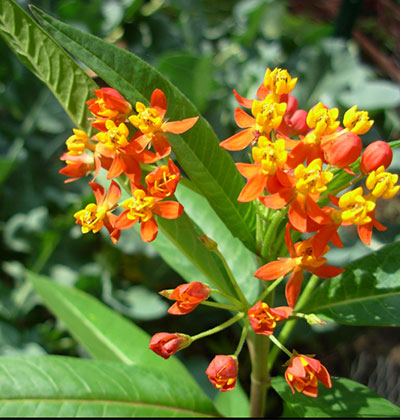
Tropical milkweed is not native to California. (Asclepias curassavica) Creative Commons Doug Tallamy is the academic scientist most closely associated with the native plant ideology. His claim that insects require native plants is based on his mistaken assignment of nativity to an entire genus, when only a few species within that genus are actually native. For example, there are over 35 species of milkweed in the genus Asclepias, but only two species are native to California. Most members of the milkweed family are useful to monarch butterflies. It is therefore not accurate to claim that monarchs require native plants. They have lived all over the world for over 200 years in some places where there are no native species of milkweed.
Chalker-Scott’s meta-analysis of 120 studies concurs with Mr. Marzluff: “The published research overwhelmingly identifies diversity, structure, and function as the most important vegetation characteristics for enhancing community biodiversity…In fact, sometimes landscapes require the inclusion of exotic trees and control of natives to maintain diversity.” (2)
Doing more harm than good
Our readers know that we do not begrudge the preference of native plant advocates for native plants. We encourage them to plant whatever they want. We only ask that they stop destroying the plants they don’t like. That request is based on our belief that they are doing far more harm to our public lands than any perceived benefit of native plants. Much of that harm is caused by the widespread use of herbicides to destroy non-native vegetation. These herbicides are known to damage the soil and they migrate in the soil, damaging neighboring plants that are not targeted. These issues are surely a factor in the conspicuous lack of success of their “restorations.” There is also mounting evidence of the toxicity of herbicides to bees, birds, and other animals including humans.
But there is another, equally important reason why we object to the futile attempts to eradicate non-native plants. They are providing valuable habitat for wildlife. Even when they are replaced by native plants after being destroyed, the animals that depended upon them are not necessarily restored to the landscape. In fact, few projects plant natives after the eradication of non-natives.
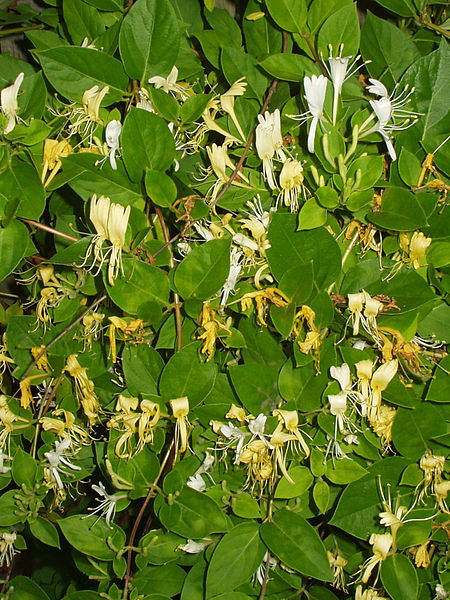
A recently published study (3) of the removal of Amur honeysuckle (Lonicera maackii) is an example of the loss of valuable habitat. The hypothesis of this study was that “invasion of urban habitats by exotic plants was the underlying mechanism driving changes in bird-plant networks.” The study tested this hypothesis by comparing forest plots dominated by honeysuckle with those in which honeysuckle had been removed and the surrounding forest habitat replicated. They measured nesting birds, nest predators, and nest survival.
They found that the lowest overall nest survival rates were found in the plots in which honeysuckle had been removed. In other words, “…removal of invasive honeysuckle from urban forests did not restore network structure to that of rural landscapes.” The authors concede, “This finding was not consistent with our original hypothesis that invasion of forests by the exotic Amur honeysuckle was responsible for the urban-associated changes in bird-plant networks.” They conclude, “The degree to which native communities can be restored following removal of exotic plants remains unclear.”
Actually, we think it is quite clear that eradicating non-native plants does not benefit man or beast. We marvel that the fantasy persists that there is some theoretical benefit to killing harmless plants, despite the consistent lack of evidence of any benefit and the considerable evidence of the harm of such attempts.
*Like most ornithologists, Marzluff comes down hard on cats as killers of birds in his book. However, he cites just one study about predation of fledglings. The study used radio transmitters to determine the fate of 122 newly fledged birds over a period of two years.
The results do not justify the demonization of cats: “Only 20 percent of radio-tagged birds died during our study. Birds such as Cooper’s hawks and mammals such as Townsends’ chipmunks, ermine, and Douglas squirrels were the most likely predators. The most notorious of all bird predators, the out-of-the-house cat, was implicated in only one death, though we could never be entirely sure which mammal or which bird had killed the fledging.” (1) Marzluff credits a neighborhood coyote for controlling the cat population. Frankly, that doesn’t make sense. Chipmunks and squirrels are just as likely to be prey for the coyotes.
We have reported on similar studies which reach the same conclusions. A meta-analysis of 8 studies of nest predators of song birds in North America used video cameras to identify the predators of 242 depredation events. Only one of those nest predators was a cat.
We have no objection to the general advice to keep your cat indoors. (We have never had a cat and don’t plan to.) However, we think that estimates of birds killed by cats are greatly exaggerated. Humans seem to have an unfortunate desire to look for scapegoats and cats seem to fit the bill for bird lovers.
- John M. Marzluff, Welcome to Subirdia, Yale University Press, 2014
- Linda Chalker-Scott, “Nonnative, Noninvasive Woody Species Can Enhance Urban Landscape Biodiversity,” Arboriculture & Urban Forestry, 2015, 41(4): 173-186
- Amanda D. Rodewald, et. al., “Does removal of invasives restore ecological networks? An experimental approach,” Biological Invasions, March 2015
 Conservation Sense and Nonsense