Here in the San Francisco Bay Area we are having a spectacular spring after heavy fall and late spring rains. Perhaps the blooming abundance in your garden inspires you to plant a tree! Taking care of your new tree is just as important as planting it. So, we are grateful to Mark Spreyer for offering us a guest post about taking care of newly planted trees.
Mark Spreyer is the Executive Director of the Stillman Nature Center in Barrington, Illinois. He can be reached at stillmangho@gmail.com.

THE UPS AND DOWNS OF WATER AND TREES
© 2026
How dry I am, how dry I am
It’s plain to see just why I am
No alcohol in my highball
And that is why so dry I am –From The Near Future by Irving Berlin
No, I’m not promoting booze but I could not write about thirsty trees without hearing this 1919 Irving Berlin classic in my head. Of course, the song is associated with alcohol prohibition.
This article is about how important another liquid, water, is to trees and the surrounding habitat.
Arbor Day 101
If you plant a sapling for Arbor Day or Labor Day, for that matter, you can’t just expect it to grow. It needs to be watered. Actually, it needs a good soaking.
According to tree experts, here’s what should be done. When selecting a young tree, you should get one grown in a local nursery. Odds are it will have survived local weather extremes. It should thrive, if you give it proper care and attention. Nurseries often guarantee their saplings for twelve months from the date of planting. Such guarantees do not cover death due to mechanical damage or obvious neglect.
The transplanting procedure is traumatic to a tree. Most trees will exhibit symptoms of shock (withered leaves, dead twigs) in varying degrees. Such symptoms do not indicate your tree is declining or dead.
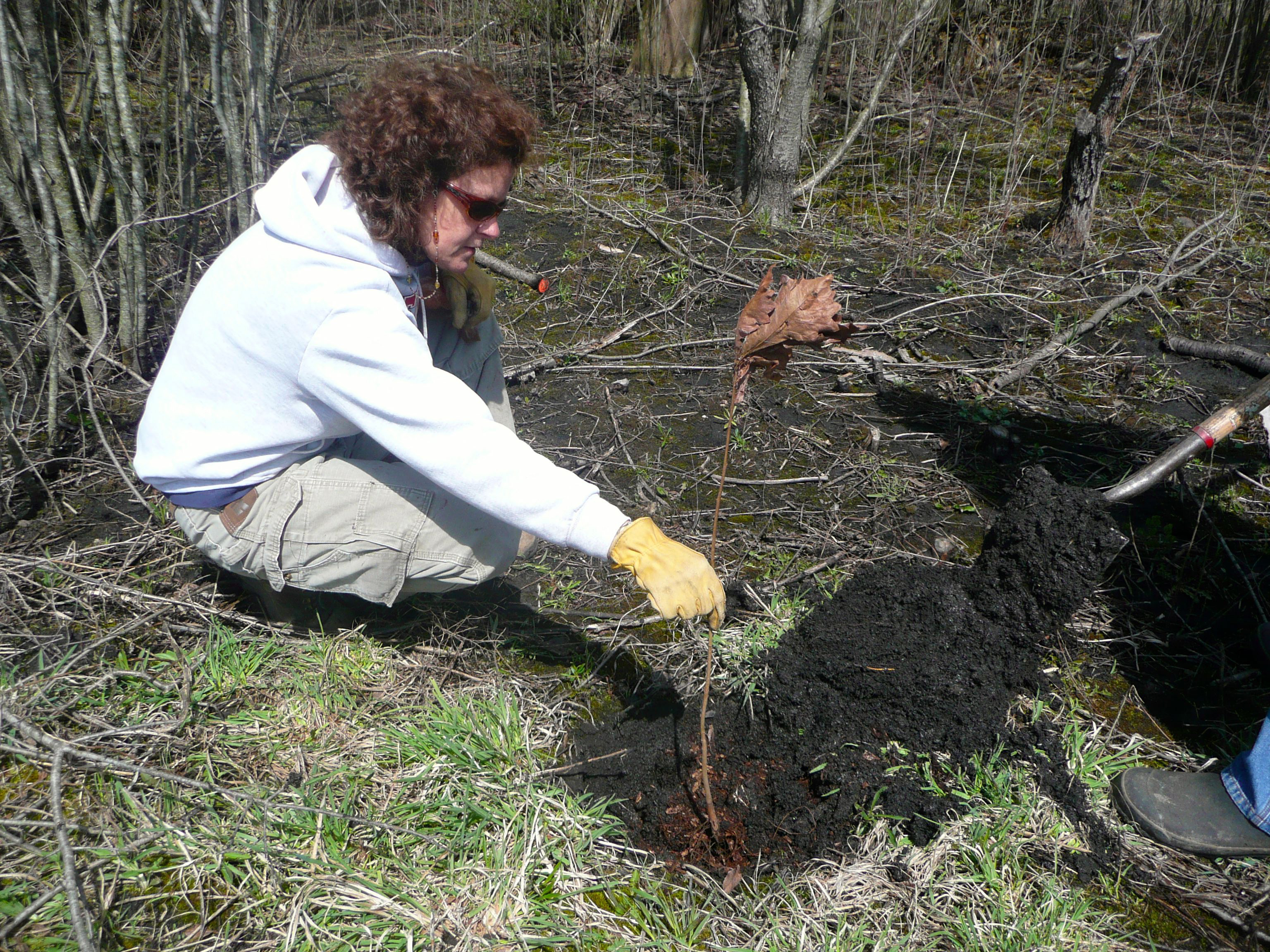
Proper watering can minimize the effects of such shock. It is is an important requirement for the first two years following transplanting. Trees may die from either too little or too much water; so care must be taken to assure neither occurs.
The ground area around the rootball (approximately 5 feet in circumference) should be saturated every 3-4 days during hot weather and every 7-10 days during normal weather conditions. Remember, one thorough deep watering is better than a dozen shallow irrigations.
If you have an automatic irrigation system, you should change the timing to allow for longer less frequent watering (approx. 20 minutes, 2 times per week). If you live in a place where it freezes, take special care to insure that the rootball of the tree freezes in a wet state, not a dry one!
Lichen Review
So, I was looking at possible pictures for this column, when I saw this one (see photo) of a tree trunk I had taken, years ago, here at Stillman. What caught my eye was the pattern of lichen growing on this maple’s stem.
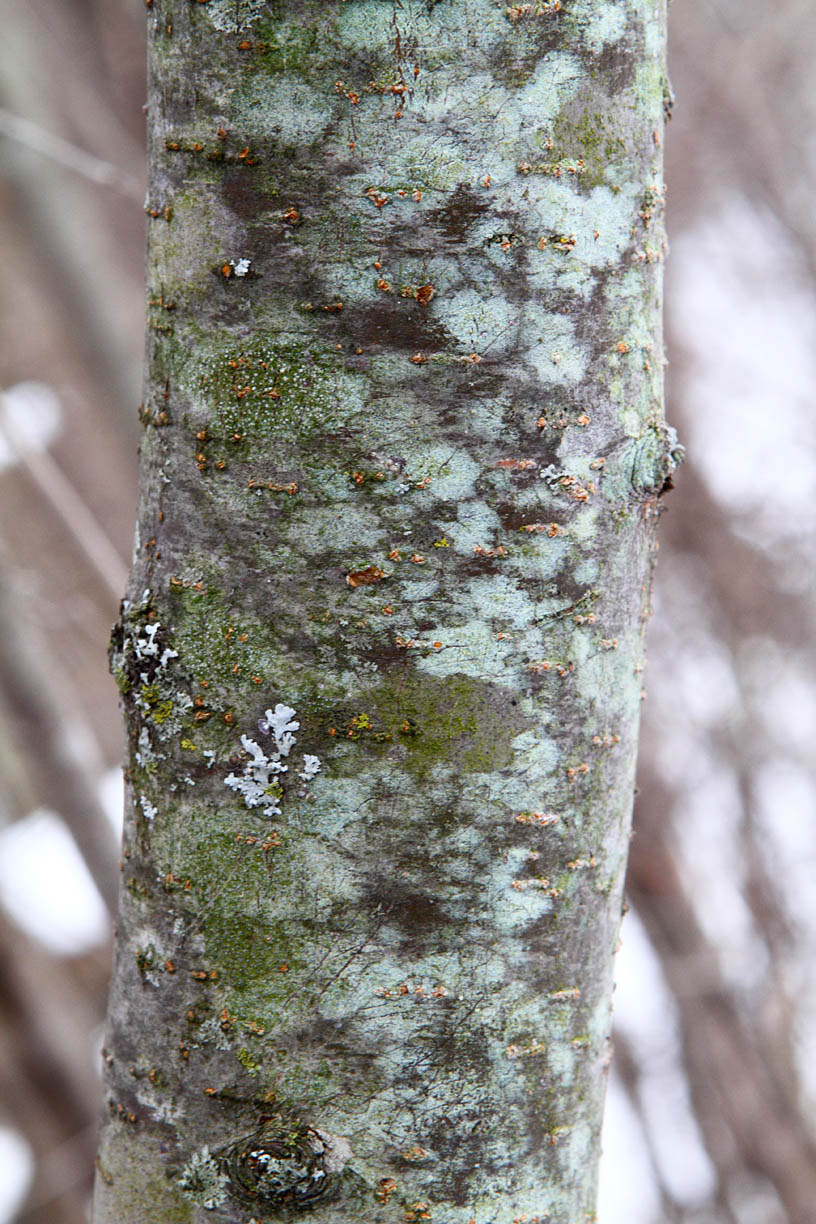
At the risk of oversimplifying, lichens are a symbiotic combination of algae and fungi.
The fungi provide the structure and the photosynthetic algae supply the food. Lichen lack stems or leaves, instead they use a thallus. Thalli are simplified plant structures that are typical of algae, fungi, and lichens.
Now lichens, especially the algae component, need water. Where does it come from? The simple answer is rain but how does the water reach these lichen clinging to a tree trunk? Leaves catch rain overhead and the ground absorbs it below but rain rarely travels horizontally to hit a tree’s trunk. Let me explain.
Putting the Rain in Rainforest
Interestingly, water isn’t always traveling from the roots to the leaves, it can also make the reverse trip. That is to say, plants can both take and return water to the soil.
California’s redwoods dramatically illustrated this phenomena. When fog rolls into a redwood, its millions of fine needles act as mist collectors. This fog drip eventually falls from the branches to the ground. A 100-foot-tall tree can deposit the equivalent of four inches of rain in one night!
Where does all this drip water go? Besides being absorbed by roots or evaporating, 25% moves by runoff towards the nearest creek or lake. In some cases, streams depend on this water to keep flowing and providing habitat for fish, frogs, and so on. John Muir was right when he said everything is connected to everything else.
Large tropical rainforest trees also return water to the ground. In some cases, the stemflow is so substantial that it can erode gullies at the bases of trees. Of course, trees in our temperate zone are not as large and they don’t see the precipitation that occurs in coastal or tropical rainforests which brings me back to the photo but first, stemflow.
Stemflow and Lichens
When precipitation is not intercepted by leaves, it proceeds to the ground in three basic ways. First is throughfall. As the name suggests, rain falls through the leaves on its way to the ground.
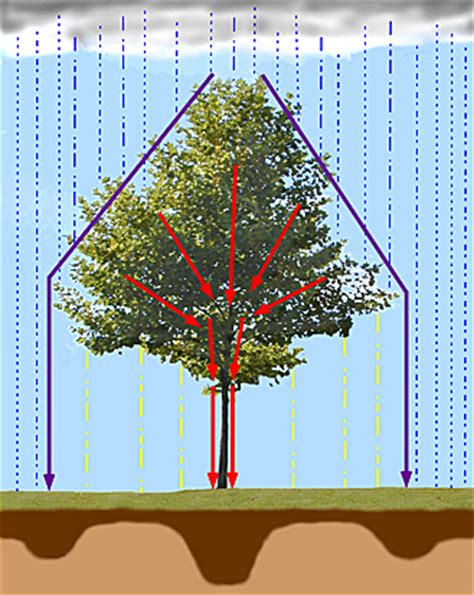
The second manner is canopy drip which is particularly common with conifers. A canopy is the roof of leaves over your head when you walk in a forest. In this case, the tree’s design directs snow or rain along the edge of an individual tree’s canopy.
The third method is stemflow which is more common with deciduous trees. In this process, water flows from the leaves, to the twigs, along branches, and down a tree’s trunk; right where those lichens had attached themselves to the maple. Stemflow hydrates lichens.
Author Neil Evernden suggests “we might regard a tree as a centre of a force-field towards which water is drawn.” Perhaps the idea of a force-field makes you think of Star Trek, but it works for me. I would love it if I could give people a special pair of binoculars that would allow them to see the water circulating through not only trees, but also other plants and lichens.
O.K., I’d better get my head out of the clouds, so to speak. Simply put, please remember to water your Arbor Day trees after they are planted. Young trees should never be subject to a water prohibition.
—Mark Spreyer, Director of the Stillman Nature Center in Barrington, Illinois.


Hi Mary…
I assume you saw this big new (“unsurprising but shocking”) expose in the latest Mother Jones mag?… https://www.motherjones.com/politics/2026/04/roundup-glyphosate-spraying-forests-monsanto-science-retraction-cancer-health-concerns-maha-trump-executive-order-supreme-court-bayer-lawsuits/
All so depressing. Most important mid-terms of our lifetimes… as we all have to keep saying…
Jack
Thanks for the link to “We Are Bombarding America’s Forests With Roundup” published by Mother Jones. For the benefit of other readers, here is an excerpt that explains what the article is about: “unbeknownst to most people, logging companies and the US Forest Service have been spraying massive amounts of herbicide in clear-cut and fire-ravaged forests of California—and throughout the nation. And not just any herbicide, but glyphosate, a potent and problematic weed killer best known by the brand name Roundup.”