Adapting to more wildfire in western North American forests as the climate changes

The National Academy of Sciences (NAS) has published its recommendations for a new approach to managing forests in the American West to adapt to the increasing frequency and intensity of wildfires in the changing climate.  The authors of the NAS publication regarding adaptive forest management in the changing climate are 12 academic scientists from major public universities in 8 western states. (1)

Although the National Academy of Sciences was created by an Act of Congress in 1863, during the Lincoln administration, it is a non-governmental non-profit that receives no direct government funding.  Its charge is “providing independent, objective advice to the nation on matters related to science and technology. … to provide scientific advice to the government ‘whenever called upon’ by any government department.” Members of the Academy serve without salary as “advisers to the nation.” Election to the National Academies is one of the highest honors in the scientific field. The independence of NAS is ensured by lack of governmental funding and salaries to its members.  However, 85% of NAS funding is government grants and contracts. (2)

In other words, this publication is an important policy document, prepared by distinguished scientists and published by America’s most prestigious scientific institution.  It deserves our attention and respect.

Why is a new forest management approach needed?

In the past, forest management policies have focused primarily on preventing fire, reducing fuel loads, and restoring burned areas.  Given the increasing intensity and frequency of wildfires, there is a new understanding that these approaches are no longer adequate to address new conditions created by the changed and changing climate.  The new approach recognizes that fuels reduction cannot alter regional wildfire trends and therefore must adapt ecosystems and residential communities to more frequent fires, including “planning residential development to withstand inevitable wildfire.”  This represents a shift from restoring historical conditions, now considered unsustainable, to developing fire-adapted communities.

The authors of this publication tell us that managing forest fuels has been ineffective:  “Mechanical fuels treatments on the US federal lands over the last 15 years totaled almost 7 million hectares, but the annual area burned has continued to set records.  Regionally, the area treated has little relationship to trends in the area burned, which is influenced primarily by patterns of drought and warming.”  Where fuels treatment was done, wildfires subsequently occurred:  “10% of the total number of US Forest Service forest fuels treatments completed in the 2004-2013 period in the western United States subsequently burned in the 2005-2014 period.”  This suggests that “most treatments have little influence on wildfire.” In any case, only 40% of wildfires occurred in forests since 1984, with most fires burning grasslands and shrublands.  Clearly, these projects have been a waste of time, trees, and taxpayer money.

This area on the west side of Grizzly Peak Blvd is known as Frowning Ridge. It is one of the first areas that was clear-cut by UC Berkeley over 10 years ago. Destroying the trees did not prevent the grass and shrubs from igniting in the August 2017 fire. Pictures of that area before and after the trees were destroyed are available here: https://milliontrees.me/2013/06/08/guest-article-about-fema-projects-by-a-student-of-the-forest/  The fire in August 2017 was stopped when it reached the forest on the opposite side of the road.

Nor do the authors consider “thinning” of forests a viable method of reducing fire hazards because “when thinning is combined with the expected warming, unintended consequences may ensue, whereby regeneration is compromised and forested areas convert to non-forest.”  When trees are thinned, the trees that remain are more vulnerable to wind and they lose the ability to share resources with the neighboring trees that have been removed.
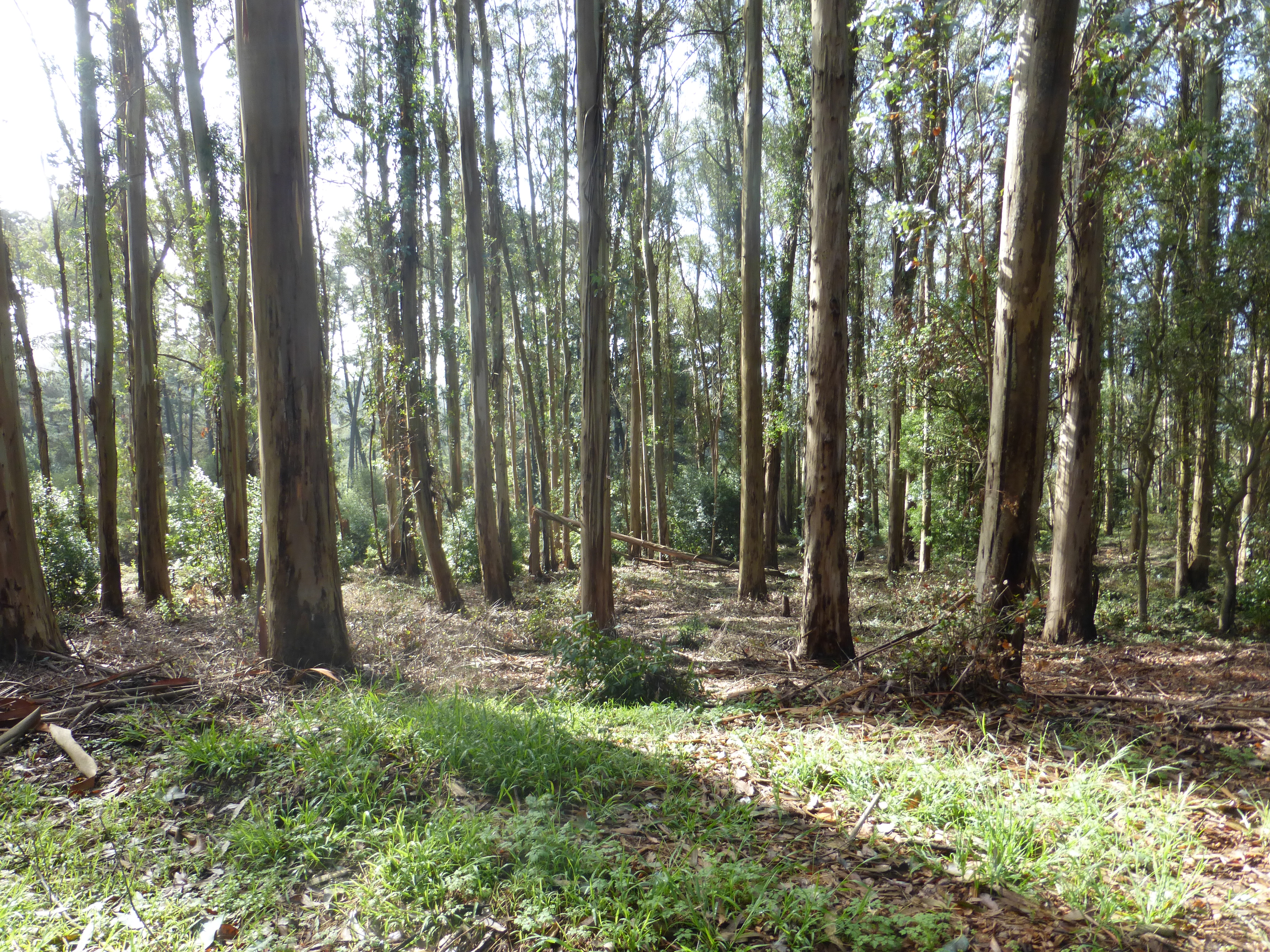
Tilden Park, October 2016. East Bay Regional Park District has radically thinned this area to distances of 25 feet between remaining trees. This area is about 2 miles away from any residential structures. Cal Fire defines “defensible space” as 100 feet around structures.

There are two major reasons for increased wildfire hazards.  More than 50% of the increase in areas burned by wildfire in the American West is attributed to climate change.  The expansion of residential development into forested areas—called the Wildland-Urban-Interface (WUI)—is the second factor:  “Between 1990 and 2010, almost 2 million homes were added in the 11 states of the western United States, increasing the WUI by 24%.”  35% of wildfires in the WUI since 2000 were in California, more than any other state.

What is the new management goal?

Whereas past policies were designed to maintain forest conditions to historical conditions, this is no longer considered a realistic goal.  The recommended goal is now “supporting species compositions and fuel structure that are better adapted to a warming, drying climate with more wildfire.”  Sounds like planting tree species that are adapted to new climate conditions, doesn’t it?

The other, equally important new goal is to reduce the vulnerability of communities to wildfire by “changing building codes to make structures more fire-resistant…and providing incentives, education, and resources to reduce vulnerability to future wildfire.”  The only tree removals that make sense to the authors are those immediately around residential communities, “strategically located to protect homes and the surrounding vegetation.”  That is the principle of creating “defensible space” immediately around structures:  “fuels management for home and community protection will be most effective closest to homes…where ignition probabilities are likely to be high.”
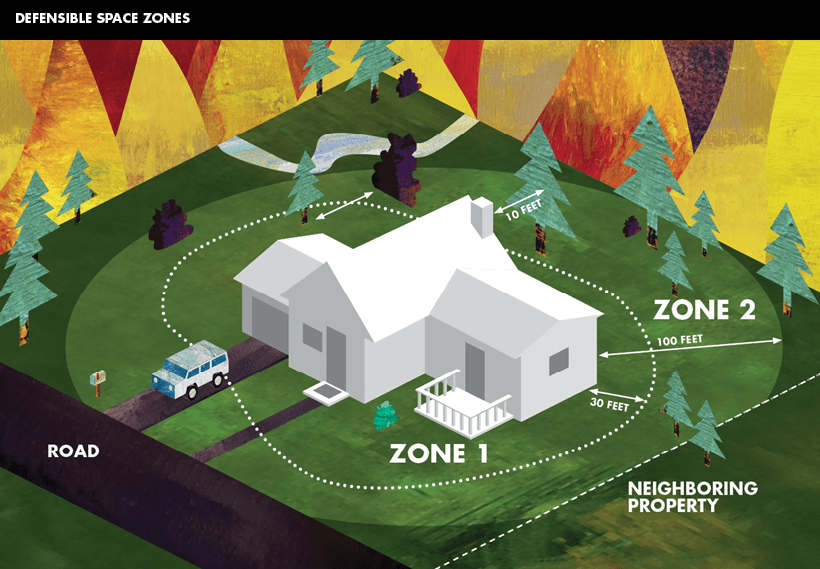
Source: Cal Fire

These strategies are called “transformative resilience,” which “refers to planned fundamental change in response to drastically altered disturbances that have the potential to create broad-scale, systemic shifts in ecological states or radical shifts in values, beliefs, social behavior, and multilevel governance.”  The authors of these policy recommendations acknowledge that such rapid and radical shifts in social and ecological transformation are rare and difficult to achieve.  We certainly agree with that observation.

The urgently needed paradigm shift

Public policy and conventional wisdom is wedded to the past.  The public is unable or unwilling to acknowledge the realities of climate change.  They remain committed to “restoring” the landscape to an imagined pre-settlement ideal in the distant past.  And public land managers remain committed to creating that fantasy landscape, by destroying existing landscapes and using herbicides to do so.  They destroy the trees of the future and plant the trees of the past.  And they destroy trees miles from any residential properties while property owners resist the creation of defensible space needed to protect their homes.

The authors of the NAS publication clearly state the risks of continuing down that path:  “[Such policies] may be the easiest, most familiar path with the least uncertainty, but this approach is short-sighted and could come at the cost of adaptation to future wildfire as climate change continues.”

They also urge the public to wake up to this new reality:  “Some ecosystems will survive and thrive as they adapt to novel future conditions, but not all.  Embracing rather than resisting ecological change will require a significant paradigm shift by individuals, communities, and institutions and will challenge our conservation philosophies.”

Our safety and the future of our land are at stake.  We must take our heads out of the sand and look forward instead of back to a past that is long gone and will not return.  Since climate change is causing more wildfires, destroying more trees than necessary to achieve fire safety is counterproductive because deforestation is the source of about 10% of carbon emissions contributing to climate change.


(1) Tania Schoennagel, et. al., “Adapt to more wildfire in western North American forests as climate changes,” Proceedings of National Academy of Sciences, May 2017

(2) Wikipedia https://en.wikipedia.org/wiki/National_Academy_of_Sciences
Another innocent introduced plant with a bad rap

Professor Mark Davis, known as “a friend to aliens,” is one of a growing number of academic scientists who are critical of invasion biology.  His research has exonerated some of the introduced plants that are accused of harming native plants. Garlic mustard is an example.  Professor Davis has briefly summarized his research of garlic mustard for publication on Million Trees.

The Nature Conservancy says, “…garlic mustard [is] one of the ten most destructive invasive species in Indiana today… It…displaces native or other desired plants in a relatively short period of time.” Although the Nature Conservancy description of the lifecycle of garlic mustard is identical to Professor Davis’s description, it reaches the opposite conclusion about its effect on native plants.  The Nature Conservancy describes laborious methods of eradication and concludes that herbicides and prescribed burns may be necessary. 

It is precisely that accusation that non-native plants “displace” native plants that is at the heart of the debate about so-called “invasive species.”  Nativists do not believe that native and non-native plants can co-exist.  In fact, when empirical studies test that hypothesis, they rarely find evidence of such displacement.  The fact is, the environmental conditions that support native plants also support non-native plants and the result is usually more biodiversity, rather than less. 

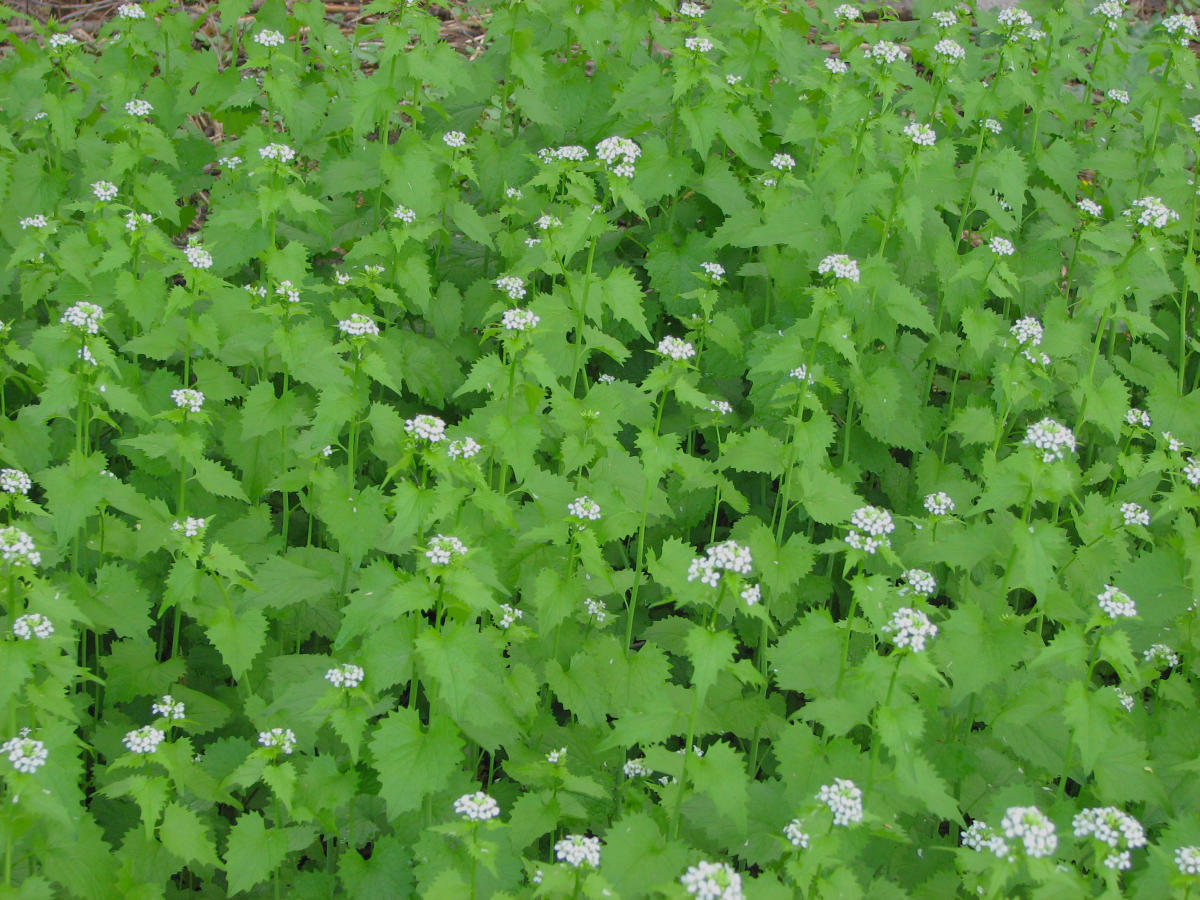
The first sighting of the garlic mustard herb in the U.S.A. was in 1868 in Long Island, New York. Garlic mustard was intentionally introduced into the northeastern United States for food, erosion control, and medicine. Pretty isn’t it? It’s tasty as well.

If native plants are not doing well, compared to non-natives, it is usually for other reasons, such as changes in the climate or available water or the arrival of a new insect or pathogen.  It is rarely because of the arrival of new plants.  Killing non-native plants with herbicide is simultaneously killing native plants and damaging the soil they live in.

There is room for everyone in the human world and in the natural world.  Nativism in the human realm is as unnecessary as it is in the natural world.  Fear and anger about human immigrants to America is strongest in places with few immigrants.  I am fortunate to live in a place with many immigrants.  I can see first-hand how they enrich my community.  I also see first-hand how introduced plants are not doing any harm, but the futile efforts to kill them with herbicides IS doing a great deal of harm to every living thing in the environment.

Million Trees


Garlic mustard, Alliaria petiolata (Brassicaceae), is a European biennial plant (completing its life cycle over 2 years) now common in many Midwestern and eastern North American forests. It is self-pollinating, has abundant seeds that are viable in the soil for long periods of time, and can grow in a variety of forest environments.  These characteristics allow garlic mustard to spread easily. Many consider it to be an invasive species that displaces native herbs and inhibits tree seedling growth and survival.

For the past six years I have worked with colleagues and students to determine to what extent garlic mustard is negatively affecting native herbs and tree seedlings in an oak forest in east-central Minnesota.  Based on our monitoring of garlic mustard and the other plant species, garlic mustard appears to be acting similarly to other species.

Specifically, garlic mustard and the other common native herbs seem to be changing in abundance largely independent of one another. In other words, changes in abundance of one species is unrelated to changes in other.  In six years of study, we have not been able to document any substantial effects by garlic mustard on other plant species, positive or negative.

In fact, the best predictor of garlic mustard presence is high diversity of native plants.  The most likely explanation for this fact is that all the species, garlic mustard included, are simply establishing in microsites favorable to plants in general.  The same conditions that benefit native plant species also probably benefit non-native plant species.

Overall, our findings are not consistent with the common claim that garlic mustard is a noxious invasive species responsible for the decline of many North American native forest herbs. Rather, our findings are more consistent with other recent studies and reviews that have concluded that garlic mustard is primarily responding to ecological changes in North American forests.

In other words, at many sites garlic mustard is not a significant driver of change but rather is a passenger of change.  What might be the drivers of change, the real causes of declines of many native wildflowers?  Evidence points to both earthworms and white-tailed deer.

Earthworms, which have been introduced from Europe and Asia, have drastically reduced the abundance of litter in these forests.  The near absence of litter has been shown to negatively impact many of the native species.  However, eradicating earthworms would be impossible and attempting to do so would cause more damage to the environment.

Due to the abundance of habitat, secondary forests, and lack of predators, white-tailed deer populations have exploded throughout many of the Midwestern and eastern forests.  And, native plants are a common food of the deer.  The deer tend to avoid garlic mustard due to its garlicy oils.

Mark Davis, Macalester College


Professor Davis’s studies of garlic mustard:

Davis MA, Anderson MD, Bock-Brownstein L, Staudenmaier A, Suliteanu M, Wareham A, and Dosch JJ.  2015.  Little evidence of native and non-native species influencing one another’s abundance and distribution in the herb layer of an oak woodland.  Journal of Vegetation Science 26:105-112.  PDF

Davis MA, MacMillen C, LeFevre-Lefy M, Dallavalle C, Kriegel N, Tyndel S, Martinez Y, Anderson MD, and Dosch JJ.  2014. Population and plant community dynamics involving garlic
mustard (Alliaria petiolata) in a Minnesota Oak Woodland: a four year study. Journal of the Torrey Botanical Society 141: 205–216.  PDF

Davis MA, Colehour A, Daney J, Foster E, MacMillen C, Merrill E, O’Neil J, Pearson M, Whitney M, Anderson MD, and Dosch JJ. 2012.  The population dynamics and ecological effects of garlic mustard, Alliaria petiolata, in a Minnesota oak woodland. American Midland Naturalist 168: 364-374.  PDF