This is a story of the influence of interest groups on the process of making new laws. When Assembly Bill 1573 was introduced in February 2023, it seemed to be primarily a water-saving measure that would “eliminate the use of irrigation of nonfunctional turf” (turf that is not a recreational area or community space with foot traffic). AB1573 also mandated that all new or renovated nonresidential areas install not less than 25% local native plants by 2026, 50% local native plants by 2030, and 75% local native plants by 2035. It defined local native plants as “California indigenous plants to an area that have evolved and occur naturally in the Jepson Region associated with a specific California location.”
As AB1573 passed through legislative committees in the Assembly and the Senate it was amended six times (legislative history of AB1573 is available HERE.). California Native Plant Society and its many allies pulled out all the stops to influence the legislation and ensure its passage. Members of these advocacy organizations were asked at each juncture to contact their elected representative to urge them to pass this legal mandate requiring public and commercial properties to plant native plants.
The final revision of AB1573 occurred on September 1st, after consideration by the Senate Appropriations Committee. The final revision made two significant changes:
- The requirement for native plants in new and renovated landscapes on non-residential properties was lowered to 10%.
- However, the definition of native plant was revised to include: “a plant that is nonnative and noninvasive that provides pollinator benefits, and that is a low-water use plant, as determined by the Department of Water Resources and the Natural Resources Agency” In other words, the final revision considers many non-native plants the functional equivalent of native plants.
On September 7, 2023, the authors of AB1573 asked that the bill be moved to the “inactive file.” They have given up. Their bill has been so emasculated that they don’t see the point of continuing to try to pass it.
Why did this attempt to legally mandate native plants fail?
There are probably many aspects of this story that I don’t know. There were probably many private meetings and written communications that I’m not aware of. I could probably learn about some of them by making a public records request, but I think I know enough of the story to relate it to my readers. If you know more about the process than I do, please share it with us.
The first visible sign that AB1573 was in trouble was in June 2023, when the Associate Director of Plant California Alliance published an editorial about AB1573 in an agricultural newsletter, available HERE. Plant California Alliance represents “California’s nursery industry. Our membership includes farmers, growers, urban agriculturists, wholesalers, retail garden centers, landscapers, garden suppliers, horticulturalists, as well as educators and researchers.” This is an organization with horticultural knowledge and practical experience growing plants in California. The editorial explained why the goals of AB1573 are unrealistic and based on mistaken assumptions about California native plants:
- There aren’t enough native plants available for sale to meet such a requirement. California Native Plant Society claims nursery sales are about 6% native, but two large wholesale nurseries estimate their stock is not more than 1% native.
- “…there is also the fundamental question of why a native plant mandate is included in a water conservation bill at all. Not all native plants are low water plants…Sometimes a non-native plant is a better choice when designing a drought resilient, low water garden.” California Water Service recommends: “Plants that are adapted to long, dry summers and short, rainy winters are called “Mediterranean-zone” plants. These include plants that are native to California, as well as those that originated in southern Europe, South America, and other “Mediterranean” climates. These plants don’t need much water in the summer and have thrived in water-scarce conditions for thousands of years.”
- “And, what about native plants’ impacts on fire? Unfortunately, some California native plants are not considered fire-resistant, and some are even considered fire prone. For example, FireSafe Marin has several California native plants on their list of fire-prone plants, including manzanita (Arctostaphylos), coyote brush (Baccharis spp.), California buckwheat (Erigonum fasciculatum), and California bay (Umbellularia californica).” Most wildfires in California occur in native chaparral and native conifer forests. When wildfires occur in residential neighborhoods, the homes themselves are the primary fuel for the fire. Everything burns in wind-driven fires, regardless of the native origins of plants.

In August, tree advocacy organizations finally woke up to the implications of AB1573 for California’s urban forests when they realized that the definition of “native plant” also included native trees. California Releaf and California Urban Forests Council asked their members to contact the Senate Appropriations Committee to ask that trees be explicitly exempted from the requirement for native plants on non-residential properties in California.

Only 9% of California’s urban forests are native to California. (1) Pre-settlement San Francisco was virtually treeless. One-third of San Francisco was barren sand dunes on its western edge. San Francisco’s urban forest is now predominantly non-native and much of it is being destroyed to accommodate native plant restorations that require full sun.
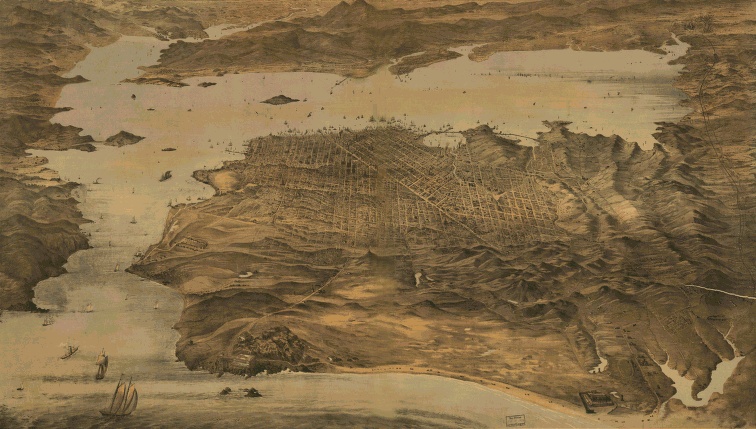
Non-native trees were planted in Oakland in the 19th century because there were few native trees: “Vegetation before urbanization in Oakland was dominated by grass, shrub, and marshlands that occupied approximately 98% of the area.” (2) Non-native tree species in the East Bay are adapted to soil and microclimate conditions that are not suitable for native species. Non-native annual grasses will replace Oakland’s urban forest in the hills, not native trees, if native plant advocates get the Vegetation Management Plan they have been fighting for for nearly 8 years.
A Learning Experience?
I would like to think that California’s policy makers learned something from the process of considering AB1573. Do they have a better understanding of what grew in California in the past and therefore what is capable of growing in the future?
Probably not
Ironically, on the same day that AB1573 was withdrawn by its authors, the San Francisco Examiner published this article about a new initiative to plant more greenery in San Francisco, led by the California Academy of Sciences. It’s an excellent idea, except that the leaders of this initiative equate greenery with native plants: “He’s looking to introduce more native plants in The City, which will in turn attract more native insects and more native birds throughout San Francisco.” Nature is not synonymous with native plants. The scientific definition of biodiversity includes both native and non-native plants. In fact, San Francisco’s Open Space Element of the General Plan also defines biodiversity as including both native and non-native plants.
As much as I would like to hope that Californians have a more realistic goal for the future of California’s landscapes after watching the failure of AB1573, I don’t think I can.
- Matt Ritter, A Californian’s Guide to the Trees Among Us, Heydey Books, 2016.
- David Nowak, “Historical vegetation change in Oakland and its implications for urban forest management,” Journal of Arboriculture, September 1993
 Conservation Sense and Nonsense
That photo of the Scripps Ranch neighborhood is dramatic. Do you have a link to the original article?
I saw very similar things after the Tubbs Fire swept through Santa Rosa – buildings burnt to the ground, cars reduced to ash and puddles of melted aluminum, with green pine trees standing nearby.
If I remember correctly, I was sent that photo over 10 years ago by someone who lived in Scripps Ranch at the time of the fire. I have not looked for an NYT link. The NYT search engine is very weak.
I have many similar photos. The photos in this article were provided by Jack Cohen who was a fire scientist at the US Forest Service fire lab in Missoula, Montana at the time, now retired: https://milliontrees.me/2016/05/06/fire-scientist-says-eucalyptus-did-not-burn-with-high-intensities-leading-to-home-destruction/ One of my collaborators asked Mr. Cohen his opinion of the role of eucalyptus in the 1991 fire in the East Bay Hills. This article is his reply. Mr. Cohen advocated for creating defensible space to protect property from wildfires. The FEMA technical report on the 1991 fire is even more definitive in saying that the houses were the main fuel source.
Here’s another article about a fire in San Bruno, CA that was caused by a broken gas main: https://milliontrees.me/2010/11/14/trees-withstand-the-firestorm/
On the broader topic of why fire is used to justify the destruction of non-native trees, I recommend this article based on a study by Marcel Rejmanek of UC Davis (and others): https://milliontrees.me/2022/02/01/the-global-war-on-non-native-trees/
Thanks for your interest.
Better approach would be to ban unwanted, invasive and destructive species of plan. Eliminate the worse ones that are doing the most damage. Use the scalpel instead of the shotgun.
No, that would kill countless native species of animals. The best approach is leave it alone and stop killing trees and other plants. Just stop.
Ban means stop the importing and sale of seedlings and small trees to he planted, not to cut down living, mature trees.
But why? We need every plant we can get. Clearly if the trees are imported and sold, they are wanted, and the native animals need them too. Trees also die of old age, like 8 in our yard, but you’d have us be banned from getting more fruit trees?
I did not say anything about banning fruit trees.
I was talking about things like kudzu, nandina, bamboo, English ivy, privet hedge and other invasive and destructive plants.
And no more pythons. They are doing real damage in South Florida.
No, that is the same horrible mess that will kill countless animals. Just leave nature alone and stop killing trees and other plants. Just stop it.
Thank you so much for this update. What good news and what a relief!
When I’m out in the world, I often start talking to people about how important it is to protect our trees and other plants in spite of the nativist propaganda saying we should kill most. I also bring up how Eagles, Hawks, Owls, Kestrels, etc., choose Eucalyptus to nest in and raise their babies, and after being answered for years that Eucs cause fire, I’m hearing less of that and more “I love Eucalyptus!” The Birding Community knows, but, increasingly, so do many other people
I also lead nature strolls and point out the exquisite butterflies and birds and then name the non-native species they often are eating from.
I guess we just keep trying to reach people and get more to know the truth and care for all the plants and animals who live near us.
It sounds like you don’t know the plants that live here, Ernest. It’s too cold for Pythons here.
Nandina is not a problem, and neither is Bamboo, which we use to screen our yard. Privets turn into small trees that many animals use. And English Ivy/Hedera helix is far less “invasive” than Algerian Ivy/Hedera canariensis, which does cover trees, buildings, etc. but humans can easily stop it from climbing trees (snip it at the base of the tree), but I also feel differently about it after seeing Cedar Waxwings eating the berries.
Thank you so much for this update. What good news and what a relief!
When I’m out in the world, I often start talking to people about how important it is to protect our trees and other plants in spite of the nativist propaganda saying we should kill most. I also bring up how Eagles, Hawks, Owls, Kestrels, etc., choose Eucalyptus to nest in and raise their babies, and after being answered for years that Eucs cause fire, I’m hearing less of that and more of “I love Eucalyptus!” The Birding Community knows, but, increasingly, so do many other people
I also lead nature strolls and point out the exquisite butterflies and birds and then name the non-native species they often are eating from.
I guess we just keep trying to reach people and get more to know the truth and care for all the plants and animals who live near us.
Is anyone heading up the “down with liquid amber trees” yet? I have a self-pruning city tree in the curb here that has almost taken out a couple of cars and brushes the ankle to stroller pushing moms TWICE. If it weren’t a city-sacred tree, I could have planted a lower-growing tree to replace it over 20 years ago. I am glad this bill failed.. choose love,,common-sense
Where do you live where liquid amber trees are considered a “sacred tree?” Here in Oakland liquid amber is not on our list of approved street trees because they break up the sidewalk, as you describe. They can also be removed without permits because they aren’t native. Only native trees have any protection here (I would prefer that weren’t the case).
Your problem with liquid amber can be addressed with some sensible public policy.
Hmmmm- Very Interesting and completely in opposition to what I have heard from City of Oakland!
They ARE in the curb EVERYWHERE here in N.Oakland and currently self-pruning like crazy..Mind where you park!
Here’s Oakland’s list of approved street trees: https://cao-94612.s3.amazonaws.com/documents/Oakland_StreetTreeList_April-2017-v2.pdf. Liquid amber isn’t on the list. Perhaps liquid amber was on the list in the past. I don’t know when it was removed from the list.
Did you ask Oakland Tree Services to remove it for you? Their resources are so limited that they are only removing trees they consider dead or hazardous. They wouldn’t be responsible for removing the tree if they didn’t plant it. I believe you could take it down yourself. Have you been told otherwise?
I want to understand Oakland’s tree policies, so please help me do that.
I have been told : 1. I can’t trim the tree at all,2. I can PAY to have the tree trimmed by an “approved “Oakland” arborist[at the cost of $30.K!]3. Upon inspection, one of those guys said the work could not be done if I didn’t pay for the the street-side pruning as well[the street-side is the most self-pruning side of all] 4. a city “arborist” pulled out a rubber mallet and stethoscope and “listened” to the the area below a large limb that fell the next day, claiming the tree to be “healthy”.
There is more …
choose love,
KO
Your experience seems to be consistent with Oakland’s policies for pruning street trees:
“The City of Oakland will only prune trees in hazardous or emergency situations. In 2008, nearly half of the Tree Services unit was eliminated due to lack of funding. The tree planting, watering, pruning and pollarding services were all eliminated.”
Here is the policy and procedure for pruning your own street trees: https://cao-94612.s3.amazonaws.com/documents/oak025616.pdf You can prune your tree if you are willing to pay for it. I agree that the policy is restrictive, cumbersome, and expensive for home owners.
I live in San Francisco, where some public trees are rotten through and through and yet are still standing and waiting to collapse on a vehicle or resident.