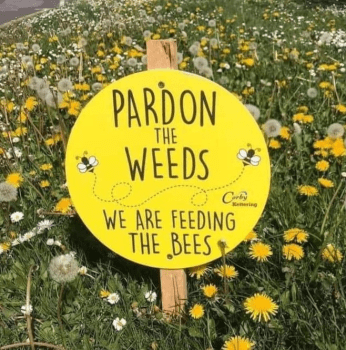
On November 16, 2024 I attended a conference at the Oakland Museum of California, where I live, sponsored by Bringing Back the Natives Garden Tour and featuring Doug Tallamy as the key note speaker. The conference was sold out. Two hundred enthusiastic native plant gardeners attended the conference. Although a native Coast Live Oak is the crown jewel in my garden, I don’t consider myself a native plant advocate. I listened quietly.

I have heard Doug Tallamy speak several times and I have read his books, so there were few surprises in his talk, except for this slide:
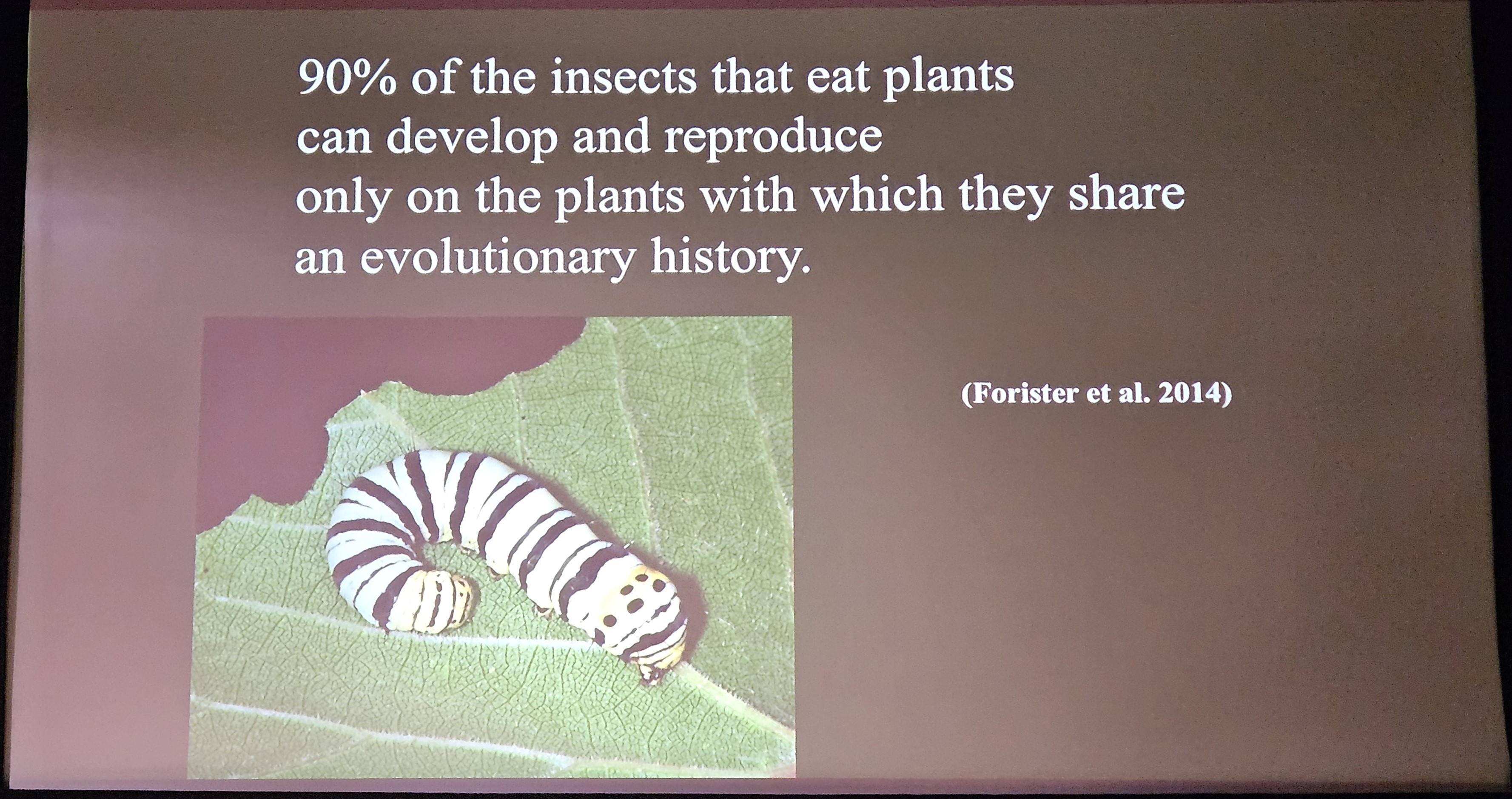
The cited study for this slide was published by Matthew Forister (and others). Professor Forister is an academic entomologist who is a specialist in lepidoptera (moths and butterflies). I have read several of Forister’s studies and I respect his research, so I was surprised that he would reach the conclusion claimed on Tallamy’s slide.
I read the study (available HERE) and I was unable to find a conclusion in the study that was consistent with Tallamy’s interpretation of it. Hmmmm, I said to myself, does Tallamy’s slide accurately represent Forister’s study?
I asked Claude.ai to compare the study with Tallamy’s brief summary of the study. Claude’s response was:
“After carefully reviewing both the original study and Professor Tallamy’s summary slide, I find that his statement represents a somewhat oversimplified interpretation of the study’s findings…While Professor Tallamy’s statement captures the general spirit of the research – that most insect herbivores are specialists – it appears to be a simplified interpretation that makes stronger and more specific claims than what’s directly supported by the study’s data. The “90%” figure and the explicit connection to evolutionary history, while perhaps derived from other research, aren’t directly demonstrated in this particular study.”
Forister’s study found a continuous distribution between specialists and generalists, not a strict dichotomy, as Tallamy’s slide claims. For example, an insect that is confined to plants in a genus is more specialized than an insect that is confined to a plant family. Insects that are confined to a single plant species are extremely rare because they are often an evolutionary dead end.
Professor Forister’s study is interesting. It found that dietary specialization of insects varies by latitude and that specialization is greatest near the equator, where diversity of plant species is greatest, creating more opportunities for ecological niches in which specialized insects can find what they need with less competition.
The same principle applies in the temperate zone, where we live. That is, greater diversity creates more opportunities for insects to find what they need. The scientific definition of biodiversity includes both native and non-native species.
The relationship between plant species in the Apiaceae family and the anise swallowtail butterfly evolved in the distant past, eons before individual members of the family evolved into different genera and species. The association between an insect and its host plant is chemical rather than being a connection to a specific plant species. In other words, anise swallowtail butterflies co-evolved with fennel.
Likewise, monarch butterflies co-evolved with tropical milkweed, which is native to Mexico and Central America. Both tropical milkweed and local native plants in the same genus contain the chemical that monarchs seek, a chemical that renders it unappealing to its predators because it makes them sick. Again, this similarity is fortunate because tropical milkweed is evergreen and local natives are deciduous, making it available for monarchs to breed in winter months in a warming climate. Winter breeding of monarchs is recent and may not benefit the monarch population because fewer food sources are available in winter months. (2)
With the help of genetics, we can understand why individual members of a family of plants are closely related. Plants and animals with a common ancestor are dispersed around the globe in a variety of ways, of which many are natural and long precede the advent of humans around 300,000 years ago. Plants are carried by ocean currents, rivers, wind, storms, birds, animals, etc.
When plants arrive in a new home, they quickly begin to change, partly because of random genetic drift and partly because they respond and adapt to the specific environment in which they have landed. Over time, the change in the plant becomes great enough to be considered a new species, but its chemical properties remain similar to its ancestors in most cases. Exceptions abound because nature is complex and our understanding is limited.
Why does it matter?
I attended this conference because native plant advocates are unhappy about Oakland’s Urban Forest Plan. I support the plan because it will improve Oakland’s urban forest by addressing hazardous tree conditions, expanding the forest with diverse tree species, and more equitably distributing Oakland’s forest resources to neighborhoods that have been short-changed in the past. I expected the plan to be discussed at the conference. It was.
Native plant advocates want Oakland to plant more native trees and fewer non-native trees. Opinions vary, of course, but some want a forest of exclusively native trees because of their belief that native trees support wildlife and non-native trees are not useful to wildlife. There are many reasons why a diverse urban forest best serves Oakland and every animal that lives here:
- The pre-settlement vegetation of Oakland was 98% grass, shrub, and marshland.(1) There were only 10 species of trees that are native to Oakland: coast live oak, bay laurel, coast redwood, madrone, big leaf maple, holly leaf cherry, toyon, willow, buckeye, redbud. There are now over 500 tree species in Oakland.
- The goal of the Urban Forest Plan is to increase the population of street trees. Most of the trees that are native to Oakland are not suitable as street trees. Some are too big. Some are shrubs rather than trees. The branching habit of some native trees are too low to be street trees, which must not obstruct sidewalks or streets.
- Some shrubs can be pruned into trees, but that would be very costly and Oakland is broke! A shrub that has been severely pruned into a tree is not stable.
- Growing conditions where trees are needed in Oakland are often not suitable for native trees. That’s why they didn’t grow there prior to settlement. Oakland’s urban forest is predominantly non-native because they are adapted to our growing conditions.
- Climate change requires a diverse urban forest because a more diverse forest is more resilient. Sudden Oak Death has killed millions of oaks throughout California for the past 25 years. We can’t predict which tree species will survive the warming climate. Therefore, we must hedge our bets by planting a diverse forest.
As expected, the first question the audience asked of Doug Tallamy was why Oakland Tree Services is telling native plant advocates that Oakland can’t plant exclusively native trees because they aren’t adapted to the challenging conditions that street trees face. Doug Tallamy replied that Oakland’s Tree Services is mistaken. He showed this slide of the many native alternatives that he believed would be suitable street trees:
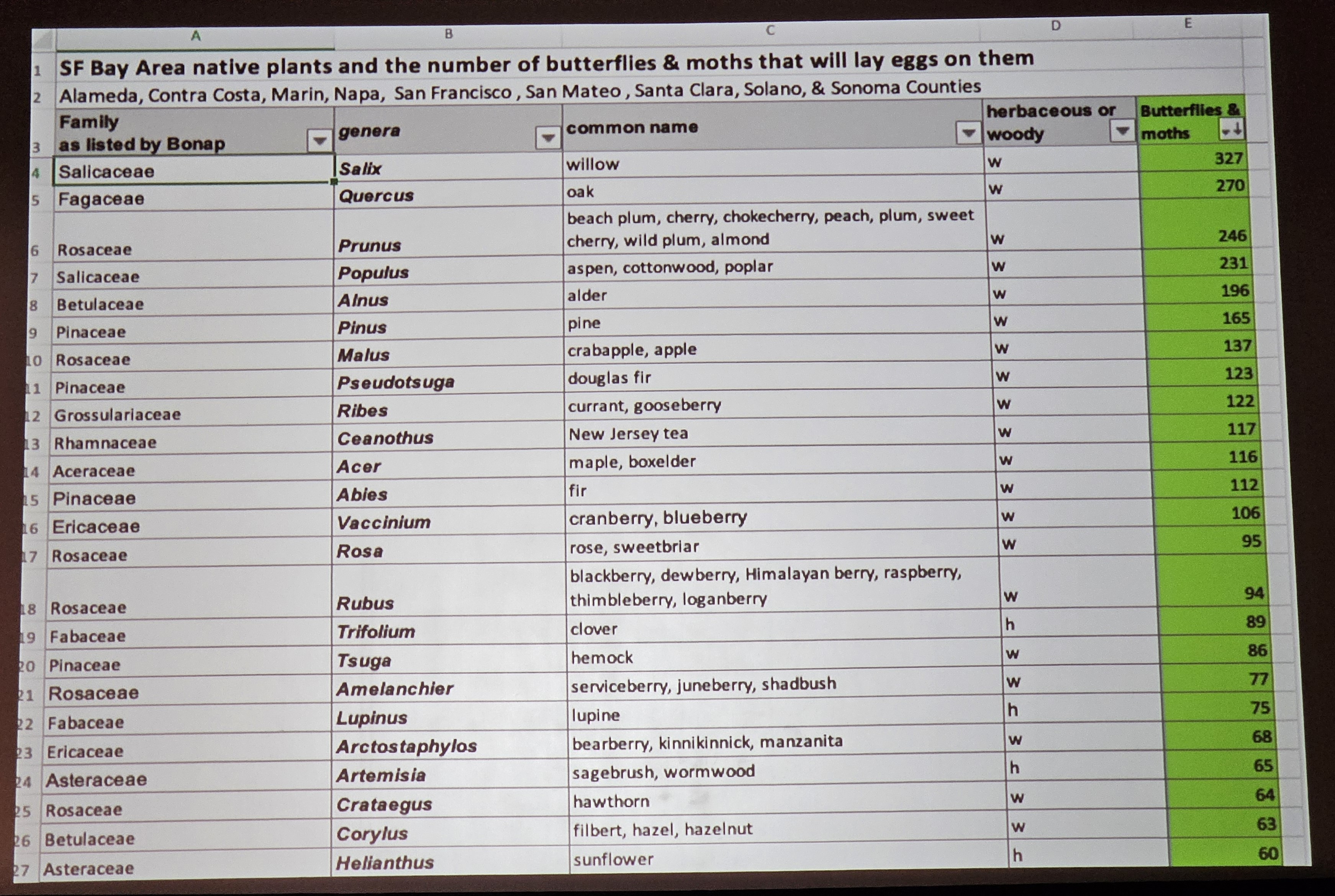
This list is predominantly shrubs. Some are not native to Oakland. Some plants native to Oakland are missing from the list. At least one—Himalayan blackberry—is a notorious invasive non-native that most public land managers have been trying to eradicate for decades. Himalayan blackberry is, however, an extremely useful plant for wildlife. The list is a mixed bag, but it won’t create an urban forest.
Update: The Public Works & Transportation Committee of the City of Oakland approved the Urban Forest Plan for Oakland today, December 10, 2024. Eleven people spoke in support of the plan. No one spoke against the plan.
Dan Kalb, City Council representative for District 1, asked why Oakland is planting non-native trees, which he claimed are breaking sidewalks and destroying the foundations of people’s homes by sending their roots into their yards. David Moore, the head of Tree Services, handled these questions well and Kalb did not pursue the issue further. No speaker objected to non-native trees in Oakland.
I have a native Coast Live Oak in my front yard, which damaged the foundation of my home, destabilizing the house and doing extensive damage inside the house. To save the tree, we had to repair the foundation by suspending the new foundation over the roots from two steel-reinforced piers that are 10 feet deep at each end of the foundation. In other words, although there is some variation in the configuration of tree roots, the variation is unrelated to the national origin of the tree species.
Given the budget deficit in Oakland, it was necessary to reduce the goal of the plan to maintain the tree canopy rather than increase it. No one objected to that change in the goal. We all understood that the change was necessary.
On the bright side
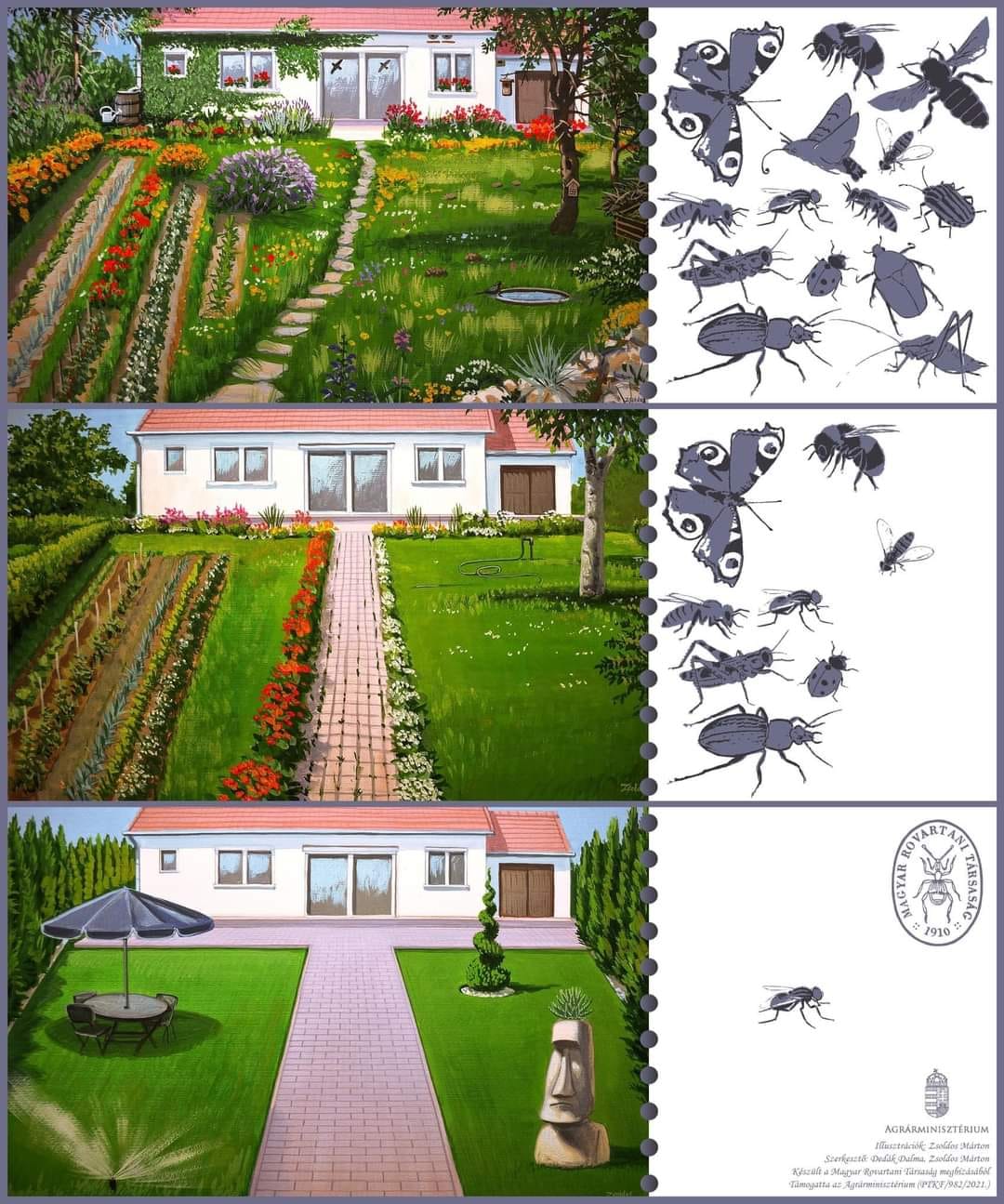
I enjoyed two presentations by native plant gardeners who transformed their yards from barren places into lovely native plant gardens. One started her project by digging up concrete covering her back yard. The other began by digging up a front lawn. Of course, their new gardens are an improvement over their predecessors. They are more beautiful and they serve more wildlife.
However, would these new gardens be even more beautiful and useful to wildlife if they were more diverse? Would they be more resilient as the climate continues to change in unpredictable ways? Maybe.
Thankfully, there was little talk of destruction in either of these inspiring presentations. One exception was an anecdote about the visit of a native plant advocate to the garden of a fellow gardener. The gardener asked his visitor where agapanthus in his garden is from. When told it was from South Africa, he promptly pulled it out of the ground. The audience was very amused by the story.
When traveling in distant places, I don’t want to know which plants are native. Don’t ask, don’t tell. It’s a pleasant break from the “good” plant, “bad” plant dichotomy.
Tallamy advised against using insecticide, but he made no mention of using herbicides.
I have no quarrel with these gardeners. I firmly believe that everyone should be free to plant whatever they wish in their gardens. I respect everyone’s plant preferences and I ask that they respect mine.
However, our public parks and open spaces belong to everyone and our tax dollars are used to maintain them. I ask only that public land managers quit destroying healthy trees and landscapes, especially with herbicides.
(2) Professor Emeritus Arthur Shapiro sent the following “qualifiers” in an email. The article has been revised accordingly. “…a couple of qualifiers. First, zelicaon cannot breed all year because it has a seasonal pupal diapause (dormancy) in winter which is photoperiod—T mediated. Its native wetland hosts (Cicuta and Oenanthe) support breeding March-October. It is unclear that it had any native hosts at all in upland, dry habitats. It was probably a tule marsh species in pre-European CA (below about 4000′), just as its close relative machaon is a fenland species in the U.K. Second, monarchs didn’t breed in winter until recently, again because of photoperiod-T induced reproductive (adult) diapause. Tropical milkweed has been cultivated in CA for well over a century but was not bred on in winter, even in SoCal. I hypothesize that warming T is responsible for the change. It is NOT advantageous to breed in winter. Because curassavica is the only plant available, it gets reused over and over again and becomes contaminated with high levels of an infectious protozoan parasite that causes significant morbidity and mortality. The butterfly might be better off if it didn’t try to breed in winter.” November 21, 2024.
 Conservation Sense and Nonsense
Thanks for this extremely interesting and informative analysis and summary.
I’m consistently gratified by the sense-making in your articles. They are well-presented, thoroughly researched, and contain incredibly important information for anyone who manages any space full of non-human, living beings. Thank you so much.
Thank you for this! I guess Tallamy still doesn’t mind twisting the data to suit his narrative. One of his first papers in the subject was only able to conclude that native plant genera support more native insects because he erased the contribution of non-native plants in his analysis. If a plant genus had species present in North America that are both native and non-native, he treated it as native, effectively pre-skewing his data to favor natives. If you add those non-natives plants back in his conclusion disappears.
Lambstrom Garden Ecology LLC 401.206.0197 http://www.gardenecology.us
I can’t help believing that nativism about plant species is related to nativism in our nation as a whole. All kinds of things are dreamed up to support removing “non-natives” of all kinds. The truth is that diversity in all areas is the only thing that supports thriving ecosystems and the continuation of life.
Although that association between anti-immigration sentiment and the native plant movement’s crusade against non-native plants seems logical, there is one counterintuitive problem with it. The nativists who are aggressively pushing the effort to eradicate non-native plants are usually politically liberal. That is, the same people who usually support the rights of immigrants are the very same people who hate non-native plants.
I can’t explain this strange contradiction in the ideology of nativism in the natural world, but having observed nativists for 25 years, I can only report what I have observed. When this contradiction is pointed out to them, they usually get angry. Their explanation for the contradiction is usually that what is true for humans cannot be true for plants. They put humans in another realm, outside nature, which is perhaps why they don’t seem to understand or acknowledge evolution.
Thank you for your visit and your comment.
Knowing that most of the nativist in our area are liberals (but who betray a number of groups with their politics, including women and girls), I wrote my article on behalf of “non-native plants” several years ago, hoping that their support undocumented human immigrants might get them to stop hating plants:https://keepingreallesbianfeminismsimple.wordpress.com/2017/08/03/help-defend-our-undocumented-immigrant-plants-and-animals-as-we-should-do-our-humans/Thank you so much again, for this brilliant, needed article.
Thanks to Conservation Sense and Nonsense for introducing me to Doug Tallamy. He very clearly knows what he is talking about and I’m glad this website could introduce me to a like minded thinker