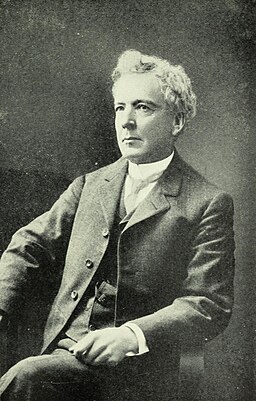
Luther Burbank was born in Massachusetts in 1849, the 13th of 15 children. As a child, he had an interest in nature. With an inheritance from his father, who died when Burbank was 18 years old, he purchased a 17-acre farm in Massachusetts.
Burbank bought his small farm intending to be a market farmer, selling seasonal fruits and vegetables. He was handicapped by challenging climate and growing conditions and competition from other market farmers with a head start. He could see that he would have to produce the best produce and offer it before his competitors could, which pushed him down the path of improving the plants he grew.
Burbank’s methods for improving plants
Burbank found his inspiration as a breeder of improved plants in his local library where he found the writings of Charles Darwin. He could see that the concept of natural selection described by Darwin, applied equally to breeding plants. He wrote, “It opened a new world to me. It told me, in plain simple sentences, as matter-of-fact as though its marvelous and startling truths were commonplace that variations seemed to be susceptible, through selection, of permanent fixture in the individual…I doubt if it is possible to make anyone realize what this book meant me.” (1)
Burbank quickly put his new understanding of selection to use as a means to improve the food crops he grew. He developed the Burbank potato that is known today as the Burbank russet potato. He found a seed ball on his potato plants containing 23 seeds. He grew the seeds, selecting the plants that produced the best potatoes in successive crops until he had a potato with smooth skin and few eyes that tasted good and stored well. It was also mildly resistant to the blight that caused the potato famine in Ireland, which killed one million people and caused a mass exodus from Ireland.
He understood that he had created a valuable commodity, but he couldn’t see how he could profit from it because he couldn’t produce it at scale on his small property and he didn’t have the commercial infrastructure to market it widely. At the time, it wasn’t possible to patent new plant varieties, so he sold his new variety to an established seed merchant for $150. It was a paltry sum, even at the time, but it was the beginning of a business model that financed most of Burbank’s career as a plant inventor.
Charles Darwin also introduced Burbank to another method of improving plants in his publication, “The Effects of Cross and Self-Fertilization in the Vegetable Kingdom.” Burbank described how Darwin led him to the realization that hybridization is another means of improving the quality and performance of plants: “One sentence in the very introductory chapter of that volume opened the door of my mind and took possession of my fancy. After discussing briefly the marvel of cross- and self-fertilization in plants, Darwin said: ‘As plants are adapted by such diversified and effective means for cross-fertilization, it might have inferred from this fact alone that they derive some great advantage from the process; and it is the object of the present work to show the nature and importance of the benefits thus derived [from hybridization].’” (1)
Darwin identified natural selection and hybridization as tools of evolution that produced plants and animals best adapted to current environmental conditions. When environmental conditions changed, as they have constantly over 4.6 billion years of the Earth’s existence, natural selection and hybridization enabled the survival of plants and animals best adapted to changed conditions. Using the same methods, but different criteria, Burbank bred the plants that conformed to the needs of humans: the most flavorful fruit, sturdy enough to be transported from fields to tables and the most beautiful flowers, in the opinion of humans. Burbank directed and accelerated evolution to serve humans, using the tools of natural evolution.
Grafting the branches of one type of fruit onto the root stock of another species of tree was the third method Burbank used to create new plants. Most orchard fruit is grown from grafting because growing fruit trees from seeds is unpredictable. The seeds of a flavorful apple, don’t necessarily grow into a tree that produces an equally flavorful apple. It takes years for some fruit trees to produce fruit, which can ultimately produce disappointing fruit. Grafting is a means of reducing risk and accelerating production.
California’s Bounty
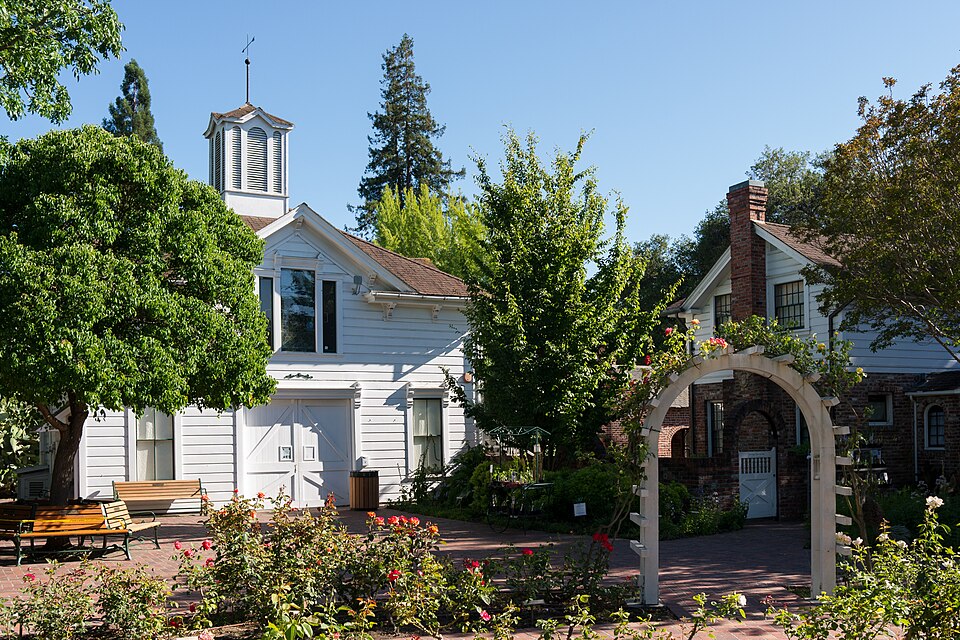
After years of economic hardship, Burbank moved to California in 1875 at the age of 26 to join his brothers. Instantly, he was an enthusiastic promoter of the ideal climate and growing conditions of his new home in Santa Rosa. He bought 4 acres of land where he built a greenhouse, nursery, and experimental fields. Later, he bought an 18-acre plot of land in nearby Sebastopol he called the Gold Ridge Farm, where his experiments expanded.
In California, Burbank had the climate and the acreage needed to run many experiments on fruit and nut trees as well as vegetables and flowers simultaneously. Each experiment required planting thousands of individual plants, grown through many generations. These experiments produced hundreds of varieties of many species of plants:
Fruits
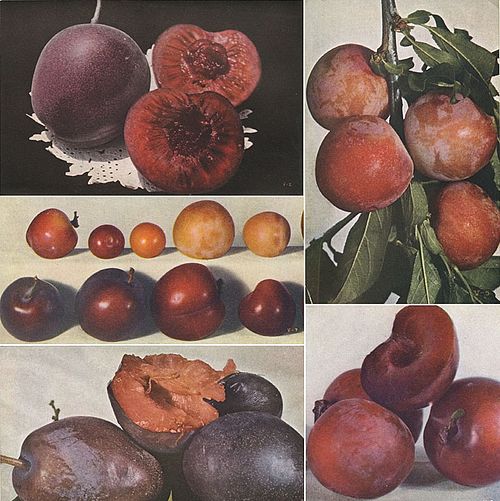
113 plums and prunes
69 nuts
35 fruiting cactus
16 blackberries
13 raspberries
11 quinces
11 plumcots
10 cherries
10 strawberries
10 apples
8 peaches
6 chestnuts
5 nectarines
4 grapes
4 pears
3 walnuts
2 figs
1 almond
Grains, grasses, forage
9 types
Vegetables
26 types
Ornamentals
91 types
Source: Wikipedia
Finding His Tribe: Scientist or Businessman?
By the turn of the century, Burbank had made his reputation as the creator of new plant varieties. He captured the attention of scientists who wanted to adopt him into their community, learn his methods, and teach them to their students: “The San Francisco Chronicle advocates the seizing of Luther Burbank at his home in Santa Rosa and placing him in a chair at Stanford University….The main thing is to get the recluse away from his practical experiments long enough to tell people what he has done.” Los Angeles Times, June 7, 1901.
Burbank was invited to give a series of lectures at Stanford University at a time when botanical scientists were newly influenced by the discovery of the role of genetics in producing individual variations in plants and animals. Gregor Mendel’s studies of genetic variation done in the 1860s was buried in the archives of Mendel’s local botanical society until 1900, when they were rediscovered.
Burbank’s audience at Stanford was expecting his lecture to reflect the mechanistic determinism of Mendelian genetics. Instead, they got a dose of Burbank’s almost mystical view of the workings of nature “…as an intricate web of vibrations and magnetic forces where ‘all motion, all life, all force, all so-called matter are following the same law of heredity found in plants and animals, a forward movement toward attraction through lines of least resistance.’” (1)
Today, our understanding of genetics is more nuanced than it was over one hundred years ago and it is more consistent with Burbank’s observations. With the help of molecular analysis, we now know that there are hundreds of unexpressed genes that are latent unless triggered in response to specific growing conditions as well as random mutations. Burbank’s view of variation in nature was based on close, persistent observation and his own subjective intuition, based on decades of experience.
The Carnegie Institute of Technology tried to bridge this gap between science and Burbank’s art of creating new plant varieties by giving him a generous grant of $10,000 per year on the condition that a botanical scientist would trail Burbank in the field and turn his art into a data-driven algorithm capable of replicating Burbank’s accomplishments.
The scientist assigned to that task was immediately frustrated by the haphazard jumble of Burbank’s sketchy record-keeping. Watching Burbank in the field was equally frustrating. Burbank couldn’t translate the choices he made into words because his judgment was intuitive. Finally, The Carnegie Institute lost patience with the project and terminated the grant.
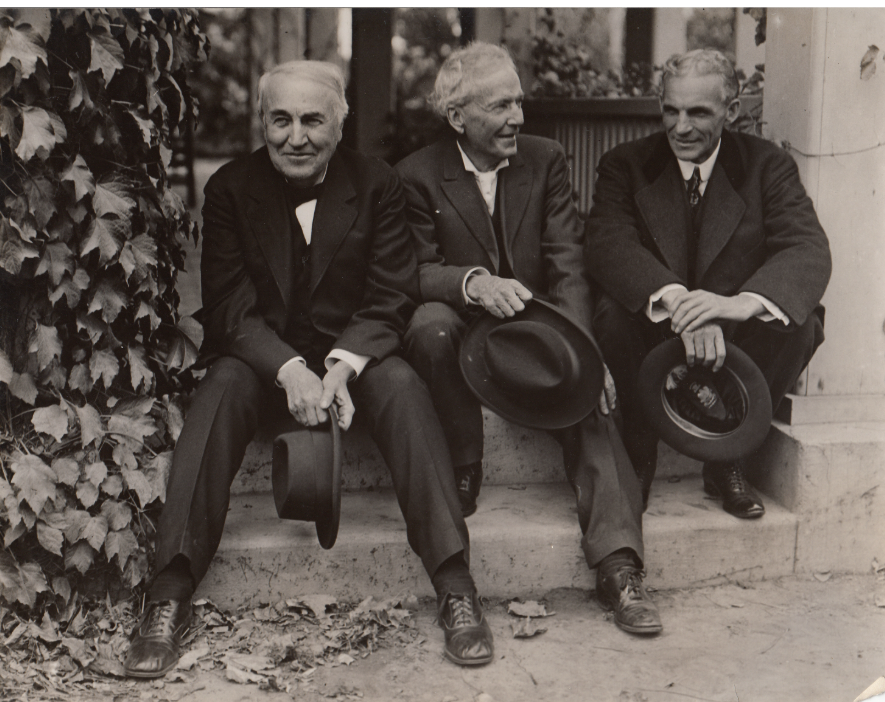
Henry Ford and Thomas Edison came to visit Luther Burbank in 1915 after their visit to the Panama-Pacific Exposition in San Francisco. It was a meeting of the minds and kindred spirits. They were businessmen whose commercial success was based on tireless effort, continuous incremental improvement, and practical invention. They were Burbank’s tribe, who became fast friends for the rest of their lives.
Burbank Defends Evolution
It took Charles Darwin nearly 20 years to publish his treatise on evolution, On the Origin of Species, partly because he knew it challenged some of the basic premises of organized religion to which his family was committed. The evidence that life on Earth evolved over millions of years directly contradicted the religious belief that God created all life on Earth, as it presently exists, only 6,000 years ago. Evolution is also inconsistent with the religious belief that humans are chosen by God to rule the world and that all other creatures are subservient to our command.
In fact, pushback to the concept of evolution was minimal in the 19th century after Origin of Species was published in 1859. Full-throated opposition to evolution emerged in the 20th century and is epitomized by the Scopes trial that occurred in 1925, just one year before Burbank’s death.
The Scopes trial occurred because the state of Tennessee banned the teaching of evolution in public schools. The ACLU persuaded a high school teacher, John Scopes, to test the law. Two of the greatest orators of the time, stepped forward to try this important case. Clarence Darrow, defended Scopes for the ACLU. William Jennings Bryon was the prosecutor for the state of Tennessee.
Both Darrow and Bryon asked Luther Burbank to appear as a witness at the trial, which was an indication that the public was confused about Burbank’s close relationship with the natural world. Much to the disappointment of William Jennings Bryon, who considered himself a personal friend of Burbank’s, Burbank came down unequivocally in support of the teaching evolution.
In a letter submitted as evidence in the trial, Burbank said, “Those who would legislate against the teaching of evolution should also legislate against the teaching of gravity, electricity, and the unreasonable velocity of light, and also introduce a clause to prevent the use of the telescope, the microscope…or any other instrument of precision which in the future may be invented…for the discovery of truth.” (1)
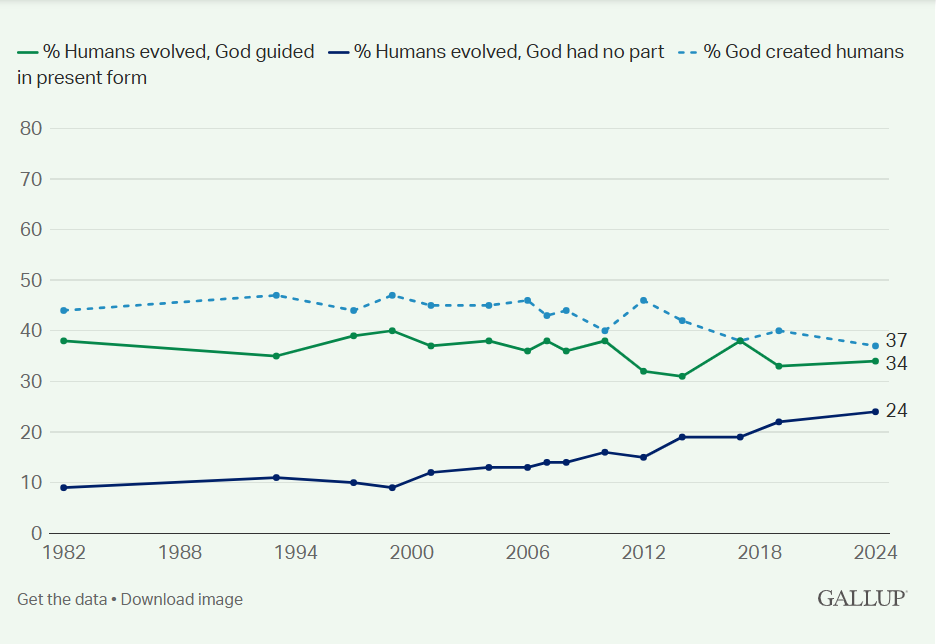
Despite Burbank’s effort, Scopes was found guilty and the ban on teaching evolution in Tennessee remained in effect until 1967. In 2024, the Gallup Poll reported that only 24% of Americans believe in evolution unguided by God, a percentage that has increased steadily since 2000. The dominate view—at 37%–is that humans were created by God in their present form:
In a series of interviews with the news media, Burbank expressed his doubts about the afterlife and his admiration and kinship with Christ as a man rather than a deity: “[Christ] was an infidel of his day because he railed against the prevailing religions and his government. I am a lover of Christ as a man, and his work and all things that help humanity, but nevertheless just as he was an infidel then, I am an infidel today.” (1)
Burbank’s Last Success
By any measure, Burbank must be considered a success. Although he managed to make a living, he was not wealthy because his plant inventions could not be patented. Without patent protection, profits were realized by seed merchants, nurseries, and agricultural operations.
Burbank made many appeals to the US Patent Office for patent protection. His appeals sounded desperate and angry about the unfairness that often threatened him with economic ruin. His death in 1926 at the age of 77 sparked another campaign by other plant breeders to extend patent law to the development of new plant varieties.
The effort to extend patent law to plants was boosted by the Great Depression, which began in 1929. Farmers are always in debt as they must borrow money to plant their next crop. When commodity prices collapsed during the depression, many farmers lost their farms.
The proposal to extend patent law to plant “inventions” was perceived by many politicians as a way to help farmers, although the logic of that connection is questionable because patented seeds are likely to be more expensive. Despite that concern, the Plant Patent Act was passed with little opposition in 1930. There were many limitations on the first patent law, many of which have since been revised.
Sixteen of Burbank’s creations received patents, a small fraction of the plants being developed at the time of Burbank’s death.
We can still learn from Luther Burbank
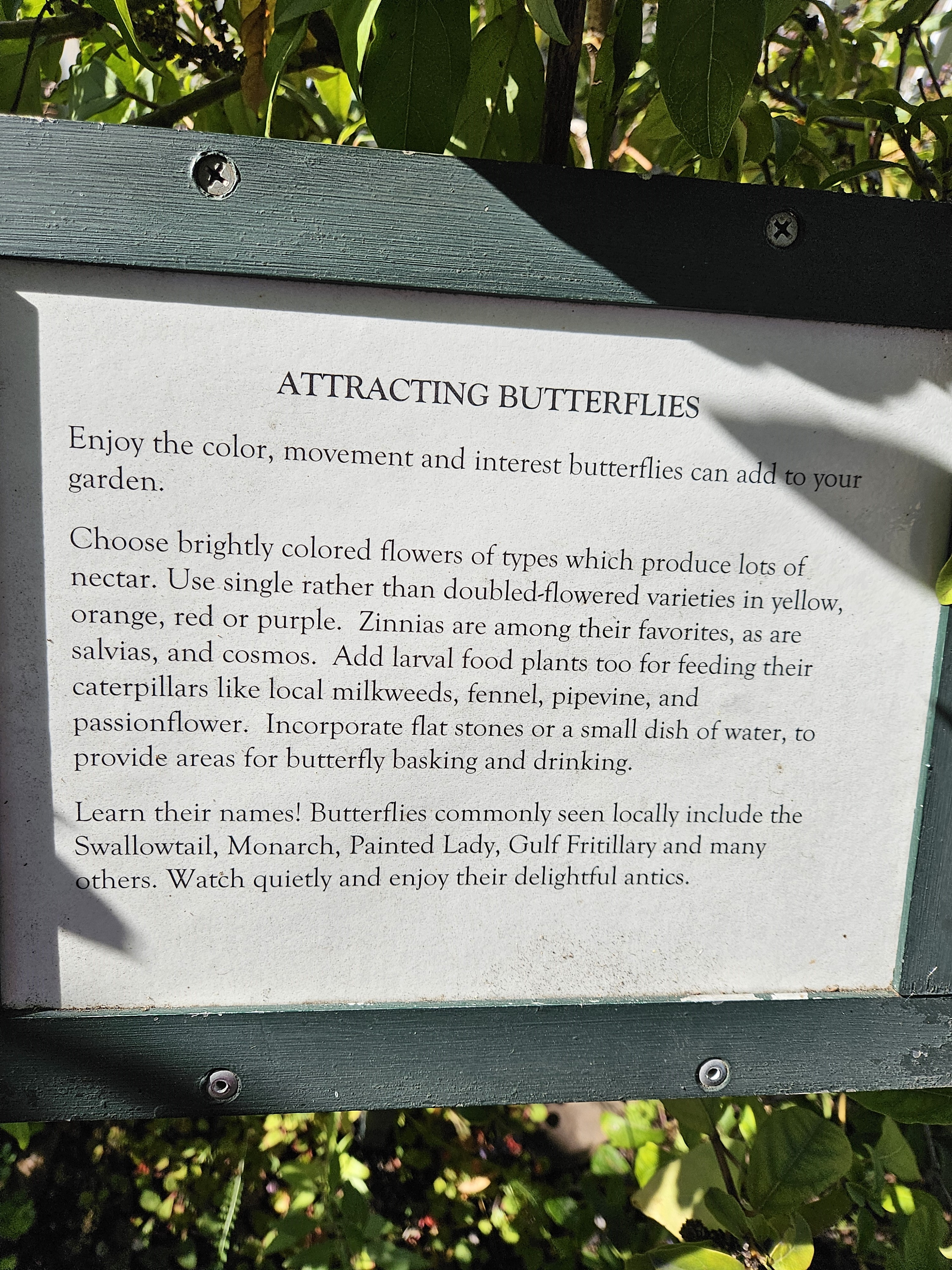
I encourage readers to visit Luther Burbank’s home and garden in Santa Rosa, which is now a free public park, and the museum that is open during summer months. You will find many informational signs throughout the garden about Burbank’s inventions. You won’t find any hint of a nativist bias in the signs. This sign about creating a garden for butterflies makes it clear that these lovely creatures have no preference for native plants:
(1) The Garden of Invention: Luther Burbank and the Business of Breeding Plants, Jane S. Smith, Penguin Books, 2009
 Conservation Sense and Nonsense
Beautifully laid out — and extremely informative. As an aside, I find it so odd when I come across strident nativists who are vocally anti [traditional] religion – because their stridency, doctrine and dogma (not to mention prosthetisation), is so in keeping with the worst tendencies of traditional religious framework.
This mindset is also vocally opposed to (and ignores) the alternative to Creationism — the evolutionary adaptations of species in reaction to a changing planet and the actions of other species. ALL species, including humans. After all we are not aliens 🙂 So where does this leave them? Trying to preserve a moment in time. –MW
Thanks for this very interesting article about Burbank. I often stop reading a long article on my phone, but this one was very much worth reading and I read it to the end and discovered so much about Burbank that I had not known before. Lynn Hovland
Thanks for reading the article.
Love Joins All Things.
Wonderful article! I grow Burbank’s Santa Rosa plum, white blackberries, and his amazing and underrated Phenomenal Berry, among other cultivars. KUTGW!
I too read this article from beginning to end. I remember as a child reading a series of books for children which were called Blue Books I believe. One was on Luther Burbank and another on George Washington Carver if I remember correctly. Both made an impression and started my love of plants and nature.
Although he had no children of his own, Burbank had a strong interest in children. He encouraged parents to give their children freedom to explore nature. He and his wife developed educational materials for children to foster their knowledge of and interest in nature.
“The main thing is to get the recluse away from his practical experiments long enough to tell people what he has done.”
hah, i resemble this comment. here are my ficus hybrids…
ficus opposita x carica
ficus fraseri x carica
ficus ulmifolia x carica
ficus racemosa x carica
ficus aspera x carica
ficus lutea x carica
haven’t had a chance to write much about them, since i’ve been busy trying to make more. now that it’s winter i’ve had a bit more time to write. here’s a comment that i just wrote on alexbinck’s journal entry on inaturalist where he asks, “Should cities plant native or introduced tree species?”…
last year the city of santa ana chopped down a huge ficus drupacea tree. my friend don hodel, one of the most respected tree authorities in california, tried to talk the city out of it, but to no avail. this was probably deju vu for him, because back in 1985 he unsuccessfully tried to persuade the city of whittier to not chop down a historic ficus elastica tree. you can read the story in the la times… https://www.latimes.com/archives/la-xpm-1985-02-03-hd-13582-story.html
in 2016 the owner of a new home in la quinta (near palm springs california) chopped down the fruiting coconut palm in their front yard. a couple years ago 2 vandals chopped down the iconic sycamore gap tree in the uk. this tree had won the 2016 uk tree of the year contest.
why doesn’t california have a tree of the year contest? this is what i texted hodel yesterday… “our california tree foundation can have 3 winners each year… one determined by popular vote, another determined by a panel of experts, and a 3rd determined by donations.” this would provide 3 very different answers to your question about whether cities should plant native or introduced trees.