Julian Burgoff wrote a guest post for Conservation Sense and Nonsense about the undervalued functions of non-native aquatic plants in 2023. Necessary Nuisance explained that non-native aquatic plants perform valuable ecological functions. Attempts to eradicate aquatic plants deprive aquatic animals of valuable habitat. The herbicides used to kill aquatic plants also pollute the water, harming aquatic animals and killing non-target aquatic plants.
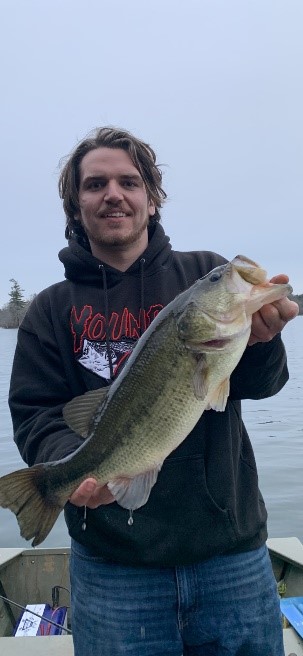
Julian Burgoff is an avid bass angler and aspiring fisheries ecologist from western Massachusetts. He recently received a master’s degree with the Massachusetts Cooperative Fish and Wildlife Research Unit at UMass- Amherst where he studied juvenile river herring growth, diets and habitat use in coastal Massachusetts lakes and estuaries. He is passionate about lake ecology and the management of aquatic vegetation in lakes and hopes to work in a field related to lake conservation and warmwater fisheries management in the future.
I am grateful to Julian for giving us another opportunity to publish an article about a specific project that is trying to kill valuable aquatic plants with herbicides. Thank you, Julian.
Conservation Sense and Nonsense
Hydrilla and the Connecticut River: Falling into the “Invasive” Trap
If you spend time on the tidal Connecticut River in summer, you will likely see thick green mats covering its shorelines, coves and backwaters. This is hydrilla — a non-native aquatic plant that’s long been demonized by state agencies and lake managers across the country.
One morning during a summer internship performing fisheries related fieldwork on the river, I saw a young doe on the bank nibbling on a clump of hydrilla exposed at low tide. I laughed to myself — I knew it was good fish habitat, but even deer like the stuff!
The “official” position was that it was choking the river, outcompeting native species, and impeding recreational use of the river. But as a passionate angler and ecologist who studies aquatic ecosystems, I’ve learned that what we (as western scientists) think about non-native species and their impacts — especially in the world of aquatic plants — often turns out to be driven more by ideology than by scientific evidence.
The War on Hydrilla
Hydrilla arrived in the Connecticut River around 2016 and has since spread through the lower mainstem and its tributaries. In response, the Connecticut Agricultural Experiment Station (CAES) and the U.S. Army Corps of Engineers (USACE) have launched an aggressive herbicide campaign that seeks to “restore” native aquatic plant communities and study the efficacy of using a cocktail of various herbicides to treat the areas of the river where the growth of hydrilla is most prolific. Over the past few summers and into next year, private contractors plan to treat hundreds of acres of river coves with a mix of chemicals, including diquat and florpyrauxifen-benzyl.
On paper, this might sound like responsible ecological stewardship — reducing non-native plant stands such that their native counterparts can flourish. But in my view, it’s another example of what resource managers in Minnesota have referred to as “the invasive trap”: the belief that any non-native species must be “harmful”, and that launching management campaigns to kill them must be ecologically and economically beneficial.
The problem is that this assumption is not based on data, but on the dogmatic assumptions of invasion biology that underpin the world view of many western scientists and management agencies.
Unexpected Ecosystem Services: What the Evidence Shows
Across the country, hydrilla has often played the opposite role of what managers might expect. In the Chesapeake Bay and its tributaries, researchers found that hydrilla helped stabilize sediments, clear up murky water, and create habitat for fish and invertebrates — even helping native aquatic plant stands return. In Florida lakes, scientists compared lakes with and without hydrilla and found no major differences in fish, bird, or aquatic plant diversity.
In other words, hydrilla didn’t destroy these ecosystems where it was introduced. It filled open niche space, performed valuable ecosystem services, and is now integrated into the food web, for better or for worse.
That’s not to say hydrilla should be introduced to new water bodies or can’t impact ecosystems in ways that are perceived as harmful. Like many aquatic plants (native and non-native), hydrilla can grow in thick stands that interfere with swimming or boating, alter water chemistry and change physical habitat suitability for aquatic organisms. But many of these impacts are human nuisances, not ecological disasters, and should be managed as such. In large, dynamic systems like the Connecticut River, hydrilla’s role is likely far more complex — and possibly beneficial — than its label as “one of the world’s most invasive aquatic plants” suggests.
The Risks of Herbicide Use to “Restore” Native Plant Communities
Despite the lack of evidence that hydrilla is causing ecological “harm” to the Connecticut River, the proposed management intervention — widespread herbicide use — carries significant ecological risk.
Diquat, one of the main herbicides being applied, is what’s called a contact herbicide: it kills whatever plant tissue it touches (including native plant taxa). Florpyrauxifen-benzyl is a systemic herbicide, meaning it’s absorbed into plants and disrupts their growth. When a large quantity of aquatic plants rapidly die, they decay and release nutrients into the water, which can fuel algal blooms that reduce water clarity. If water clarity is significantly reduced, the very native plants managers aim to “restore” can’t regrow.
Ironically, hydrilla often bounces back first because it’s more tolerant of poor water quality than many native species. This can lock managers into a costly, never-ending cycle: herbicide use → temporary die-off → algal bloom → hydrilla regrowth → more herbicides.
Similar outcomes have been observed in Florida, where researchers found a large-scale florpyrauxifen-benzyl treatment sharply reduced hydrilla abundance in a Florida lake, but the plant regained dominance within a year as reduced water clarity from the treatment hindered native plant recovery.
Cascading Food Web Effects
As primary producers, aquatic plants are essential to the foundation of food webs — sheltering young fish, providing surfaces for invertebrates to live, and supporting wildlife like waterfowl. When herbicides are used to kill aquatic plants, there are often complex indirect impacts to the integrity of aquatic food webs.
Diquat is known to be toxic to not just plants (native and non-native) but invertebrates (the tiny animals that feed fish), such as amphipods. Even at concentrations lower than what’s used in field applications, diquat has the potential to impact these organisms which in turn may reduce available habitat for organisms higher up the food web like fishes.
Diquat also contains bromide, a compound that researchers have linked to a neurological disease killing bald eagles in the southeastern U.S. The disease develops when a particular cyanobacteria grows on hydrilla plants and interacts with bromide — forming a toxin that bio-magnifies as it moves up the food web. Ducks eat the hydrilla, eagles eat the ducks, and the toxin accumulates, damaging the eagles’ brains.
While this phenomenon hasn’t yet been documented in the Connecticut River, applying bromide-based herbicides in a manner that is likely to contribute to algal blooms (including cyanobacteria blooms) is not an ecologically sound management practice.
What We Don’t Know
Despite the confidence behind these large-scale management interventions, there’s little data showing how hydrilla has actually affected biodiversity or water quality in the Connecticut River. To prove that hydrilla is causing ecological “harm”, we’d need long-term monitoring — decades of data on aquatic plants, fish, wildlife, and water quality — collected before and after hydrilla became established. These data likely don’t exist at the scale needed to make an informed, unbiased assessment. Yet herbicide applications in the name of ecological “restoration” are moving forward anyway. The “post-monitoring” required by the project plan mostly focuses on the “efficacy” of the treatment (e.g. how much hydrilla biomass is reduced) not on whether algae blooms occur or how invertebrate and fish communities are affected.
This is a common phenomenon with herbicide treatments: the indirect effects of the management intervention are simply too complex and too costly to quantify. Based on the current “post-monitoring” protocol, if it’s found that hydrilla biomass is reduced and that native aquatic plant communities continue to exist following treatment, the project will be considered a success.
Less is More: Observation Based Management
Sometimes, the most ecologically mindful (and most cost effective) management decision is to pause to let species interactions occur unmolested and find their own equilibrium rather than impose an imaginary concept of what a given ecological community “should” be.
Where hydrilla interferes directly with human activities — say, blocking a boat ramp or clogging a marina — mechanical removal or small, targeted herbicide treatments could be reasonable management interventions. But broad, river-wide herbicide use is neither justified by science nor a long-term sustainable solution to non-native aquatic plant management.
With non-native species introductions, the truth is that there is no going back. Climate change, nutrient loading, and decades of physical habitat alteration via damming etc. have already changed this river beyond what it was a few centuries ago. Plants and animals are constantly being introduced and adapting to a new reality — one where species origins and “native” vs. “non-native” status matter far less than their role in maintaining ecosystem functions.
Rather than pouring more chemicals into the water, perhaps we should pour our efforts into observing, monitoring, and trying to understand why certain plants succeed and how ecosystems adjust to change over time. Instead of “controlling” non-native plants, perhaps we should practice more “self-control” and let nature heal itself without the imposition of the human ego and its desire to constantly fight the expressions of the natural world in the Anthropocene.
Julian Burgoff
Amherst, MA
jburgoff@umass.edu
 Conservation Sense and Nonsense
Thank you! This is so important. No reason to use more poisons, but they are increasing. I want to ask those doing it, not enough cancer yet?
Do you know about these artists?
https://www.climavore.org/seasons/season-of-non-native-invasives
Thank you for alerting me to this website, which I had not seen before. However, the concept that plants and animals considered invasive in one place are often considered useful in other places is not new to me.