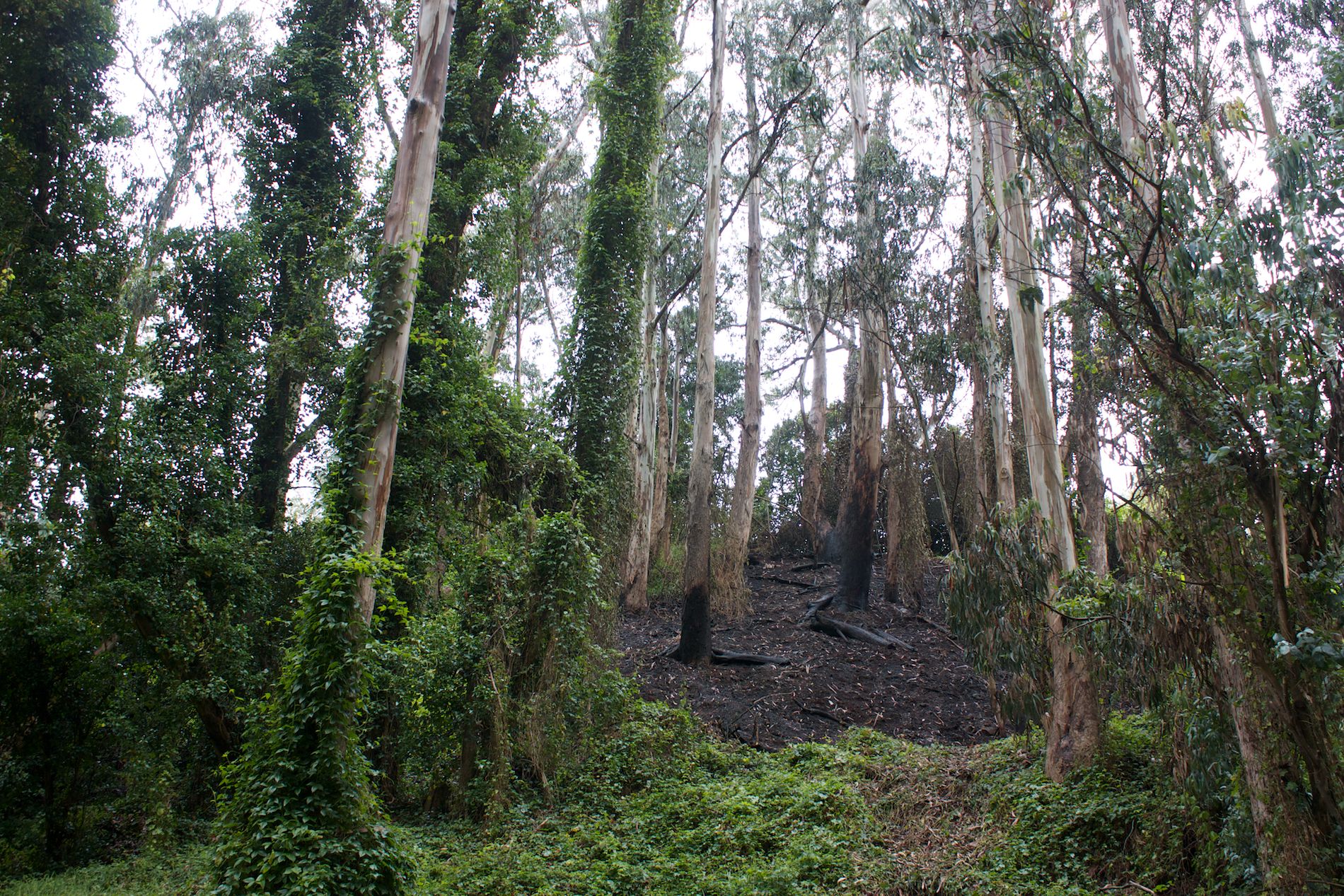
The fire in Stern Grove was reported by a local television station. You can view photos and videos of the fire on their website. They report that the fire was started by homeless campers. Nearly 40 firefighters battled the blaze which they described as challenging because it was the middle of the night and visibility was low. The fire moved up a steep hill which has a tendency to accelerate the spread of fire.
This fire in Stern Grove was a particularly rigorous test of the flammability of eucalypts because many of them are shrouded in ivy. The ivy creates a fire ladder to the canopy of the tree, which increases the risk that the tree will ignite. But they did not ignite. The understory of the trees was completely engulfed in flames. The trunks of the trees were badly scorched by the fire in the understory. The fire did not travel up the trees and ignite the canopy.
Aftermath of fire in Stern Grove
Let’s talk about ivy
This is an opportunity to talk about the ivy that we find growing up the trunks of the trees in San Francisco. The ivy was planted at some time in the past and in fact, the Recreation & Park Department is still planting ivy when it renovates the parks, believe it or not. It’s a popular groundcover because it thrives with no care and it grows almost anywhere.
Another absurd argument that nativists use to advocate for the destruction of eucalypts in San Francisco is that they are covered in ivy. This seems an extreme case of cutting off your nose to spite your face. Why kill the tree when it’s the ivy that is the problem? It’s not the tree’s fault that it’s covered in ivy. It’s the fault of the Recreation and Park Department that it provides so little maintenance in the parks that the ivy grows out of the control. How does destroying the tree solve the problem? The ivy will overwhelm anything that grows there. Trees aren’t the exclusive target of ivy.
Our personal experience with ivy
We know from personal experience that it’s not that difficult to control ivy. We’ve never planted ivy but we have inherited it in our gardens from previous owners. My spouse complained bitterly about the ivy. But as the primary gardener in the household, I knew we did not have the fortitude to eliminate it. We don’t use pesticides in our garden so without the physical stamina or the resolve to eliminate it, our only option was to manage it. It wasn’t that hard to do. With an annual “haircut” our ivy was never out of control.
Ivy management in Dracena Park, Piedmont, CA
We have also had the experience of watching ivy being successfully managed in a public park. In the City of Piedmont’s beautiful parks, ivy is the predominate ground cover. It doesn’t crawl up trees or overwhelm shrubs because it is managed.
Another case of eucalyptus being scapegoated
The eucalypts in San Francisco’s parks are shrouded in ivy because the Recreation and Park Department does almost no maintenance in our parks. Watering and mowing the lawns is about the limit of their maintenance. Why would we expect maintenance to improve just because the trees are destroyed? We certainly haven’t seen any evidence of improved maintenance in the 1,100 acres of “natural areas” in which non-native plants and trees are repeatedly destroyed, native plants are planted and are quickly overwhelmed by foxtails and other non-native weeds.
The money being wasted on these unsuccessful “restorations” would be much better spent maintaining the landscape that exists. It would certainly be less destructive.
Nature in the City (NIC) is one of many organizations that support native plant “restorations” in San Francisco as well as the principle entity which engages in them, the Natural Areas Program (NAP) of the Recreation and Park Department. NIC is consistently critical of anyone who questions the value of these restorations, but in their most recent newsletter they confront our objections directly. Although we don’t presume to represent the many constituencies which are critical of the Natural Areas Program, we are responding in this post to NIC based on our knowledge of the issues. (The NIC newsletter is in quotes and is italicized. Our response is not italicized.)
“Natural Areas in 2012
Last fall saw the the [sic] Planning Commission public meeting for the Draft Environmental Impact Report (DEIR) for the Significant Natural Resource Areas Management Plan. Some time later this year, the City will issue a Final Environmental Impact Report, which may be appealed by opponents of the Natural Areas Program.
Unfortunately, a handful of people are still propagating misinformation about the rationale, values, and intention of ecological restoration, management and stewardship, and of the City’s celebrated Natural Areas Program.”
Webmaster: Critics of the Natural Areas Program cannot be described accurately as a “handful of people.” We now have four websites(1) representing our views and there have been tens of thousands of visits to our websites. Comments on our websites are overwhelmingly supportive of our views. Our most recently created website, San Francisco Forest Alliance, lists 12 founding members. That organization alone exceeds a “handful of people.”
Our objections to the Natural Areas Program have also been reported by three major newspapers in the past month or so (San Francisco Examiner, Wall Street Journal, Sacramento Bee).
Many critics of NAP have been engaged in the effort to reduce its destructive and restrictive impacts on our parks for over 10 years. Scores of public meetings and hearings have been held to consider our complaints. We consistently outnumbered public speakers in support of NAP until 2006, when the NAP management plan was finally approved by the Recreation and Park Commission. Although we were outnumbered for the first time, there were over 80 speakers who asked the Recreation and Park Commission to revise NAP’s management plan to reduce its negative impact on our parks.
The public comments on the NAP DEIR are the most recent indicator of the relative size of the groups on opposite sides of this issue. These comments were submitted in September and October 2011. We obtained them with a public records request. The Planning Department reported receiving about 400 comments. In analyzing these comments, we chose to disregard about half of them because they were submitted as form letters, even though they were from dog owners who were protesting the loss of their off-leash privileges in the natural areas. We also leave aside the comments from golfers whose only interest is in retaining the golf course at Sharp Park. In other words, we set aside the majority of the comments critical of the NAP management plan in order to focus on those comments that demonstrate a comprehensive understanding of the impact of NAP on the city’s parks. Of the comments remaining, those critical of NAP and its deeply flawed DEIR outnumbered comments in support of the NAP DEIR about three to one. We urge NAP supporters to read these public comments to learn about the wide range of criticisms of NAP, including pesticide use, destruction of trees, recreational access restrictions, loss of wildlife habitat and more.
We will challenge NIC’s accusation that we are “propagating misinformation” within the context of their specific allegations:
“Contrary to the many myths that continue to percolate, the Natural Areas Plan and Program seek to do the following (among other worthwhile endeavors):
1. Protect and conserve our City’s natural heritage for its native wildlife and indigenous plant habitats and for the overall health of our local ecosystem;”
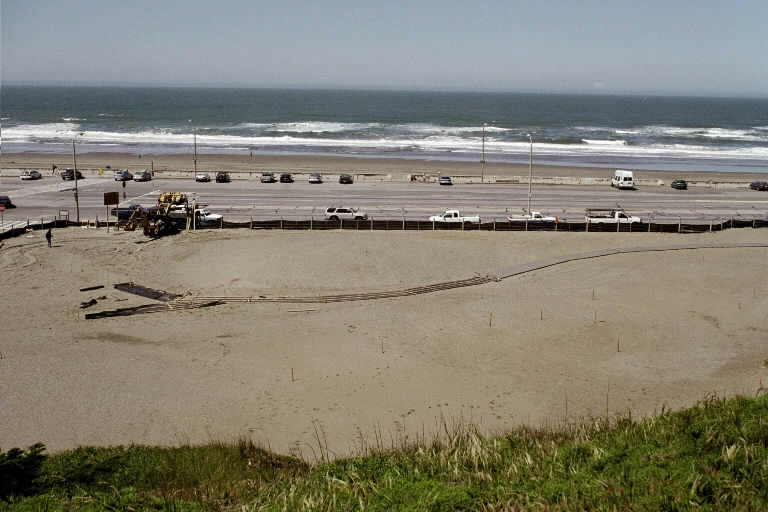
Webmaster: Since the majority of acreage claimed as natural areas by NAP 15 years ago had no native plants in them, there is little truth to the claim that NAP is protecting our “natural heritage.” The so-called “natural area” at Balboa and the Great Highway is typical of the “natural areas.” There is photographic evidence that it was built upon for about 150 years. It was the site of Playland by the Beach before it was designated a “natural area.” Sand had to be trucked onto the property and disked down 18” into the construction rubble, then shaped into dunes by bulldozers before native plants could be planted on it.
Natural Area at Balboa & Great Highway under construction
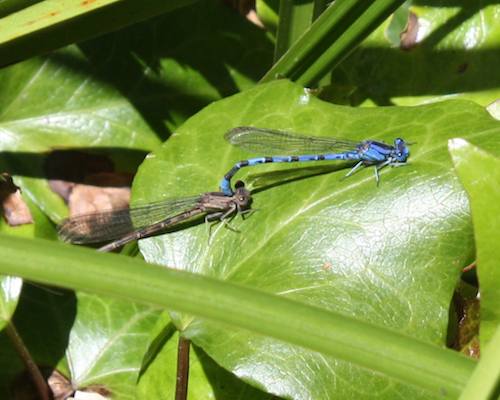
We don’t make any distinction between “native wildlife” and any other wildlife currently living in our city. We value them all. Most are making use of existing vegetation, whether it is native or non-native. They do not benefit from the loss of the blackberries that are their primary food source or the loss of the thickets or trees that are their homes. We do not believe that wildlife in San Francisco benefits from the destructive projects of the Natural Areas Program. See photos of insects, birds, and other wildlife using non-native plants in the natural areas here.
Damselflies mating on ivy, Glen Canyon Park
We do not think an ecosystem that has been sprayed with herbicides qualifies as a “healthy ecosystem.” NAP sprayed herbicides at least 86 times in 2011. Their use of herbicides has increased over 330% in the last 4 years. NAP uses herbicides that are classified as more toxic than those most used by other city departments. Last spring, 1,000 visitors to Glen Canyon Park signed a petition, asking the Natural Areas Program to stop using pesticides in their park. This petition was given to Scott Wiener, the Supervisor representing the district in which Glen Canyon Park is located.
These are statements of fact that can be easily verified by the public record.
2. “Educate our culturally diverse city about the benefits of local nature and about helping with natural areas stewardship in your neighborhood;”
And we also have had bad experiences with the volunteers who are called “stewards” by NAP, but sometimes act more like vandals. We see them spraying herbicides that they aren’t authorized to use. We see them hacking away at trees that haven’t been designated for removal. NAP is not providing the necessary guidance and supervision to the volunteers many of whom seem to consider themselves the de facto owners of the parks.
3. “Manage the City’s wildlands for public access, safety and the health of the “urban forest.””
“We hear occasional complaints about public access and tree removal. Three simple facts are thus:
1. Every single natural area in the City has at least one trail through it, where one can walk a dog on a leash;”
Webmaster: The loss of recreational access in the natural areas is real, not imagined. The following are verbatim quotes from the NAP management plan:
“Approximately 80 percent of the SFRPD off-leash acreage is located within Natural Areas.” (page 5-8). The NAP DEIR proposes to close or reduce the size of several off-leash areas. The DEIR provides no evidence that these areas have been negatively impacted by dogs. It also states that all off-leash areas in the natural areas are subject to closure in the future if it is considered necessary to protect native plants. Since NAP has offered no evidence that the proposed immediate closures are necessary, one reasonably assumes it will offer no evidence if it chooses to close the remainder of the 80% of all off-leash areas in San Francisco located in natural areas. We know from the DEIR public comments that NAP supporters demand their closure.
“Public use in all Natural Areas, unless otherwise specified, should encourage on-trail use… Additionally, interpretive and park signs should be installed or modified as appropriate to include “Please Stay on Trails” with information about why on-trail use is required.” (page 5-14) In other words, the only form of recreation allowed in the natural areas is walking on a trail. Throwing a ball or frisbee, having a picnic on the grass, flying a kite, climbing the rocks are all prohibited activities in the natural areas. And in some parks, bicycles have been prohibited on the trails by NAP.
“Finally, this plan recommends re-routing or closing 10.3 miles of trail (approximately 26 percent of total existing trails).” (page 5-14) So, the only thing visitors are allowed to do in a natural area is walk on the trails and 26% of all the trails in the natural areas will be closed to the public.
2. “The act of removing (a small subset of) non-native trees, e.g., eucalyptus, that are in natural areas has the following benefits:
a. Restores native habitat for indigenous plants and wildlife;
b. Restores health, light and space to the “urban forest,” since the trees are all crowded together and being choked by ivy;
c. Contributes to the prevention of catastrophic fire in our communities.”
Webmaster: Destroying non-native plants and trees does not restore indigenous plants and wildlife. Native plants do not magically emerge when non-native plants and trees are destroyed. Planting indigenous plants might restore them to a location if they are intensively gardened to sustain them. However, in the past 15 years we have seen little evidence that NAP is able to create and sustain successful native plant gardens. Native plants have been repeatedly planted and they have repeatedly failed.
NAP has not “restored” the health of the urban forest. They remove trees in big groups as they expand their native plant gardens. They are not thinning trees. They are creating large openings for the grassland and dune scrub that they plant in the place of the urban forest. Every tree designated for removal by the NAP management plan is clearly selected for its proximity to native plants. It is disingenuous to suggest that NAP’s tree removal plans are intended to benefit the urban forest.
3. “The overall visual landscape of the natural areas will not change since only a small subset of trees are planned to be removed over a 20-year period.”
“Please feel free to email steward@natureinthecity.org if you would like more clarification about the intention, values and rationale of natural resources management.”
Webmaster: We urge our readers to take NIC up on this offer to provide ”more clarification” of its spirited defense of the Natural Areas Program.
Do you think NIC is deluded about there being only a “handful of people” that are critical of the Natural Areas Program?
Did you notice that NIC does not acknowledge the use of herbicides by NAP? Do you think that a fair representation of criticism of NAP can omit this issue?
If you visit a park that is a natural area, do you think NAP has demonstrated in the past 15 years what NIC claims it is accomplishing?
Do you think NIC has accurately described recreational access restrictions in the natural areas?
Do you think that San Francisco’s urban forest will be improved by the destruction of 18,500 mature trees and countless young trees?
(2) “The California Department of Forestry and Fire Protection (CAL FIRE) has no record of any wildfire in San Francisco.” San Francisco Hazard Mitigation Plan, 2008, page 5-18.
Laura Cunningham’s book, A State of Change* is a remarkable achievement, reflecting a lifetime of observing nature, informed by formal training in paleontology and biology and finally depicting that knowledge in oil paintings of the historical ecology of California.
Ms. Cunningham introduces her theme with the title of her book. California is the state that changes and is always in a state of change. She acknowledges the physical forces of geology and climate as well as the biological interactions of plants and animals as she describes the dynamic qualities of nature. She treats the complexity of these interactions with respect, frequently declining to reach conclusions because of the speculation that would be required to do so.
Although we will touch on just a few themes of her book which are relevant to the mission of the Million Trees blog, we encourage readers to give this book the complete read it deserves.
Sustainability of native plant gardens
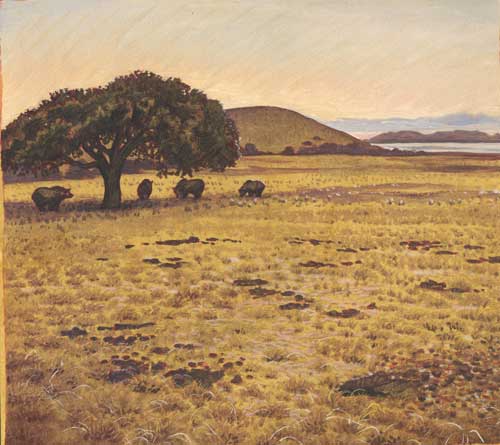
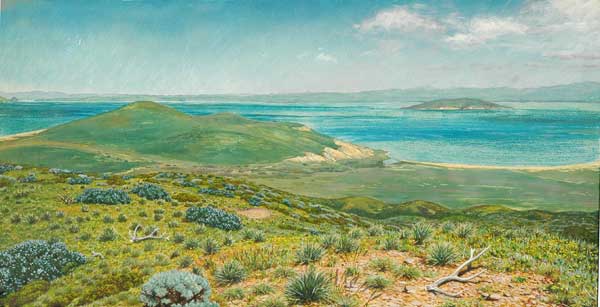
Site of the El Cerrito Plaza with the Albany Hill in the background, centuries ago. Oil painting by Laura Cunningham, with permission
Ms. Cunningham tells the charming story of her first experience with native plant restorations as a teenager in the hills of Berkeley/Richmond in the mid-1980s. With her parents’ permission, she dug up the lawn in their backyard so that she could plant native grassland. She started with the seeds of native grasses that she collected locally and later transplanted native bunch grasses from nearby properties slated for development. After several years of regular weeding and new planting, her small plot resembled the grassland she had envisioned.
When she finished her education at UC Berkeley and began to work further away, her grassland slowly succeeded to shrubs and non-native plants, a process she describes as follows:
“Visiting deer brought weed seeds in on their fur, scrub jays planted live oak seeds into the grass, and flying finches dropped the seeds of Himalayan blackberry in the yard. The latter, a thick, tenacious vine, slowly formed great thickets over the grasses, shading them out in places. The food web had won, although I had learned a lot in the process. I dug up the yard again, back to bare dirt, and gave it back to my parents.”
This personal story is consistent with other local experiences reported on the Million Trees blog:
In “Wildlife” we report the extensive use of non-native plants by wildlife, which then spread the seeds of the plants. This is another natural process that cannot be prevented.
Fire Ecology of California
Those who continue to believe that non-native plants are more flammable than native plants should read Ms. Cunningham’s book, which describes at length the important role that fire plays in California’s ecology. She introduces this topic with the heading, “Chaparral: Burning Like a Torch of Fat.” Charcoal deposits in ancient sediments prove that wildfires in California’s brushlands have occurred frequently for hundreds of thousands of years. Some shrubs, such as chamise, contain resinous leaves that encourage burning. Others, such as ceanothus and manzanita require the intense heat of a fire to germinate. Others will germinate only in the ashes of a fire. As we have said repeatedly on the Million Trees blog, eradicating non-native plants and trees will not eliminate fire from California.
Ms. Cunningham also reports on the modern debate about reducing wildfires in California. Although we are very familiar with this debate, we have not read so clear a presentation of it as Ms. Cunningham provides.
One “camp” in this debate believes that the suppression of wildfires in California has resulted in fuel loads that are much greater than in the past and therefore result in bigger, more damaging fires. This camp believes that fire danger can be reduced by allowing smaller fires to burn and conducting periodic prescribed burns.
The opposing view is that fire suppression has been largely unsuccessful and therefore fuel loads are not substantially greater than they were historically. Wildfires are attributed to hot, wind-driven fire in which fuel load is irrelevant; that is, everything will burn in a wind-driven fire. Although this is the historical fire regime, fires are causing more loss of lives and property in modern times only because of the development of residential communities in the wildland-urban interface. This camp therefore sees no point in prescribed burns and proposes to reduce risk to lives and property by limiting residential developments in wildlands and creating defensible space around residences by eliminating most vegetation.
With humility, Ms. Cunningham declines to choose a side in this debate, acknowledging there is much compelling evidence to support both views.
The Million Trees blog prefers the theory that wildfires are caused by hot winds rather than accumulated fuel loads because our perspective is limited to the San Francisco Bay Area. We don’t think prescribed burns are appropriate in a densely populated urban setting where both pollution and risk of wildfire are major concerns. And, based on our local experience, the only fires that have become raging wildfires are those that were wind-driven. We advocate for reducing fire hazards by creating defensible space and routine maintenance of flammable vegetation litter.
Historical Ecology
San Francisco 500 years ago, looking eastward from the top of Nob Hill. Oil painting by Laura Cunningham, with permission
We are grateful to Ms. Cunningham for giving us permission to publish two of her historical paintings of California. These paintings enable us to confirm that trees were not a conspicuous part of the landscape of the Bay Area. The dominant landscape was grassland and shrubs. Although there may have been more trees if the landscape had not been frequently burned by Native Americans, based on our knowledge of horticultural requirements of native trees, we believe that even in the absence of fire there would have been few trees. The native trees will not tolerate the wind on the hills of San Francisco. Even in places where trees are sheltered from the wind, they must have access to sufficient water to become established.
When native plant advocates demand that non-native trees be destroyed, they frequently claim that non-native trees will be replaced by native trees (even without being planted in some cases). We assume their claims are based either on strategy (i.e., promising “replacement” trees in order to diffuse the opposition of those who like trees) or on ignorance of California’s natural history.
With deep respect, we acknowledge Ms. Cunningham’s impressive knowledge of California’s ecological history and the accomplishment which her book represents. Our thanks to Ms. Cunningham for sharing her lifetime of study and observation of nature with us and rendering that knowledge so beautifully in her paintings.
* Cunningham, Laura, A State of Change: Forgotten Landscapes of California, Heydey Books, Berkeley, California, 2010
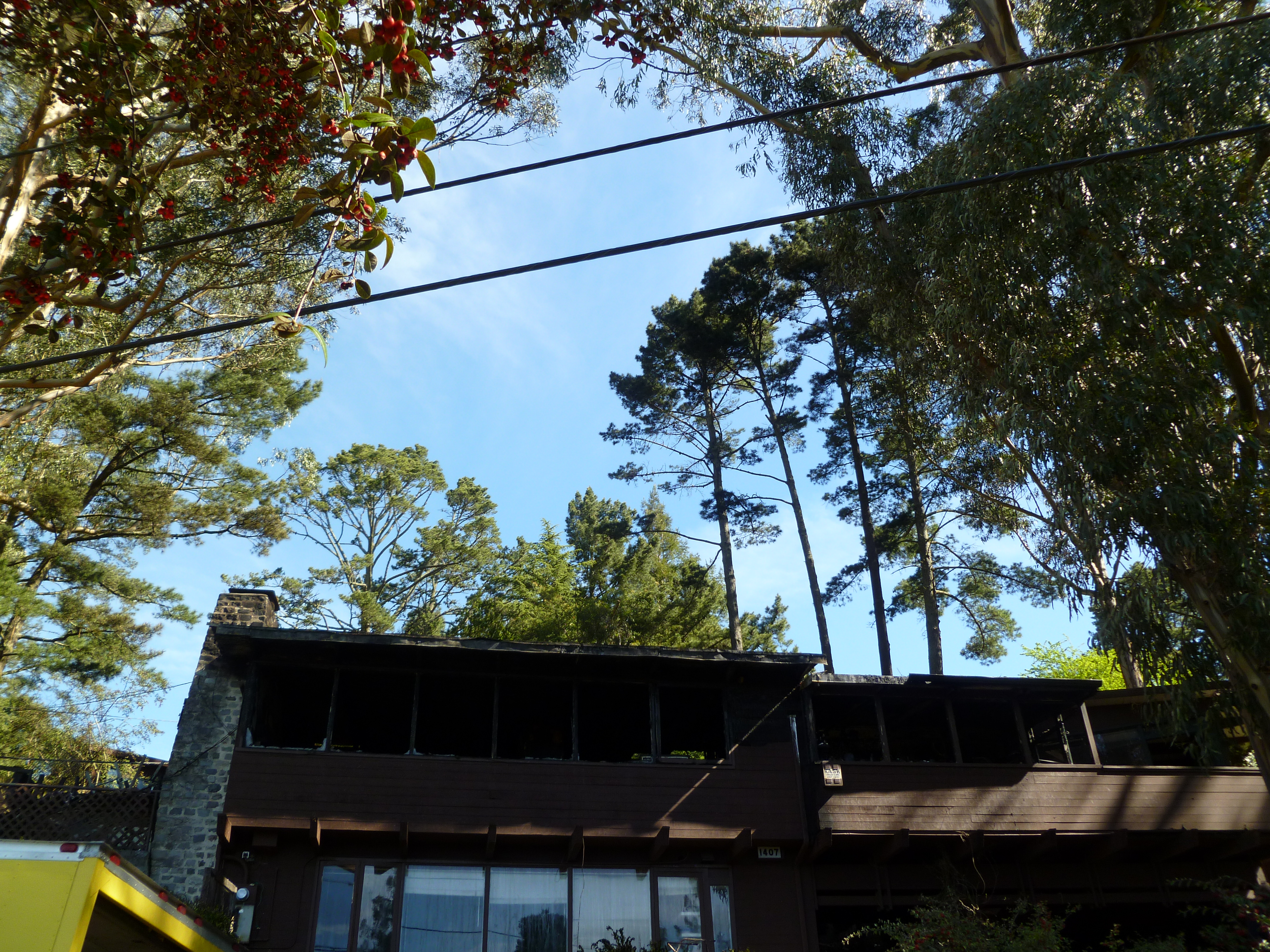
There was a fire in the Berkeley hills yesterday. A home in the 1400 block of Queens Drive was gutted by the fire. The home was completely surrounded by eucalyptus trees, some branches overhanging the home. The trees did not ignite. The leaves do not appear to be scorched by the fire.
Fire on Queens Road
Despite the fact that the trees didn’t burn, the news coverage of the fire focuses on the flammability of the trees: “Eucalyptus trees are especially flammable and often used for kindling because of their oils.” The accusation of flammability is not new. We see it in any news story in which eucalypts are mentioned in any context, even those unrelated to fires.
The claim that eucalyptus is used as kindling is something we have not heard before. In fact, it makes no sense since the oil in eucalyptus is contained in the leaves, not in the wood, which is the usual definition of kindling. However, we are accustomed to new anti-eucalyptus stories being fabricated at every opportunity.
All species of plants and trees will burn under certain circumstances, such as a wind-driven fire on a hot, dry day. Property owners can reduce their risks of wildfire with appropriate maintenance, such as removing lower limbs on all trees, pruning trees and shrubs away from structures, and removing accumulated leaf litter.
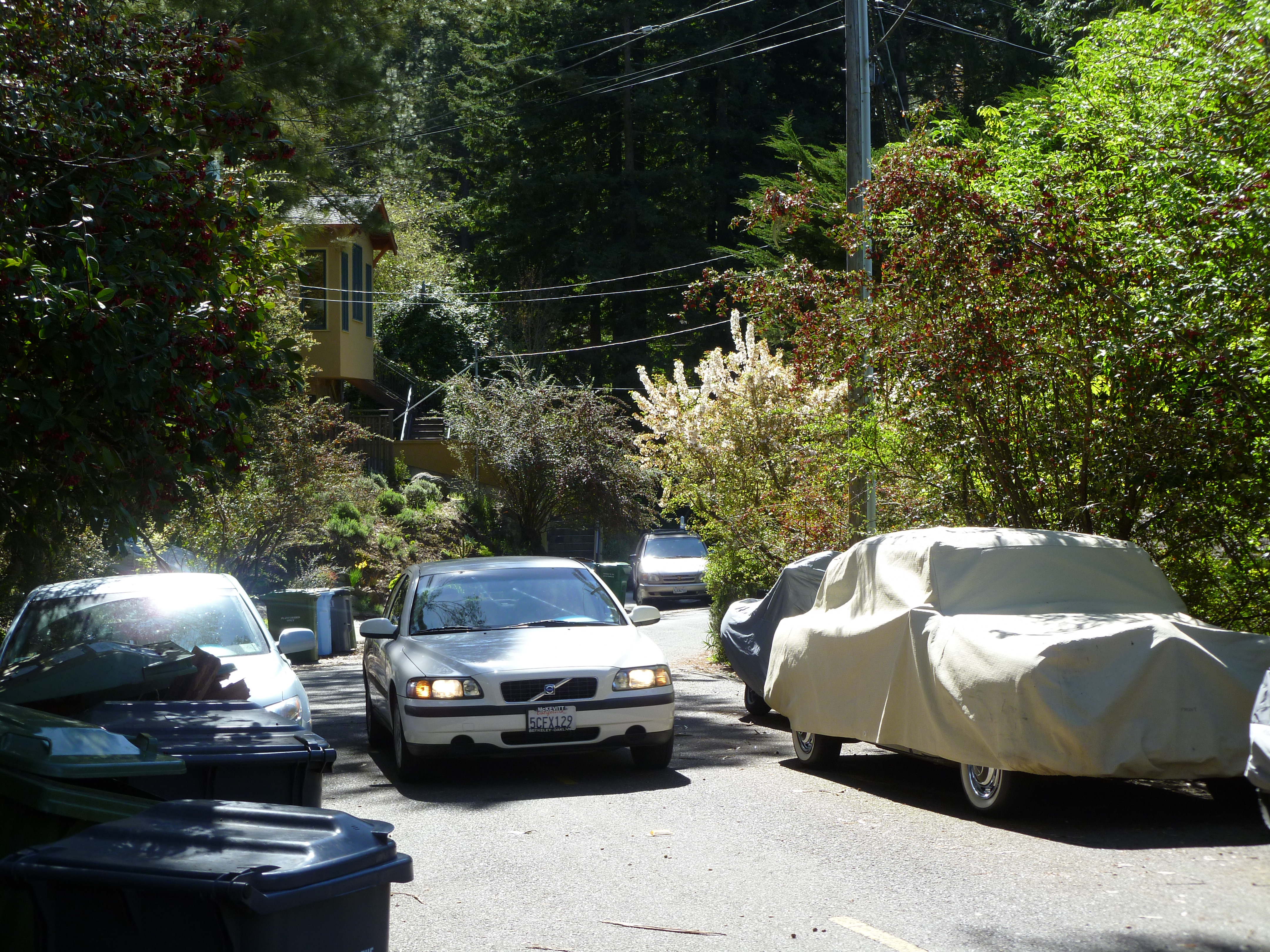
In the case of the fire on Queens Road, the neighbors put themselves in harm’s way by parking cars on both sides of a narrow street, narrowing the road to one-lane which severely restricted access to the home by fire trucks.
Parked cars restrict access on Queens Road
As usual, humans are always looking for a non-human scapegoat for the risks they choose to take. Rather than taking care of the vegetation around their home and reducing the number of cars parked on a narrow road, they prefer to blame the trees. In this case the trees had nothing to do with this fire.
The Pt Reyes Light is one of the last bastions of investigative reporting in the Bay Area. Following its tradition of digging deep into the actions of its biggest neighbor, the Pt Reyes National Seashore (PRNS), it has recently published two hard hitting articles about the massive destruction of eucalyptus on the properties of the National Park Service in Marin County. This two-part article, “Myth of the eucalyptus blight,” is available here and here.
The Light reports that the Pt Reyes National Seashore is destroying between 400 and 600 eucalypts per year. Its neighbor, the Golden Gate National Recreation Area, is engaged in the same eradication effort. The Light repeats the PRNS justification for this destruction and reports the evidence that the justification is fabricated. This justification is based on myths propagated by native plant advocates to frighten the public into supporting the destruction. The myths and their negative impact on our environment are reported and refuted elsewhere on the Million Trees blog:
That eucalypts are not more flammable than native trees and vegetation
There is also much new information in the Light articles, particularly in the quotes of a certified arborist from Berkeley, California, Mark Bowman. Mr. Bowman adds context and clarification to the Light article for the readers of Million Trees.*
In response to the claims that the “shreddy” bark of the Blue Gum eucalyptus provides a fire ladder to its canopy and casts embers long distances from its great height, Mr. Bowman says,
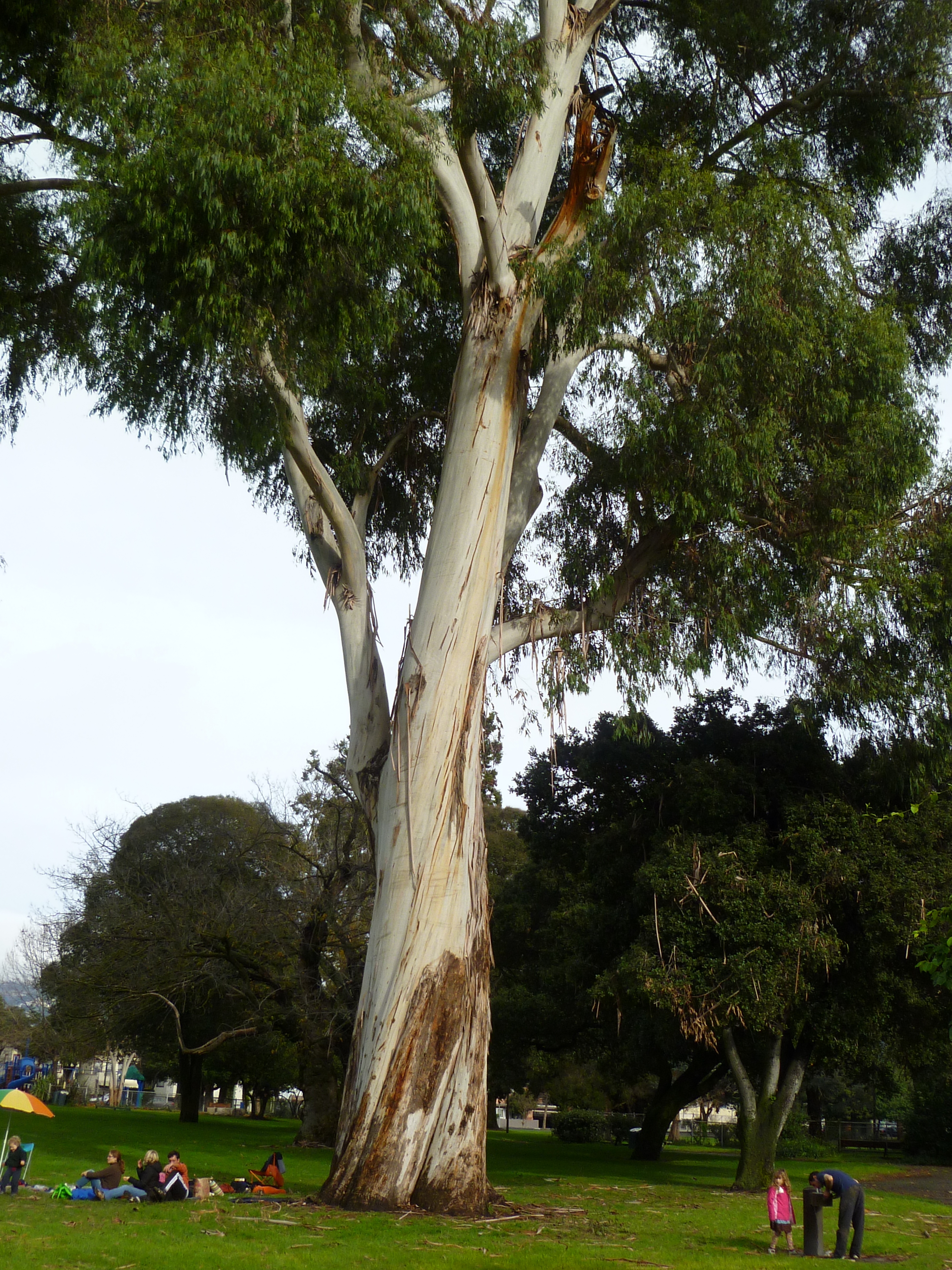
“There are many mitigating factors such as the age and the amount of wind the trees receive which would determine how much bark litter would remain on the tree or be scattered on the ground. In general, the bark that sheds doesn’t reach all the way to the top. It usually tapers off before it reaches the first branches. As a rule of thumb it tends to be most noticeable on the lower 20 feet or so of the trunk and collects around the tree base, which makes it rather easy to pick up if you are worried about fire safety. This may be news to some folks, but there is no such thing as a maintenance free tree unless it is made out of plastic. If you are going to purchase a home in or next to the forest, then you shouldn’t assume you have the right to cut it down; after all you do have a choice to live elsewhere if you consider that environment too extreme for one reason or another.”
Eucalyptus, shreddy bark low on the trunk, smooth bark higher on the trunk, Mosswood Park, Oakland, CA
As an arborist working in that neighborhood, Mr. Bowman is familiar with the area of the 1991 fire in the Oakland-Berkeley hills. He says that theeucalypts were a casualty of that fire, not the cause of it:
“I took care of a property next door to where the fire started and, as I recall, that neighborhood on Charing Cross and Buckingham was comprised predominantly of pine and native oaks, not eucalyptus. If my memory is accurate, then it appears the fire department could not halt the burning of native oaks, dry grass and pines located in that steep terrain in the beginning, before the fire became that inferno, so I don’t understand why eucalyptus is getting this bad rap as a fire starter. There was plenty of blame for that tragedy to go around: the homeowners who failed to maintain their properties; the city, county and state who failed to maintain theirs; and the fire department who failed to put out the blaze the day before. When a fire ignites due to low humidity, hot dry Santa Ana winds, massive amounts of dry grass, shrubs and trees coupled with the steep terrain, there is nothing that is going to stop it but luck. The fuel for that inferno had been obviously accumulating for years on both public and private lands. I saw the smoke that day when I was driving along Grizzly Peak Blvd., and the first thing that came to mind was that ‘it finally happened.’ Anyone who worked in that area in the aboriculture and landscaping fields knew it was inevitable, and never once did I think that the eucalyptus trees were the issue; 20 years later I still don’t. I want to state that I have no expertise in fighting fires; however when a fire gets to the point that even homes being saturated with water burn, then obviously the trees burn too. The fire could care less what species of tree is in its path or whether it was here before 1750 or not. The simplest and cheapest solution to this problem is for: (1) owners of both public and private lands to maintain and clean their properties of dry grass, shrubs and leaf litter and; (2) insist that public agencies in charge of fire prevention use the laws and enforcement codes already on the books for those who fail to comply. Let’s use a little common sense, that way the trees won’t burn. This “native plant is superior” mentality is going to end up being a big taxpayer and/or rate payer fraud with no significant benefits and (more to the point) many guaranteed unintended consequences if this movement is allowed to come to fruition. Grab a hold of your wallet folks.”
Mr. Bowman says that eucalyptus is no more likely to uproot or shed its branches than any other tree of comparable size:
“From a structural standpoint, Blue Gum eucalyptus has no inherent weakness on any below ground or above ground parts endemic to the species which would make it more prone to failure than any other large tree. I have seen no scientific proof, nor do I have any hands on evidence that would lead me to believe that the cellular structure of this species is any more prone to failure from tension, torsion or compression forces than any other species. Just because a large tree may look intimidating in the eyes of some people doesn’t mean it is dangerous, yet there are plenty of tree industry people all too happy to take advantage of that fear. Every tree has its own individual and unique characteristics. It is imperative when you are looking for advice to not take the word of the “Free Estimate” people you talk to without getting a second opinion. Obtain a consultation from someone who has no conflict of interest in that they are not there to try and sell you on their service. Removing eucalyptus or any other tree can be very expensive and sometimes completely unnecessary. I’ve been in business for over 30 years and that experience has proved to me repeatedly that there is an awful lot of hopefully well intentioned but all too often misinformed people giving advice. The best advice would be to consult with an arborist who does not have a vested interest in performing tree work.”
In fact, thinning the eucalypts can in some instances make those that remain more dangerous than they would otherwise be:
“Here again, there are many mitigating factors and situations which have to be taken into account but sometimes leaving them alone can be the best option. There is no doubt that selective thinning of any tree species will reduce the fuel load in case of fire, but at the same time there is a myriad of potential unintended consequences when you undertake this approach: (1) exposing the trees left behind to wind forces their root systems haven’t developed a resistance to, thus making them more prone to blow down; (2) introduction of wood decay organisms and parasitic fungi; (3) invasion of grasses and small understory plants that are more easily ignited, and (4) erosion of steep slopes previously stabilized by the roots of the trees. Since I have mentioned unintended consequences a number of times, perhaps we should learn something from that old adage, ‘If it ain’t broke, don’t fix it.’”
Ironically, the PRNS staff interviewed by the Light actually agrees with Mr. Bowman that destroying the eucalyptus may not accomplish anything. He observes that areas cleared of eucalypts are populated with shrubs that can be equally flammable: “Just getting rid of them doesn’t necessarily solve anything. It’s like swapping one problem for another…Even if it’s a native component, it might be less desirable.”
So, why are we destroying these trees? Clearly we are doing more harm than good. The results are not less flammable. The trees that remain are more dangerous than they were before their neighbors were removed. And the landscape is doused with toxic herbicides.
Perhaps the answer to that question is in the answer to this question: Who benefits from the eradication of non-native trees? The chemical companies that manufacture the pesticides used to kill the trees. The people who make their living destroying trees. The people making their living “restoring” native plants. The employees of the California Invasive Plant Council. etc., etc.
It’s a growth industry, funded by your tax dollars. In the past two years tree destruction on federal lands (GGNRA and PRNS) has been funded by the federal economic stimulus program. How does destroying trees stimulate the economy? Might this money have made a more lasting contribution to our economy if it had been spent repairing or improving our infrastructure?
* Quotes from Mr. Bowman were made directly to Million Trees. Not all these quotes appear in the Light articles. Quotes of PRNS staff are from the Light.
Today, we visited the site of the fire in San Bruno that destroyed 37 homes, damaged many others and killed 8 people on September 8, 2010. The fire occurred because a 30 inch natural gas pipeline exploded, sending a 200 to 300 foot fireball into the sky, according to the San Francisco Chronicle. A federal investigation reported that it took the responsible utility company 1-1/2 hours to shut the supply valves to the burning gas line, so the fireball persisted for sometime, producing intense heat.
San Bruno blast destroyed this home, but the Monterey pines did not burn
Although trees in the immediate area of the blast burned, along with the homes, the fire did not spread into surrounding trees.
Eucalypts on the ridgeline did not burn
The area of the blast is a small valley. The ridgeline of that valley is lined with eucalypts. The fire did not spread into those trees. The eucalypts did not explode nor did they “loft embers” from one side of the ridge to the other, as we are often told they will by those who want us to believe that they are highly flammable and must be destroyed.
Trees adjacent to the blast did not burn
The San Bruno fire is therefore the most recent example of the fire resistance of trees. There are many other examples. An entire neighborhood of homes in San Diego burned in 2003, but the surrounding eucalypts just a few feet away did not ignite.
NY Times reported that 150 homes burned in this wind-driven fire in San Diego in 2003, but the eucalyptus did not burn. NY Times photo
The fire on Angel Island in 2008, twelve years after most eucalypts were destroyed, stopped at the edge of the remaining 6 acres of eucalypts. The eucalypts did not ignite during the fire in the Tamalpais Valley in 2006, according to the National Park Service, which continues to destroy eucalypts anyway, based on a bogus claim that they are highly flammable.
How much more evidence do we need to debunk the myth that eucalyptus and Monterey pine are highly flammable? Since those making this claim don’t seem to be influenced by actual experience, let’s subject their myth to some laboratory science.
The predominant species of eucalyptus in California, the Blue Gum eucalyptus (E. globulus) is native to Tasmania. Scientists at the University of Tasmania conducted laboratory experiments on the plants and trees in the Tasmanian forest to determine the relative flammability of their native species. The Blue Gum eucalyptus (E. globulus) is included in this study. The study reports that, “E. globulus leaves, both juvenile and adult, presented the greatest resistance [to ignition] of all the eucalypts studied. In this case, leaf thickness was important as well as the presence of a waxy cuticle.” Also, in a table entitled “Rate of flame front movement,” the comment for E. globulus leaves is “resistant to combustion.”* In other words, despite the oil content in the leaf, its physical properties protect the leaf from ignition.
Although local native plant advocates still maintain that non-native trees are highly flammable, we are encouraged by the comments of the Environmental Protection Agency (EPA) regarding the FEMA grant applications in the East Bay Hills. These and many other comments submitted to FEMA to identify the environmental issues are now available on FEMA’s website (scroll down to Appendix F). Although the projects propose to clear-cut non-native trees in most areas, the EPA does not consider this necessary for fire safety:
“Include a commitment to leave trees greater than a specific DBH [trunk diameter at breast height] in size, and identify how this should be implemented. Diameter and height are, in effect, measures of tree resistance to fire damage. Large diameter trees are generally more able to withstand wildfire, assuming that surface and ladder fuels have been reduced and the severity of the fire is not extreme. By leaving the largest trees and treating surface and ladder fuels, fire tolerant forest conditions can be created.”
This sensible fire safety policy is finally emerging from the highest levels of government. Surely it is only a matter of time before this common sense approach to fire safety penetrates local levels of government. We can only hope that it does so before our trees are destroyed.
* Dickinson, K.J.M. and Kirkpatrick, J.B., “The flammability and energy content of some important plant species and fuel components in the forests of southeastern Tasmania,” Journal of Biogeography, 1985, 12: 121-134.
Those who are still members of the Sierra Club, but are concerned about the Club’s endorsement of projects to destroy trees and use toxic poisons to kill their roots, might be interested in the Club’s public comment (scroll down to Appendix F “Written Comments) to Federal Emergency Management Agency (FEMA) in preparation for the Environmental Impact Study of four such projects in the East Bay hills.
The Chairman of the Bay Area Chapter of the Sierra Club begins by asking FEMA to ignore those who are critical of these projects: “1. We urge FEMA to discount the views of any individual or group that uses sophomoric name calling tactics in the press or in their FEMA scoping comments to categorize people or advocacy groups as ‘nativists’ (or other similar pejorative labels)…”
Apparently the author does not consider calling someone “sophomoric” an example of “name-calling.” Webster defines “sophomoric” as “intellectually pretentious and conceited but immature and ill-informed.” Hmmm…that sounds pretty insulting to us.
We don’t use the word “nativist” here on Million Trees, not because we consider it an inaccurate description, but rather because we have been told that it offends native plant advocates. Since our goal on Million Trees is to inform, rather than to offend, we stick with the clunky phrase, “native plant advocates.”
What about “other similar pejorative labels?” Does the Club also object to the phrase “native plant advocates?” We are at a loss to arrive at some phrase that would appease them. For the moment, we’ll stick with “native plant advocates” to describe those who advocate for the restoration of native plants to our public lands. After all, the Sierra Club freely admits its preference for native plants in their letter: “We obviously prefer our local native species and plant communities when compared to…introduced species.”
The Sierra Club also instructs FEMA to put the restoration of native plant communities on an equal footing with fire hazard mitigation: “We also urge FEMA to ensure that natural resource protection is given equal status with fire hazard reduction work when final projects are developed.” The letter provides a detailed description of the “natural resource protection” it has in mind. In this context, that phrase translates to “native plant restoration.”
Since the stated purpose of FEMA’s pre-disaster and hazard mitigation grants is to reduce fire hazard to the built environment and the humans who live in it, this doesn’t seem an appropriate request. FEMA’s legal and fiduciary responsibility is to respond to disasters when they occur and to reduce the potential for disasters in the future. FEMA seems to have its hands full doing just that. FEMA’s assigned mission does not include native plant restoration.
As we observed in our post “Open Letter to the Sierra Club,” the Club tends to ignore the fact that the tree destruction for which they advocate requires the use of toxic herbicides. However, in its public comment letter to FEMA, the Club acknowledges the use of such herbicides and endorses their use: “We are not currently opposed to the careful use of Garlon…” On our page about “Herbicides,” we report that the EPA classifies Garlon as “hazardous” and we cite the laboratory research on Garlon, indicating that it is harmful to many species of animals and is mobile in soil and water.
We hope that FEMA will maintain its mandated focus on hazard mitigation, its sole responsibility to the taxpayers. If the taxpayers wish to fund native plant restorations, they should do so by designating an appropriate fund source. FEMA is not an appropriate fund source for native plant restorations.
The Federal Emergency Management Agency (FEMA) has seen through the smokescreen that native plant advocates have created as a pretext for destroying non-native trees in the San Francisco Bay Area. Native plant advocates claim that destroying non-native trees will reduce fire hazard. As taxpayers, and as fans of all trees, we commend FEMA for preserving their limited resources for legitimate disaster mitigation.
In February 2010, UC San Francisco (UCSF) announced that it had withdrawn its application for FEMA funding to destroy most of the eucalypts on 14 acres of the Sutro Forest. When making that announcement UCSF explained that FEMA would require a comprehensive Environmental Impact Study before the grant would be awarded which would result in a two-year delay in the implementation of the project. UCSF preferred to pay for the project with its own funds rather than delay it during the environmental review. Therefore, UCSF withdrew its application for FEMA funding. Since then, UCSF has proceeded with its plans, expanding them to 40 acres, and continues to claim that there is extreme fire hazard in the Sutro Forest which it claims will be mitigated by the project.
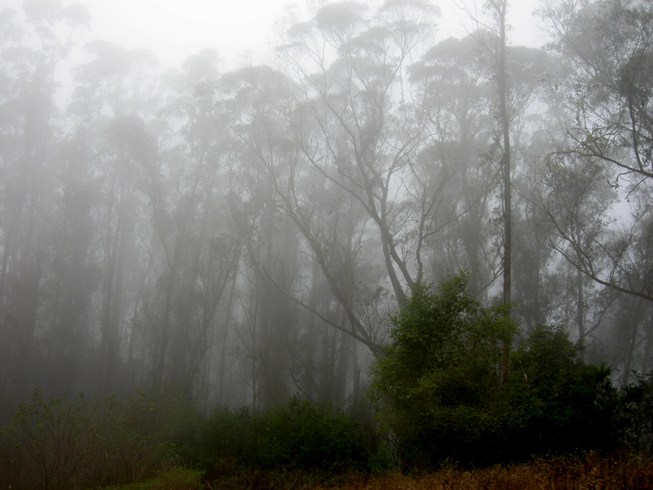
Sutro Forest on a typically foggy day in late summer. Courtesy SaveSutro.wordpress.com
We now know there is more to the story than is revealed by UCSF’s announcement. The neighbors of the Sutro Forest who have been trying to save their forest for over a year, have since obtained correspondence from FEMA regarding UCSF’s grant applications through a public records request. The correspondence with FEMA indicates that:
UCSF misrepresented and exaggerated the fire hazard on Mount Sutro by rating it as “extreme.” FEMA confirmed with the state’s fire authority that fire hazard on Mount Sutro is moderate, CAL Fire’s lowest rating of fire hazard. (1)
FEMA asked UCSF to explain how fire hazard would be reduced by eliminating most of the existing forest, given that: (2)
Reducing moisture on the forest floor by eliminating the tall trees that condense the fog from the air could increase the potential for ignition, and
Eliminating the windbreak that the tall trees provide has the potential to enable a wind-driven fire to sweep through the forest unobstructed.
FEMA asked UCSF to consider alternatives to its project, which would have the potential to mitigate fire hazard to the built environment by creating defensible space around buildings, structural retrofits, and vegetation management projects. (3)
UCSF has elected to ignore this advice from FEMA, choosing instead to proceed with its project as originally designed using its own funds at a time of extreme budgetary limitations. Clearly this is an indication that fire hazard mitigation is not the purpose of their project. UCSF chooses to increase fire hazard rather than reduce it, putting themselves and their neighbors at risk.
FEMA is now engaged in a comprehensive Environment Impact Study of four similar projects in the East Bay hills that propose to destroy hundreds of thousands of trees. The applicants are UC Berkeley, the City of Oakland, and East Bay Regional Park District. Fire hazard in the East Bay is greater than in San Francisco because the summer is hotter, the frequency of Diablo winds is greater, and there are rare deep freezes that cause some non-natives to die back, creating dead leaf litter on the forest floor. However, the remaining issues are the same as those on Mount Sutro:
The loss of tall trees will reduce moisture on the forest floor and eliminate the shade that maintains that moisture. The remaining native landscape will be predominantly grassland studded with scrub, chaparral, and short native trees in sheltered ravines. This will be a flammable landscape, not less flammable than the existing landscape.
The loss of the windbreak provided by the tall trees will enable a wind-driven fire to travel unhindered through the community.
The projects in the East Bay hills do not provide defensible space around homes, which would reduce fire hazard to homes and those who live in them, the stated purpose of FEMA grants.
We hope that FEMA will see the similarity between the East Bay projects and those in San Francisco and advise the applicants in the East Bay to revise their projects so that they are appropriately aimed at creating defensible space around homes. Destroying hundreds of thousands of trees will not make us safer. In fact, it is likely to increase the risk of wildfire.
———————————————————————————-
Sources:
(1) Excerpt from FEMA’s letter of October 1, 2009, regarding UCSF’s grant applications:
“In its response to provide a clarification of the wildfire hazard, UCSF inaccurately interprets a map, provides inadequate details regarding the history of wildfires in the Sutro Forest, and provides a simplistic and ineffective comparison of the wildfire hazard in the Sutro Forest to the hazard in other areas that have burned in the San Francisco Bay Area…The 2007 FHSZ [Fire Hazard Severity Zones] map shows the Sutro Forest to have a “Moderate” wildfire hazard in the 2007 FHSZ maps. “Moderate” is the lowest of the three fire hazard severity zones…”
(2) Excerpt from FEMA’s letter of October 1, 2009, regarding UCSF’s grant applications:
“Commenters argue that the proposed projects would increase wildfire hazard by removing some of the material that collects fog drip and keeps the forest moist and resistant to ignition and fire, thus allowing the forest to dry out more easily and increase the relative hazard for ignition. Can UCSF specifically address this comment and describe how overall forest moisture content will change after implementation of the proposed projects? Please provide scientific evidence to support any claims.”
“Additionally, several of these unsolicited public comments have stated that the proposed projects could result in changed wind patterns on Mount Sutro which could also increase the wildfire hazard in the forest. New wind patterns could reduce biomass moisture as well as reduce the effective windbreak created by the current forest. These comments argue that the effective windbreak created by the existing forest limits the potential for wildfire spread in the forest and the immediately surrounding area. As UCSF has stated, winds are a contributing factor in wildfires. Provide a citable and logical defense regarding how the proposed projects, and the resulting changes in wind patterns, would not result in an increase in the wildfire hazard in the Sutro Forest.”
(3) “Assuming that UCSF has been able to establish a clear need for wildfire mitigation activities, UCSF must conduct a more thorough analysis to identify alternatives to the proposed projects that could mitigate wildfire hazard in the Sutro Forest to the vulnerable built environment. These alternatives must be technically, economically, and legally practical and feasible and can include activities not eligible for FEMA grant funding. As described in FEMA’s Wildfire Mitigation Policy…wildfire mitigation grants are available for defensible space, structural retrofit, and vegetation reduction projects. It would seem reasonable that alternatives to the proposed projects could include defensible space or retrofit projects.” (emphasis added)
Those who have a sincere desire to reduce fire hazards in the Bay Area would be wise to turn their attention away from the distracting and irrelevant debate about the flammability of native compared to non-native plants and trees. California native ecology is dependent upon and adapted to fire. The native landscape is not less flammable than non-native plants and trees. Most firestorms in California are wind-driven fires in which everything burns, including native and non-native trees and plants as well as any buildings in the path of the fire.
Rather, the creation of “defensible space” immediately around your home is your best defense against the loss of your home in a wildfire. Creating defensible space means reducing fire fuels around your home by appropriate pruning and maintenance, such as limbing up trees to remove the fire ladder to the tree canopy and removing leaf litter. Defensible space is intended to slow the progress of fire to your home.
In this post we will visit several reputable sources of information about fire safety that advise homeowners about how to protect themselves, particularly those who live in the Wildland-Urban Interface where fire hazards are greatest. We will see that all these sources of information have in common that they do not single-out specific species of plants or trees. Rather they emphasize that how vegetation is pruned and maintained is more important to reducing fire hazard and that materials we use in building our homes are equally important to our safety. These sources of information are not native plant advocates. Their advice is not based on a desire to destroy non-native plants and trees in the belief that their destruction will benefit native plants and trees.
Firewise Communities is an internet resource provided by the National Fire Protection Association and co-sponsored by the US Forest Service and the US Department of the Interior. This resource offers on-line courses in fire safety. In the course on “Firewise Landscaping” these criteria are listed as the characteristics of fire-resistant plants: low leaf litter, high water retention ability, high salt retention ability, lack of aromatic oils, low fuel volume, height and spread that fits well into the intended space. Some native and some non-native plants fit these criteria and some do not. For example, although the leaves of eucalyptus contain aromatic oils, so do the leaves of the native California bay laurel.
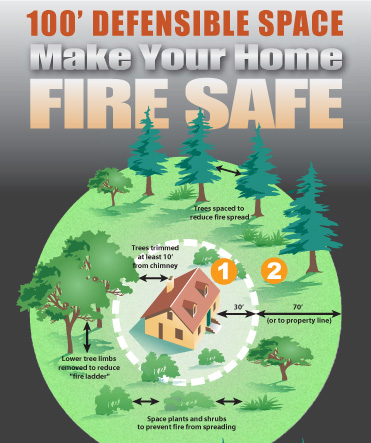
Homeowners in the Wildland-Urban Interface should focus on creating defensible space around their homes rather than on choosing particular plant or tree species. CALFire guidelines for creating defensible space do not advise for or against any particular species of plant or tree. Rather CALFire focuses on how to prune and maintain vegetation around your home and create a “defensible space” around your home with low fuel volume, as illustrated in this brochure on their website.
Creating defensible space around your home. CALFire
Likewise the UC Berkeley Fire Center in their brochure “Home Landscaping for Fire” says, “It is important to remember that given certain conditions, all plants can burn…how your plants are maintained and where they are placed is as important as the species of plants that you choose…landscape management (e.g., pruning, irrigation, and cleanup) have a greater impact on whether or not a plant ignites than does the species.” It is ironic that UC Berkeley is engaged in the destruction of every non-native tree and plant on its property, despite the advice on its own website about fire safety, which is obviously being ignored.
The August 2010 issue of Sunset Magazine includes a comprehensive “Wildfire Survival Guide,” including advice about planting a fire-safe garden.
The City of Oakland passed an ordinance in 2006 requiring homeowners to maintain defensible space around their homes and voters in Oakland agreed to tax themselves to pay for the enforcement of this requirement. Unfortunately, a drive in the Oakland hills informs us that these requirements are not being enforced.
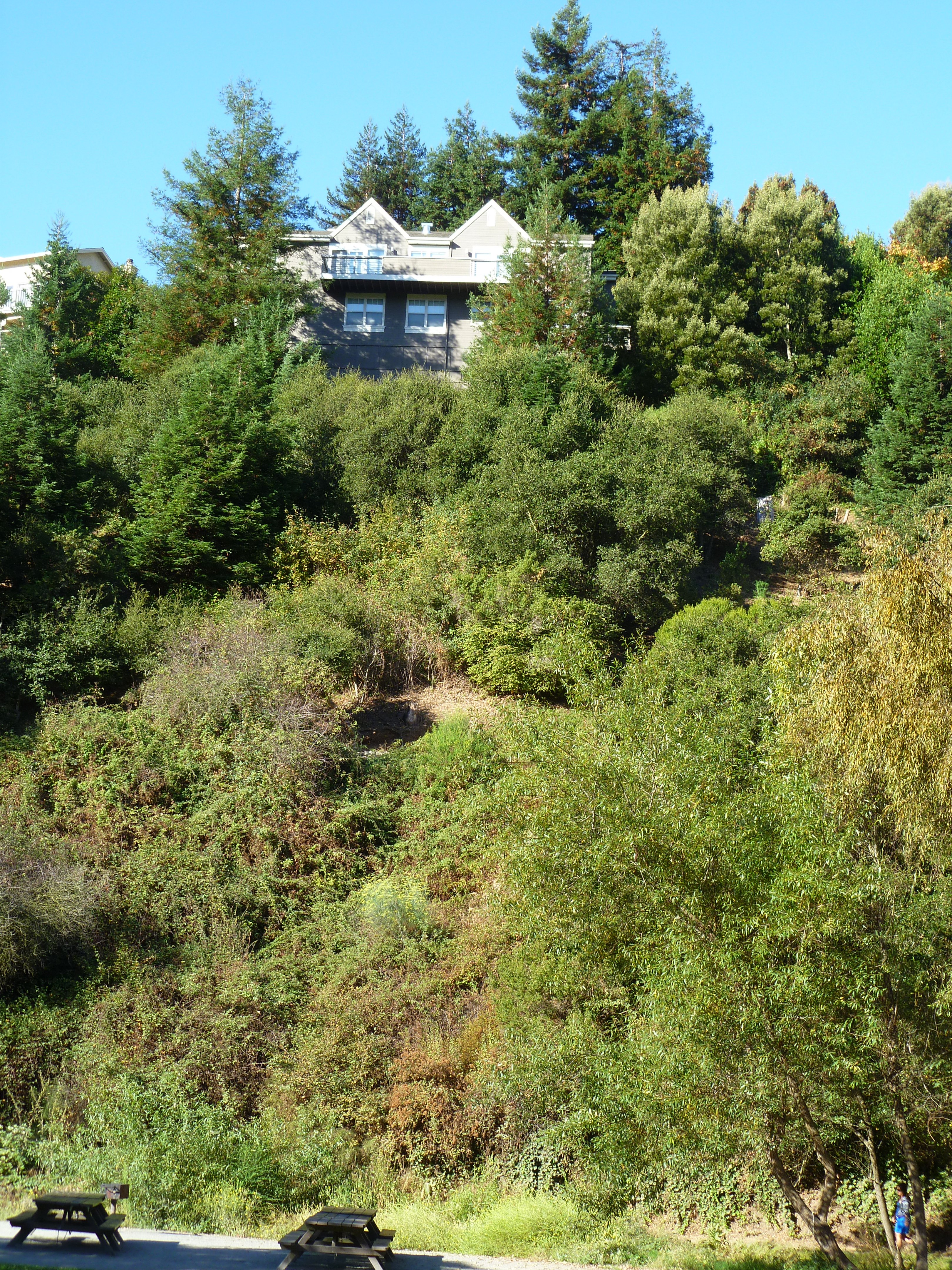
Oakland hills
This home is particularly vulnerable because fire tends to travel up hill. Firewise says that a 30% slope will accelerate the rate of spread of fire to twice the speed of fire on flat ground.
Wouldn’t the people of Oakland be better served by enforcement of requirements for defensible space around homes rather than paying shared costs of $662,280 for a FEMA grant to eradicate all non-native vegetation from 325 acres of wildland? (see “Our Mission, Projects in the East Bay”) Oakland is flat broke and one of the most violent cities in the country. Eighty policemen were recently laid off and 120 more are likely to be laid off if voters don’t vote to tax themselves further. Shouldn’t homeowners be required to create defensible space around their homes where their lives and property are most at risk before “vegetation management” is extended far beyond the perimeter of homes?
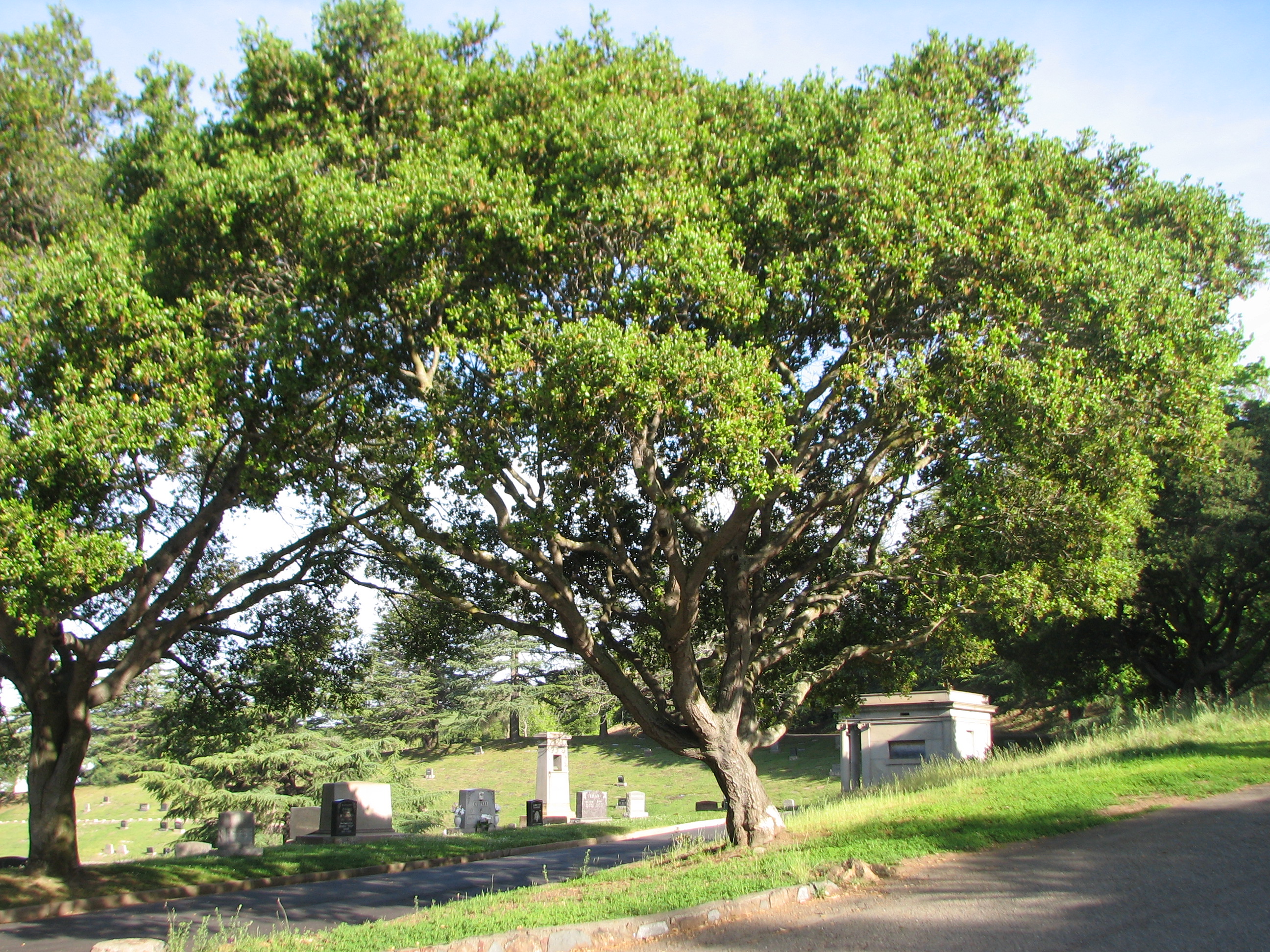
The coast live oak that is native to the Bay Area is one of our favorite trees and we would be happy to see more of them. However, the epidemic of Sudden Oak Death that is killing oaks in California and Oregon makes us question the wisdom of replacing non-native trees with oaks that may not survive that epidemic. Since any dead tree is more flammable than any living tree, we are also skeptical about claims that restoration of the oak-studded grassland will reduce fire hazard in the Bay Area.
Sudden Oak Death, US Forest Service photo
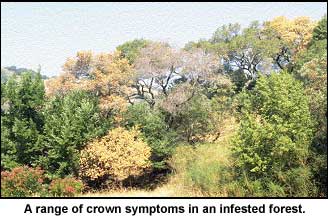
The pathogen (Phytophthora ramorum) that causes Sudden Oak Death (SOD) was reported on the UC Berkeley campus in 2002. At that time it also existed at the UC Botanical Garden and the researcher who identified the pathogen speculated that it probably existed throughout the East Bay. By 2008, the SF Chronicle reported that the infestation of SOD existed in several parks in the East Bay. The researcher estimated that about 20% of all coast live oaks in the East Bay are infected with the pathogen that will eventually kill them.
In February 2008, the California Oak Mortality Task Force estimated that ”millions of tanoak and coast live oak” have been killed by SOD in California. Thirty four other species of trees and shrubs are also infected with the pathogen, including bay laurels and redwoods. Although these species are not usually killed by the pathogen they are vectors of the disease. The bay laurel is singled out by the scientific literature as being particularly effective at transmitting the pathogen to the oaks that are then killed.
The “Wildfire Hazard Reduction and Resource Management Plan” of the East Bay Regional Park District proposes to destroy most non-native trees on over 1,500 acres of parkland. The “vegetation management goal” for most of these acres is the restoration of “oak-bay woodland.” And so we ask these rhetorical questions:
What is the probability that coast live oak will survive the deadly SOD pathogen in the Bay Area?
Does the proximity of bay laurel to the local oak population increase the probability of infection?
If the oaks are killed by SOD will the risk of wildfire in the East Bay hills increase?
If the non-native trees are destroyed and the oaks are killed by SOD will the resulting landscape be entirely treeless?
We believe these are legitimate questions and when we have asked them of native plant advocates we have not heard an adequate answer. We believe that eradicating non-native plants and trees without a clear understanding of the future of the natives, is irresponsible.


 Conservation Sense and Nonsense