“Drought-Adapted Eucalyptus NOT Dying by the Thousand”

Native plant advocates in the Bay Area have always had trouble convincing the public and their elected representatives that it is necessary to destroy every non-native tree in our urban forest.  They have therefore resorted to fear-mongering to convince the public that it is necessary to eradicate all non-native trees for public safety. 

Fear of fire has been effective in the East Bay where there have been fires, although claims they were caused by non-native trees are a distortion of the facts.  For the past year, native plant advocates in San Francisco have been using a variation on that theme to support their demands to destroy all non-native trees.  They now claim our eucalyptus forest is dying of drought and must be destroyed before it causes a disastrous fire.  You can read that story line in Jake Sigg’s Nature News (here) or in his recent public comments to San Francisco’s Urban Forestry Council (here), which is in the process of developing Best Management Practices for San Francisco’s urban forest.

It is our pleasure to republish this post from Save Mount Sutro Forest, responding to those claims.  As usual, it is meticulously researched and documented.  We only wish to add this small bit of common sense: The drought is hard on all plants.  If the drought were capable of singling out one species of tree to kill, it would not be the drought-tolerant eucalyptus. 


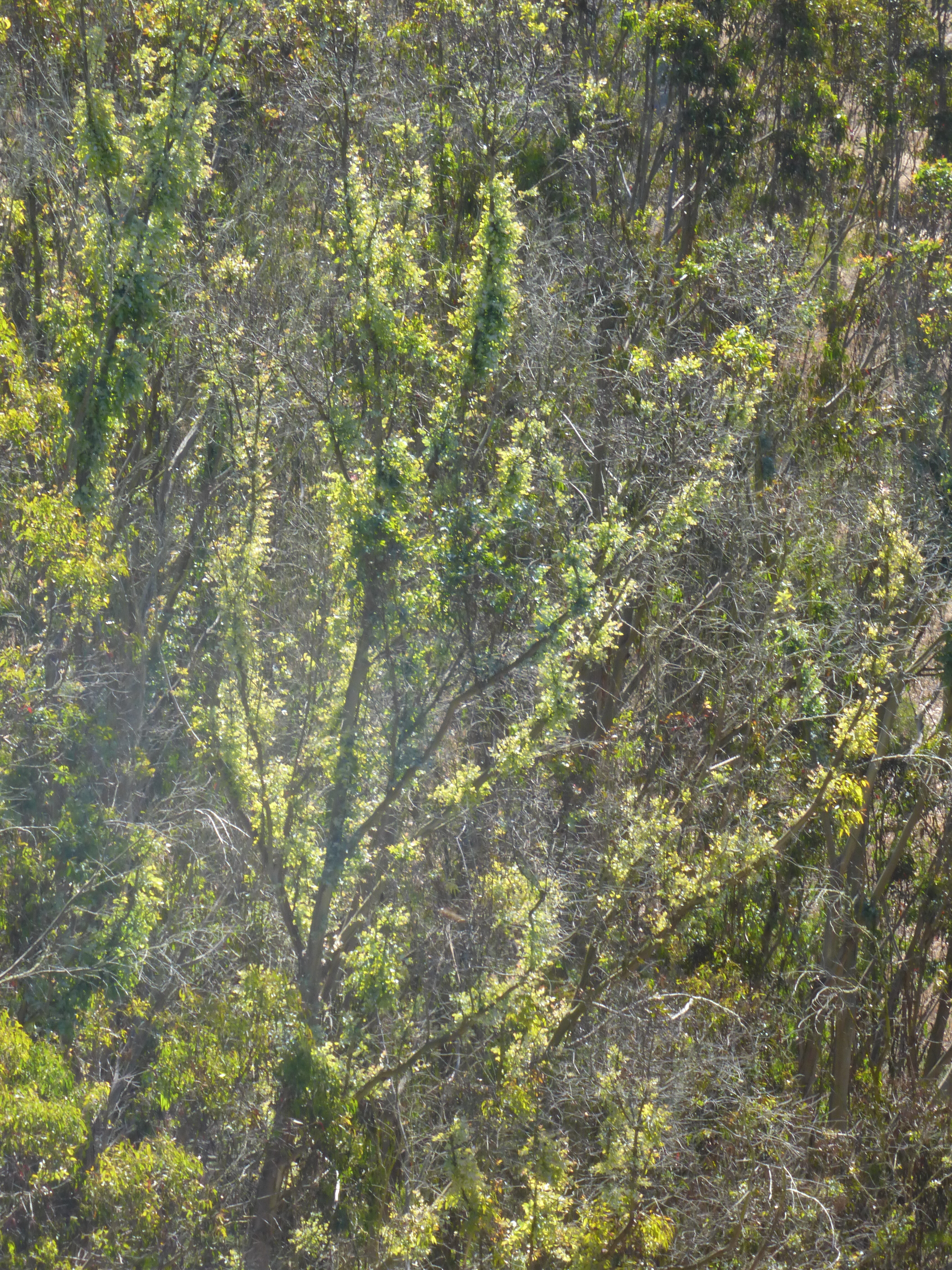
Jake Sigg, retired San Francisco Recreation and Parks Department (SFRPD) gardener who is considered the doyen of the Native Plant movement in San Francisco, has a widely circulated email newsletter. In it, he has been pushing the argument that thousands of eucalyptus trees in San Francisco are dying of drought, as evidenced by epicormic growth on these trees: “2015 is the year of decision, forced upon us by 20,000 to 30,000 dead trees.” He is suggesting they will be a fire hazard and that SFRPD must act, presumably by cutting down the trees. In a recent post, he published a picture of a tree covered in young blue-green leaves, and predicted it would be dead within a year.

But he’s mistaken.

Eucalyptus trees are drought-adapted, and the shedding of mature leaves followed by sprouting of juvenile leaves (epicormic sprouting) is one of their defense mechanisms. These trees survive in areas far drier than San Francisco, where fog-drip provides an important source of summer moisture.

2015-05-27 ab eucalyptus with epicormic growth wordEUCALYPTUS RESPONSE TO DROUGHT

Eucalyptus trees are adapted to drought. They shed mature leaves and twigs so they don’t lose water through transpiration (the tree version of breathing, which takes place mainly in the leaves.) Later, they can replace the lost branches and leaves through “epicormic sprouting.”

Blue gum eucalyptus trees have buds buried deep under their bark. When the tree is stressed, they may shed adult leaves and later sprout new leaves along their branches. When you see a eucalyptus tree that seems to have shaggy light bluish-green new leaves along its branches or trunk – that’s epicormic sprouting.

Here’s what Jake Sigg said in a recent newsletter: “According to arborists, the trees produce these abnormal shoots from epicormic buds when their lives are seriously threatened. In this case, the tree is expected to be dead by the end of 2015. On Bayview Hill, barring heavy unseasonal rain, hundreds of the trees will be dead this year. Yet the City continues to not see a problem.”

We asked UC Berkeley Professor Emeritus Joe McBride and California’s leading expert on eucalyptus for his opinion. He’s observed this condition in trees along the edge of the Presidio forest and explains, “This response is common in blue gum as a mechanism to reduce transpiration rates in order to survive drought years.”

He continues: “I am not convinced that the trees will die in large numbers.

bayview-hill-2010 smTHE GIRDLED TREES OF BAYVIEW HILL

As an aside, we find it ironic that Mr Sigg should be so concerned with dead trees on Bayview Hill, given that’s where nativists girdled hundreds of healthy eucalyptus trees to kill them. Two girdled trees

(This is done by cutting around the tree, thus starving it of nutrients that are carried only in the outer layers of the tree-trunk.) It’s clearly visible in the two photographs here, both taken on Bayview Hill.

EUCALYPTUS ADAPTS

In fact, one of the reasons eucalyptus is so widely planted – including in climates both hotter and drier than in San Francisco – is that it adapts to a wide range of conditions.

Eucalyptus globulus thrives in Southern California, Spain, Portugal, India – all places hotter and drier than San Francisco.

Here’s a quote from R.G. Florence’s textbook, Ecology and Silviculture of Eucalyptus Forests:

florence quoteFrom p.121 of the same book: “… they regulate their water usage in hot dry summers by closing their stomata [breathing pores in the leaves] during the day and lowering their rates of gaseous exchange. They adapt by their elastic cell structure to water stress.”

EPICORMIC SPROUTING IS IMPORTANT IN EUCALYPTUS

Mr Sigg describes “how to identify a dying blue gum” as follows: “Look for trees with thinning foliage and copious juvenile leaves (called coppice shoots) hugging the main stems. These coppice shoots are easy to see because of their blue color and tight clustering, as opposed to the adult leaves, which are 6-8 inches-long, dull-olive-colored and sickle-shaped and which hang from the ends of long branches. These coppice shoots are the give-away that the tree is in trouble and is destined to die soon…” (He later corrected “coppice shoots” to epicormic growth.)

But again, this is not actually true.

In fact, epicormic sprouting allows eucalyptus to survive not only drought, as described above, but even fire. The epicormic sprouting grows into new branches to replace the ones that have been damaged in the fire. This is from Wikipedia: “As one of their responses to frequent bushfires which would destroy most other plants, many Eucalypt trees found widely throughout Australia have extensive epicormic buds which sprout following a fire, allowing the vegetative regeneration of branches from their trunks.[4][5] These epicormic buds are highly protected, set deeper beneath the thick bark than in other tree species, allowing both the buds and vascular cambium to be insulated from the intense heat.[4]”

(The references are: [4] “Effects of fire on plants and animals: individual level”. Fire ecology and management in northern Australia. Tropical Savannas CRC & Bushfire CRC. 2010. Retrieved 27 December 2010. [5] “Learn about eucalypts”. EUCLID – Eucalypts of Australia. Centre for Plant Biodiversity Research. Retrieved 27 December 2010.)

And sometimes, dead branches and leaves and epicormic growth don’t even indicate stress – it’s part of the normal growth cycle. R.G. Florence’s book on eucalyptus says: the “mature crown of a eucalypt maintains itself by the continual production of new crown units, which die in turn. There will always be some dead branches in a healthy mature crown.” He goes on to say an “undue proportion of dead branches is an unhealthy sign” but a “reasonable proportion of death of crown units should be accepted as normal.” He also discusses the “epicormic shoots from dormant buds on the top and sides of the branch develop into leaf-bearing units of the mature crown.” (p.13) Eucalypts go through stages of development that include extensive self-thinning, particularly in younger trees. (p. 194)

Another reason for epicormic sprouts on eucalyptus is increased light. From Wikipedia, with references: “Epicormic buds lie beneath the bark, their growth suppressed by hormones from active shoots higher up the plant. Under certain conditions, they develop into active shoots, such as when damage occurs to higher parts of the plant or light levels are increased following removal of nearby plant. Epicormic buds and shoots occur in many woody species, but are absent from many others, such as most conifers.” [The Wikipedia article references the Encyclopedia Britannica.]

We have seen these epicormic sprouts in eucalyptus trees around the clubhouse in Glen Canyon after many trees were removed.

epicormic sprouts on eucalyptus when nearby trees removed

We also saw them on Mount Sutro near where 1,200 trees were removed for “fire safety.”

MISTAKING DEFENSES FOR DEATH THROES

In summary, then, epicormic sprouting does not indicate that the tree is near death. It may indicate that the tree is responding to drought (or even to other stresses like pesticide use or damage to its root systems) with defensive measures. It’s like declaring that everyone who has a fever is bound to die of it. The trees below are the same ones featured in the picture at the start of this article – one year later, they’re surviving, not dying.

Epicormic sprouting on eucapyptus 2014In some cases, epicormic sprouting may indicate nothing at all, except that the tree is going through a normal growth phase, or changed light conditions following removal of nearby trees.

LIVING WITH A FEW DEAD TREES

We asked Dr McBride if it made sense to cut down these trees. “I do not think the city would be justified in cutting trees down as a fire prevention action,” he says. “Cutting down drought-stressed trees at this point would be much more costly, sprouting would be difficult to control without herbicides, and the litter on the ground would have to be removed to decrease the fire hazard.”

“The problem as I see it is the accumulation of leaves, bark, and small branches on the ground. This material presents a serious fuel problem when it dries out sufficiently.” However, he points out that “In many eucalyptus stands in San Francisco the eucalyptus ground fuel (leaves, bark, and small branches) seldom dries to a point that it can be ignited because of summer fog and fog drip.” In dry areas, the best course is to “launch a program of ground fuel reduction by removing the litter from beneath eucalyptus stands.”

The eucalyptus-tree nest hole of the red-shafted flicker - San Francisco. Janet Kessler
Eucalyptus-tree nest hole of red-shafted flicker – San Francisco. Copyright Janet Kessler

A few trees may indeed die, with the drought or without it. If you think of a forest as a normal population, you expect to find some trees that are thriving and some that are hanging on, and some that are dying – just like in any population. And dead and dying trees are very valuable to wildlife: They’re more likely to have cavities that are suitable for nesting (and are easier to excavate for woodpeckers and other cavity-building species). They also have bugs that come to feast on the decaying wood, and that’s bird-food.
Eucalyptus: A fairy tale

We were browsing in our local used book store when a book caught my eye with the title, Eucalyptus.*  Of course, I had to buy it.  It is fiction, a welcome reprieve from the dry, often dense reading I must do to inform the readers of Million Trees.  Now I have the pleasure of sharing this diversion with you.

A fairy tale told among the trees

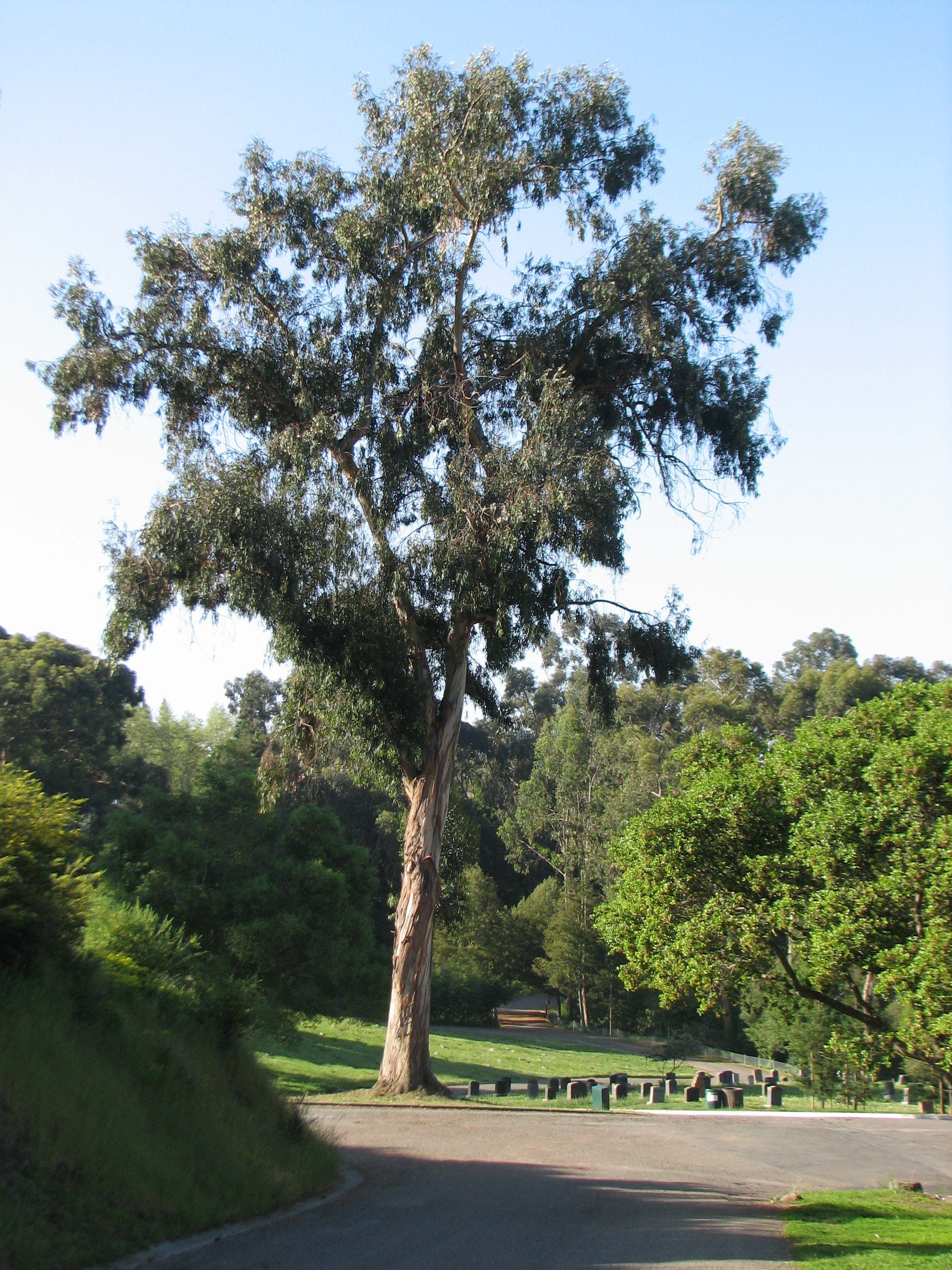
Blue gum eucalyptus tree in the Mountain View Cemetery.

We are in post-war Australia.  A young man marries a mail-order bride and soon loses her in childbirth, but not before insuring her life.  With this windfall, he buys a beautiful piece of land beside a river in southeast Australia.  His life is spent collecting and planting hundreds of different species of eucalyptus while raising his daughter.

The hundreds of species of eucalyptus provide what little structure there is to the book.  Chapters are given the botanical names of the great variety of species and their various shapes and characters are described.  Our very own blue gum is mentioned at length:  “The Blue Gum is easily recognizable.  The name E. globulus for the shape of its fruit, now describes the imperial distribution of this majestic tree:  through the Mediterranean, whole forests in California and South Africa, and all states of Australia.”

The farmer is as devoted to his trees as he is to his beautiful daughter, so when the young men start coming around to court his daughter he protects her by devising a scheme that renders her nearly unattainable.  He announces that the man who wins his daughter’s hand must first name every species of eucalyptus on his property.  This proves an insurmountable task, but his daughter is indifferent to the failures of a long line of men who come from all over Australia to see her legendary beauty, but fail over many years to pass the test.

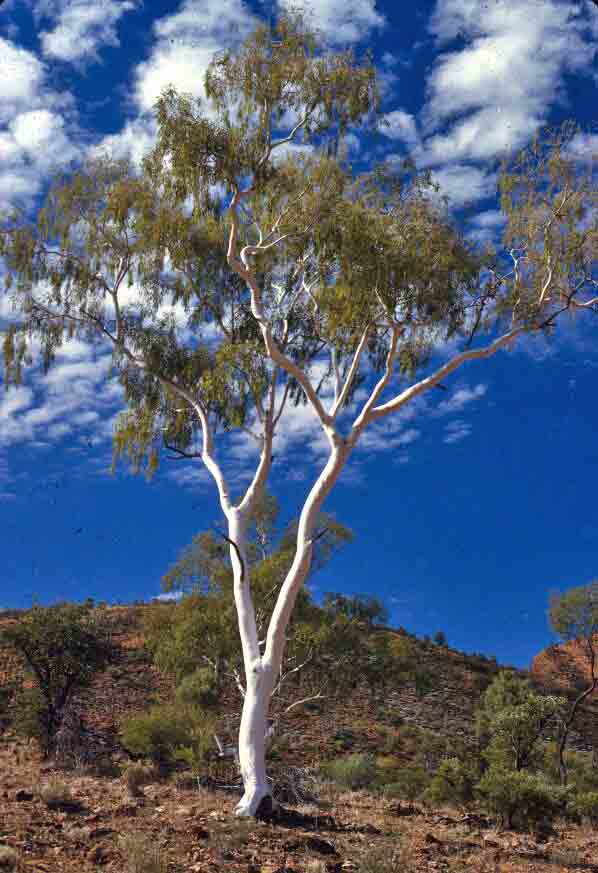
Ghost Gum.  Courtesy Cynthia Clampitt, Waltzing Australia
Ghost Gum. Courtesy Cynthia Clampitt, Waltzing Australia

Finally, a uniquely qualified botanist presents himself to the challenge.  It becomes apparent that he will pass the test.  While the father and this botanist tick off the list of hundreds of eucalypts, a mysterious stranger visits the daughter in the forest.  He tells her stories that charm her.  For the first time in her life, someone interests her.  He brings to her his knowledge of a wide world full of unusual lives and human predicaments.

When the stranger suddenly disappears without explanation, she falls into a deep stupor.  Meanwhile, the botanist passes the difficult test and comes to claim his bride.  But she languishes in despair and he is unable to revive her.

We must leave the story here, because the end is a wonderful surprise of which we do not wish to deprive you.   It was a great pleasure to read about our trees where they are respected and admired, as they deserve to be here as well.


*Murray Bail, Eucalyptus, Melbourne, Australia, 1998

Understanding the eucalyptus forest – Professor Joe R. McBride

This article has been republished from the  website of Save Mount Sutro Forest, with permission.


Dr. Joe McBride of UC Berkeley spoke at the Commonwealth Club in April 2014 as part of the series “The Science of Conservation and Biodiversity in the 21st Century.” His main message:

  • Eucalyptus groves in California provide habitat for as many native species as do most ‘native’ habitats.
  • They grow well at high densities and an average spacing of 8 feet between trees is quite typical.
  • They have relatively high fuel loads, but the cool and damp dense eucalyptus forests reduce the risk of fire.
  • Eucalyptus is subject to few diseases or pests, and parasitic wasps provide pest control.
  • It provides a host of ecosystem services including carbon sequestration, pollution reduction, slope stabilization, windbreaks, wildlife habitat, and recreational value.

Dr. Joe R. McBride was Professor of Landscape Architecture and Environmental Planning, Department of Environmental Science, Policy, and Management, UC Berkeley. (He has since retired.)

Read on for notes from Dr. McBride’s talk. (There are also links to his Powerpoint presentation.)

—————————————

sutro forest with dappled sunlight

THE HISTORY, ECOLOGY AND FUTURE OF EUCALYPTUS PLANTATIONS IN THE BAY AREA

Notes From a Talk By Dr. Joe R. McBride

Dr McBride’s wide-ranging talk covered a lot of ground. He talked about the ecology of the eucalyptus forest in the Bay Area: its structure, the variety of plants and animals that live within it, its health and the ecological functions it performs; the dynamics within these forest stands; and their invasive potential.

WHY EUCALYPTUS CAME TO CALIFORNIA

Eucalyptus was first planted in California during the Gold Rush, possibly for oil to use in eucalyptus king of the forest smgold-mining and in medicine.

In the 1870s, eucalyptus planting was encouraged for many objectives: to beautify cities, to improve farmland, as windbreaks, and to dry out swamps to combat malaria.

It was grown in woodlots for firewood, but as people switched to natural gas and other fossil fuels this became rare. Later, it was planted for timber – which didn’t work out because the trees were harvested too young; and still later for bio-fuel, which did not become commercially attractive.

By the 1950s, it had become an integral part of the California landscape. Six species were planted, primarily blue gum in Northern California, and red gum and river gum in Southern California. (Worldwide, there are perhaps 640 species.)

Eucalyptus beautifies our cities, and helps stabilize soil on steep hills. The surface area of the leaves, broader than those of conifers, help trap particulate pollution. Unlike deciduous trees, the evergreen foliage of eucalyptus removes pollutants all year long.

HOW DENSE MAKES SENSE?

The density of eucalyptus plantations in Bay Area ranges from 150-160 trees per acre to about 1700 trees per acre. mt davidson understory(The highest density resulted from a freeze in 1970s: trees were cut down because of the perceived fire hazard, but the trees presumed dead later resprouted.) On Angel Island, the normal density was 8ft spacing (about 680 trees per acre) but it ranged to 30 feet between trees.

In the East Bay, 8 ft. x 8 ft. is quite typical eucalyptus plantation density. Left to grow naturally, stands become denser through in-growth, mainly by sprouting and also by sibling establishment.

Is management by thinning necessary for the health of the forest, someone asked, and what density is ideal?

Dr McBride had seen no examples of stands that could be improved by thinning. Eucalyptus grows well with a high density at an average of 8 ft x 8ft spacing between trees. In Australia and New Zealand no one thins; they just harvest the trees and let them regrow from sprouts.

In the US, eucalyptus was not marketable, so there’s no history of managing eucalyptus plantations. Also, until recently there were no diseases or insects. The long-horned borer and the psyllid have now appeared in some places, and thinning is not seen as a solution to these insect problems; they are better controlled by certain predatory wasps.

Logging eucalyptus would mean a lot of ground disturbance and erosion. If the logs are removed, the skid trails can destabilize the soil.

MUCH GROWS UNDER EUCALYPTUS – NATIVE AND NOT

Contrary to popular belief, eucalyptus forests have as many species (or more!) growing in their understory as do oak woodlands. A 1990 survey in Tilden Park found 38 species in the understory of eucalyptus forests (24 native plants; 14 introduced plants), while the oak woodland had 18 species in understory (14 native plants; 5 introduced plants). Only the riparian woodlands in Murray Park are somewhat richer in species than riparian eucalyptus forest (58 species vs 34).  In East Bay eucalyptus forests, California Bay, Coast live oak, poison oak, bedstraw, California blackberry, and chickweed were ubiquitous. The amount of light reaching the ground influences which species can be found in the understory.ferns and blackberry and poison oak

What about allelopathy? Under experimental conditions, eucalyptus litter inhibited germination and growth of cucumber seeds, so eucalyptus litter may be somewhat allelopathic to some plants. But a study from UC Santa Barbara indicates that if eucalyptus litter is removed, within 2 years there’s no inhibitory effect on other plants germinating. And clearly, it isn’t allelopathic to all the species mentioned earlier.

Someone asked whether it would be advisable to “manage eucalyptus stands that have an invasive understory.”

Dr McBride responded: “I have no prejudice against invasive plants. I am an invasive Californian myself.” (There was amused applause.) He continued that each eucalyptus grove is different, so it’s important to look at it on a stand-by-stand basis and measure the fire hazard of eucalyptus plantations against the value of each stand for wildlife habitation, recreation, and wind break functions.

eucalyptus trees in Sutro Forest

In response to a question about whether ivy kills eucalyptus trees, Dr McBride said he has not seen evidence the ivy shades the foliage of eucalyptus trees. He’s seen no evidence of ivy killing eucalyptus, although on Mt. Davidson, he did see ivy growing over trees that had been killed by girdling with an axe or chainsaw.

INSIDE A EUCALYPTUS FOREST

Shading and leaf litter changes the microclimate of a eucalyptus grove. As you move in from the edge to the interior of the forest, conditions change. The species change from the edge to the interior of the forest as the amount of light decreases, so there are different species at the edge of the forest and inside it. A 1980s study in the Presidio compared conditions outside a eucalyptus forest and inside it. It showed:

  • Temperature moderation: Daytime temperature fell an average of 10%, and night-time temperature rose an average of 5%
  • Windbreak: Wind velocity dropped 40%
  • Relative humidity was 5% higher (from the edge to the interior).
  • Shade: Light intensity was 90% lower.
  • Moisture: Precipitation (rain) decreased 12%; but fog-drip (i.e., moisture precipitated from the fog) increased 300%

EUCALYPTUS STORES CARBON

Eucalyptus increases the carbon content in the soil compared to grasslands (Zinke et al, 1988). Its fast growth and large size means it sequesters a lot of carbon in its trunk and root systems.

EUCALYPUS SUPPORTS WILDLIFE

Owlets in an eucalyptus tree nest

Again, contrary to belief, eucalyptus provides a good environment for a wide variety of wildlife. A number of studies demonstrate this.

  • A 1970 study showed many birds make “moderate use” of eucs as habitat and a few birds make “great use” of eucs. (Almost all these species are native.) Birds that make most use: mourning doves; Great Horned Owls, whose range has been extended by CA eucalyptus; Stellar’s jays; yellow-bellied sapsuckers; Allen’s hummingbirds; olive-sided flycatchers; brown creepers; dark-eyed juncos; Audubon warblers.
  • Some reptiles make great use of eucalyptus groves: Southern Alligator lizard and the slender salamander. Among mammals, deer mice make “heavy” use of eucalyptus.
  • photo credit: Janet Kessler
    photo credit: Janet Kessler

    Robert Stebbins’ monumental 1978 study on the attractiveness of eucalyptus for habitat in the East Bay found that all species making use of eucalyptus for habitat found eucalyptus about the same as grasslands in attractiveness, but oak/bay woodlands were even more attractive.

  • Monarch butterflies most commonly use eucalyptus trees in state parks. But some of the insects in eucalyptus hurt the trees. One is the eucalyptus long horned borer – but can be controlled by a parasitic wasp. The red gum lerp psyllid is more of a problem in Southern California, which has more red gum. However, it’s part of the food chain: woodpeckers and other bird species feed on their larvae.
  • A study showed that eucalyptus in a riverside environment doesn’t impact species diversity of stream insects or pollution tolerance compared with native riparian environments.

NATURAL SUCCESSION IN EUCALYPTUS?

Over the next 200-300 years, the eucalyptus forests in the East Bay could gradually – and naturally – shift to oak-bay woodlands. In the East Bay (though not at Mt. Davidson or Mt. Sutro), the eucalyptus plantations have California Coast live oaks and California bay trees in the understory, and they are doing well. The live oaks are “tolerant” of shade and the bays are “very tolerant” of shade. If they aren’t disturbed, the oaks and bays regenerate well in the understory, and being even longer-lived than the eucalyptus trees, they will eventually naturally succeed the eucalyptus. The bay tree is higher in regeneration than the Coast live oak in Tilden Park (McBride, 1990).

WHAT ABOUT FIRE HAZARD?

fog in mt sutro cloud forest sept 2013Eucs support considerable fuel load on the ground because of rapid decay of foliage and shredding of its bark. They have a higher fuel load than California bays or Coast live oaks. They release an aromatic compound that can ignite with sparks, and they burn hot.

However, while the tree density of eucalyptus plantations can mean a greater accumulation of fuel in the understory, the higher density means a cooler, wetter understory that might not dry out as fast. Three risk factors in fire risks of any tree: amount of fuel it produces; tissue moisture content; fuel ladder based on presence of other plants in its understory.

IS EUCALYPTUS INVASIVE?

Under certain circumstances, eucalyptus can spread – for instance, on Angel Island, some stands spread through road cuts and prescribed burns (which destroyed competing vegetation). However, in most cases they don’t: aerial photographs show that boundaries are stable. The eucalyptus forests on Mount Davidson and in Tilden Park show stable boundaries.

mt D comparison 1927 -2010In the Bay Area, Dr McBride found eucalyptus forest area declined between 1939 and 1997. The natural spread hasn’t increased the area of eucalyptus groves.

DO TREES DEPLETE AQUIFERS?

Someone mentioned attending a talk where the speakers said that tree removal would help to replenish aquifers. Was that true? Dr McBride thought it very unlikely; most aquifers are much deeper than tree roots.

WHAT ABOUT PESTICIDES?

Someone speaking for people with disabilities owing to chemicals said herbicide use in these areas violated their right to access, and wondered how “environmental” organizations – like the Sierra Club – could support this. Dr McBride sympathized, said he was also concerned about toxic herbicide use. He mentioned that the East Bay tree-felling project is on hold owing to a number of unanswered questions that would need further research.

Here are links to his Powerpoint presentation in ppt and pptx formats.
PPT: McBride Presentation – Eucalyptus
PPTX: McBride Presentation – Eucalyptus

Here is a link to the audio notes taken by a member of the audience


Birds and butterflies in the eucalyptus forest

The deadline for sending comments to the California Invasive Plant Council (Cal-IPC) about their draft reassessment of blue gum eucalyptus is Thursday, July 31, 2014 (send to info@cal-ipc.org).  We are hoping to inspire you to write your own comment by sharing our personal favorites of some of the goofy statements Cal-IPC uses to justify its classification of blue gum as “moderately invasive.”

Eucalyptus trees do NOT kill birds!

Our regular readers have heard the absurd claim that eucalyptus trees kill birds by “gumming” up their noses or beaks with the nectar of the eucalyptus flowers.  We have published detailed critiques of this claim, so we won’t repeat them because you can visit those posts by clicking HERE and HERE.

Of course, all of this detailed information was provided to Cal-IPC when the original request to reconsider their classification of blue gum was submitted in December 2013.  In their draft reassessment, Cal-IPC now sinks to a new low by claiming Ted Williams as the source of the claim that eucalypts kill birds.  Mr. Williams writes an opinion column published by Audubon magazine, which is appropriately entitled “Incite.”  In 2002, Audubon magazine published Mr. Williams’s opinion of eucalyptus, which he called “America’s Largest Weed.” 

Ted Williams is not a scientist or a journalist.  He is a commentator. His column in Audubon magazine is not entitled “Insight,” because it is intentionally inflammatory.  It engages in rhetoric and hyperbole in support of Mr. Williams’s opinion.  In an article in High Country News, Mr. Williams describes “Incite” as a “muckraking column” and he calls himself an “environmental extremist.”  Citing Mr. Williams as a source of information undermines the credibility of Cal-IPC’s draft reassessment.  Quoting Mr. Williams on the subject of eucalyptus is a bit like quoting Rush Limbaugh on the subject of immigration.

But let’s be more specific with examples of the absurd statements Mr. Williams makes and the evidence that these statements are not factually correct.

The truth about Anna’s hummingbirds

Hummingbird in eucalyptus flower.  Courtesy Melanie Hofmann
Hummingbird in eucalyptus flower. Courtesy Melanie Hofmann

Cal-IPC’s draft reassessments says, “Williams reported that PRBO found that 50% of the Anna’s hummingbird nests [in eucalyptus] are shaken out by the wind, while only 10% of nests are destroyed by wind in native vegetation.”

Cal-IPC’s quotes from Williams are not found in any publication of the Point Reyes Bird Observatory (PRBO), which Williams claims as the source of the information.  Statements about the nests of Anna’s hummingbird are explicitly contradicted by Cornell Ornithology Laboratory, America’s preeminent research institution of bird biology and behavior:

  • “In the first half of the 20th century, the Anna’s Hummingbird bred only in northern Baja California and southern California.  The planting of exotic flowering trees provided nectar and nesting sites, and allowed the hummingbird to greatly expand its breeding range.”
  • “Anna’s Hummingbird populations increased by almost 2% per year between 1966 and 2010, according to the North American Breeding Bird Survey…The Anna’s Hummingbird is the most common hummingbird on the West Coast, and it has thrived alongside human habitation.  Its range has increased dramatically since the 1930s, when it was found only in California and Baja California.  Thanks to widespread backyard feeders and introduced trees such as eucalyptus, it now occurs in healthy numbers all the way to Vancouver, Canada.”
  • “Females choose the nest site, usually a horizontal branch of trees or shrubs 5-20 feet off the ground (occasionally higher) near a source of nectar.  They often build nests in oak, sycamore, or eucalyptus trees…”
  • “They [Anna’s Hummingbirds] are notably common around eucalyptus trees, even though eucalyptus was only introduced to the West Coast in the mid-nineteenth century.”

In other words, the nation’s most prestigious ornithological research institution tells us that Anna’s Hummingbirds have benefited greatly from eucalyptus trees, which provide both winter sources of nectar not otherwise available in California as well as safe, secure nesting habitat.  Since Anna’s Hummingbirds nest preferentially in eucalyptus, their populations would not be increasing if 50% of their nests were destroyed, as Mr. Williams claims.

Red-tailed hawk nesting in eucalyptus.  Courtesy urbanwildness.org
Red-tailed hawk nesting in eucalyptus. Courtesy urbanwildness.org

Furthermore, the implication that eucalypts provide a less stable nest site than native trees is also explicitly contradicted by a study that Cal-IPC cites elsewhere in its draft reassessment.  Stephen Rottenborn studied the nesting choices and reproductive success of red-shouldered hawks in Santa Clara County.  He found that the hawks prefer eucalypts to native trees and that their nests were more successful when they made that choice.  He attributes that greater success rate to the fact that eucalypts are “large, sturdy trees” that provide “greater stability and protective cover.”

“Fourteen of 27 nests in 1994 and 38 of 58 nests in 1995 were in exotic trees, predominantly eucalyptus.  Nesting and fledging success were higher in exotic trees than in native trees in both years, owing in part to greater stability and protective cover.  Most nest trees in upland areas were exotics, and even in riparian habitats, where tall native cottonwoods and sycamores were available, Red-shouldered Hawks selected eucalyptus more often than expected based on their availability.  Of the habitat and nest-tree variables measured at each nest, only nest-tree height and diameter were significantly associated with reproductive success, suggesting that large, sturdy trees provided the best nest sites.  Red-shouldered Hawk populations in the study area have likely benefited from the planting of exotic eucalyptus and fan palms.” (1)

 Magic!  Turning 2 dead birds into 300

Cal-IPC’s draft reassessment says, “Stallcup reported finding two dead warblers and ‘about 300 moribund warblers with eucalyptus glue all over their faces’ over the years, including ‘a large number of gummed-up Townsend’s warblers, yellow-rumped warblers, ruby-crowned kinglets, Anna’s and Allen’s hummingbirds, and a few Bullock’s orioles. Anyone who birds around eucalyptus trees sees it all the time’ (Williams 2002).”

This particular quote from Ted Williams is easily discredited because Rich Stallcup published his theory about birds being harmed by eucalyptus trees (available HERE).  In this publication, Mr. Stallcup reports seeing just two dead birds (one hummingbird and one ruby-crowned kinglet) in the eucalyptus forest during his long, illustrious career as an amateur birder.  He says nothing about seeing “300 moribund warblers” in his publication.  A small measure of common sense enables the reader to evaluate Mr. Williams’s claim:  If Mr. Stallcup had seen 300 dying birds, why would he say he had only seen 2 dead birds in his published article in which he is trying to make the case for removal of eucalyptus?

Overwintering monarch butterflies use predominantly eucalyptus

Monarch butterflies roosting in eucalypus tree.

Cal-IPC’s draft reassessment says, “Natural experimental evidence from mixed stands (native trees mixed with eucalyptus) show that Monarchs do not consistently cluster preferentially on eucalyptus, and at times, appear to prefer native trees in some seasons and locations. (Griffiths & Villablanca 2013)”

This is a misleading statement because it implies that monarchs have the option of overwintering in native trees.  In fact, the reference cited by Cal-IPC is speaking specifically of three species of native trees with small native ranges:  Monterey pine, Monterey cypress, and redwoodsThe study is reporting observations of monarchs within the native ranges of these three tree species.  These tall trees provide a similar microclimate to overwintering monarchs.     However, the native ranges of these tree species are small.

Monterey pines are native in “three disjunct populations in San Mateo and Santa Cruz counties, Monterey County, and San Luis Obispo County.  The native population of Monterey cypress is significantly smaller:  “The native range of the species was confined to two small relict populations, at Cypress Point in Pebble Beach and at Point Lobos near Carmel, California.” Where Monterey pine and cypress have been planted outside their native range, they are being eradicated by the same public land managers who are eradicating eucalyptus.

For example, when UC Berkeley destroyed approximately 18,000 non-native trees over 10 years ago, many were Monterey pines.  Their plans to eradicate 80,000 more trees include all Monterey pines in the project area.  In San Francisco, the plans (SNRAMP) of the Natural Areas Program propose to destroy many Monterey cypresses on Mount Davidson.  The GGNRA has destroyed about 500 Monterey pines on Hawk Hill in Marin County and many Monterey cypresses throughout their properties.

Furthermore, both Monterey pine and Monterey cypress have much shorter lives than eucalyptus.  Monterey pine lives at most 150 years and Monterey cypress about 250 years, compared to E. globulus, which lives in its native range from 200-500 years.  Therefore, even where they are not being eradicated, they will die long before E. globulus and are unlikely to be replanted outside their small native range by public land managers who are committed to a “natives-only” policy.

We are unaware of any attempts to eradicate redwoods outside their native range, in the few locations where they still exist. They seem to have escaped the wrath of nativism. However, the range of redwoods is very narrow:  “The redwoods occupy a narrow strip of land approximately 450 miles (724 km) in length and 5 to 35 miles (8-56 km) in width.  The northern boundary of its range is marked by two groves…within 15 miles (25 km) of the California-Oregon border.  The southern boundary of redwood’s range is marked by a grove…Monterey County, California.”

Although native plant advocates may be willing to plant redwoods outside their native range, they do not have that option because of the horticultural requirements of redwoods.  Redwoods require more water than Monterey pine and cypress and they do not tolerate wind, which prevents them from being successful in many coastal locations, where monarchs overwinter.  Redwoods cannot be successfully grown south of Monterey County where the climate is warmer and drier than its native range.

In other words, monarchs do not have the option of roosting in native trees in most of the places in California where they overwinter.  This is a more accurate description of the behavior of overwintering monarchs and the alternatives that are available to them in about 300 locations along the entire coast of California, where they have overwintered in the past:

Three types of trees were used most frequently by roosting monarchs:  eucalyptus (75% of the habitats primarily Eucalyptus globulus), pine (20% of the habitats; primarily Pinus radiata), and cypress (16% of the Cupressus macrocarpa).  Twelve other tree species were identified…with a combined prevalence of only 10%…The negative sign for this indicator means that habitats had smaller populations when the roosting tree type was a species other than eucalyptus, pine, or cypress…our long-term analysis showed that abundance has historically been greater at habitats dominated by eucalyptus, pines, or cypress than at those with ‘other’ species.  Stands of these three signature taxa may be more likely to produce a community structure and associated microclimate that increases the residence time of monarchs.  Furthermore, these taxa may produce a more attractive landscape architecture in terms of sensory cues to migratory monarchs arriving in a certain region.” (2)

For the record, we will add that we would be happy to have more Monterey pines and cypress and if public land managers would quit destroying them, we would consider them attractive alternatives to eucalyptus.  However, for the moment, we must assume that the crusade against all non-native trees will continue unabated.

What is your personal favorite?

We have shared our personal favorites with you, but everyone comes to this issue from a different place.  We have been flabbergasted by the unfounded claims that the eucalyptus forest is devoid of life.  We wonder if the people who say that, really believe it.  Or is it just one of the many strategies used to justify their demands that our non-native landscape be destroyed?

Please choose your own personal favorite and write your own comment by Thursday, July 31, 2014.  Are you primarily concerned about the herbicides that are needed to prevent the trees from resprouting when they are destroyed?  Are you concerned about the loss of your protection from wind or noise?   Or do you value eucalyptus as a sight screen or for shade in an otherwise treeless environment?  Are you concerned about the carbon loss that will contribute to climate change?  Please help us to save our urban forest from being needlessly destroyed by telling Cal-IPC why they should take blue gum eucalyptus off their “hit list.”

Thank you for your help to save our urban forest.

Update:  On March 13, 2015, the California Invasive Plant Council published its final reassessment of Blue Gum Eucalyptus (available HERE).  Cal-IPC has downgraded its rating of invasiveness and ecological impact from “moderate” to “limited.”  Although the detailed assessment is less than perfect, the over all rating itself is an improvement.  Thanks to those who sent comments to Cal-IPC.


(1)    Stephen Rottenborn, “Nest-Site selection and reproductive success of urban red-shouldered hawks in Central California,” J. Raptor Research, 34(1):18-25

(2)    Dennis Frey and Andrew Schaffner, “Spatial and Temporal Pattern of Monarch Overwintering Abundance in Western North America,” in The Monarch Butterfly Biology and Conservation, Cornell University Press, 2004.

Tracking down the truth about blue gum eucalyptus

Last week, we told our readers about the California Invasive Plant Council’s (Cal-IPC) draft reassessment of blue gum eucalyptus, Eucalyptus globulus. (available HERE) Cal-IPC is accepting comments on its draft until July 31, 2014 (send to info@cal-ipc.org).  Although Cal-IPC now acknowledges that blue gum has “low invasive potential” and its population is stable in California, it proposes to maintain its over-all classification of “moderately invasive.”  You might wonder how Cal-IPC manages to accomplish this sleight of hand, so we will tell you how its scoring system enables it to maintain its overall rating of blue gum.

Cal-IPC has three main evaluation categories:  “Impact,” “Invasiveness,” and “Distribution,” which are combined to produce an over-all rating.  Cal-IPC’s draft lowers the rating of “invasiveness” to “limited,” but it has changed its rating of “impact” from “moderate” to “severe.”  These changes cancel one another, enabling them to reach the same over-all rating of “moderately invasive.”  In this post, we will focus your attention on Cal-IPC’s opinion of the “impact” of blue gum so that you can see how they arrived at their conclusion. 

Drought is on our minds

Epicormic sprouts on trees in Glen Canyon Park, June 2014

As we told our readers recently, the drought in California is making water use an important issue that is getting a lot of attention, as it should.  Native plant advocates have not hesitated to jump on that band wagon.  For example, they now claim that eucalypts in San Francisco are dying of drought.  With the help of a highly qualified arborist, we evaluated that claim in a recent post and reported that the trees are reacting to the loss of their understory and their neighboring trees, as well as the herbicides used to kill the understory and prevent their former neighboring trees from resprouting from their stumps.

Given this recent experience, we weren’t surprised to find that Cal-IPC has introduced accusations of extreme water use into their assessment of blue gum for the first time, and this new issue helps them to claim that blue gums have a “severe” impact on the environment.  Now let’s drill down into this claim, examine the source of the claim and tell you why we believe this is another bogus issue used to vilify eucalyptus.

Tracking down the truth about water use by blue gums was a bit like a game of gossip.  Starting with the final version of the rumor in Cal-IPC’s draft reassessment, we tracked that version back to its original source.  We found exaggeration at each iteration of the rumor, from its source to its landing in the Cal-IPC draft.  The final version bore little resemblance to the original version.  The original version is over 100 years old and therefore describes circumstances that have since changed substantially.

Exaggerated and outdated description of root structures

Cal-IPC’s draft assessment of “impact on hydrology” is: “Eucalyptus globulus is adept at tapping into deep groundwater, even under drought conditions (DiTomaso & Healy 2007), altering water availability to depths of 45 feet and distances of 100 feet from the trunk.”

The first distortion of evidence occurs with Cal-IPC’s exaggeration of its cited source.  Here’s what DiTomaso & Healy actually said about the roots of blue gum:   “In deep soils with high water tables or other deep soil water source, lateral roots grow toward the moisture source and can deeply penetrate soil to 14 m deep.”  In other words, DiTomaso and Healy say that such deep roots occur only in certain conditions of “deep soil,” “high water table,” or a “moisture source.”

The source of DiTomaso & Healy’s description of the roots of blue gum is a similar statement in Bean & Russo, who wrote an evaluation of blue gum for the Nature Conservancy in 1989:  “Large roots have been discovered at a depth of 45 feet below the surface, and surface roots frequently spread over 100 feet away from the trunk. (Sellers 1910)”

Bean & Russo provide a reference for their statement, which takes us to the original version of this rumor.  A book about eucalyptus in California by C.H. Sellers was published in 1910.  Here is what Sellers actually says about the roots of E. globulus, grown in the State of California

“The root system consists mostly of numerous strong laterals; the tap root rarely penetrates to a depth of more than 10 feet.  Abundant supply of moisture is demanded and as the roots grow quickly toward water Eucalyptus globulus should never be planted near wells, cisterns, water pipes, irrigating ditches or similar water impounding structures.  In loose, sandy or gravelly soils the large lateral roots penetrate to great depth, and extend almost incredible distances.  In digging wells large roots have been discovered at a depth of 45 feet below the surface and the surface roots of large trees frequently spread over 100 feet from the trunk of the tree.” (1)

In other words, the extreme root lengths reported by DiTomaso & Healy are an anomaly, only found in specific conditions and unusual cases.  The roots of E. globulus are “rarely” deeper than 10 feet, according to this original source of information regarding the roots of E. globulus

Contemporary sources which are not trying to make a case against E. globulus describe its roots in a less extreme manner: “Bluegum eucalyptus generally does not form a taproot.  It produces roots throughout the soil profile, rooting several feet deep in some soils.” (Esser 1993)  Also:  Bluegum eucalyptus generally does not form a taproot. It produces roots throughout the soil profile, rooting several feet deep on soils that permit it, or shallowly otherwise.” (Skolmen & Ledig 1990)  Esser and Skolmen wrote their evaluations of blue gum for the US Forest Service.

Bringing Sellers up to date

We will assume that Sellers’s observations are accurate, but we will now consider the possibility that an observation that is over 100 years old may not be relevant to present conditions. For a more contemporary perspective on blue gum, we turn to R.G. Florence, an Australian academic scientist who studies eucalyptus and was also a visiting professor at UC Berkeley.  R.G. Florence helps us to understand why the observations of Sellers may be very different from more recent observations:  “As a tree develops through the sapling and pole stages it will tend to form a main root which penetrates vertically downward, but this main root is rarely significant in a large tree.“ (2) Florence reports that E. globulus uses more water during early stages of growth, when it is growing quickly, than it does as a mature tree.  Sellers was reporting in 1910 at a time when most eucalypts in California were young.  Their roots may have been longer during these early stages of growth.  Since E. globulus has not been planted in California for decades and is no longer available for planting, its root structure at early stages of development is irrelevant to evaluating its behavior in California presently.

Is blue gum drought tolerant?

Cal-IPC denies that blue gum is drought tolerant:  “E. globulus is able to withstand prolonged dry summers by tapping into deep water reservoirs; they do not economize in the use of water but have far-reaching root systems and can extract water from the soil at even higher soil moisture tensions than most mesophytic plants (Pryor 1976, Florence 1996).”

Once again, Cal-IPC misquotes its cited sources.  R.G. Florence does not make the statement that Cal-IPC attributes to him.  Rather, this is how Florence describes the water needs of eucalypts:  “…the eucalypt might be generally characterized as being a drought-tolerant mesophyte, that is, it tends to maintain transpiration and cell metabolism under conditions of developing drought.”  (2)

Florence says drought tolerance and water use varies by species of eucalyptus.  He places E. globulus in this category of drought tolerance:  “coastal zone species with high rates of growth and water use, but with somewhat wider environmental [drought] tolerance.”  He makes these observations about water use by E. globulus:

  • Water use is greatest when the trees are young and generally tapers off as the tree grows, between 10-15 years of age.  As we have said, only mature E. globulus exists in California presently or will in the future.
  • E. globulus has been observed to regulate water use by opening and closing its stomata in response to temperature and moisture:  “Water use may be regulated in this way.” (2)

Pryor’s description of drought tolerance of eucalypts was published 20 years earlier than Florence at a time when variations in drought tolerance of different species of eucalyptus had not yet been studied.  He therefore, does not report on the ability of E. globulus to withstand drought, as Florence does in 1996.  He acknowledges some variability with respect to drought tolerance in genus Eucalyptus, which is consistent with Florence’s later report specifically about E. globulus, although Pryor says nothing specifically about E. globulus.

Self-watering blue gums

Sutro forest on a typical summer day.  Courtesy Save Sutro Forest.
Sutro forest on a typical summer day. Courtesy Save Sutro Forest.

E. globulus was planted most widely along the coast of California.  Most of the coast of California is foggy during summer months, when there is little if any rainfall.  Tall eucalypts are known to condense the moisture in the fog which has been measured to double annual rainfall. (3) In these regions, eucalyptus is essentially self-watering.  Ironically, Cal-IPC acknowledges this self-watering feature of eucalypts:  “The volume of water channeled down the stem is about eight times more than that of falling rain, so soil at the base of trunks receives relatively large quantities of water…” (May & Ash, see “allelopathy” section of Cal-IPC draft).

A recent study conducted in 24 parks in San Francisco measured moisture in the soil in the late summer months (August to September), when the soil would be driest in the absence of fog condensation.  That study reported that the greatest amount of moisture (15%) was found in the parks with eucalyptus forests.  Soil in parks vegetated with grassland or scrub contained significantly less moisture.  In other words, even late in the dry season mature eucalypts were not draining all available moisture from the soil.  Their water needs were met by the condensation of moisture from the fog during the dry summer season. (4)

Please come to the defense of our urban forest!

We hope that we have made the case that the draft reassessment is not a fair evaluation of the predominant tree in our urban forest, blue gum eucalyptus.  We ask that you write to Cal-IPC by July 31st about their biased reassessment.  Tell them why you think our urban forest is important to the environment and the people and animals living in it.  Ask them to remove blue gum eucalyptus from their “hit list” which is being used by managers of our public lands to justify the destruction of our urban forest. 

Eucalyptus forest, Lake Chabot

Thank you for your help to save our urban forest from being needlessly destroyed.

Update:  On March 13, 2015, the California Invasive Plant Council published its final reassessment of Blue Gum Eucalyptus (available HERE).  Cal-IPC has downgraded its rating of invasiveness and ecological impact from “moderate” to “limited.”  Although the detailed assessment is less than perfect, the over all rating itself is an improvement.  Thanks to those who sent comments to Cal-IPC.


(1)    C.H. Sellers, Eucalyptus:  Its history, growth and utilization, published by A.J. Johnston, Sacramento, CA, 1910

(2)    R.G. Florence, Ecology and Silviculture of Eucalypt Forests, CSIRO, 1996

(3)    Page 37, Weather of the San Francisco Bay Area, Harold Gilliam, 2002

(4)    Kevin M. Clarke, et.al., “The influence of urban park characteristics on ant communities,” Urban Ecosyst., 11:317-334, 2008


Californian-Australian Exchange

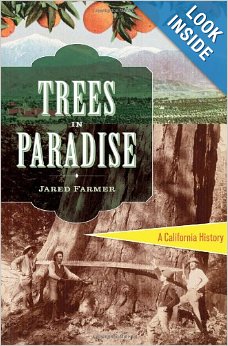
With a little help from our friends, we have discovered a new resource to help us understand why Blue Gum eucalyptus was brought to California from Australia.  True Gardens of the Gods:  Californian-Australian Environmental Reform 1860-1920 was written by an Australian historian, Ian Tyrrell.  Although we have read other accounts of the introduction of eucalyptus to California (most recently Jared Farmer’s Trees in Paradise), the perspective of an Australian on this history was new to us.

Those who despise eucalyptus often portray its introduction to California as a horrible mistake to be regretted and reversed.  Ian Tyrrell helps us to understand that there are actually good reasons for the introduction of eucalyptus that make sense in the context of the geographic and cultural realities of the historical period in which it was introduced. 

Historical geography of eucalyptus introduction

The gold rush in California and Australia occurred nearly simultaneously in 1849.  As these gold rushes played out, there was considerable travel of hopeful miners and their support structures between the two continents.  Naturally, they brought things with them that they considered useful to their enterprises and seeds of the Blue Gum were amongst their baggage from Australia to California.  Although there is speculation about the precise time and means of initial introduction, they remain theories.

Presently we think of Australia as being far away because our primary means of transportation is air travel and that trip is much longer than the trip to the East Coast of the US.  However, at the time of the gold rush, travel by ship was the primary means of transportation and the trip to Australia by ship was much shorter than the trip to our East Coast.  The trip around the horn of South America was both long and extremely dangerous.  In Richard Henry Dana’s Two Years Before the Mast, we share his terror during that voyage in the 1830s.

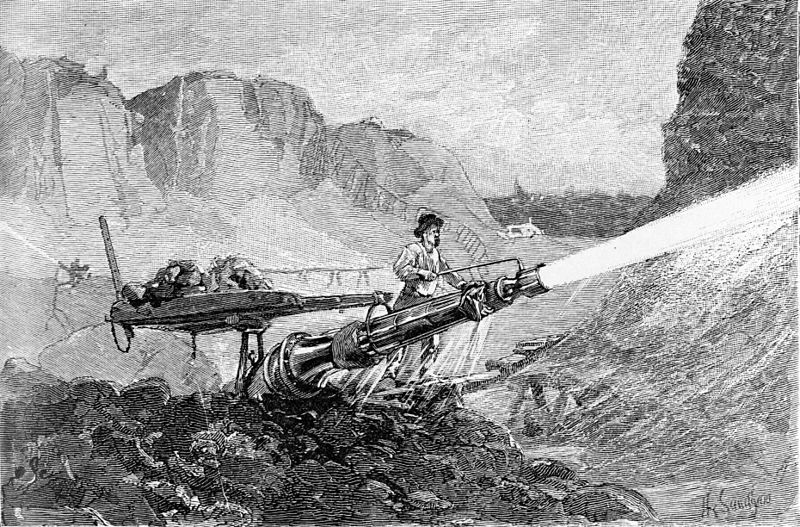
Hydraulic gold mining in California.

This shared experience of a gold rush meant that California and Australia also shared the environmental damage caused by the methods used to extract gold from the land.  Hydraulic mining was the primary method of extraction.  This method uses high-powered water pumps to erode riparian corridors to expose the gold in the soil.  Erosion is the result of this method of mining.

Ian Tyrrell tells us that the initial motivation for planting eucalyptus in California was to heal environmental damage caused by the gold rush.  Eucalyptus was an attractive choice for this task because it grows quickly and is well adapted to California which shares the same Mediterranean climate as much of Australia.  It seems ironic that the initial motivation for planting eucalyptus in California was to repair environmental damage, given that today the same trees are blamed for environmental damage by native plant advocates and mainstream environmental organizations such as the Sierra Club.

Our East Coast remained inaccessible to California until the completion of the transcontinental railroad in 1869.  The Panama Canal (completed in 1914) accommodated movement of large shipments of goods between the West and East coasts.

The cultural context

Tyrrell also introduces us to the intellectuals on both continents who were the environmentalists of the era of the gold rush.  George Perkins Marsh in America and Baron Ferdinand von Mueller in Australia were the environmental leaders of that period.  They were both committed to introducing species to their respective countries to improve the environment by creating “gardens of the gods”:  “These were pragmatic thinkers who leaned toward afforestation rather than preservation when the opportunity presented itself.  Early conservationists were, at bottom, advocates of a constructed landscape that would improve nature, not preserve.  In short, they were advocates for the garden concept.”   (1)

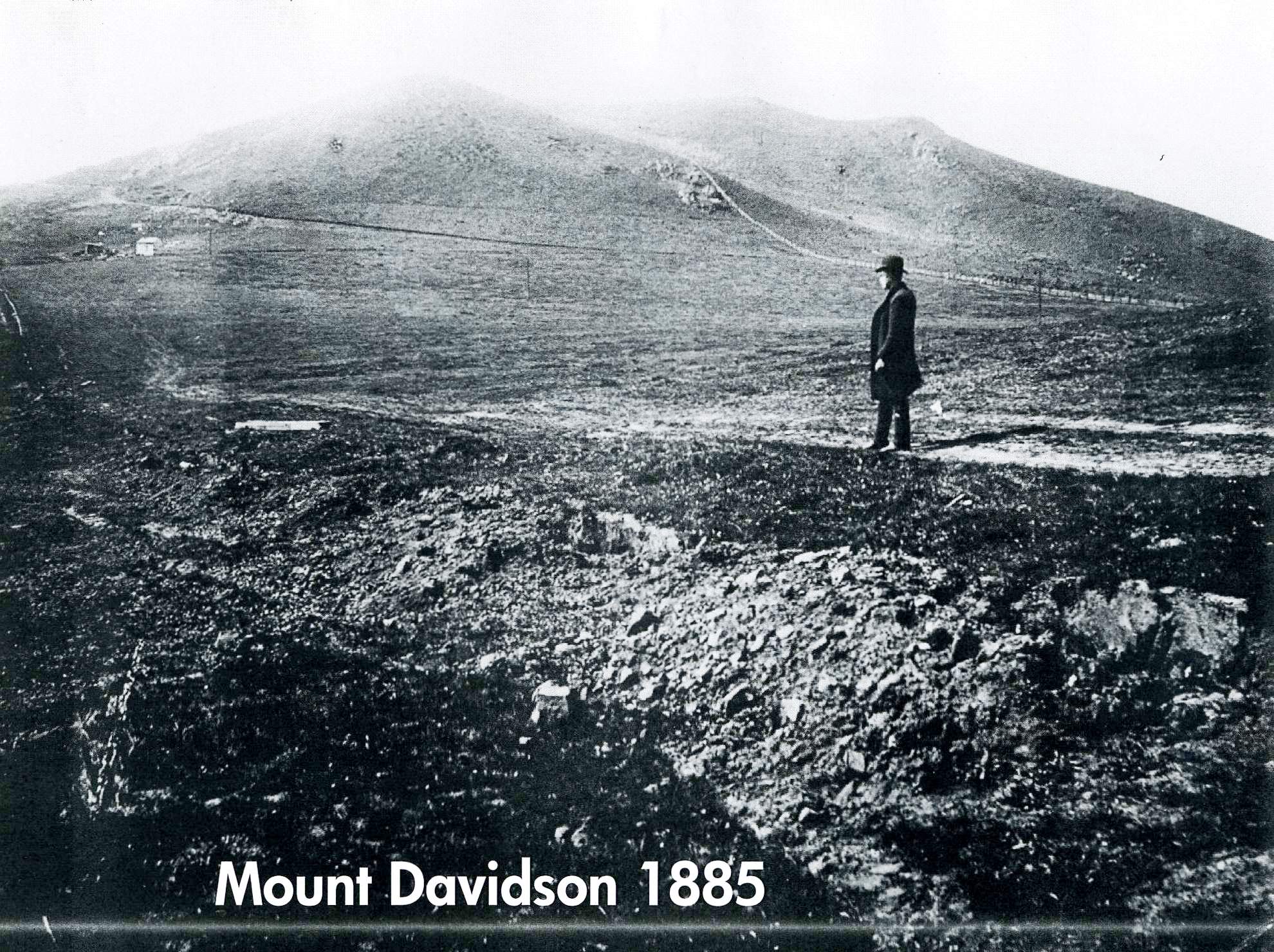
Mount Davidson, San Francisco, 1885.

In California, the desire to import tree species from outside California was supported by the fact that much of California is naturally treeless.  Many species of trees that are native to California are not well adapted to many microclimates.  For example, if you want trees on a windward facing hill along the coast of California, you must plant a non-native.  So, cultural preference for introduced trees was supported by horticultural requirements of native tree species.

Timber famine

A second phase of afforestation with eucalyptus occurred towards the end of the 19th century when there was widespread fear in America that we had severely depleted our timber resources and would soon experience a shortage of timber needed to build our new communities.  Eucalyptus was considered an attractive substitute for native timber sources because it grew quickly.  Plantations of eucalyptus were planted throughout California based on the belief that a valuable market for the timber was just around the corner.

This period of speculative investment in eucalyptus came to an abrupt end around 1914 for several reasons:

  • Young eucalyptus does not make suitable lumber for building purposes.  We have since learned that eucalyptus makes valuable lumber at about 80 years of age.  We have also perfected kiln-drying techniques that produce high-quality eucalyptus lumber.
  • The economic value of eucalyptus forest for timber was also reduced because of the limited ability of eucalyptus to regenerate naturally:  “The eucalyptus bore ‘seeds abundantly, but apparently the latter does not find, as a rule, the proper conditions for germination…Except with the aid of the hand of man, therefore, the eucalyptus will not sensibly encroach upon the treeless area’” (1)  (This is yet more evidence that eucalyptus is NOT invasive, as native plant advocates claim.)
  • The demand for timber declined precipitously when alternative building materials were developed such as iron and cement.

Australia on the receiving end

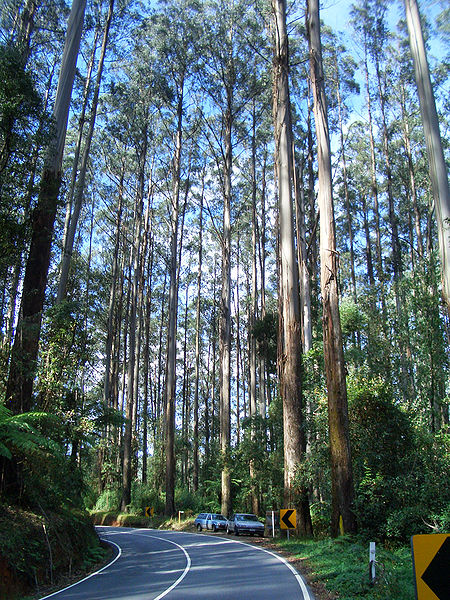
Australian eucalyptus forest (Eucalyptus regnans). Victoria, Australia

As eucalyptus was introduced to California, Australians were importing the Monterey pine for timber.  Monterey pine is planted all over the world for timber.  It is the predominant timber species in New Zealand, but it never became as popular in Australia because it is softwood.  Eucalyptus is a hardwood and Australian’s developed a preference for hardwood that could not be satisfied with Monterey pine.  Unfortunately, that preference for hardwood has decimated the old-growth eucalyptus forests of Australia.

There is a lesson in this for us.  One of the advantages of introducing non-native trees is to protect native forests.  If we use our non-native trees to fulfill practical needs such as lumber and firewood, we are taking the pressure off the need to destroy our native forests.  Eucalyptus is still planted in many developing countries where firewood is still needed for fuel.  Wouldn’t we rather that these countries burn fast-growing eucalyptus than their native forests?

What can we learn from the Californian-Australian exchange?

Environmentalism is a cultural construct.  Its meaning has changed and will undoubtedly continue to change because culture is dynamic, just as nature is dynamic.  Mid-Nineteenth Century environmentalism was not wedded to native species, as is contemporary environmentalism.  Fifty years ago, when Rachel Carson’s Silent Spring was published, pesticide use was considered harmful to the environment.  Now we find that mainstream environmental organizations are actively promoting the use of pesticides to support their demands for eradication of non-native plants and trees.

We tend to look back at historical ways of doing things—such as planting eucalyptus—with a condescending attitude: “How could they be so stupid?”  Another way to look at the past is to look at the historical context in which those choices were made.  If we had sufficient knowledge of the historical context, perhaps those choices would make good sense.

Finally, if we look around the world at what is being planted today, we must acknowledge that planting non-native tree species often has practical advantages.  Non-native tree species might grow where native species won’t grow and where we need trees for windbreaks, visual and sound screens, erosion and pollution control, carbon sequestration, etc.  Or non-native tree species might protect native species by fulfilling specific needs that would otherwise require the use of native species.

As we often do on Million Trees, we reach the conclusion that more knowledge often results in more tolerance.  Thanks to Ian Tyrrell for these insights and to our friends for alerting us to this valuable resource.


(1) Ian Tyrrell, True Gardens of the Gods:  Californian-Australian Environmental Reform, 1860-1930, University of California Press, 1999

Eucalyptus in the news

Because our mission is to inform our readers of the many projects all over California that are destroying non-native trees and vegetation in order to “restore” the native landscape of grassland and dune scrub, we are obligated to tell many sad stories.  So, we are always pleased when we have the opportunity to relay some good news for a change.  In this post we will tell you about several articles in the media that have treated our non-native landscape, as well as those who defend it, with more respect.

High Country News

Taking these articles in chronological order, we’ll start with an article in the High Country News which was published December 23, 2013. (1)  We considered it our Christmas present!

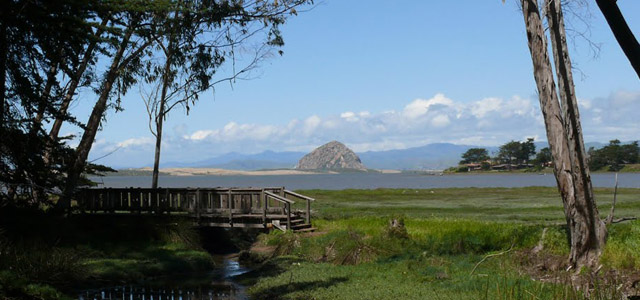
The article was informed by Jared Farmer’s Trees in ParadiseWe have reported extensively about this book, so we’ll leave that information aside to focus on what is new in this article.  It is written in the context of a specific project which had originally planned to destroy about 120 of 450 eucalypts on a 32-acre preserve managed by the Morro Coast Audubon Society.  The Sweet Springs Nature Preserve is in Los Osos, California, near San Luis Obispo.

Sweet Springs Nature Preserve, Los Osos, California

When the project was announced, defenders of eucalyptus objected:  “the Morro Coast Audubon Society was so stunned by the outcry when it filed for a county permit to remove some of the…blue gums that they put the project on hold,”  The defenders of the eucalypts are treated with respect by the author of the High Country News article.  She portrays the controversy as a question of different conservation priorities.  The eucalypts are serving a population of monarch butterflies and raptors.  Those who want to destroy the eucalypts believe they are shading out rare native plants that would theoretically serve a different species of native butterfly.  The author implies that these are all worthy goals.

She seeks the advice of a local scientist, Matt Ritter of Cal Poly State University in San Luis Obispo.  He tells us that  of the 38 species of eucalyptus that are widespread in California, only 18 have naturalized and only two—blue gums and red gums—are considered “moderately invasive, and then only in places refreshed by perennial moisture in the form of streams, springs or summer fog. “  He shows the author photographs of a place where eucalypts spread at a rate of 2 feet per year during the period 1931 to 2001.  Mr. Ritter concedes that that isn’t a particularly fast rate of spread compared to other plants.  For example, we wonder how it would compare to the spread of coyote brush into grassland that isn’t burned periodically to prevent natural succession to shrubs.

The article isn’t specific about the location of the photographs except to say it is “150 miles north” of San Luis Obispo.  That would put the location south of Santa Cruz.  That technique was also used In “Vegetation Change and Fire Hazard in the San Francisco Bay Area Open Spaces” by William Russell (USGS) and Joe McBride (UC Berkeley). (2) They used aerial photos of Bay Area parks taken over a 60 year period from 1939 to 1997, to study changes in vegetation types.  They studied photos of 3 parks in the East Bay (Chabot, Tilden, Redwood), 2 parks in the North Bay (Pt Reyes, Bolinas Ridge), and one on the Peninsula (Skyline).  These photos revealed that grasslands are succeeding to shrubland, dominated by native coyote brush and manzanita.  Eucalyptus and Monterey pine forests actually decreased during the period of study.  In those cases in which forests increased in size, they were native forests of oaks or Douglas fir.  In other words, they found no evidence that non-native trees are invading native trees or shrubs. 

The High Country News article ends with this happy ending:  “…the Morro Coast Audubon Society board backpedaled on its plan to remove blue gums.  While approving the removal of small trees—those with trunk diameters of eight inches or less—it took the larger trees off the table.  Flagged as exceptions to be considered on a case-by-case basis were trees that pose risks to life or property.”  This is the kind of compromise that we hope will ultimately resolve this conflict.  This particular compromise is especially welcome because a chapter of the Audubon Society made this decision.  We hope that the Bay Area chapter of the Audubon Society—Golden Gate Audubon—will note this compromise and learn from it.  To date, they have reflexively supported every destructive project in the Bay Area. 

High Country News is often quoted in Jake Sigg’s Nature News, which suggests it is influential with native plant advocates.  We hope this even-handed treatment of those who object to the destruction of eucalyptus will come to their attention.

San Francisco Chronicle

Trees in Paradise, by Jared Farmer

On Sunday, January 12, 2014, the San Francisco Chronicle published an op-ed by Jared Farmer, the author of Trees in Paradise. (3) It was also a balanced article that treated both sides of the debate about eucalyptus with respect.  We won’t describe the op-ed in this post because we have covered the book extensively in earlier posts.

To date, the article has drawn 115 on-line comments and three letters to the editor.  They are typical of the highly polarized debate about eucalyptus.  Here is the letter to the editor from the “other side:”

“I have never read such unsubstantiated, unscientific, navel-gazing in 50 years of reading The Chronicle. The logic of celebrating this invasive human-introduced species is the same as celebrating the hydraulic mining of the Sierra foothills or the decimation of the native Californians by disease and organized murder. We may never be able to restore our oaks and redwoods to their previous place, but a euke is as natural as a strip mine – and even more dangerous to life through falling limbs and fire.”

The commenter equates “human-introduced” trees to genocide and “organized murder” of Native Americans.  My, my…such hyperbole.  “Euke” rhymes with “nuke”…how clever.  He also reveals his ignorance of our natural history in the Bay Area where eucalyptus did not displace oaks and redwoods because there were virtually no trees here.  We won’t be looking to this person for the compromise that we seek.  This is the religious fervor which is standing in the way of compromise.

Bay Nature

The following day, January 13, 2014, Bay Nature published an excellent article about eucalyptus, featuring the reforestation effort at the Presidio in San Francisco. (4)  The article informs readers of Bay Nature of these facts which we know to be true:

  • Pre-settlement San Francisco was virtually treeless:  “Looking out along the high western ridge of the vista would have unfolded in rolling waves of sand and grass, dotted with scrubby plants that unfurled all the way to sea.  A few oaks lined the creek beds, and everything was bent to the wind and salt air.”
  • Non-native trees were planted to provide protection from the wind which enabled establishment of the entire landscape:  “The native oaks that grew in the area were too short to serve as protection from the wind and sand, and the dune habitat looked nothing like the forests that Easterners knew and loved.  And after the dunes of Golden Gate Park were forested in the 1880s, confidence mounted that the same transformation could take place at the Presidio.”
  • Non-native trees and native plants can and do thrive together:  “Like sentinels [cypresses planted just a few years ago] preside over the Presidio, but they also co-exist with the original settlers of the area:  native plants.”
  • Non-native trees provide valuable habitat for native birds:  “…the forest has also increased habitat for native species of birds that wouldn’t normally be able to nest here…”
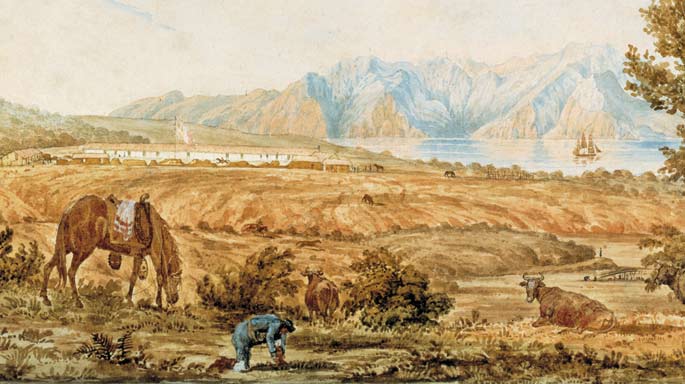
The San Francisco Presidio, painting by Richard Beechey, 1826

Bay Nature is also widely read by native plant advocates and it often defends their destructive projects.  This article represents a significant change of tune, one that is very welcome.   We hope it predicts the compromise we are seeking.

San Francisco Examiner

On Sunday, January 19, 2014, the San Francisco Examiner published an op-ed by Joel Engardio about San Francisco’s Natural Areas Program. (5)  In a perfectly balanced article, he accurately describes the two sides of the conflict about the destruction of trees by the Natural Areas Program.  Frankly, Mr. Engardio implies that he thinks the passion of the conflict is a bit silly, but he also makes it perfectly clear that he considers it a waste of taxpayers’ money to engage in needless tree destruction on the scale proposed by the plans of the Natural Areas Program.

A particularly nasty on-line comment on the article ends with this sentence:  “Not only does it display an impossible amount of ignorance, but a complete lack of ethics or morality.”  Having lost the debate on scientific grounds, native plant advocates now resort to self-righteous moral arguments.  Surely that is weaker ground.  Managers of our public lands are not obligated to deliver the moral imperatives of a particular interest group.

What does all this add up to?

Together, these articles represent a sea change of attitude on the part of publications that in the past were consistently supportive of the ecological “restorations” that are destroying much of our urban forest.  Critics of these projects have not been treated with such respect in the past.  Supporters of the projects were called “environmentalists” in the past.  Now the conflict is portrayed as a conflict amongst environmentalists.  That is a big step forward.

We hope that this significant improvement in media coverage of this controversy will create the atmosphere needed to find a compromise with which we can all live in peace.  We won’t predict the exact nature of that compromise because we know there is a range of opinions.  Speaking for the Million Trees blog—and no one else—we will say that the word “eradication” must be expunged from the debate and whatever the compromise is, it must include a commitment to quit using pesticides in our public parks for the sole purpose of killing non-native vegetation.

We are grateful to all of these publications for their participation in this debate.  That is the balanced reporting we are looking for from a socially responsible media.

*******************************

(1)    Madeleine Nash, “Eucalyptus:  Beauty or Beast?,” High Country News, December 23, 2013. 

2)    Russell, W. H., and J. R. McBride. 2002.  “Vegetation change and fire hazard in the San Francisco bay area open spaces.”  Pages 27-38 in:  Blonski, K.S., M.E., and T.J. Morales.  Proceedings of the California’s 2001 Wildfire Conference:  Ten Years After the East Bay Hills Fire; October 10-12, Oakland California.  Technical Report 35.01.462.  Richmond CA:  University of California Forest Products Laboratory.

(3)    Jared Farmer, “Going out on a limb to defend eucalyptus,” SF Chronicle, January 12, 2014

(4)    Rachel Diaz-Bastin, “New Life for Presidio’s Historic Forest,” Bay Nature, January 13, 2014

(5)    Joel Engardio, “Tree war is Campos vs.Chiu wild card,” San Francisco Examiner, January 19, 2014

Falling from grace: The history of eucalyptus in California

Eucalypti, painting by Guiseppe Cadenasso (1858-1918)

There is much to like in Jared Farmer’s chapters in Trees in Paradise about eucalyptus in California.  He begins with a comprehensive history of when, where, why, and by whom eucalypts were planted in California.  The history begins in the 1870s:  “Planters believed variously that the exotic trees would provide fuel, improve the weather, boost farm productivity, defeat malaria, preserve watersheds, and thwart a looming timber famine.  First and foremost, settlers propagated them to domesticate and beautify the land, to give it more greenery. (1)

Although eucalyptus proved to be a disappointment as a source of timber, it continued to be widely planted in California until about 1913 because it was so well adapted to California’s climate, readily available, and grew quickly:  “In 1924 a botanical investigator estimated that the state contained 40,000 to 50,000 acres of solid eucalyptus, broken down as 80 percent blue gum, 15 percent “red gums,” 4 percent sugar gum, and 1 percent others.”  In 1927, the Los Angeles Times said of eucalyptus, “[it] seems more essentially California than many a native plant; so completely has it adopted California, and so entirely has California adopted it, that without its sheltering beneficence our groves and vineyards would be like Home without a Mother.’” (1)

Well into the 1960s eucalypts were still considered a valuable asset in California.  Harold Gilliam, the nature writer for the San Francisco Chronicle, said, “The Eucalyptus seems an indispensable element of this State’s landscapes, as indigenously Californian as the redwoods, the poppy fields, the long white coastal beaches, the gleaming granite of the High Sierra,’” (1)

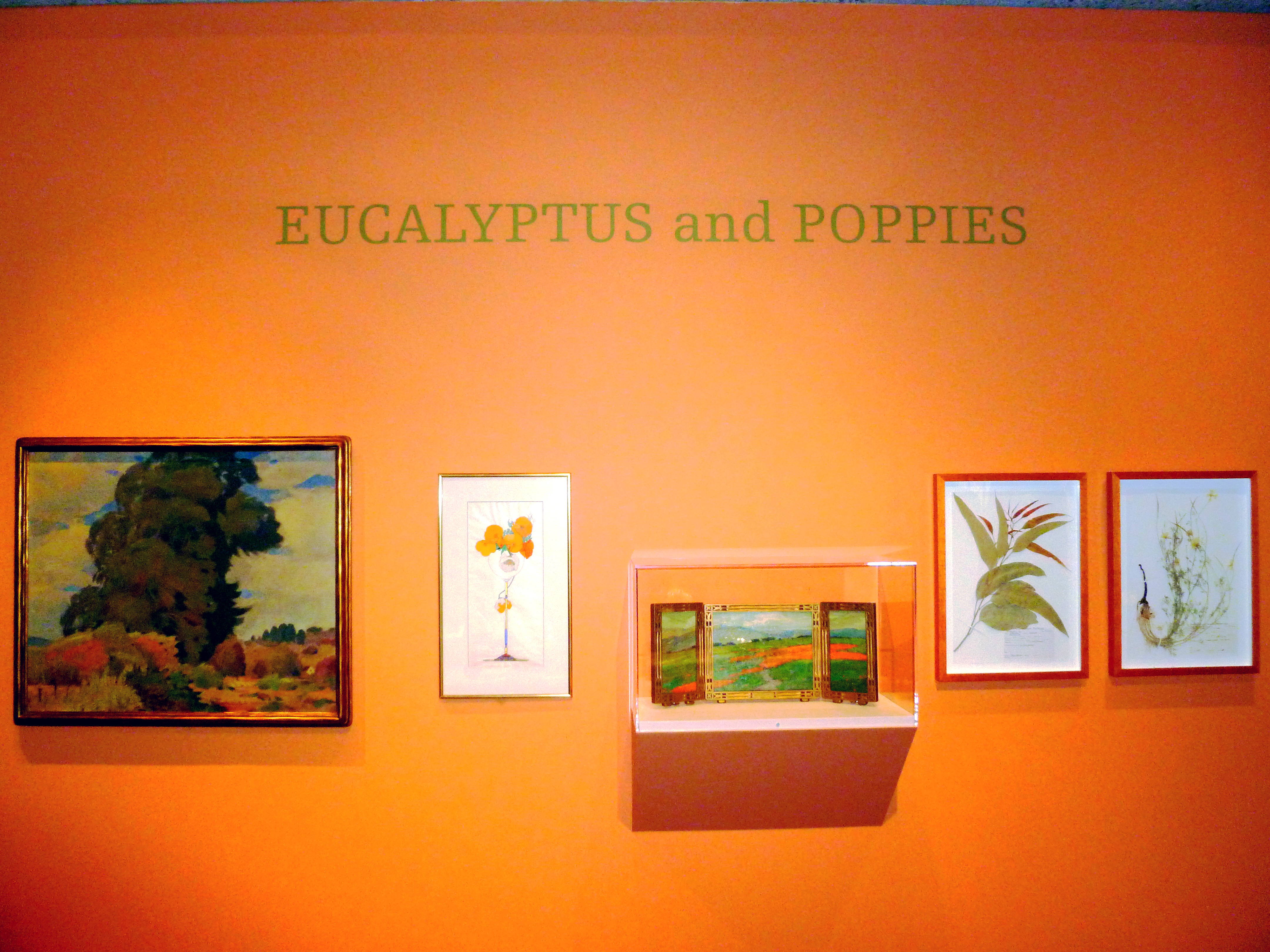
Exhibit at Oakland Museum of California

The tide turns against eucalyptus in California

Jared Farmer dates the reversal of the reputation of eucalyptus in Northern California to 1972, when an unusually deep and prolonged freeze caused eucalyptus to die back.  Because this was a unique event in California, with which there was little experience, the initial assumption was that the eucalypts were dead.  Thus began a concerted effort to remove the dead trees that were presumed to be a fire hazard.  Before the question of who would pay for this massive clean-up could be resolved, it became clear that the trees weren’t actually dead and would resprout. The removal effort was abandoned for the time being. This was an early lesson in the indestructibility of eucalyptus that would prove central to the debate in the future.  Eucalypts resprout regardless of how they are destroyed; whether they are burned by fire or frost or cut down, they will resprout unless their roots are repeatedly poisoned with herbicide (usually Garlon).  

Shortly after this episode, the managers of our public lands began to adopt policies requiring the removal of non-native species based on an assumption that native species would benefit from their removal.  In 1982, the Golden Gate National Recreation Area (GGNRA), properties managed by the National Park Service, adopted a policy of destroying all blue gum eucalyptus on 600 acres of park property in Marin County.  Ironically, they chose to announce their intention to destroy the trees on Arbor Day in 1986.  They were flabbergasted by the public’s response to their announcement.  They received letters from 350 members of the public and petitions from hundreds more, virtually all adamantly opposed to the proposed plan.  Marin County supervisors were also opposed to the plans.  Farmer says the GGNRA was forced to scale-back their plans to a single demonstration area. (Farmer doesn’t mention that subsequently GGNRA has destroyed tens of thousands of eucalypts using a variety of justifications including fire hazard. (See “Our Mission.”)

The State Parks Department adopted the same policy to remove all blue gum eucalyptus from State parks around the same time.  They started with Angel Island in the San Francisco Bay and the reaction of the public was much the same as it had been to the plans of the GGNRA.  This time the State Parks Department didn’t back down.  They did a complete Environmental Impact Report in response to public demands and then they removed virtually all the eucalyptus on the island in 1990, with the exception of 6 acres deemed to have historic value.  Eucalyptus has been removed from two other State Parks:  Annadel in Sonoma County and Montana de Oro in San Luis Obispo County.  (If the State of California hadn’t experienced severe budgetary difficulties, this list of parks in which eucalyptus was eradicated would undoubtedly be longer.)

Public opinion about eucalyptus changed radically after the fire in the Berkeley-Oakland hills in 1991.  It is important to note that the managers of public land had adopted the native plant ideology that requires the removal of non-natives such as eucalyptus prior to that fire.  The fire was an opportunity for the managers of public lands to justify their projects based on a claim that the trees are a fire hazard. 

Is it accurate to blame eucalyptus for the 1991 fire?  Although Farmer says the eucalypts were not the cause of the fire, he claims there were eucalypts on only 20% of the burned area but that eucalyptus was 70% of the fuel in the fire.  These statistics are new to us and are not consistent with FEMA’s technical report which says that the homes destroyed by the fire were the biggest fuel source. The primary reason there was so much eucalyptus leaf and bark litter was that there had been another deep, prolonged freeze the winter before the fire that caused the eucalyptus to die back as it had in 1972. As in 1972, no coordinated civic effort was made to clean up the dead tree litter.

Such deep freezes are rare in the San Francisco Bay Area.  The freeze in 1990 was the first and only freeze since 1972 and there has not been another since 1990. The current balmy and dry winter is a harbinger of the warming climate.  Such freezes in the future are unlikely.  If there were another freeze, would we have the sense to clean up the dead litter next time?  We would like to think so.

NY Times reported that 150 homes were burned in the Scripps Ranch fire in 2003, but none of the eucalyptus surrounding the homes caught fire.

Farmer identifies other factors in the reversal of the reputation of eucalyptus in California.  There have been a few fatalities caused by falling limbs and trees, although Farmer rejects the suggestion that eucalypts are inherently more dangerous than other trees.  Available databases and media reports of tree failures and fatalities don’t support the claim that eucalypts are more hazardous than other trees.

Farmer also reports insect infestations in eucalyptus, particularly in Southern California.  He dances around the question of whether or not these insect predators of eucalyptus were imported from Australia by native plant advocates for the purpose of killing the trees.  We have reported on a study by an entomologist at UC Riverside that supports that theory and we have witnessed native plant advocates bragging about having a hand in that scheme.

However, Farmer rejects the claim that eucalyptus is very invasive.  He also reports the studies that find equal diversity and abundance of wildlife in eucalyptus forest and native woodlands.  Claims to the contrary are often used by native plant advocates to justify the eradication of the eucalyptus forest.

Farmer ultimately concludes that eucalypts in California are dying of old age, implying that this will be the graceful resolution of the conflict about their existence in California.  We believe he is mistaken in that judgment.  Blue gum eucalyptus lives in Australia from 200-500 years, towards the longer end of that range in milder climates such as the San Francisco Bay Area.  Our blue gums haven’t been here that long, so we don’t yet know how long they will live here.  However, many professional arborists with no vested economic interest in their destruction have judged our eucalyptus forest in the Bay Area to be healthy.

We don’t advocate for planting blue gum eucalyptus.  In any case, they aren’t available in nurseries in California any more.  We ask only that existing trees be allowed to die of natural causes because of the environmental damage that would be done by destroying them prematurely:  the release of millions of tons of carbon dioxide into the atmosphere, the spraying of herbicides to prevent them from resprouting, the loss of the habitat they provide.

We are grateful to Jared Farmer for his book about the trees of California.  Mr. Farmer is a professor of history at State University of New York, Stony Brook.  He is the author of a favorably-reviewed book about Utah where he grew up and received his graduate education.  He has done a prodigious amount of research of both scientific and historical documents about the trees of California.  His writing style is engaging and he steps back from his subject to muse about the philosophical issues raised by his findings.  His book deserves the respect of both tree and native plant advocates.

*******************************

(1)    Jared Farmer, Trees in Paradise:  A California History. W.W. Norton & Company, 2013


Holiday greeting from John Muir

Christmas Card from John Muir
“From eucalyptus cloistered aisles sweet wind born anthems rise and from tall silvery spires there wafts a living incense to the skies.” (1)

This 1911 New Year’s greeting from John Muir is a reflection of his fondness for eucalyptus.  He planted eucalypts around his home in Martinez, California.  Muir’s daughter reported that her father bought about a dozen different varieties of eucalyptus from a neighbor and she helped to plant them on the property.  The property was planted with many non-native plants and trees, including palms that now tower over the property.

John Muir National Historical Site, NPS photo

Muir’s home was built by his wife’s parents in 1882.  Muir and his wife moved into the home in 1890 after his wife’s father died.  Muir lived in that home for the last 24 years of his life.  It is now The John Muir National Historic Site.

The site is administered by the National Park Service which unfortunately actively engages in ecological “restorations” that destroy non-native species.  In the San Francisco Bay Area, eucalypts are one of their highest priority targets for destruction.  According to the Martinez News Gazette, the Park Service destroyed the eucalypts on Muir’s property in about 1991 and replaced them with redwoods.  Twenty years later, they destroyed the redwoods because they decided they weren’t historically accurate.  The Park Service has a contradictory mission of ecological “restoration” to a native landscape which is inconsistent with its mission of maintaining the historical integrity of the properties it manages.

John Muir was co-founder of the Sierra Club.  He is also given credit for convincing President Teddy Roosevelt to protect Yosemite, Sequoia, Grand Canyon and Mt. Rainier as National Parks.  Wouldn’t Muir be appalled by the current policies of the Sierra Club and the National Park Service which advocate for the destruction of eucalyptus in our public lands? 

Theodore Lukens was another eucalyptus aficionado

The recipient of John Muir’s New Year’s greeting was another eucalyptus aficionado.  Jared Farmer mentions Muir’s holiday card to Theodore Lukens in Trees in Paradise:  “In 1911 Muir sent a holiday card to his friend Lukens with a watercolor depicting gum trees and a poem evoking the ‘cloistered aisles,’ ‘silvery spires,’ and ‘living incense’ of eucalypts.” (2)

According to Farmer’s excellent historical account of eucalyptus in California, Lukens was a “banker, real estate developer, one-time mayor, and self-taught forester” in Southern California who “worked tirelessly on behalf of afforestation.”  Lukens and Muir shared the belief that “forest cover was key to the whole hydrological system:  trees and tree litter encouraged rainfall, captured fog drip, increased rainfall retention, decreased transpiration and regulated stream flow.”

We recommend Jared Farmer’s book to our readers.  This is a serious history of eucalyptus in California. It’s a complex story that requires an understanding of scientific as well as historical documents. Although we would quibble about some details, it is also a fair treatment of a controversial subject. Mr. Farmer is an historian, not a tree or native plant advocate.

Mr. Farmer tells the story in an engaging way and he puts it into a social context that deserves respect from both tree and native plant advocates. We are grateful to Mr. Farmer for bringing some solid information to an otherwise emotional debate. If it is widely read it could contribute to the resolution of a conflict that has been intractable.

We wish our readers a Merry Christmas and a Happy New Year.  We are hopeful that the New Year will bring more success to our mission to save healthy trees from destruction which will also reduce the needless use of pesticides in our public open spaces.

 ******************************

(1) Published in Images of the Pacific Rim by Erika Esau, Power Publishing, February 2011.

(2) Jared Farmer, Trees in Paradise:  A California History, Norton & Company, 2013.

2013 Progress Report

As we approach the end of the year, let’s review the progress we’ve made in 2013 on our mission to save healthy trees and prevent the unnecessary use of herbicides in our public open spaces.  It’s been a good year:

  • University of California San Francisco (UCSF) has decided to scale back its plans to destroy about 30,000 trees and the forest understory on Mount Sutro.  They have also made a commitment to NOT use herbicides in the forest in the future.   (Visit Save Sutro for details.)
  • UCSF’s plans to destroy most of the trees on Mount Sutro were criticized by the mainstream press, i.e. the New York Times and Nature magazine.
  • Thousands of citizens in the Bay Area signed our petitions to object to the Mount Sutro project and the projects in the East Bay which FEMA is considering funding.  Likewise, critics of these destructive projects overwhelmed a handful of supporters at the public hearings about these projects.
  • Marin County Open Space District and Parks Department engaged a consultant who reported that “vegetation management” projects result in more non-native plants and that managers of public lands in the Bay Area no longer consider it feasible to eradicate all non-native plants in open spaces.

The California Invasive Plant Council has noticed the public’s opposition

Anise Swallowtail butterfly in non-native fennel

Another barometer of our progress is the latest edition of the newsletter of the California Invasive Plant Council (Cal-IPC) which is available here.  Readers are immediately alerted to a change of attitude by the photograph on the cover of a native butterfly and a native bee feeding on a non-native thistle.  As anyone who has debated the issues with native plant advocates or read their propaganda knows, they usually deny that non-native plants are useful to native insects.

Bumblebee on Cotoneaster, Albany Bulb
Native bumblebee on Cotoneaster, Albany Bulb

The cover photograph makes a concession and sets the tone of the Cal-IPC newsletter.  The opening message from the Cal-IPC Executive Director begins with a quote from Invasive and Introduced Plants and Animals:  Human Perceptions, Attitudes and Approaches to Management“…intervention in conservation practice hides behind a veneer of pseudoscience and certainly challenges democratic processes.”    We told our readers about that book and ironically we selected the same sentence to describe its conclusion.  So, have we found some common ground with native plant advocates, as represented by Cal-IPC?

Not quite.  The title of the Director’s message is “A ‘cottage industry of criticisms.’”  This is the phrase used to describe those who criticize invasion biology.  Speaking for Million Trees and those with whom we collaborate, it is not accurate to call us an “industry” because we derive no economic benefit from our advocacy on behalf of non-native species.  In contrast, the ecological “restorations” that are based on the assumptions of invasion biology are an industry.  The economic interests of those who are employed by “restoration” projects are one of the reasons they cling desperately to the ideology that supports their employment.

The Cal-IPC Director tells us that, “Though they raise critical issues to address, such critiques underestimate the degree to which these issues are already being addressed.”  He claims that “Cal-IPC’s workshop asked participants to consider ecological services offered by top weeds of concern.  Weighing such information will become increasingly important as land stewards design management approaches to meet long-term conservation goals in an age of great environmental change.”

Cal-IPC can demonstrate this new management approach

What an excellent idea!! And we hope that Cal-IPC will start that new approach by revisiting its outdated assessment of Blue Gum eucalyptus which presently contains nothing but demerits, most of which are not even accurate.  If Cal-IPC takes into consideration the significant ecological services provided by Blue Gum eucalyptus, they will surely remove it from their long list of “invasive species.”  Here is a brief list of the ecological services provided by Blue Gum eucalyptus in California:

  • These large, hard-wood trees are storing millions of tons of carbon which will be released into the atmosphere as carbon dioxide when they are destroyed and as their wood decays on the ground, thereby contributing to climate change.
  • These trees are expected to live another 200-300 years, which means that this ecological service would be needlessly terminated by their premature destruction.
  • These trees are providing windbreaks on windy hills and for agricultural crops.
  • The roots of these trees stabilize the soil on hills that will erode when the trees are destroyed and roots die.
  • These trees provide the over-wintering roost of tens of thousands of monarch butterflies.
  • These trees are a source of winter nectar for bees, butterflies, and birds.
  • These trees are the nesting and roosting habitat of raptors and owls.

We urge Cal-IPC to demonstrate its professed willingness to consider the benefits of non-native species by revising their assessment of Blue Gum eucalyptus, which is rarely invasive and is providing valuable ecological services to animals as well as humans.