One of native plant advocates’ favorite justifications for eradicating eucalypts is the claim that they are invasive. But are they? In one of our early posts (“ALIEN INVADERS!! Another Scary Story”) we reported a scientific study, based on photographic evidence over a 60 year period, that eucalyptus and other non-native trees have not invaded public lands in Marin, Alameda and San Mateo counties. In fact, the non-native forests in these public lands decreased in size, while native forests increased in size.
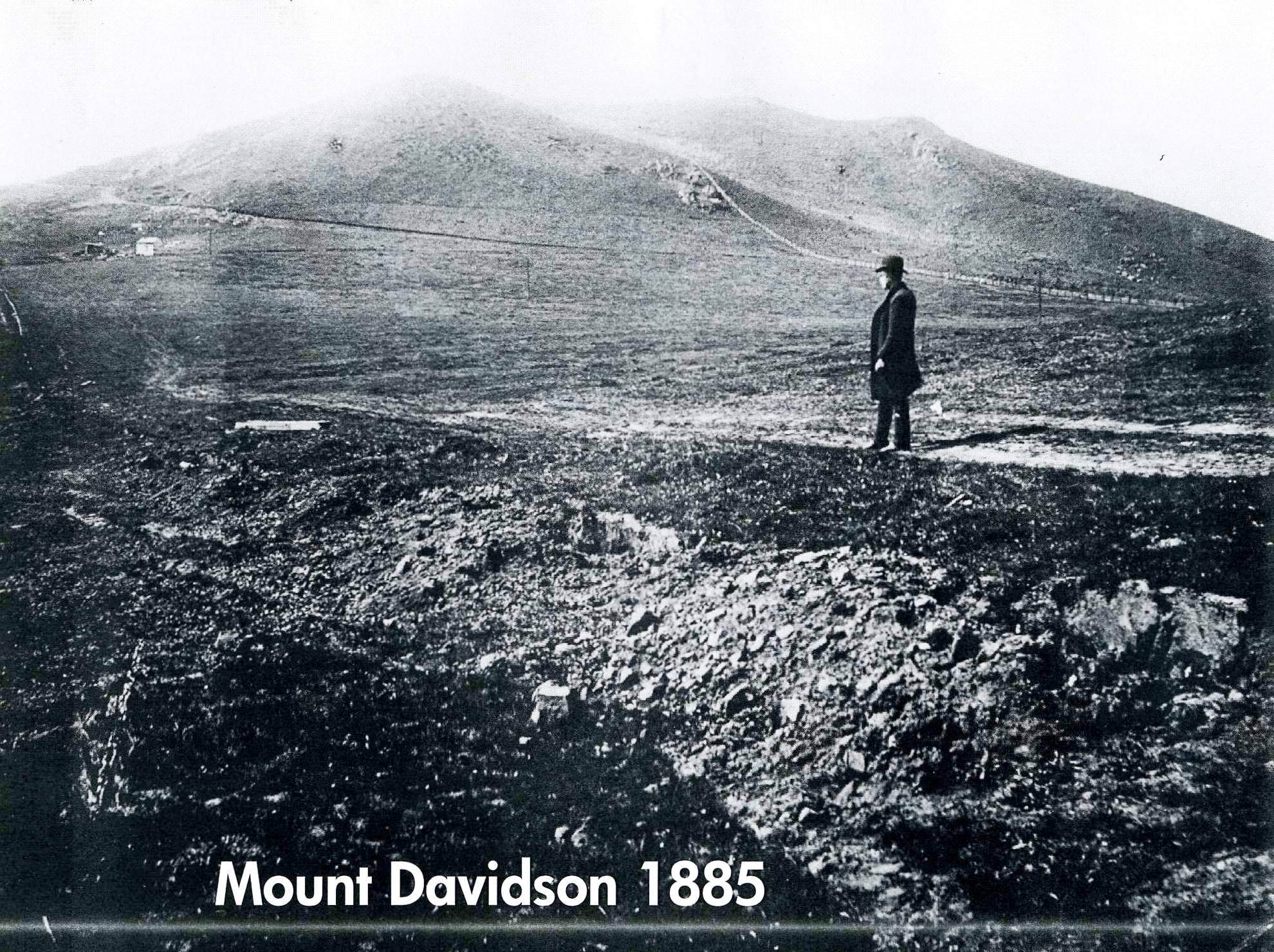
Now we have photographic evidence that eucalyptus has not been invasive when planted in San Francisco. Adolph Sutro purchased Mt. Davidson in 1881.(1) He planted it—and other properties he owned in San Francisco—with eucalyptus because he preferred a forest to the grassland that is native to the hills of San Francisco. Here is a historical photo of what Mt. Davidson looked like in 1885:
Sutro foretold the future of his property:
“…people… will wander through the majestic groves rising from the trees we are now planting, reverencing the memory of those whose foresight clothed the earth with emerald robes and made nature beautiful to look upon.”(2)
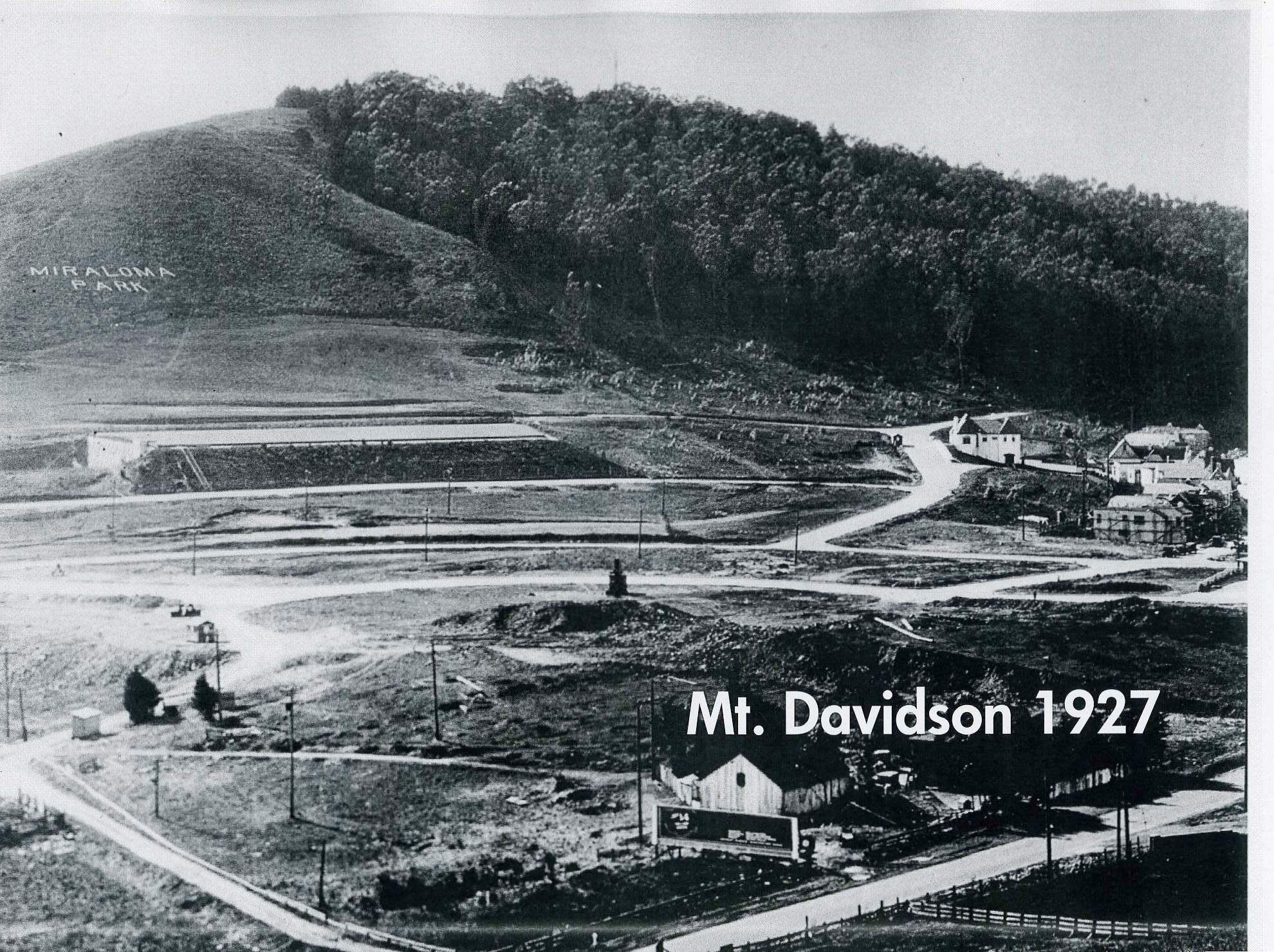
Since Sutro didn’t own all of Mt. Davidson, there was a sharp line between the forest he planted and the grassland when this photo was taken in 1927.
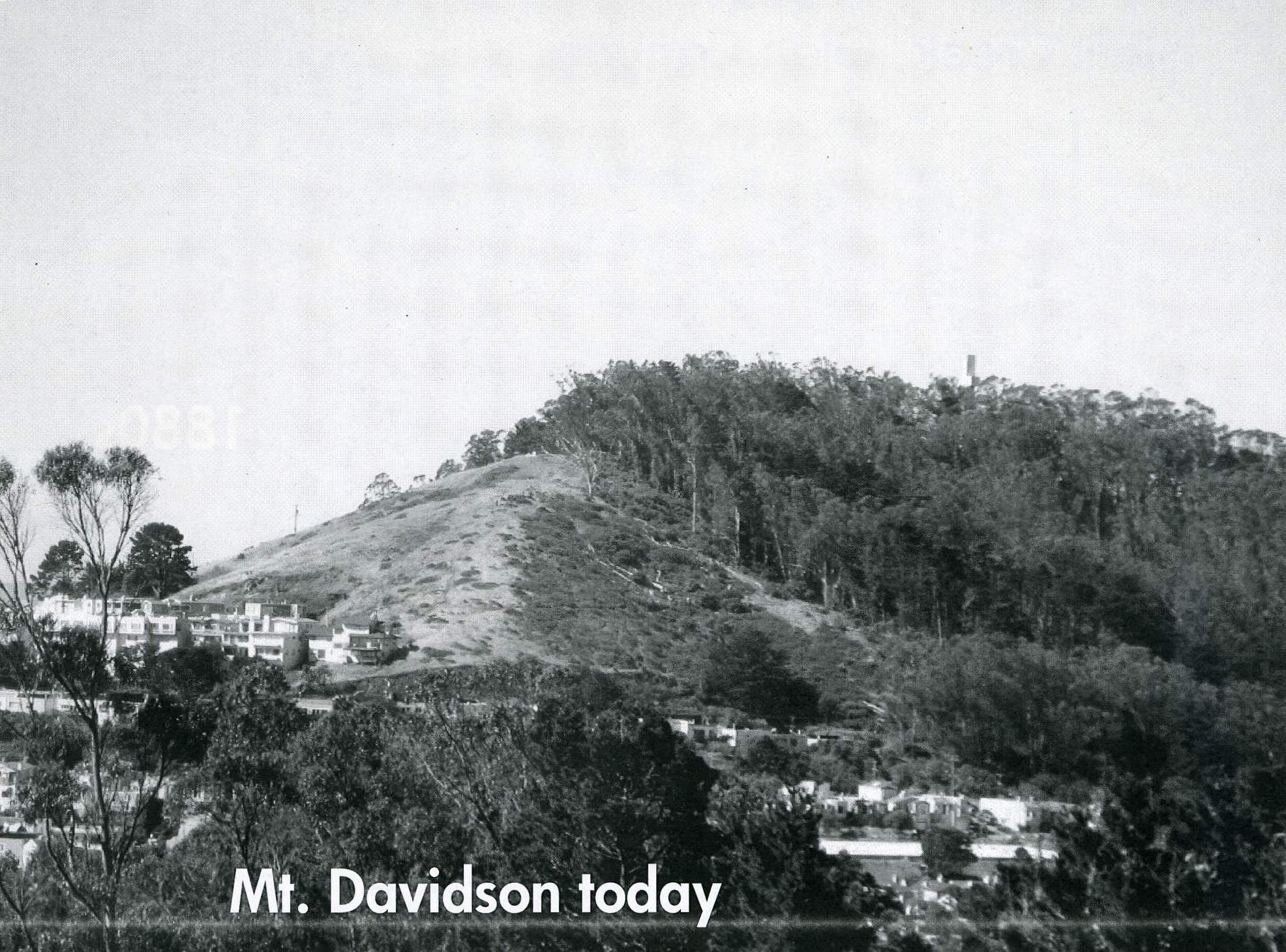
Over 80 years later, in a photo taken in 2010, there is still a sharp line between the forest and the grassland. We see more trees in the foreground where residential areas have been developed and home owners have planted more trees, but the dividing line on the mountain is nearly unchanged. The eucalyptus forest has not invaded the grassland.
Adolph Sutro would be saddened by a walk in the forest on Mt. Davidson to see over 50 dead and dying trees that have been girdled by native plant advocates. And the Natural Areas Program’s management plans for Mt. Davidson also announce the intention to destroy 1,600 more trees over 15 feet tall. Smaller trees to be destroyed are not quantified by the plan.
Despite the lack of evidence, the California Invasive Plant Council (CIPC) has designated both the eucalyptus and the Monterey pine as “moderately invasive.” There is even less evidence that Monterey pine grow where not intentionally planted. These trees and many of the nearly 200 plants on the CIPC “hit list” are on that list because they aren’t native, not because they are invasive.Few of these plants are truly invasive, but CIPC designates them as such so that their eradication can be justified.
Native plant advocates use many arguments to justify the destruction of non-native species and we have debunked many of those arguments here on Million Trees. Now we will examine the claim that non-native species must be destroyed because their mere existence reduces biodiversity by out-competing native plants and animals. Because eucalyptus trees are one of the primary targets for eradication, we will focus on the specific claim that the eucalyptus forest is a “biological desert.” We are frequently told that “nothing grows” under the eucalypts and that they are not providing food or habitat to insects, birds, and other animals.
Professor Dov Sax (Brown University) tested these claims while a student at UC Berkeley. He studied the eucalyptus forest in Berkeley, California, and compared it to native oak-bay woodland. He found little difference in the species frequency and diversity in these two types of forest.
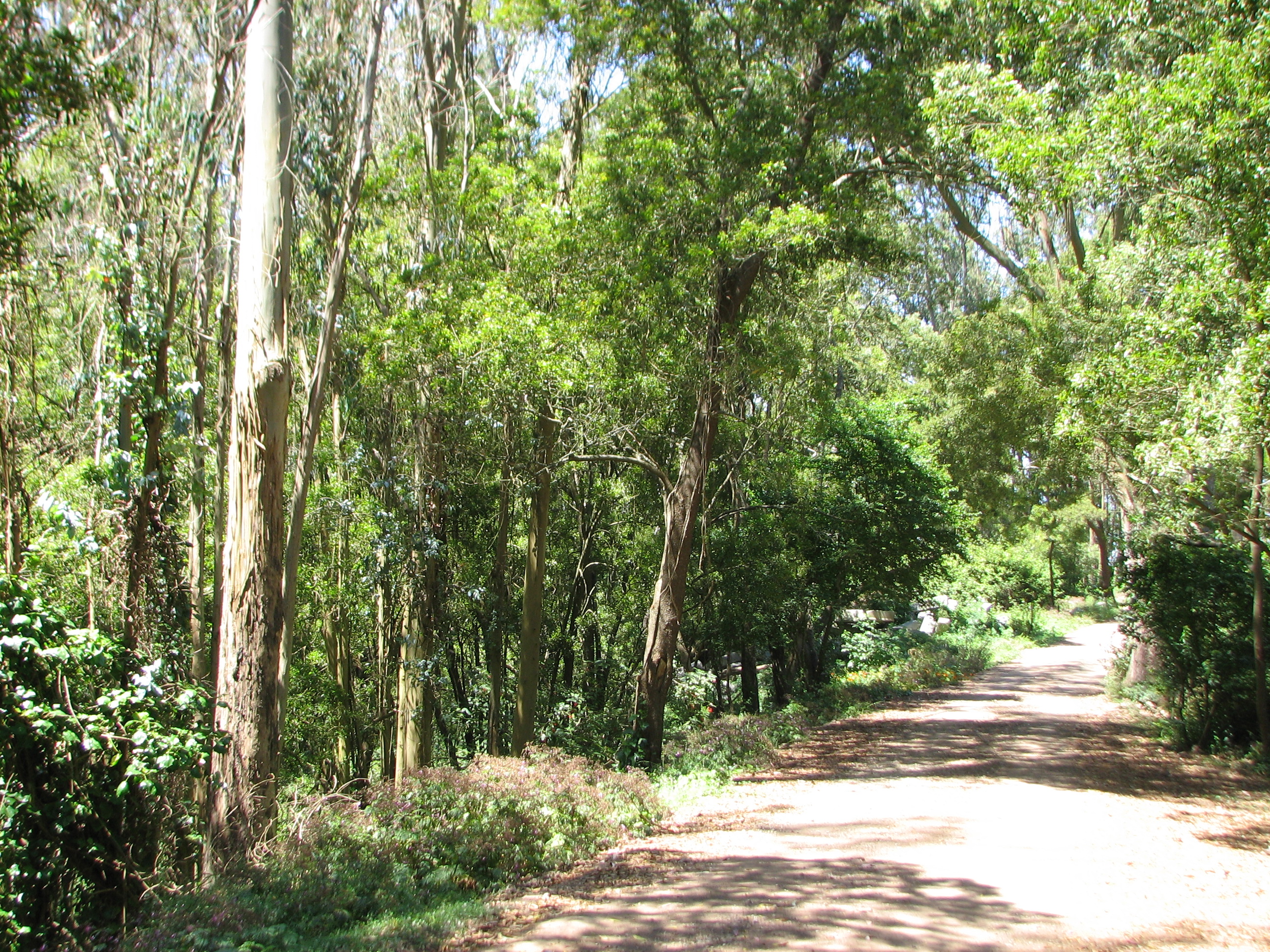
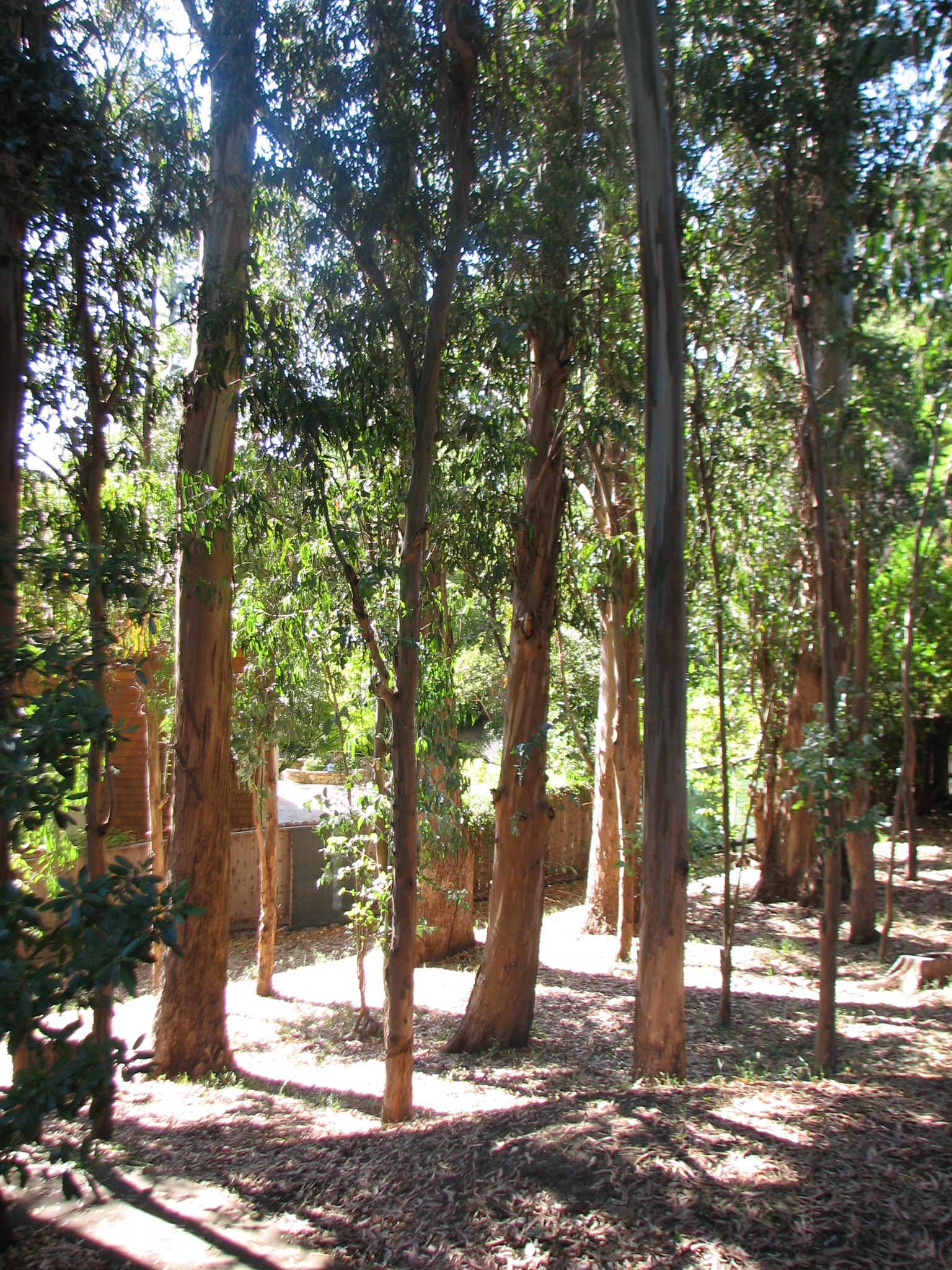
Eucalyptus forest and its thriving understory, Mt. Sutro, June 2009
He studied six forests of about 1 hectare each, three of eucalypts and three of native oaks and bays. The sites were not contiguous, but were selected so that they were of similar elevation, slope, slope orientation, and type of adjacent vegetation. He conducted inventories of species in spring and autumn. He counted the number of:
Species of plants in the understory
Species of invertebrates (insects) in samples of equal size and depth of the leaf litter
“Species richness was nearly identical for understory plants, leaf-litter invertebrates, amphibians and birds; only rodents had significantly fewer species in eucalypt sites. Species diversity patterns…were qualitatively identical to those for species richness, except for leaf-litter invertebrates, which were significantly more diverse in eucalypt sites during the spring.”
Professor Sax also surveyed the literature comparing biodiversity in native vs non-native forest in his article. He reports similar findings for comparisons between non-native forests and local native forests all over the world:
In Spain, species of invertebrates found in the leaf-litter of eucalyptus plantations were found to be similar to those found in native forests, while species richness of understory plants was found to be greater in the native forests.
In Ethiopia the richness of understory species was found to be as great in eucalyptus plantations as in the native forest.
In the Mexican state of Michoacán, species richness and abundance of birds were found to be similar in eucalyptus and native forests.
In Australia species richness of mammals and of soil microarthropods were found to be similar in native forests and in non-native forests of pine.
The only caveat to these general findings is that fewer species were found in new plantations of non-natives less than 5 years old. This helps to illustrate a general principle that is often ignored by native plant advocates. That is, that nature and its inhabitants are capable of changing and adapting to changed conditions. In the case of non-native forests in the San Francisco Bay Area, they have existed here for over 100 years. The plants and animals in our forests have “learned” to live in them long ago.
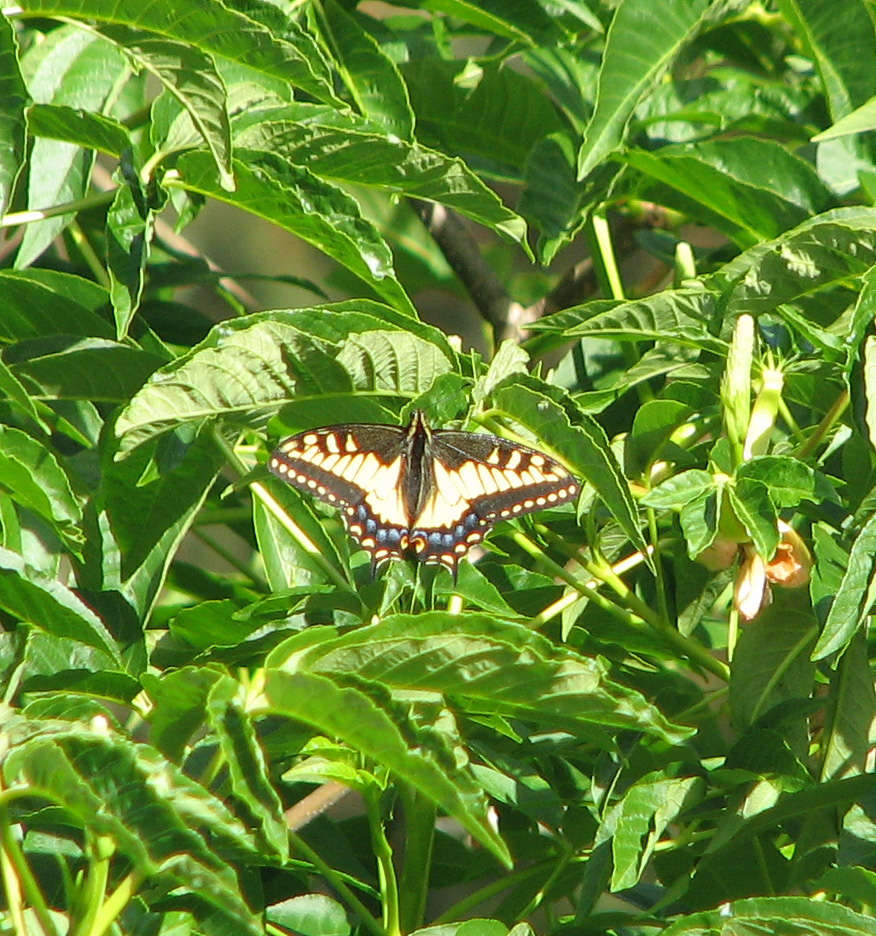
Anise Swallowtail, Mt. Sutro, March 2010
We recommend that you visit the SaveSutro website for a description of the richness of the non-native forest that thrives on Mount Sutro in San Francisco. It is the perfect illustration of these scientific principles. We can discuss scientific principles in the abstract, but there is no substitute for a walk in the forest to confirm with our eyes what science tells us.
*Dov Sax, “Equal diversity in disparate species assemblages: a comparison of native and exotic woodlands in California,” Global Ecology and Biogeography, 11, 49-52, 2002.
Mark Davis, Professor of Biology at Macalester College is interviewed in the February issue of Scientific American. He tells us that invasion biology must distinguish between change and harm when labeling non-native species as “invasive,” a term which he believes should be used only in those rare cases when the non-native species pose “health threats” or economic harm. With the exception of isolated places, such as islands, Mr. Davis tells us that non-natives have not been the cause of extinctions of native species.
He believes it is irresponsible to label non-native species as “invaders” if they do not cause such harm because attempts to eradicate them are wasteful of scarce resources and often harm the environment more than the mere existence of non-natives. He advises us to learn to live with those species that are not harmful.
He also points out that the eradication of non-natives is often futile and is likely to become even more futile in the future as global travel and commerce increase and the climate continues to change. All species are going to move, both natives and non-natives and in fact, natives are as likely to cause problems in their expanded range as the non-natives in those regions. He offers the example of the mountain pine beetle in Western coniferous forests, which is killing half the timber forest in British Columbia as it expands its range, probably in response to increasing temperatures.
Mr. Davis was also interviewed by Environment 360, a publication of Yale University, in November 2009. In that interview, he is joined by Dov Sax, assistant professor of biology at Brown University, one of the growing number of biologists who are questioning the assumptions of invasion biology. He provides a local example of exaggerated claims of invasiveness: “Dr. Sax says he began to question exotic species orthodoxy as an undergraduate at the University of California, Berkeley. A professor leading a field trip described the Bay Area’s abandoned plantations of Australian eucalyptus trees as a “biological desert.” Says, Sax, ‘There was all kinds of stuff growing in there. I found there were really a similar number of species in both [native oak and eucalyptus] woodland types. Exotics weren’t always doing the awful things people seemed to think they were doing.’”
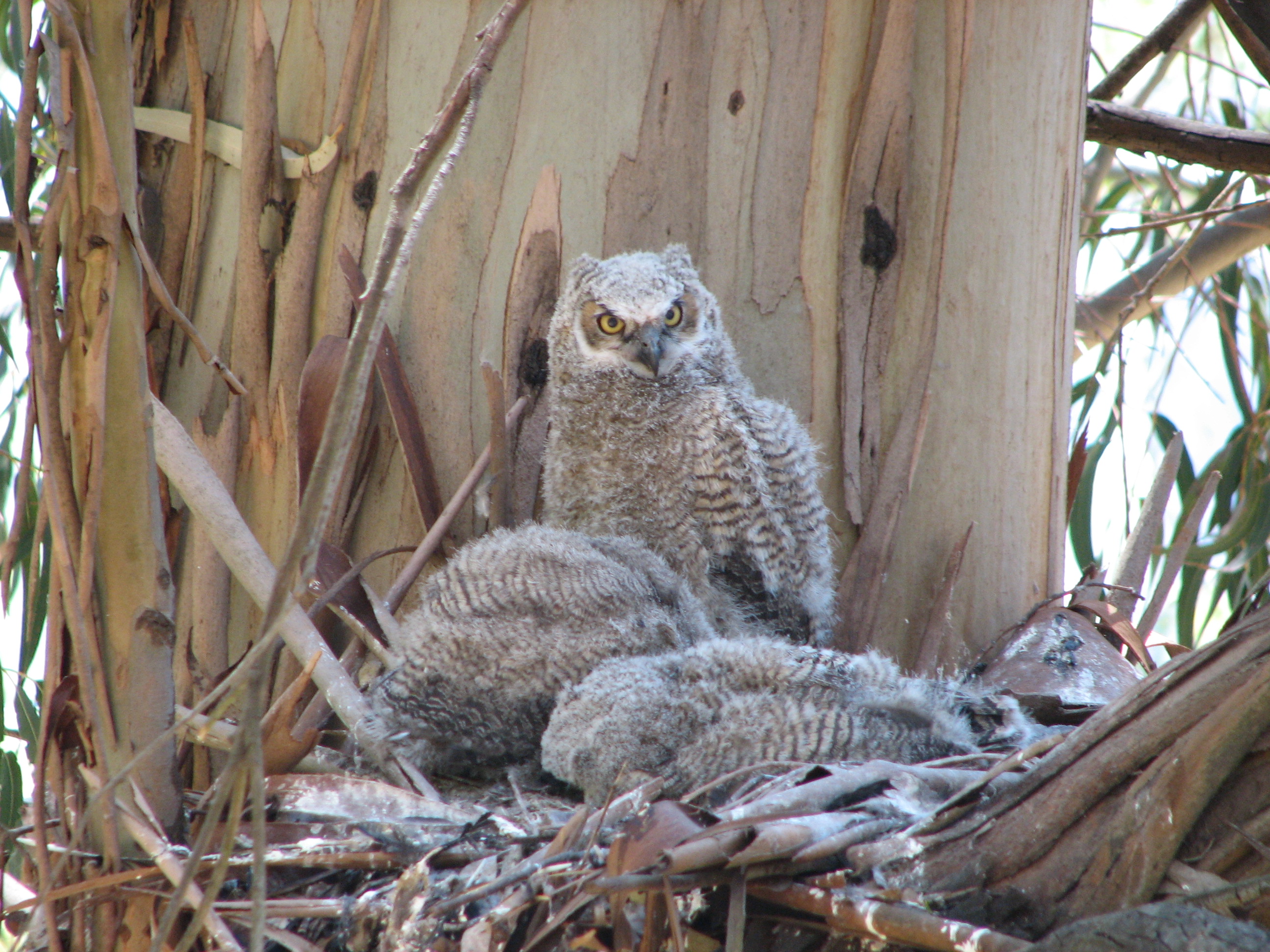
Owlets in eucalyptus, Claremont Canyon, Oakland
We attended a few lectures of an undergraduate course at UC Berkeley that fit with Dr. Sax’s experience. Students in this undergraduate course were required to “volunteer” in a variety of different “restoration” projects in the Bay Area. One of the projects on the property of UC Berkeley focused on the eradication of eucalypts. The leader of this project and supervisor of the students who chose his project had an undergraduate degree in “natural resources” and an MBA in “operations management.” He made a number of unsubstantiated claims to justify the eradication of eucalypts, but the most flagrantly stupid statement was this: “The carbon sequestered in non-natives doesn’t count. Only the carbon sequestered in natives counts.” This statement has no scientific meaning. We assume it is intended as a philosophical statement. In any case, students aren’t learning any science from such a statement.
Critics of native plant ideology are accustomed to criticism from true believers and Mark Davis is no exception. In an interview available on the Macalester College website, Mr. Davis says he, “…received rebuttals that, he felt, veered toward ad hominem attacks on his inexperience in the field.” But he has not backed down and has come to view this debate as an example of the “values and age-old religious attitudes toward nature [that] frame scientific study and debates more than most scientists would acknowledge.” He concludes that interview with this observation: “People can get addicted to paradigms. Then paradigms become an ideology. Belief and conviction are very difficult adversaries since they are little affected by data and evidence.”
As we have said in other posts on Million Trees, those who demand the destruction of non-native trees justify their demand by making many critical claims about them. One of the most disturbing of these claims is that eucalypts kill birds. Reprinted here with permission is an excerpt from an article in the April 2010 newsletter of the Hills Conservation Network which debunks this myth.
The Hills Conservation Network is a group of residents in the Oakland-Berkeley Hills who advocate for fire safety without clear-cutting non-native trees. Most of the members of the network are survivors of the 1991 fire in their neighborhood. Some lost their homes. Some lost members of their family. They are highly motivated to improve fire safety in their neighborhood and they strongly believe that fire hazard mitigation can be achieved without destroying all non-native trees.
Please visit their website to see other issues of their newsletter which is a valuable source of information on the subject of fire hazard mitigation. You may subscribe to their free on-line newsletter by sending an email to inquiries@hillsconservationetwork.org.
Brochures distributed by various agencies in northern California state that the flowers of eucalyptus trees kill birds. According to these brochures, birds feeding on insects or on the nectar of eucalyptus flowers may have their faces covered with “gum” and die of suffocation. Luckily for the birds, according to one brochure, most of them prefer native vegetation, and avoid eucalyptus groves.
These stories are, of course, extremely upsetting to all of us who love birds.
The bird-suffocation story began with a 1996 article by Rich Stallcup, a legendary birder who writes for the Pt. Reyes Bird Observatory. In the PRBO Observer, he reported that, on one day in late December, he counted, in one eucalyptus tree: 20 Anna’s Hummingbirds, 20 Audubon Warblers, 3 Orange-crowned Warblers, 10 Ruby-crowned Kinglets, a few starlings, 2 kinds of orioles, a Palm Warbler, a Nashville Warbler, a warbling Vireo, and a summer Tanager.
That was an unusually large number of birds, even for Stallcup to see in one tree, but what most surprised him, he says, is what he found under that blue gum eucalyptus tree: a dead Ruby-crowned Kinglet, its face “matted flat from black, tar-like pitch.”
Years before, Stallcup recalled in the article, he had found “a dead hummingbird with black tar covering its bill” under eucalyptus trees. This was all Stallcup needed to come up with his theory about what had happened.
This theory is now stated as fact in restorationist literature and it is stated three times as fact in the “Wildfire Plan”/EIR issued by the East Bay Regional Park District in August 2009.
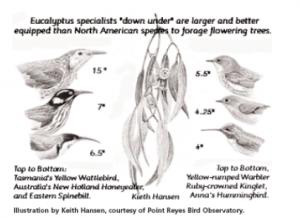
Stallcup theorizes that North American birds are different from birds indigenous to Australia. He speculates that North American birds such as kinglets, warblers, and hummingbirds have evolved short, straight bills while Australian birds evolved long, curved bills. Thus, he says, when American birds with short bills seek nectar or insects on eucalyptus flowers, they have to insert their whole head into the blossom, so they get gummy black tar all over their faces.
Misleading illustration from Stallcup article
We have great respect for Stallcup’s ability to identify birds. But we have a few problems with his theory.
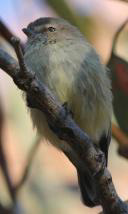
Australian Weebill. Credit: Stuart Harris
1. A bird-loving friend who has photographed birds in Australia points out that Australian field guides show birds with a wide variety of bill length and curvature. When he was in Australia, he saw birds with small bills just like American kinglets and warblers. “How do you suppose the Australian Weebill got its name?” our friend asked. Many of us not so familiar with Australian birds have seen parakeets and other small small-billed parrots native to Australia. Weebills and many other American and Australian birds with small bills forage on eucalyptus leaves or flowers.
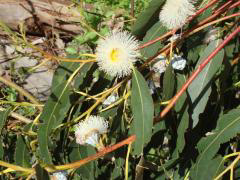
Blue gum eucalyptus flowers on tree, March, 2010. Credit: John Hovland
2. Where’s the gum? The flower of a blue gum eucalyptus tree has no gum, glue, or tarlike substance on it or in it. The gum in “gum trees” refers to the sap or resin that, in some species, comes from the trunk. Other species of gum trees, such as the sweet gum (Liquidambar) are common sidewalk trees in Berkeley and Oakland. The flowers on the blue gum eucalyptus are white or cream-colored with light yellow or light green centers. There is no black, sticky, gummy or tarry substance in or on the living flower. In fact, both the Ruby-crowned Kinglet and the Australian Weebill are leaf-gleaners. They take insects off leaf surfaces, not from flowers. If the kinglet had gum on its face, the gum did not come from a eucalyptus blossom.
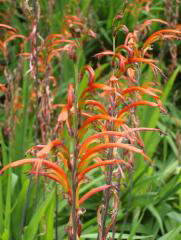
3. A euc flower looks most like a chrysanthemum, with longer petals. Unlike a morning glory, the euc flower is not shaped like a tube that a bird would need to poke its bill into to get nectar or insects. A hummingbird is more likely to pick up a sticky substance from inside a cup-shaped tulip, poppy, or any of the tiny tube-flowers such as California fuchsia, Indian paintbrush, watsonia, or honeysuckle that hummingbirds love. Common sense tells us that no bird, even a tiny one, could suffocate while feeding on a euc flower or leaf.
Watsonia, Willow Walk, Berkeley, 2010. Credit: John Hovland
4. We have all seen hummingbirds poking their beaks into tube-like flowers. If you peel back these tube-like flowers, you will sometimes find a sticky substance on your finger. You’ve probably seen birds, especially tiny hummingbirds, sipping from these flowers. How do they escape getting nectar on their faces? An article in the NY Times proves truth is stranger than the fiction of suffocated hummingbirds. The article explains that a hummingbird gets nectar from a flower by wrapping its tongue into a cylinder to create a straw about ¾ inch long extending from its bill. This means that a hummingbird’s face does not touch the surface of a flat type of flower such as the flower of a blue gum eucalyptus.
After Stallcup wrote his article in 1996, it was accepted by birders and eucaphobes all across America. In January, 2002, Ted Williams, wrote about the “dark side” of eucalyptus in his opinion column called “Incite” for Audubon Magazine.
Stallcup, he wrote, had told him he had found 300 dead birds over the years “with eucalyptus glue all over their faces.” Williams wrote that the bird artist, Keith Hansen, who illustrates Stallcup’s articles, had found “about 200 victims.”(How did one kinglet and one hummingbird in 1996 add up to 500 victims by 2002 even though few if any other people have seen even a single victim?) Williams and Hansen also describe the suffocating material as “gum.”
Williams, in that same over-the-top column, dares to contradict Stallcup, claiming that he has heard only one Ruby-crowned Kinglet in a eucalyptus grove, and has never actually seen any birds in eucalyptus trees. Yet he repeats (and exaggerates) Stallcup’s story about eucalyptus suffocating birds. The National Park Service, U.C., EBRPD, and the Audubon Society have spread Williams’ interpretation of Stallcup’s story—apparently without questioning any part of it.
Stallcup and Williams are bird-lovers and writers. They are not scientists. David Suddjian, a wildlife biologist, has read Stallcup’s theory about birds suffocating on the “black pitch” of eucalyptus flowers, but in his article, “Birds and Eucalyptus on the Central California Coast: A Love-Hate Relationship,” he casts doubt on Stallcup’s claim that the kinglet (and other birds) could have been suffocated by eucalyptus flowers. Here is an excerpt from his article:
“. . . in my experience and the experience of a number of other long-term field ornithologists, we have seen very little evidence of such mortality. It has been argued that the bird carcasses do not last long on the ground before they are scavenged. However, when observers spend hundreds of hours under these trees over many years but find hardly any evidence of such mortality, then it seems fair to question whether the incidence of mortality is as high as has been suggested. Not all bird carcasses are scavenged rapidly, and large amounts of time under the trees should produce observations of dead birds, if such mortality were a frequent event. . .more evidence is needed.”
The Suddjian article is not generally favorable to eucalyptus trees. However, Suddjian notes that more than 90 species of birds in the Monterey Bay Region use eucalyptus on a regular basis. Additionally some rare migratory birds bring the total to 120 birds seen in euc groves. These include birds that use eucalyptus trees, leaves, seeds, or flowers for breeding, nesting, foraging, and roosting. A complete list of birds that depend on eucalyptus trees is too long to include here. We encourage you to click on the link to the Suddjian article so you can look for the names of the various bird species and note how they use—and depend on—eucalyptus trees.
Million Trees Webmaster: Shortly after this urban legend surfaced over 10 years ago, I had an opportunity to ask a local scientist about it. While attending an open house at the California Academy of Sciences in San Francisco, I was able to talk to the head of its ornithology division at the time.
He started by saying that although he had never seen a dead bird in a eucalyptus forest, there weren’t as many birds there because the eucalypts don’t offer as much food for birds as other vegetation types. (Those who bird in the eucalyptus forest without a nativist bias don’t agree with this generalization about a lack of birds, however.) He also said he hadn’t heard the claim.
Then, the scientist said that the story didn’t seem consistent with bird anatomy. He said that birds are capable of lifting their feet to their heads and clearing whatever might be accumulating there with their toes.
Ten years and many walks in the eucalyptus forest later, we have yet to see a dead bird, but the myth lives on.
Have you visited the Oakland Museum since it reopened this summer after extensive renovation? It looks pretty spiffy and continues to be a valuable resource for our community.
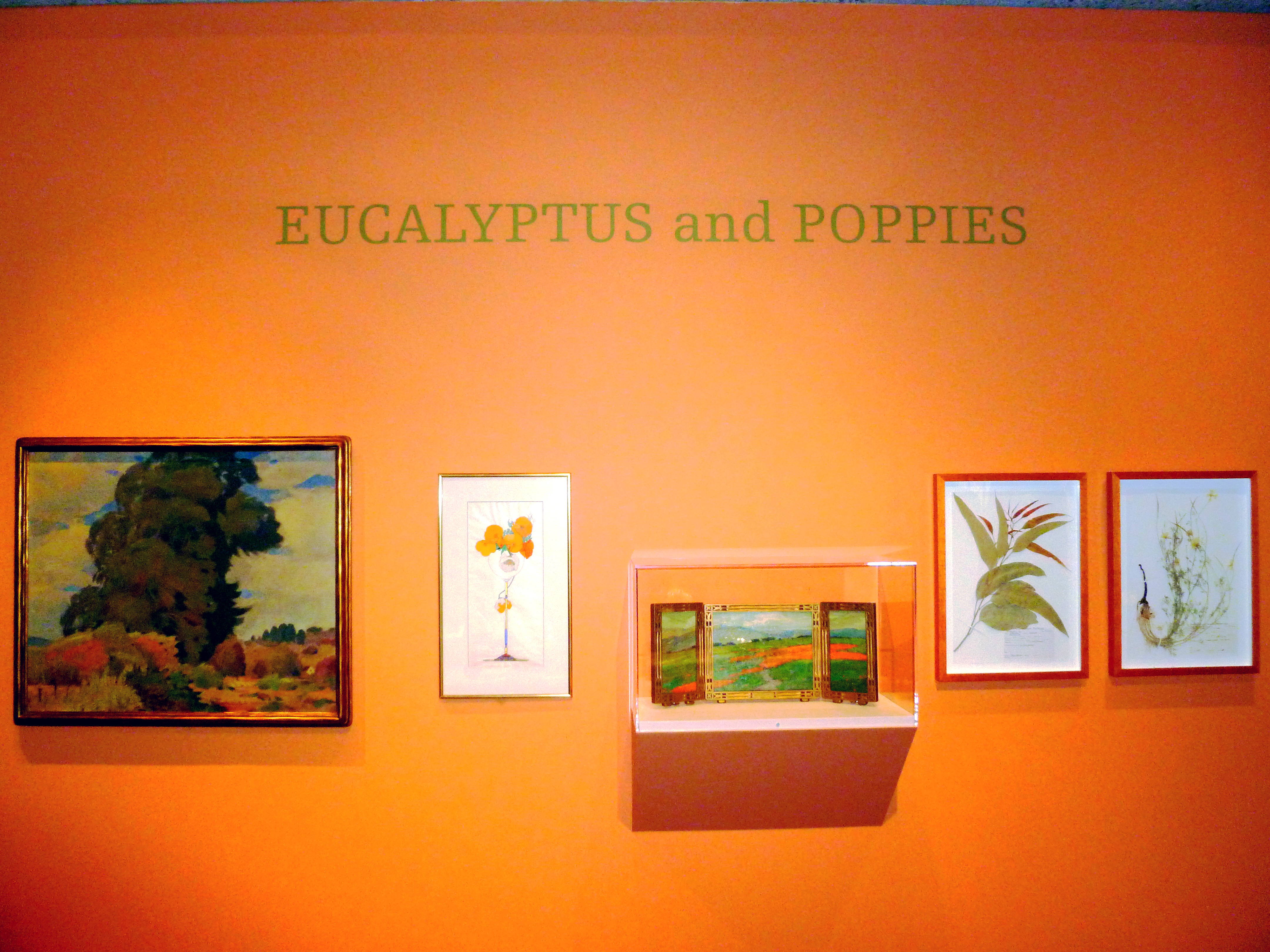
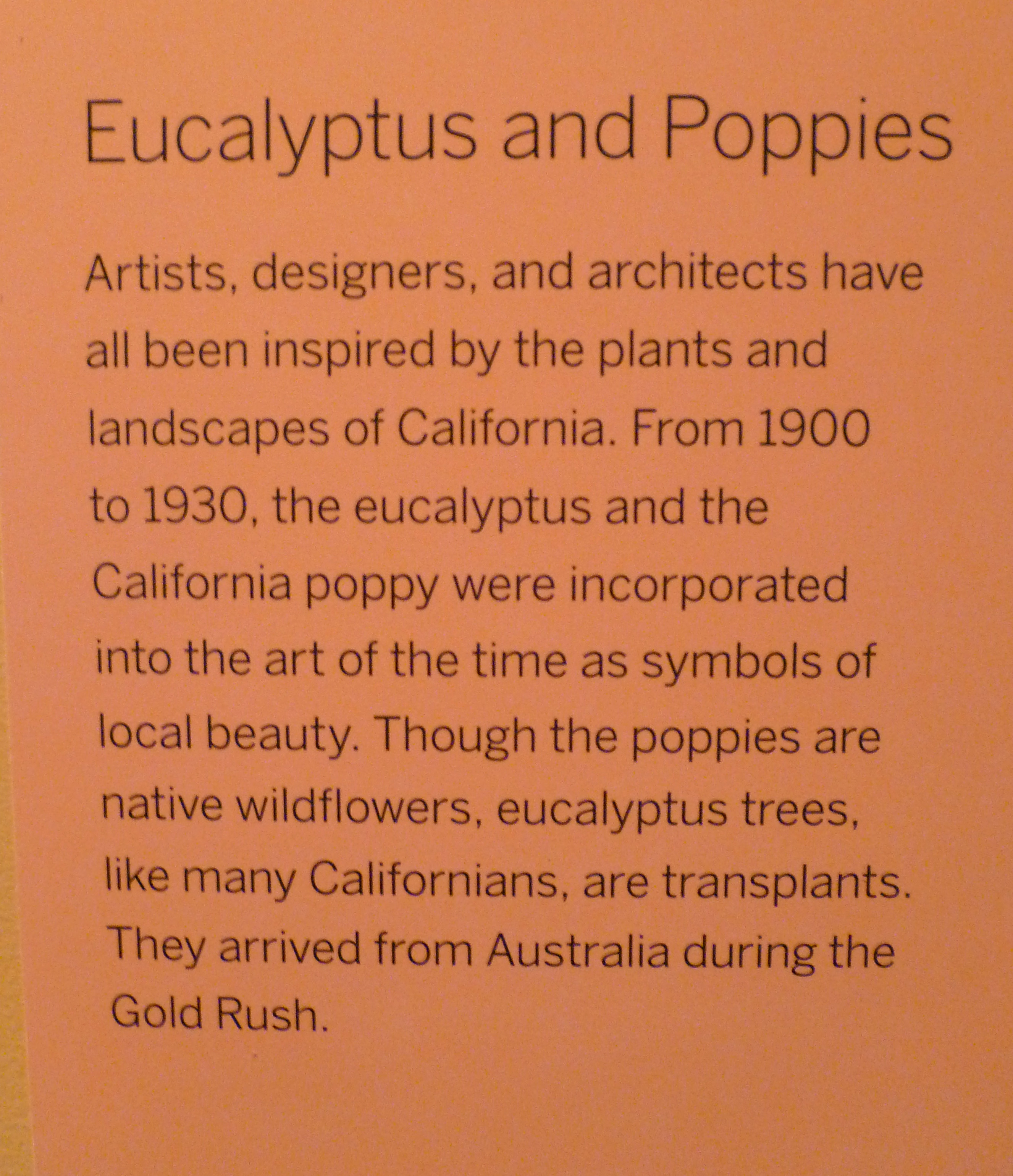
The museum’s collection of California art and design represents “the region’s creative output and its relationship to, and influences on, the nation and the world from the mid-1800 to the present,” according to its website. And so, as we would expect, the exhibit includes a fitting tribute to one of California’s iconic landscapes, “Eucalyptus and Poppies.”
Oakland MuseumDescription of exhibit
The artworks in this exhibit were created from 1916 to 1940, a period when eucalypts were popular. They are out of fashion now, as are leisure suits and beehive hairdos. Will they make a comeback, as did bell bottoms and hip hugger jeans?
There was a time, not so long ago, when Californians thought eucalypts fit in just fine with our native poppies. Are they really the destructive intruders that native plant advocates make them out to be? We don’t think so. We believe that eucalypts are the victims of a “bad rap,” scapegoats for a fire they didn’t cause and a dwindling native landscape that is succumbing to climate change and other factors unrelated to the existence of eucalypts.
Million Trees was created to inform the public of the many projects that have destroyed or plan to destroy non-native trees on public lands at every level of government from the federal government to local jurisdictions such as the Alameda County Water District. However, private properties are not immune from such efforts to destroy non-native trees. The legal battle to destroy 28 of 45 trees on private property in Larkspur is a case in point.
We learned of this legal battle from the San Francisco Chronicle . The property owner, Dr. Anne Wolff, was sued by her neighbors who claimed that her trees are hazardous. When the judged ruled that her trees must be destroyed, she appealed that decision.
We attended the appeal hearing. It was disturbing to hear the case law cited by the attorney representing the neighbors. We learned that other property owners had been ordered by the court to destroy their trees for such frivolous reasons as “leaves in the rain gutters” of their neighbors. One court ruling said that the “sheer size [of the tree] is a menace.” In other words, neighbors have successfully forced the destruction of their neighbors’ trees without any evidence that the trees were dangerous. The mere theoretical existence of danger was sufficient for the court to require the destruction of trees.
As we have reported in our post KILLER TREES!!!, arborists are sometimes willing to declare trees as hazardous if they are hired to do so. Therefore we are not convinced by the assessment that Dr. Wolff’s trees are hazardous. If these trees are in fact hazardous, it is not visually apparent.
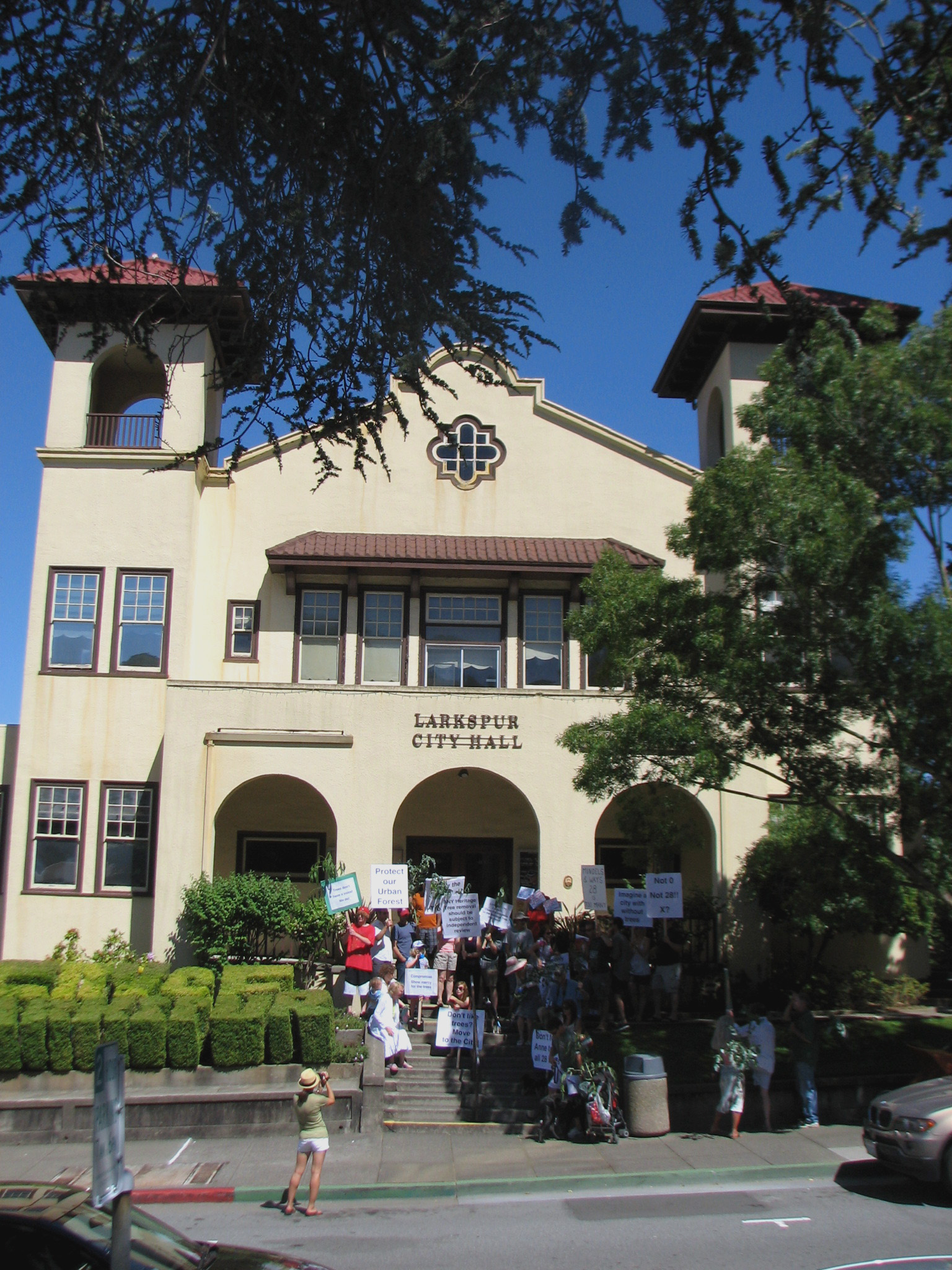
Trees on private property in Larkspur
Dr. Wolff told us she has received many calls from other property owners who did not have the financial resources to challenge the legal demands of their neighbors to destroy their trees.
Dr. Wolff is now hoping that the Larkspur City Council will invoke the city’s Heritage Tree ordinance to prevent the destruction of the largest trees. We attended the demonstration on June 13, 2010, organized to appeal to the city council to save the trees. About 50 people attended and the media reported on the demonstration.
Native plant advocates attempt to support their claim about the flammability of eucalypts by citing specific characteristics such as shreddy bark and volatile oils. Shreddy bark and volatile oils are characteristics of many plants, both native and non-native. They are not characteristics exclusive to eucalypts:
“The [chaparral] community has evolved over millions of years in association with fires, and in fact requires fire for proper health and vigor…Not only do chaparral plants feature adaptations that help them recover after a fire, but some characteristics of these plants, such as fibrous or ribbonlike shreds on the bark, seem to encourage fire. Other species contain volatile oils.” (page 341, A Natural History of California, Schoenherr, UC Press, 1992)
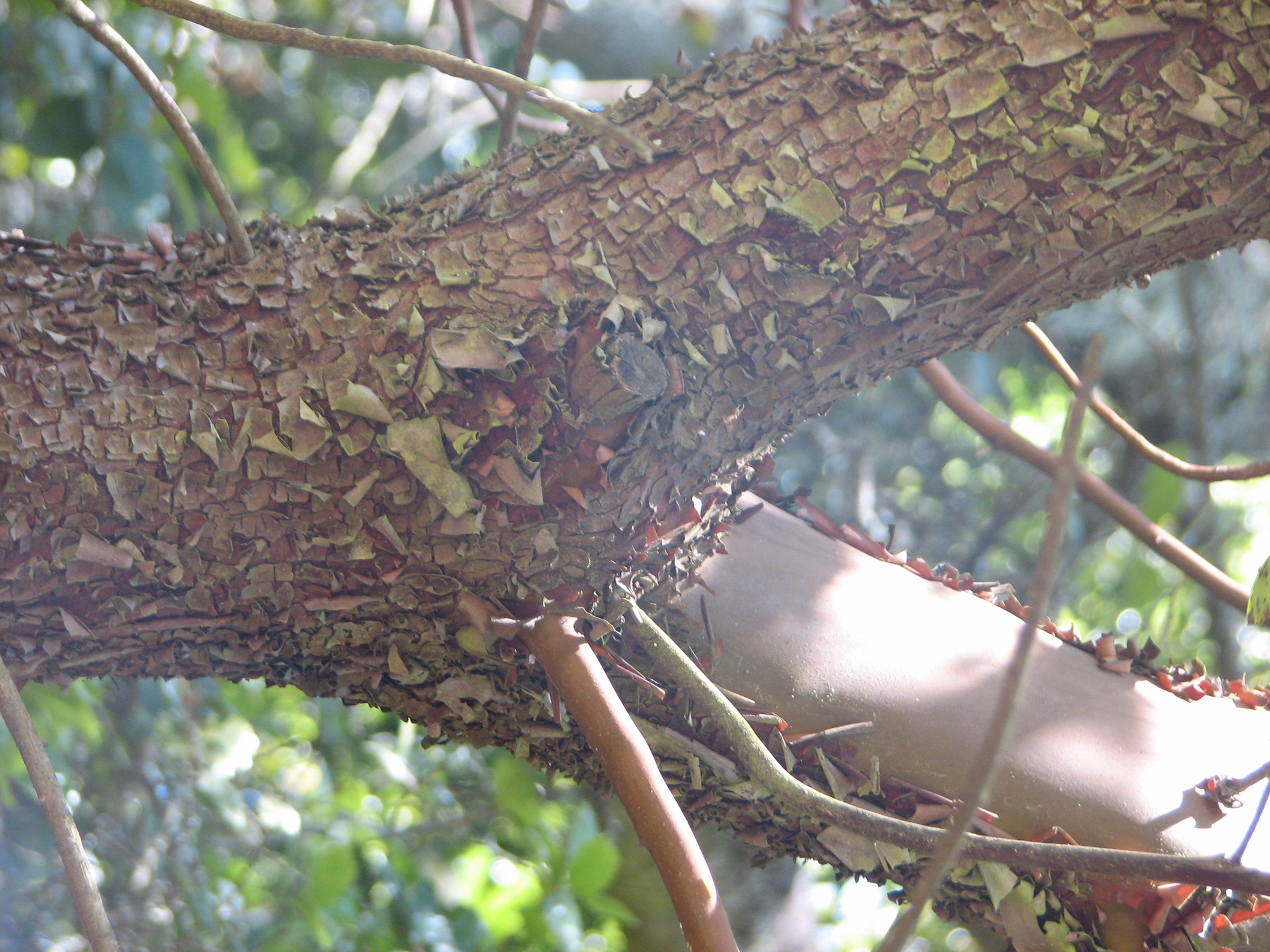
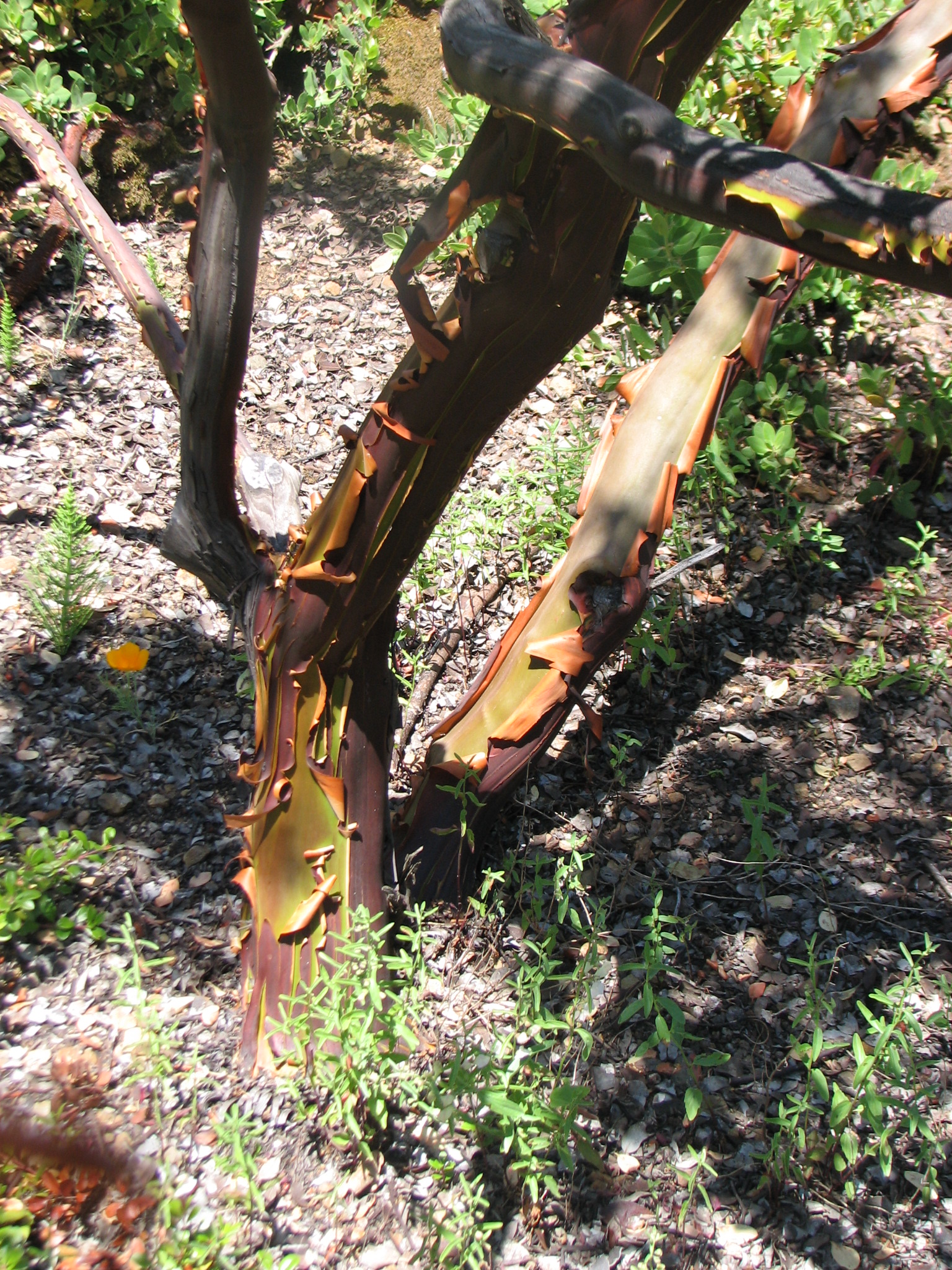
Madrone and Manzanita are examples of native plants with “ribbonlike shreds on the bark” that are highly flammable. Coyote brush and bay laurels are examples of native species which contain highly flammable oils.
Shreddy bark of Madrone
Shreddy bark of manzanita
Anyone with knowledge of the natural history of California could provide any number of such invidious comparisons between native and non-native plants with respect to their flammability. We hope the examples we have provided illustrate that flammability characteristics of plants are unrelated to whether the plants are native or non-native. The claim that non-native plants are more prone to fire than native plants is fallacious.
 Conservation Sense and Nonsense