Concern about herbicide use: Legitimate or “chemophobia”?

Recently there was a brief dialogue about herbicide use in San Francisco’s so-called “natural areas” in Jake Sigg’s Nature News that was of some interest to those who consider such use a contradiction in a public park designated as a “natural area”:

  •  Jake Sigg:  “Spurious, damaging information being circulated regarding herbicide use in our open spaces:  Mischievous people…are circulating false information…whipping up fears that have no foundation”  (Nature News, February 14, 2011)
  • Reader:  “…Garlon is legally classified as a hazardous chemical.  I am therefore writing to supply you with information from reputable sources.  I ask that in your future communications on this subject, you accurately describe the facts that are known about this chemical.” (Nature News, February 18, 2011)
  • Jake Sigg:  “The chemophobia rampant in this country is primarily based on emotion and anxiety, and does us a great disservice.” (Nature News, February 18, 2011)
  • Jake Sigg:  “The anti-herbicide crazies quickly seize on articles like this NYT one as proof of their contentions…” (Nature News, March 30, 2011)

This dialogue and the positive feedback that Mr. Sigg reported from his readers in support of herbicide use, suggest that herbicides are an important tool for the native plant movement.  They are anxious not to lose this tool in their crusade to eradicate non-native plants and trees.  After researching how much herbicide is being used by the Natural Areas Program, we can understand why they angrily defend its use.

Herbicide use by San Francisco’s Natural Areas Program

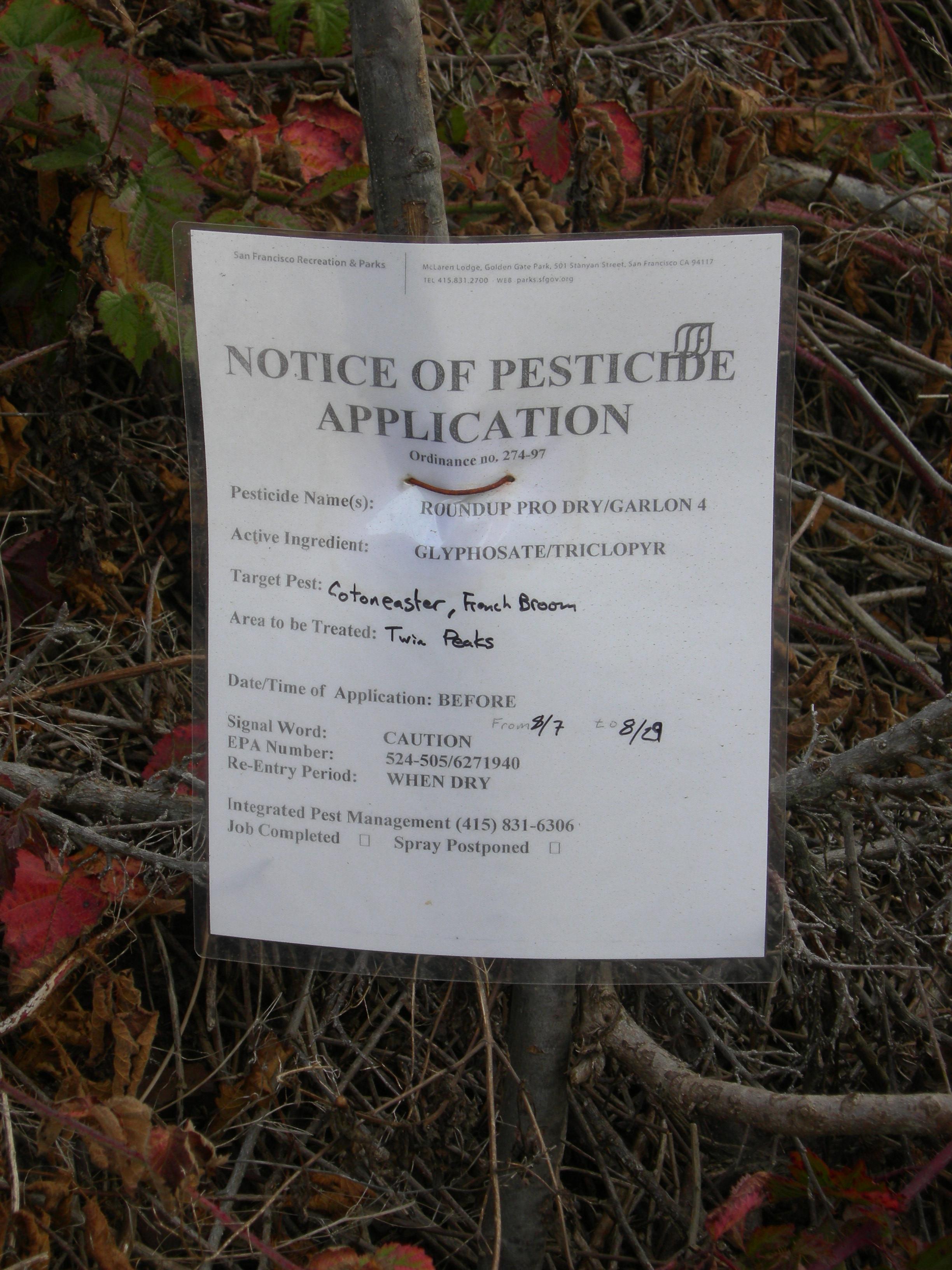
The Natural Areas Program (NAP) reports having used herbicides 69 times in 2010:  36 applications of Garlon, 31 applications of Roundup, and 2 applications of Milestone.  Putting those numbers into perspective, other areas (those not designated as “natural areas”) in the Recreation and Park Department sprayed Garlon, the most hazardous chemical, only a few times in 2010.

About 20% of these herbicide applications were done by a contractor who was paid $9,000 per application.  The employees of this contractor are therefore equally committed to this source of revenue, contributing to the economic interest that is a motivating factor in the native plant movement.

Not all of the “targets” of these sprayings are identified, but those that are include:  oxalis, blackberry, ivy, fennel, cotoneaster, hemlock, pampas grass, broom, erharta grass, mustard, and thistle.  Blackberry is an important source of food for wildlife in the city. We hope that children in the park do not graze on the blackberries.  Garlon was also sprayed on Scabiosa, which has not been identified as an “invasive plant” by the California Invasive Plant Council.

Glen Canyon, with a creek running through it and a year-around day care center adjacent to that creek, was sprayed 12 times.  Twin Peaks, the watershed to that creek, was sprayed 16 times.  Lake Merced was sprayed 3 times, despite the fact that it has been officially designated as red-legged frog habitat.

What is known about these chemicals?

The City’s policy regarding “Integrated Pest Management” classifies the chemicals used on city properties in terms of the risks associated with their use.  Here is how the City’s policy classifies these chemicals: 

  • Garlon:  Tier I, Most Hazardous.  Use Limitations:  “Use only for targeted treatments of high profile or highly invasive exotics via dabbing or injections.  May use for targeted spraying only when dabbing or injection are not feasible and only with use of a respirator.  HIGH PRIORITY TO FIND ALTERNATIVE.”
  • Roundup:  Tier II, Less Hazardous.  Use Limitations:  “Spot application of areas inaccessible or too dangerous for hand methods, right of ways, utility access, or fire prevention.  Use for cracks in hardscape, decomposed granite and edging only as last resort.  OK for renovations but must put in place weed prevention measures.  Note prohibition on use within buffer zone 60 feet around water bodies in red-legged frog habitat.”
  • Milestone:  Tier I, Most Hazardous

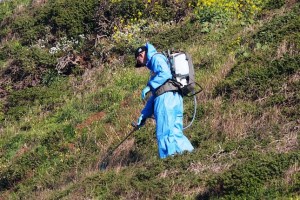
    Spraying Garlon on Twin Peaks without use of the respirator required by City policy, February 2011

Federal law also requires that chemicals be evaluated by the Environmental Protection Agency (EPA) before being commercially available to consumers.  The EPA conducts a number of tests of toxicity, reports the results of those tests on a mandated Material Safety Data Sheet (MSDS), and classifies the chemical with respect to its relative toxicity.  Here are a few highlights from the MSDS for these chemicals:

  • Garlon 4 Ultra is defined as a “Hazardous Chemical” according to the OSHA Hazard Communication Standard.  “Material is highly toxic to aquatic species” and “slightly toxic to birds.”
  •  Roundup Pro is defined as a “Hazardous Chemical” according to the OSHA Hazard Communication Standard. Toxicological effects in rats:  “decrease in body weight gain; histopathologic effects.”  “Moderately toxic” to aquatic life.

The Marin Municipal Water District (MMWD) quit using all herbicides in 2005 in response to the public’s protests.  They have been engaged in a process of evaluating herbicides for possible use in the future.  In 2008, MMWD contracted for a risk assessment of 5 herbicides they were considering for possible use.  That risk assessment determined that Garlon 4 Ultra is the most hazardous of the 5 chemicals that were evaluated.    MMWD is not considering the use of Garlon in the future. 

Does NAP’s herbicide use conform to the City’s Integrated Pest Management Law?

 San Francisco’s Integrated Pest Management Ordinance makes the following commitments regarding pesticide use on the city’s properties:

  • 300a “…the policy of the City..to eliminate or reduce pesticide applications on City property to the maximum extent possible.”
  • “The City…shall assume pesticides are potentially hazardous to human and environmental health.”
  • “The City shall give preference to reasonably available nonpesticide alternatives when considering the use of pesticides.”
  • “Consider the use of chemicals only as a last resort.”
  • “This Chapter applies the Precautionary Principle to the selection of reduced risk pesticides and other pest management techniques.”

The City’s ordinance that obligates the City to follow the Precautionary Principle makes this commitment:

“A central element of the precautionary approach is the careful assessment of available alternatives using the best available science. An alternatives assessment examines a broad range of options in order to present the public with the consequences of each approach. The process takes short-term versus long-term effects or costs into consideration, and evaluates and compares the adverse or potentially adverse effects of each option, giving preference to those options with fewer potential hazards. This process allows fundamental questions to be asked: ‘Is this potentially hazardous activity necessary?’ ‘What less hazardous options are available?’ and ‘How little damage is possible?’”

We do not believe that herbicide use by the Natural Areas Programs meets the standards of either the City’s ordinance about pesticide use or its commitment to the Precautionary PrincipalThese laws are theoretically rigorous, but the enforcement of those laws is not.  The Natural Areas Program is using an herbicide (Garlon) categorized by City policy as the “Most Hazardous” most of the time.  They are using that chemical in sensitive areas in which water can be contaminated and in which children can be exposed.  Their use of that hazardous chemical has increased over time and they have been using that chemical for at least 5 years, perhaps longer (the 2006 management plan for the Natural Areas Program reports the use of this chemical).  If Garlon has not been capable of eradicating in 5 years, the non-native plants that are the target of the Natural Areas Program, it is not likely to do so in the foreseeable future.  

Legitimate concern or “chemophobia”?

Let the reader be the judge.  Given what we know about these chemicals, the frequency of their use, the length of that use, and the locations of that use:

  • Do you think there is reason to be concerned about the herbicides that are being sprayed on our public parks? 
  • Do you think that places that have been designated as “natural areas” should be sprayed with herbicides which are legally and officially designated as hazardous chemicals? 
Broom: “I’m ba-ack”

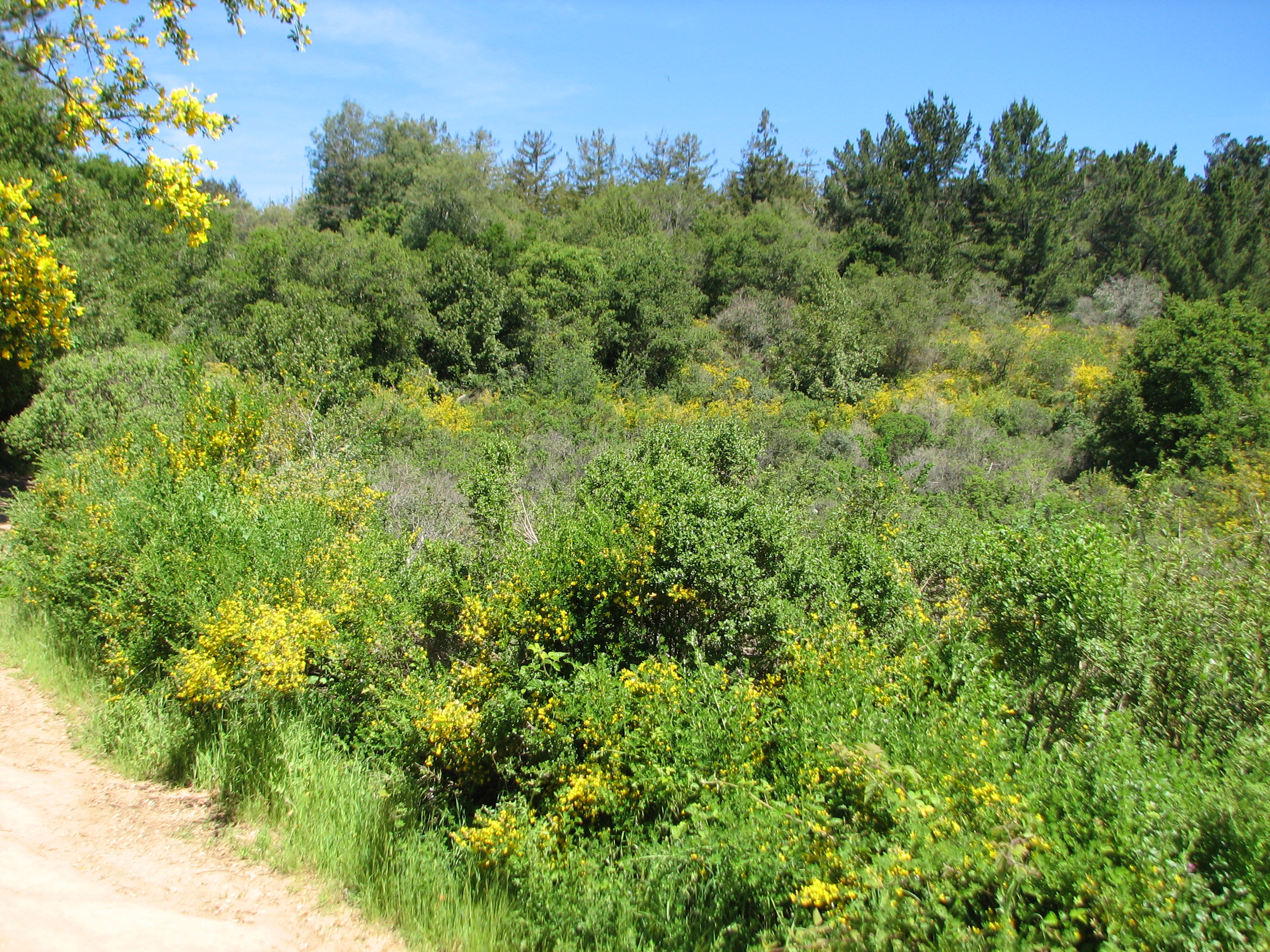
Leona Canyon, Spring 2011

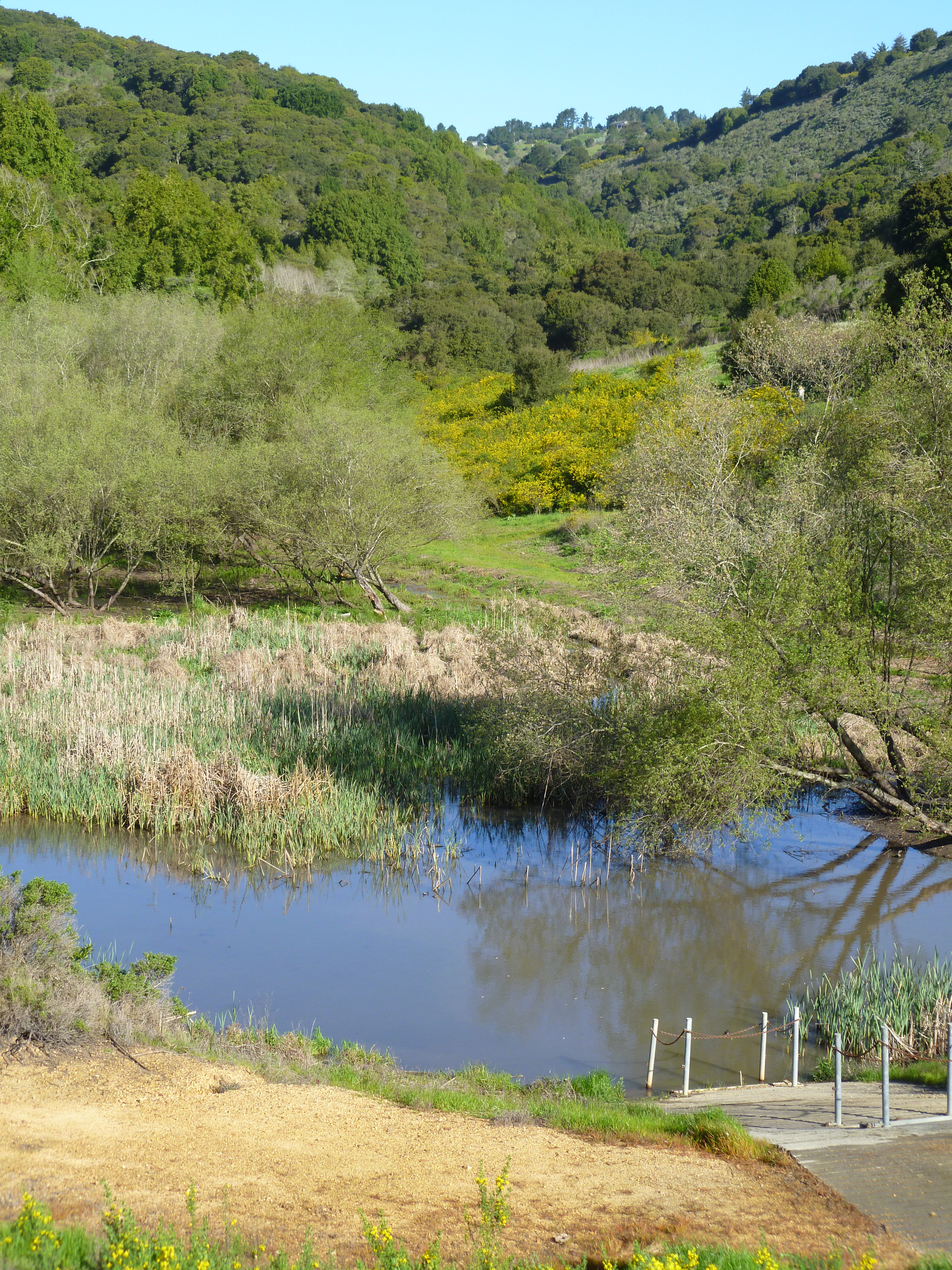
One of our first posts, nearly one year ago, was about attempts to eradicate broom (see “Broom:  I’ll be back!”).  It’s that time of year again, when the broom is blooming around the Bay Area, adding a dash of bright yellow color to our public lands.

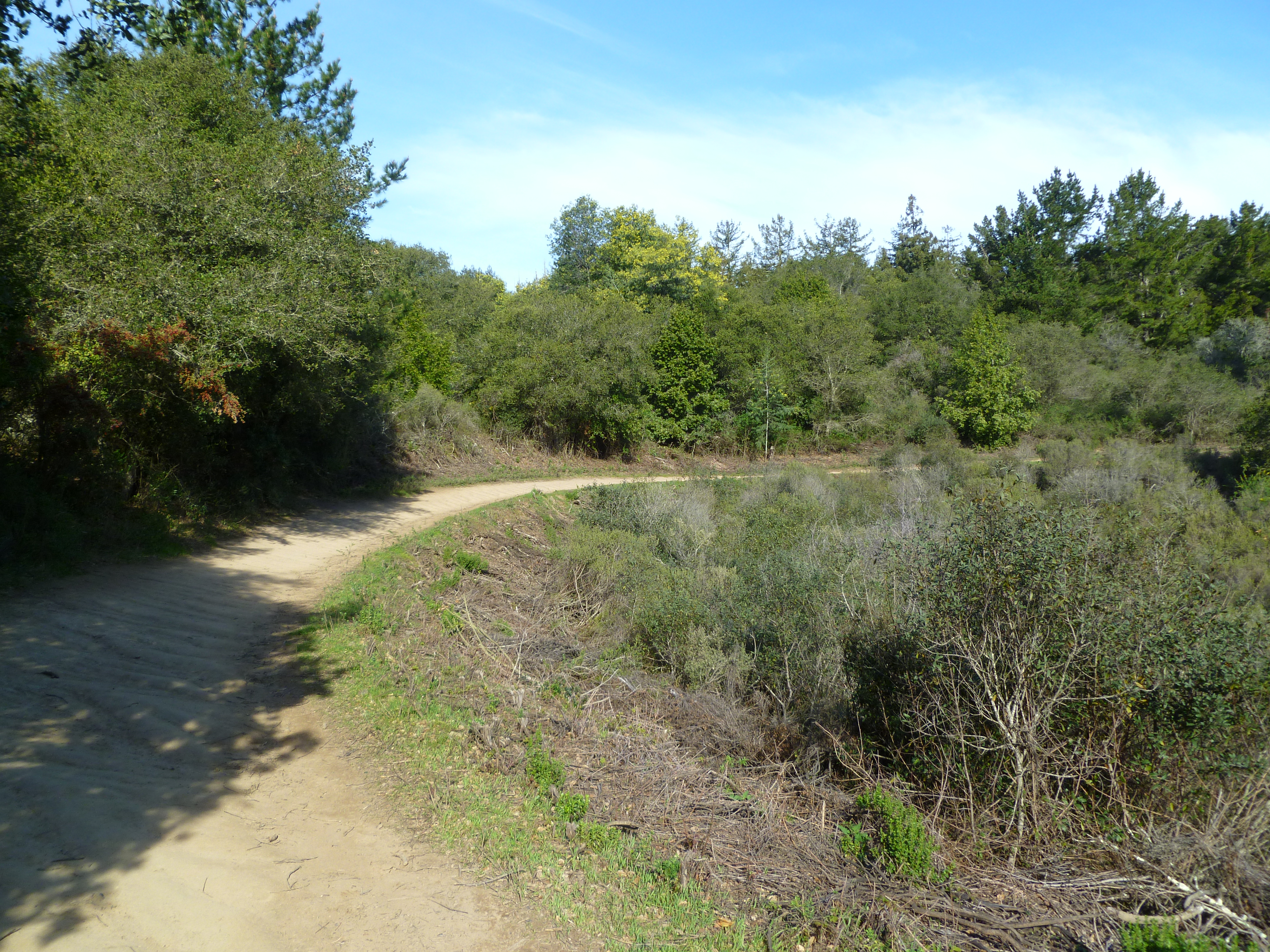
Despite continuing efforts to eradicate broom, it makes this annual comeback, regardless of the method used to kill it.  Mechanical destruction is one of the methods used.  In the photograph taken in fall 2010 of a trail in Redwood Park we see the unsightly result of such an attempt to eradicate the broom shown in our first post about broom in spring 2010.

Redwood Park, Spring 2010
Redwood Park, Fall 2010

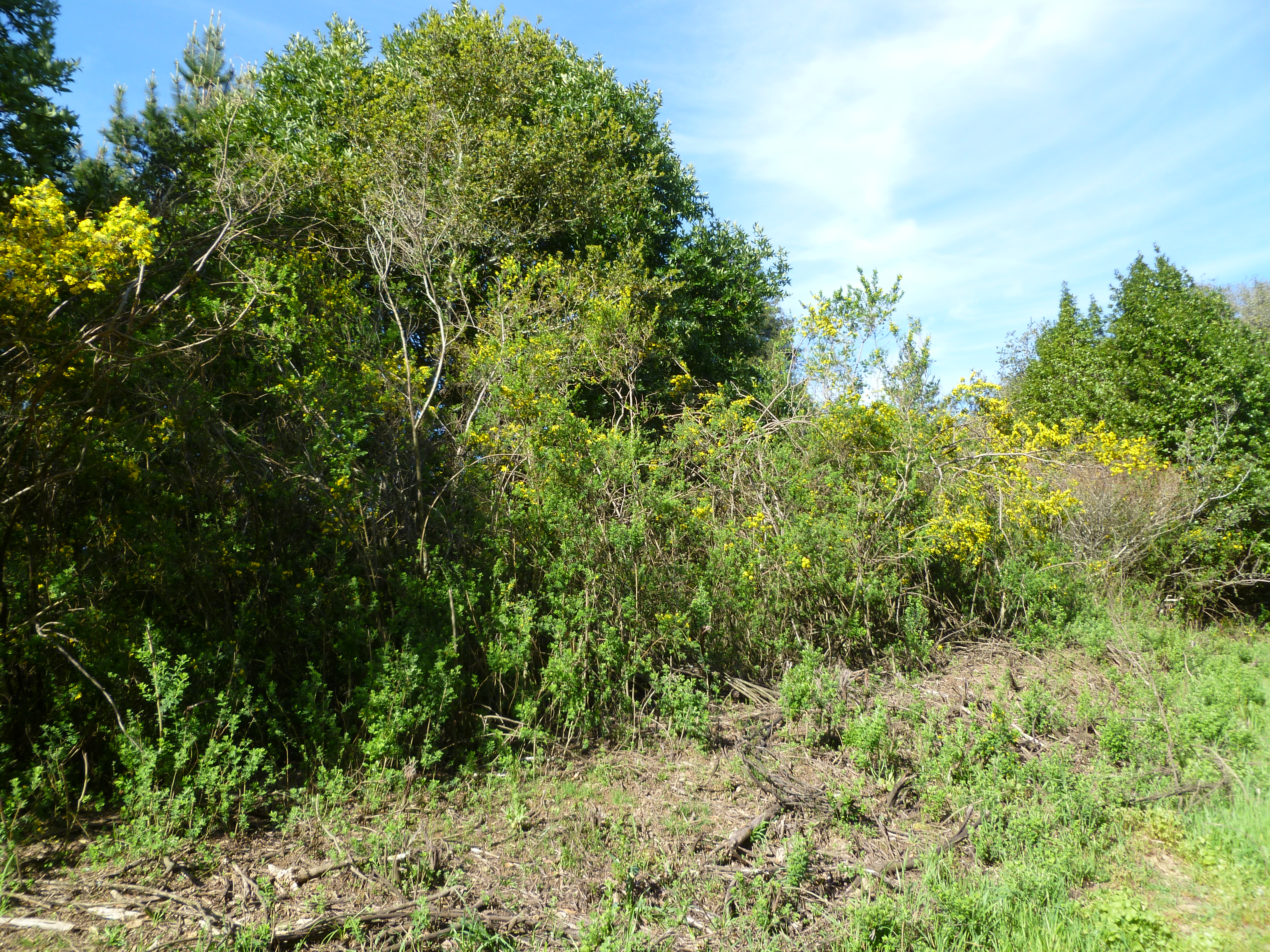
The UC Davis Statewide Integrated Pest Management Program  predicts the results of this effort to eradicate broom:  “Brush rakes and bulldozers often leave pieces of rootstalks that readily can resprout…using large equipment to clear land creates a perfect environment for new seedling establishment, making follow-up control essential.”  So, we shouldn’t be surprised when we revisit this same site the next spring to find that although it is still unsightly, it is also covered with the resprouts of the broom.

Broom resprouts, Redwood Park, Spring 2011

Herbicides are also used to eradicate broom.  The East Bay Regional Park District uses Garlon for foliar spraying of broom, despite the public’s concern about herbicide use in our parks.  In contrast, Marin Municipal Water District (MMWD) has not used herbicides on its properties since 2005, in response to public protests.  In December 2010, the Marin Independent Journal reported that MMWD is considering using Roundup (which is considered less toxic than Garlon) for broom control, but that a proposal will not be made until 2012 at the earliest, after an environmental impact study that will consider all alternatives for “pest management.”

Even if we are willing to accept the health and environmental risks associated with herbicides, they are not a guarantee of success.  According to UC Davis, “One application of an herbicide does not always completely control brooms…Watch treated areas closely for at least a year, and retreat as necessary.”


Since the seeds of broom are known to live in the ground from 50 to 60 years, we should expect that it is very difficult to eradicate.  Unless we make a commitment to kill the plant above the ground every year for as long as the seeds live in the ground, we cannot expect to be successful in that effort.

We were therefore amused by this exchange that Jake Sigg had with one of the readers of his “nature newsletter” (December 20, 2010):

Reader:  “…We have been up there every year for about 3-1/2 years now…It has been quite instructive about how flat out difficult it is to reverse the process [of “displacement” of native plants].  Like most invaders, the non-native plants like it here and want to stay.  The broom in particular are [sic] astoundingly persistent in holding whatever territory that they have gained.  It sounds strange to say, that sometimes I think the project is an exercise in futility while at the same time is extremely satisfying work and will continue it into the indefinite future.”

Jake Sigg:  “…It is such a lop-sided struggle…And yet, we all keep going.  It is a paradox that I don’t understand.  While working I’m fully aware of the seeming futility of what we’re doing, and yet keep going—and enjoying it!!”

Jake Sigg and his readers would benefit from the advice of Mark Davis in his book, Invasion Biology.*  Professor Davis suggests that unless a non-native species causes great health or economic harm, we adopt the “LTL approach” i.e., “Learn to love ‘em” or at least “Learn to live with them.” 

If it is futile to eradicate a plant we don’t like, if that plant isn’t doing us or any other plant any harm, and if we are damaging our environment in our futile attempt, let’s change our attitude toward that plant.  If we can’t change the plant, it is still within our power to change ourselves.  Surely we can find something more fruitful to do that is equally satisfying such as planting more native plants rather than destroying non-native plants.

Broom is an especially good candidate for LTL.  It is green all year around.  It requires no care whatsoever.  And in the spring it treats us to a lovely carpet of bright yellow.   What’s not to love?


* Mark Davis, Invasion Biology, Oxford University Press, 2009, page 150

Open Letter to the Sierra Club

In this post we are writing an open letter to the Sierra Club about an article in their recent edition of the Yodeler, the newsletter of the Bay Area Chapter of the Club.  The article is available here

——————————————————————————————-

Dear Sierra Club,

We are writing about an article in the Yodeler about the “Wildfire Hazard Reduction and Resource Management Plan” of the East Bay Regional Park District.  A charitable description of that article is that it is misleading and inaccurate.

The most important flaw in the article is that it omits the most controversial issue in the “Wildfire Plan.”  It describes the methods used to eradicate non-native plants and trees as follows:  “Methods for removal include hand removal, grazing by cattle and goats, and limited controlled burns.”

In fact, herbicides are often used by EBRPD to kill non-native plants and trees.  The failure to mention this use of herbicides in the Yodeler cannot be dismissed as ignorance of this fact since it is described in detail in the “Wildfire Plan” and was the most frequently mentioned issue in the meeting of the EBRPD Board of Directors at which the Plan was approved.  The Sierra Club was represented at this meeting and surely noticed that many speakers expressed their concern regarding the use of herbicides officially designated “hazardous chemicals” by OSHA.  The toxicity of these herbicides is reported  here and here.

The description of controlled burns required by the Plan as “limited” is debatable.  We believe that the use of controlled burns for the sole purpose of restoring native plants is dangerously irresponsible.

At the recent meeting of the Executive Committee of the Board of Directors of the EBRPD, the “fuel management” plans for 2011 were presented and approved.  These plans included prescribed burns in 5 locations, on approximately 250 acres.  These burns were described by the Assistant Fire Chief as unrelated to reduction of fuel loads, but rather for the purpose of supporting restoration of native plants to the parks.  A representative of the California Native Plant Society expressed  gratitude to East Bay Regional Park District  for conducting these burns for the benefit of native plants.

We object to the use of controlled burns for this purpose because such burns have a history of causing major wildfires (reported here).  Some of these controlled burns will occur in areas with many acres of eucalyptus and Monterey pine that both the Sierra Club and the East Bay Regional Park District claim are highly flammable.  The burns are scheduled to occur during the height of the fire season.  Such burns also reduce air quality and release carbon and particulates into the air.

It baffles us that the Sierra Club endorses the use of dangerous herbicides and prescribed fires.  However, we aren’t surprised because the Club’s comments on the Draft EIR for the “Wildfire Plan” warned us that the Sierra Club considers the restoration of native plants a higher priority than the public’s safety.  The lawyer representing the Club said on behalf of the Club, “Perhaps the most serious problem with the Plan is that it explicitly makes the preservation and enhancement of wildlife a secondary concern, with minimizing fire danger the primary concern” and concluded, “However, the over-emphasis on decreasing wildfire risks at the expense of habitat values is disturbing.”

The Club’s priorities reveal a misanthropic agenda that betrays its original ideals and its commitment to the environment on behalf of all living creatures, including humans.

Million Trees

Herbicide Subterfuge

The public is unaware of the scale of herbicide use in our parks and public lands.  Nor are they aware of the toxicity of herbicides to humans and animals.  We will describe just two examples of the subterfuge that is used by “restorationists” to hide the use of herbicides.

The management plan of San Francisco’s Natural Areas Program (NAP) includes a description of the NAP’s herbicide use. Table 4-2 of the plan identifies 16 species of non-native plants and trees on which herbicides (Roundup and Garlon) are used.  Although the plan states specifically that herbicides are used, the Initial Study of environmental impact of the program says absolutely nothing about the use of herbicides. It does not acknowledge that herbicides are used or analyze their impact on the environment and its inhabitants.

Twin Peaks, San Francisco

The use of herbicides by a program calling itself the “Natural Areas Program” is particularly ironic in San Francisco, a city that has officially adopted the Precautionary Principle.  The PP theoretically obligates the city of San Francisco to ban any substance that might harm the environment or its inhabitants, even if there is not yet scientific evidence of that harm.  In the case of herbicides, there is plenty of evidence of the harmful effects on humans and other animals.

The East Bay Regional Park District is also using herbicides without acknowledging the risks in doing so.  In its Wildfire Plan, EBRPD misinforms the public that the Marin Municipal Water District is using herbicides:  “Using herbicides to control invasive [AKA non-native] plant species…can be an efficient and cost-effective method…Recent studies conducted by the Marin Municipal Water District (MMWD)  confirm this approach; the results of their studies on the use of non-chemical control methods for the control of invasive non-native plants indicated that non-chemical alternatives are ineffective for large-scale vegetation management projects. (see Appendix H…)”  (page 92) .  In other words, EBRPD in its Wildfire Plan is inaccurately claiming that MMWD is using herbicides when they are not.  MMWD has confirmed in writing that they have not used herbicides since 2005.

But, EBRPD doesn’t stop there.  When the public pointed out to EBRPD during the public comment period on the Environmental Impact Review (EIR) that MMWD is not using herbicides, EBRPD responded (Response to Comments) as follows:  “As of March 2010, MMWD’s draft reports and analyses have shown no significant risk associated with the use of the chemicals studied on human health, animals or non-target plants, and a greatly increased average annual cost for eradicating 100 acres of the 750 acres of broom without the use of herbicides…”  (page 394) Whoever wrote that sentence has either not read MMWD’s risk assessment of herbicide use or is misrepresenting it.  In fact, MMWD’s risk assessment is perfectly clear in describing significant harm to the environment caused by herbicide use.

No wonder the public is in the dark about the use of herbicides.  Every effort is being made to keep them in the dark.