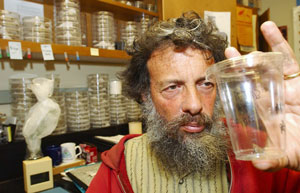
With permission and in its entirety we are publishing the comment of Arthur M. Shapiro. He is Distinguished Professor of Evolution and Ecology at UC Davis and a renowned expert on the butterflies of California. We hope that you will take his credentials into consideration as you read his opinion of native plant restorations in general and the Natural Areas Program in San Francisco in particular. We hope that Professor Shapiro’s comment will inspire you to write your own comment by the deadline, which has been extended to October 31, 2011. Details about how to submit your comment are available here.
*************************
October 6, 2011
Mr. Bill Wycko
San Francisco Planning Department
Re: DRAFT EIR, NATURAL AREAS PROGRAM
Dear Mr. Wycko:
Consistent with the policy of the University of California, I wish to state at the outset that the opinions stated in this letter are my own and should not be construed as being those of the Regents, the University of California, or any administrative entity thereof. My affiliation is presented for purposes of identification only. However, my academic qualifications are relevant to what I am about to say. I am a professional ecologist (B.A. University of Pennsylvania, Ph.D. Cornell University) and have been on the faculty of U.C. Davis since 1971, where I have taught General Ecology, Evolutionary Ecology, Community Ecology, Philosophy of Biology, Biogeography, Tropical Ecology, Paleoecology, Global Change, Chemical Ecology, and Principles of Systematics. I have trained some 15 Ph.D.s, many of whom are now tenured faculty at institutions including the University of Massachusetts, University of Tennessee, University of Nevada-Reno, Texas State University, and Long Beach State University, and some of whom are now in government agencies or in private consulting or industry. I am an or the author of some 350 scientific publications and reviews. The point is that I do have the bona fides to say what I am about to say.
At a time when public funds are exceedingly scarce and strict prioritization is mandatory, I am frankly appalled that San Francisco is considering major expenditures directed toward so-called “restoration ecology.” “Restoration ecology” is a euphemism for a kind of gardening informed by an almost cultish veneration of the “native” and abhorrence of the naturalized, which is commonly characterized as “invasive.” Let me make this clear: neither “restoration” nor conservation can be mandated by science—only informed by it. The decision of what actions to take may be motivated by many things, including politics, esthetics, economics and even religion, but it cannot be science-driven.
In the case of “restoration ecology,” the goal is the creation of a simulacrum of what is believed to have been present at some (essentially arbitrary) point in the past. I say a simulacrum, because almost always there are no studies of what was actually there from a functional standpoint; usually there are no studies at all beyond the merely (and superficially) descriptive. Whatever the reason for desiring to create such a simulacrum, it must be recognized that it is just as much a garden as any home rock garden and will almost never be capable of being self-sustaining without constant maintenance; it is not going to be a “natural,” self-regulating ecosystem. The reason for that is that the ground rules today are not those that obtained when the prototype is thought to have existed. The context has changed; the climate has changed; the pool of potential colonizing species has changed, often drastically. Attempts to “restore” prairie in the upper Midwest in the face of European Blackthorn invasion have proven Sisyphean. And they are the norm, not the exception.
The creation of small, easily managed, and educational simulacra of presumed pre-European vegetation on San Francisco public lands is a thoroughly worthwhile and, to me, desirable project. Wholesale habitat conversion is not.
A significant reaction against the excesses of the “native plant movement” is setting up within the profession of ecology, and there has been a recent spate of articles arguing that hostility to “invasives” has gone too far—that many exotic species are providing valuable ecological services and that, as in cases I have studied and published on, in the altered context of our so-called “Anthropocene Epoch” such services are not merely valuable but essential. This is a letter, not a monograph, but I would be glad to expand on this point if asked to do so.
I am an evolutionary ecologist, housed in a Department of Evolution and Ecology. The two should be joined at the proverbial hip. Existing ecological communities are freeze-frames from a very long movie. They have not existed for eternity, and many have existed only a few thousand years. There is nothing intrinsically sacred about interspecific associations. Ecological change is the norm, not the exception. Species and communities come and go. The ideology (or is it faith?) that informs “restoration ecology” basically seeks to deny evolution and prohibit change. But change will happen in any case, and it is foolish to squander scarce resources in pursuit of what are ideological, not scientific, goals with no practical benefit to anyone and only psychological “benefits” to their adherents.
If that were the only argument, perhaps it could be rebutted effectively. But the proposed wholesale habitat conversion advocated here does serious harm, both locally (in terms of community enjoyment of public resources) and globally (in terms of carbon balance-urban forests sequester lots of carbon; artificial grasslands do not). At both levels, wholesale tree removal, except for reasons of public safety, is sheer folly. Aging, decrepit, unstable Monterey Pines and Monterey Cypresses are unquestionably a potential hazard. Removing them for that reason is a very different matter from removing them to actualize someone’s dream of a pristine San Francisco (that probably never existed).
Sociologists and social psychologists talk about the “idealization of the underclass,” the “noble savage” concept, and other terms referring to the guilt-driven self-hatred that infects many members of society. Feeling the moral onus of consumption and luxury, people idolize that which they conceive as pure and untainted. That may be a helpful personal catharsis. It is not a basis for public policy.
Many years ago I co-hosted John Harper, a distinguished British plant ecologist, on his visit to Davis. We took him on a field trip up I-80. On the way up several students began apologizing for the extent to which the Valley and foothill landscapes were dominated by naturalized exotic weeds, mainly Mediterranean annual grasses. Finally Harper couldn’t take it any more. “Why do you insist on treating this as a calamity, rather than a vast evolutionary opportunity?” he asked. Those of us who know the detailed history of vegetation for the past few million years—particularly since the end of Pleistocene glaciation—understand this. “Restoration ecology” is plowing the sea.
Get real.
Sincerely,
Arthur M. Shapiro
Distinguished Professor of Evolution and Ecology