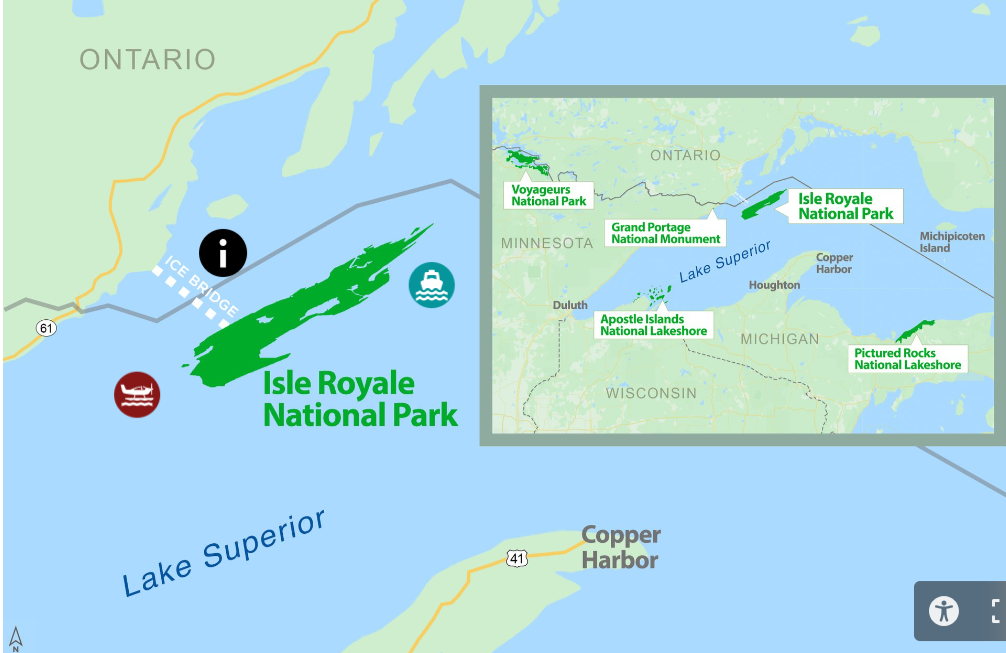
Isle Royale is an island and US National Park in Lake Superior. It is 45 miles long and 9 miles wide. Big enough to be the home of many animals, but small enough to be intensively studied and well understood.
The closest land is 24 miles away, in Canada. Far enough away to limit opportunities for animal migrations and control public access to the island, but close enough that ice bridges from the land to the island have formed in the past that animals used to migrate to the island. It is isolated, but not totally isolated, which contributes to the dynamism of the ecosystem.
The animals at the top of the food web on Isle Royale are wolves and moose. Moose are said to have arrived via an ice bridge at the beginning of the 20th century. Wolves arrived using another temporary ice bridge in the late 1940s. The predator/prey relationship between moose and wolves has been studied on Isle Royale continuously since 1958, making it the longest-running predator/prey study.
When the study began 66 years ago, scientists expected to find an equilibrium balance point between populations of wolves and moose that would be stable in the long term. That’s not what they found on Isle Royale. Instead, they observed continuous, unpredictable change, such as disease, tick outbreaks, immigrant wolves, severe winters and hot summers.
Scientists recorded the population dynamics of wolves and moose on Isle Royale for 66 years, as depicted in this graph:

As we would expect, moose populations increased when wolf populations decrease and vice versa. Scientists can explain the turning points in the population curves of both wolves and moose, but in many cases they could only do so long after the fact as they identified the causal factors:
- Between 1958 and 1969, the moose population doubled, while the wolf population declined from 30 to 15.
- Between 1969 and 1980, the wolf population increased as the moose population decreased until 1982, when canine parvovirus was introduced to the island by a visiting dog.
- The wolf population decreased from 50 to 14 until parvovirus died out, but the wolf population did not rebound. The wolves had become inbreed because they were all descendants of a single breeding pair. The wolf population suffered spinal deformities that handicapped their hunting until a single new male introduced new genes in 1997.
- Between 1982 and 1996 the moose population increased to an all-time high of 2,400 until 1996 when their over-population caught up with them. The population plummeted because of lack of forage, an increase in the tick population and a severe winter. Ticks cause moose to lose their hair during winter, at a time when they were already thin because of over-browsing of vegetation.
- When the moose population plummeted in 1996, there was a corresponding decrease in the wolf population, until a new wolf arrived via a temporary ice bridge. In 1997 a single male wolf made his way to the island on an ice bridge during the extreme winter. He was very prolific and infused new genes into the wolf population that enabled the wolf population to rebound to 30 by 2005. The arrival of the new wolf was not identified by the scientists who study Isle Royale until 14 years later, as the result of genetic tests.
- Between 2000 and 2005 there was a series of hot summers, which increased the tick population and suppressed the moose population, causing a corresponding decline in the wolf population.
- Between 2005 and 2011, the moose population rebounded, but the wolf population continued to decline. By 2011 there were only 15 wolves with only 2 females and most males were without functioning packs. Inbreeding was probably contributing to the inability of the wolf population to recover.
In 2018, the National Park Service decided to take matters into their own hands. There were only 2 wolves left at that point and over-population of moose was taking its toll on vegetation on the island. New migration of wolves was no longer expected because the warming climate prevents the formation of new ice bridges to the island. NPS adopted an interventionist policy for the first time. They made a commitment to introduce 20-30 new wolves to the island over 3-5 years.
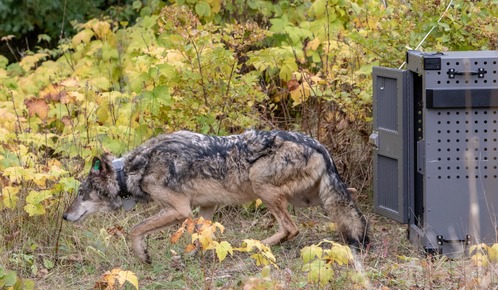
The graph depicts the arrival of new wolves on Isle Royale in 2018. The wolf population has increased and it is more genetically diverse because of the arrival of wolves from distant genetic pools. Greater genetic diversity will improve the resiliency of the wolf population. The moose population is decreasing in response to restoration of wolves to a population of 30.
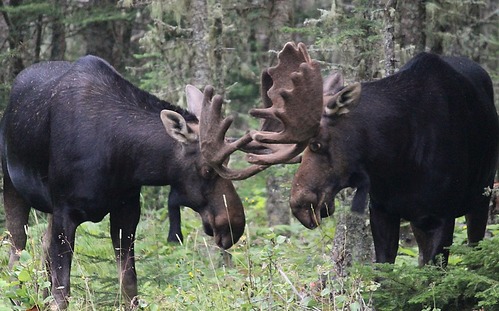
The dynamic predator/prey relationship between moose and wolves in Isle Royale will continue in unpredictable ways. Climate change is expected to play a bigger role. Hotter weather will increase tick populations and cause more moose mortality. Changes in the climate will effect vegetation. Balsam fir that are the preferred food of moose are being killed by spruce budworm. Ice bridges that bring newcomers to the island will no longer form.
Scientific Humility
However, the scientists who have studied Isle Royale for decades don’t want to leave you with the mistaken impression that they understand everything that has happened in the past or that they can predict everything that will happen in the future on Isle Royale. Their humility is refreshing:
“For 50 years, the focused purpose of the Isle Royale wolf-moose project has been to predict and understand a relatively simple natural system. But the more we studied, the more we came to realize how poor our previous explanations had been.” (1)
These scientists want us to understand the limits of our understanding of nature because if and when we don’t, we make serious mistakes:
“If we see Nature as a system whose future we can predict, then we will be confident in our efforts to control and manage Nature. If, in Nature, we are more impressed by its essentially contingent, and hence unpredictable character, then our relationship will be more strongly rooted in striving to live within the boundaries of Nature’s beautifully dynamic variation.” (1)
Readers of Conservation Sense and Nonsense know that I believe humans cannot control nature. We don’t understand nature well enough to control it and the forces of nature are far more powerful than we are. When we try, we often do more harm than good. The scientists who have studied Isle Royale for 66 years seem to agree with me. I am grateful for their work and their wisdom.
(1) Wolves & Moose on Isle Royale, Project Overview
Sources for this article:
Wolves & Moose on Isle Royale, Project Overview
Wolves & Moose on Isle Royale, Ticks
Isle Royale National Park
Isle Royale, Wikipedia
 Conservation Sense and Nonsense