Hybridization: “Genetic pollution” or a natural process?

 
Presidio variety of California poppy. NPS photo
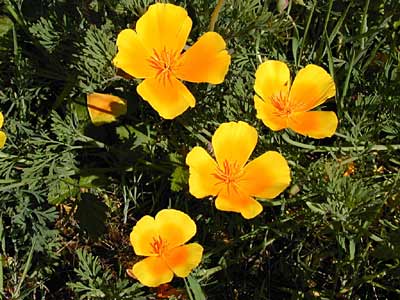
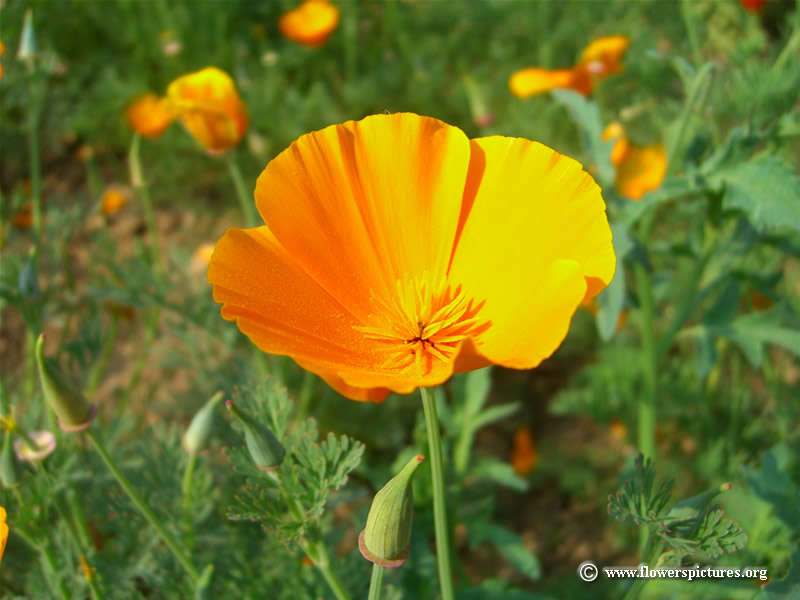
The San Francisco Chronicle’s gossip columnist, Leah Garchik, recently published a story about California poppies in the Presidio.  Apparently, someone planted the “wrong” poppy, or it migrated there.  The poppy that is native to the Presidio is small and yellow.  This “alien” poppy is the large orange poppy that most of us consider the classic California poppy.  The historical record indicates that this classic poppy grew elsewhere in San Francisco, but since it didn’t grow in the Presidio it must be removed because the Presidio’s Vegetation Management Plan “contains the requirement to remove any plants that could jeopardize the integrity of the genetics of native plants in the Presidio.” 
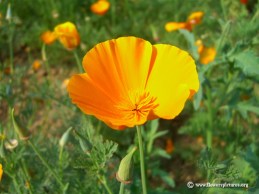
The “wrong” poppy

This incident reminded us of an article published in the newsletter of the local chapter of the California Native Plant Society several years ago, entitled “Contaminating the Gene Pool.”  In this article Jake Sigg instructs gardeners to beware of planting the wrong variety of a native plant because it will cause “genetic pollution.”  The California poppy is one of the examples he gives of a variety of California native being planted in San Francisco that doesn’t belong here.  It isn’t sufficient in his opinion, to plant a California native if that specific variety of the species didn’t historically occur in San Francisco.  He asks gardeners to “think in terms of preserving the genetic integrity of the local landscape.”  And he speculates many negative consequences of selecting the wrong variety, such as “genetic swamping, you’ve got all these foreign genes that are going to overwhelm the native population.”  We were reminded of Mr. Sigg’s vocal opposition to human immigration. 

For the benefit of our readers who aren’t gardeners, we should explain what Jake Sigg and the Presidio are worried about.  In a word, they are worried about hybridization, defined as “to breed or cause the production of a hybrid,” which is defined as “the offspring of two animals or plants of different breeds, varieties, or species.”  Hybridization is as likely to occur between two native plants as two non-native plants, but native plant advocates are concerned about the possibility of a native and a non-native plant producing a hybrid variety that is distinct from the native plant.  Hybridization is not inevitable, but it does occur naturally as well as through human manipulation.  The “From the Thicket” blog recently told the fascinating story of the development of a valuable garden cultivar variety of a favorite California native, ceanothus or California Lilac. 

Aside from the unpleasant association with eugenics, Mr. Sigg’s advice raises several practical questions.  How is the gardener supposed to know exactly which variety of a native plant “belongs” in San Francisco or even in a specific neighborhood within San Francisco, such as the Presidio?  And, in the unlikely event that gardeners might have such esoteric knowledge, where would they get the seeds of this specific variety?  Jake Sigg acknowledges this practical obstacle, but advises gardeners to get their seeds and plants only from the annual plant sale of the local chapter of the California Native Plant Society.  One wonders how many gardeners will follow this rather restrictive advice.

However, the more important question is the scientific question.  Is hybridization an inherently harmful process that always reduces species diversity?    We turn to Mark Davis for a less gloomy view of hybridization.  Like most scientific questions, there is evidence of both positive and negative effects of hybridization on species diversity.  Since you’ve heard the negative view from Mr. Sigg, we’ll let Mark Davis speak for the positive view.  Professor Davis reports in his book Invasion Biology* that “the fossil record generally shows that following the invasion of new species, the number of species resulting from adaptive radiations and evolutionary diversification exceeds the number of extinctions.”   And he concludes his discussion of hybridization and evolution by saying, “…a fair appraisal must also acknowledge that species introductions can enhance diversity as well, through hybridization, and the creation of new genotypes.”

The native plant movement has a narrow view of nature, which we do not share.  Their ideology is based on dire predictions of ecological disaster if we don’t follow their restrictive advice.  And when the managers of public lands choose to follow their advice, the consequences are usually the destruction of plants and animals that we value, in this case a field of California poppies. 


* Mark Davis, Invasion Biology, Oxford University Press, 2009, page 78-82.
“Mother Nature’s Melting Pot”

The Sunday New York Times of April 3rd published an op ed in defense of non-native plants.  In “Mother Nature’s Melting Pot” Professor Hugh Raffles (New School) reminds us that our country was built by immigrants.  Despite our origins, we also have a long tradition of opposition to immigration.  As each generation becomes established, it wishes to pull up the welcome carpet to new immigrants.  During times of economic crisis this anti-immigration sentiment is particularly strong.

Professor Raffles notes the extension of this anti-immigration sentiment to non-native plants and animals.  Just as immigrants have contributed to the dynamism and creativity of our society, non-native plants are contributing to our natural world as, “They arrive unannounced, encounter unfamiliar conditions and proceed to remake each other and their surroundings.” (1)

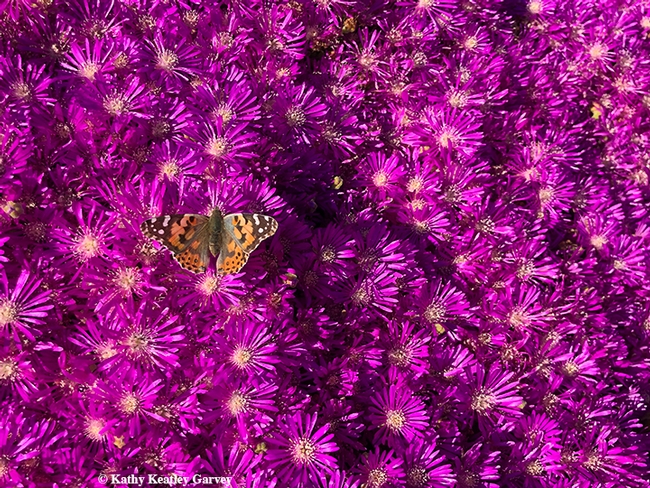
He provides many examples of non-native plants and animals that benefit both humans and native animals, including several examples that are locally relevant.  He reminds us that the eucalyptus is a rare source of winter nectar for the honeybees that were imported in the 1600s and now pollinate about one-third of our food crops.  He also reminds us that ice plant can stabilize sandy soils that might otherwise inundate our roads and neighborhoods as they shift in the wind.

Painted Lady butterfly on ice plant. Bug Squad, UC Davis

He notes that attempts to eradicate non-native plants and animals are often futile once the species become firmly established and that attempts to do so often harm the environment.   Here in the San Francisco Bay Area we are acutely aware of the harm being done by attempts to eradicate non-native plants.  We witness hundreds of thousands of healthy, mature trees being needlessly destroyed.  We see acres of park land being sprayed with toxic herbicides.  We watch precious recreational space being fenced off for “restorations” in places that are completely artificial, yet also entirely natural in the sense that they are sustained without being actively gardened.

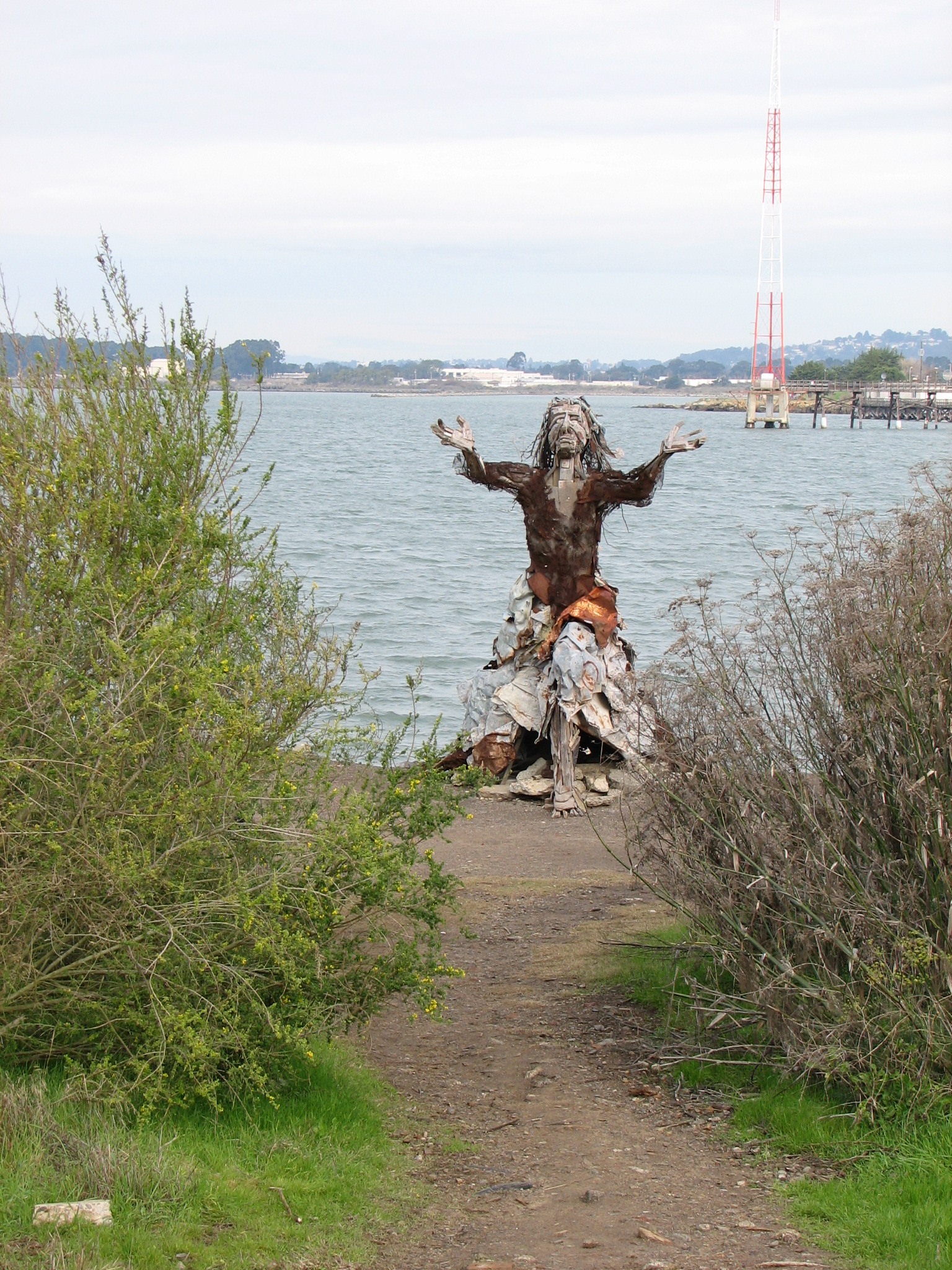
The most recent example is the announcement that the Albany Bulb (in Albany, CA) will soon be transformed into a native plant garden.  The Albany Bulb is composed of landfill that was used for decades as a city dump and is now a heavily used park, populated by art created from the junk that remains from the dump.  Non-native plants and trees thrive there without any care.  It is pointless to destroy this valuable artistic and recreational resource, yet native plant advocates demand its “restoration.”

Sculpture of “Albany Bulb Greeter”

Professor Raffles makes the logical connection between anti-immigration sentiment and the native plant movement’s commitment to the eradication of non-native plants and animals.  This connection is relevant in the Bay Area because a prominent leader of the native plant movement here is strongly opposed to immigration.

Jake Sigg has been an officer in the local chapter of the California Native Plant Society for many years.  He was a gardener in San Francisco’s Recreation and Park Department for 31 years.  He was awarded the “Jake Sigg Award for Vision and Dedicated Service” by the California Invasive Plant Council in 2003.  This award was named for him, “For years of tireless service and leadership on invasive plant issues in California.”

For many years, Mr. Sigg has published a “Nature News” newsletter several times each week.  This newsletter is widely distributed throughout the Bay Area and is a valuable source of information about nature-related activities.  It is also Mr. Sigg’s podium from which he expresses his opinion on a range of topics.  In most issues, he expresses his deep concern about immigration, both legal and illegal.

“Virtually All Of California’s Problems Can Be Traced Back To Too Many People…Virtually All Of California’s Population Growth In The Last 10 Years Was Due To Immigration…If We Don’t Do Something About Immigration, Our Problems Will Get Much Worse.”  April 2, 2011, Nature News

He is equally concerned about related issues such as granting visas to workers with unique skills and granting citizenship to children born to undocumented immigrants.

“The Ever Expanding Pool of Cheap Labor and the Case For Fewer Visas By Joe Guzzardi”  January 25, 2011, Nature News

“Current U.S. policy results in over 300,000 additional citizens from anchor babies each year.  The demographic impact is far greater because their families stay and bring in additional relatives. Anchor babies are eligible to sponsor their illegal alien parents and other relatives when they turn 21. Moreover, taxpayers pick up the tab for the medical costs and subsequent welfare outlays because of the child’s citizenship status. ACTION NEEDED  Please ask your Congressional representative to co-sponsor HR 140.”  January 13, 2011, Nature News

And so, we conclude that Professor Raffles is not making an idle philosophical connection between the native plant movement and anti-immigration sentiment.  There IS a connection because we see it discussed repeatedly by a prominent voice in the community of native plant advocates.  Occasionally, one of Mr. Sigg’s allies challenges his opinion on this subject.  However, such a debate is apparently rare in his community of interests.

We thank Professor Raffles for making explicit what is implicit in the native plant movement.  We believe that the connection between the eradication of non-native plants and animals and opposition to immigration should be acknowledged and discussed.  The desire to be rid of immigrants—both plants and animals, including humans—is grounded in a need to find someone or something to blame for problems that we are unprepared to face or are powerless to change. 

In the case of human immigration, our living standards are declining primarily because of the globalization of the economy.  Building a wall around our country will not isolate us from the fact that developing countries with lower standards of living are presently more economically competitive.

Likewise, eradicating non-native plants and animals will not prevent the climate change and associated changes in air and water quality that make those newcomers more competitive than the natives that thrived in a different environment, one that is gone and is unlikely to return.    In fact, the destruction of healthy, mature non-native trees is exacerbating the climate change that will ultimately exterminate many species of native plants and animals.(2)


(1) Hugh Raffles, “Mother Nature’s Melting Pot,” New York Times, April 3, 2011

(2) “Multitude of Species Face Threat of Warming,” New York Times, April 4, 2011