On Monday, March 26, 2012, the San Francisco Forest Alliance (SFFA) gave a presentation to a neighborhood association in San Francisco about the Natural Areas Program. SFFA expressed its objection to the destruction of healthy non-native trees and vegetation which is useful to wildlife, the use of pesticides, and the closure of trails in the so-called “natural areas” as well as the money being spent on these destructive projects.
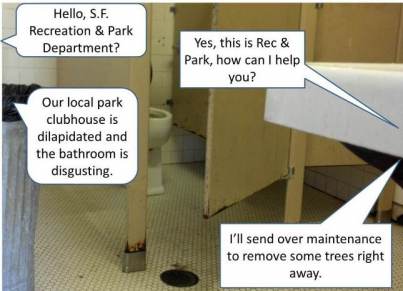
Park Bathroom Paradox. Courtesy San Francisco Forest Alliance
Jake Sigg, one of the leading proponents of native plant “restorations” in San Francisco was invited by the neighborhood association to give a rebuttal. For some reason that remains mysterious, Mr. Sigg chose to speak exclusively about Mt. Sutro which is not owned or managed by the Natural Areas Program. Therefore, there was a bit of a disconnect in these two presentations, with the common theme being only the destruction of non-native trees for the purpose of restoring native plants.
During his presentation, Mr. Sigg said that SFFA’s presentation was “disinformation” and/or “nonsense.” However, he provided no specific examples of these misdeeds, so SFFA is unable to respond to these accusations.
The following day, March 27, Mr. Sigg published an exchange about the SFFA presentation with one of his fans on his internet blog, “Nature News from Jake Sigg.” Mr. Sigg’s fan said he “…was so aghast at this evening’s display of ignorance and mendacity…” And Mr. Sigg agreed: “The ignorance and ill will of the Forest Alliance was on full view for anyone caring to look. The cherry-picking of facts, the distortions and outright lies were transparent.”
The presentation by the Forest Alliance was based on public documents and nothing was said that could not be documented by the public record. So, naturally SFFA was mystified by these accusations. SFFA allies wanted to know if the SFFA presentation contained any factual errors, so they asked Mr. Sigg, “What were the ‘outright lies?’”
Mr. Sigg responded to the question, but not with an answer: “I don’t have any reason for answering this, as I’m time-short…” In addition to being busy, Mr. Sigg wasn’t really in a position to answer the question because he admitted that he hadn’t listened to the presentation: “I listened to the presentation for the first five minutes, then decided my time was better spent tightening up my talk outline; there wasn’t enough substance to make listening worthwhile.”
The accusation of lying, and the refusal to be specific about it, is particularly ironic because of Mr. Sigg’s plea during his presentation that “demonizing the other side is not leading to accommodation or understanding.” On this we can agree. Calling people liars and refusing to tell them specifically what you think they are lying about, is clearly not leading to “accommodation and understanding.”
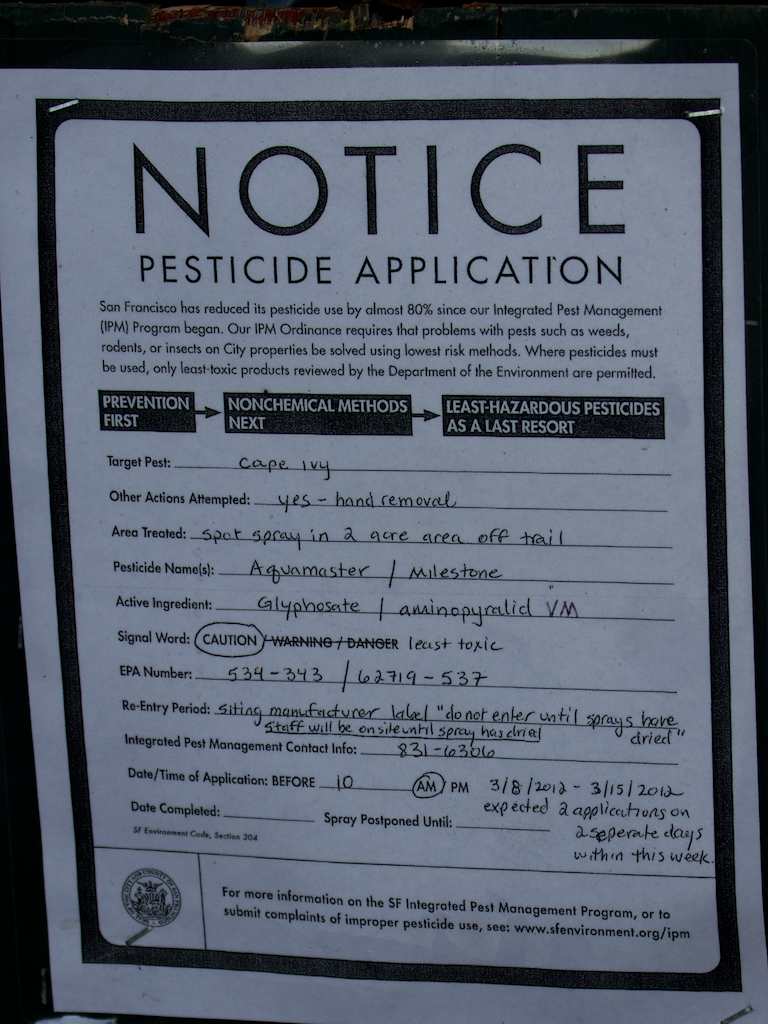
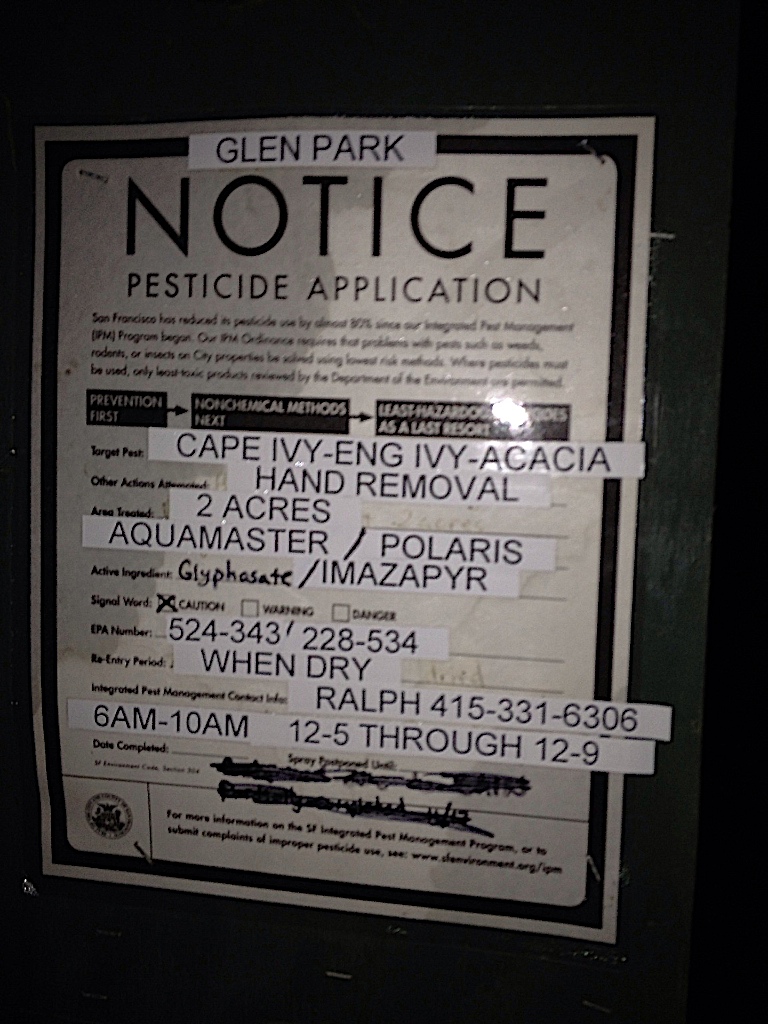
Latest Pesticide Application Notice, Glen Park, March 3, 2012
Nature in the City (NIC) is one of the non-profit organizations in San Francisco that supports native plant “restoration” projects in our public lands, especially the Natural Areas Program (NAP) in the Recreation and Park Department. We recently published a response to a NIC newsletter which described critics of NAP as “a handful of people” and accused them of “misrepresenting” NAP’s plans for San Francisco’s parks. In their most recent newsletter they seem to have changed their tune. This suggests they are starting to take criticism of NAP more seriously. But does it suggest any change in actions or plans? With this open letter, we will ask Nature in the City for clarification.
Here is NIC’s latest attempt to communicate with NAP critics or discredit them. We don’t know which.
“Restore to 1769 or to Now?!
I often hear the question, “to what year do you restore?” Some folks are skeptical about ecological restoration since, of course, we can’t turn back the clock!
Some skeptics sardonically say, “are you going back to the ice age, pre-last glacial maximum (22,000 BP)? Well, then, Monterey Pine are native…”
In fact, the answer I give is that we restore to now. Ecological restoration, like all human activities, has a social and environmental context, which is historical indeed, but also very current. And restoration is about healing and looking toward a brighter future, not looking back into the abyss of ecological destruction. Thus, we Spring Forward, taking into account current conditions, constraints, as well as opportunities.
We document historical ecology; are blessed with knowledge of and from a recent and current indigenous cultural context; and study nearby ecological reference sites. Meanwhile, we have laws, recent history, and communities that present a unique local context in every case. Wildlife habitat now takes diverse forms, including in the human-dominated landscape.
If restoring integrity and biodiversity are always the goals, the specifics can vary widely. And this is just fine, because restoration should be a community-driven, democratic process, like every other human endeavor. -Peter Brastow
Open Letter to Nature in the City:
We are writing to request clarification of your newsletter of March 8, 2012.
What does it mean to “restore to now?” If we are satisfied with our parks now, why do they need to be restored? Isn’t that a contradiction? If not, what—if anything—does that mean?
Why is it necessary to “heal” a park that we don’t think is in “the abyss of destruction?” What if we think that spraying our parks with gallons of pesticides is sending us into “the abyss of destruction?” Is there a “brighter future” in spraying places called “natural areas” with pesticides 86 times in one year?
What does it mean to “restore integrity and biodiversity?” If biodiversity is the goal of the Natural Areas Program why are they eradicating non-native species, thereby reducing biodiversity? As for “integrity,” we assume NIC means in the sense of “unimpaired.” But we don’t consider our parks impaired, so we aren’t concerned about their “integrity.”
Talking out of both sides of your mouth
The tone of the latest NIC newsletter is definitely an improvement over the previous accusatory tone. However, it isn’t comprehensible, nor is it credible because it is contradicted by the words and actions of NIC. Here are a few phrases from NIC’s public comment on the Draft Environmental Impact Review (DEIR) of the Natural Areas Program:
“…the analysis [of the DEIR] neglects to fully address the long-term impact of invasive plants from the retention of invasive weed-nurturing eucalyptus groves in the MA-3 areas.”
In other words, NIC wants all the eucalypts destroyed in all of the acres of “natural areas.” Expanding tree removals into the lowest-priority management areas (MA-3) would increase the number of tree removals substantially. MA-3 acres are 42% of the total acres of “natural areas.” The management plan currently prohibits removal of healthy trees in MA-3 acres.
The DEIR reports that the Maximum Restoration Alternative would have the most impact on the environment. NIC says in its written public comment on the DEIR that this judgment “may be…a misinterpretation of the intent of CEQA.” Peter Brastow, Founding Director of NIC, said during his public testimony to the Planning Commission on October 6, 2011, that the Maximum Restoration Alternative should be designated as the environmentally superior alternative in the final version of the Environmental Impact Report. The Maximum Restoration Alternative would expand all the destructive activities of NAP into all 1,107 acres of “natural areas:” tree removals, eradication of non-native plants, reintroduction of legally protected species, recreational access restrictions, etc.
But Mr. Brastow is not satisfied with maximizing native plant restorations in San Francisco’s parks. In his public comment for the revision of the Recreation, Open Space Element (ROSE) of San Francisco’s General Plan, he proposes that a new agency be created to manage all public lands in San Francisco as “natural areas.” All open space in the city, currently managed by Public Utilities, Port, and Public Works agencies as well as Recreation and Park should be “become part of a single natural resources agency.” This new agency would “Integrate the protection and restoration of biodiversity within all open space management activities (not just natural areas), e.g., native plant landscaping in designed landscapes, wildlife management and monitoring in all parks, etc.”
But why stop there? Mr. Brastow also proposes in his public comment on the ROSE that these principles be extended to private yards: “Conserve private open space, especially rear yards, as habitats and habitat connectors.”
Is there any way to reconcile these demands to expand the empire of the Natural Areas Program into every piece of vacant property in San Francisco, both private and public, with the empty phrases of NIC’s latest newsletter?
Looking how far back into the botanical past?
Before we leave this contentious topic, we will address NIC’s opening gambit, “Restore to 1769 or Now?” The author goes on to dismiss 1769 as the standard, preferring a more forward looking goal. However, he is once again stuck with the written record, which establishes the pre-European landscape as the goal of the Natural Areas Program.
The management plan for the Natural Areas Program says explicitly that. “The following are the list of criteria…to determine the location of potential plant re-introductions: Evidence of historic presence (based on Howell et al. 1958).” (page 2-6) And Howell (1958) says that “Native plant [is] present within the geographic limits of present-day San Francisco prior to the arrival of Portola expedition in 1769.”
NIC may be prepared to welcome plants into San Francisco that arrived after 1769, but until the language in the management plan (and other similar documents such as “Assessment for Forestry Operations,” for Recreation and Park Department, June 2010.) is changed, we will continue to assume that is the standard used by the Natural Areas Program.
Making Peace
The tone of the latest NIC newsletter is welcome and we hope it is a first step toward resolving the conflict over the future of San Francisco’s parks. If this is a sincere effort to address the objections of San Franciscans to the destructive and restrictive actions of the Natural Areas Program, the next step should be to demonstrate intentions with actions. We therefore ask Nature in the City to join us in making the following requests of the Natural Areas Program and the Recreation and Park Department:
The Natural Areas Program should STOP spraying pesticides in the so-called “natural areas” NOW.
The Natural Areas Program should STOP expanding their native plant gardens until the Environmental Impact Report is complete and approved.
The Natural Areas Program should STOP destroying non-native plants and healthy trees until the Environmental Impact Report is complete and approved.
These actions would set the stage for the next step. A lawyer and a critic of the Natural Areas Program has notified the Planning Department, the Natural Areas Program, and the City Attorney that the public comment period for the Draft Environmental Impact Report for the Natural Areas Program did not meet legal standards. The law requires that notice of the public comment period be posted in all the natural areas and mailed to the neighbors of the natural areas.Neither of these requirements was met. Therefore, the lawyer requests that the public comment period be announced as required by law and repeated.
Since NIC says in its current newsletter that “restoration should be a community-driven, democratic process” NIC should agree that another properly announced public comment period is required. The public cannot participate in this “democratic process” if they are unaware of what is planned for their parks.
Webmaster:We are grateful to Save Mount Sutro Forest for their research on pesticide use by San Francisco’s misnamed Natural Areas Program and for giving us permission to reprint this update on NAP’s pesticide use in 2011.
********************************************
We spent a couple of hours, the other day, in the beautiful McLaren Lodge, leafing through a thick binder of pesticide reports for the San Francisco Rec and Park Department. It was so thick in part because it contained a lot of nil reports… supervisors of various sections writing in to say things like “No Roundup used in this complex.”
The monthly reports from the Natural Areas weren’t nil. Far from it.
Some months ago, we wrote that the pesticide use in the Natural Areas seemed to have increased sharply in 2010 compared with 2009. Oh, said a critic, don’t focus on an individual year. It might go back down next year, it might just be a blip.
If so, we’re not blip-free yet. According to our preliminary figures (which we will update if we get better information) pesticide applications in 2011 were up 20% from 2010.
The NAP continues to use glyphosate regularly (38 39 times in 2011). It’s mostly switched from Roundup to a different formulation, Aquamaster. This alternative provides better control over the adjuvant, the stuff that the pesticide is mixed with. It still contains glyphosate, with its attendant risks.
GLYPHOSATE IS STILL TOXIC
Part of the reason for switching to Aquamaster is that POEA, the adjuvant in Roundup, is actually toxic instead of being inert. But it’s not just the POEA. Glyphosate itself has problems, particularly in terms of pregnancy problems and birth defects. A 2005 article published in the journal of the National Institutes of Health noted that glyphosate was toxic to placental cells (and Roundup was even more so):
“… glyphosate is toxic to human placental JEG3 cells within 18 hr with concentrations lower than those found with agricultural use, and this effect increases with concentration and time or in the presence of Roundup adjuvants.”
In addition, it’s an endocrine disruptor. French scientists published an article in the journal Toxicology titled, “Glyphosate-based herbicides are toxic and endocrine disruptors in human cell lines.”
According the the guidelines from San Francisco’s Department of the Environment, Aquamaster is to be used “Only as a last resort when other management practices are ineffective.” Since this last resort occurs some 40 times in a year, we suggest the DoE consider reclassifying Aquamaster as Tier I to reflect the latest research on glyphosate.
FROM THE FIRE INTO THE FRYING PAN
The big change this year was the move from Garlon (triclopyr) to Polaris or Habitat (imazapyr). According to the record, Garlon was only used thrice in 2011, while imazapyr was used 40 times.
This is somewhat of an improvement in that Garlon is a very toxic chemical, classified as Tier I; imazapyr is less toxic and classified as Tier II.
Unfortunately, it’s possible that the best thing about imazapyr is that it isn’t as bad as Garlon. It is very persistent, and doesn’t degrade easily. It moves around, being exuded by the roots of the plants it’s meant to poison. And its break-down product is a neurotoxin – it poisons the nervous system. It’s banned in the European Union.
The NAP also used Milestone four times. (That does sound like a last resort.) Fortunately. Milestone is an extraordinarily persistent chemical that has been withdrawn from sale in the UK, and is rightly classified as Tier I, Most Hazardous.
MORE VIOLATIONS OF POLICY
The NAP also continued to violate pesticide guidelines. In August 2011, they used Aquamaster against ludwigia (water primrose) in Lake Merced — a lake that is considered red-legged frog habitat. The guidelines ask for a 60-foot buffer zone. Since the water primrose is in the water (and so, we presume is the frog), this buffer zone’s not happening.
Some readers will remember this post about the dateless sign threatening pretty much all the vegetation near the Twin Peaks reservoir with Garlon and Aquamaster. We never got to the bottom of that. The pesticide records don’t mention it.
[Edited to Add (22 Jan 2012): One of our readers asked about this Glen Canyon notice, too, listing the use of Glyphosate and Imazapyr against ivy and acacia.
Again, we don’t know what happened but it’s not in the pesticide records.]
MORE MONEY FOR SHELTERBELT
Shelterbelt Builders, the contractor the Natural Areas uses for pesticide application, earned more fees from Rec & Park as pesticide applications increased:
In fiscal 2009-10 (year ending June 30), it earned $51 thousand;
In fiscal 2010-11, it was paid $78 thousand;
In fiscal 2011-12, it’s been paid (or is owed) a total of $84 thousand, and the fiscal year is only half-finished.
[Edited to Add: This is public information from the SF Controller’s website. You can see it here. ETA2: The report on the SF Controller’s website has been changed. Here is the new link. Also, the picture here can be enlarged by clicking on it until it’s readable.]
On Mount Sutro, though the Sutro Stewards’ volunteers have been gutting the understory and destroying habitat, we are glad to say there is still no use of herbicides. Again, our thanks to UCSF for preserving possibly the last pesticide-free wildland in San Francisco. Even if only temporarily.
DOES SAN FRANCISCO HATE ITS TREES?
It’s not a good time to be a plant or a tree in San Francisco. The San Francisco Chronicle reports that the city is handing off 23,000 street trees to homeowners to care for. It estimates it will save $300 thousand. The kind of comments people made on the article don’t bode well for the future of those trees. Meanwhile, it seems to be able to find funding to destroy trees in Natural areas across the city, trash habitat needed by the city’s wildlife, and take out quirky old trees that give some of these wild areas their character.
As our readers know, we troll the websites of supporters of the native plant movement, looking for clues about the basis for belief in that ideology. We hope that our understanding will enable us to provide the scientific information to our readers that will reveal the fallacies of nativism.
The following comment on the San Francisco Forest Alliance website alerted us to a new theme in this debate: native plant advocates seem to believe that we can and should return our urban parks to “wilderness.”
“It is interesting that your post shows the trail side covered with English ivy, and possibly a fallen eucalyptus or two. Each of these is a non-native element. Any and all exotic species present in the canyon destroy the wilderness aspect of Glen Canyon Park.
Please note the term “wilderness”. It implies natural, native flora and fauna; the wild plants and the bird and animal populations that support one another. That is what we want to have if we want a wild retreat. A morass of garden escapes and foreign invasive species is to be deplored. Let’s progress toward returning the area to a REAL wilderness. Do not let the concept that a plant’s becoming established in an area is a sign of its becoming native to the area. It remains an invasive element, a weed. It disrupts and destroys the normal habitat of native plants, animals, and insects in its surroundings.
It will be a huge and long term task, but we can restore the entire canyon to a truly wilderness state. Lets get started!”
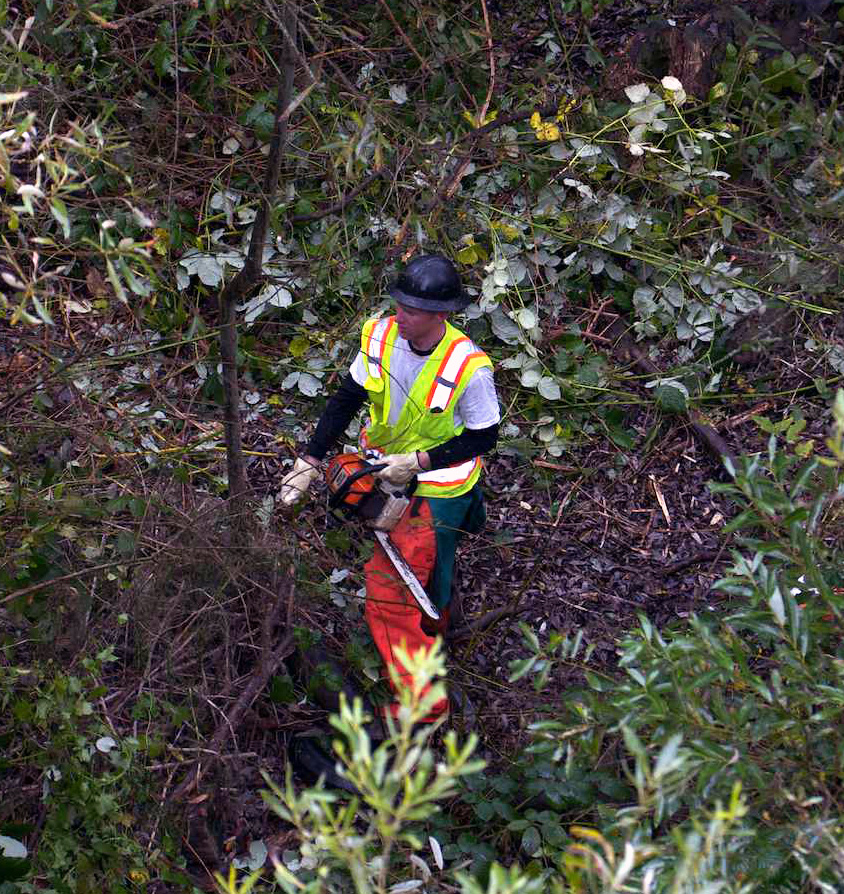
Chainsaw massacre in Glen Canyon, November 2011
In this particular native plant advocate’s view, wilderness is composed exclusively of native plants. Everything else must be eradicated. If chainsaws and pesticides must be used repeatedly in perpetuity, so be it. All this destruction is justified by the glorious goal of “wilderness.” This wilderness is apparently not disturbed by chainsaws and pesticides. Presumably they must be ignored to achieve the glorious goal.
We rarely indulge in sarcasm on Million Trees. We hope our readers recognize it when they see it.
Nature in the City (NIC) is one of many organizations that support native plant “restorations” in San Francisco as well as the principle entity which engages in them, the Natural Areas Program (NAP) of the Recreation and Park Department. NIC is consistently critical of anyone who questions the value of these restorations, but in their most recent newsletter they confront our objections directly. Although we don’t presume to represent the many constituencies which are critical of the Natural Areas Program, we are responding in this post to NIC based on our knowledge of the issues. (The NIC newsletter is in quotes and is italicized. Our response is not italicized.)
“Natural Areas in 2012
Last fall saw the the [sic] Planning Commission public meeting for the Draft Environmental Impact Report (DEIR) for the Significant Natural Resource Areas Management Plan. Some time later this year, the City will issue a Final Environmental Impact Report, which may be appealed by opponents of the Natural Areas Program.
Unfortunately, a handful of people are still propagating misinformation about the rationale, values, and intention of ecological restoration, management and stewardship, and of the City’s celebrated Natural Areas Program.”
Webmaster: Critics of the Natural Areas Program cannot be described accurately as a “handful of people.” We now have four websites(1) representing our views and there have been tens of thousands of visits to our websites. Comments on our websites are overwhelmingly supportive of our views. Our most recently created website, San Francisco Forest Alliance, lists 12 founding members. That organization alone exceeds a “handful of people.”
Our objections to the Natural Areas Program have also been reported by three major newspapers in the past month or so (San Francisco Examiner, Wall Street Journal, Sacramento Bee).
Many critics of NAP have been engaged in the effort to reduce its destructive and restrictive impacts on our parks for over 10 years. Scores of public meetings and hearings have been held to consider our complaints. We consistently outnumbered public speakers in support of NAP until 2006, when the NAP management plan was finally approved by the Recreation and Park Commission. Although we were outnumbered for the first time, there were over 80 speakers who asked the Recreation and Park Commission to revise NAP’s management plan to reduce its negative impact on our parks.
The public comments on the NAP DEIR are the most recent indicator of the relative size of the groups on opposite sides of this issue. These comments were submitted in September and October 2011. We obtained them with a public records request. The Planning Department reported receiving about 400 comments. In analyzing these comments, we chose to disregard about half of them because they were submitted as form letters, even though they were from dog owners who were protesting the loss of their off-leash privileges in the natural areas. We also leave aside the comments from golfers whose only interest is in retaining the golf course at Sharp Park. In other words, we set aside the majority of the comments critical of the NAP management plan in order to focus on those comments that demonstrate a comprehensive understanding of the impact of NAP on the city’s parks. Of the comments remaining, those critical of NAP and its deeply flawed DEIR outnumbered comments in support of the NAP DEIR about three to one. We urge NAP supporters to read these public comments to learn about the wide range of criticisms of NAP, including pesticide use, destruction of trees, recreational access restrictions, loss of wildlife habitat and more.
We will challenge NIC’s accusation that we are “propagating misinformation” within the context of their specific allegations:
“Contrary to the many myths that continue to percolate, the Natural Areas Plan and Program seek to do the following (among other worthwhile endeavors):
1. Protect and conserve our City’s natural heritage for its native wildlife and indigenous plant habitats and for the overall health of our local ecosystem;”
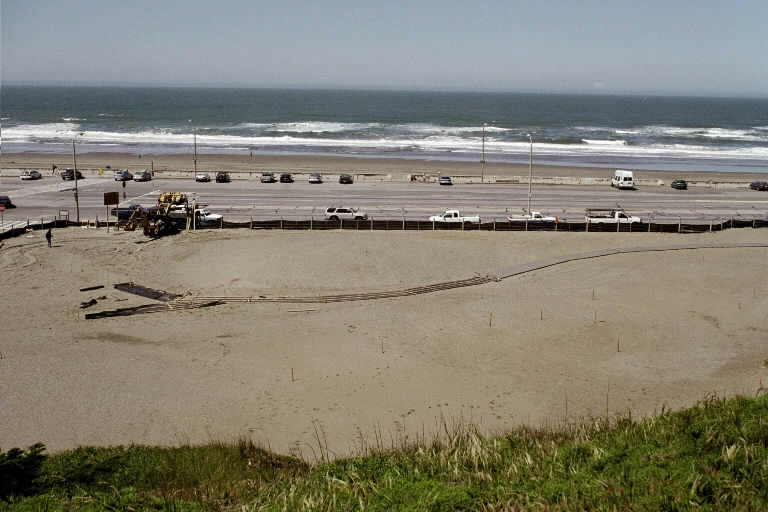
Webmaster: Since the majority of acreage claimed as natural areas by NAP 15 years ago had no native plants in them, there is little truth to the claim that NAP is protecting our “natural heritage.” The so-called “natural area” at Balboa and the Great Highway is typical of the “natural areas.” There is photographic evidence that it was built upon for about 150 years. It was the site of Playland by the Beach before it was designated a “natural area.” Sand had to be trucked onto the property and disked down 18” into the construction rubble, then shaped into dunes by bulldozers before native plants could be planted on it.
Natural Area at Balboa & Great Highway under construction
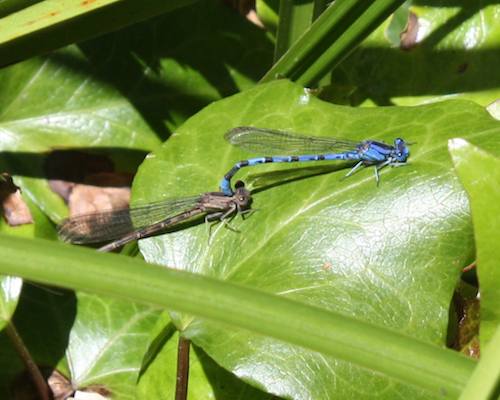
We don’t make any distinction between “native wildlife” and any other wildlife currently living in our city. We value them all. Most are making use of existing vegetation, whether it is native or non-native. They do not benefit from the loss of the blackberries that are their primary food source or the loss of the thickets or trees that are their homes. We do not believe that wildlife in San Francisco benefits from the destructive projects of the Natural Areas Program. See photos of insects, birds, and other wildlife using non-native plants in the natural areas here.
Damselflies mating on ivy, Glen Canyon Park
We do not think an ecosystem that has been sprayed with herbicides qualifies as a “healthy ecosystem.” NAP sprayed herbicides at least 86 times in 2011. Their use of herbicides has increased over 330% in the last 4 years. NAP uses herbicides that are classified as more toxic than those most used by other city departments. Last spring, 1,000 visitors to Glen Canyon Park signed a petition, asking the Natural Areas Program to stop using pesticides in their park. This petition was given to Scott Wiener, the Supervisor representing the district in which Glen Canyon Park is located.
These are statements of fact that can be easily verified by the public record.
2. “Educate our culturally diverse city about the benefits of local nature and about helping with natural areas stewardship in your neighborhood;”
And we also have had bad experiences with the volunteers who are called “stewards” by NAP, but sometimes act more like vandals. We see them spraying herbicides that they aren’t authorized to use. We see them hacking away at trees that haven’t been designated for removal. NAP is not providing the necessary guidance and supervision to the volunteers many of whom seem to consider themselves the de facto owners of the parks.
3. “Manage the City’s wildlands for public access, safety and the health of the “urban forest.””
“We hear occasional complaints about public access and tree removal. Three simple facts are thus:
1. Every single natural area in the City has at least one trail through it, where one can walk a dog on a leash;”
Webmaster: The loss of recreational access in the natural areas is real, not imagined. The following are verbatim quotes from the NAP management plan:
“Approximately 80 percent of the SFRPD off-leash acreage is located within Natural Areas.” (page 5-8). The NAP DEIR proposes to close or reduce the size of several off-leash areas. The DEIR provides no evidence that these areas have been negatively impacted by dogs. It also states that all off-leash areas in the natural areas are subject to closure in the future if it is considered necessary to protect native plants. Since NAP has offered no evidence that the proposed immediate closures are necessary, one reasonably assumes it will offer no evidence if it chooses to close the remainder of the 80% of all off-leash areas in San Francisco located in natural areas. We know from the DEIR public comments that NAP supporters demand their closure.
“Public use in all Natural Areas, unless otherwise specified, should encourage on-trail use… Additionally, interpretive and park signs should be installed or modified as appropriate to include “Please Stay on Trails” with information about why on-trail use is required.” (page 5-14) In other words, the only form of recreation allowed in the natural areas is walking on a trail. Throwing a ball or frisbee, having a picnic on the grass, flying a kite, climbing the rocks are all prohibited activities in the natural areas. And in some parks, bicycles have been prohibited on the trails by NAP.
“Finally, this plan recommends re-routing or closing 10.3 miles of trail (approximately 26 percent of total existing trails).” (page 5-14) So, the only thing visitors are allowed to do in a natural area is walk on the trails and 26% of all the trails in the natural areas will be closed to the public.
2. “The act of removing (a small subset of) non-native trees, e.g., eucalyptus, that are in natural areas has the following benefits:
a. Restores native habitat for indigenous plants and wildlife;
b. Restores health, light and space to the “urban forest,” since the trees are all crowded together and being choked by ivy;
c. Contributes to the prevention of catastrophic fire in our communities.”
Webmaster: Destroying non-native plants and trees does not restore indigenous plants and wildlife. Native plants do not magically emerge when non-native plants and trees are destroyed. Planting indigenous plants might restore them to a location if they are intensively gardened to sustain them. However, in the past 15 years we have seen little evidence that NAP is able to create and sustain successful native plant gardens. Native plants have been repeatedly planted and they have repeatedly failed.
NAP has not “restored” the health of the urban forest. They remove trees in big groups as they expand their native plant gardens. They are not thinning trees. They are creating large openings for the grassland and dune scrub that they plant in the place of the urban forest. Every tree designated for removal by the NAP management plan is clearly selected for its proximity to native plants. It is disingenuous to suggest that NAP’s tree removal plans are intended to benefit the urban forest.
3. “The overall visual landscape of the natural areas will not change since only a small subset of trees are planned to be removed over a 20-year period.”
“Please feel free to email steward@natureinthecity.org if you would like more clarification about the intention, values and rationale of natural resources management.”
Webmaster: We urge our readers to take NIC up on this offer to provide ”more clarification” of its spirited defense of the Natural Areas Program.
Do you think NIC is deluded about there being only a “handful of people” that are critical of the Natural Areas Program?
Did you notice that NIC does not acknowledge the use of herbicides by NAP? Do you think that a fair representation of criticism of NAP can omit this issue?
If you visit a park that is a natural area, do you think NAP has demonstrated in the past 15 years what NIC claims it is accomplishing?
Do you think NIC has accurately described recreational access restrictions in the natural areas?
Do you think that San Francisco’s urban forest will be improved by the destruction of 18,500 mature trees and countless young trees?
(2) “The California Department of Forestry and Fire Protection (CAL FIRE) has no record of any wildfire in San Francisco.” San Francisco Hazard Mitigation Plan, 2008, page 5-18.
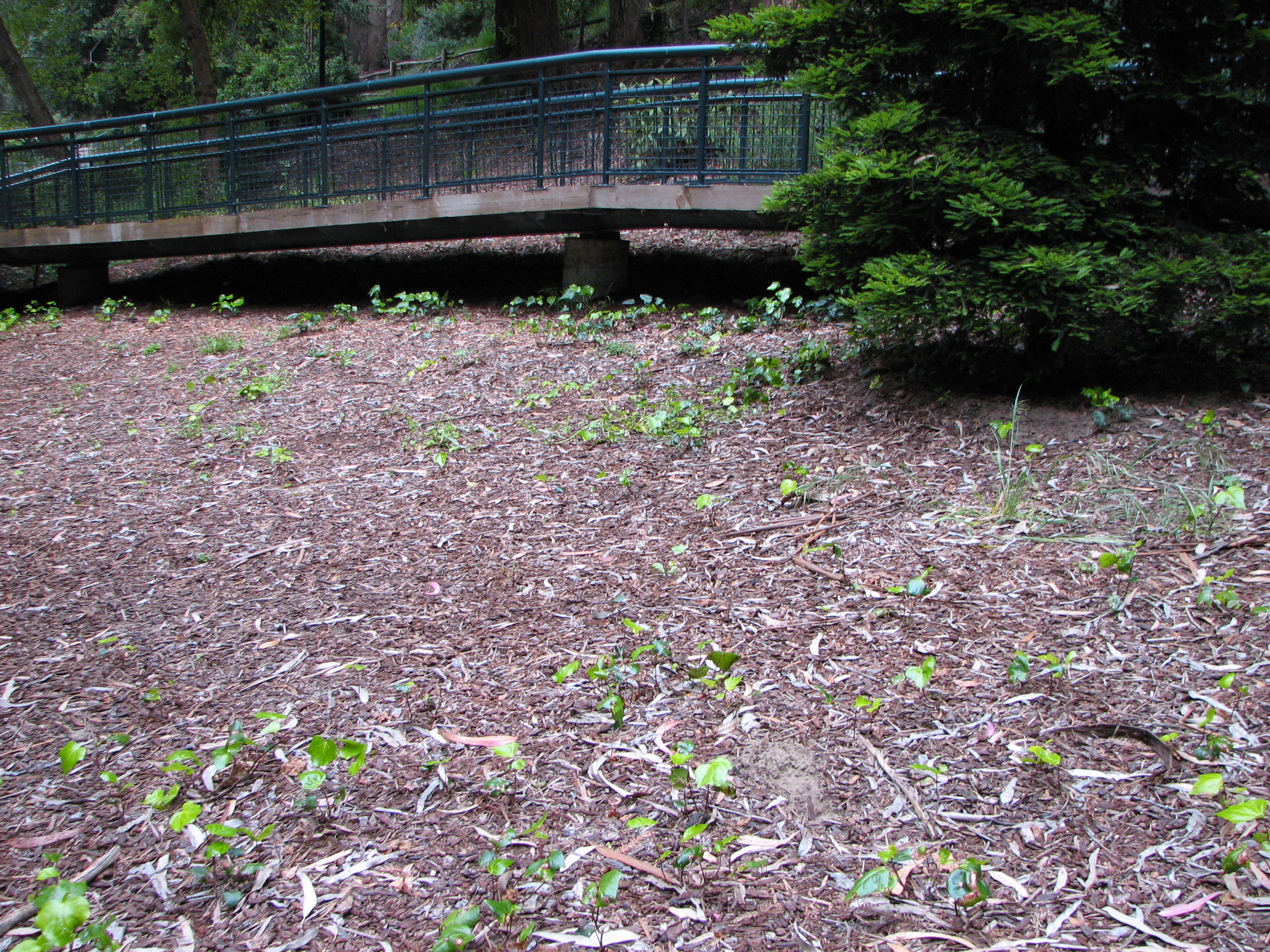
When the concert meadow in San Francisco’s Stern Grove was renovated in 2005, at a cost of $15 million, we were surprised that ivy was planted as the ground cover because ivy grows rampant in Stern Grove, shrouding many of the trees. But, hey! Who are we to question the choices of horticultural professionals?
Ivy planted in Stern Grove, 2005
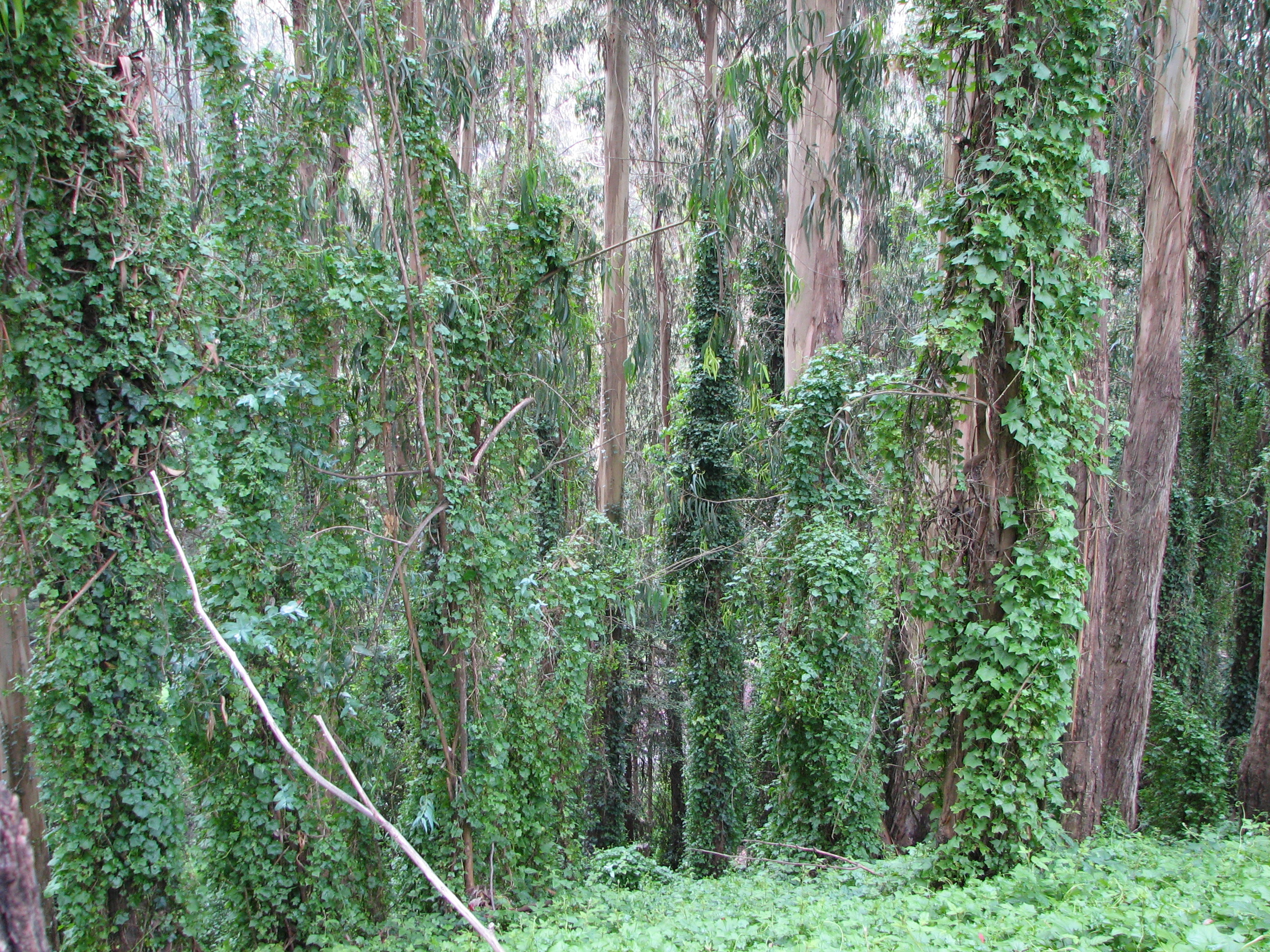
Now ivy is being sprayed with herbicide–presumably with the intention of killing it–by San Francisco’s Natural Areas Program in other parks in San Francisco, so one wonders if the staff who plant it are aware of the future of the ivy they plant. Seems like another case of man creating problems which he then must solve. Perhaps full employment is the objective, rather than the creation of a beautiful garden. But we digress.
Ivy climbing trees in Stern Grove
Combining pesticides
Many members of the public are of the opinion that all pesticide (herbicides, insecticides, etc.) applications are inappropriate in a park that has been designated as a “natural area.” Last year, the public complained about the spraying of Garlon in the natural areas by the Natural Areas Program because it is classified by the city’s Integrated Pest Management (IPM) policy as “Most Hazardous.” Consequently, the Natural Areas Program significantly reduced its use of Garlon in 2011.
For the most part they have substituted a mixture of glyphosate and imazapyr for Garlon. Is this an improvement? Maybe not. Although glyphosate and imazapyr have a lower hazard rating of “More Hazardous,” the Natural Areas Program increased their pesticide applications in 2011 at least 20% compared to 2010. But more importantly, little is known about the toxicity of imazapyr and nothing is known about the toxicity of combining glyphosate and imazapyr.(1) Imazapyr was approved for use in California in 2005, so only the minimal tests required by law have been done on it.
The manufacturer’s labels for these herbicides suggest that combining them is not an approved use. The label for Aquamaster (glyphosate) does not include imazapyr on the list of pesticides with which it can be safely combined. And the Polaris (imazapyr) label says it should not be combined with another pesticide unless it is expressly recommended by the manufacturer of that pesticide.
The “Aquatic Pesticide Application Plan for the San Francisco Estuary Invasive Spartina Project” is cited by San Francisco’s IPM program as the evaluation upon which it based its decision to add imazapyr to the list of pesticides approved for use in San Francisco in 2010. The evaluation explained why imazapyr is being combined with glyphosate by the non-native Spartina eradication project.
Imazapyr is apparently slow acting. It can take some months before it kills the plant on which it is sprayed. Glyphosate, on the other hand, is fast acting. The plant on which it is sprayed begins to yellow and die within a few weeks. Glyphosate is therefore used by the Spartina eradication project to provide quicker feedback to those spraying the herbicide. They know within a few weeks if they have sprayed in the right place. They don’t have to wait for the next season to spray again if necessary.
Pesticide Application Notice, Glen Canyon Park, December 2011
However, glyphosate should be applied to perennial broadleaf plants during their reproductive stage of growth, when they are budding in the late spring and summer, according to the manufacturer. In Glen Canyon Park, a mixture of glyphosate and imazapyr was sprayed on ivy in December 2011, clearly not the recommended time period for spraying. A month later, there is no indication that the ivy was damaged by this spraying. This suggests that there was no point in combining glyphosate and imazapyr in this application. The public was exposed to the unnecessary risk of combining these herbicides, with no potential benefit of taking that risk.
Pesticides accumulate and persist in the soil
Was it appropriate for the city’s IPM program to use the evaluation of imazapyr for the Spartina project as the basis of their decision to approve its use by the Natural Areas Program? We don’t think so. The circumstances of the Spartina project are substantially different from those of its use by the Natural Areas Program.
Imazapyr is used to eradicate non-native Spartina in a tidal estuary. For that reason the evaluation of its use assured the public that this herbicide would not accumulate in the environment because it would be flushed away from the ground by the tide twice each day.
The evaluation also said that when imazapyr was used in a pond or stable water source, it persisted in the ground for a longer period of time.In fact, that’s exactly how imazapyr is being used by the Natural Areas Program. It has been used at Lake Merced and at Pine Lake, both stable water sources. It is also being used in Glen Canyon Park, which is a watershed.
We don’t assume that imazapyr is being used safely to eradicate Spartina. However, even if it is, it does NOT follow that it is safe for use in watersheds that are not tidal, such as those being sprayed by the Natural Areas Program.
Collateral damage of pesticides
Glyphosate is a non-selective herbicide. That is, it kills any plant it is sprayed on at the right stage of its growth. But imazapyr is far more insidious as a killer of plants because it is known to travel from the roots of the plant that has been sprayed to the roots of other plants. For that reason, the manufacturer cautions the user NOT to spray near the roots of any plant you don’t want to kill. For example, the manufacturer says explicitly that imazapyr should not be sprayed under trees, because that tree is likely to be killed, whether or not that was the intention.
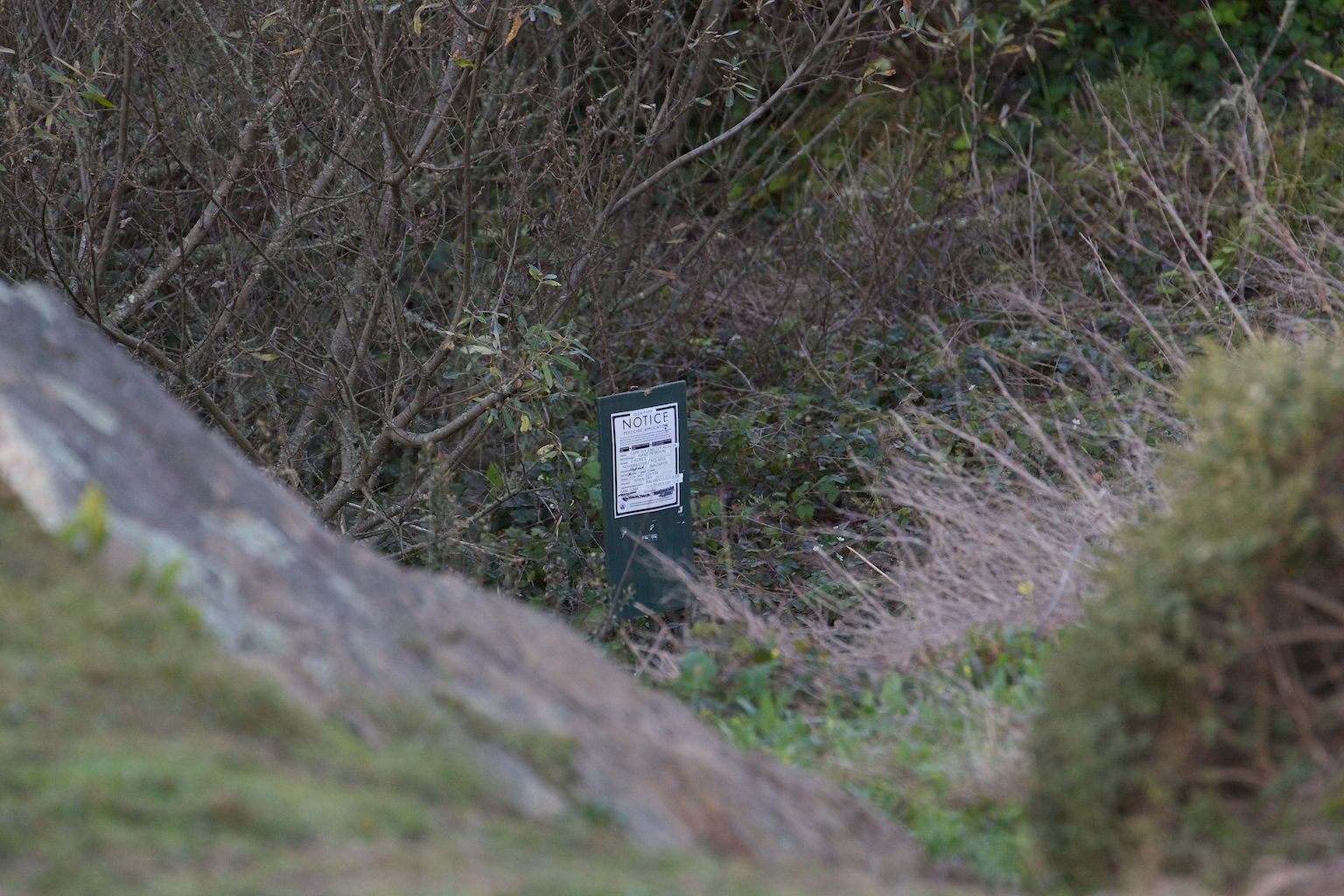
Pesticide Application Notice under willow trees in Glen Canyon Park, December 2011
Much of the ivy that was sprayed by the Natural Areas Program in Glen Park in December 2011 was sprayed under willow trees. The willow trees are native, so it seems unlikely that they intended to kill them.
Resistance to pesticides
The Federal Drug Administration recently banned some use of antibiotics in domesticated animals because the bacteria antibiotics are intended to kill are developing resistance to the antibiotics. This resistance is becoming increasingly dangerous to humans who are also the victims of those bacteria. Antibiotics are being rendered useless by overuse on domesticated animals. When humans need them, they won’t work because bacteria have developed a resistance to them.
Likewise, plants and animals are also capable of developing resistance to pesticides. Glyphosate is the most heavily used herbicide in agriculture. Recent research indicates that weeds are developing resistance to glyphosate.
The manufacturer of imazapyr says explicitly that repeated use of this herbicide is likely to result in resistance to it over the long term: “When herbicides with the same mode of action are used repeatedly over several years to control the same weed species in the same application site, naturally occurring resistant weed biotypes may survive…propagate and become dominant in that site.” So, does it make sense to use imazapyr on a plant as persistent as ivy?
The GGNRA reported spending $600,000 over 3 years trying to eradicate ivy from 127 sites. They were successful in only 7 of the sites.(2) Obviously eradicating ivy is not a one-shot deal.
If ivy must be eradicated, pesticides do not have to be used to do it. The Audubon Canyon Ranch in Bolinas Lagoon reported “qualified” success using hand-pulling methods on 5 acres over 5 years “utilizing 2375 volunteer hours.” Biannual monitoring of resprouts will be required for the foreseeable future. It’s a big commitment, but at least it is safe.
All risk, no reward
Congratulations to any reader with the patience to slog through this tedious list of apparently incompetent use of pesticides by San Francisco’s misnamed Natural Areas Program. We reward your persistence with this summary:
Combining pesticides is risky business because the toxicity of such combinations has not been tested. Therefore, when there is no benefit in doing so, these combinations should be avoided.
A pesticide that is appropriate for one purpose is not necessarily appropriate for another. In this case, imazapyr may not accumulate and persist in a tidal estuary, but it is more likely to do so in a stable watershed.
The Natural Areas Program may be killing plants it does not intend to kill by using herbicides indiscriminately.
Herbicides should not be used repeatedly on the same plants in the same locations because the plants will develop resistance to those herbicides.
If the Recreation and Park Department is planting ivy in one park and destroying it another, could it be such a bad plant that it is worthwhile to expose the public to toxic pesticides? We don’t think so, but if we are wrong, then ivy should be removed by hand without using pesticides.
(1) “Aquatic Pesticide Application Plan for the San Francisco Estuary Invasive Spartina Project,” August 2010, page 32.
(2) Liston, Heather, “Reuniting old adversaries can beat back exotic invaders,” California Wild, Winter 2006
In 2000 Robert Putnam’s (Harvard University) masterpiece of American social science, Bowling Alone* was published. He reported the significant decline of all forms of civic participation in American society and politics from the P.T.A. to voting. Religious participation is the notable exception to this trend.
We are deeply concerned about the increasing isolation of Americans from one another and we believe that the polarization of viewpoints, particularly in politics, is one of the consequences of this trend. Only the highly motivated extremes of opinion are still engaged in the civic dialogue. The middle ground is no longer represented in the debate. However, we will focus on the topic that is relevant to Million Trees, that is, the implications for the environmental movement.
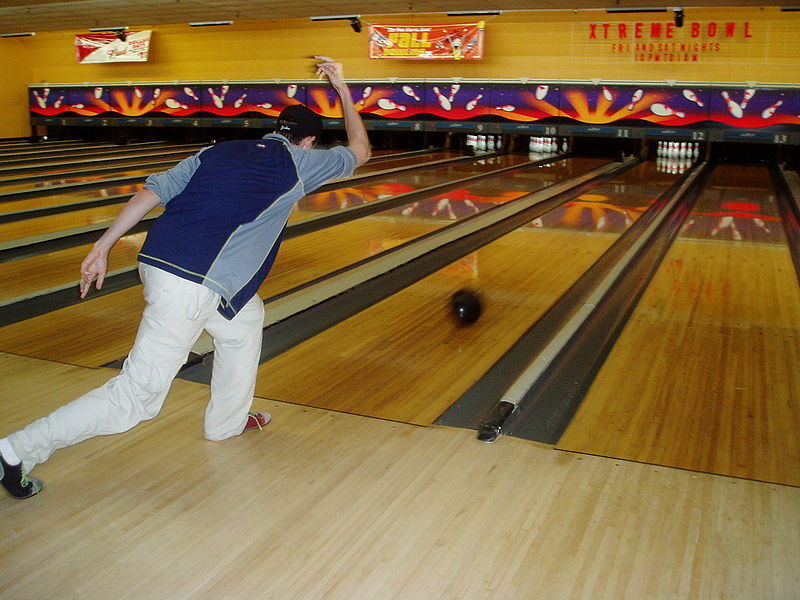
Bowling Alone. Attribution: Xiaphias
Membership in environmental organizations reached its peak in 1995, according to Bowling Alone after decades of enormous growth since the 1960s. This peak was consistent with public opinion regarding environmentalism. In 1990 three-quarters of Americans considered themselves “environmentalists.” By the end of the decade, that percentage had dropped to only 50%.
The growth in membership was achieved by the use of a new marketing tool known as direct mail. Think about it. How many invitations do you receive in the mail from non-profit organizations, asking you to contribute to a wide-range of worthy causes? Typically these organizations spend between 20-30% of their budgets on such fund raising and the rate of return on these solicitations is only 1-3% of the cost depending upon the quality of the mailing list. Using this technique, Greenpeace tripled its membership between 1985 and 1990 to 2.35 million.
What does “membership” mean?
After tripling its membership, Greenpeace lost 85% of its members in the next 8 years. The drop-out rate after the first year is typically 30% in these organizations.
In fact, most contributors to these organizations don’t even consider themselves “members” in the usual sense of that word. The commitment to the organization doesn’t extend far beyond writing a check. Only 8% of contributors to the Environmental Defense Fund, for example, described themselves as “active” in the organization.
These organizations are therefore distinctly different from their historical antecedents. Participants in the civil rights movement frequently put their lives on the line. The social lives of Rotary Club members revolved around the Rotary lodge.
Since few people are active participants in environmental organizations, they have become “bureaucratized,” meaning they are run by and for paid professionals. Most members have little idea what policies the professional staff has adopted on their behalf.
The Sierra Club
In 1989, a survey of Sierra Club members determined that only 13% of its members had attended even one meeting of the Sierra Club. The Bay Area Chapter of the Sierra Club claims to have 10,000 members, but chapter leadership of a group (the chapter is broken into many geographical groups, such as the San Francisco Group)was elected by as few as 59 votes. The top vote-getter in the Club’s most recent election received 327 votes in a Chapter-wide race, but only one chapter group (Northern Alameda County) had more candidates than there were available seats. In other words, there was no competition for most of the leadership seats.
Yet, the incumbents in these leadership positions are free to determine the local policies of the Sierra Club. Here are a few recent examples of positions taken by the Bay Area Chapter of the Sierra Club:
The opinion of the membership is not asked when these policy positions are taken by the leadership. However, if members read the chapter’s quarterly newsletter (The Yodeler) they have the opportunity to learn about them after the fact.
The influence of the Sierra Club
We believe that the influence of the Sierra Club exceeds the size of its membership. The Sierra Club endorses candidates for political office. These endorsements are highly sought after because politicians believe that the endorsement confers the votes of its membership. This belief was recently tested in the race for mayor of San Francisco.
State Senator Leland Yee sought and received the endorsement of the Sierra Club in his bid for mayor of San Francisco. In the past, he had been critical of the Natural Areas Program. His stated reason for that criticism was that the veneration of native plants was offensive to his roots as an immigrant. In particular, the Chinese community suffered horrendous discrimination in California in the 19th Century. The rhetoric of the native plant movement is reminiscent of the xenophobia from which the Chinese community has suffered historically.
It seems unlikely that Senator Yee’s emotional reaction to nativism changed when he sought the endorsement of the Sierra Club, but he had to disavow that opinion in order to receive the Club’s endorsement. He did so because he believed that the votes of Sierra Club members would help him to be elected mayor of San Francisco. His bet did not pay off. He did not win. In fact, he came in fourth.
We hope that political candidates in the future will heed this warning. The Sierra Club may have many “members” but that membership does not necessarily confer votes. The vast majority of “members” have no commitment to the policy positions taken by the Club.
An appeal to Sierra Club members
There were over 4,000 public comments on the Environmental Impact Study for the Dog Management Plan of the Golden Gate National Recreation Area (GGNRA). The Dog Management Plan proposes to eliminate about 80% of existing off-leash areas, which are now only 1% of the 74,000 acres of GGNRA property. The Sierra Club supports that plan. There were thousands of comments from people with dogs who are presently enjoying the small areas now available to them for off-leash recreation. Sixty-four of those people said they are Sierra Club members. That’s enough members to elect someone to a leadership position in the Club.
If you are a member of the Sierra Club, here’s what you can do to influence the Club’s policies:
Inform yourself of the policies of the Sierra Club.
If you don’t agree with those policies, we urge you to vote in the election of officers to the leadership positions in the Sierra Club.
If you don’t know the policies of the candidates, ask them.
If there are no candidates that represent your viewpoint, find candidates who do.
If you can’t find a candidate you can support, it’s time to vote with your feet.
If you leave the Club tell them why.
Quit Bowling Alone!
Attribution: GNU Free Documentation
*Putnam, Robert, Bowling Alone: The Collapse and Revival of American Community, Simon & Schuster, New York, 2000. All quotes in this post are from Bowling Alone unless otherwise noted.
Many passionate, well-informed comments were sent to San Francisco’s Planning Department about the Draft Environmental Impact Report (DEIR) for the Natural Resources Areas Management Plan (SNRAMP). Today we’re celebrating the end of the comment period by telling you about one of our favorite comments.
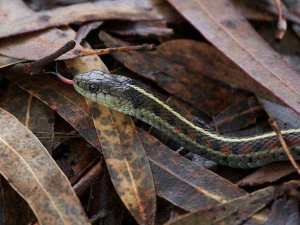
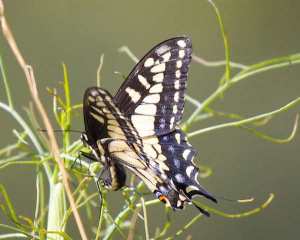
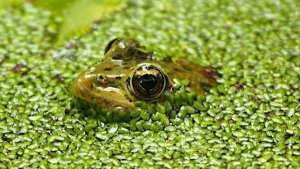
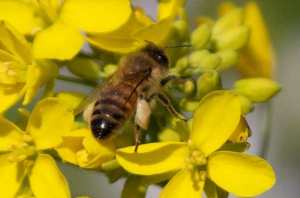
This comment was written by a talented photographer of wildlife in San Francisco’s parks who prefers to remain nameless. She has exhibited her photos in several venues around town, including San Francisco’s Main Library. She wrote her comment primarily on behalf of the wildlife that lives in our parks and she illustrated it with beautiful photographs of the birds, insects, amphibians, reptiles, and mammals that she has photographed nesting, hiding, hunting, roosting, slithering in non-native plants and trees.
Garter snake in eucalyptus leaf litter
We will share the heart of her comment with you. The soul of her comment is her photographs which were all taken in the parks of San Francisco.
“NAP is actually harming the environment by destroying trees, established habitat, and established ecosystems which include our existing wildlife. NAP wants to recreate our environment as one of native grasses which might have existed in the area in 1776 — in very delimited spaces this seems fine, but they should not be taking over our parks which have evolved on all levels since that time. The grasses were native to a sand-dune ecology, but that is no longer the case within the city, and the grasses provide no protective habitat to the animals which now occupy these spaces — animals which are not on NAP’s “specified” or “endangered” lists. There has been an alarmingly high rate of failure when “endangered” species have been introduced — this is because they are no longer suited to this environment which has evolved and changed since 1776. NAP is a political program, not a program based on science, and one which is hampering people’s enjoyment and use of their parks.”
Anise Swallowtail butterfly in non-native fennel
Although we have been engaged in this debate about destructive native plant “restorations” in the Bay Area for many years, we are still shocked by some of the arguments used to defend them. Nature in the City is one of many organizations in San Francisco which considers itself an “environmental” organization. In its latest newsletter, recruiting comments in support of the Environmental Impact Report, Nature in the City characterized critics of the Natural Areas Program and the DEIR as the “anti-nature forces.” As we have said before, “environmentalism” has been stolen from us by the native plant movement, which we firmly believe is doing more harm than good to our environment.
Frog hiding in pond plants
When was “nature” redefined exclusively as “native?” We didn’t get that memo. We are committed to preserving the habitat of all animals that live in San Francisco, whether the animals are native or non-native or the habitat that shelters and feeds them is native or non-native. How does that make us “anti-nature?”
As the deadline for written comments on the Draft Environmental Impact Report on the Natural Resource Areas Management Plan approaches (October 31, 2011), we are reprinting with permission a post from the Save Sutro website about the many violations of San Francisco’s pesticide policy by the Natural Areas Program.
Anyone with the time and patience to read the 600+ page EIR knows that it does not provide us with any information about the volume of pesticides used by the Natural Areas Program. Instead, it claims that the pesticides used by the Natural Areas Program will have no impact on the environment because they are following the rules; therefore, by definition there can be no negative impact on the environment. This seems a non-sequitur to us. But, even if we accepted this illogical premise, the fact is, they AREN’T following the rules. Save Sutro tells us about the many violations of the city’s pesticide policy by the so-called Natural Areas Program.
Details about how to submit your public comment by October 31 are provided at the end of this post.
*************************
As we noted in our previous post, the San Francisco Natural Areas Program seems to be using increasing amounts of toxic pesticides. From time to time, we’ve posted information here about pesticide use in the Natural Areas Program (NAP) lands. Roundup, Garlon, Imazapyr in Glen Canyon, at Pine Lake, on Twin Peaks, Mt Davidson, in the Interior Greenbelt — usually with a photograph. (Search this site on any pesticide name to see other relevant posts.)
What our readers have pointed out to us is that many of these violate the rules of the San Francisco Department of the Environment (SF DoE). We really appreciate SF DoE regulating toxic pesticides. They’re our second line of defense, when the Environmental Protection Agency seems all too ready to approve first and question later (or not question later). But they can only be effective if their rules stick.
What do we mean, violations? Well, here are a few, all from 2009 and 2010. Were there others? We don’t know.
A BUNCH OF VIOLATIONS
Missing dates on notices. The signs for pesticide spraying are meant to warn people — both the NAP staff and the general public with their kids and pets — that toxic chemicals are in use in an area. It’s pretty well-designed; it requires the dates the application is planned, how it will be applied, and then when it’s been used and when it will be safe to go back in there. But as with every precaution from seat-belts to poison symbols, it only works if it’s used. From the time we started collecting notices (pictures, not the actual notices), we often found key data missing: the date and time of the actual application. That means it’s never clear when (or whether) the pesticides were used and whether it’s safe to re-enter.
Using pesticides before they’re approved. In 2009, when we published a photograph someone sent us of Imazapyr usage at Pine Lake in Stern Grove, other readers were surprised. How come? SF DoE hadn’t approved it for use, had it?
They hadn’t.
It’s been approved only in 2011, as a Tier II pesticide.
Using pesticides where they’re not approved. In November 2010, we saw a notice that said they were spraying Aquamaster (glyphosate, same active ingredient as Roundup) “near shoreline” of Lake Merced. The target plant was “ludwigia – aquatic weed.” Also known as water-primrose, this grows in the water and presumably that’s what they were after. Except… Lake Merced is red-legged frog habitat. Use there is restricted: “Note prohibition on use within buffer zone (generally 60 feet) around water bodies in red-legged frog habitat.” (Glyphosate is death on frogs.) This was a lot less than 60 feet.
Spraying when they shouldn’t be spraying. According to the SF DoE, here’s how Roundup should be used: “Spot application of areas inaccessible or too dangerous for hand methods, right of ways, utility access, or fire prevention…OK for renovations but must put in place weed prevention measures. Note prohibition on use within buffer zone (generally 60 feet) around water bodies in red-legged frog habitat.” But according to all the notices (and the records) they’ve been using a backpack sprayer.
Spraying Garlon without a respirator.The signs said Garlon. The SF DoE regs said that this Tier I pesticide was for “Use only for targeted treatments of high profile or highly invasive exotics via dabbing or injection. May use for targeted spraying only when dabbing or injection are not feasible, and only with use of a respirator. HIGH PRIORITY TO FIND ALTERNATIVE.” The person spraying wore a blue “space-suit” — but no respirator. (Don’t know who it was, whether a Parks employee or someone from contractor Shelterbelt. Whoever, please be careful. The regs are there for a reason.)
Poorly maintained data. Pesticide use is recorded, and again the records are pretty specific. The serial number of the use, and the date. The chemical used, its trade name and chemical name and its EPA number. Where it’s been applied, and what it’s targeting. Who applied it. Analyzing these records would give a pretty good idea of who’s using what, where and why. But… the records aren’t complete, or at least they don’t appear to be. We’ve found notices in the field with no corresponding database entry.
IMPLICATIONS FOR THE DEIR
We understand how these violations occur. We don’t attribute adverse motives to NAP; they’re not going through the books thinking, which rule shall we break today? Remembering all the restrictions, maintaining records and filling in signs is tedious, and it’s easy to forget in the press of work. Even NASA makes mistakes.
Still, the objective of the rules is to keep us all safer and reduce the use of toxins as far as possible. With good reason, we don’t think the NAP is able to comply.
As readers will be aware, the Draft Environmental Impact Report (DEIR) for the San Francisco Natural Areas Management Plan is now open for public comment. What the DEIR says is: “Pesticide and herbicide use in the Natural Areas would be in accordance with the SFRPD’s Integrated Pest Management (IPM) Program and San Francisco’s Integrated Pest Management Ordinance...”
Seriously? Can they even do it?
——————————————————————————
[Edited to add:
For readers who are interested in commenting on the DEIR:
“A public hearing on this Draft EIR and other matters has been scheduled by the City Planning Commission for October 6, 2011, in Room 400, City Hall, 1 Dr. Carlton B. Goodlett Place, beginning at 1:30 p.m. or later. (Call 558‐6422 the week of the hearing for a recorded message giving a more specific time.)”
“Public comments will be accepted from August 31, 2011 to 5:00 p.m. on October 17 31, 2011. [Please note, the deadline has been extended.] Written comments should be addressed to Bill Wycko, Environmental Review Officer, San Francisco Planning Department, 1650 Mission Street, Suite 400, San Francisco, CA 94103. Comments received at the public hearing and in writing will be responded to in a Summary of Comments and Responses document.”
“If you have any questions about the environmental review of the proposed project, please call Jessica Range at 415‐575‐9018.”]






 Conservation Sense and Nonsense