Today, I’m publishing an excerpt of “The Post-Native World,” which was originally published by Ground Up, the Landscape Architecture and Environmental Planning Journal of the University of California, Berkeley.
The author of the article, Mark Wessels, received his Master in Landscape Architecture at UC Berkeley. He is a licensed landscape architect and certified arborist. He is a Senior Associate with PGAdesign in Oakland, California.
Mark sent the following excerpt of his article in Ground Up to the members of the Oakland Urban Forest Forum, of which I am a member. Mark’s article reflects my own belief that resilience of urban landscapes in a changing climate requires diversity, redundancy, and flexibility that can only be achieved with both native and introduced plants.
Conservation Sense and Nonsense
CITIES AS HARBINGERS OF A POST-NATIVE WORLD
Native plant enthusiasts argue that native plants have evolved for thousands of years to be optimized for their environments. This is based on the assumption that environmental factors like soil type, climate, and ecological communities change very slowly, at the rate of geologic time. The fitness advantage of native plants depends on a relatively static, unchanging environment.
Yet cities are anything but static. Urban soils are altered by construction, compaction, and contamination. Impermeable surfaces and water infrastructure change urban hydrology. Urban heat island effect and microclimates affect soil and air temperatures. Cities are defined more by how urban they are than by where on the planet they are located. A tree adapted to urban environments, for example, is much more likely to flourish in San Francisco than one adapted to coastal dunes. In short, cities are post-native; they no longer reflect the environmental conditions for which native plants evolved. They are something new.
Cities are not the only places irreversibly altered by human activity. Human influence ripples out through resource extraction, food and energy production, and global climate change. Cities are already several degrees warmer than their historical temperatures, and many native plants cannot survive in this altered environment. Climate models predict several degrees of warming globally in the next 50 years. Native plants face challenges in urban settings today, and 50 years from now they will face challenges everywhere. As the effects of climate change spread beyond cities, landscape architects will need to move beyond geographic provenance to find plants adapted to a post-native world.
DIVERSITY OF APPROACHES VS. SINGLE STRATEGY
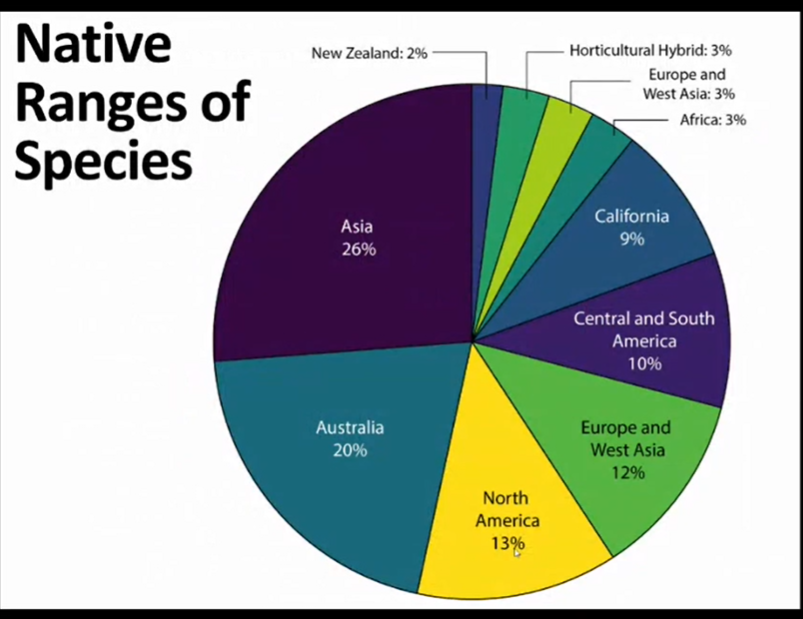
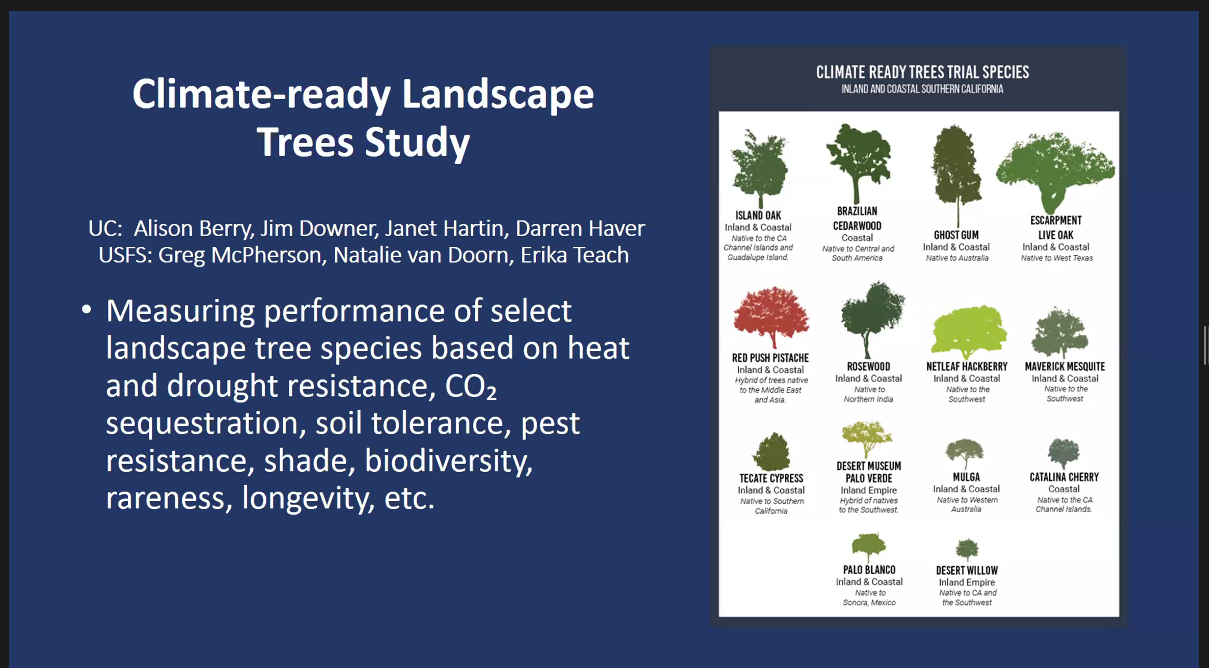
Globalization has irreversibly altered the planet, but it may also hold the key to surviving climate change. Designers today have unprecedented access to plants from around the world. For millennia, plants have been continuously evolving new, more efficient ways to survive in an astounding array of environmental conditions. In a post-native world, we will have to reconsider the idea that each plant is custom-evolved for a particular place on the earth, and instead think of global biodiversity as a library of adaptation. This library holds the key to successful planting in urban areas today, and hope for an uncertain future.
What I’m suggesting is that we embrace global biodiversity while we still have it; that our cities become hotbeds of plant species richness, hybridization, and cross-pollination; that we start a thousand divergent experiments, in small and controlled ways; and that we embrace this moment of globalization to produce an unprecedented explosion of diversity with which we can begin to replant and repopulate this irreversibly altered planet.
The resilience of natural systems lies in diversity, redundancy, and flexibility. Individual plants, and even individual species, die off frequently, but there is always another individual or another species to fill the void. Relying on a small set of native trees without embracing the redundancy and diversity of natural systems is a recipe for disaster.
Mark Wessels
 Conservation Sense and Nonsense