Isle Royale: Long-term study of predator/prey dynamics

“Natural history might be much like human history — explainable, but not predictable.” – Isle Royale Wolf-Moose Project

Isle Royale is an island and US National Park in Lake Superior.  It is 45 miles long and 9 miles wide.  Big enough to be the home of many animals, but small enough to be intensively studied and well understood. 

The closest land is 24 miles away, in Canada.  Far enough away to limit opportunities for animal migrations and control public access to the island, but close enough that ice bridges from the land to the island have formed in the past that animals used to migrate to the island. It is isolated, but not totally isolated, which contributes to the dynamism of the ecosystem. 
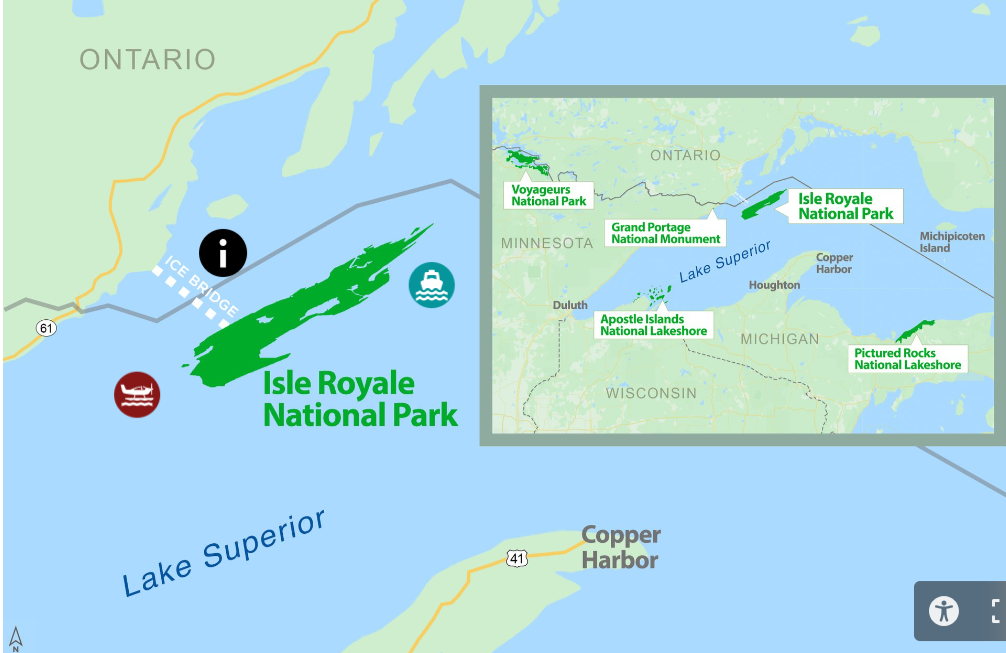
Source: National Park Service

The animals at the top of the food web on Isle Royale are wolves and moose.  Moose are said to have arrived via an ice bridge at the beginning of the 20th century.  Wolves arrived using another temporary ice bridge in the late 1940s.  The predator/prey relationship between moose and wolves has been studied on Isle Royale continuously since 1958, making it the longest-running predator/prey study.

When the study began 66 years ago, scientists expected to find an equilibrium balance point between populations of wolves and moose that would be stable in the long term.  That’s not what they found on Isle Royale.  Instead, they observed continuous, unpredictable change, such as disease, tick outbreaks, immigrant wolves, severe winters and hot summers. 

Scientists recorded the population dynamics of wolves and moose on Isle Royale for 66 years, as depicted in this graph:

Source:  2023-2024 Annual Report of Ecological Studies of Wolves on Isle Royale

As we would expect, moose populations increased when wolf populations decrease and vice versa.  Scientists can explain the turning points in the population curves of both wolves and moose, but in many cases they could only do so long after the fact as they identified the causal factors:

  • Between 1958 and 1969, the moose population doubled, while the wolf population declined from 30 to 15. 
  • Between 1969 and 1980, the wolf population increased as the moose population decreased until 1982, when canine parvovirus was introduced to the island by a visiting dog. 
  • The wolf population decreased from 50 to 14 until parvovirus died out, but the wolf population did not rebound.   The wolves had become inbreed because they were all descendants of a single breeding pair.  The wolf population suffered spinal deformities that handicapped their hunting until a single new male introduced new genes in 1997.
  • Between 1982 and 1996 the moose population increased to an all-time high of 2,400 until 1996 when their over-population caught up with them.  The population plummeted because of lack of forage, an increase in the tick population and a severe winter.  Ticks cause moose to lose their hair during winter, at a time when they were already thin because of over-browsing of vegetation.  
  • When the moose population plummeted in 1996, there was a corresponding decrease in the wolf population, until a new wolf arrived via a temporary ice bridge.  In 1997 a single male wolf made his way to the island on an ice bridge during the extreme winter.  He was very prolific and infused new genes into the wolf population that enabled the wolf population to rebound to 30 by 2005.  The arrival of the new wolf was not identified by the scientists who study Isle Royale until 14 years later, as the result of genetic tests. 
  • Between 2000 and 2005 there was a series of hot summers, which increased the tick population and suppressed the moose population, causing a corresponding decline in the wolf population.
  • Between 2005 and 2011, the moose population rebounded, but the wolf population continued to decline.  By 2011 there were only 15 wolves with only 2 females and most males were without functioning packs.  Inbreeding was probably contributing to the inability of the wolf population to recover. 

In 2018, the National Park Service decided to take matters into their own hands.   There were only 2 wolves left at that point and over-population of moose was taking its toll on vegetation on the island.  New migration of wolves was no longer expected because the warming climate prevents the formation of new ice bridges to the island. NPS adopted an interventionist policy for the first time.  They made a commitment to introduce 20-30 new wolves to the island over 3-5 years.
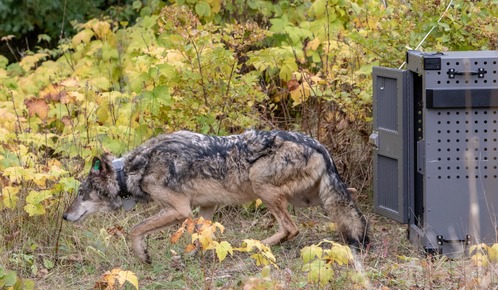
The first introduced female wolf arrives from Minnesota, 2018. Source: NPS

The graph depicts the arrival of new wolves on Isle Royale in 2018.  The wolf population has increased and it is more genetically diverse because of the arrival of wolves from distant genetic pools.  Greater genetic diversity will improve the resiliency of the wolf population.  The moose population is decreasing in response to restoration of wolves to a population of 30. 
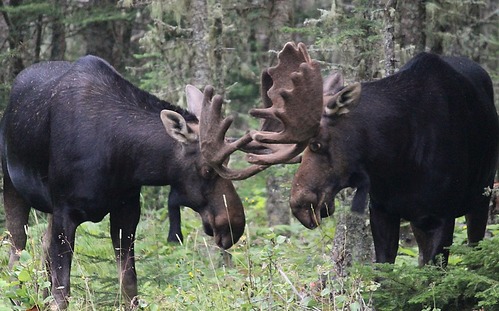
Dueling bull moose on Isle Royale, 2001. Source: NPS

The dynamic predator/prey relationship between moose and wolves in Isle Royale will continue in unpredictable ways. Climate change is expected to play a bigger role.  Hotter weather will increase tick populations and cause more moose mortality.  Changes in the climate will effect vegetation.  Balsam fir that are the preferred food of moose are being killed by spruce budworm.  Ice bridges that bring newcomers to the island will no longer form. 

Scientific Humility

However, the scientists who have studied Isle Royale for decades don’t want to leave you with the mistaken impression that they understand everything that has happened in the past or that they can predict everything that will happen in the future on Isle Royale.  Their humility is refreshing: 

“For 50 years, the focused purpose of the Isle Royale wolf-moose project has been to predict and understand a relatively simple natural system.  But the more we studied, the more we came to realize how poor our previous explanations had been.” (1)

These scientists want us to understand the limits of our understanding of nature because if and when we don’t, we make serious mistakes: 

“If we see Nature as a system whose future we can predict, then we will be confident in our efforts to control and manage Nature.  If, in Nature, we are more impressed by its essentially contingent, and hence unpredictable character, then our relationship will be more strongly rooted in striving to live within the boundaries of Nature’s beautifully dynamic variation.” (1)

Readers of Conservation Sense and Nonsense know that I believe humans cannot control nature.  We don’t understand nature well enough to control it and the forces of nature are far more powerful than we are. When we try, we often do more harm than good.  The scientists who have studied Isle Royale for 66 years seem to agree with me.  I am grateful for their work and their wisdom.


(1) Wolves & Moose on Isle Royale, Project Overview

Sources for this article:

              Wolves & Moose on Isle Royale, Project Overview
              Wolves & Moose on Isle Royale, Ticks
              Isle Royale National Park
              Isle Royale, Wikipedia
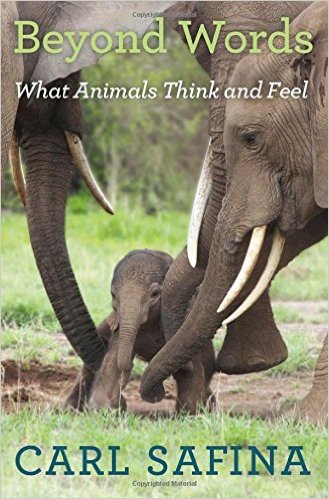
“Beyond Words: What animals think and feel”

Beyond WordsBeyond Words, by Carl Safina, was written by an animal lover for other animal lovers.  His mission is to convince his readers that animals are capable of the full range of emotions experienced by humans and that their communities are often as complex and varied as human communities.  His hope is that humans who understand the feelings and capabilities of animals, will therefore treat them with the respect they deserve.  It is a worthy cause and not hard to sell to this animal lover.

Inadequate scientific inquiry

Safina begins by lamenting the sorry state of scientific inquiry into animal behavior.  He speculates that the dominance of humans in the environment fostered a condescending attitude toward animals that prevented scientific inquiry of the animal kingdom until very recently.  Animals were perceived by humans as utilitarian objects to be exploited for food and transport or destroyed if perceived as a threat or a competitor.  This attitude is still prevalent in human societies.

One of the first studies of animal behavior was Jane Goodall’s long association with a community of chimpanzees.  When she wrote papers about her observations, she faced extreme resistance to their publication.  One of the most common reactions of the academic scientists to studies of animal behavior has been to dismiss them as anthropomorphic projections of human feelings and motivation.

Observing animals

The lack of respect for animal studies among academic scientists has created opportunities for many volunteer and non-scientist observers to break new ground as reporters of animal behavior.  Safina visited several communities of animal observers and shares their experiences with us:

  • He watches elephants in Africa as they go about their business under the watchful eyes of park rangers trying to protect them from poachers.
  • He joins teams of volunteer observers of wolves in Yellowstone National Park.
  • He follows orcas (AKA killer whales) with researchers in Puget Sound in Washington State.

Emotional lives of elephants

Unfortunately, elephant populations in Africa are being decimated by poachers because of the value of ivory.  Observers of elephant communities therefore have many opportunities to witness the grief that accompanies every loss of a beloved member of the community.  Here are a few observations of the behavior of elephants in response to the loss of a comrade:

  • “The elephants cautiously extend their trunks, touching the body gently, as if obtaining information. They run their trunk tips along the lower jaw and the tusks and the teeth:  the parts that would have been most familiar in life and most touched during greetings…” (1)
  • “Elephants sometimes cover dead elephants with soil and vegetation, making them, I think, the only other animals who perform simple burials…When sport hunters shot a large male elephant, his companions surrounded his carcass. The hunters returned hours later to find that the others had not only covered their dead comrade with soil and leaves but had plastered his large head wound with mud.” (1)
  • “…a matriarch named Eleanor, ailing, collapsed. Another matriarch, Grace, rapidly approached her with facial glands streaming from emotion.  Grace lifted Eleanor back fully onto her feet.  But Eleanor soon collapsed again.  Grace appeared very stressed, and continued trying to lift Eleanor.  No success.  Grace stayed with Eleanor as night fell.  During the night, Eleanor died.  The next day an elephant named Maui started rocking Eleanor’s body with her foot.  During the third day, Eleanor’s body was attended by her own family, by another family, and by Eleanor’s closest friend…A week after her death, Eleanor’s family returned and spent half an hour with her.” (1)
  • “When a female named Tonie gave birth to a stillborn baby, she stayed with her dead child for four days, alone in the heat, guarding it from the lions who wanted it.” (1)

A full range of human emotions are implicit in these incidents, such as loyalty to one’s friends and family and maternal love.

Social structure of animal communities

There is as much variety in the structure of animal communities as there is in human communities.  Elephant communities are matriarchal.  The oldest female is the leader of the group and the group is composed only of females and their offspring.  When male elephants reach maturity they wander on their own, interacting with matriarchal families only when the females are in heat.  Leadership is conferred on the oldest female because she is the most experienced member of the group.  She is therefore in the best position to make important decisions about where the group will go for food and how they will respond to threats from their predators.  The quality of that leadership can vary based on the personal attributes of the oldest female, but seniority is the only apparent criterion for that role.

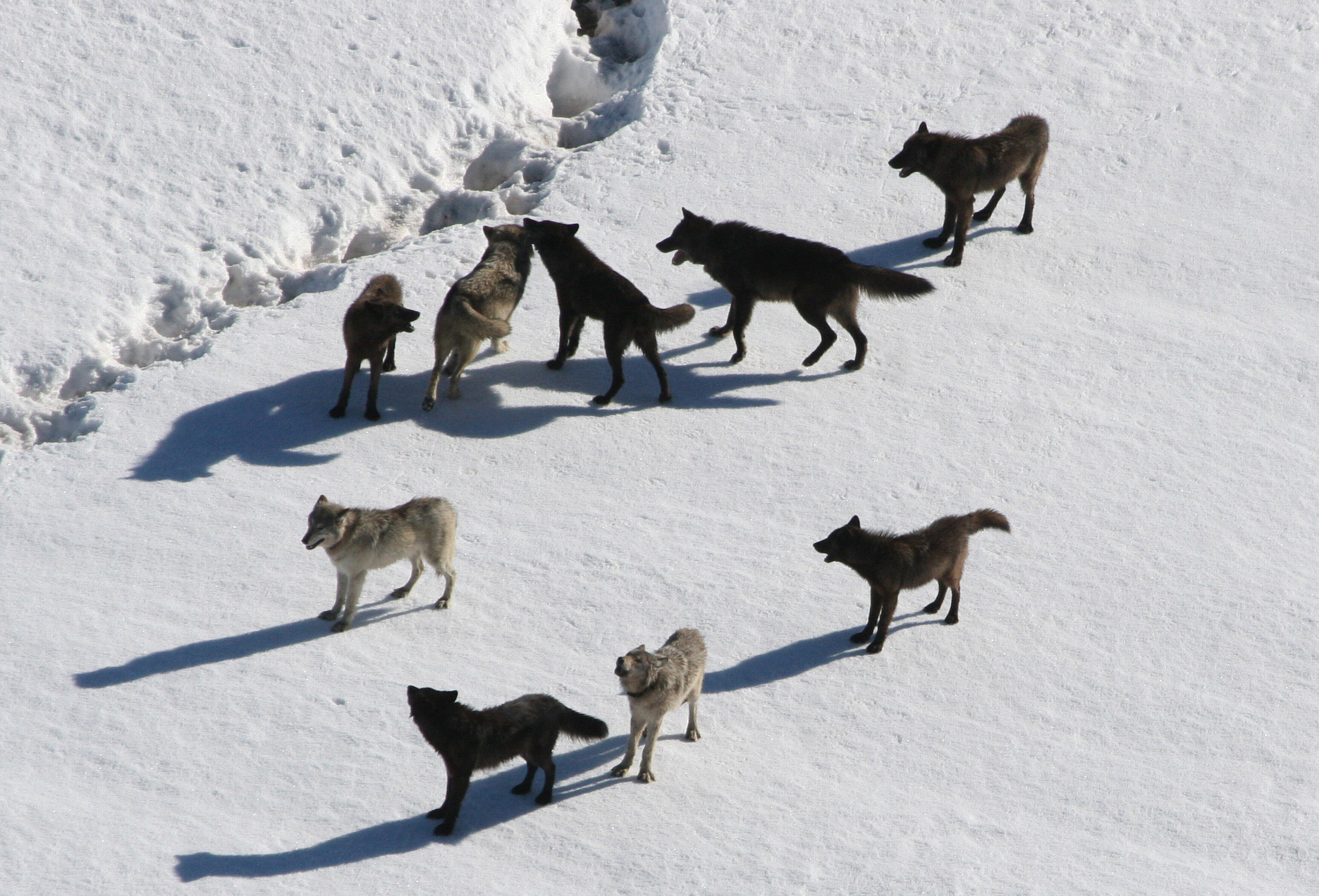
Pack of Gray Wolves, Yellowstone National Park

In contrast, the leadership of the wolf pack is the male and female alpha pair.  That status is achieved by virtue of physical strength and dominance; in some cases leadership is more magnanimous than it is dominant.  The male and female young of the alpha pair are also members of the pack, but personalities or loss of key members can splinter the pack.  There is intense competition for hunting territory and mates between packs and sometimes within packs.  This competition is often physical, and results in the death of members of the pack.  Safina tells us that as many wolves are killed by other wolves, as are killed by humans with guns.

The wolf pack resembles human families and communities.  Sibling rivalry is common.  Tribal competition between packs resembles human secular and sectarian wars.  The volunteer observers of wolves in Yellowstone Park are extremely dedicated to their task.  They explain their obsession by pointing out that the lives of wolves are much like watching a soap opera.

Individuality

While it is possible to generalize about the behavior and social structure of animal communities, we must also keep in mind that there is much individual variation.  Just as humans have distinctly different personalities, so too do animals.  Safina often turns to his dogs to illustrate this variability within species and we can do the same.  Our family has lived with nine dogs, usually in pairs.  No two dogs were exactly alike.  One was as shy as another was gregarious even though they were the same breed.  Some were obsessed with catching balls; others were completely uninterested in them.  Some were very attached and responsive to their human guardians, while others were independent.

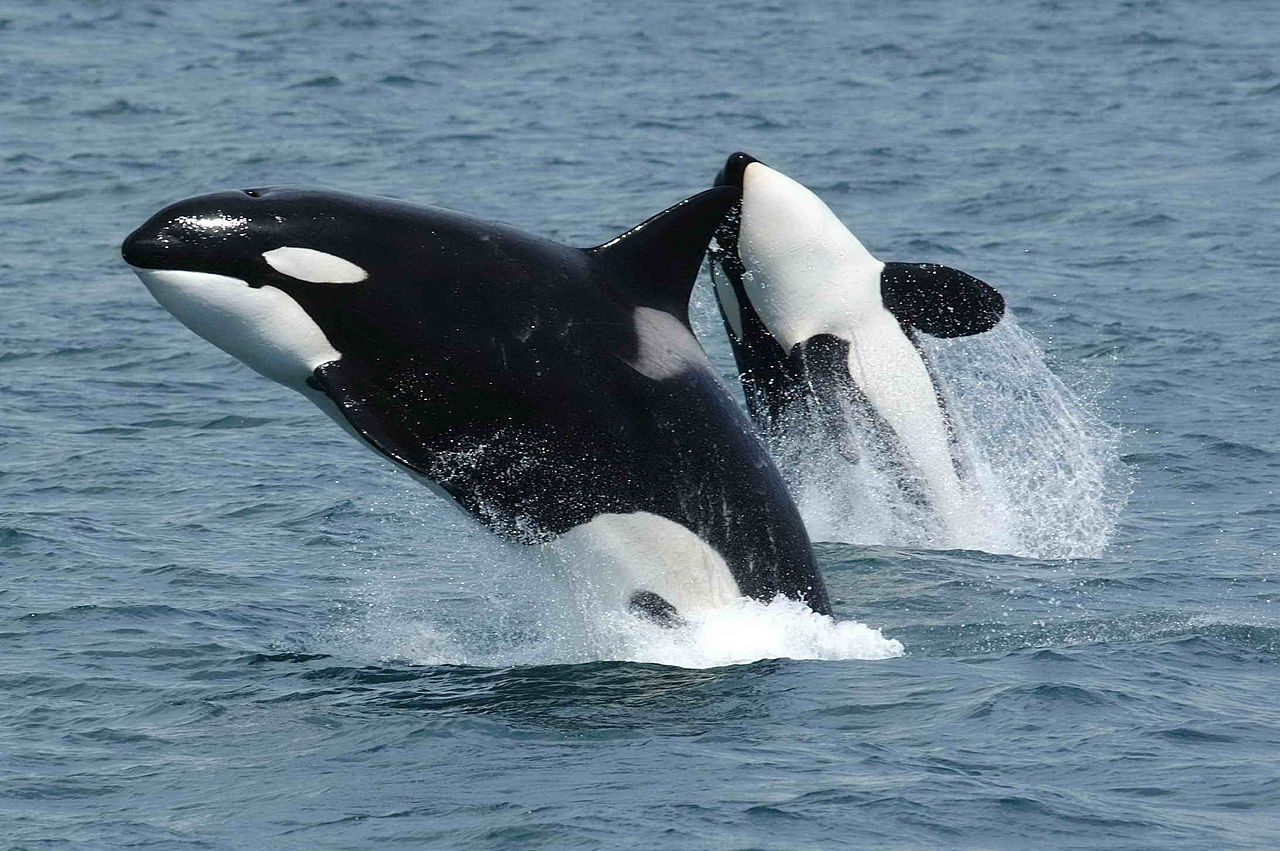
In addition to the variability of personalities in animal communities, their social structures may vary just as human societies vary.  Some orca pods stay close within a home range in Puget Sound and eat an exclusively fish diet.  Other orca pods travel long distances and eat exclusively other marine mammals such as seals.  Human societies vary widely in many ways, such as the range from extreme individualism of American society to a more communal society in places like Iceland.                                                                                                                                                                                                                                                                                                               Domestication

Safina tells us that our dog companions evolved from wolves.  Less shy members of wolf communities were willing to approach human settlements where they could often find discarded food.  In exchange, dogs alerted humans to the presence of predators.  This partnership developed over thousands of years.  While the dogs were domesticated by that relationship, they changed physically to conform to the requirements of their new, less active life, becoming cuddlier to accommodate the preferences of humans.

Likewise, humans have been domesticated by changes in their lifestyles.  Hunters and gatherers had to be much more observant about their surroundings than humans in agricultural communities.  Hunters were always wary that they could easily be the hunted.  Gatherers were always looking for edible plants; knowing the difference between edible and inedible plants was a matter of life and death.  The territorial range of agricultural communities is small compared to that of foraging communities.

Bad news for animals

Animals are often the losers when human populations grow and their communities expand into animal habitats.  In the case of elephants, the value of ivory is threatening their future in Africa.  In the case of wolves, their appetite for domesticated animals makes them targets of ranchers.  When endangered status of wolves is removed, wolves are quickly killed when they stray out of national park boundaries.  Wolf packs must travel great distances to find the prey they need and the park boundary is only an abstraction that does not restrain their movements.

Orcas in Puget Sound

The threats to orcas in Puget Sound are many and are associated with many anthropogenic changes in the environment.  Agricultural runoff from industrial sized feed lots and pesticide applications pollute the water.  Pesticides are also used to kill marsh grasses so that huge clam beds can be installed on the shores of Puget Sound.  Human sewage is sometimes inadequately treated before it reaches the sound.  All of these sources of pollution are a factor in declining populations of salmon.

Salmon populations have also declined because dams have blocked access to their spawning streams and the streams they used to reach them have been channeled and diverted into culverts.  Overfishing is another factor in declining salmon populations.  Global warming has increased water temperatures in oceans, which has disrupted the entire ocean food web.

All this results in less food for orcas.  Consequently, orca reproduction has declined significantly and infant mortality of orcas has soared.  The future of orcas in Puget Sound is very much in doubt.

Food for thought

Carl Safina has written an excellent book that we recommend to our readers without reservation.  We guarantee that it will warm your heart to read about animal communities that share both the positive and the negative aspects of human societies.  We hope it will make you reflect, as it did us, about the ways in which the activities of humans intrude on the lives of animals.  Thank you, Mr. Safina, for giving us this opportunity to learn more about our animal friends.


(1) Carl Safina, Beyond Words: What animals think and feel, Henry Holt & Co., 2015