The WordPress.com stats helper monkeys prepared a 2011 annual report for this blog.
Here’s an excerpt:
The concert hall at the Syndey Opera House holds 2,700 people. This blog was viewed about 13,000 times in 2011. If it were a concert at Sydney Opera House, it would take about 5 sold-out performances for that many people to see it.
In 2000 Robert Putnam’s (Harvard University) masterpiece of American social science, Bowling Alone* was published. He reported the significant decline of all forms of civic participation in American society and politics from the P.T.A. to voting. Religious participation is the notable exception to this trend.
We are deeply concerned about the increasing isolation of Americans from one another and we believe that the polarization of viewpoints, particularly in politics, is one of the consequences of this trend. Only the highly motivated extremes of opinion are still engaged in the civic dialogue. The middle ground is no longer represented in the debate. However, we will focus on the topic that is relevant to Million Trees, that is, the implications for the environmental movement.
Bowling Alone. Attribution: Xiaphias
Membership in environmental organizations reached its peak in 1995, according to Bowling Alone after decades of enormous growth since the 1960s. This peak was consistent with public opinion regarding environmentalism. In 1990 three-quarters of Americans considered themselves “environmentalists.” By the end of the decade, that percentage had dropped to only 50%.
The growth in membership was achieved by the use of a new marketing tool known as direct mail. Think about it. How many invitations do you receive in the mail from non-profit organizations, asking you to contribute to a wide-range of worthy causes? Typically these organizations spend between 20-30% of their budgets on such fund raising and the rate of return on these solicitations is only 1-3% of the cost depending upon the quality of the mailing list. Using this technique, Greenpeace tripled its membership between 1985 and 1990 to 2.35 million.
What does “membership” mean?
After tripling its membership, Greenpeace lost 85% of its members in the next 8 years. The drop-out rate after the first year is typically 30% in these organizations.
In fact, most contributors to these organizations don’t even consider themselves “members” in the usual sense of that word. The commitment to the organization doesn’t extend far beyond writing a check. Only 8% of contributors to the Environmental Defense Fund, for example, described themselves as “active” in the organization.
These organizations are therefore distinctly different from their historical antecedents. Participants in the civil rights movement frequently put their lives on the line. The social lives of Rotary Club members revolved around the Rotary lodge.
Since few people are active participants in environmental organizations, they have become “bureaucratized,” meaning they are run by and for paid professionals. Most members have little idea what policies the professional staff has adopted on their behalf.
The Sierra Club
In 1989, a survey of Sierra Club members determined that only 13% of its members had attended even one meeting of the Sierra Club. The Bay Area Chapter of the Sierra Club claims to have 10,000 members, but chapter leadership of a group (the chapter is broken into many geographical groups, such as the San Francisco Group)was elected by as few as 59 votes. The top vote-getter in the Club’s most recent election received 327 votes in a Chapter-wide race, but only one chapter group (Northern Alameda County) had more candidates than there were available seats. In other words, there was no competition for most of the leadership seats.
Yet, the incumbents in these leadership positions are free to determine the local policies of the Sierra Club. Here are a few recent examples of positions taken by the Bay Area Chapter of the Sierra Club:
The opinion of the membership is not asked when these policy positions are taken by the leadership. However, if members read the chapter’s quarterly newsletter (The Yodeler) they have the opportunity to learn about them after the fact.
The influence of the Sierra Club
We believe that the influence of the Sierra Club exceeds the size of its membership. The Sierra Club endorses candidates for political office. These endorsements are highly sought after because politicians believe that the endorsement confers the votes of its membership. This belief was recently tested in the race for mayor of San Francisco.
State Senator Leland Yee sought and received the endorsement of the Sierra Club in his bid for mayor of San Francisco. In the past, he had been critical of the Natural Areas Program. His stated reason for that criticism was that the veneration of native plants was offensive to his roots as an immigrant. In particular, the Chinese community suffered horrendous discrimination in California in the 19th Century. The rhetoric of the native plant movement is reminiscent of the xenophobia from which the Chinese community has suffered historically.
It seems unlikely that Senator Yee’s emotional reaction to nativism changed when he sought the endorsement of the Sierra Club, but he had to disavow that opinion in order to receive the Club’s endorsement. He did so because he believed that the votes of Sierra Club members would help him to be elected mayor of San Francisco. His bet did not pay off. He did not win. In fact, he came in fourth.
We hope that political candidates in the future will heed this warning. The Sierra Club may have many “members” but that membership does not necessarily confer votes. The vast majority of “members” have no commitment to the policy positions taken by the Club.
An appeal to Sierra Club members
There were over 4,000 public comments on the Environmental Impact Study for the Dog Management Plan of the Golden Gate National Recreation Area (GGNRA). The Dog Management Plan proposes to eliminate about 80% of existing off-leash areas, which are now only 1% of the 74,000 acres of GGNRA property. The Sierra Club supports that plan. There were thousands of comments from people with dogs who are presently enjoying the small areas now available to them for off-leash recreation. Sixty-four of those people said they are Sierra Club members. That’s enough members to elect someone to a leadership position in the Club.
If you are a member of the Sierra Club, here’s what you can do to influence the Club’s policies:
Inform yourself of the policies of the Sierra Club.
If you don’t agree with those policies, we urge you to vote in the election of officers to the leadership positions in the Sierra Club.
If you don’t know the policies of the candidates, ask them.
If there are no candidates that represent your viewpoint, find candidates who do.
If you can’t find a candidate you can support, it’s time to vote with your feet.
If you leave the Club tell them why.
Quit Bowling Alone!
Attribution: GNU Free Documentation
*Putnam, Robert, Bowling Alone: The Collapse and Revival of American Community, Simon & Schuster, New York, 2000. All quotes in this post are from Bowling Alone unless otherwise noted.
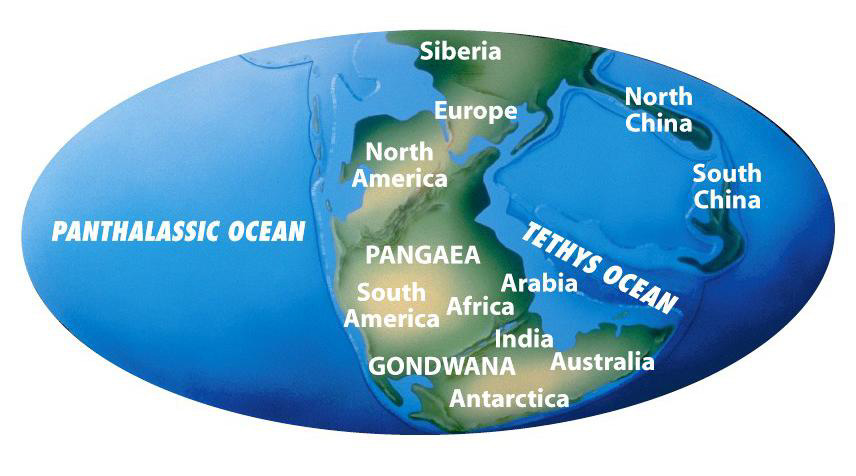
The continents have been sliding about on the Earth since it was “created”(1) approximately 4.5 billion years ago. Although geologists tell us that the continents came together and broke apart several times prior to the formation of the supercontinent geologists call Pangaea, this is the geologic period of most interest to us because life forms were sufficiently complex by that period that we can recognize their modern counterparts.
The supercontinent Pangaea
Pangaea is said to have been assembled about 237 million years ago, during the Early Triassic Period, shortly after the great Permian extinction, the period of the most extensive extinctions of plant and animal species in the history of the Earth. Pangaea began to break apart about 50 million years later, but the African and South American continents remained fused–into a continent dubbed Gondwana–until about 100 million years ago. (1)
During that period of nearly 160 million years, many new life forms emerged and others died out. Cone-bearing plants replaced some spore-bearing plants before Pangaea formed and dominated the Earth during much of Pangaea’s existence. The first true mammals, flowering plants, birds, lizards, and salamanders appeared before the break up of Pangaea was complete.
What are the implications of the development of new species of life on Earth at a time when there was a single, unified continent? That is the question we are considering today. Obviously, the transport of plant and animal species into new territories is facilitated by their proximity. Seeds are more easily transported by wind and animals if they need not cross barriers such as oceans, as they must today. As a result there was greater homogeneity of species during the geologic periods of Pangaea. And species diversified rapidly when Pangaea broke up into the 7 continents of today. (2) These diversified species have common ancestors.
Even after Pangaea began to break up into separate continents, there were land bridges between some of the continents during periods of glaciations when water was locked into ice, draining the oceans. Animals could travel over these land bridges from one continent to another, often bringing plant species with them, usually unwittingly. That’s how the first humans in North America and ultimately South America traveled from Asia about 13,000 years ago at the time of the last ice age.
The common ancestry of many plants and animals is one of many reasons why the concept of “native” is ambiguous and is often debated. We will consider a few examples in which the designation of a particular plant as native or non-native seems debatable.
Is the Dawn Redwood native to California?
Dawn redwood (Metasequoia glyptostroboides) is closely related to our redwood trees, Coast Redwood and Giant Sequoia. Dawn redwood is unique in being a conifer that is also deciduous (loses its foliage in winter), unlike our redwood trees which are evergreen. Dawn redwoods were until recently considered native to remote regions of China where they are considered “critically endangered.”
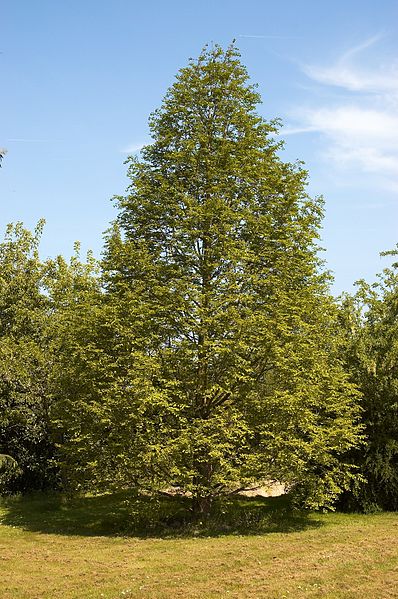
Dawn redwood in spring. Wikimedia Commons
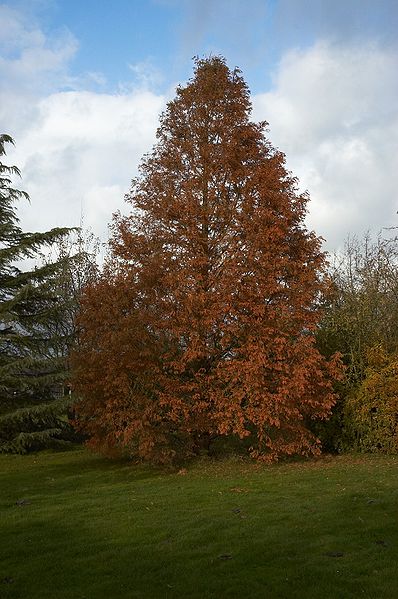
However, scientists at the Museum of Paleontology at UC Berkeley tell us that there is fossil evidence that dawn redwoods grew in California about 40 million years ago. Dawn redwoods now grow successfully in the Bay Area. There is a famous specimen in front of McLaren Lodge in Golden Gate Park, headquarters of San Francisco’s Recreation and Park Department. Every autumn, when the tree turns red, park staff receives calls from the public expressing their concern that the beautiful tree is dying.
Dawn redwoods died out in California during the last ice age because the climate was cooler than dawn redwoods could tolerate. So, now that the climate has warmed again, and dawn redwoods are back, why not welcome them as a “return of the natives?” That’s the kind of flexibility that makes sense to us, particularly in a time of rapidly changing climate.
Dawn redwood in autumn. Wikimedia Commons
Unfortunately, we don’t find such flexibility in the native plant ideology. Dawn redwoods are rare both in California and in China from which it was reintroduced, and it is therefore not one of the trees that native plant advocates demand be eradicated. Monterey pine and Monterey cypress are not so fortunate. These are also trees for which fossil evidence suggests that they lived in San Francisco in the distant past and their native range is less than 150 miles down the coast in Monterey. Both tree species are also considered threatened in their native range. Yet, native plant advocates demand their eradication in San Francisco.
This is an example of the rigidity of the native plant ideology that has earned them the reputation of fanatics.
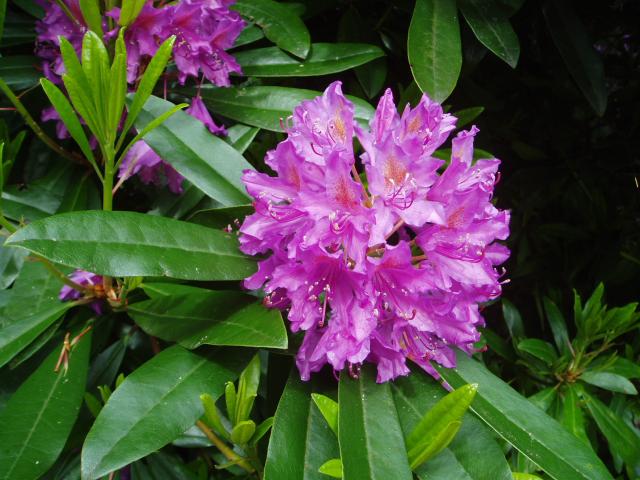
“The next most serious weed is probably rhododendron which, unusually, has the ability to invade existing ancient woodland, especially in the west of Britain. This may be because, if one employs a very long time scale, it is not strictly an alien. The species that forms impenetrable thickets in western Britain is Rhododendron ponticum, whose pollen remains have been found in deposits in Ireland dating back to the last interglacial. The species was plainly accustomed to growing in Atlantic woodland and may have retained a genetic “memory” of how to cope with this habitat and its competing species. But it didn’t grow spontaneously in Britain for the next 30,000 years, and all the current feral colonies are regarded as originating from garden escapes.”(3)
Rhododendron ponticum. Wikimedia Commons
Once again, we wonder if “welcome home” isn’t a more appropriate response to this beautiful plant. We find the definition of “native” as arbitrary as the definition of “invasive.” Both seem to be terms used by people who abhor change. And in a rapidly changing world, does such resistance to change make any sense? We don’t think so.
Plants have many different strategies to ensure their reproductive success. Sometimes they are passive participants in their propagation. Charles Darwin studied the dispersal of the seeds of plants and reported a particularly stunning example: “He raised more than eighty plants from the mud-ball gathered round a wounded French partridge’s leg.”* He also raised plants from seeds found in the stomachs of birds, which brings us to today’s topic: the non-native plants which are eaten by birds are categorized as “invasive” plants and are therefore doomed to be eradicated.
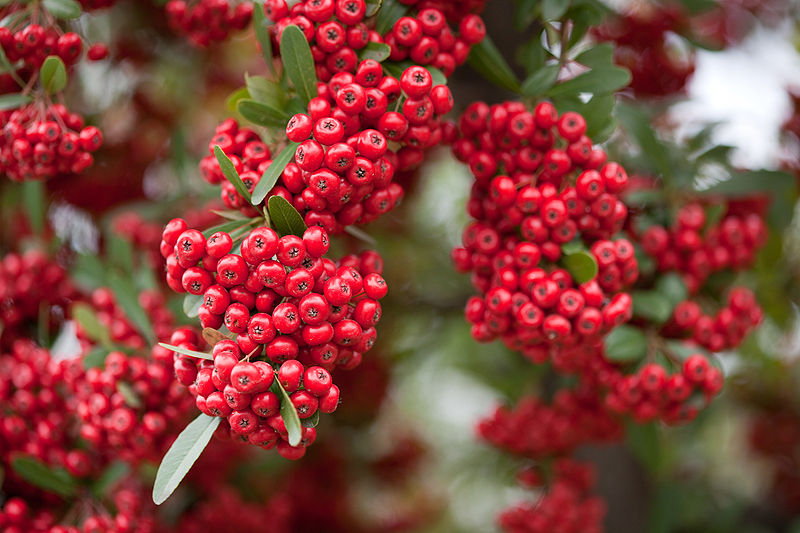
There are also several species of non-native shrubs which produce berries on the list of “invasive” plants that we know don’t spread in our gardens: English holly trees, Cotoneaster, and Pyracantha. So, why are they on the hit list? The garden columnist in the San Francisco Chronicle recently told us why in answer to a question about planting a non-native holly tree for Christmas foliage in the garden:
“Berries are a little harder to come by if we follow the advice of native plant specialists who are concerned about escape of holly, cotoneaster and pyracantha into nearby wildlands, particularly in coastal counties. Birds that eat the fruit and deposit seeds are the culprits.”
Pyracantha. Wikimedia Commons
In other words, native plant advocates don’t want gardeners to plant non-native plants that produce berries that birds eat because they don’t want the plants to spread. Obviously, their dedication to native plants trumps whatever concern or interest they might have in the welfare of birds. Native plant advocates frequently claim that their “restorations” will benefit wildlife. Clearly the eradication of berry-producing shrubs does not qualify for such a claim.
The loss of food and habitat for the wildlife that lives in our public lands is only one of many issues in the debate about native plant “restorations.” But for bird lovers, this is a high priority. In this regard, we were struck by one of the public comments that was recently submitted on the Draft Environmental Impact Report for the Natural Areas Program. This self-identified “birder” said this about the radical “restorations” in San Francisco:
“Restoration areas such as Land’s End, El Polin Spring, Crissy Field are seldom spoken about anymore by birders or others looking for populations of wildlife. Since the vast majority of the city’s resident bird species feed, roost and breed in trees, they leave, starve or are predated when their habitat is destroyed.”
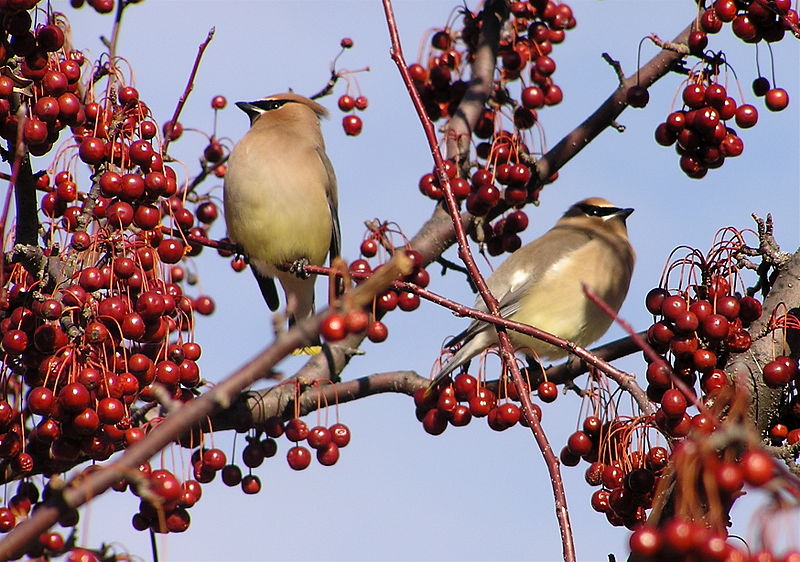
Cedar Waxwings in crab apple tree. Wikimedia Commons
As the Cedar Waxwings pass through the Bay Area on their annual migration, we see them eating the berries in our holly tree. They remind us that the eradication of non-native trees benefits neither animals nor birds, nor insects. Who benefits from these destructive projects besides the people making their living at it? It’s a mystery.
* Mabey, Richard, Weeds: In Defense of Nature’s Most Unloved Plants, HarperCollins, 2010, page 29
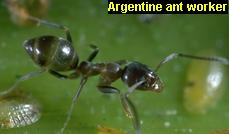
The Argentine ant is one of a gazillion non-native species that have been labeled “invasive species.” Like most non-native species, they are considered aggressive competitors of native ants. The usual tools are employed to eradicate them, e.g., pesticides.
Argentine ant. UC Davis
But wait! Now scientists are suddenly noticing that the Argentine ant is disappearing from some of their colonial haunts.Scientists in New Zealand have recently reported the disappearance of the Argentine ant from 40% of sites they populated in the past and their populations have shrunk significantly where they are still found. Native ants have “reinvaded” the areas vacated by the Argentine ant. The scientists reporting this finding “concluded the species naturally collapses after 10 to 20 years.”
The scientists in New Zealand don’t claim to know why the populations of Argentine ant have disappeared. They speculate that a virus is to blame. They don’t claim “pest control” deserves credit for the disappearance which is estimated to have cost $53 million (NZ$68) per year since the Argentine ant was originally found there in 1990. That’s right, New Zealand spent approximately $53 million per year trying to eradicate the Argentine ant, which apparently is disappearing on its own.
This is apparently not an isolated phenomenon. An entomologist at UC Davis reports that the Argentine ant has been declining in California as well. How much pesticide was poured on Argentine ants before they showed the good grace to just disappear?
The Africanized Bee: Another scary story that didn’t materialize
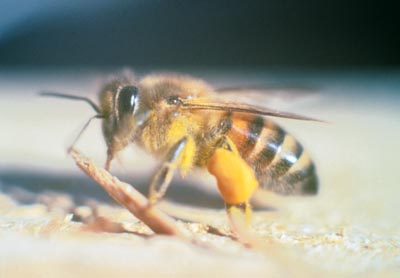
Another example of an “invasion” that seems to have resolved itself is the Africanized bee. Do you remember about 15 years ago when the media created a panic about the Africanized bee? We were told that it was spreading rapidly from Latin America, headed our way and that it was so dangerous that it was capable of swarming people and animals and stinging them to death!
Africanized honeybee USDA
What happened to that particular “alien invasion” story? Professor Gordon Frankie (UC Berkeley), our local expert about bees, was asked that question in a lecture he was giving to Cal Alumni in October 2011. He said that the Africanized bee didn’t turn out to be as aggressive as it was originally thought to be and that it didn’t spread as far or as fast as predicted.
Does “Invasion Biology” make more problems than it solves?
Some months ago we created a Google alert for “invasive species.” Now we are treated to a daily barrage of scary “alien invasion” stories from all over the world. We wonder how many of these “invasions” will eventually prove to be benign. We wonder how much money will be spent, how many animals will be killed, how much pesticide will be poured on our public lands, before we figure out that we need not be afraid of everything that is new in the environment. We wonder how many people are making their living on these eradication efforts and what role they play in frightening the public into funding their projects and tolerating the destruction they inflict on the environment.


 Conservation Sense and Nonsense