Girdling a tree by cutting through the outer layer of bark into the woody trunk eventually kills the tree by interrupting the channel through which the tree receives moisture and nutrients from its roots. The bigger the tree, the longer it takes to die, but the death of a girdled tree is inevitable.
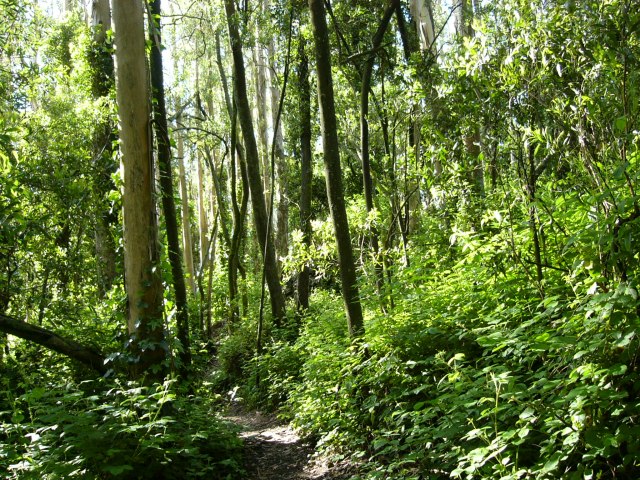
Girdled trees, Bayview Hill, San Francisco
Between about 1998 and 2003, approximately 1,200 non-native trees in San Francisco were girdled by native plant advocates, including a few who were employees of the Recreation and Park Department’s so-called Natural Areas Program. This vandalism was finally stopped after one of the native plant advocates was caught and prosecuted and the Recreation and Park Department was embarrassed by the media coverage.
In addition to killing trees by girdling them, an entomologist has published a study which reports that Australian pests of eucalypts were intentionally and illegally introduced to California for the purpose of killing non-native eucalypts. These stories are told here.
More recently, we have learned that native plant advocates are also spraying non-native vegetation in public parks in San Francisco with herbicides, in violation of San Francisco’s policy regarding pesticide use. The people who are spraying these herbicides are not authorized to do so. They are not posting notices of the application of herbicides as required by law. They are also using herbicides that are not approved for use in San Francisco’s public properties. That story is told here.
Guerilla Gardening in the East Bay
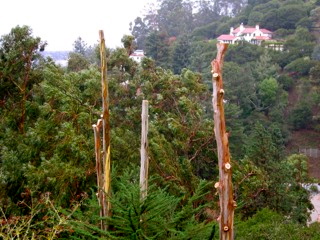
These guerilla tactics have recently spread to the East Bay. Shortly before Christmas in December 2010, the neighbors of Garber Park (Evergreen Lane) in the Oakland hills were shocked when an enormous crane pulled up to their park and began to take down several huge eucalyptus trees. The neighbors had been told nothing about their destruction and they had no idea why they were being destroyed. A little frantic investigation revealed that one of their neighbors had requested that the trees be removed and, because she was willing to pay for their removal, the City of Oakland obliged her without any further consultation with her neighbors. Needless to say, many neighbors were not pleased with this undemocratic method of altering their neighborhood landscape. That story was reported in the Hills Conservation Network newsletter which is available here.
Eucalypts destroyed in Garber Park, December 2010. Photo by Michael Wallman
The removal of those trees was the first step in an ambitious project to eradicate non-native plants and trees in Garber Park and replace them with native plants. That project is described on the website of the “Garber Park Stewards.”
Garber Park native plant “restoration”
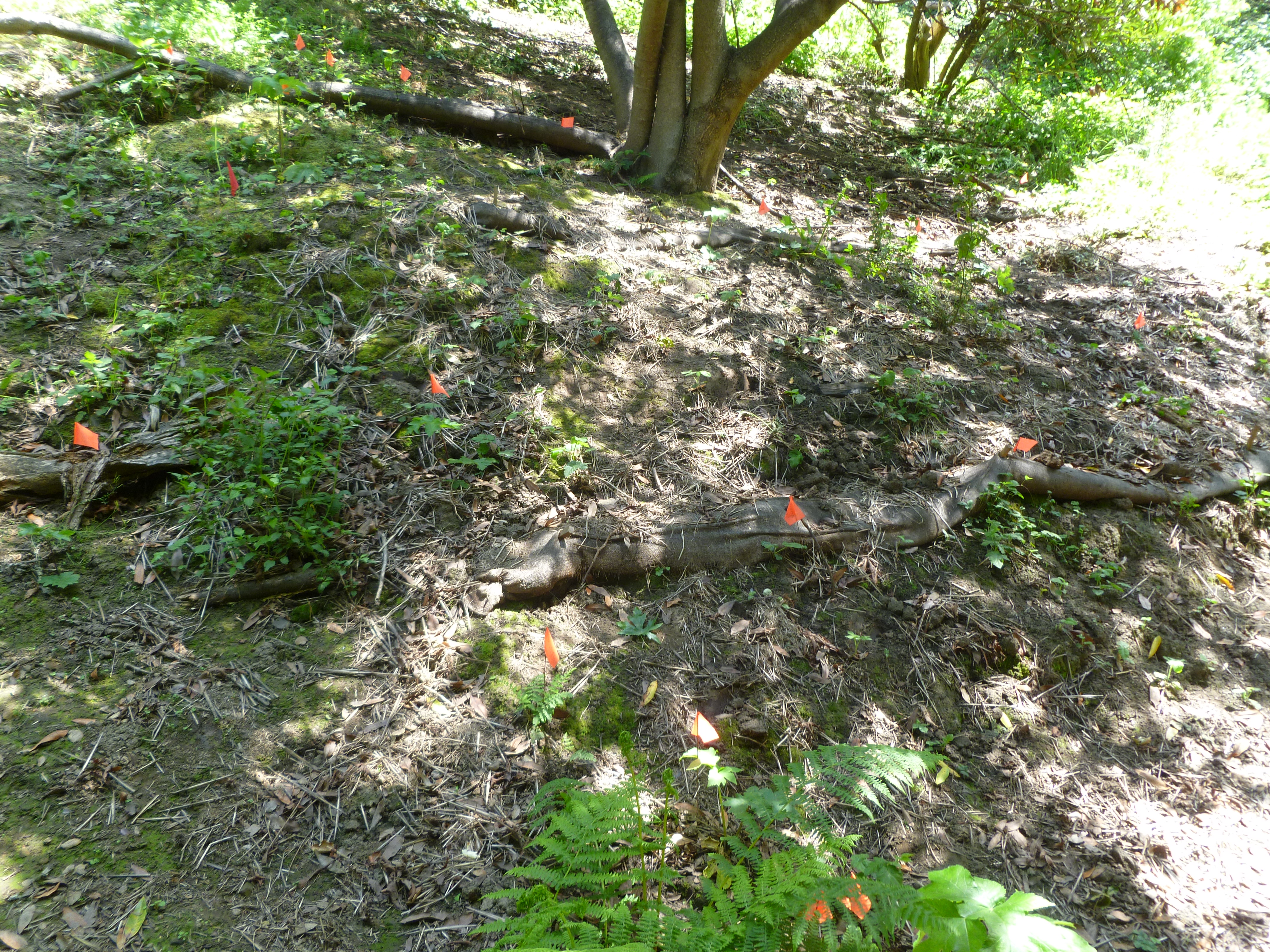
On a recent visit to this wild 13-acre park, we saw little evidence of this effort. A rough, barely passable trail meanders through the park. Most of the trees are native oaks, bays, big leaf maples, and buckeyes. The tangled understory is a mix of natives (cow parsnip, horsetail, poison oak, etc) and non-natives (annual grasses, forget-me-knots, etc). The only evidence of the work of the stewards was typical of these projects: a small patch of bare ground with colored flags.
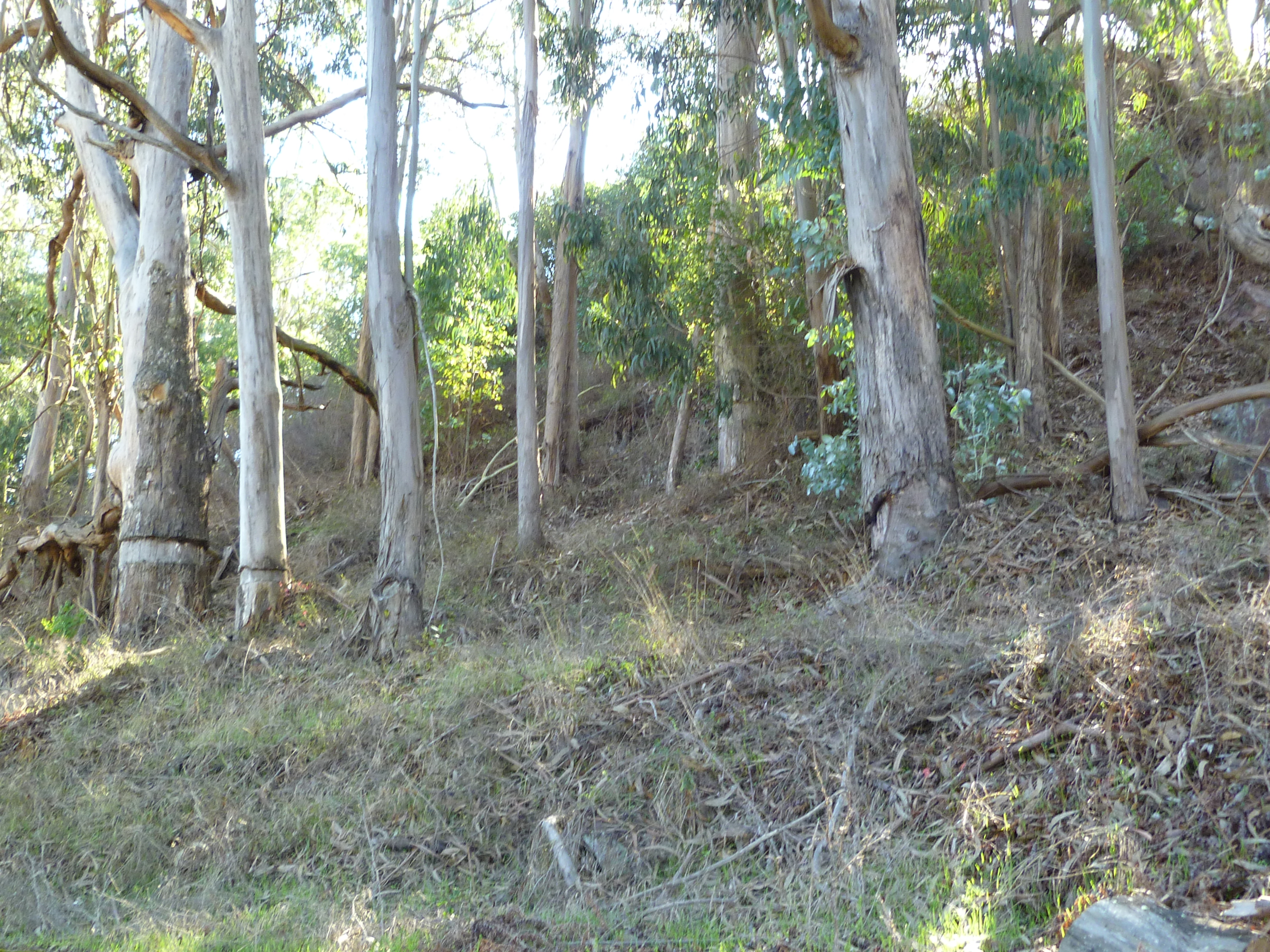
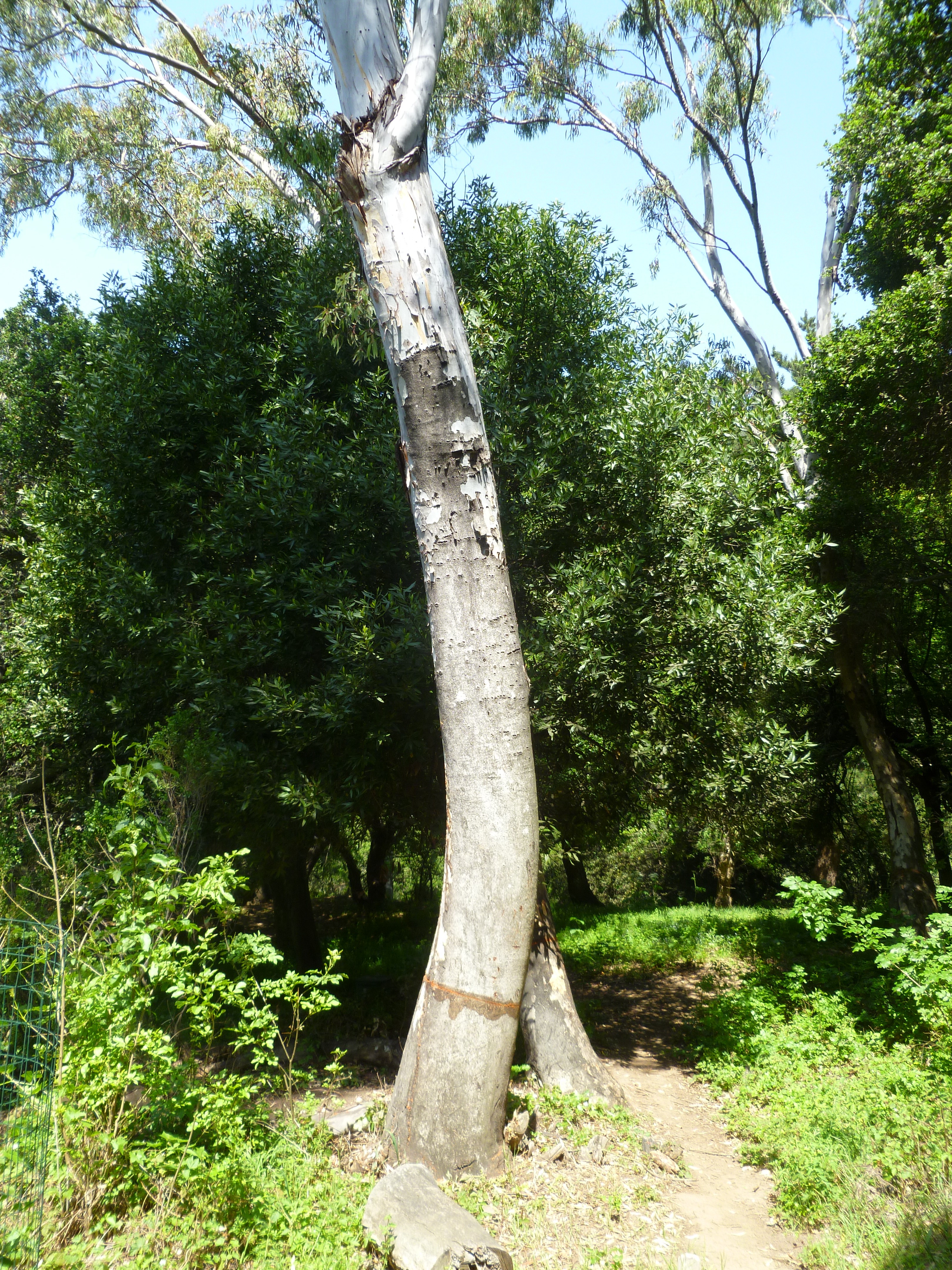
Girdled tree, Garber Park
Now more eucalypts are being destroyed in Garber Park by girdling them. A chain saw was apparently used to cut into the cambium of the tree, which is the channel that carries nutrients from the roots of the trees to its canopy. Something was painted or sprayed into the cuts which we speculate is an herbicide that will accelerate the death of the trees.
We speculate that the girdling of these trees was not authorized by the City of Oakland. The neighbors of the park say they were not informed that the trees were going to be destroyed. Therefore, we assume that this is a case of vandalism which we hope will be reported to the police as such.
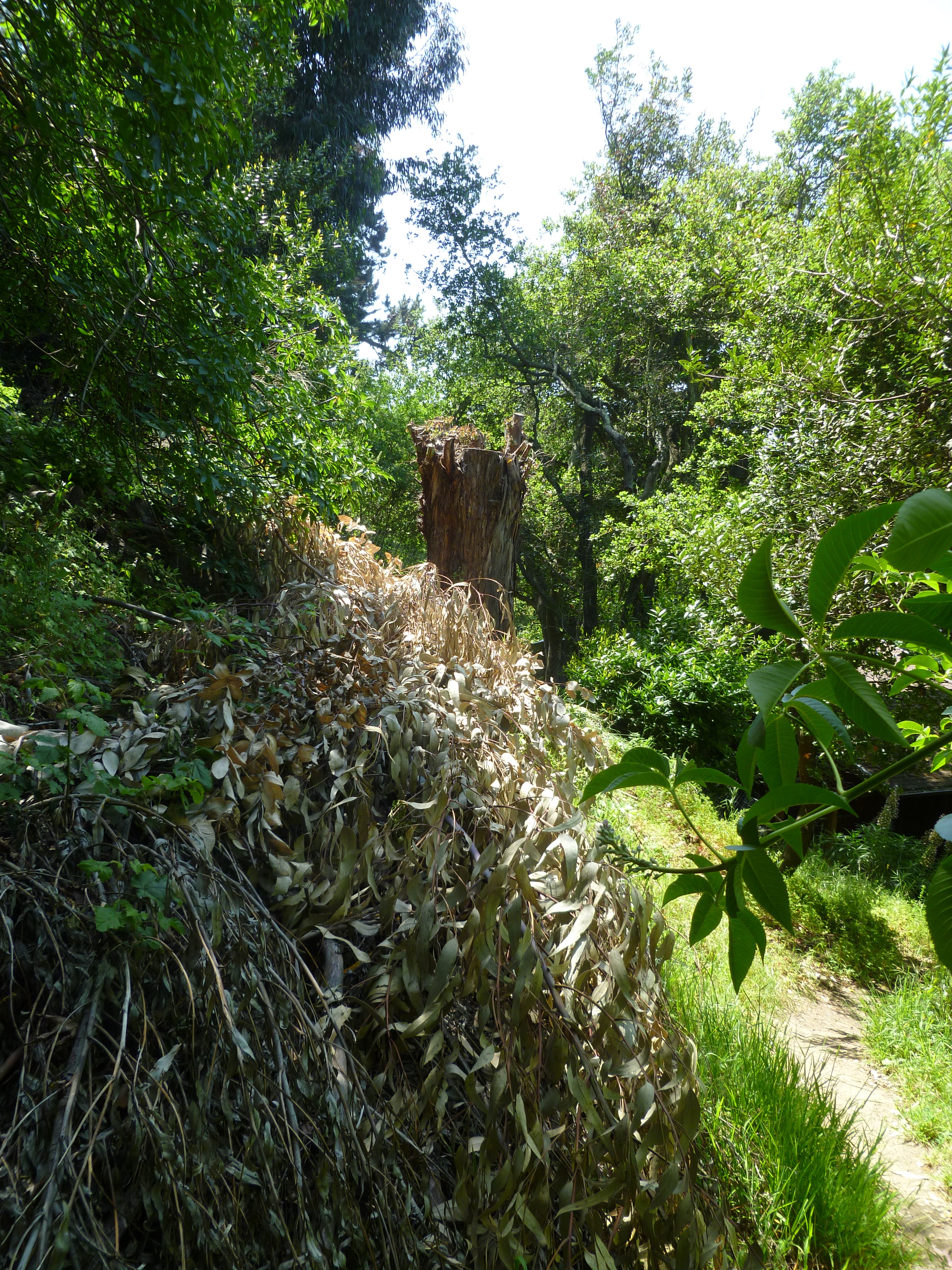
Eucalyptus stump and dead litter, Garber Park. If you were concerned about fire hazard, would you leave dead litter in the park for over 2 years?
We have no idea who girdled the trees in Garber Park. We therefore make no accusations. However, based on our experience in San Francisco, we speculate that whoever killed these trees believes their destruction will enhance the native plant restoration project. There are few eucalypts in this park. We saw only one that was not either girdled or a stump. We wonder what harm these few trees could do in this wild place. They are clearly not spreading
We repeat the Million Trees mantra
We say at every opportunity that we like native plants and trees and we encourage native plant advocates to plant them. We ask only that they stop destroying the plants and trees that have lived peacefully in the San Francisco Bay Area for over 100 years and are performing valuable ecological functions. We remind native plant advocates that we live in a democracy and that our public lands belong to all of us. If the landscape is to be permanently altered, a democratic process should be used to reach that conclusion.
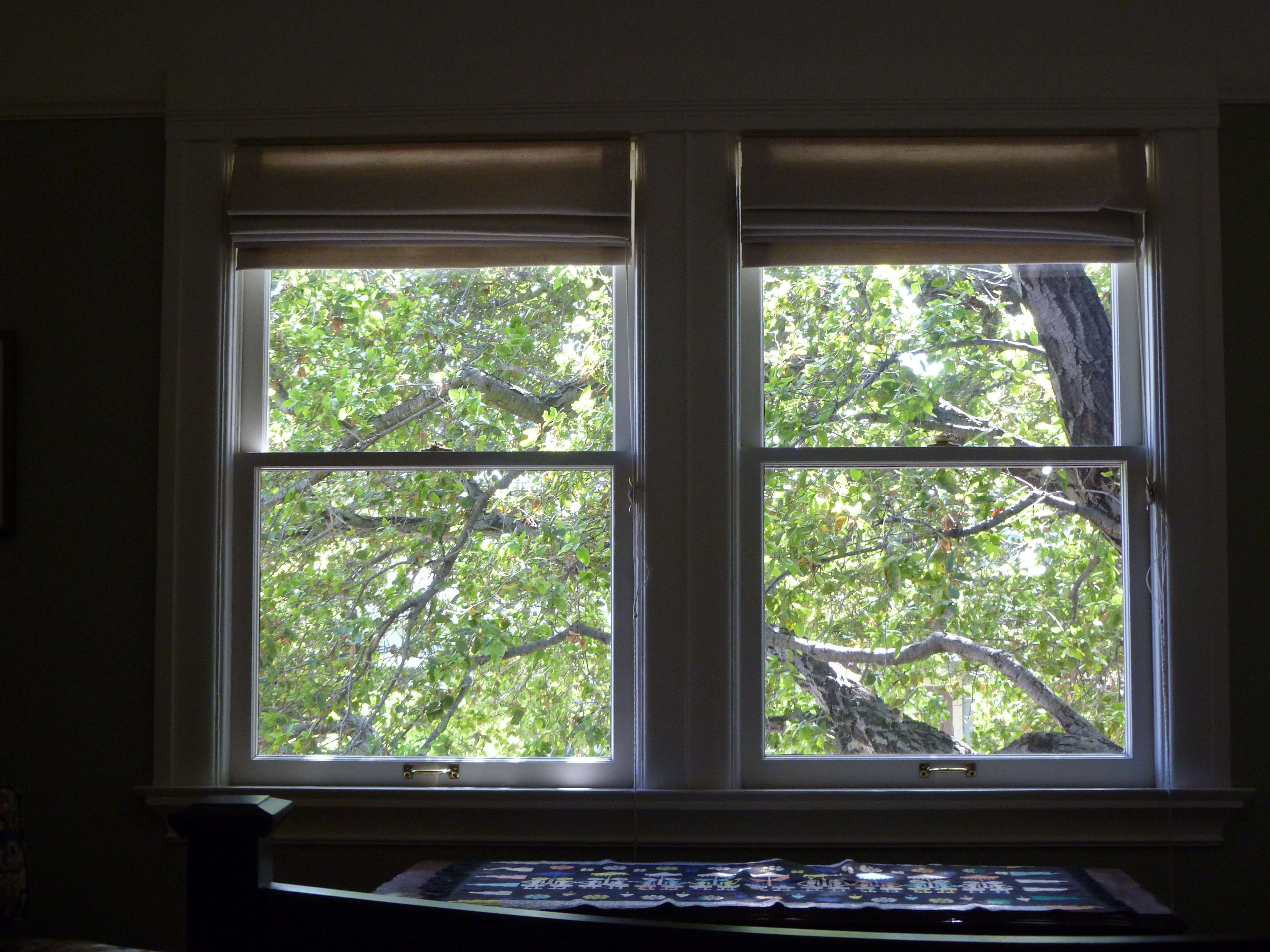
I am still recovering from a bad bout of pneumonia. I spent a month in bed with little energy to do anything but look out the window. Fortunately, that means that I was looking through the branches of my Coast Live Oak all day. As the sun moved in the sky from the East to the West, the illumination on the tree branches changed the perspective. In the late afternoon, when the light comes from the West, the deeply creviced bark of the tree was high-lighted.
The view from my bed: Coast Live OakRobin and chicks
The birds are busy this time of the year, finding their nesting partners, staking out the territory for their nest and building it, then hunting for the insects that their nestlings require when they are young. Even birds that will be primarily fruit and seed eaters as adults are fed insects as babies because they need the high quality protein. Their activity in the tree contributed to my peaceful view.
I don’t know how much of a role this scene played in my recovery. What I know is that it was the only source of pleasure in what was otherwise an unpleasant episode in my life.
“A Year in Trees”
I hadn’t planned to tell this personal story until reading an op-ed in the New York Times on Sunday, April 6, 2013, entitled “A Year in Trees.” The author, Bill Hayes, tells us about the important role that the trees surrounding his apartment in New York City played in his recovery from his grief from the loss of his long-time partner in life.
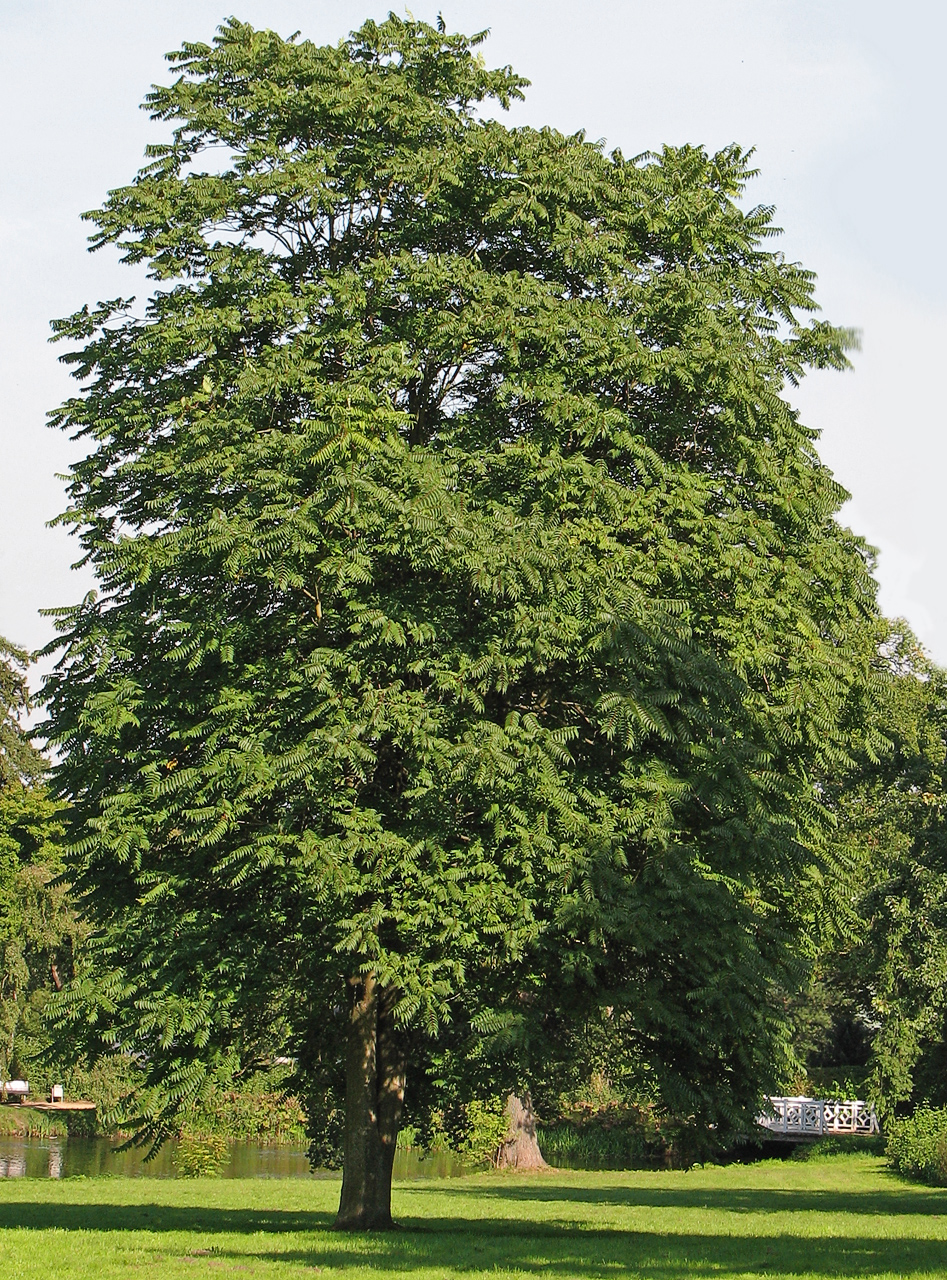
Tree of Heaven is a handsome tree.
The species of the trees that were visible in the windows of his apartment was Tree of Heaven (Ailanthus altissima), a non-native tree that is despised by native plant fans who consider it an invasive weed. This judgment did not influence Mr. Hayes’ appreciation for the trees, though he acknowledges that opinion.
Mr. Hayes watched those trees through their seasonal changes for the year he spent in that apartment, just as I watched my tree during the month I spent in bed. He called it “Tree TV.”
One particular episode in that year of those trees illustrated the role they played in the healing of his profound grief:
“…during a ferocious thunderstorm, I’d just managed to escape, I found the boughs being tossed about like rag dolls. The branches thrashed violently—whipping back and forth, slamming against the windows with a thud, sliding down slowly before being lifted aloft again. I was riveted. The trees, clearly overmatched by the combination of winds, rain and lightning were not fighting this storm but yielding to it.”
The trees were a metaphor for the final stage of grief, acceptance or a yielding to the sorrow that incorporates it into your life. They were also a reminder of our resilience.
Scientific verification of the healing power of trees
These anecdotal stories are probably only meaningful to those who have had the experience. However, there is much scientific evidence that these experiences of the healing power of trees are in fact universal. We have reported several such studies in an earlier post.
Now there is a new study which used a different technique to test the affect that trees have on people:
“New research out of Edinburgh [Scotland] supports the idea that spending time in green spaces with trees reduces stress and brain fatigue. What makes this study different from earlier research is that it looks at real-time data from the brains of people while they were actually outside, moving through the city and the parks. The study makes use of a recently developed lightweight, portable version of the electroencephalogram, a technology that studies brain wave patterns.” *
The loss of our urban forest will be the loss of our peace
Our urban forest shields us from the noise and visual chaos of the densely populated city. It also protects us from the wind. Destroying our urban forest will expose us to more noise and wind. The landscape that native plant advocates wish to substitute for the urban forest is native grassland and dune scrub. These landscapes will not provide a shield from the noise and chaos of the city. In losing our urban forest, we will lose some of our peace.
The public comment period for the Draft Environmental Impact Report (DEIR) for UCSF’s plans to destroy 90% of the forest and its understory on 46 acres of the Mount Sutro Open Space Reserve ended on March 19, 2013. We studied that document carefully to evaluate its accuracy and form our own opinion of the impact this project will have on the environment. Because Mount Sutro is a very windy environment, we paid particular attention to the influence of the wind for the consequences of UCSF’s proposed plans to destroy most of the forest. In the process, we learned something about the interaction between wind and trees that we would like to share with our readers.
The wind on Mount Sutro
Mount Sutro is a 900+ foot hill that is directly exposed to the wind from the west, coming off the ocean. Steep slopes accelerate the wind as it moves uphill. On the leeward side of a steep hill the wind breaks into turbulent gusts. This is an oversimplification of the movement of wind over a hill because in a complex topography such as Mount Sutro, the movement of the wind is as complex as the topography. For example, Mount Sutro is penetrated by a number of steep canyons that funnel the wind as it moves uphill.
Anyone who has visited the UCSF campus on the top of the hill knows that it is a cold, miserable, windy place much of time. But if you walk in the dense forest on Mount Sutro, you are often unaware of the wind because the trees are shielding you from the wind.
UCSF plans to destroy its windbreak by reducing the density of the forest from 740 per trees acre to only about 15-50 trees per acre. The campus and the neighborhoods on the leeward side of Mount Sutro are going to be subjected to a great deal more wind. They will also experience more fog which is now being “caught” by the tall trees and condensed as moisture to the forest floor. That fog is now going to flow freely from the ocean to the neighborhoods on the leeward side of Mount Sutro.
The consequences for the few trees that remain
UCSF would like the public to believe that it doesn’t intend to destroy the entire forest. However, that is the likely consequence of destroying 90% of the trees on 46 acres because trees develop their defenses against the wind in a specific environment with a specific amount of wind and they often fail when they are exposed to more wind than they are adapted to.
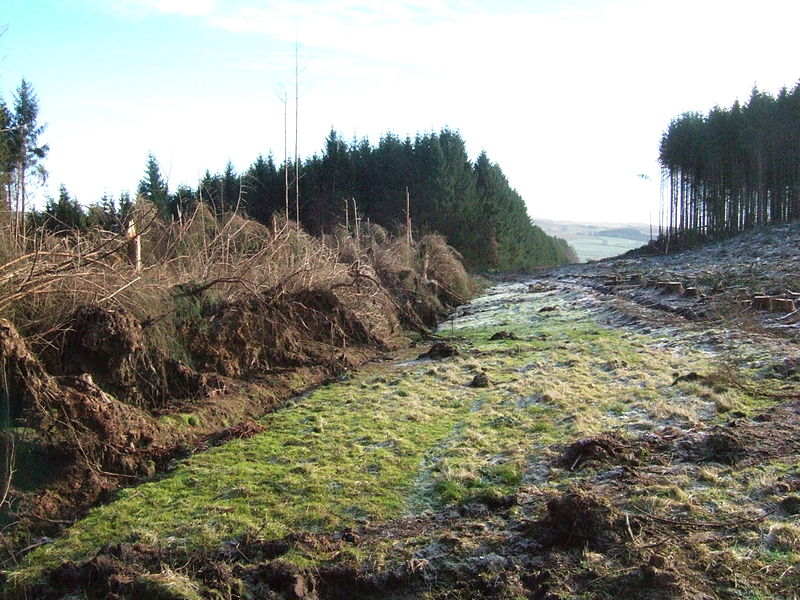
Wndthrow caused by adjacent clearcut, Britain. Creative Commons
UCSF’s own written plans for this project acknowledge that thinning the forest will increase the likelihood of the remaining trees failing: “Individual trees that suddenly become more exposed to high winds are also more likely to fall. For this reason, any thinning of the forest that is considered must not be so extensive that it will subject remaining trees to increased windfall.” (1, page 15) Ignoring its own advice, UCSF proposes to destroy over 90% of the trees on 46 acres of the reserve.
The DEIR also acknowledges that the trees remaining after the forest is thinned will be vulnerable to windthrow for some unknown period of time during which they adjust to the changed environment. The DEIR suggests that it is possible to mitigate for this potential for windthrow by monitoring the remaining trees to identify potential hazards. In other words, the DEIR claims that it is possible to accurately identify trees that might fall before they fall.
This is a fiction. If it were indeed possible to accurately predict that a tree will fall, we wouldn’t read reports of thousands of trees falling all over the country every year. Over 5,400 tree failures were reported to the University of California’s “California Tree Failure Report Program” in 2012. Since reporting is voluntary, we assume that is an underestimate of all tree failures in California in 2012. (Oaks (Quercus) were the most frequently reported genus to have failed in 2012: 22.7% of 5,415 reported tree failures were oaks. Failures of eucalyptus were nearly half that (11.90%).)
Any reputable arborist will tell you that evaluation of trees for potential hazards is an art, not a science. That is, it is a subjective judgment and this is reflected in the wide numerical range used to rate trees for potential hazards. When an arborist agrees to a contract to conduct such an evaluation, he/she usually does so with a liability caveat, making it clear that he/she cannot accept legal responsibility for trees that fail which haven’t been identified as hazardous by their evaluation.
For these reasons, the mitigation offered by the DEIR looks like a trap. If the evaluation is applied conservatively, the ultimate destruction of the entire forest seems likely. In other words, the few trees that remain will be declared hazardous and destroyed. Since those who demand this project have made it perfectly clear that they want the entire forest destroyed, that seems the likely scenario. If, on the other hand, the evaluation is not applied conservatively, unpredicted tree failures are likely. In either case, the ultimate outcome is a forest with fewer trees than projected by the DEIR.
In a consultation with Professor Joseph McBride of UC Berkeley, we were provided with two specific examples to illustrate this trap. Professor McBride evaluated two extreme windthrow events in the San Francisco Presidio and Sea Ranch. This study is cited by the Sutro DEIR. (2) Professor McBride told us that of the 6,000 trees that failed in the Presidio in an extreme weather event in 1993, most would not have been identified in advance as being vulnerable to windthrow. Healthy, structurally sound trees fail in extreme weather events. Conversely Professor McBride told us of an evaluation of all trees on the Berkeley campus in 1976 that judged about 3% of the trees as hazardous for which removal was recommended. Shortly after the evaluation was conducted, UC went through a period of budgetary constraints (much like the one UC is having presently) which prevented the removal of the trees judged to be hazardous. Over 35 years later, about 80% of those trees are still standing. In other words, trees judged healthy by professional arborists sometimes fail and trees judged hazardous often do not fail.
On April 7, 2013, the Bay Area experienced high winds that demonstrated both our windy environment and the consequences for our trees. Winds of 75 miles per hour were recorded in San Francisco. At the San Francisco airport, on the eastern (leeward) side of the City, winds of 35 miles per hour or more were recorded for 21 consecutive hours, an unusually sustained high wind. Both the strength of the wind and its duration caused many trees to fail. In San Francisco, 75 fallen trees were reported to the Department of Public Works. Here’s a brief article in the San Francisco Chronicle about this destructive wind, including photos of some of the many trees that fell.
How wind affects the health of trees
The DEIR would like the public to believe that the thinned forest will be capable of growing sufficiently to compensate for the loss of the existing capability to sequester carbon and recoup the loss of much of the existing stored carbon because the remaining trees will be released from competition. One of the reasons why this is wishful thinking is that the trees that remain will be subjected to a great deal more wind and that wind is going to reduce the trees’ ability to grow:
“As the magnitude of the stress (windspeed) increases, so do the resulting strains, resulting in a cascade of physiological strain responses. The physiological responses range from rapid changes in transpiration and photosynthesis at the foliar level, to reduced translocation, callose formation and ethylene production in the phloem and cambial zone. Long-term developmental and structural changes occur in canopy architecture and biomechnical properties of the xylem. “(3)
This same article explains that the canopy of a tree that is subjected to a great deal of wind tends to be narrower than one subjected to less wind and its leaves are smaller, which is one of the reasons why photosynthesis and transpiration are suppressed in a windy environment.
We turn to Joe McBride’s wind study of the Presidio (4) for a specific, local example that illustrates these general principles. This is what Professor McBride observed at the Presidio:
“Wind at the Presidio affects tree growth, form, and mortality. Exposure to winds in excess of 5 mph usually results in the closure of the stomata to prevent the desiccation of the foliage (Kozlowski and Palhardy, 1997) Photosynthesis is thereby stopped during periods of moderate to high wind exposure resulting in a reduction in tree growth…Eucalyptus showed the greatest reduction in growth with trees at the windward edge being only 46 percent as tall as trees on the leeward side.” (4, page 6)
The plans to destroy 90% of the trees on 46 acres of Mount Sutro will subject the few trees that remain to a great deal more wind. The growth of the few trees that remain will be significantly retarded by the wind. The claim of the DEIR that those trees will grow significantly larger when released from competition from their neighbors is fallacious because it does not take into account that the trees will be subjected to significantly more wind.
Why, oh why?
We cannot imagine why UCSF wants to destroy most of its forest. These are a few of the most mysterious questions that we cannot answer:
Why does UCSF want to subject its students, its patients, and its staff to more wind? Why does it want to subject its neighbors to more wind and fog?
Does UCSF really believe that destroying 90% of the forest on 46 acres of the Sutro Reserve will not result in the destruction of the entire forest?
Does UCSF really believe that the few trees that remain will grow so large and so fast as to compensate for the loss of the ability of the forest to sequester carbon?
We are speaking of a world-class scientific institution. Could it really be so ignorant? Or is there some ulterior motive that is not visible to us? Conspiracy theories abound in the public comments that have been submitted. We cannot verify any of those theories, so we won’t repeat them. We actually prefer to believe the latter explanation, because the thought of such an important scientific institution being so ignorant of scientific facts is too painful to contemplate.
***********************
(1) “Mount Sutro Open Space Reserve Management Plan,” EDAW (consultant to UCSF), 2001
(2) McBride and Leffingwell, “Assessing windthrow potential in urban forests of coastal California,” Society for American Forests Newsletter, 2006
(3) F. W. Telewski, “Wind induced physiological and development responses in trees,” in Wind and Trees, edited by MP Coutts and J Grace, Cambridge University Press, 1995
(4) Joe R. McBride, “Presidio of San Francisco, Wind Study, First Phase,” circa 2002
Although they can provide no scientific evidence, native plant advocates claim that the eucalyptus forest is a “biological desert” in which nothing grows and nothing lives. We can see with our own eyes in the Sutro forest that a diverse understory thrives in the eucalyptus forest, but it is more difficult to quantify the biodiversity of wildlife in the forest. For that we turn to scientists.
Professor Sax also reported similar studies all over the world that reached the same conclusions, i.e., the introduced eucalyptus forest is just as biodiverse as the native forest all over the world. According to the Encyclopedia of Biological Invasions there are about 40 million acres of eucalypts planted in tropical, sub-tropical, and temperate countries. We have had the opportunity to observe them in several counties.
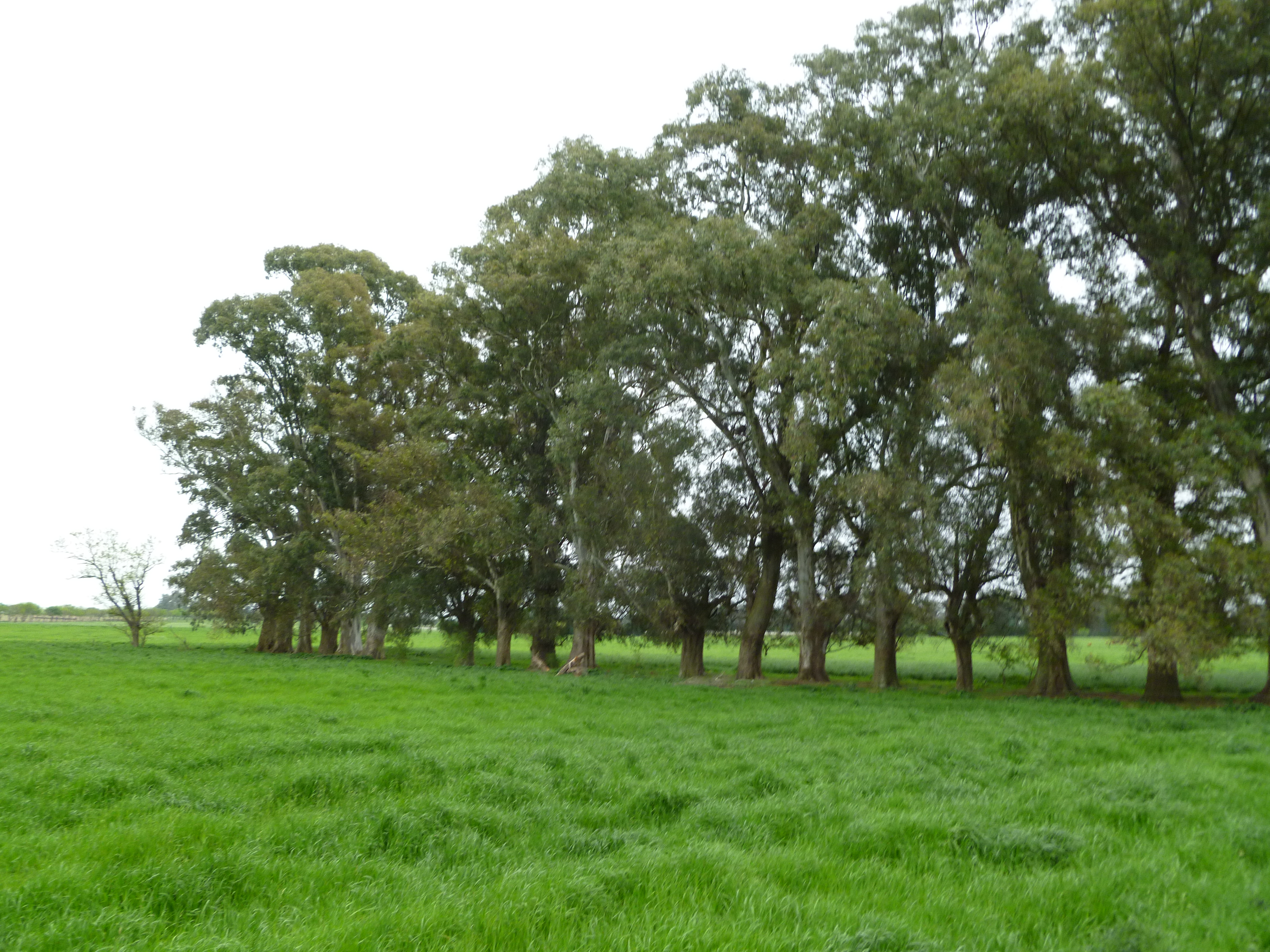
Much of Argentina is a treeless grassland prairie, called pampas. They imported eucalyptus to provide their economy with pulp. We observed many acres of densely growing eucalyptus forest throughout Argentina during our visit there. They also seemed to be used on the perimeter of agricultural lands, presumably as windbreaks.
Eucalypts used as agricultural windbreak, Argentina, 2010
We also saw many eucalypts growing in Sicily. We were told by our guides that they were planted by Mussolini in the 1930s as the means of draining swampland to reduce the population of malaria-carrying mosquitoes.
We found more eucalypts in Morocco where they also were being widely used as landscape trees. There seemed to be more diversity of eucalyptus species and they were obviously considered valuable for horticultural purposes. We also saw eucalypts sheltering agricultural crops from the wind.
Eucalypts are obviously considered valuable trees in many countries all over the world. We marvel at the hatred they have generated in California.
More evidence of the biodiversity of the eucalyptus forest
Professor Robert Stebbins (Professor of Zoology and Emeritus Curator in Herpetology, Museum of Vertebrate Zoology, University of California, Berkeley) was hired to study the eucalyptus forest in Berkeley, California for the Nature Conservancy’s California Field Office. This is an excerpt from his report which was published in 1983. (It is available at wiki.bugwood.org)
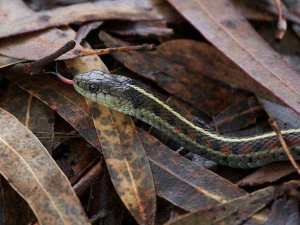
Garter snake in eucalyptus leaf litter. Courtesy urbanwildness.com
“Contrary to popular belief, many animals, both vertebrates and invertebrates, have adapted to life in the Eucalyptus groves. Moisture from the air condenses on the leaves and the drippage keeps the groves moist and cool even during the dry season. This is a suitable ground habitat for a wide variety of animal life. Amphibians such as arboreal salamander, California slender salamander, ENSATINA, California newt, rough skinned newt, and Pacific tree frog live in the forest, primarily under fallen logs and duff. Amphibians feed on such invertebrates as millipedes, centipedes, sow bugs, COLLENBOLA, spiders and earthworms.
“Several snakes such as the ring-necked snake, rubber boa and sharp tailed snake have adapted to Eucalyptus groves. The ring-necked snake feeds on the California slender salamander, the rubber boa feeds on meadow mice, and the sharp tailed snake feeds strictly on slugs. Other common reptiles include the northern and southern alligator lizards, which live under fallen logs, and the western fence lizard and western skink, which live in the less densely forested groves.
“Over 100 species of birds use the trees either briefly or as a permanent habitat. The heavy-use birds feed on seeds by pecking the mature pods on trees or fallen pods; so they must wait for the pods to disintegrate or be crushed by cars. Among the birds that feed on seeds in the trees are: the chestnutback chickadee and the Oregon junco. Examples of birds that feed on ground seeds are the song sparrow, the fox sparrow, the brown towhee, and the mourning dove. Birds that take advantage of the nectar from blossoms either by drinking the nectar or by feeding on the insects that are attracted to the nectar include Allen’s hummingbird, Bullock’s oriole, redwinged blackbird, and blackheaded grosbeak. Birds that use the trees as nest sites include the brown creeper, which makes its nest under peeling shags of bark and feeds on trunk insects and spiders, the robin, the chickadee, the downy woodpecker, and the red shafted flicker. The downy woodpecker and the red shafted flicker peck into the trunk of dead or dying trees to form their nests. When these nests are abandoned, chickadees, Bewick wrens, house wrens and starlings move in. Downy woodpeckers use dead stubs to hammer out a rhythmic pattern to declare their territories.
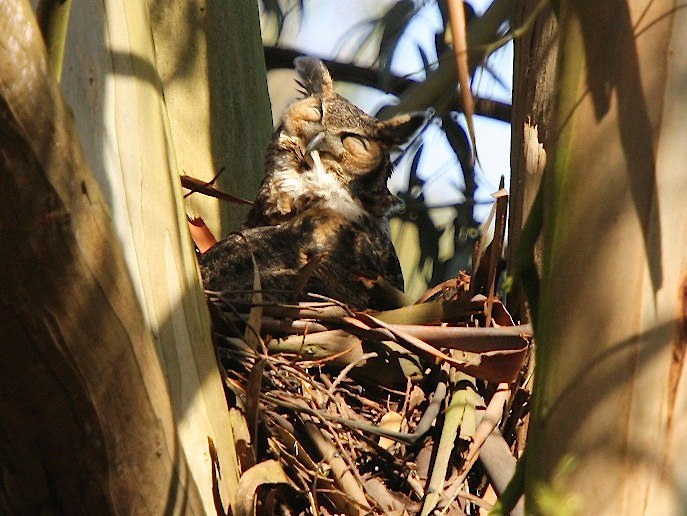
Owl nesting in eucalyptus, courtesy urbanwildness.com
“The red-tailed hawk prefers tall trees for a nesting site. It therefore favors eucalypts over trees such as oak or bay. Great horned owls use nests that have been abandoned by red-tail hawks or they nest on platforms formed between branches from fallen bark. The brown towhee and the golden crowned sparrow are birds that use piles of debris on the ground for shelter during rains.
“Several mammals have adapted to Eucalyptus. Deer find concealment in dense groves where there are suckers, coyote brush, and poison oak; moles live in the surface layer of the soil; meadow mice, gophers, and fox squirrels are found in the forest.
“A Eucalyptus grove is not a sterile environment. The population density of the animals mentioned can be partially attributed to the presence of eucalypts. With a program of cutting trees and burning debris, some animal residents will disappear because they have restricted home ranges or are sedentary. If an animal’s living area (leaf litter, logs, bark) and food supply are destroyed, the animal will either die or attempt to move to another area which is already fully occupied. ‘The wildlife section draws heavily upon conversations with Professor Robert Stebbins. No errors which may exist should be attributed to the professor.’”
Refusing to see the evidence
We stumbled upon this new information in the on-line comments on SFGATE (the San Francisco Chronicle’s website) on an article about the “tree wars of San Francisco.” (Available here) A defender of the forest was responding to the usual claims about the eucalyptus forest being a sterile environment. The defender of the forest was quickly attacked by a native plant advocate who called the commenter a “creepy imbecile.” The native plant advocate also attempted to discredit the source of information on the grounds that Professor Stebbins is apparently now dead. Obviously he was alive when he wrote his report, but the native plant advocate apparently believes that anything he wrote before he died is not credible. Or at least I think that was his/her “reasoning.” Oddly, another native plant advocate then chimed in, complaining that native plant advocates are being “demonized.” Wait! Who called whom a “creepy imbecile?”
Update: When we published this article we assumed that the native plant advocate who claimed that Professor Stebbins was dead at the time was correct about that. Since then we have learned that that was inaccurate information. Professor Stebbins died on September 23, 2013, according this obituary in the New York Times. So, the name-calling native plant advocate was fabricating “information” as well as engaging in ad hominem attacks. We are embarrassed that we assumed the native plant advocate was at least factually correct.
Unfortunately the name-calling comment has been removed from SFGATE which I suppose is consistent with their policy. However, it is a loss because it illustrated the low standards for civility and quality of information being used by native plant advocates to defend their destructive projects. (We are quoting from that comment only the portion for which evidence remains in replies to it.)
We saw these same low standards used by native plant advocates at the February 25, 2013 public hearing at UCSF about their plans to destroy the Sutro forest. There were only about 15 speakers in defense of the project, but their comments were devoid of information. One fellow walked to the microphone and said simply, “I hate eucalyptus” and walked away. Another claimed that the Angel Island fire of 2008 was evidence of the flammability of eucalyptus although 80 acres of eucalypts were destroyed over 12 years before that fire. Only 6 acres of eucalypts remain. The grass fire stopped at the edge of that small remaining stand of eucalypts.
One wonders where people find the energy to hate anything, let alone a tree. We struggle to understand the motivation of these crusaders against the forest. We believe that the most highly motivated amongst them are earning their living on these projects and are simply defending their economic interests. Nothing else makes sense to us.
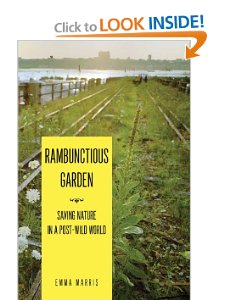
Professor Shapiro has written a review of Emma Marris’ Rambunctious Garden and given us permission to reprint it here. We share his high opinion of Ms. Marris’ book and we urge you to give it the careful read it deserves.
*************************
Rambunctious Garden: Saving Nature in a Post-Wild World by Emma Marris
Review by: Arthur M. Shapiro
The Quarterly Review of Biology, Vol. 88, No. 1 (March 2013), p. 45
Published by: The University of Chicago Press
Stable URL: http://www.jstor.org/stable/10.1086/669328
“Several years ago, I attended a seminar on the psychology of the animal-liberation movement. The speaker observed that although very few animal-lib activists were actually religious, most such people scored very highly on the “religiosity” scale in personality inventories. He suggested that animal liberation served the same functions for such people as religion did for many more: it gave life meaning and conferred a group identity centered on shared moral superiority over others. After years of interacting with “weed warriors”—people who spend their free time trying to eradicate “invasive species” from parks and public lands—I would advance the same hypothesis about most of them. They tend to be absolutely convinced of the righteousness of their cause and highly resistant to any suggestion that naturalized exotics might not be all bad. They also tend to be oblivious to the disconcerting degree to which their rhetoric converges to that of racists and xenophobes, and highly defensive if you point that out to them. After all, they are on the “green” side, right?
In the face of such popular enthusiasm for the alarmist viewpoint on exotics, Emma Marris, a professional science writer, has produced an eminently reasonable, well-researched, and engagingly written defense of the notion that human beings have changed the world and the most sensible way to deal with that is to manage it for the greatest good. She demonstrates very convincingly that communities and ecosystems have always been in flux as the physical world changes around them. The idea of freezing them at some arbitrary moment in time is as wrongheaded as it is impractical. Some naturalized exotics present serious threats to human beings or their support systems: we call them pests, pathogens, and vectors, and they are not what is at issue. Some are such radical ecological gamechangers that they need to be assessed with an eye to the full scope of their impacts (think cheatgrass in the desert and its impact on fire ecology). Most, however, are trivial, and in a world of limiting resources where we must assign priorities to our actions, they do not merit serious attention. But it is not merely a matter of using our management resources effectively. Much of our “invasive species” discourse simply ignores the evolutionary creativity consequent on community reorganization.
Yet we know both in theory and from the fossil record that precisely such creativity is essential for long-term survival in a changing physical context. Ecotypes or ecological races arise in response to novel challenges, both biotic and abiotic. The future of endangered species is likely to depend on such processes. Failure to appreciate this is the single biggest flaw in the “climatic envelope” or “niche modeling” approach to conservation biology. Much of California’s lowland butterfly fauna is now dependent on nonnative larval host plants. When I tell garden clubs—or public land managers—that successful eradication of invasive “weeds” would drive their beloved backyard butterflies to extinction, they stare at me in disbelief. But it is true and emblematic of the larger problem explored very well in this volume.
Shortly after Marris’s book appeared there was a flurry of articles in the professional literature advancing precisely the same ideas. Among the best are by Carroll (2011. Evolutionary Applications 4:184–199) and Thomas (2011. Trends in Ecology and Evolution 26:216 –221). But Marris got there first, and with luck her wise words will be read and acted upon far and wide.”
Arthur M. Shapiro, Center for Population Biology, University of California, Davis, California
 Conservation Sense and Nonsense