On November 19, 2015, a visitor to Mount Davidson park in San Francisco video recorded a pesticide application that is available here:
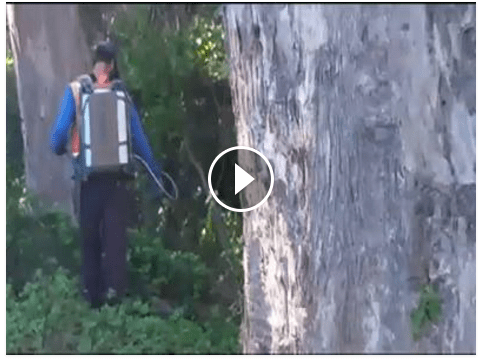
One of the people who saw that video reported several concerns regarding that pesticide application to the city employees who are responsible for the regulation of pesticide use in San Francisco. Here is the email he sent to Kevin Woolen in the Recreation and Park Department and Chris Geiger in the Department of the Environment:
To: Kevin Woolen kevin.woolen@sfgov.org
Dear Mr. Woolen,
I understand that you are responsible for the records of pesticide applications on properties managed by San Francisco’s Recreation and Park Department. I have heard you speak at public meetings, so I am aware that you have some expertise in that area. Therefore, I am writing to you about a pesticide application on Mt. Davidson on November 19, 2015. That pesticide application was recorded by this video: https://www.facebook.com/ForestAlliance/videos/934479473312166/?fref=nf
I have several concerns about this pesticide application:
- One of the herbicides that was sprayed was Stalker with the active ingredient imazapyr. I notice that most of the spraying was done around a tree, which was not a target of the application according to the posted Pesticide Application Notice. As you may know, imazapyr is not supposed to be sprayed under and around non-target trees according to the manufacturer’s label: http://www.cdms.net/ldat/ld01R013.pdf: “Injury or loss of desirable trees or other plants may result if Stalker is applied on or near desirable trees or other plants, on areas where their roots extend, or in locations where the treated soil may be washed or moved into contact with their roots”
Here is a newspaper article about unintentional damage done to trees by spraying an imazapyr herbicide beneath them: http://www.mlive.com/news/grand-rapids/index.ssf/2012/09/no_quick_fix_for_herbicide_dam.html
- The Pesticide Application Notice says that the application method will be “spot treatment/daub cut stem.” This does not seem to be an accurate description of the application method on November 19th. It seems that “backpack sprayer” would be a more accurate description of this particular pesticide application.
- The Pesticide Application Notice says that Himalayan blackberries were one of the targets of this Pesticide Application. As you know, birds and other wildlife cannot read the signs that are posted to warn the public about these applications. Can you assure me that the Himalayan blackberries were no longer fruiting? Does the Recreation and Park Department have a policy against spraying vegetation when there are fruits eaten by birds and other wildlife? If not, would the Recreation and Park Department consider adopting such a policy?
- Although Garlon was not used in this particular pesticide application, it is often used in San Francisco’s so-called “natural areas.” Therefore, it is worth mentioning that Garlon is also known to be mobile in the soil and there are documented incidents of it damaging non-target trees when it has been sprayed on the stumps of nearby trees after they were destroyed.
Thank you for your consideration. I hope you will share my concerns with the staff and contractors who are engaged in these pesticide applications.
Cc: Chris Geiger chris.geiger@sfgov.org
This is not an isolated incident. Park visitors in San Francisco have been complaining for years about pesticide use in parks that were designated as “natural areas” over 15 years ago. Ironically, those areas were never sprayed with pesticides before being designated as “natural areas.” In fact, they really were natural areas prior to being officially designated as such. Plants and animals lived in peace in those places before being “managed” by people who are committed to eradicating all non-native plants in many of San Francisco’s parks.
What can you do about it?
If you are opposed to pesticide use in San Francisco, or you object to the pointless destruction of harmless plants that are useful to wildlife, here are a few things you can do to express your opinion and influence the public policy that allows pesticide use in the public parks of San Francisco:
- You can join over 11,000 people who have signed a petition to prohibit the use of pesticides in public parks. The petition is HERE. The San Francisco Chronicle reported on pesticide use in San Francisco’s parks and the petition against that use. (Available HERE)
- You can sign up HERE to be notified of the annual meeting in which pesticide policy in San Francisco is discussed for subsequent approval by the Environment Commission. That meeting has been scheduled in December in past years. Update: The annual meeting has been announced. “Annual Public Hearing on Pest Management Activities on City Properties and San Francisco’s Draft 2016 Reduced-Risk Pesticide List 4:30-7:00 pm
Wednesday, December 16, 2015 Downstairs Conference Room, 1455 Market St. (near 11th St.; Van Ness MUNI stop)” The meeting agenda is available HERE. - You can apply for one of the two vacant seats on the Environment Commission. These seats have been vacant for nearly a year. In the past, the Environment Commission has actively promoted pesticide use in San Francisco’s “natural areas.” Qualifications and duties of commissioners are available HERE.
- Appointments to the Environment Commission are made by Mayor Ed Lee. If you don’t want to serve on the Environment Commission, you can write to Mayor Lee (mayoredwinlee@sfgov.org) and ask him to appoint people to the Commission who do not support the use of pesticides in San Francisco’s public parks.
The parks of San Francisco belong to the people of San Francisco. They have paid to acquire those properties for public use and they are paying the salaries of those who are “managing” the parks. If you don’t like how parks are being managed, you have the right to express your opinion. Our democracy works best when we participate in the public policy decisions that affect us.
What does this have to do with the East Bay?
Our readers in the East Bay might wonder what this incident has to do with you. Parks in the East Bay are also being sprayed with herbicides for the same reasons. HERE are reports of pesticide use by the East Bay Regional Park District.
Many of the pesticide applications on the properties of EBRPD are done by the same company that sprayed herbicides on Mount Davidson on November 19, 2015. That company is Shelterbelt Builders. You can see their trucks in the above video. Pesticide use reports of San Francisco’s Recreation and Park Department often report that pesticide applications were done by Shelterbelt.

Shelterbelt Builders is based in the East Bay. One of its owners is Bill McClung who is a member of the Claremont Canyon Conservancy and a former officer of that organization. The Claremont Canyon Conservancy is the organization that is demanding the eradication of all non-native trees on public land in the East Bay Hills. Here is a description of Mr. McClung’s responsibilities on Shelterbelt’s website:
“Bill McClung joined Shelterbelt in 1997 to help refocus Shelterbelt on native plant restoration and open land management/fire safety. After his house burnt down in the 1991 Oakland Fire, this former book publisher became interested in how wildland and fire are managed in the East Bay Hills. He became a member of the Berkeley Fire Commission in 1994 and has a strong interest in the vegetation prescriptions of the Fire Hazard Program & Fuel Reduction Management Plan for the East Bay Hills issued in 1995 by the East Bay Hills Vegetation Management Consortium and the East Bay Regional Park District Wildfire Hazard Reduction and Resource Management Plan Environmental Impact Report of 2009/10. He has managed many properties in the East Bay where wildfire safety and native habitat preservation are twin goals, and continues to work on interesting and biologically rich lands in the Oakland Hills.”
Claremont Canyon Conservancy
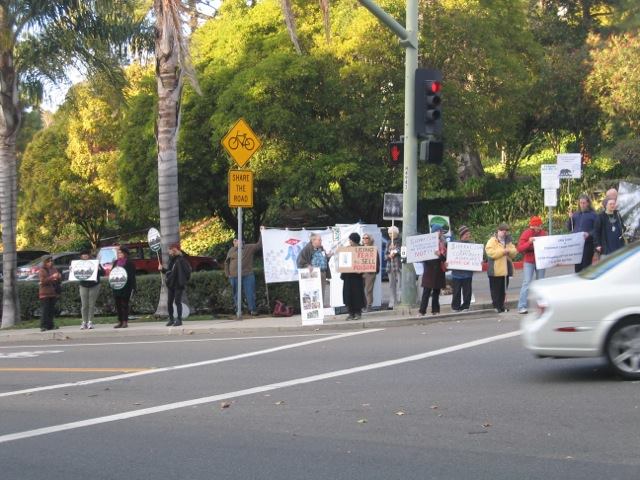
The Claremont Canyon Conservancy held their annual meeting on November 15, 2015. Oakland’s Mayor, Libby Schaaf, was one of the speakers. Although she took questions at the end of her presentation, one of the officers of the Conservancy called on the questioners. There were many people in the audience who are opposed to the FEMA projects that will destroy over 400,000 trees in the East Bay Hills and many of us tried to ask questions. With one exception, the person controlling the questions only called on known, strong supporters of the FEMA project. Therefore, those who wished to express their opposition to the FEMA projects to the Mayor were denied that opportunity. Fortunately, there were many demonstrators outside the meeting who could not be denied that opportunity.
Norman LaForce was the other main speaker at the meeting. He is an elected officer of the Sierra Club and he identified himself as one of the primary authors of the project to destroy all non-native trees in the East Bay Hills. (An audio recording of his complete presentation is available here: ) This is the paraphrased portion of his presentation specifically about the herbicides that will be used by the FEMA project:
“Part of the FEMA program will be to use herbicides in a concentrated, careful program of painting or spraying herbicides to prevent the trees from resprouting. It may need to be done more than once but ultimately the suckers give up. There is no other way to do that cost effectively.
People are saying that glyphosate causes cancer. Radiation causes cancer but when people get cancer they are often treated with radiation. Nobody tells them they can’t have radiation because it causes cancer.
There are a lot of people of a certain age in this room who are probably taking Coumadin as a blood thinner for a heart condition. Coumadin is rat poison. Nobody tells them they can’t take Coumadin.*
You must take dosage and exposure into consideration in evaluating the risks of pesticides.
Nature Conservancy used glyphosate on the Jepson Prairie.
State Parks used Garlon on Angel Island when they removed eucalyptus.
The European Union says that glyphosate does not cause cancer, so I don’t know if it does. I’m not going to take a position on that.
Now they are saying that red meat causes cancer.
We need to put aside the question of pesticides. They will be used properly. We must proceed in a scientific manner.”
We leave it to our readers to interpret Mr. LaForce’s justification for pesticide use. He seems to be suggesting that pesticides are good for our health. There are instances in which pesticides do more good than harm, but using them to kill harmless plants in public parks isn’t one of them, in our opinion. Since many chemicals accumulate in our bodies throughout our lives, it is in our interests to avoid exposure when we can. If we must take Coumadin for our health, that’s all the more reason why we should avoid unnecessary exposure to rat poison when we can.
Connecting the dots
We have tried to connect the dots for our readers. Here are the implications of what we are reporting today:
- Pesticide applications in San Francisco are probably damaging the trees that are not the target of those applications. The food of wildlife may be poisoned by those pesticide applications.
- You can influence the public policy that is permitting pesticide use in San Francisco.
- The same company that is spraying pesticides in San Francisco is also doing so in the East Bay.
- That company is also actively engaged in the attempt to transform the landscape in the San Francisco Bay Area to native plants. They have an economic interest in native plant “restorations.”
- The Sierra Club is actively promoting the use of pesticides on our public lands.
*Coumadin is prescribed for people who are at risk of heart attack or stroke caused by blood clots. Coumadin thins the blood and suppresses blood coagulation. Rat poison kills animals by bleeding them to death. There is a fine line between preventing blood clots and bleeding to death. Therefore, people who take Coumadin have frequent blood tests to check that the dosage is at the optimal level. Rat poisons are killing many animals that are not the target of the poison. Animals such as owls, hawks, vultures are often killed by eating dead rodents that have been poisoned. We should not conclude that rat poison is harmless because humans are using it in carefully controlled doses. Herbicides being sprayed in our public lands are not being closely monitored as Coumadin use is.


 Conservation Sense and Nonsense