InfoWar: UC Berkeley bombards us with propaganda against trees

First we must recapitulate the long history of UC Berkeley’s destruction of non-native trees on its property.

UC Berkeley (UCB) started destroying non-native trees on its property in the East Bay hills in 2000 and continued destroying trees until 2005, when it applied for FEMA grant funding to complete the destruction of all non-native trees.  UCB published detailed reports of its first phase of tree destruction, which reported the destruction of about 18,000 trees on 150 acres on Panoramic Hill, Claremont Canyon, Frowning Ridge, Chaparral Hill, and Lower Strawberry Canyon.

UCB completed the first phase without completing an Environmental Impact Report, which is what enabled it to avoid informing the public in advance of the destruction.  When UCB applied for FEMA funding it expected to be able to continue those projects without completing an environmental impact report. UCB’s FEMA grant application proposed to destroy 54,000 trees on 284 acres in Strawberry and Claremont canyons and Frowning Ridge. But the public was now alerted to UCB’s intentions and objected to the project being done without environmental review.  After completing the Environmental Impact Statement required by federal law, the FEMA grant to UCB was cancelled after a successful legal challenge of the project. 

UCB tried to implement its plans with its own funding without completing an Environmental Impact Report, as required by California State law.  Again, they lost a legal challenge that prohibits it from implementing its plans without an EIR. 

UCB’s most recent demonstration of its continued commitment to destroying all non-native trees on its property was a legal complaint filed in June 2017, which demands that FEMA reinstate the grants that were cancelled about one year ago.  At the same time, UCB has launched a new public relations effort to convince the public to support its projects.  In this post we will take a closer look at UCB’s recent round of propaganda.

New “informational” signs in Strawberry Canyon

We learned of new “informational” signs along the fire trail in Strawberry Canyon in July 2017, but we don’t know precisely when they were installed.  Those who often visit Strawberry Canyon tell us the signs are recent. This sign about “biodiversity” is an example of the message UCB is sending to the public.

Many of the statements on this sign are inaccurate:

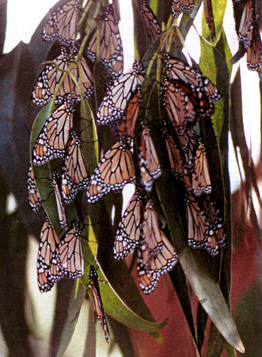
  • Monarch butterflies roosting in eucalyptus tree.

    The sign claims that native plants “provide food and habitat for native wildlife” but that non-native plants “provide food and habitat for other non-native species.” Neither of these statements is accurate.  If a native plant provides food and habitat for native wildlife, it also provides both to non-native wildlife.  Conversely, if a non-native plant provides food and habitat for non-native wildlife, it also provides both to native wildlife. The notion that wildlife makes such distinctions is ridiculous.  Wildlife does not know or care what humans consider native or non-native.  If the plant is edible, it is food.  If the plant provides cover, it is useful habitat.

  • The sign also claims that the roots of native plants are deep, but the roots of non-native plants are shallow. These are equally ridiculous statements.  The depth of roots may vary, but that variation is completely unrelated to whether or not the plant is native.

Tree roots

Nativists often claim that the roots of eucalyptus trees are shallow (except when they claim they are very deep in order to make the opposite case that they use more water than other tree species).  So, we will digress briefly to provide some information about tree roots from a reputable, scientific source.

According to a study of tree roots by Harvard’s forestry research institution, Arnold Arboretum, (1) tree roots vary little by species.  The configuration of tree roots varies somewhat over the life of trees.  Early in their life, trees often have a deep tap root, but the tap root is slowly replaced by a wide, lateral network of fine roots around the perimeter of the tree, usually far wider than the tree canopy.  To the extent that the root system varies, it is more a reflection of soil conditions.  If the soil is very compact or the tree is planted in a rock or concrete basin, the width of the root system will be physically constrained.  If the tree is unstable in the ground, it is usually because of where it has been planted.

UC Alumni Magazine gins up fire hysteria

 In June 2017, the UC alumni magazine published an article in defense of its plans to destroy all non-native trees in the East Bay hills.  (Available here: UC Alumni Mag – Glen Martin interviews Scott Stephens)  Curiously, this article appeared in an edition devoted to climate change and adaptation to the changing climate.  You might think that concern about climate change would predict a greater respect for our urban forest, which stores the carbon that will contribute to greenhouse gases when the trees are destroyed.  Again, don’t look for consistency in the nativist viewpoint.  You won’t find it.

Here are a few of the absurd statements made in the article in the alumni magazine:

  • The article claims that the 150 acres where UCB destroyed trees over 15 years ago are now covered in native trees and shrubs that “came in” on their own when the trees were destroyed. All of these areas are easily visited and observed.  They are occupied by non-native weeds and piles of wood chips.  Here is a picture of one of those areas taken on August 6, 2017.
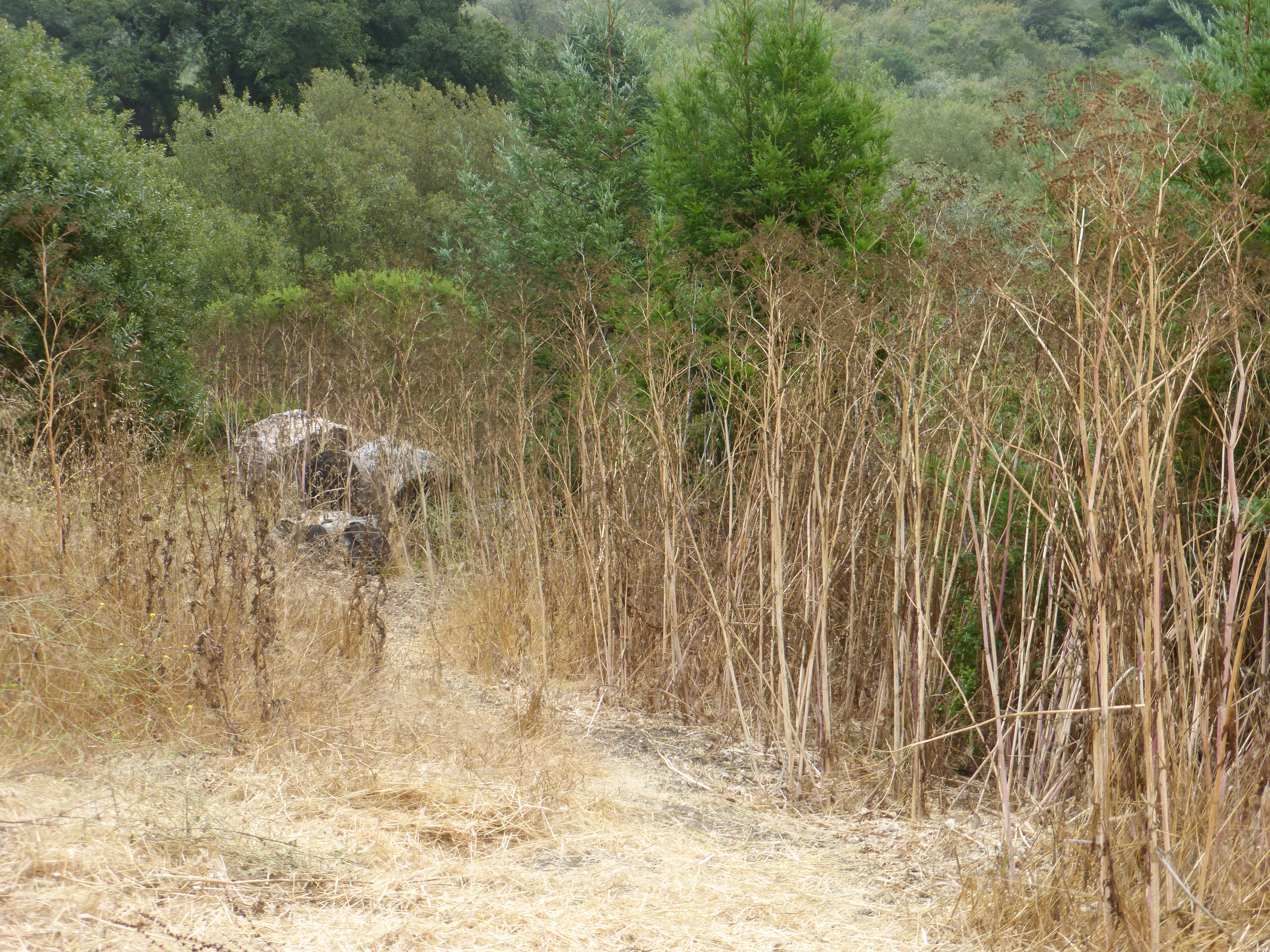
Site 29. The tall, dry weeds are the remains of poison hemlock that dominates this site where eucalyptus was destroyed by UCB. Shade is lost when trees are destroyed and weeds thrive in the full sun. The weeds dry out during dry summer months and become fuel for summer fires.
  • The article repeats the ridiculous claim that eucalypts are called “gasoline trees” in Australia. The word “gasoline” is not used in Australia.  As in all British Commonwealth nations, what we call gasoline is called petrol.  Calling eucalyptus trees “gasoline trees” is an American rhetorical device.  A native plant advocate probably made it up, then it was shared in their closed community until it became a “fact” in their minds.  It is a means of generating fear.  It is a tool used by native plant advocates to support their demand to destroy all non-native trees in California.
  • The article describes the huge die off of native conifers in California, caused by climate change and related infestation of native bark beetles and it predicts that they will be replaced by different species of trees that are adapted to present climate conditions. These observations are made with no apparent understanding of how it contradicts UCB’s strategy here in the Bay Area.  If the climate is changing in California and its landscape must change along with it, why is UCB trying to install the landscape that existed here 250 years ago?

UCB’s latest propaganda installment

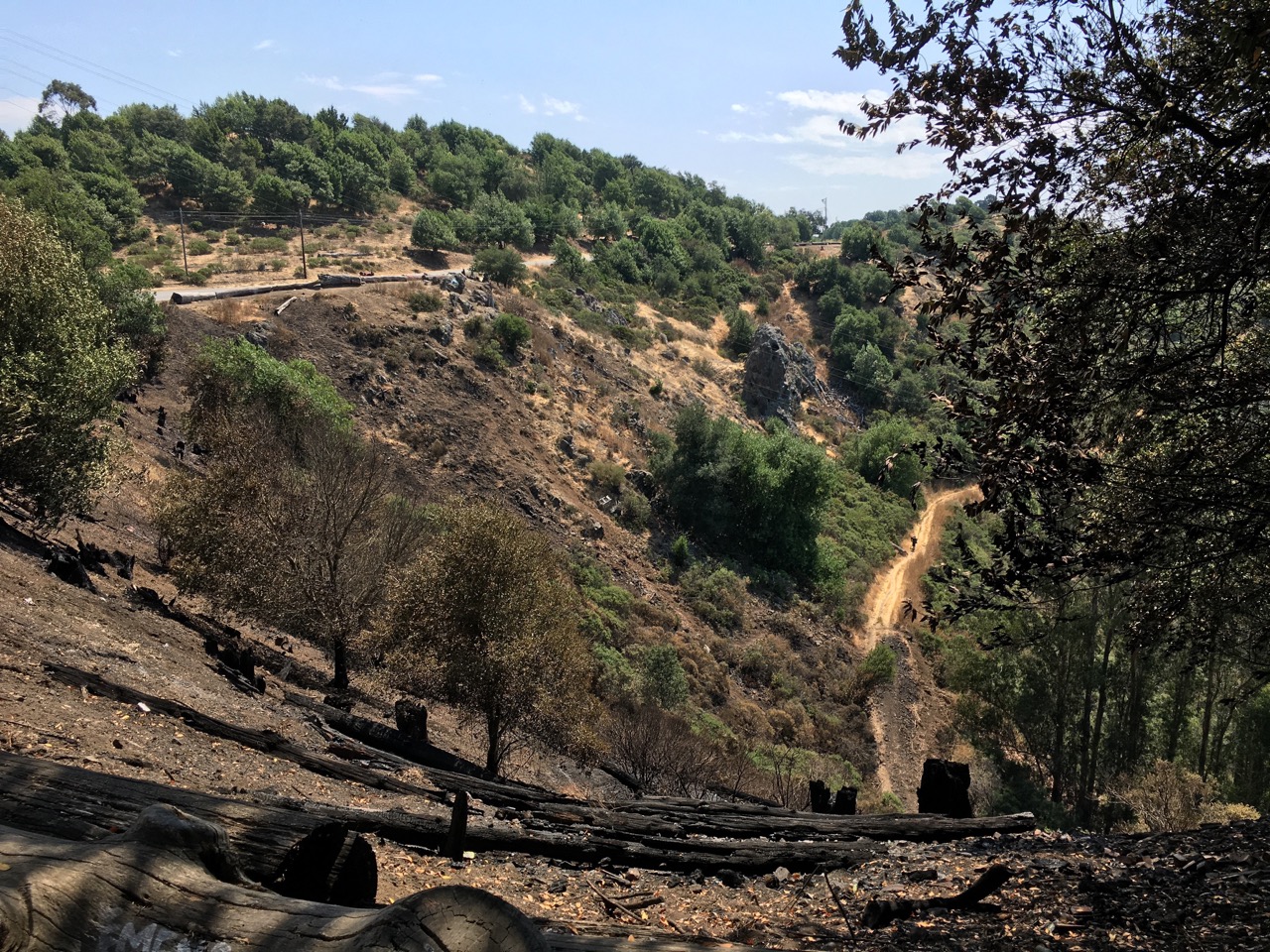
The recent fire in the East Bay Hills was another opportunity for UCB to gin up the fear machine against non-native trees.  The fire started on Grizzly Peak Blvd where UC Berkeley destroyed 1,900 eucalyptus trees on 11 acres in 2004.  When the trees were destroyed, the ground was quickly colonized by non-native annual grasses and the road was lined with the trunks of the trees they had destroyed.  The dried grass and the dead logs were the fuel of the fire that started on August 2, 2017.  The fire was stopped when it crossed the road into the eucalyptus forest in Tilden Park.

This area on the west side of Grizzly Peak is known as Frowning Ridge. It is one of the first areas that was clear-cut by UC Berkeley over 10 years ago. Destroying the trees did not prevent the grass and shrubs from igniting in the August 2017 fire. Pictures of that area before and after the trees were destroyed are available here: https://milliontrees.me/2013/06/08/guest-article-about-fema-projects-by-a-student-of-the-forest/

UCB now writes in its alumni magazine that there was no major damage to property and no loss of life because of UC’s “fuels management program” that destroyed the trees.  The fire risk to life and property was increased by the “fuels management program,” as facts on the ground tell us.  Scott Stephens, speaking for UCB, speculates that the fire “would have thrown embers miles ahead, starting hundreds of spot fires that would also burn explosively and merge.  That’s what happened in 1991.”

In fact, that’s NOT what happened in 1991.  The only source of embers identified by the FEMA Technical Report on the 1991 fire was “brush.”  That report also says the maximum distance of the fire spread was less than 3 miles, so if embers started spot fires, they did not travel many miles.

A study by US Forest Service of embers starting spot fires during wildfires all over the world included the 1991 fire.  The only known ember reported in the ‘91 fire was a wooden shingle from one of the homes that burned.  That study said of urban fires in California, “In the wildland-urban interface fires in California—Berkeley in 1923, Bel-Air in 1961, Oakland 1991—wooden shingles which were popular in California as roof material, assisted fire spread. Wooden shingles increase fire hazard owing to both ease of ignition and subsequent firebrand production.” (2)

But here is the kicker to this rewriting of fire history by Scott Stephens.  Less than a month ago, Stephens was interviewed about the many wildfires in California this year.  He blamed the wildfires on the heavy rains that produced a lot of grass and he said forests are less likely to burn: “UC Berkeley Fire Science Professor Scott Stephens says most of the fires so far have been in grassland areas that were revived from the rain, then dried out early during triple-digit heat waves… He says forests are better at retaining moisture and the Sierra will be more resilient this year because of the rains.” 

Stephens knows what is causing wildfires in California, but he chooses to misrepresent the fire in the East Bay Hills last week, presumably in the service of UCB’s desire to destroy our urban forest.  Perhaps it is naïve of me to expect more from a faculty member at California’s most prestigious research and educational institution.  But I find it disappointing.

Please join Million Trees in rejecting fear as the maker of public policy.  Be suspicious when you are asked to be afraid of something.  Are you being manipulated?  Do the fear mongers have ulterior motives? 


  1. Thomas O. Perry, “Tree Roots:  Facts and Fallacies,” Arnold Arboretum, Harvard University
  2. Eunmo Koo, et. al., “Firebrands and spotting ignition in large-scale fires,” International Journal of Wildland Fire, 2010, 19, 818-843
Fire in the East Bay Hills, August 2017

On Wednesday, August 2, 2017, a fire started in the Berkeley/Oakland hills in the San Francisco Bay Area.  This is an area with a history of catastrophic wildfires and so the media and the public paid close attention to the fire as firefighters fought to contain it. 

The East Bay Times reported that the fire began on Grizzly Park Blvd near mileage sign marker 14 and spread to 20 acres until it was contained late Friday, August 4, 2017. 

Dan Grassetti, the President of the Board of Directors of Hills Conservation Network, monitored the fire while it was in progress and when the road was opened again, he wrote the following report about the fire and what we can learn from it.  We are grateful to Dan for the photos he took and for sharing his observations about the fire.

The Hills Conservation Network is a 501C3 non-profit which advocates for fire safety in the East Bay.  Visit their website to see how they advocate for reducing fire hazards without clear cutting trees and using pesticides.  

Million Trees


I was able to tour the site today and took some photos. The fire was split between an area that had previously been treated [by removing all eucalyptus] by UC and an adjacent area that still had some eucalyptus. The fire took out all the ground fuels, including the dead tree carcasses [logs] that Tom Klatt [of UC Berkeley] had left there from years ago. Apparently what the experts tell us about live trees not being fuel while dead trees being fuel is true! [Despite what Tom Klatt tells us about UC’s projects, which leave the logs on the ground.]

This area on the west side of Grizzly Peak is known as Frowning Ridge. It is one of the first areas that was clear-cut by UC Berkeley over 10 years ago. Destroying the trees did not prevent the grass and shrubs from igniting in the August 2017 fire. Pictures of that area before and after the trees were destroyed are available here: https://milliontrees.me/2013/06/08/guest-article-about-fema-projects-by-a-student-of-the-forest/
When UCB destroys trees, they leave the logs lying on the ground. Note that some of those logs burned in the August 2017 fire.

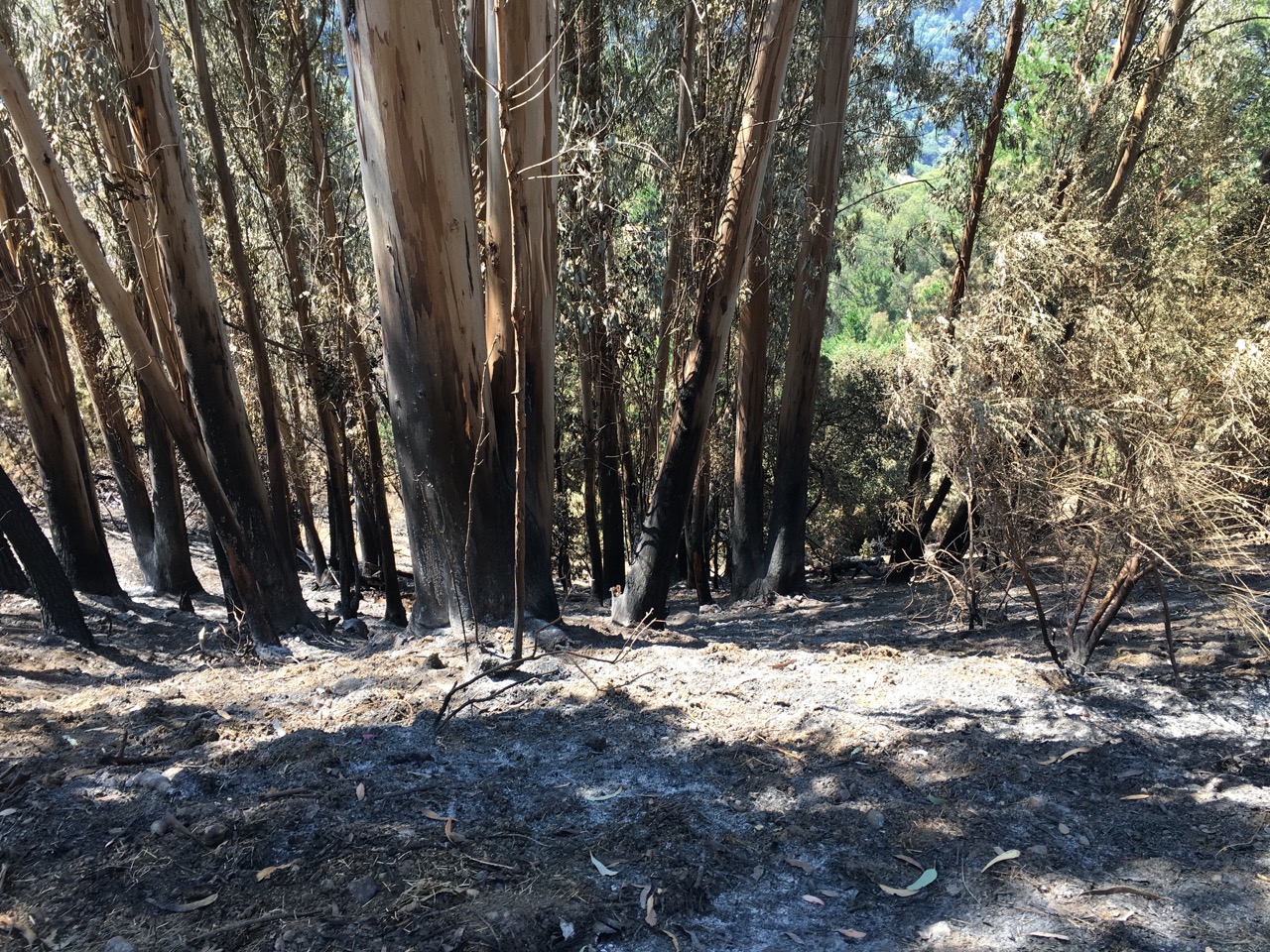
You will note that the fire burned under a number of trees, including Monterey pines and eucalyptus without igniting them. This is the same pattern we have seen in every fire site we’ve walked since the ’91 disaster.

On the east side of Grizzly Peak where eucalypts are still standing, the fire burned the understory and scorched the trunks of the trees, but did not ignite the trees. We have seen that pattern several times in past fires since 1991.

The lessons seem clear. Roadside party sites attract folks who start fires. If you’re going to have these zones you pretty much have to create a vegetation free zone a goodly distance from these sites. What burns in a wild land fire are the ground level fine fuels. Tall trees provide shade which tends to lessen the amount of ground level fine fuels.

Dan Grassetti, Hills Conservation Network

August 5, 2017


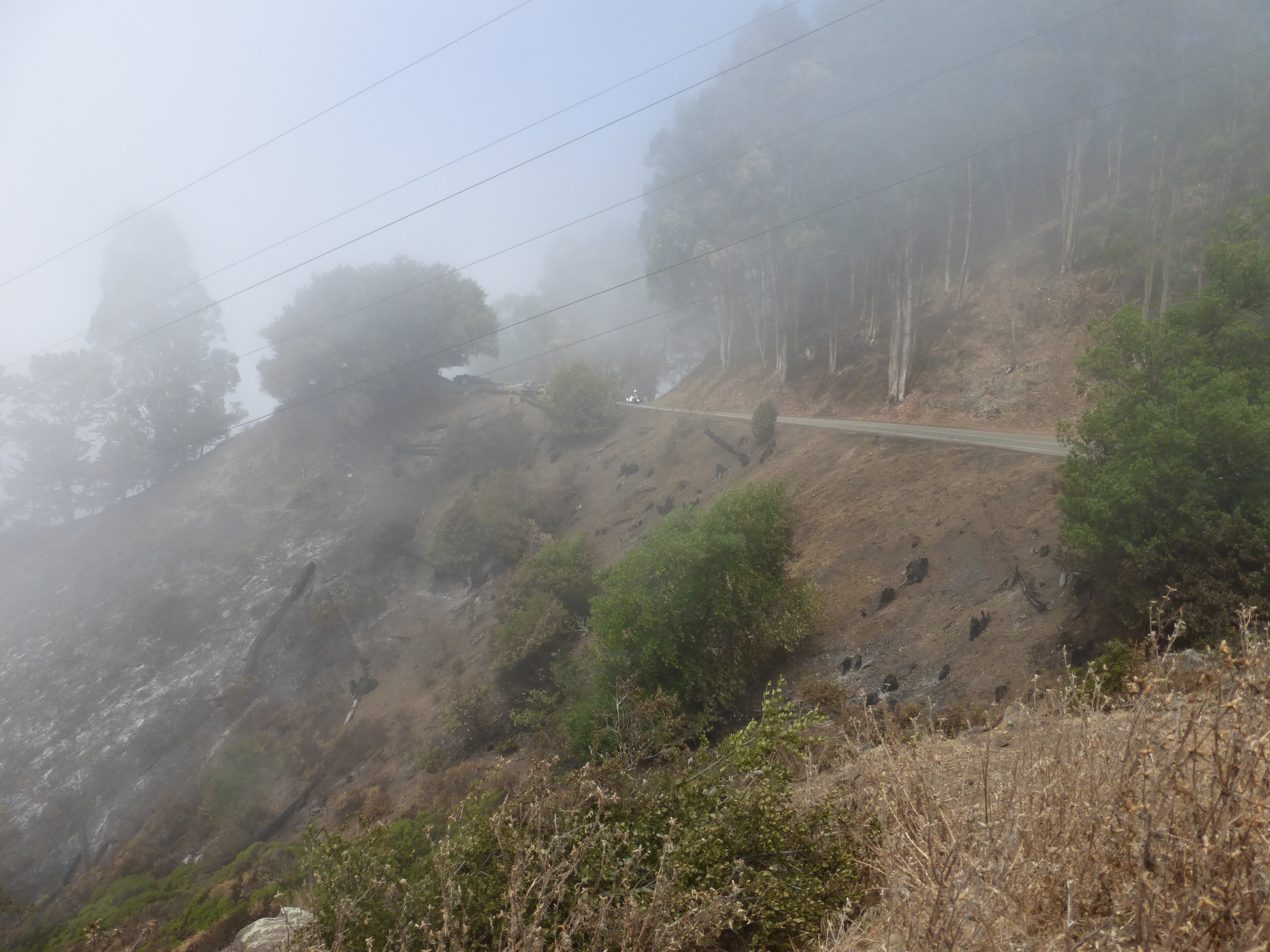
Addendum:  It’s foggy in the East Bay Hills today, August 6, 2017.  At midday, Frowning Ridge is barely visible through the fog. 


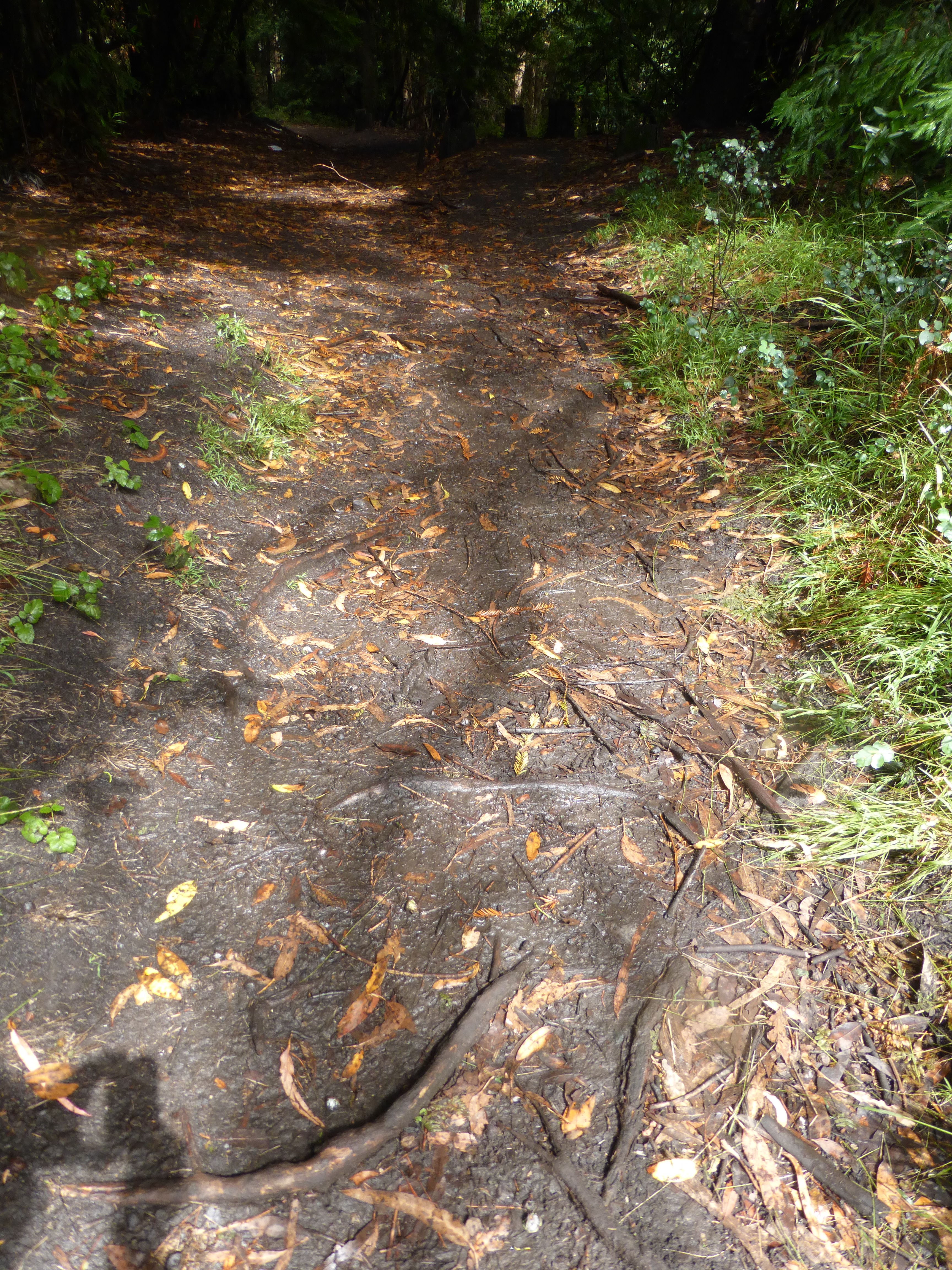
 Across the road, in Tilden Park, the trail is muddy under the trees that are dripping the fog from above.   The moist ground prevents fires from igniting and spreading.


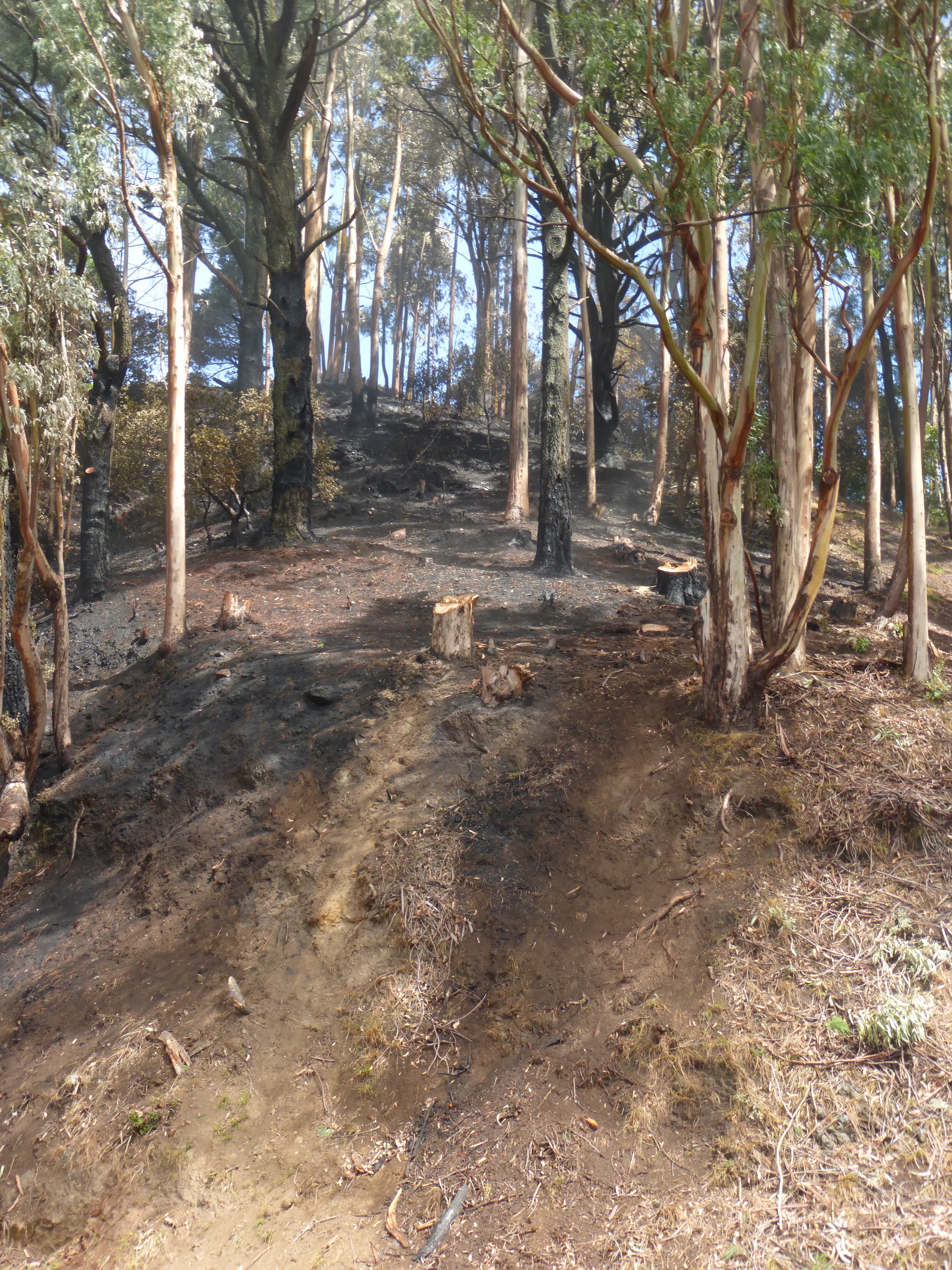
A few trees were cut down by fire fighters on the east side of Grizzly Peak, in Tilden Park.  Their stumps are visible.


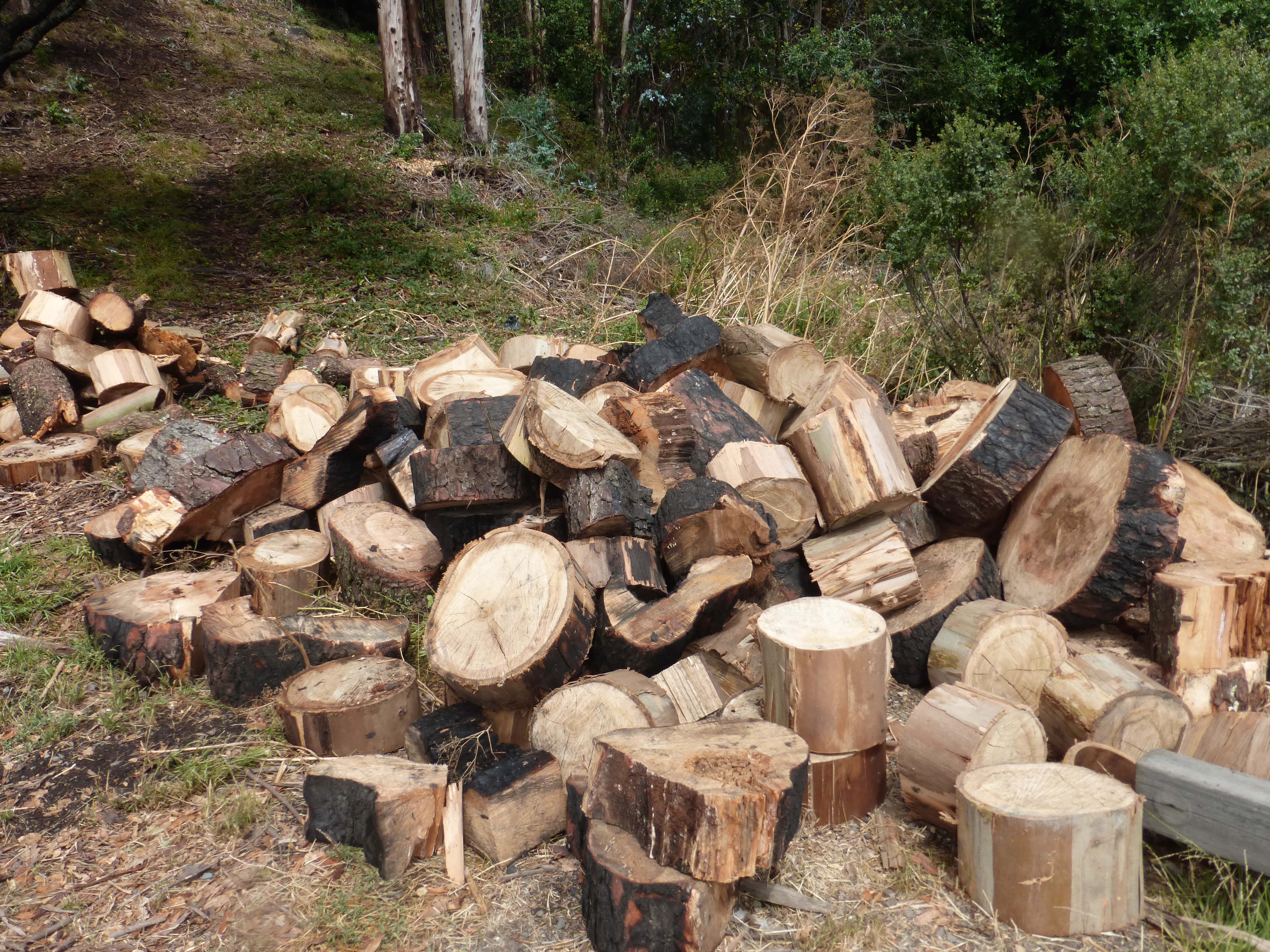
The trees that were cut down have been cut into pieces and stacked beside the road.  You can see that the bark of trees is charred by the fire in places, but the heart of the tree did not burn.


Million Trees

Tamarisk beetle: A case study in the dangers of biological controls to eradicate non-native species

Our readers were introduced to Matt Chew in his guest post about the economic interests of ecological “restorations.”  Dr. Chew is a faculty member of Arizona State University’s Center for Biology and Society and an instructor in the ASU School of Life Sciences. 

The most recent newsletter (see page 8) of the California Invasive Plant Council (Cal-IPC) informed us that the beetle that was introduced in Arizona to eradicate tamarisk has spread to California, where it was not introduced.  When the beetle was originally introduced, its spread beyond where it was introduced was not predicted, based on climatic restrictions on its life cycle.  As usual, evolution overturns the best laid plans.  According to Cal-IPC, Rapid evolution in this developmental trait, however, allowed beetles to stay active later in the season and thus facilitated their expansion southward…”   

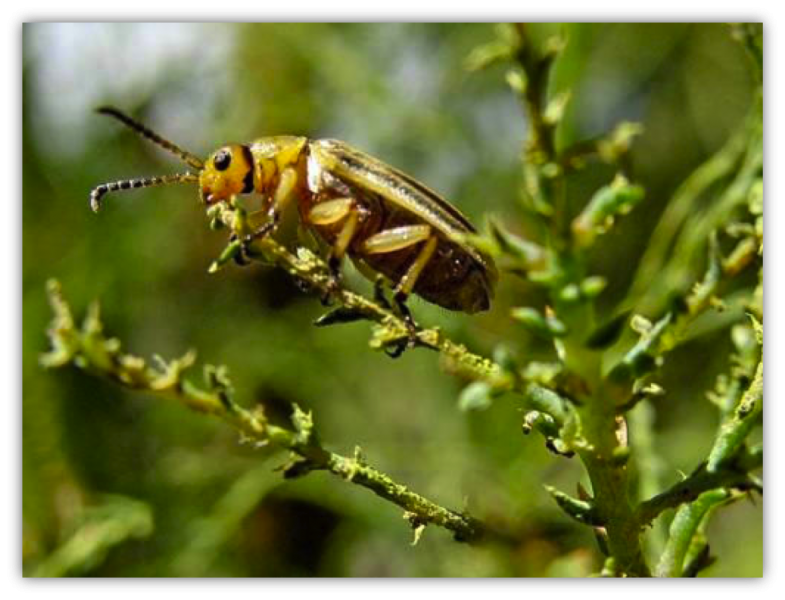
Tamarisk defoliated by tamarisk leaf beetle along Colorado River, near Needles, California

The rapid defoliation of tamarisk throughout the southwest, including California, is an immediate threat to the endangered Southwestern willow flycatcher, which long ago adapted to tamarisk in the absence of its native host, willow.  The native willow requires a great deal more water than tamarisk. Therefore, willow died off when water throughout the southwest was diverted out of riparian corridors for human consumption and agricultural production.

Dr. Chew is an expert on tamarisk and the role it plays in the ecosystems of the southwest and so we asked him to write another guest post for us on this topic.  He has generously obliged with this detailed history of biocontrols and their use to eradicate non-native species. 

Biocontrols are also topical because a new biocontrol was recently approved by the USDA to eradicate cape ivy.  This biocontrol was eagerly anticipated by native plant advocates and is likely to be widely used by land managers in California.  Therefore, this is a timely opportunity to learn about the pros and cons of biocontrols.  How long will it take the introduced insect to start feeding on the many other species of ivy that are not considered “invasive?”

Evolution and natural selection are wild cards in attempts to eradicate non-native plants and animals.  Although there are many dangerous consequences of using pesticides, the role that evolution plays in rendering pesticides useless is less understood and taken into consideration.  Much like the hungry beetle that now is running rampant in the southwest, the weeds that are continuously sprayed with herbicide are also adapting and evolving defenses against the chemicals being used to eradicate them.  There are now millions of acres of agricultural crop land infested by weeds that are immune to the pesticides that were sprayed on them for decades.  Our pesticides are now useless on these “superweeds.” Instead of getting off the pesticide treadmill, we are developing stronger—and therefore more toxic—herbicides.

There are many reasons why we object to the eradication of non-native plants and animals.  The tamarisk beetle is an example that illustrates a few of our objections:

  • Many of the plants being eradicated are providing food and habitat for animals. The animals that depend upon them are being harmed by their elimination.
  • The methods used to eradicate non-native species often have unintended, negative consequences, such as breeding “superweeds” that cannot be eradicated.
  • The puny tools of humans are often powerless against the much stronger forces of nature, such as natural selection and evolution. These forces of nature should be treated with greater respect, particularly by people who call themselves “scientists.”

Million Trees


Southwestern willow flycatcher

From California to Texas and occasionally beyond, tamarisks are among the most talked-about introduced plants in the US. Most of that discussion consists of familiar anti-alien dogma, augmented by the long-obsolete assertion that tamarisks are profligate water-guzzlers. Suffice for now to say that anti-tamarisk sentiment led to state and federal suppression policies beginning around 1940, and eventually to legislation at both levels. Little more than accumulated bad reputation of tamarisk and its presence in the region of interest led the US Fish and Wildlife Service to include tamarisks among the supposed threats to the persistence of the Southwestern Willow Flycatcher (Empidonax traillii extimus) when that subspecies was formally listed “endangered” in 1993. All of that meant both political will and appropriations were applied to the US Department of Agriculture’s search for biological control agents to deploy as “counter-pests” against tamarisks. By 1998 they had their critter, an Asian leaf-eating beetle that putatively specialized on tamarisks and would rather die than eat anything else.

By that time, though, circumspection had set in, because especially in southern Arizona the endangered birds had taken to nesting in tamarisk stands. USDA promised USFWS that their armored foreign legion would not jeopardize flycatcher populations. USDA argued that the beetles they were about to propagate and release by the multi-millions were genetically incapable of surviving below 38° North latitude. In addition to famously dividing North from South Korea, that frontier runs from near the tip of Point Reyes through Stockton and Mono Lake; just south of Tonopah, Nevada; south of Canyonlands Nation Park; through Moffat and Swink, Colorado; on through the Garden City Kansas and increasingly irrelevant points east. Southern Arizona would surely never see a tamarisk leaf beetle. “Because SCIENCE!” Hold that thought.

In 1952 the otherwise obscure and perhaps pseudonymous writer Rose Bonne copyrighted a succinct cautionary account of biological pest control. Perhaps it was read or sung or shown to you as a child: I know an Old Lady [who swallowed a fly].  Ms. Bonne denied knowing how or why the old lady swallowed the fly, but considered it portentous: “Perhaps she’ll die!” Subsequent actions had definite (if sometimes puzzling) rationales. The next four animals consumed represented a hopeful trophic cascade: the Old Lady swallowed a spider to catch the fly, then a bird to catch the spider, a cat to catch the bird and a dog to catch the cat. At that point, distended and incoherent, she panicked, swallowing a goat to catch the dog, a cow to catch the goat, then finally, fatally, a horse. (Revisionists inserted a pig between the goat and the cow. If you doubt me, Google it.)

The history of biocontrols

We can barely pause to consider the long and checkered history of biological control. Its inception required a few conditions, which may have arisen in different orders in different places.  A sense of ownership, territorial claims or resource collection rights seems necessary, as does dissatisfaction with the dictates of fate. Why attempt to affect an outcome without expecting to benefit from the effort? A bit of empirical, practical natural history knowledge is also indispensable. Together they add up to the possibility of acting on the basis that “the enemy of my enemy is my friend,” to garner a greater share of whatever natural product seems desirable. Dogs to guard flocks and cats to discourage rodents are biological controls. The more organized and concentrated agriculture became, the greater the need for knowledge of “natural enemies” to enlist as economic allies. Even after revolutions in industrial chemistry offered alternatives, better living was still sometimes available through biology.

With private property rights come boundary disputes, complaints about trespass and spillover effects of management decisions. Public property, especially where subject to intensive multiple use mandates, adds complexity and diversity (if not novelty) to the mix. Rights collide with powers and authorities. Politically compromised jurisdictions—like U.S. state authority over wildlife except where superseded by federal laws and treaties or licensed to private parties—are endless fodder for litigation and finger pointing. All the while, science reconstructs what is known or considered knowable, changing expectations, affecting policies and destabilizing political balances.

Modern civilizations depend upon the plants they have introduced

Modern agricultural, horticultural and forestry practices are all legacies of the Renaissance, Reformation and Enlightenment motivations underpinning European colonialism. Empires were assembled and contested primarily for their economic advantages. During the past half-millennium they generated new wealth and new social classes that developed new governments. Among the array of actions those governments continue to undertake is facilitating the redistribution of valuable plants and animals. A visit to any retail food market reveals our near-total embrace of that redistribution. Almost every staple ingredient in every foodstuff is raised or grown far from its “wild” point of origin. Even insistent locavores prefer locally raised food, not locally evolved food. A negligible fraction of us recognize never-transported, never-domesticated edible organisms. Fewer still could survive on them as hunter-gatherers. Such are among the generally intended, hoped-for, positive outcomes of imperial colonialism. Famine is unnecessary, though it is a political tool, deployable as a weapon.

Fish, meat and leather, plant and animal fibers, timber, pulp and derived products can still be wild harvested, but are mostly and increasingly farmed. Anything worth gathering is worth cultivating, from redwood trees to bison to sugarcane to minks to soybeans to insects, yeasts, and bacteria. Even aspirational exceptions like native plant gardening are actually impossible to accomplish: seed intentionally transported from one location to another has been biogeographically rerouted; plants sold by native plant nurseries are raised in multi-source, formulated soils in plastic pots. Even simply deciding to leave a plant where it was found can render it an artifact, and there may no longer be any wilderness so remote that the configuration of its biota remains uninfluenced by human agency.

Benefits of introduced species often outweigh harm

We are told that some of the consequences of all this redistributed and reconfigured biota are marginally negligible. Others are cutting into the profits. Some organisms are moved around unintentionally and unknowingly (zebra mussels, various “blight” fungi) often because unaware transportation technology designers and operators never prevented their distribution. Many intentionally abducted and marooned populations are behaving in unexpected ways, thriving without always accomplishing their intended purposes (alligator apples and cane toads in Australia; house sparrows and wild carrots in North America) or even significantly over-achieving (“Asian” carps and kudzu in North America; rhododendrons and grey squirrels in Britain). Even where post-colonial inclinations to recover and reinstate pre-colonial values are tolerated, they hardly withstand translation into economic choices.  We are adeptly, fundamentally invested in moving things around. We are likewise invested in competition, and building coalitions and alliances to help us win competitions. Especially competitions we thoughtlessly or accidentally set in motion.

Tamarisk on the Colorado River

The Old Lady who swallowed the fly would probably have been fine had she not overthought the problem. The fly was doubtless well on its way to being digested by the time she found a spider, which was likewise moribund before a bird came to hand. Maybe should could have swallowed a willow flycatcher (already protected by the Migratory Bird Treaty Act) and skipped the spider? Had the US Army Corps of Engineers, the USDA and others not overthought the problem in the late 19th and early 20th centuries, they might have come up with suitable alternatives to planting tamarisks to stabilize Texas barrier islands, deepening Four Corners arroyos and fly-away Dust Bowl topsoils. Yes, tamarisks, too, were brought to us to biologically control problems of our own making and conception. Then we needed a beetle…

As things turned out, USDA scientists were either mistaken or disingenuous regarding the latitudinal limits of their tamarisk leaf beetles. Likewise, even about the identity of the beetles, which is why I haven’t inflicted their Latin epithets on you yet. By 2010, sniping between USFWS and USDA, abetted by various conflicting conservation NGOs, led to a new “Biological Assessment” for the federally imposed tamarisk leaf beetle invasion. (I usually avoid using “invasion” in such circumstances, because invading exceeds many capacities of so-called “invasive species.” This was a real invasion, though, planned and carried out by people, not beetles. Beetles merely bred and spread.) One species of beetle became five, four which had been introduced: Diorhabda carinulata; D. elongata; D. sublineata; and D. carinata. Some were quite well-adapted to life in southern Arizona (31-32° N) and beyond. Furthermore, the endangered birds were also nesting in tamarisks in southern Utah, c. 37° N. USDA washed its hands of the federal program and revoked federal permits to release beetles; but that had no effect on the State of Colorado, which was heavily invested in producing them and continues to do so.

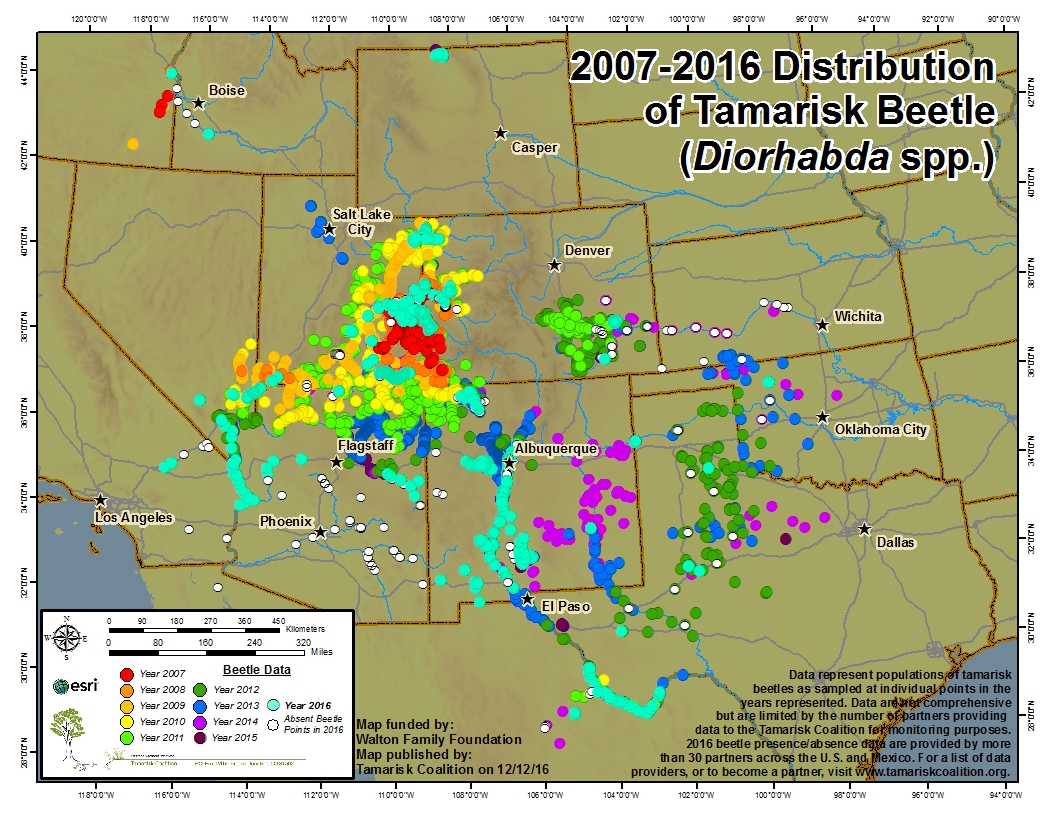
Distribution of tamarisk leaf beetle. Tamarisk Coalition
Tamarisk leaf beetle

Fast-forward to 2017. Tamarisk leaf beetles have been spreading along Arizona waterways at rates up to ten times faster than their most ardent cheerleaders imagined they could, and from multiple directions. They will arrive in almost every known Southwestern Willow Flycatcher nesting area sometime this year. By next spring those riparian thickets will be defoliated just at the point when the nestlings most require thermal cover (i.e., shade). Thanks to Reclamation-Era water diversion projects, attempts to re-vegetate those areas with willows will require constant gardening. Reclamation replaced willow habitat with tamarisk habitat. Nevertheless, the birds persisted. Beetle releases suppressed the tamarisks, but will almost certainly fail to eliminate them entirely. Beetles are just another evolutionary pressure on a tamarisk population that is already unlike any other in the world due to unforeseen hybridizing among several species. New tamarisks and new beetles are evolving. Maybe the beetles will try a bite of something else. They’re in California now; could they find something there? Maybe the birds will evolve to eat the beetles, although that hasn’t happened yet. Perhaps the day will come when the Southwestern Willow Flycatcher gives way to the Tamarisk Beetlebird. It might not even take very long. But don’t bet on it. And don’t bet on biologists, bureaucrats or any other ambitious adults to re-learn the lesson of unintended consequences they laughed at as children, then (like so many other lessons) forgot.

Matt Chew