Butterfly Bush: An example of the escalating war on non-native plants

The war on so-called “invasive species” continues to escalate.  One of the indicators of this escalation is the recently revised California Invasive Plant Council’s (Cal-IPC) inventory of “invasive” plants.  Nearly 100 plant species were added, a 50% increase in the inventory. 
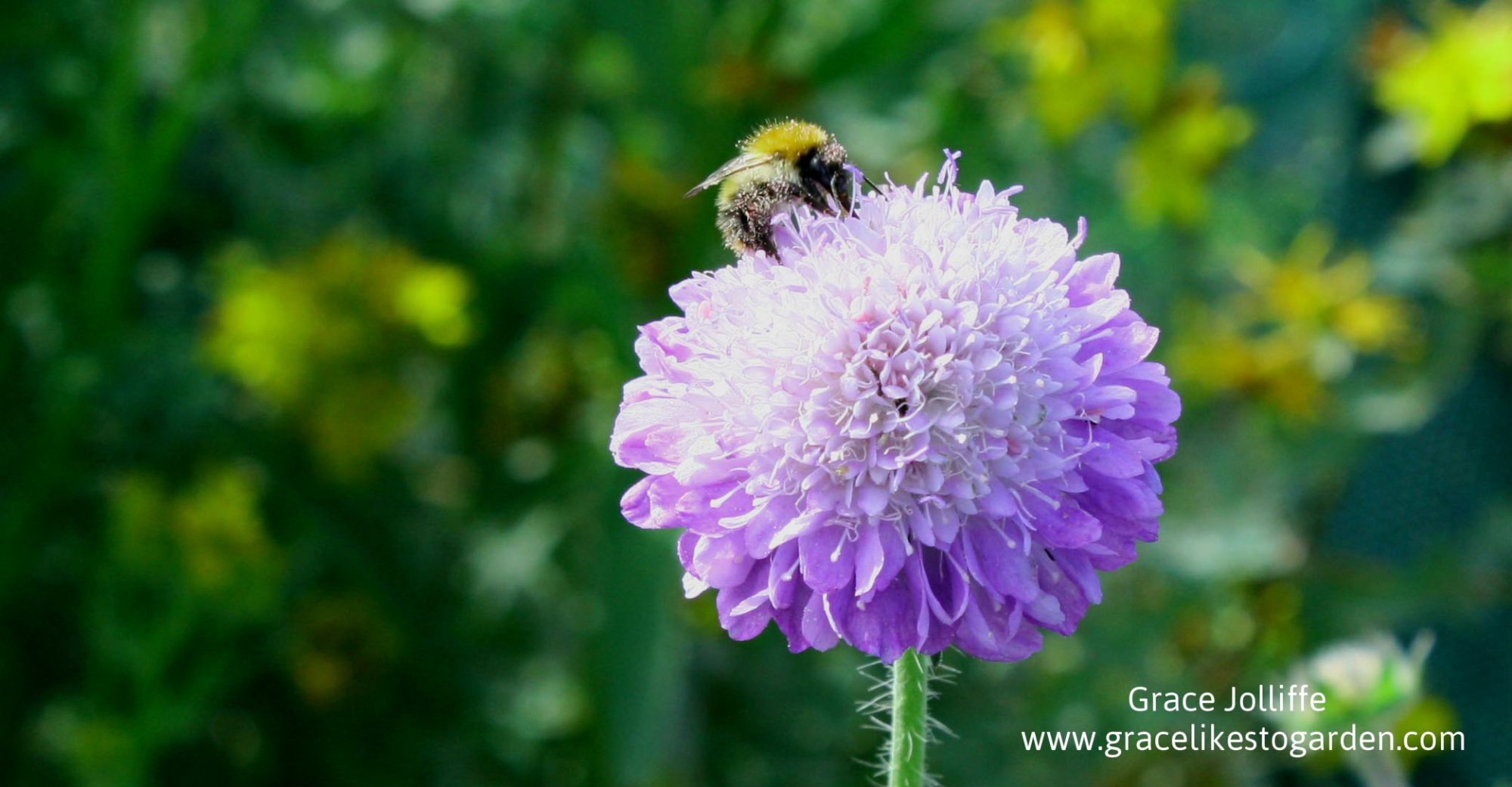
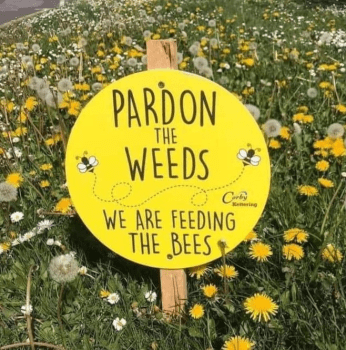
Scabiosa is one of 87 plants recently added to the inventory of “invasive” plants in California, despite the fact that is isn’t invasive in California. Scabiosa is very useful to bees because it blooms prolifically for much of the year.

More alarming is that most of the additions to the list are not considered “invasive” in California.  Rather, a new category of “potentially” invasive plants was created, based on their behavior elsewhere.  Many of the plants in the new category are considered invasive in Hawaii, a place with a distinctly different climate than California.  Hawaii is a tropical climate, hotter than much of California and wetter and more humid than everywhere in California.

The big increase in the number of plant species now designated as “invasive” in California is a concern partly because of the herbicides that are usually used to eradicate them.  Not only do we lose that plant species in our landscape when it is added to the hit list, we can also expect to see an increase in the use of the herbicides that are used to kill it.

Increased use of herbicides

Native plant advocates are aggressively defending the use of herbicides. Policies and practices are being developed to accommodate increased use of herbicides on our public lands.

East Bay Municipal Utilities District (EBMUD) is evaluating its Integrated Pest Management Program (IPM), including practices and policies regarding pesticide use.  The first draft of EBMUD’s revised IPM program was made available to the public in July 2017.  The draft adds several new goals to the IPM program:  “habitat protection and restoration,” reducing populations of “invasive plant species,” and “use of alternative vegetation such as native plants.”  EBMUD is the supplier of our drinking water in the East Bay and the quality of the water they supply should be the top—if not the only—priority.  If destroying non-native plants requires greater use of herbicides, that goal contradicts EBMUD’s obligation to providing safe drinking water.
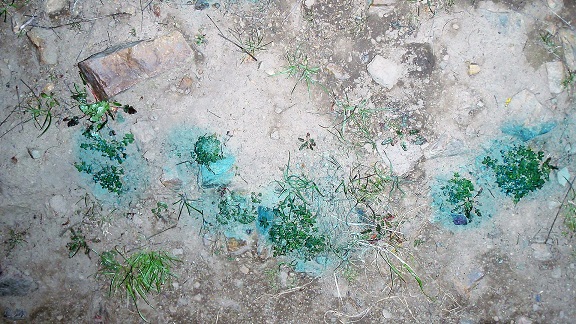
Garlon sprayed on the trail in a San Francisco park. San Francisco Forest Alliance

San Francisco’s IPM program has also changed some policies to accommodate use of herbicides in parks on plants the Natural Resource Division of the parks department considers “invasive.”  The parks department restricts all park access to the established trails in the 33 “natural areas” where non-native plants are eradicated and replaced by native plants.  The new IPM policy permits the spraying of herbicides without posting pesticide application notices in places that are “publicly inaccessible.”  In other words, pesticide application notices are no longer required in the “natural areas” unless herbicides are sprayed on the trails.  One way to reduce the public’s opposition to pesticides is to hide their use and this policy seems designed to do that.

Update:   The San Francisco Forest Alliance (SFFA) has informed me that Chris Geiger, head of San Francisco’s IPM program, has given assurances that the IPM program will no longer offer City departments a blanket exemption to apply herbicides without posting in areas the department considers “publicly inaccessible”.  Previous to this, each land manager was empowered to make their own decisions as to which areas they considered “publicly inaccessible”.  The IPM group did not provide oversight of the decisions or keep records of which areas were exempted.  Now specific exemptions will be issued and recorded on the IPM exemptions webpage.  Chris Geiger reports RPD will not be requesting any posting exemptions.   SFFA is still waiting for formal written documentation of this change.

San Francisco’s IPM Program is also demonstrating its commitment to native plants and the eradication of non-native plants by sponsoring a webinar on October 5th, 2017, featuring Doug Tallamy:  The Plant-Pollinator Connection: Why Pollinators Need Native Plants.”  Tallamy is the academic entomologist who has devoted his career to the promotion of native plants based on his claim that insects at the base of the food web are dependent upon native plants.  He has said in many publications that non-native plants will cause the collapse of our ecosystems.  Many of the statements he makes in support of his dire theory are not accurate.

This post will focus on the intersection of these symptoms of the escalating war on “invasive” plants:  the expansion of California’s inventory of “invasive” plants and the closely associated claim that non-native plants must be eradicated because they compete with the native plants required by wildlife.  We use buddleia, commonly known as butterfly bush, as an example.

Butterfly Bush (Buddleia):  friend or enemy of butterflies?
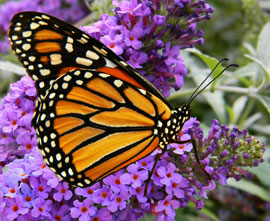
Monarch nectaring on butterfly bush. butterflybush.com

Buddleia is one of 87 plant species recently added to Cal-IPC’s inventory of “invasive” plant because it is considered invasive outside of California.  Buddleia is called butterfly bush because it produces large quantities of nectar that attract swarms of butterflies.  Since buddleia is very appealing to butterflies, it is popular with gardeners who like to see butterflies in their gardens.

Since buddleia is obviously useful to butterflies and Doug Tallamy claims to be concerned about the welfare of our pollinators, why is he telling gardeners to quit planting buddleia?  His advice is based on the fact that buddleia is considered invasive in some places and his belief that it will eventually be invasive everywhere.  In fact, that’s his belief about all non-native plants:  they may not be invasive now, but he predicts that eventually they all will be invasive.

Secondly, Tallamy argues that although buddleia provides food for butterflies, it is not a host plant for butterflies.  The host plant is where butterflies lay their eggs and where the caterpillar feeds when the eggs hatch.  The choice of host plant species is much smaller than the number of food plant species available to butterflies, but it is not as small as Tallamy thinks it is.  Tallamy does not seem to realize that many plants are chemically similar, which enables butterflies to make a transition from a native plant to a chemically similar non-native plant.  Here in California, many butterfly species have made that transition and a few butterfly species are dependent upon abundant non-native plants that are available year-around because their original native host plant is dormant much of the year.

Buddleia “starves” butterflies?

This is Tallamy’s apocalyptic prediction about the fate of butterflies if gardeners continue to plant buddleia:

“It’s no exaggeration to say that when you choose which plants to include in your garden, even the beautiful, seemingly harmless butterfly bush, you’re deciding if members of your community’s local food web will be nourished or unintentionally starved.  And to get to that mind frame, which is a way of thinking that truly benefits nature, including its butterflies, you’re going to have to come to a harsh realization: You need to stop planting the butterfly bush—forever.” (1)

Ironically, this harsh verdict on buddleia was published by a blog entitled, “Organic Life.”  Is Organic Life unaware of the fact that the most widely used method of eradicating non-native plants is spraying herbicides?  The consequence of adding more plant species to the long list of “bad plants,” is more pesticide use.  That’s not very “organic.”

What amoral, selfish gardener would plant buddleia in their garden after such a severe scolding?  First, let’s stop and think about the logic of the claim that buddleia will disrupt the “food web” and starve butterflies.  Since buddleia is an excellent source of nectar and swarms of butterflies are observed nectaring on buddleia, how could we be “starving” them?  Professor Art Shapiro (UC Davis), our local butterfly expert, said when asked about this article, “The ‘disrupting food webs’ argument is ludicrous. It’s equivalent to saying that if you eat popcorn rather than apples, you’re contributing to unemployment in the apple-picking industry.”

Is buddleia a host plant for butterflies?

Now let’s consider the argument that we should not plant buddleia in our gardens because although it feeds butterflies, it isn’t their host plant where they lay their eggs.  The problem with that argument is that it isn’t true!!
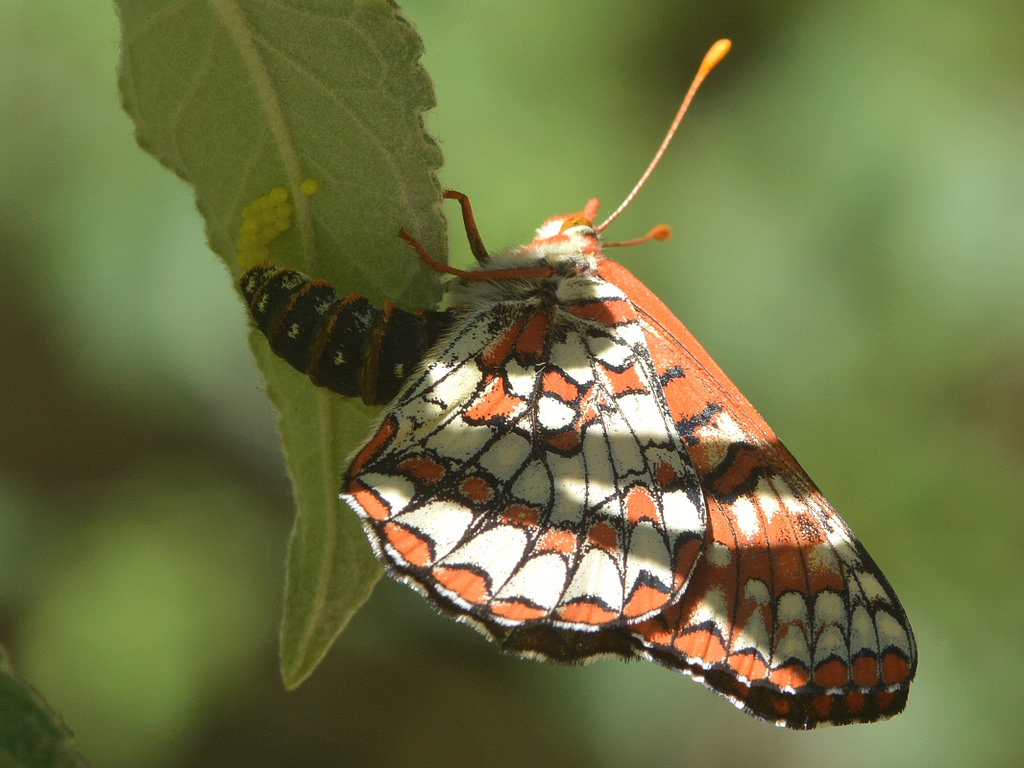
Checkerspot laying eggs on buddleia, near Santa Barbara. Photo by Marc Kummel

In 1940, Charles M. Dammers reported that the Variable Checkerspot (Euphydryas chalcedona) “can use” buddleia as a substitute for its usual native host in southern California desert-mountain areas, based on a laboratory study of the larval stages of its caterpillar on buddleia.   In 2001, chemical analysis of buddleia found that it is chemically similar to the native host of the checkerspot, which confirmed the potential for such a substitution.

The first actual observation of checkerspot butterflies breeding spontaneously and successfully on buddleia was in Mariposa County, California in the Sierra Nevada foothills.  “Mariposa” is Spanish for butterfly.  Mariposa County was named by an early Spanish explorer who saw many butterflies near Chowchilla.

Checkerspot bred successfully on buddleia in 2005 and in subsequent years.  This colony of checkerspot on buddleia was reported in 2009:  “We conclude that buddleia davidii [and other species of buddleia] represents yet another exotic plant adopted as a larval host by a native California butterfly and that other members of the genus may also be used as the opportunity arises.” (2)
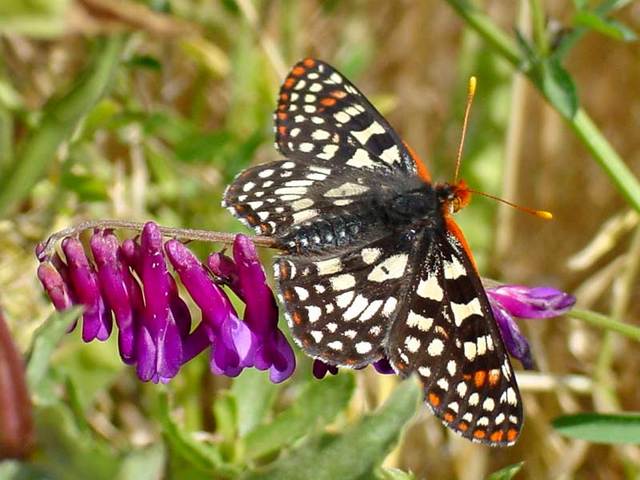
Variable checkerspot. Photo by Roger Hall

More recently, a gardener in Mendocino County also reported the use of buddleia as the host plant of checkerspot:

“By now I am questioning how it was that butterfly larvae were using my butterfly bush as a host plant, completely against everything I’d ever heard. How was this possible? I emailed Art Shapiro, a very well-known butterfly expert and author, sending him a pic. He wrote back to confirm they were butterfly larvae, but added, ‘These are not mourning cloak butterflies. They are checkerspots. And the only time I’m aware this has happened [like, ever, except one in a lab in 1940…] is in Mariposa County.’” (3)

Bad rap for non-native plants

When the native plant movement began some 30 years ago, native plant advocates promoted their agenda with a straight-forward claim that they are superior to non-native plants.  The public was initially resistant to that argument because non-native plants have been around for a long time and people have become fond of them.

Native plant advocates began to fabricate stories about the evils of non-native plants to convince the public that eradicating them was necessary because they are harmful to wildlife and they damage the environment.  The Million Trees blog was created to address those claims.

But Doug Tallamy’s active participation in the crusade against non-native plants is a special case because he is an academic entomologist, credentials that make him more influential with the public.  For that reason, Million Trees has critiqued several of his publications.  We publish this critique of Tallamy’s opinion of buddleia for several reasons:

  • Buddleia is very useful to butterflies. The loss of buddleia in our gardens would be a loss to butterflies.
  • San Francisco’s IPM program is using Doug Tallamy’s mistaken theories to promote the use of herbicides to eradicate non-native plants in San Francisco.
  • Buddleia is one of 87 plants that have been classified as “invasive” by the California Invasive Plant Council despite the fact that it is NOT invasive in California. The expansion of the list of “invasive” plants in California to include plants that are NOT invasive in California, will increase the use of herbicides and will eliminate plants that are performing valuable ecological functions.

  1. https://www.rodalesorganiclife.com/garden/never-plant-butterfly-bush  (N.B.  The butterfly in the photo in this article is European Small Tortoiseshell, found in Britain and in Europe.  The caterpillar in the photo is the monarch caterpillar on its host plant, milkweed.  Buddleia is food for both of these butterfly species.)
  2. Arthur M. Shapiro and Katie Hertfelder, “Use of Buddleia as Host Plant by Euphydryas chalcedona in the Sierra Nevada foothills, California,” News of the Lepidopterists’ Society, Spring 2009
  3. http://plantwhateverbringsyoujoy.com/never-pull-up-and-discard-what-you-cannot-identify/
The consequences of dune “restoration” in coastal California

It is my pleasure to publish a guest post about dune “restorations” in Humboldt County that began about 30 years ago.  Like most “restorations,” these projects are primarily destroying non-native plants.  More often than not, they don’t plant native plants to replace the plants they destroy, although the stated goal is to “restore” native plants.

 Uri Driscoll tells us why the non-native plants were planted over 100 years ago and the consequences of removing them.  According to Mr. Driscoll’s Facebook page, he has lived in Arcata, Humboldt County since 1983.  He has had a life-long interest in outdoor recreation, horses, organic farming, and conservation.  He is a member of Arcata’s Open Space and Agriculture Committee.

 If you live in the San Francisco Bay Area, you might think these projects are not relevant to us.  In fact, they have everything to do with us because there are many similar projects here and the issues with those projects are similar. 

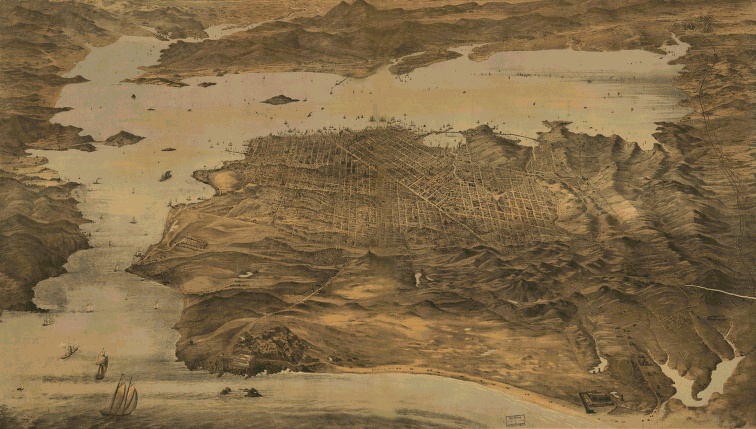
Bird’s eye view of San Francisco in 1868. US Library of Congress

 The San Francisco peninsula was about one-third barren sand dunes when Europeans first arrived at the end of the 18th century.  About 30 years ago, native plant advocates decided they wanted whatever open space that still remains on the peninsula to be returned to pre-settlement conditions, including sand dunes where they existed in the past.

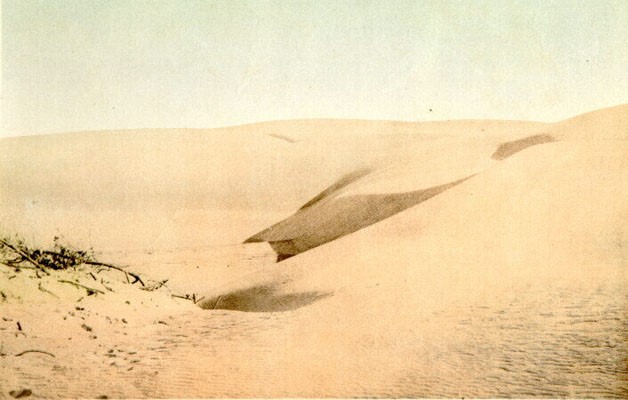
These are the sand dunes in San Francisco where Golden Gate Park was built by creating a windbreak by planting trees. The windbreak stabilized the sand dunes and made it possible to plant and sustain vegetation behind the protection of the windbreak. San Francisco Public Library, historical photo collection.
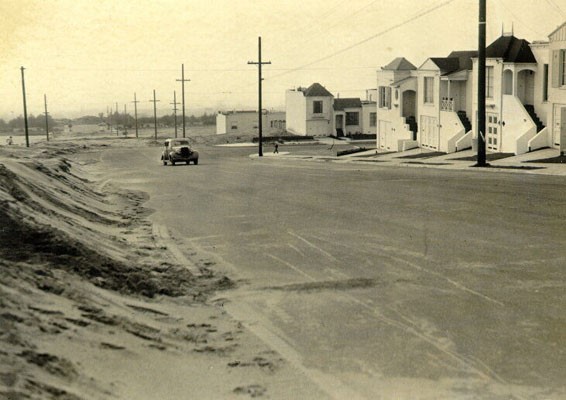
Pacheco & 32nd Ave, San Francisco, 1943. San Francisco Public Library, historical photo collection

As residential neighborhoods in San Francisco were developed, iceplant and European beach grass were planted on the sand dunes to hold the sand in place.  Native dune plants are not capable of stabilizing sand for long, before strong winds move the sand beneath them.  In fact, the long term survival of native dune plants is dependent upon these disturbances. 

Trees were planted on the windward side of residential areas to protect them against the wind.  Sand on the leeward side of the trees was stabilized by the windbreak.  One of the first dune “restorations” in San Francisco proposed to destroy about 4,000 trees in the Presidio in order to restore an endangered dune plant, Lessingia germanorum.  The purpose of destroying the trees was to enable the sand to move again, ensuring the long-term survival of a native dune plant that exists only on the San Francisco peninsula.

Iceplant has been removed from several sand hills in residential neighborhoods, dumping sand on the properties at the base of the hills.  The Great Highway, which separates Ocean Beach from the residential Sunset District is often closed because of drifting sand after removal of beach grass.

In fact, everyone living on the coast of California should have an interest in the preservation of our sand dunes because they are our first line of defense against rising sea levels and the intense storms associated with climate change.  If non-native plants and trees are needed to maintain the stability of our sand dunes, so be it.  Competing agendas must take a back seat to the safety of our coastal communities.

Million Trees


Stable Dunes or Native Plants?

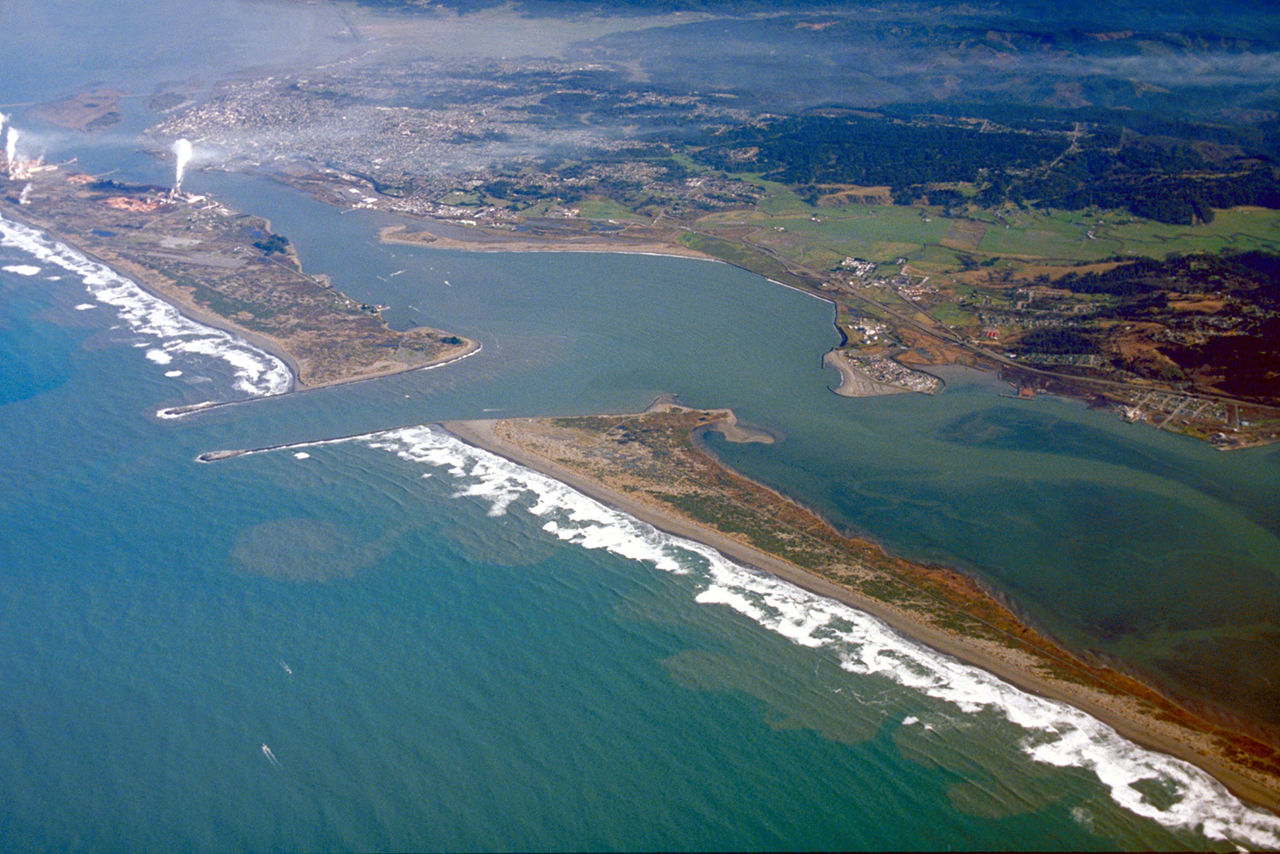
The North and South Spits of Humboldt County are the physical barrier between Humboldt Bay and the Pacific Ocean.  After the introduction of European beach grass (Ammophila arenaria) in the early 1900’s there has been a substantial stabilizing effect on the dunes as they grew wider and taller.  Prior to the establishment of the grass our dunes consisted of wide expanses of unvegetated, open, moving sand. This is in sharp contrast to the variety of plant cover we have today.

Humboldt Bay

In the 1980s public land managers began removing European beach grass with the goal of restoring native vegetation.  This is the story of the consequences of their projects.

Foredunes (the sand ridges parallel to and closest to the shore) with open, actively moving sands have a very high potential for accelerated erosion.  The foredunes of the North Spit and South Spit are still extremely vulnerable to accelerated erosion caused by disturbances to the vegetation.  A beach and dunes management plan and Environmental Impact Report (EIR) was developed in 1993 to address such issues.

Of greater concern, waves have washed over the foredunes on both spits where waves have breached the foredune where vegetative cover had been removed.  Repeated overwash events would significantly and immediately impact the only access road to the South Spit and the municipal water main and water treatment facilities on the North Spit.

These dunes could again be set in motion by removal of the protective cover of native and non-native vegetation.  Indeed, the intention to remobilize dunes was identified in the Conditional Use Permit application Bureau of Land Management (BLM) submitted for vegetation removal at Table Bluff County Park, a portion of the South Spit.  However, those intentions are contrary to the local Humboldt Bay Beach and Dune Management Plan and accompanying EIR.

The danger is that the South Spit’s dune topography is characterized as typically low and narrow.  With erosion and subsequent lowering of the foredune that occurs following vegetation removal, the right combination of concurrent high-magnitude seismic subsidence and wave attack could cause collapse of the land barrier between the Ocean and Humboldt Bay.  With anticipated sea level rise we would see this risk multiply.  

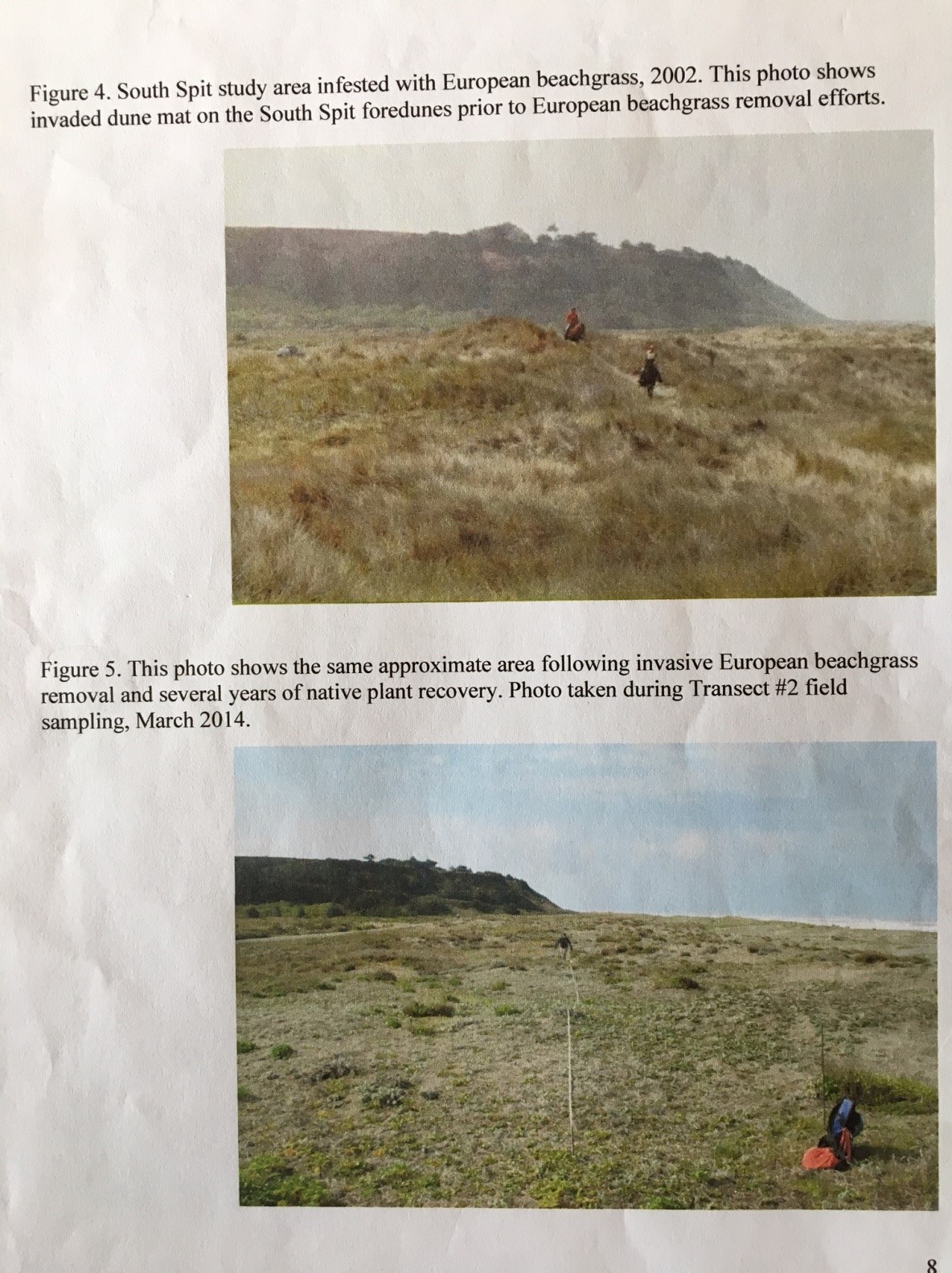
Source: 2008-2014 BLM monitoring report

The problem is that the previous and on-going work to remove European beach grass from the North and South Spits (in the effort to restore natural conditions and processes) has not and does not provide for the immediate re-establishment of other comparable  vegetative cover to trap moving sand and prevent accelerated dune erosion.  By not including this mandated mitigation measure, there is a real, legitimate potential for significant, cumulative environmental impact.

Why was European beach grass introduced?

The important thing to understand is that this specific type of beach grass (Ammophila arenaria) was introduced in Humboldt County in the early 1900’s.  It was done in order to stabilize dunes to protect growing communities and infrastructure. It had the additional benefit of creating extensive coastal wetlands and wildlife habitat.  By collecting sand from the beach the grass builds protective and multiple parallel ridges and accompanying deflation planes. These depressions behind the ridges act as sheltered nurseries for new plant and animal life. This process can take several decades but is reversed rapidly after the grass is removed. Such an effect has happened not only in Humboldt County but also in Point Reyes where valuable wetlands and organic pastures have been smothered by destabilized sand.

Why was European beach grass removed?

When the efforts to remove the non-native, albeit naturalized grasses began in the early 1990’s invasive biology was in its infant stages. Not much was known about the impacts from the eradication efforts of dominant species.  But to some it was important to return coastal areas to the pre-beach grass era so native plants would not be out-competed.

Every movement needs a poster child.  About this same time a cute little shore bird named the western snowy plover became just that.  Even though it is registered as a threatened species on the west coast, other parts of the country and Mexico have significant and stable populations.   We were told by local biologist Ron LaValley that the non-native grass needed to be removed to recover the local plover’s populationThis claim contradicted his original report showing plover eggs nestled in the non-native grass.  He was later convicted and sent to jail for falsifying data and embezzling a million dollars from similar projects involving the spotted owl.

Recognizing that manual eradication was very expensive and time consuming, California State Parks decided to bulldoze 40+ acres of Little River State Beach to provide plover breeding areas. Unfortunately, as Humboldt State Professor Mark Colwell noted in his 2008 report “importantly, eggs often fail to hatch in restored areas.”  This is largely because ravens and crows find it easy to locate the nests in open sand areas.

The Lanphere-Christenson Dunes Refuge director Eric Nelson determined during a 2016 Climate Ready project that the foredunes were being excessively eroded by the 25 California Conservation Corp (CCC) workers who were digging out beach grass.  His decision to spray glyphosate and imazapyr instead of hand removal was carried out despite public opposition.  It remains unclear whether, despite acknowledging excessive erosion from manual eradication efforts, the refuge will return to using that method again.

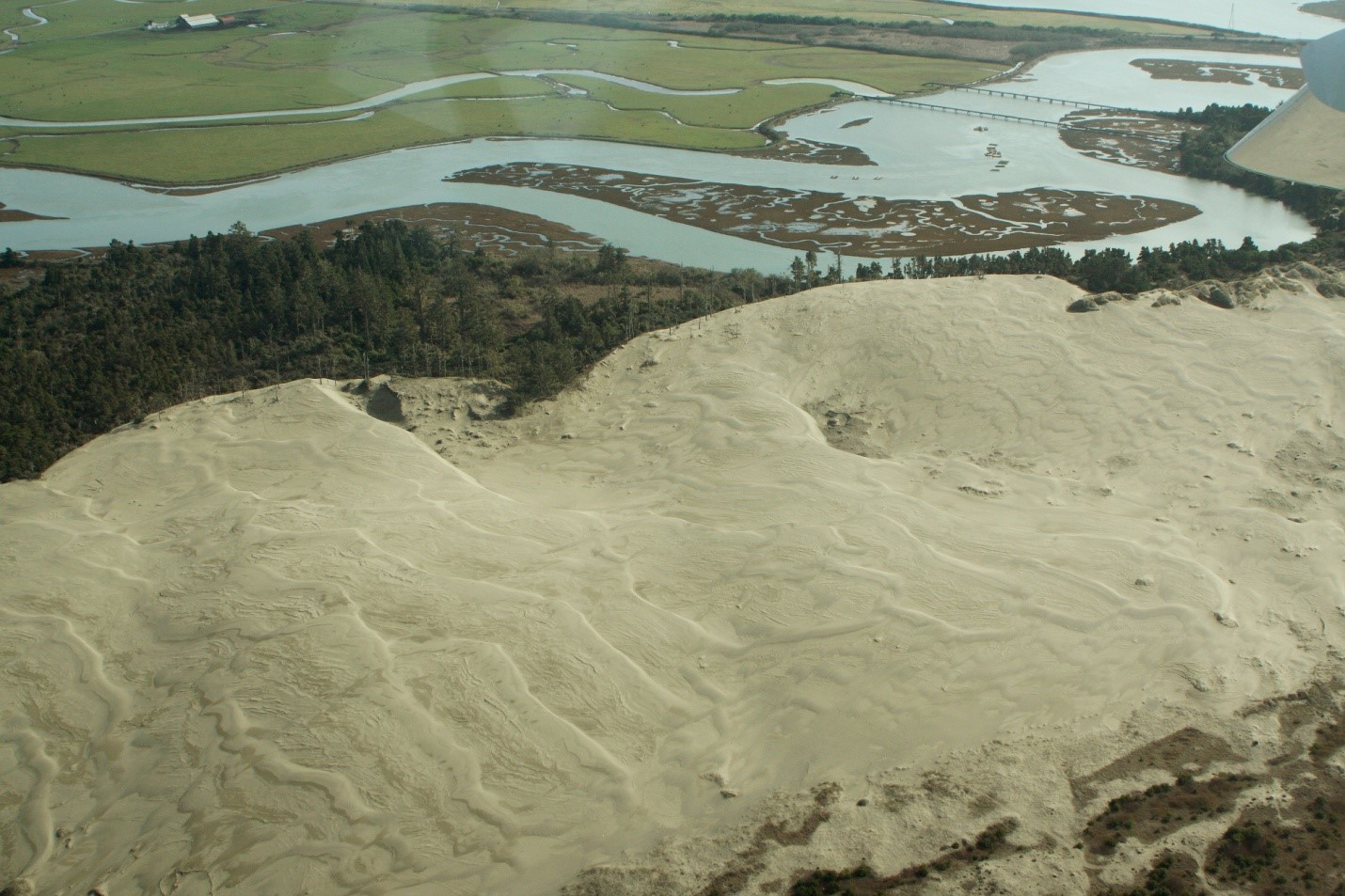
Lanphere Dunes and Mad River Slough

The public takes notice of the consequences

Some of us who live near these project areas and use them for recreation started noticing native tree mortality and changes to the landforms caused by removing the stabilizing grasses.   We started doing some initial research.  We began looking into coastal development permits, beach and dunes management plans and monitoring reports.  Our findings revealed the project areas that actually had permits also had mitigation requirements.  Those included immediate replanting and strict monitoring to make sure topography and landforms were not altered.  When we inquired about the monitoring and replanting programs we found those to be significantly deficient and in some cases non-existent.

Taking action

Our next step was to approach the various regulatory agencies.  US Fish and Wildlife Service, California Department of Fish and Wildlife and the State Water Board should be interested in the freshwater wetland infill we were witnessing.  The Harbor District and the municipal water district have a major interest in securing the two 42-inch industrial water mains protected by the same beach grass that was being removed.  The Manila Community Service District maintains a waste water treatment facility on the dunes.  We thought the California Coastal Commission would certainly want to know that these unauthorized alterations to coastal landforms were taking place. We felt sure the County planning department that issued some of the permits would take enforcement action.

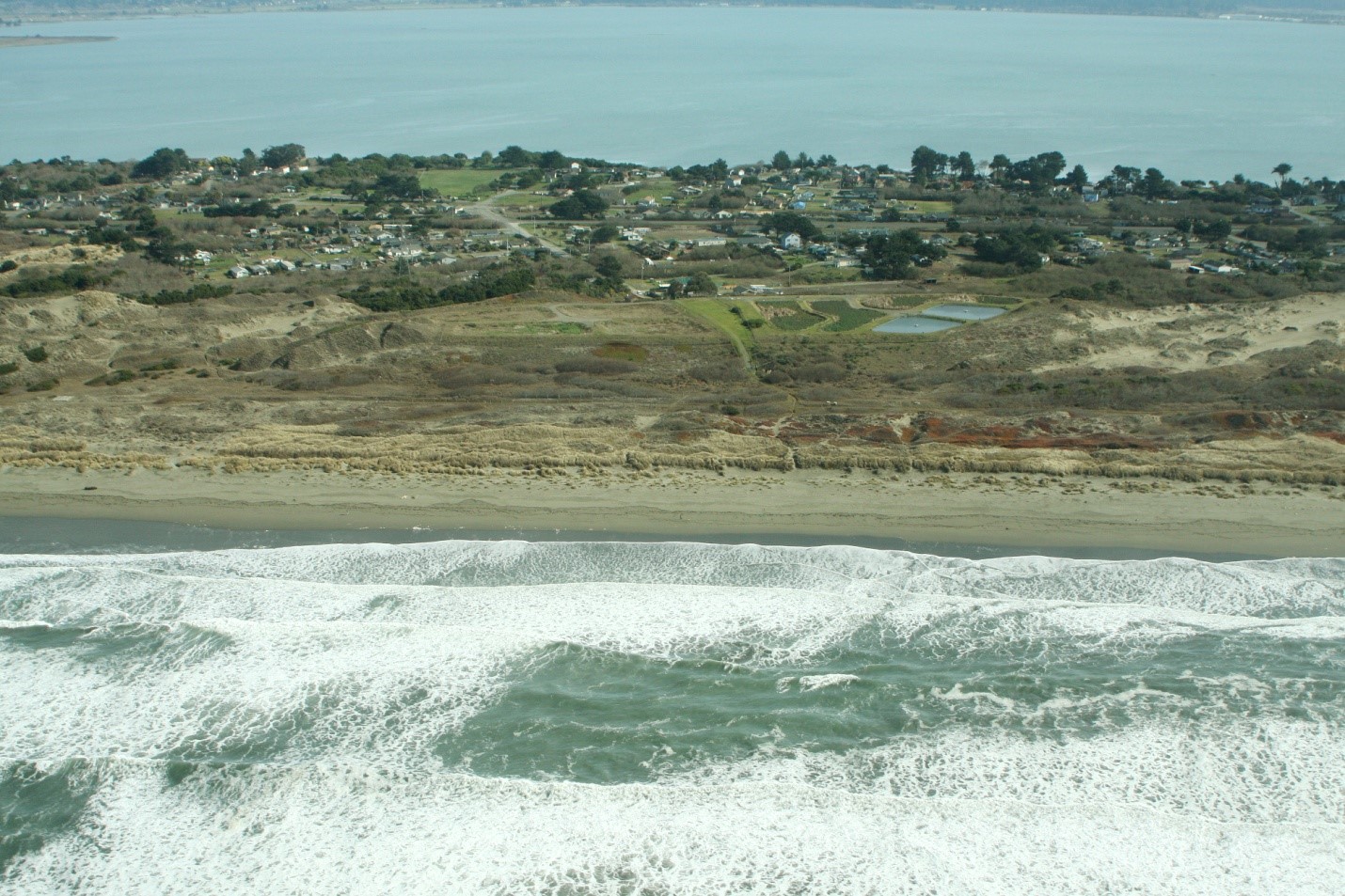
The town of Manila’s water treatment facility

We brought photo and research documents from Oregon and Washington (2 and 3), made presentations and had meetings, site visits and sent email communications to no avail.

We stepped back and took a look at the board of directors for the non-profit called Friends of the Dunes (FOD) that has been promoting the grass removal from the very beginning.  They had grown from a small, broken down 400 square foot building with a net worth of about $20,000 in 2004 to 60 + acres of ocean front property with a 3000 square foot building and a net worth of over $3.4 million in 2014.  The board of directors at the time consisted of employees of most of the agencies listed above.  We understood then why we were running into so many road blocks.

Our community is well known for environmental activism.  So why the hesitation of local environmental organizations like the North Coast Environmental Center (NEC), Environmental Protection Information Center, and Bay Keeper to call out such impacts caused by bulldozers, herbicide spraying and wetland infilling?  We can only presume that the banner of “restoration” has been used as a blindfold.

Some significant successes….more to do

We have had worthy successes.  Through our efforts the California Coastal Commission has asked the Bureau of Land Management (BLM) for a new determination to address the impacts related to the Ocean Day activities involving 1000 school children digging grasses from the dunes.  So far, the BLM does not think it needs to provide that.  BLM puts on the event but the Coastal Commission bankrolls it.  We do not know yet what the Commission’s response will be to that refusal.

The town of Manila has stopped grass removal activities in its management area and has supported the planting of native pine trees (Pinus contorta, contorta) in the dunes, which we did last February.  The County planning department is engaged and acknowledges that there has been no contract with the California Conservation Corp or BLM for prior grass removal at the County Park and will not allow any more vegetation removal until a Memorandum of Understanding is developed.

The Coastal Commission has committed to reviewing the authorization allowances for BLM’s grass removal over the rest of the South Spit.  The existing Plan states a two-acre area would be subjected to grass removal strictly for monitoring purposes not the mile long area subjected to eradication to date.  BLM contends that authorization extends over the whole 800-acre Spit but have not been able to provide supporting documents.

The North Coast Environmental Center and even the Friends of the Dunes (FOD) took a position against spraying herbicides on the dunes.

Former board members of the FOD that are regulatory agency officials have resigned their director positions.

Communities around the country are hosting events to plant beach grasses like the ones that have been removed here.  Recognition of the incredible value of stabilized dunes is becoming more wide spread.  The “non-native” label is becoming more questioned.

Setting new goals and looking ahead

For us on the North Coast of California we need a much more cost effective and precautionary approach than tearing out plants that have beneficial attributes.  We need to allow the beach grass to do its job of stabilizing and protecting our dunes.  As we allow it to do that, the beach grass “declines in vigor” (4).  When that happens, other plant and animal species utilize those protections from the harsh winds and tides of the Pacific and establish heathy vibrant wildlife habitat. Our local and migratory wildlife depend on it. And so do we.

Uri Driscoll, Arcata, California


We commend the people of Humboldt County for paying attention to the damage that is being done to their public land and we congratulate them on the progress they have made to prevent further damage.  We are impressed with the methodical approach they have taken to convincing public land managers to reconsider the goals of the project and the methods being used to accomplish them. 

We wish them the best of luck with their efforts.  We are grateful to Uri Driscoll for taking the time and trouble to share this story with our readers.

Million Trees 


(1) South Spit Interim Management Plan 2002.

(2) Evaluating Coastal Protection Services Associated with Restoration Management of an Endangered Shorebird in Oregon, U.S.A.  Lindsey Carrol

(3) Sally Hacker, Oregon State University http://rsif.royalsocietypublishing.org/content/12/106/20150017

(4) The Nature Conservancy Element Stewardship Abstract For AMMOPHILA ARENARIA,  Andrea Pickart