More opposition to Measure FF

As you make the important decision about voting on Measure FF, please take into consideration that Million Trees and the Forest Action Brigade are not the only East Bay residents who plan to vote against Measure FF.  Today we tell you more about why many East Bay voters have made that decision.

Post-election update:  Measure FF passed easily.  In Alameda County 85% of voters approved Measure FF.  In Contra Costa County 80% of voters approved Measure FF.  These were the vote tallies on the day after the election, on November 7th.  

A ’91 fire victim and survivor tells us why he will vote against Measure FF

The East Bay Times published the following op-ed about Measure FF on October 4th. It was written by Peter Scott. He states his opposition to Measure FF clearly and emphatically.  Emphasis and photo have been added.

“Save trees, ‘no’ on Alameda County’s Measure FF”

“Alameda County’s proposed Measure FF, East Bay Regional Park District Parcel Tax Renewal, appears innocent enough: improvements in area parks, safety, a 20-year continuation of a 2004 plan to enhance the public’s enjoyment of East Bay Regional Park District (EBRPD) properties.

And the tax — a dollar a month per single-family residence and $69 a month for multifamily units in Alameda County — seems affordable. But wait: Half of the money raised by this measure would fund destruction of thousands of healthy, mature trees in the East Bay hills.

This isn’t the first time this deforestation has been proposed. In 2013, FEMA offered a similar plan, to be implemented by UC Berkeley, the city of Oakland and the EBRPD. After the plan’s environmental impact was discussed in three public hearings, citizens responded with 13,000 written comments, which, by FEMA’s count, were 90 percent against the plan.

The reason, subsequently confirmed in litigation, was that the plan would involve significant, permanent negative impacts to the environment but would still fail to achieve its stated goal — to reduce risk of fire in the hills. The U.S. Forest Service commented that in terms of mitigating risk, it would be better to do nothing than to proceed with FEMA’s plan. The reason this type of proposal keeps popping up is because it is the object of long-term lobbying by a clique of nativists who want to rid the hills of species they don’t like. Their reasoning depends on myths such as these:

  • Once upon a time, before white people came and changed things, the hills were a stable environment of so-called native vegetation that was healthy and inherently fire-resistant;
  • “native” species tend to be less likely to ignite, and they have manageable flame lengths (the distance at the ground from the flame’s leading edge to its tip);
  • and trees are the culprit and were the primary reason that the 1991 fire burned out of control.

These statements are not only incorrect, they are the opposite of the truth. The old landscape burned regularly; the flame lengths of “native” brush and grasses are multiples of mature trees’ flame lengths and create conflagrations that fire personnel won’t fight because they spread and change direction so fast; the 1991 fire was a STRUCTURE fire, not a vegetation fire: houses set fire to trees, not the other way around.

Factually, the ’91 fire was human-caused. First, it was a contractor’s construction debris fire that escaped into the brush; secondly, it was a reignition from embers that the Oakland Fire Department had failed to extinguish. The official report examining the causes doesn’t mention trees but does criticize the OFD’s failures in its incident command’s preparation, training and management during the fire. Of the 16 major fires in the hills since 1905, there are basically two categories: human-caused (10 fires) and “unknown cause” — it’s a safe bet most of those “unknowns” were also human-caused.

If Measure FF is truly focused on fire risk mitigation, it would fund regular removal of fine fuels around the base of the trees — as EBMUD does so successfully — because it is the brush, grasses and debris on or near the ground that are most likely to ignite and are key to the fire’s spread and ferocity. Leave the tall trees alone, because they reduce wind, shade the ground, catch fog drip and discourage growth of flammable, weedy plants. If trees are not cut down, then repeated applications of herbicides to kill re-sprouts are unnecessary.

Measure FF proposes to fund some good things — maintenance and improvements in the parks — but they make FF a Trojan horse. They are sugar-coating on a foul and foolish enterprise: deforestation to create so-called “oak-bay savannahs,” which are actually grass- and brush-covered hills, dotted with occasional low trees — the type of landscape that has been burning so fast and ferociously in Lake and Sonoma counties and throughout the state. We must send the FF authors back to the drawing board, telling them to come back to us when they have plan that will actually reduce, not increase, the fire hazard.”

Peter Scott, Oakland, California
No one is more knowledgeable about East Bay fire history and fire hazard mitigation than Peter Scott.  He is a founding member of the Claremont Canyon Conservancy and the Hills Conservation Network.  He is passionate about fire safety in the East Bay partly because of his personal loss.  His home burned down in 1970 and 1991 and his mother was killed in the 1991 fire.  Since 1991, he has made fire hazard mitigation one of his personal priorities.  Peter Scott and his wife, Teresa Ferguson, instigated the Civil Grand Jury report about the ’91 fire.

Alameda County Green Party says “NO on Measure FF”

The Alameda County Green Party has recommended that “green” voters vote NO on Measure FF, with reservations. This was a difficult decision for the Green Party, as it was for us. We all love the parks and we know that some of the money raised by Measure FF will be used to make needed and appropriate park improvements. They explain their reservations and the reluctant conclusion they reached in their Green Voter Guide that is available on line. Here’s what they say about their decision (emphasis added):

“The Green Party of Alameda County recommends a NO vote, with reservations, on Measure FF (Alameda/Contra Costa Counties):

If approved by voters, Measure FF would simply continue existing Measure CC funding. Voters passed Measure CC in 2004 to provide local funding for park infrastructure, maintenance, safety, and services. Measure CC is a $12/year parcel tax that is set to expire in 2020. Measure FF is expected to raise approximately $3.3 million annually until it expires in 20 years.

Measure CC boasts a long list of successful improvement to East Bay Regional Parks in areas of public safety, wildfire mitigation, healthy forest management, shoreline protection, environmental stewardship, habitat preservation, park infrastructure and maintenance, recreational and educational programming, and visitor services.

While impacts of the Measure have been wide-ranging and largely celebrated, record California wildfires in 2018 have caused both opponents and proponents of the Measure to highlight the wildfire mitigation aspect of the program. Neither Measure CC nor Measure FF contains language that details how to approach reducing wildfires, however, Measure CC’s funds helped in developing the Wildfire Hazard Reduction and Resource Management Plan (“Plan”) that was approved in 2010 by the East Bay Regional Parks District (EBRPD) Board of Directors.

Proponents state that passing Measure FF is critical to continue to reduce risk of wildfires along the wildland-urban interface. They accept that thinning of certain tree species and controlled use of herbicides are tools outlined in the Plan to accomplish the task.

Opponents are against unnecessary removal of non-native species and use of herbicides (EBRPD has expanded use of herbicides and clear-cutting), arguing that extreme fires are driven by effects of climate change, not a particular tree species. Opponents agree with many fire experts that the key defense of homes against wildfire is defensible space, and argue that clear-cutting removes trees that sequester carbon (mitigating climate change) and removes the canopy that provides habitat for species and helps cool the environment. On pesticide use, they simply say: “If organic farmers can do it, so can EBRPD!”

We agree with the opponents: There are environmentally-sensitive alternate approaches to reducing wildfire risk that do not involve removing so many trees and applying poisons in East Bay parks, but the EBRPD Board must be willing to implement them. Vote “No” to send a message to the Board that we can do better. Our reservations are that we like the parks and want to protect them, and we appreciate most of the improvements that Measure FF funds.”

Alameda County Green Party

We are deeply grateful to the Green Party for their decision and we commend them for considering all sides of this complex issue, which is seldom done by political organizations.

Deliver the message to the Park District

Whatever the outcome of this election, votes against Measure FF will deliver a clear message to the Park District:  STOP destroying healthy trees and killing harmless plants and trees with dangerous pesticides!! 
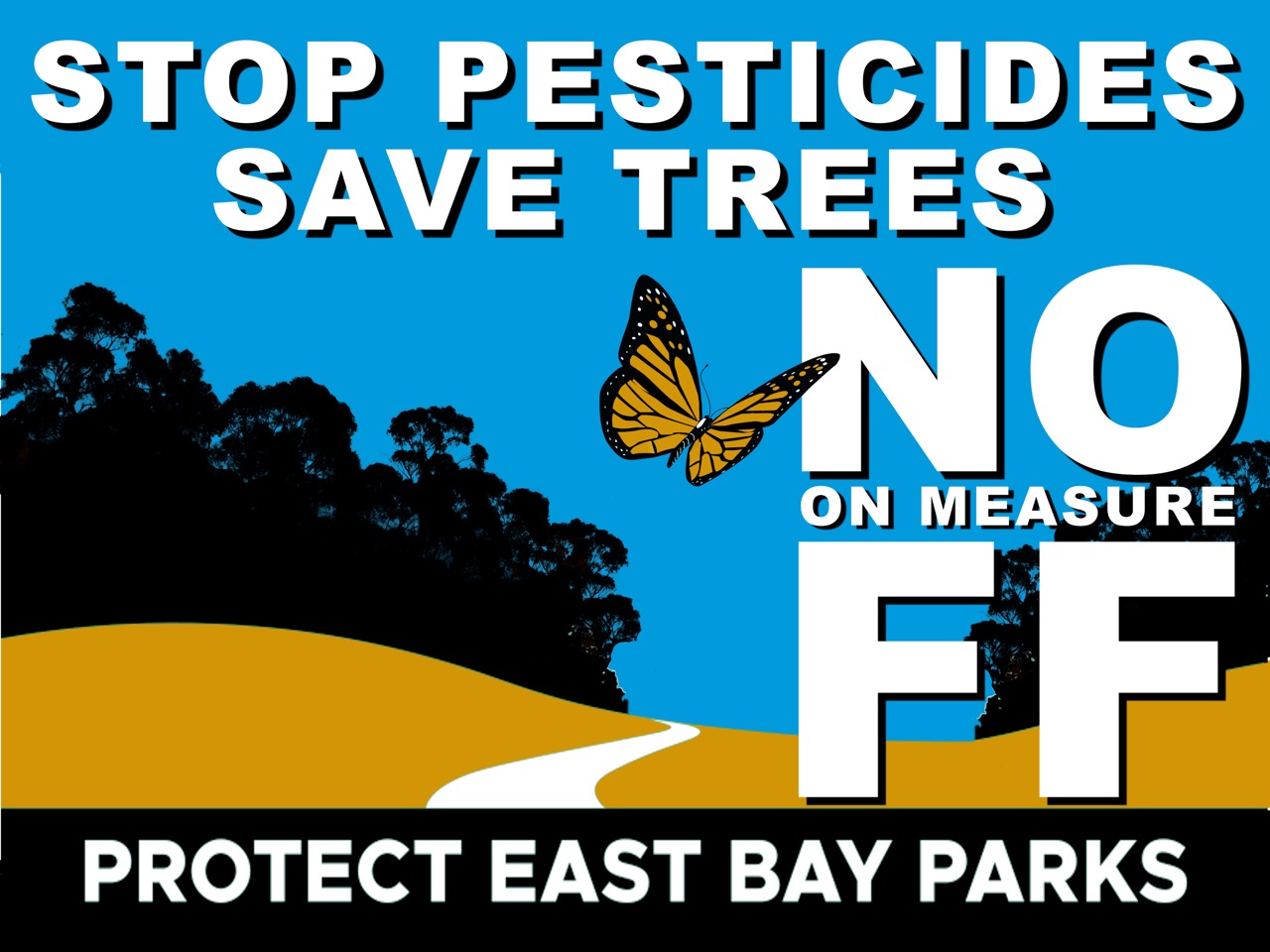
This is the big, beautiful yard sign that you can put in your yard and neighborhood road medians in the East Bay.

Peter Scott and the Green Party have delivered this message and you have the opportunity to add your voice by placing a yard sign in your own yard and in the road medians in your neighborhood in the East Bay.  The Forest Action Brigade is offering yard signs at no cost to you.  Request your yard sign by contacting the Forest Action Brigade:  forestactionbrigade@gmail.com or call (510) 612-8566.
Vote NO on Measure FF!!

A vote against Measure FF on the ballot for the November 6, 2018 election is a vote against pesticide use in the East Bay.  If Measure FF passes, it will renew a parcel tax for 20 years.  For the past 15 years, the parcel tax has funded the destruction of thousands of trees on thousands of acres of public parks in the East Bay.  The renewal of the parcel tax will increase the percentage of available funds for tree removals and associated pesticide use from 30% to 40% of funds raised by the parcel tax.

Post-election update:  Measure FF passed easily.  In Alameda County 85% of voters approved Measure FF.  In Contra Costa County 80% of voters approved Measure FF.  These were the vote tallies on the day after the election, on November 7th.  

Tree removals increase pesticide use because herbicides are required to prevent the trees from resprouting.  Also, when the shade of trees is eliminated, the unshaded ground is soon colonized by weeds that are then sprayed with herbicide.  The destruction of trees has put public land managers on the pesticide treadmill.

The public tried hard to convince the East Bay Regional Park District to stop destroying healthy trees and quit using pesticides in our parks.  We attended public hearings and wrote letters to Park District leadership and its governing board.  We made many suggestions for useful park improvements that would be constructive, rather than destructive.  Our requests and suggestions were ignored.

After making every effort to avoid opposition to Measure FF, we reluctantly take a stand against it.  The parks are important to us and we would much prefer to support park improvements.  Unfortunately, Measure FF will not improve the parks.  Rather, it will continue down the destructive path the Park District has been on for the past 15 years. In fact, Measure FF would escalate the destruction and poisoning of our public lands.

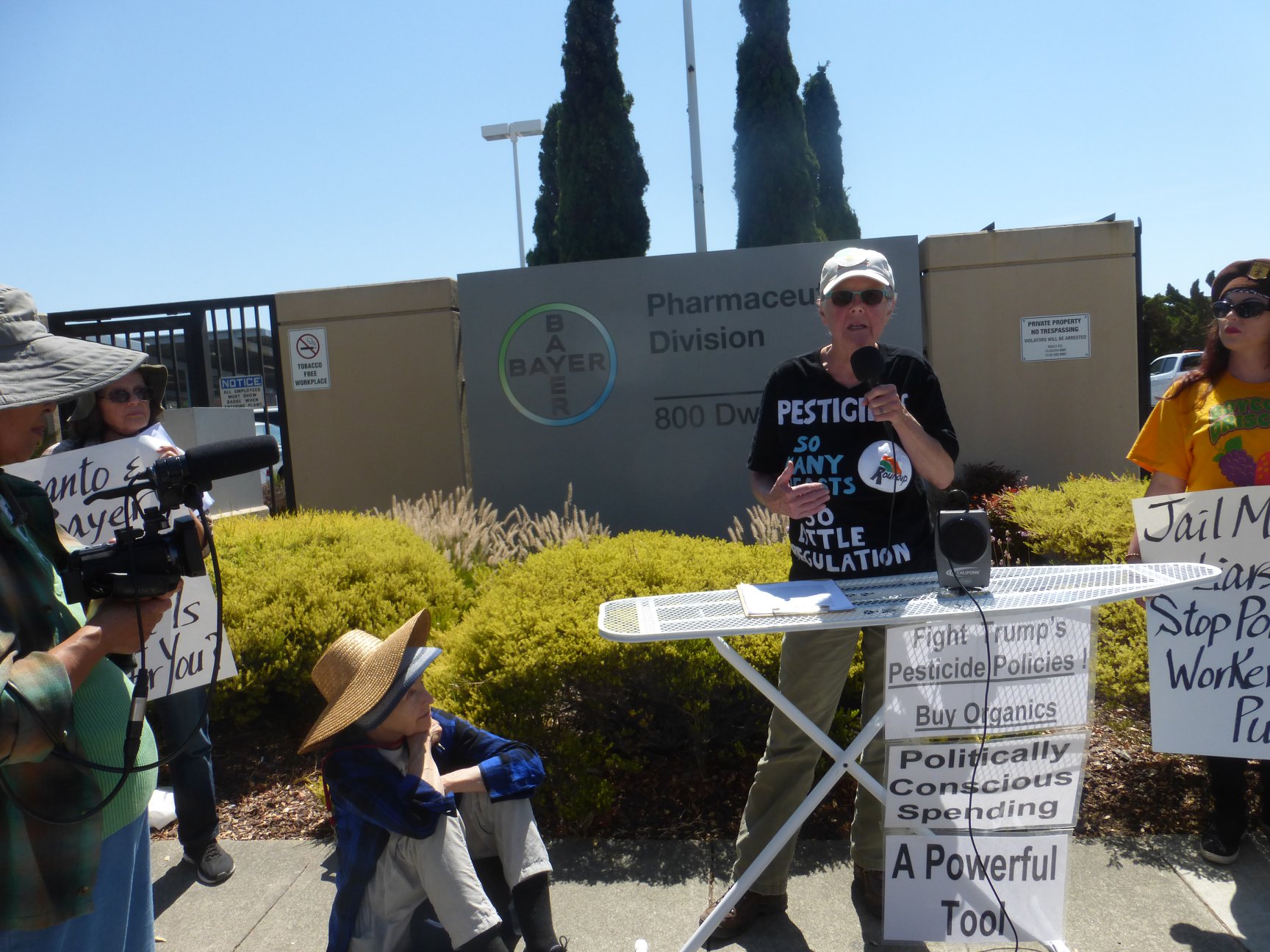
On Friday, August 31st, the Forest Action Brigade participated in a press conference rally at Bayer headquarters in Berkeley. Bayer is the new owner of Monsanto, the manufacturer of glyphosate. The rally was sponsored by a labor organization that is concerned about exposing workers to glyphosate, which is probably a carcinogen.  The President of the Forest Action Brigade, Marg Hall, spoke at the rally.

The Voter Information Guides in Contra Costa and Alameda counties have published the following argument against Measure FF that was submitted by the Forest Action Brigade.  We hope you will read it and take this important opportunity to protect our public parks from being needlessly damaged.

Million Trees

Argument Against Measure FF

“We love public parks, and we support taxation which benefits the common good. Nevertheless, We urge a NO vote. East Bay Regional Parks District (EBRPD) has previously used this measure to destroy, unnecessarily, thousands of healthy trees under pretexts such as “hazardous tree” designations and “protection against wildfires”. But fire experts point out that tree shade retains moisture, thereby reducing fire danger. The measure has also funded so-called “restoration”—destruction of “non-native” plants, in a futile attempt to transform the landscape back to some idealized previous “native” era.

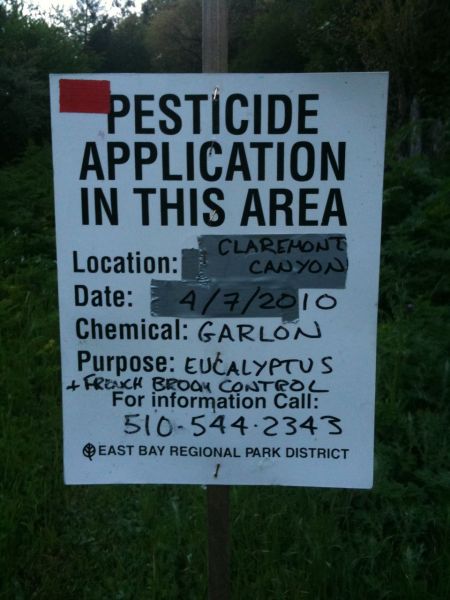
EBRPD’s restoration and tree-cutting projects often utilize pesticides, including glyphosate (Roundup), triclopyr, and imazapyr. We agree with the groundswell of public sentiment opposing the spending of tax dollars on pesticides applied to public lands. Not only do pesticides destroy the soil microbiome; they also migrate into air, water arid soil, severely harming plants, animals, and humans. Because EPA pesticide regulation, especially under the current administration, is inadequate, it is imperative that local jurisdictions exercise greater oversight. While EBRPD utilizes “Integrated Pest Management” which limits pesticide use, we strongly advocate a no pesticide policy, with a concomitant commitment of resources.

Given the terrifying pace of climate change, it is indefensible to target certain species of trees for eradication. All trees—not just “natives” —are the planet’s “lungs,” breathing in carbon dioxide and breathing out oxygen. When a tree is destroyed, its air-cleansing function is forever eliminated, and its stored carbon is released into the atmosphere, thus worsening climate change.

Throughout history, plants, animals, and humans have migrated when their given habitats became unlivable. Adaptation to new environments is at the heart of evolutionary resilience. To claim that some species “belong here” and others do not strikes us as unscientific xenophobia.

Until EBRPD modifies its approach, we urge a NO vote.”

Forest Action Brigade

Do not be misled

The arguments in favor of Measure FF are misleading.  East Bay Regional Parks District attempts to portray a destructive agenda as a constructive agenda.  Please look beneath these pretty-sounding euphemisms for the destructive projects of Measure FF:

·       EBRPD claims Measure FF will “protect against wildfires.”  Destroying harmless trees miles away from any residential structures and replacing the shaded, moist forest with dry grassland that easily ignites will NOT “protect against wildfires.”

·       EBRPD claims Measure FF will “enhance public safety” and “preserve water quality.”  Spraying thousands of acres of open space in our water shed with pesticides will endanger the public and contaminate our water supply.

·       EBRPD claims Measure FF will “protect redwoods and parklands in a changing climate.”  Destroying hundreds of thousands of healthy trees, storing millions of tons of carbon, will exacerbate climate change.  Our redwood forest in the East Bay was confined to less than 5 square miles prior to settlement because of the restrictive horticultural requirements of this treasured native tree.  Because redwoods require more water than most of our urban forest, it is a fantasy that they can be expanded beyond their native footprint.  Where they have been planted outside of that range, many are already dead.

·       EBRPD claims Measure FF will “restore natural areas.”  Our pre-settlement landscape in the East Bay was predominantly grassland in which fire hazards are greatest.  A landscape that has been sprayed with pesticide cannot be accurately described as “natural.”  Previous attempts to convert non-native annual grassland to native grassland have consistently failed, partly because the soil has been poisoned with herbicide.

You can help

The Forest Action Brigade is offering yard signs in opposition to Measure FF (shown below).  Request your yard sign by contacting the Forest Action Brigade: forestactionbrigade@gmail.com or call (510) 612-8566.  Please state how many signs you would like and the neighborhood where you plan to place them.  These are the East Bay cities in which Measure FF will be on the ballot:  Oakland, Alameda, Piedmont, Berkeley, Emeryville, Albany, Richmond, San Pablo, El Cerrito.  These cities are the top priority for yard sign placement.

Million Trees

The Truth About Animals…or not?

In The Truth About Animals, Lucy Cooke chose thirteen animal species to explore our changing relationship with animals by telling the story of how our perception of animals has changed in over two thousand years of written history.  Misconceptions about animals have always been a reflection of human culture.  Although scientific methods of studying animals have improved our understanding, we should assume that the “truth” continues to elude us because we cannot altogether escape our tendency to anthropomorphize animals.  We project our own motivations onto animals which often prevents us from accurately observing their behavior outside our own judgmental framework.  We have selected a few examples from Lucy Cooke’s book to illustrate these issues.

Sloth is one of the seven deadly sins

Three-toed sloth in Panama

Human society values hard work, which has prevented us from seeing the sloth as a respectable citizen of the animal world.  In fact, we named the sloth with the intention of insulting it for its lazy life style.  Although the sloth sprawls helplessly on the ground, in the trees, where it lives, it can move from branch to branch with surprising grace and agility, although slowly.  They have fewer muscles than would be needed to move upright on the ground which enables them to hang in the trees while using little energy.  Early explorers to the New World judged the sloth from their perspective as ground dwellers rather than from the sloth’s perspective in the trees.  The sloth’s reputation is not enhanced by being dirty and smelly.

The sloth eats leaves but lacks teeth to chew them.  The leaves are slowly broken down by bacteria in the sloth’s gut and the slowness of digestion is in sync with its slow metabolism and low body temperature.  Sloths have survived for about 64 million years, far longer than the mere 300,000 years of the ancestors of Homo sapiens, proving that they are well adapted to where they live.  The sloth is a survivor, the ultimate test of the success of a species.

Penguins:  Paragons of family values or not?

Emperor penguin family. Creative Commons

People love penguins, primarily because they are cute.  We like their torpedo shaped pint size and the dapper tuxedo they wear.  Neither their shape nor their outerwear were designed to appeal to us.  They are flightless birds that are extremely efficient catchers of fish.  Their wings propel them through the water at speeds of over 30 miles per hour.  Their feet are propellers, steering their quick maneuvers in pursuit of fish.  On land, they are awkward waddlers, which we find endearing.

Their white fronts are less visible to predators in the water when viewed from below with the glare of the light above them.  Their black backs also hide them from being seen in the water from above.

The movie March of the Penguins greatly increased the popularity of penguins partly because it featured a particular species of penguin, the emperor penguin, that is a dedicated father.  The emperor colony trudges deep into the frozen wastes of Antarctica to lay their eggs and hatch their chicks.  When the egg is laid, father penguin puts the egg on top of his feet to keep it off the frozen ice and sits gingerly on it to keep it warm.  Mother penguin promptly leaves because her energy is depleted by producing the egg.  She goes to sea to fish and restore her energy to return 2 months later.  Then they take turns raising the chick and feeding it.

March of the Penguins tried to sweeten the idealized penguin family by claiming that they are monogamous.  In fact, 85% of penguins choose different mates every year.  The time frame for raising the penguin chick is perilously short, allowing no time to hunt for last year’s mate among thousands of lookalikes.

But not all penguin species are scrupulous family members.  Adélie penguins exchange rocks for sex with unattached males.  The rocks are needed to elevate nests above frigid water that can drown eggs and chicks.  And the rocks are at a premium where the penguins nest, so mother penguin makes a deal for the safety of her nest.

Adélie penguins engage in other scandalous sexual behavior that was observed by a scientific expedition in 1911-12:  “They were ‘gangs of hooligan cocks’ whose ‘passions seem to have passed beyond their control’ and whose ‘constant acts of depravity’ run the gamut of masturbation, recreational sex and homosexual behavior to gang rape, necrophilia, and pedophilia.  Chicks were ‘sexually misused by these hooligans,’ including one who ‘misused it before the very eyes of its parent.’  Stray chicks were crushed and ‘very often suffer indignity and death at the hands of these hooligan cocks.’” (1) When the scientific expedition published its report of their findings, these dirty bits were deleted from the publication and kept under lock and key in the museum until being discovered in 2009.

If animal behavior was unseemly in the eyes of early scientists, the public didn’t need to know about it.  I think we can safely assume that there is less such censorship by scientists today, partly because there is greater tolerance for the vast range of sexual behavior among humans.

The mystery of migration


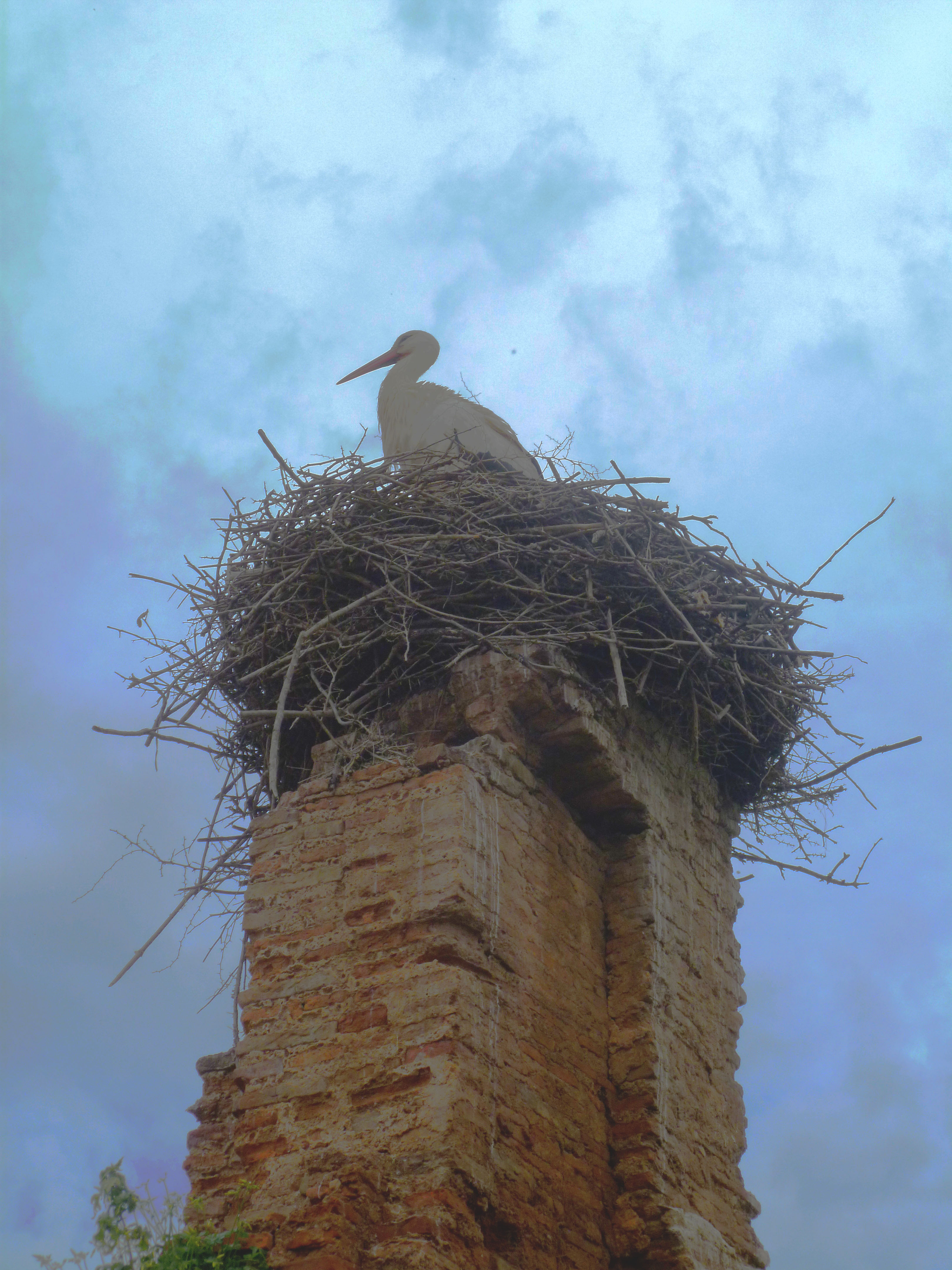
Nesting stork in Morocco, 2013

Ms. Cooke chooses the stork to tell the long story of unraveling the mysteries of migration.  The stork arrives in Europe in early spring which historically coincided with the annual baby boom.  Nine months earlier, on June 21st summer solstice was celebrated with great festivals during which many children were conceived.  This coincidental arrival of storks and babies resulted in the stork becoming a symbol of fertility and childbirth.  A young couple consulting a doctor about their disappointment in not having a child were surprised when told that the stork nesting on their chimney was not a substitute for the sexual encounter they had thought was unnecessary.

Theories about where the storks went when they left their huge nests of sticks were no less imaginative.  In the 17th century an Oxford-educated physics scholar proposed the theory that the storks migrated to the moon:  “’The stork, when it hath bred, and the young fully fledged…all rise together, and fly in one great flock…first near the earth, but after higher…till at last this great cloud…appears less and less by distance, till it utterly disappears.  Now, Whither should be creatures go unless it were to the moon?’”  (1)

This theory was considered an advance over earlier theories.  In the 3rd Century BC, Aristotle had several theories about bird migrations.  His “transmutation” theory suggested that winter robins become redstarts in summer and summer warblers become blackcaps in winter.  His alternative theory was that some birds hibernate in winter.  Actually, the poorwill is the only known hibernating bird. In western North American deserts the poorwill hides in a torpor, avoiding winter food shortages.

Aristotle is the originator of another, particularly persistent hibernation theory.  His belief that swallows spent the winter months at the bottom of lakes and rivers, like fish, is found in “scientific” publications into the 19th century:  “’It appears certain that swallows become torpid during the winter, and even that they pass the season at the bottom of the water in the marshes.’”  (1)

That theory was tested in the 18th century in a series of grisly experiments that cost the lives of many hapless swallows, reminding us that animal rights are a very recent development in science.  On the other hand, we should empathize with early scientists who had little knowledge of the world outside their narrow range of mobility, given limited transportation.  As our world expands so does our knowledge of it.

Pfeilstorch (Arrow Stork)

Ms. Cooke believes the breakthrough in solving the migration mystery occurred in the 19th century when a stork arrived for nesting season with a huge wooden spear lodged in its neck, providing “irrefutable evidence that birds migrate over Africa.”  Ironically, as our knowledge of migration improves, the migration itself is rapidly failing because of anthropogenic (caused by humans) change.

  • Hunting of birds increases as the human population increases and episodically during famines caused by war and crop failures.
  • When farmers in Africa started using pesticides, many storks were killed when they ate poisoned grasshoppers and other large insects.
  • Pollution and drainage of wetlands for farmland caused a sharp decline in Europe’s stork population in the 20th Century:  “The last breeding pair was seen in Belgium in 1895, in Switzerland in 1950 and in Sweden in 1955.” (1)
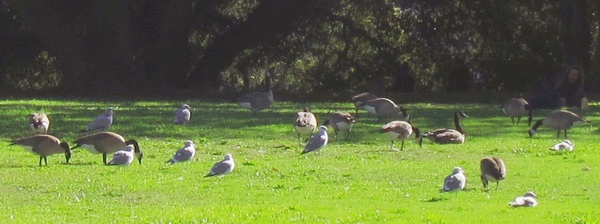
  • Some migrating birds have quit migrating because the gardened landscapes of humans are more hospitable year around than their winter homes. Flocks of Canada geese are seen year around in the parks and open spaces in the Bay Area.
Canada geese, Lake Merritt, Oakland, California. Oakland Wiki

Ms. Cooke laments:  “[Swallow] numbers along with those of dozens of long-haul bird migrants across Europe, Asia and America, are in perilous decline, thanks to the combined effect of global warming, habitat destruction, hunting and pesticides.  Some scientists have suggested that long-haul migration could soon become a thing of the past.  These amazing avian vanishing acts, which puzzled us for so many generations, could themselves magically disappear, just as they’ve finally been demystified.  (1)

Progress, but humility is still needed

Ms. Cooke concludes that although we know more about animals than we did two thousand years ago, we are undoubtedly still making mistakes and must continually refine our understanding“The quest for truth is a long and winding road, littered with deep potholes.  Thankfully our methods are less brutal than those of our eye-popping past, but we are still stumbling along in the dark and making mistakes.  With the rise of efforts to discredit science, there has never been a greater need for truth.  Yet, wrong turns are an essential part of all scientific progress, which demands blue-sky thinking as it seeks out each new horizon in understanding.  As long as our egos or dogmatic beliefs are not to blame, we should not be afraid to continue to make wondrous mistakes…” (1)

Science is a process that is never done.  We celebrate new discoveries, but we must never think of them as the end of the story.  Our minds must always be open to new information if we are to continue to make progress as humans.


  1. Lucy Cooke, The Truth About Animals: Stoned sloths, lovelorn hippos, and other tales from the wild side of wildlife, Basic Books, 2018