Monarch Mysteries Update

“I am sick to death of being told you must use natives, especially if a butterfly has no more interest in it than a fire hydrant.” –Professor Arthur Shapiro, Bay Nature, June 2022

Monarch butterfly populations are studied and quantified during the winter, when they are roosting in the shelter of trees, and during the summer breeding season in warmer climates.  These studies tell different stories.  The breeding population in North America seems to be holding steady since the 1990s in many parts of the country, but the over-wintering population has been steadily dwindling during the same period.  As an academic ecologist recently told the New York Times, “’So it’s not really a production problem,’ said Dr. Davis, an author of the new paper. ‘We don’t have fewer monarchs. We have fewer monarchs reaching the wintering colonies.’”

The most recent study of the breeding population of monarchs is based on a huge data set of 135,000 observations in 403 different sites in North America, partly collected by volunteers of the North American Butterfly Association (NABA) annual summer butterfly count since 1993.  The analysis of current population trends reveals interesting clues about the future of monarchs and probably many other butterfly species:

  • The study “used federal data to estimate how much glyphosate was being used in the area around each survey site. They found that in some regions, especially in parts of the Midwest, glyphosate use was associated with declines in abundance.”
  • “But they also documented a countervailing force: climate change. In the northern part of the United States, increasing temperatures were correlated with increases in monarch abundance. This effect was especially pronounced in the Midwest, suggesting that the warming climate might have partly offset the effects of glyphosate in that region.”

The study of monarch breeding populations in North America found that the Southwest was one of the regions in the US where monarch population declines were greatest.  That finding is consistent with the study of academic entomologists, Matt Forister and Arthur Shapiro, of butterfly populations in the West.  They analyzed data from over 40 years of counting butterfly populations (including NABA data) to learn that 450 butterfly species in western states have declined 1.6% per year in the past 20 years, for a cumulative total of 25% fewer butterflies. Although there are several factors—such as habitat loss and pesticides—their study determined that the strongest factor was climate change, particularly warmer temperatures in the fall.

Professor Shapiro explained during an interview on KALW why extreme heat is harmful to butterflies, although the reasons have not been proven yet. Monarchs are one of the butterfly species that is dormant during winter months. They breed in spring when temperatures begin to warm and days become longer. Warmer winter temperatures are reducing the length of dormancy, which increases their need for year-around food and weakens them if there is inadequate food. Extreme heat and drought have an impact on plants, reducing available food for all butterflies.

Studies of Migrating Monarchs

How do studies of migrating monarchs compare to studies of breeding populations in North America?  There are two major migrations of monarchs in North America.  The migration east of the Rocky Mountains spends the winter in Mexico and the migration west of the Rockys spends the winter on the coast of California.  Both of the overwintering populations have plummeted since the 1990s until the winter of 2022 when the population stabilized in Mexico and increased substantially in California.

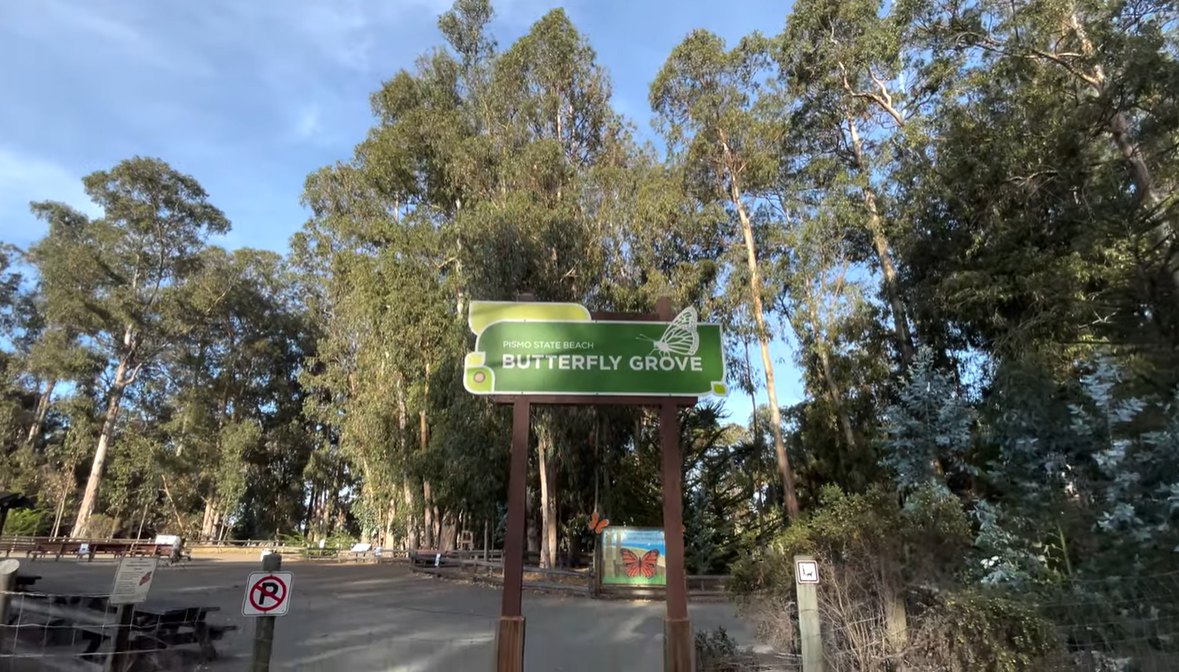
The increase in the California monarch migration was described by Jessica Griffiths in an article published by the Sierra Club’s national magazine.  That article is significant for several reasons.  The particular roosting site where the population increase was greatest was a eucalyptus grove in Pismo Beach, California:   “We are standing in a eucalyptus grove on a small patch of undeveloped land bordered by farms near the town of Pismo Beach, on the central California coast. The air smells faintly of brussels sprouts and compost, with an overlay of something like Vicks VapoRub—the distinct scent of eucalyptus. Griffiths gazes up at the branches and smiles. There are so many butterflies.”  The irony is that Jessica Griffiths is the author of a deeply flawed study that claims that monarchs prefer native conifer trees to eucalyptus trees for their winter roost.  One wonders if Jessica Griffiths experienced cognitive dissonance as she counted 17,845 monarch butterflies roosting in a eucalyptus grove where only nine monarchs roosted the previous year.
Jessica Griffiths provides an important clue to changes in the monarch migration in the Sierra Club article.  She says monarchs roost in the trees until the temperature rises to about 55⁰ Fahrenheit, when their body temperatures rise enough that they can actively seek the nectar they need to survive.  She says, “They are basically solar powered,” which is another way of saying they are cold-blooded animals that require the heat of the sun to be active.  In the eucalyptus groves that monarchs prefer as their winter roost in California, nectar is close at hand because eucalyptus blooms during winter months, at a time when little else is blooming.
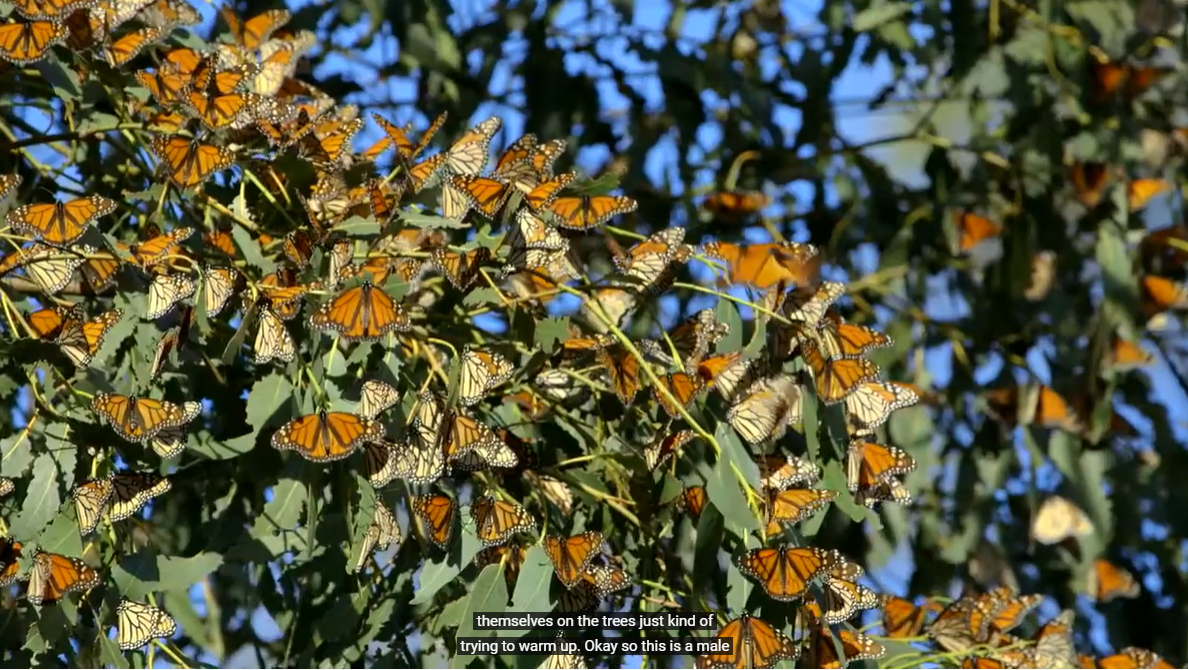
Pismo Beach, November 2021 Source: https://youtu.be/Su2Ma2lUWFY

When the climate changes, entire ecosystems change with it

When days become shorter in the fall, monarchs in California stop breeding and begin their migration to the coast.  Breeding resumes when days become longer in the spring.  But hours of daylight are not the only determinant of the monarch breeding season.  Warmer temperatures at night are triggering the monarch breeding season earlier than in the past.  In fact, some entomologists hypothesize that many monarchs are now breeding year around. The presence or absence of milkweed does not trigger the breeding season, which is determined by hours of daylight and temperature. 

If the warming climate enables monarchs to breed year around, why would we object?  The more monarchs, the merrier, right?  Unfortunately, hobbyist naturalists DO object to altering the timing and location of the breeding of monarchs.  This is a Letter to the Editor of the Yodeler, the newsletter of the San Francisco Bay Chapter of the Sierra Club:

Sierra Club Yodeler, Summer 2022

The author of the letter to the editor of the Yodeler asks us NOT to plant milkweed near the coast or monarch overwintering sites, presumably because she doesn’t want the monarch’s breeding season to begin when and where it has not occurred in the past.  The fact is, the climate has changed and monarchs are responding to those changes.  Who are we to argue with monarchs about what they need to do to survive?

Bay Nature has published an article about monarchs seen in Marin County during their breeding season, where they have over-wintered in the past, but not bred historically.  The warming climate and the availability of perennial tropical milkweed is making Marin County suitable breeding habitat:  “A lot of people have this feeling that without the migration, the monarch is nothing,” says James. “That’s not necessarily true. If we got rid of the migration, the butterflies could still continue. For humans, that would be a pity. But in the ecology of things…it’s not that bad.”  The author of the article welcomes monarchs to Marin County, “A new Bay Area neighbor, adapting to a changing world, making do with what is available, as we all must.”

The monarch migration is not sacrosanct.  Monarch butterflies also live in Central and South America, in the Caribbean, in Australia, and even in parts of Europe and New Guinea. But all of these monarch populations are sedentary, meaning they stay in one place and don’t migrate.  If changes in climate enable monarchs to live and breed year around, why would we want to prevent them from doing so? 

If monarchs can find what they need year around, why should they be forced to migrate? Migration is physically demanding, depleting the physical resources of an animal.  If survival of a species doesn’t require migration, more physical resources are available for other functions, such as increased reproduction or less need for food to fuel the migration.  Images of struggling human migrants come to mind.  Wouldn’t they all be better off if circumstances at home would enable them to stay home? 

A comparable change has occurred in the life cycle of Anise Swallowtail butterflies.  Prior to the introduction of non-native fennel to California, Anise Swallowtails bred only once each year because its native host plant—closely related to non-native fennel–was not available during most of the year.  Non-native fennel is a perennial plant that is available year-around, making it possible for Anise Swallowtails to breed throughout the year.  Thanks to non-native fennel, we enjoy the company of many more Anise Swallowtails.  We should not think of the life cycles of plant and animal species as immutable.  Rather, they are constantly changing to adapt to changes in their environment and adaptation is what will ensure their survival. 

Native vs. Non-native Milkweed?

Hobbyist naturalists also ask that we plant only native milkweed, the host plant for monarch caterpillars.  Such restrictive advice is not beneficial to the survival of monarch populations.  Although a popular opinion among hobbyists, advice against planting non-native milkweed for monarchs is contradicted by scientific sources: 

  • …there is little evidence to support the idea that planting Tropical Milkweeds will weaken Monarch populations and NO evidence to support the idea that Tropical Milkweeds are “trapping” Monarchs and stopping them from migrating…”  American Butterflies, magazine of the North American Butterfly Association
  • A study of lifespan of monarchs breeding on non-native milkweed compared to native milkweed found that monarchs raised on tropical milkweed (A. curassavica) lived as long or longer than monarchs raised on other species of milkweed. They were less likely to be infected, and once infected, tolerated the infection well. (Leiling Tao et.al., “Disease ecology across soil boundaries: effects of below-ground fungi on above-ground host—parasite interactions,” Proceedings of Royal Society of Britain, 282: 2015.1993.)
  • An article from the UC Davis Bug Squad says they plant tropical milkweed and two species of native milkweed. Monarchs have a strong preference for tropical milkweed: “In July, we collected 11 caterpillars from the narrowleaf [native] milkweed; we rear them to adulthood and release them into the neighborhood. But in the numbers game, the tropical milkweed won. From July through today, we have collected a whopping 43 eggs or caterpillars from [non-native] A. curassavica. How many from [native] A. speciosa? Sadly, none.”
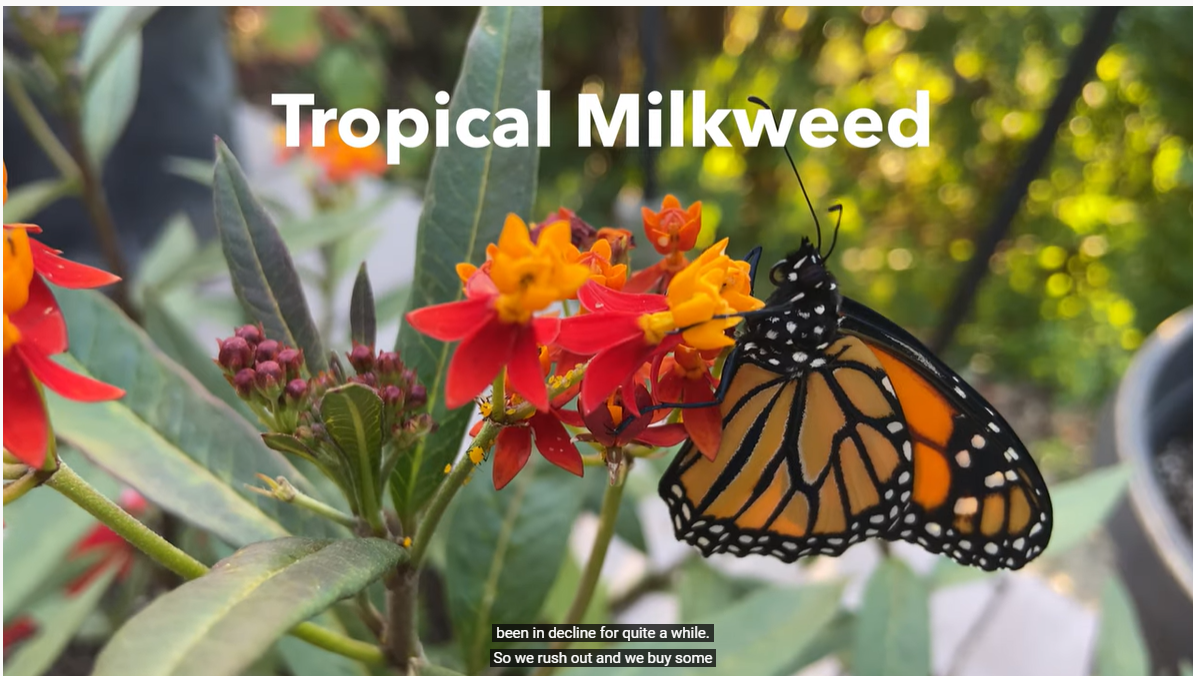
Hobbyists theorize that tropical milkweed harbors more parasites than native milkweed because tropical milkweed is a perennial plant, which suggests that parasites could accumulate from one year to the next. If gardeners are concerned about the potential for accumulation of parasites, they are advised to cut tropical milkweed back during winter months. Because tropical milkweed is a perennial, it is available for monarch breeding earlier in the spring than annual native milkweed.  If monarchs breed earlier in the spring, tropical milkweed accommodates earlier breeding.

How to help monarchs

The future of monarchs is uncertain, just as the future of all life in our changing climate is uncertain.  I am betting that monarchs have a future partly because they have survived many changes in the environment for some 50 million years since butterflies evolved from moths.  We can best help monarchs by staying out of their way.  They would also probably benefit if we would stop destroying their habitat, particularly eucalyptus trees and tropical milkweed.

Vegetation changes as the climate changes and animals follow the vegetation they need as they must to survive.  Breeding season of butterflies and other wildlife is also likely to change with the climate. The rebounding monarch population is probably another case of animals moving to find what they need. We should not stand in their way.  They know what they need better than we do.

“Restoring Our Forests by Trusting in Nature”

“The world’s forests will be restored not by trying to recreate the past, but by providing the space for such forests to find their own new future.” –Fred Pearce

Fred Pearce is the author of The New Wild, which challenged the conventional wisdom that native species are inherently superior to non-native species and the closely related assumption that all non-native species are competitors of native species.  The New Wild is the most effective of the many critiques of invasion biology, which made his latest book required reading (for me).    

A Trillion Trees:  Restoring Our Forests by Trusting in Nature (1) examines the popular notion that planting one trillion trees around the world can deliver us from the death grip of climate change.  Once again, Fred Pearce challenges the conventional wisdom.  The claim that planting a trillion trees can compensate for our continuing burning of fossil fuels is an oversimplification, but with much truth at its core.

Forest Accounting:  Debits and Credits

Pearce begins by reminding us of the ecological value of forests and the role they play in reducing greenhouse gas emissions causing climate change.  In addition to absorbing carbon dioxide from the atmosphere during photosynthesis, forests also release water into the atmosphere in the form of water vapor.  Trees pump moisture from the ground into their leaves where excess moisture is transpired from pores (stomata) in leaves, moistening the atmosphere and returning moisture to the Earth as rain.  In a time and place where extreme drought is a major issue, this is a strong argument for retaining our forests.

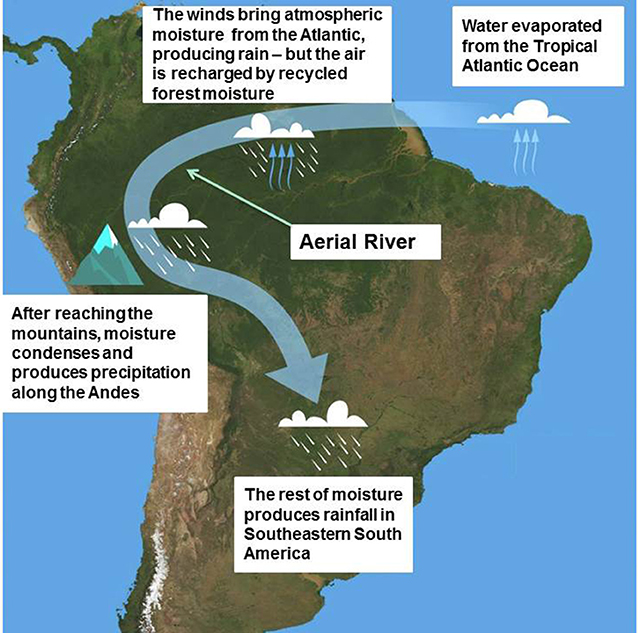
On a global scale, forests are responsible for carrying moisture from coastal forests irrigated by moist sea breezes into drier regions on streams of moisture transpired by forests, Pearce calls flying rivers.  Where coastal forests are destroyed, this moisture delivery system is interrupted, resulting in drought in interior regions.  Observational data confirms this cycle:  “Air coming from forested areas delivered more than twice as much rain as deforested areas.  Forests make rain; taking them away creates if not deserts, then certainly aridity.”

The aerial river of moisture transpired by forests is carried by the wind and forests contribute to the wind.  Transpiration emits buoyant water vapor that condenses to water as it rises and cools.  Liquid water takes up much less space than water vapor, causing a pressure drop where water vapor becomes liquid water, resulting in wind. Some scientists believe that this “biotic pump” creates stronger wind than the winds that are created by cool ocean breezes meeting hot continental air.  These theories are controversial, but Pearce finds them credible. 

All trees emit volatile organic compounds, commonly abbreviated VOCs. VOCs neutralize a chemical known to neutralize methane, resulting in increased methane emissions from forests. Methane is the most potent greenhouse gas, although it does not persist in the atmosphere as long as carbon dioxide. 

Source: Wikipedia

Although forests create their own cooling environment with shade and moisture, they also absorb heat from the sun.  Albedo is the technical term used to measure light reflection and absorption. Because dark colors absorb heat and light colors reflect heat, this balance of cooling and heating factors varies. In Northern and Southern latitudes where winter snows reflect sunlight, dark forest canopies absorb more sunlight than treeless snow-covered ground.  Likewise, desert sand reflects more light than dark forest canopy.  Measuring the net effect of the many intervening factors such as albedo on climate change is controversial, even speculative at this time.

Evaluating Planting Projects

Pearce visited tree planting projects around the world and concluded that many are counterproductive in the short term and others are not sustainable in the long term. 

  • Some projects are planting plantations of fast growing trees such as eucalyptus and pine with the intention of logging them within about 10 years to produce timber, pulp, or biofuels.  The short term objectives of these projects do not address the long term problem of climate change. 
  • Some projects are planting single tree species that aren’t necessarily well adapted to local conditions.  The resulting monoculture is more vulnerable to disease, insects, and changed climate conditions.
  • Many huge projects exist only on paper.  Elaborate plans don’t necessarily produce new forests. 

Israel’s strong commitment to planting trees on its desert land illustrates the pros and cons of tree-planting projects.  Trees are important in Jewish culture.  Jews around the world celebrate an annual holiday of trees, Tu BiShvat.  A national nonprofit group created in 1901 bought land to support the Zionist cause and has planted 250 million trees on a quarter-million acres in the desert in what is now Israel. 

Yatir Forest in Israel. Source: Wikimedia Commons

One such project has planted 4 million Aleppo pines on the slopes of Mount Hebron near Tel Aviv since 1964.  Aleppo pines grow naturally in wetter Mediterranean regions.  They cope with drought by growing only briefly during spring rains in Israel and are dormant during most of the dry, hot year.  There are limits to this adaptation.  A year-long drought in 2010 killed 10% of the forest.  Because of the slow growth of the forest, the carbon storing capacity of the forest has yet to match the heat the forest absorbs that would otherwise be reflected by light-yellow desert sands.  Scientists who study this forest do not expect the forest to attain net cooling advantage for another 80 years.  There is some doubt that the forest will live that long, given rapidly rising temperatures and associated drought. 

Deforestation and Rewilding

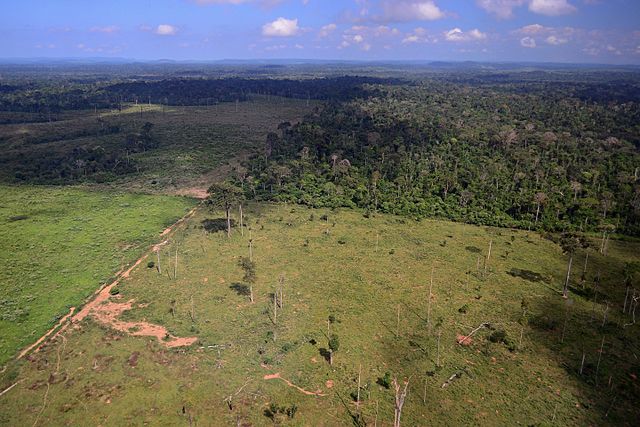
Pearce also visited places where forests are being destroyed in Indonesia, South America, and Africa.  In Indonesia, the economic value of the trees themselves is the primary motivation for destroying forests.  In Brazil, the primary goal of deforestation is to convert forests to pastures for livestock and agricultural fields for commodity crops that feed animals. 

Developed nations have exported much of their agricultural and animal production to undeveloped nations.  As agricultural land in developed nations is abandoned, forests have regenerated.  In New England, for example forest cover was only 30% by the mid-19th century after 200 years of timber exploitation and clearance of agricultural land.  Industrialization brought farmers into cities and marginal agricultural land was abandoned.  Today most of New England is forested again.  As that transition from an agricultural to an industrial economy was made in developed nations, forests in undeveloped nations were destroyed to produce agricultural products exported to developed nations. 

Deforestation in Para State, Brazil. Source: Wikimedia Commons

In Brazil, the rewilding of agricultural land is already occurring.  Forests were cleared and seeded with grass for cattle pastures, but the poor soil is quickly exhausted and grass won’t grow after a couple of years.  These abandoned pastures recover their forests even on exhausted soil, but they won’t be mature rainforests again for many years. When forests cleared for agricultural crops lose most of their rainfall, agricultural crops fail.

Pearce visited agricultural communities in Africa that have figured out that it isn’t necessary to destroy forests in order to grow crops.  Farmers had to ignore the dictates of their government to clear their land before planting crops to learn that planting crops within groves of trees is just as productive.  The trees provide shade and moisture that shelter crops as well as create a more comfortable home for the community. 

Forests that are embedded in indigenous communities are more safeguarded than forests in so-called protected areas, where indigenous people have been evicted.  If forests are sustainably used by the community, the community has a direct economic interest in its preservation.  When indigenous people are evicted from forests, a handful of salaried rangers can’t provide the same level of surveillance, making forests more vulnerable to poaching and corrupt encroachment.  People have tended their forests for eons and community forestry is an extension of that relationship.  They understand the forest as no outsider could. 

 Pearce’s Message

Pearce believes that protecting the forests we have and allowing forests to regenerate naturally where agricultural land can be abandoned is preferable to planting trees because:

  • Planting trees where trees have never grown in the past is not likely to create a sustainable forest. If soil and climate conditions have not supported trees in the past, it is probably an unsuitable location for trees.
  • Huge projects that plant millions of trees are often creating monocultures of a single species of fast-growing trees.  Such monocultures are vulnerable to pathogens, insect infestations, and changes in climate.  Forests that regenerate naturally are more diverse, although they aren’t necessarily the same species as in the past because of epidemics of pests and pathogens.  “However clever the foresters were, the planted trees were less well suited to the space they were occupying than those chosen by nature” and “Natural regeneration helps species to shift and adapt to climate change.”
  • Newly planted trees require more support than a forest that is regenerating from roots and seedbanks.  They must be irrigated while they are establishing the fungal networks that give them access to moisture in the soil.  They don’t benefit from moisture and carbon resources shared by their mature neighbors.  They aren’t members of an existing, sharing community of trees.

Much of what is done in the name of “conservation” is destructive.  Pearce makes a strong case for natural recovery rather than active intervention in natural processes:  “Most of the fifteen-percent increase in forest cover across the eastern United States in the past four decades has come from natural regeneration rather than planting.” However, urban areas in America have lost 175,000 acres of trees cover each year for the past decade, according to the US Forest Service.  We have experienced such loss of our urban forests here in the San Francisco Bay Area. 

Bringing it home

Pearce’s message is consistent with my personal experience based on observations of tree-planting projects in the San Francisco Bay Area.  Our urban forests are being destroyed for many reasons:  to make way for development, to reduce fire hazards, and to eradicate non-native trees.  Little planting is done when trees are destroyed.  The tree species that are planted are often not suitable for the location.  When new trees aren’t irrigated regularly, they don’t survive.

Point Isabel is one of many parks in the East Bay Regional Park District where redwoods have been planted that died because they are not well adapted to places where they are directly exposed to salty, ocean winds.

More effort should be devoted to preserving forests because replacing them is largely a fiction. 

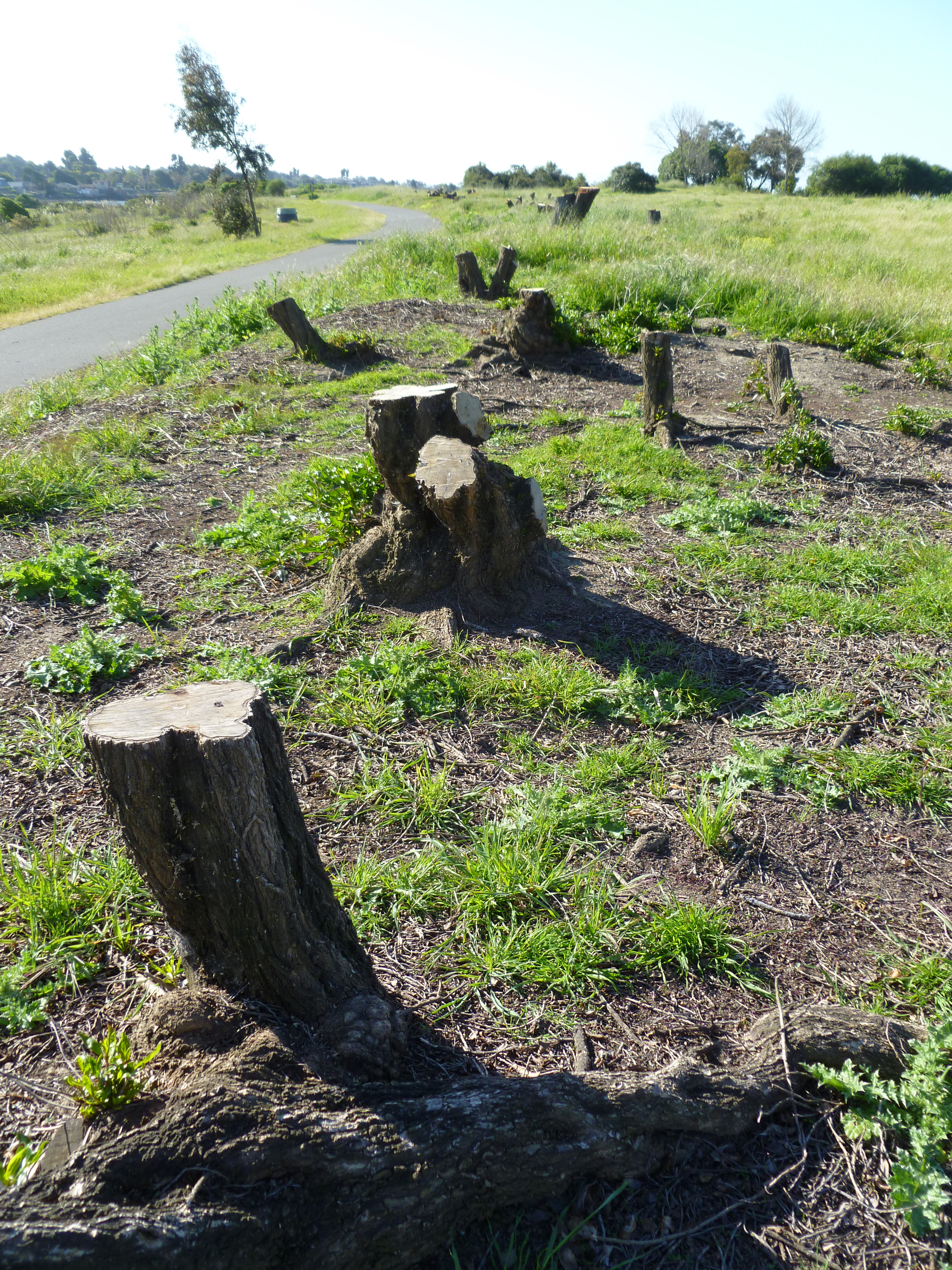
When East Bay Regional Park District acquired Oyster Bay in San Leandro, they destroyed the wind breaks of non-native trees.
Over 10 years later, the attempt to create a wind break of native trees at Oyster Bay has made little progress. This is another coastal location with salty ocean winds that are not hospitable to native tree species. Most of coastal California was treeless grassland prior to European settlement.

  1. Fred Pearce, A Trillion Trees:  Restoring Our Forests by Trusting in Nature, Greystone Books, 2021.  All quotes in this article are from this book.