As a long-time reader of Jake Sigg’s Nature News, I am very familiar with his passionate crusade against Oxalis pes-caprae. When oxalis appears in the landscape in January, Jake gears up his campaign again. This year the Westside Observer published an article by Jake about oxalis that reaches a new level of urgency and asks land managers to increase their use of herbicides to kill the plant.
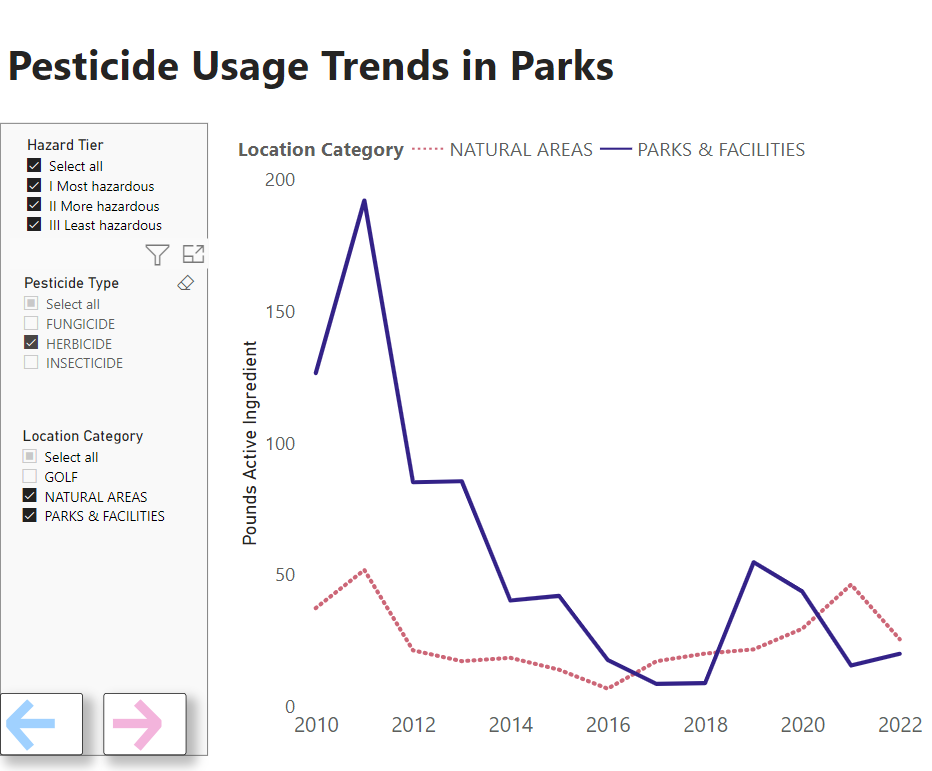
In the past, Jake has advised careful and relentless hand-pulling of oxalis with its bulb intact. Now he acknowledges that hand-pulling is useless to eradicate oxalis. Although herbicides have been used on oxalis in San Francisco’s parks for 25 years, Jake now wants MORE herbicides to be used. Over 20% of all herbicide spraying by the Natural Resources Division (NRD) of the Recreation and Park Department was applied to kill oxalis in “natural areas” in 2022. NRD sprayed oxalis 35 times in 2021 and 38 times in 2022.

From January to March, virtually all the herbicides sprayed by NRD in the so-called “natural areas” were sprayed on oxalis. If it were possible to eradicate oxalis with herbicide, why is there more oxalis now than there was 25 years ago, when NRD (then known as the Natural Areas Program) started spraying herbicides in the “natural areas?” A lot of herbicide has flowed under the bridge in the past 25 years, but oxalis thrives. What is the point of pouring more herbicide under the bridge of sighs? We’re pouring more fuel on the fire with nothing to show for it.
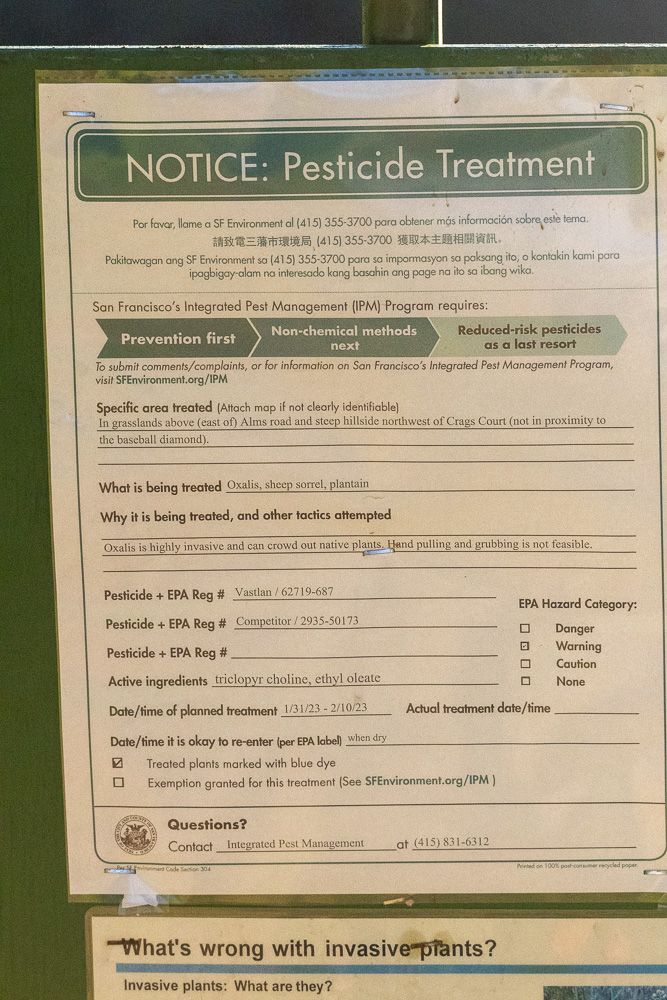
The University of California Integrated Pest Management Program explains why it’s not possible to eradicate Oxalis pes-caprae with herbicides: “Several postemergent herbicides including triclopyr and fluroxypyr (selective for broadleaf plants) and glyphosate and glufosinate (nonselective) effectively kill the top growth of this weed but are harmful to most ornamentals, so be careful these herbicides don’t drift onto desirable plants. These herbicides don’t kill the bulbs, and regrowth from bulbs should be expected.” In other words, you can kill the above-ground top growth and other non-target plants in the vicinity, but you won’t kill the oxalis.
Chemical Warfare?
On one hand, Jake urges public land managers to escalate chemical warfare against oxalis. On the other hand, he accuses oxalis of “chemical warfare” (AKA allelopathy), secreting chemicals that kill other plants. This accusation is pure speculation on Jake’s part. He offers as “evidence” of his speculation that after oxalis dies back in April “we’re left with bare ground for the rest of summer and autumn.” He ignores the obvious fact that annual spraying of gallons of herbicide on oxalis in the “natural areas” could be causing the bare ground. It has apparently not occurred to him that many herbicides are non-selective, killing everything they touch, not just targeted plants. And those herbicides that claim to be selective are very mobile in the soil, capable of killing adjacent plants through their roots. If you don’t want to see bare ground, don’t spray herbicides!
Jake asks for more research on how oxalis interacts with other plants in his article published by Westside Observer. He is apparently unaware of the research that has been done by scientists at University of Montana to address the question of how competitive oxalis is in plant communities that include native plants: “Oxalis is a poor competitor. This is consistent with the preferential distribution of Oxalis in disturbed areas such as ruderal habitats, and might explain its low influence on the cover of native species in invaded sites.”
The study explains why oxalis does not suppress the growth of other plants, including natives. Oxalis makes more phosphorous available in the soil, which essentially acts as a fertilizer for other plants: “These results are consistent with our field data and suggest that Oxalis may improve P availability in the field.”
This study was published in 2007. It found that Oxalis pes-caprae does not suppress the growth of other plants and, in fact, increases nutrients in the soil. Jake apparently doesn’t know about this study and related studies that found that pollinators are as interested in O. pes-caprae as they are in native plants.
Jake’s accusation that oxalis is waging “chemical warfare” against native plants does not come out of nowhere. The same accusation was used against eucalyptus trees for decades until a definitive empirical study proved that eucalyptus is not allelopathic. The California Invasive Plant Council removed that accusation from its evaluation of Blue Gum eucalyptus in 2015 (along with the accusation that eucalyptus kills birds). As the readers of Jake’s Nature News know, his hatred of eucalyptus is second only to his hatred of oxalis. There was never evidence that eucalyptus is allelopathic and there is no evidence that oxalis is allelopathic.
Does biodiversity justify poisoning nature?
Jake justifies his crusade against oxalis based on his belief that its existence threatens biodiversity. Since there is no evidence that oxalis kills other plants, there is no reason to believe its existence threatens biodiversity.
Jake also asks us to include only native plants in the measure of biodiversity, but he is alone in that belief. Scientific measurements of biodiversity include all species of plants and animals, whether considered native or non-native. The Recreation and Open Space Element of San Francisco’s General Plan explicitly acknowledges that both native and non-native plants contribute to biodiversity: “Parks and open spaces in San Francisco include both native and non-native species, both of which can contribute to local biodiversity.” (Policy 4.1, Recreation and Open Space of San Francisco General Plan)
Jake ups the ante against oxalis by claiming that wildlife requires solely native plants, a fundamental tenet in native plant ideology. Again, this claim is unsupported by evidence. As Professor Art Shapiro (UC Davis) says in his Field Guide to Butterflies of the San Francisco Bay and Sacramento Valley Regions, “Most California natives in cultivation are of no more butterfly interest than nonnatives, and most of the best butterfly flowers in our area are exotic.”

On one hand, Jake claims that oxalis deprives birds and other foragers of food. On the other hand, Jake acknowledges that oxalis is foraged by gophers and scrub jays (based on one observation). Jake wants it both ways because that serves his purpose.
If native plants were any benefit to wildlife, that benefit is quashed by the widespread use of herbicides being used in the “natural areas.” For example, Himalayan blackberries are an important source of food for birds and other wildlife in San Francisco’s parks and are also eaten by children visiting the parks. The blackberries are routinely sprayed with herbicides in the so-called “natural areas.” Wildlife is exposed to the herbicides and they are also deprived of important sources of food.
A recent survey of 24,000 gardens in the UK found that pesticide use had a significant effect on bird life. The study found that gardens that used pesticides had fewer species of birds than similar gardens that did not use pesticides:
“Pesticide spraying impacted the positive effect [surrounding habitat quality] had on bird richness. Specifically, ‘species richness [number of species] increases with the surrounding quality, both for gardens that do not use pesticides and for gardens that applied pesticides, but this effect is significantly less strong when pesticides are applied’ the study indicates. Scientists zeroed in on three active ingredients: the weed killer glyphosate, the neonicotinoid insecticide acetamiprid, and the synthetic pyrethroid deltamethrin as resulting in the most damaging pesticide impacts to bird species’ richness.” Note that the study’s definition of “surrounding habitat quality” made no distinction between native and non-native plants. The British are not strong supporters of native plant ideology.
Nativists keep using huge quantities of herbicide to kill vegetation they don’t like, while also claiming that their eradication projects benefit birds. This is a fundamental contradiction. Their eradication projects are harmful to birds and other creatures that live in our parks and open spaces.
Jake’s Lament
In his article, Jake laments that people are accepting changes in the landscape because they don’t remember what the landscape looked like 100 years ago. His “baseline view” of what landscapes should look like is much further in the past than most people’s memories of the landscape.
The climate has changed significantly in the past 100 years. When the climate changes vegetation changes. We should welcome the changes because they are required for the survival of any landscape. When the climate changes, plants and animals must move, adapt, or die. The changing landscape is an indication that plants are adapting to changing conditions.
We cannot stop evolution, nor should we try. Herbicides are a futile attempt to stop evolution. Herbicides cannot stop evolution, because plants evolve a resistance to them. After 25 years of constant herbicide use in San Francisco’s parks and open spaces, we should assume that they are less effective every year.
 Conservation Sense and Nonsense