We spent a few days in a small family-owned resort in Sierra City in mid-July. It’s an area we know well because we have visited many times in the past 25-years and taken many birding and geology courses at the nearby San Francisco State University Sierra Nevada Field Station.
It has been about 12 years since our last visit and we were expecting to see significant changes after a decade of drought. Our previous visits were also earlier in the summer, during nesting season in June, when birds are more active and vocal. As expected, the weather was much warmer than previous visits.
The Setting
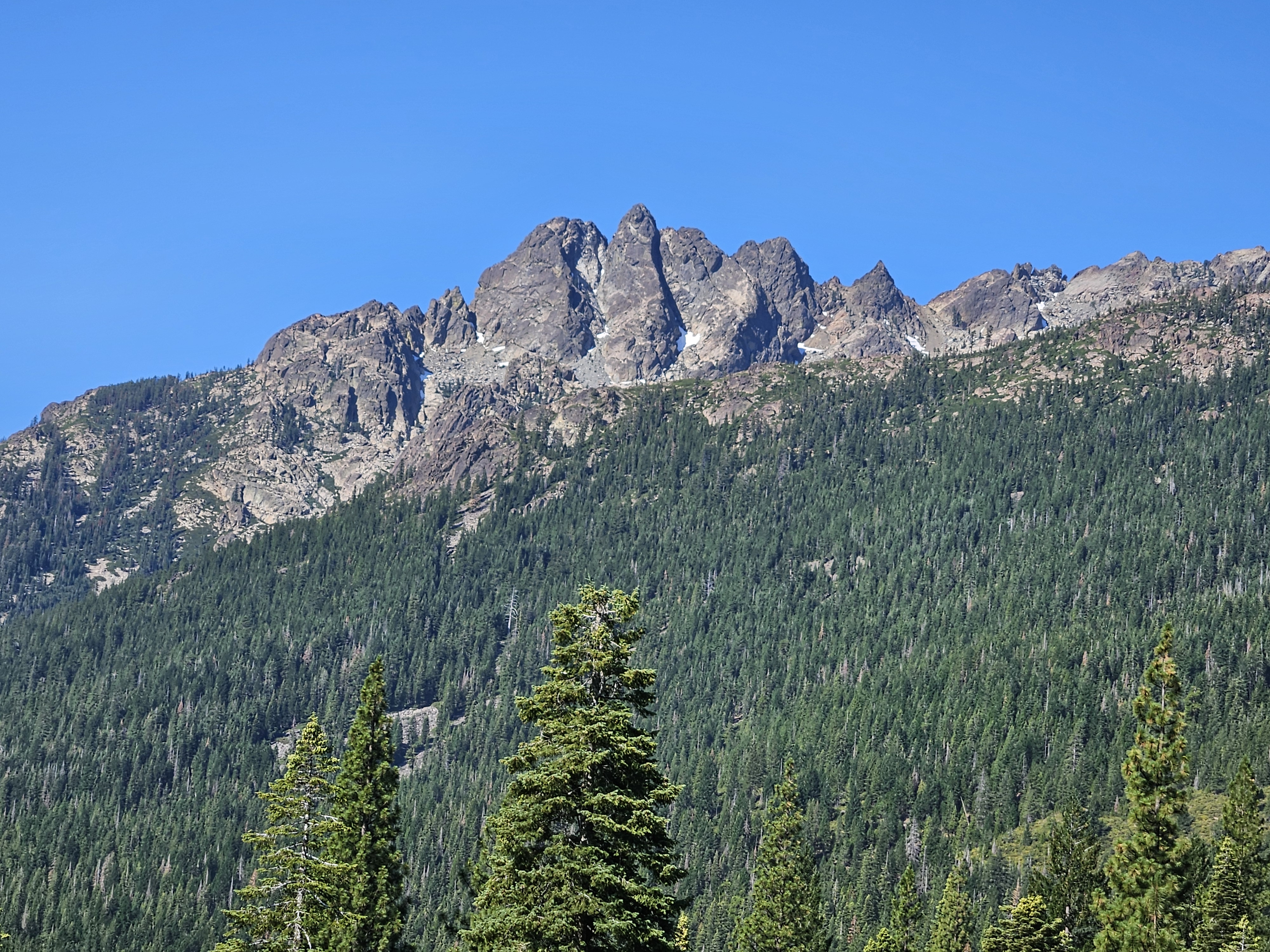
Sierra City sits at the base of Sierra Buttes at 4,200 feet elevation. Sierra Buttes tower above at 8,560 feet. The Buttes are the remains of the lava flow of an ancient volcano. The soft rock surrounding the lava flow eroded away long ago and the harder rock has been sculpted several times by glaciers during past ice ages. The glaciers sculpted rocks on the valley floor into the basins of many lakes that remain today.
This area was occupied by a hunter-gatherer culture of Indigenous people for thousands of years. They migrated according to the seasonal harvests of plants and animals until Europeans arrived in 1850 to mine for gold. The first generation of the owners of the resort arrived as miners. When gold was exhausted, ranching became the family enterprise. When the recreational treasures of the area were discovered in the 1960s, the family converted the ranch to a resort in 1967. The economy of this area has evolved, just as its flora and fauna have.
Fire Hazard Mitigation?
The most significant change we observed since we were last in the Sierras is the massive timber operations. In the 12 miles from Sierra City to Yuba Pass at 6,700 feet, we saw roadside clearings created by cutting young trees. Huge piles of small-diameter logs and wood chips were stacked in the clearings (see below).
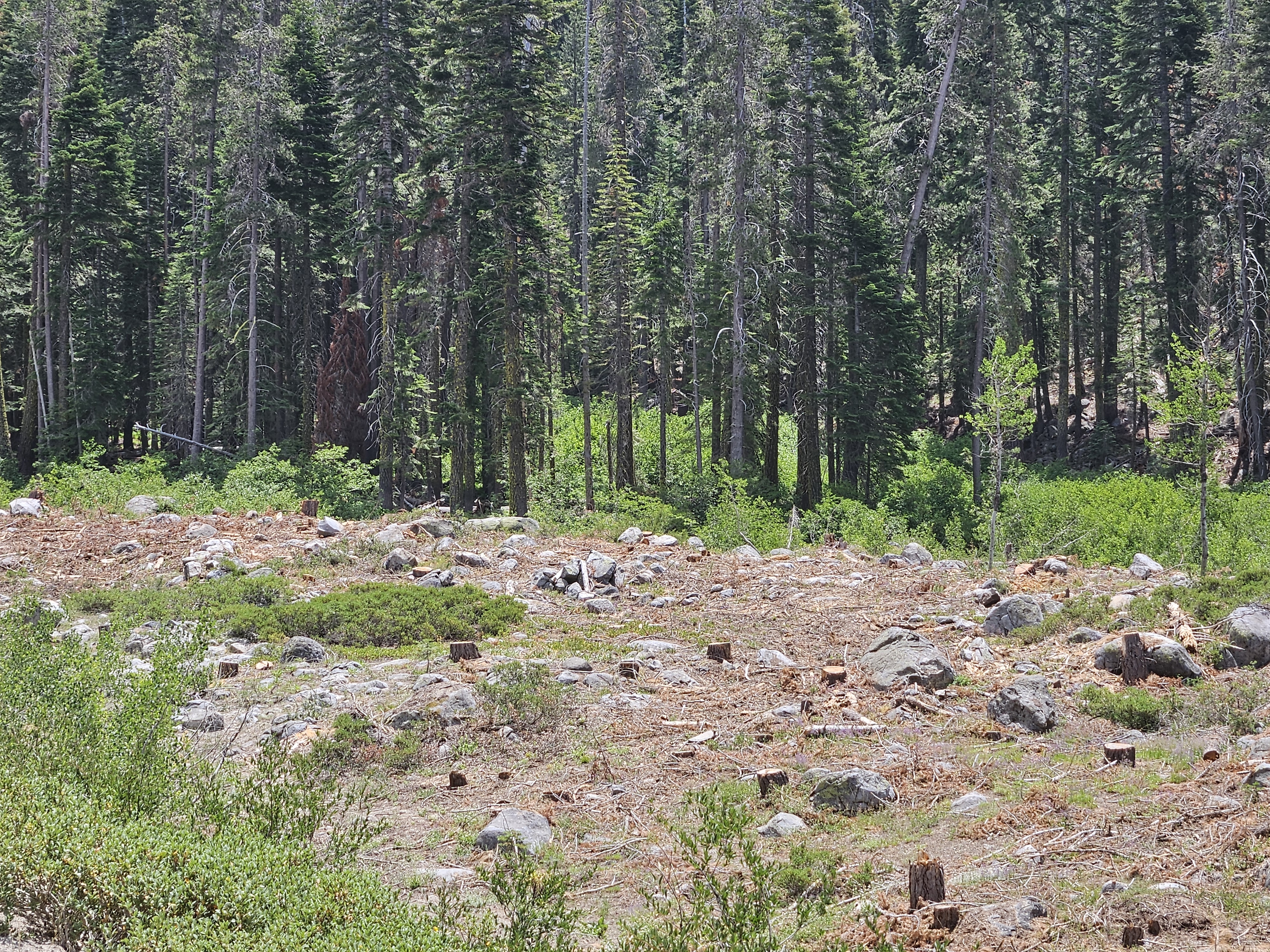
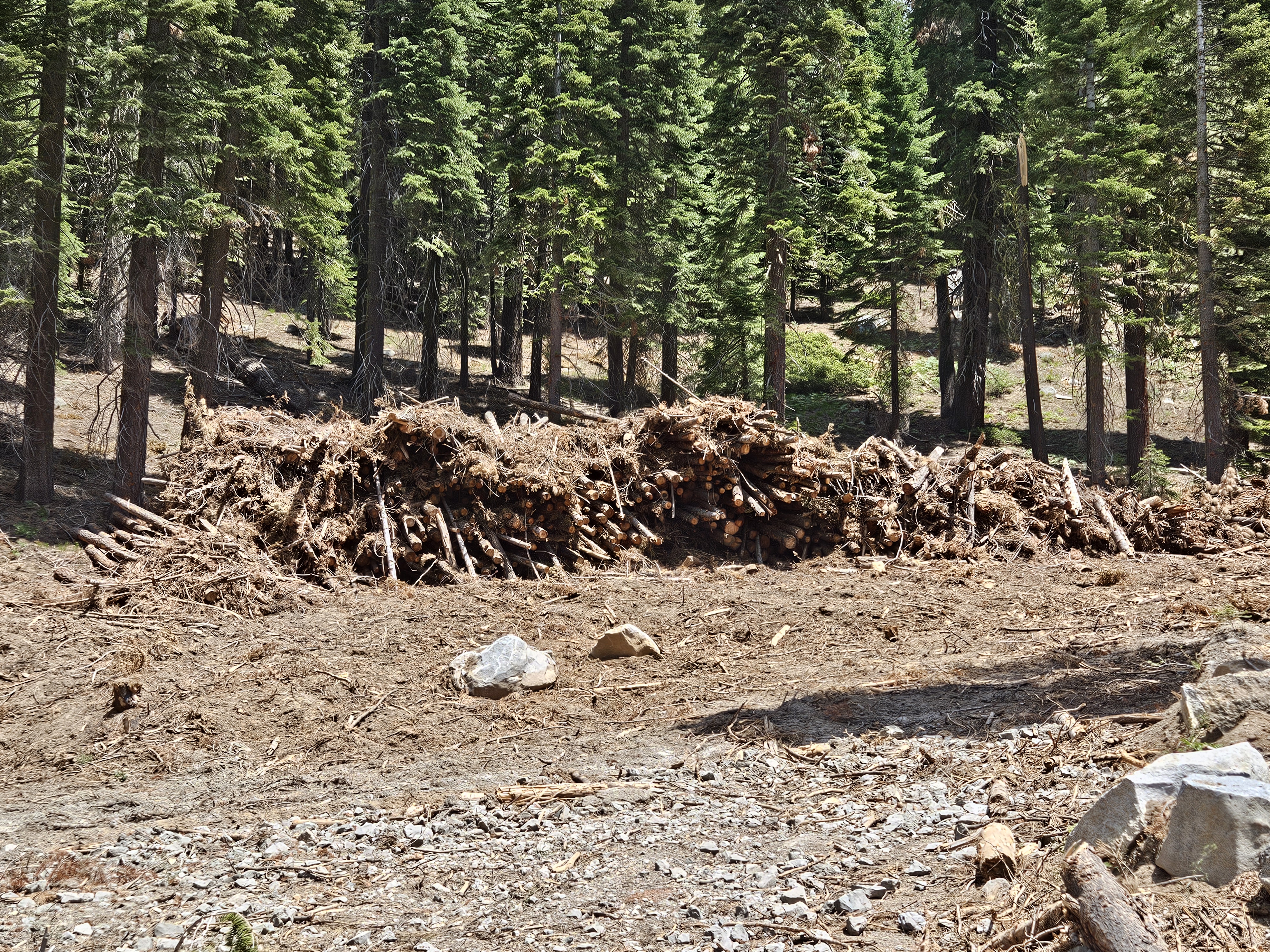
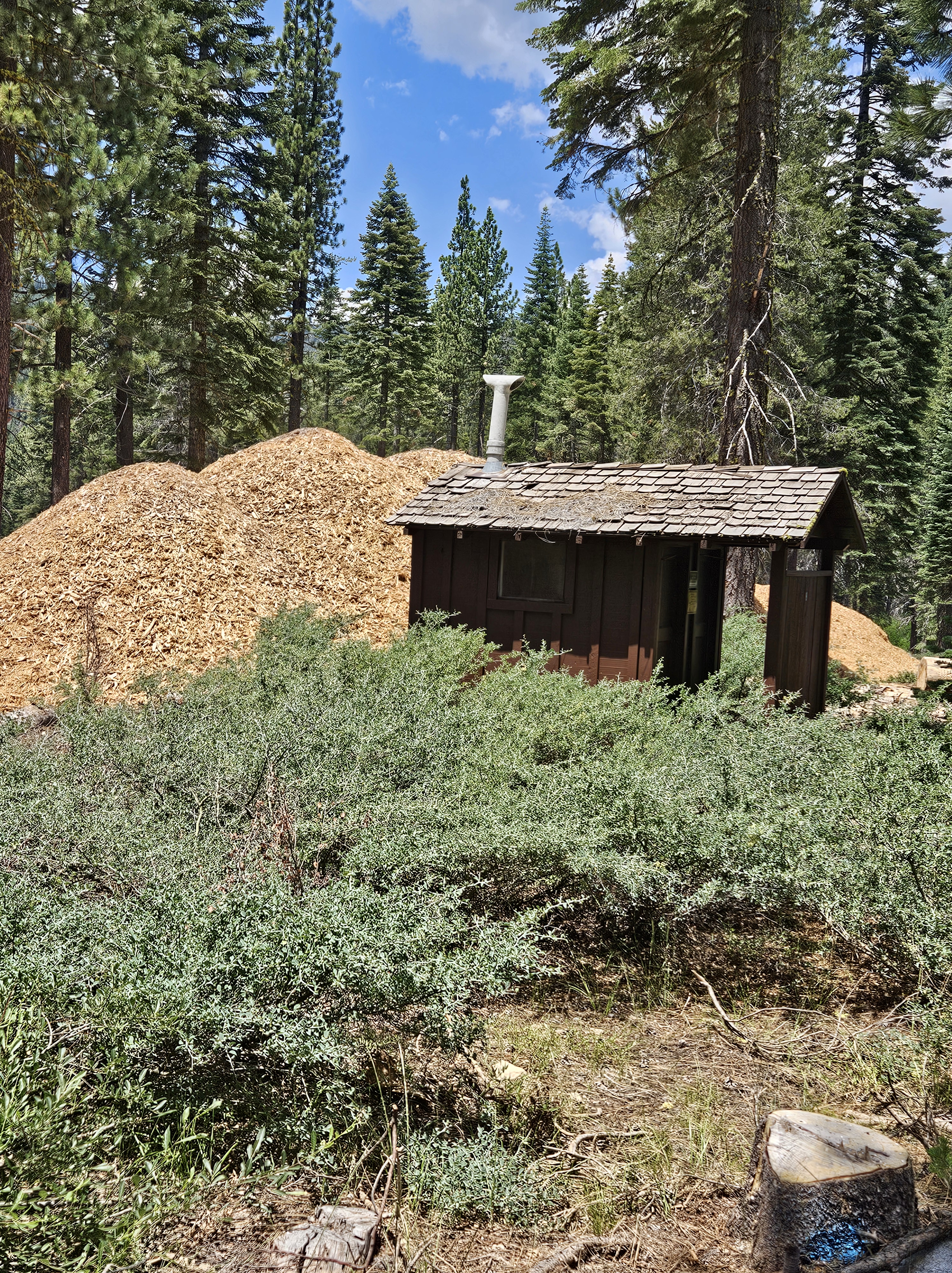
These clearings looked like fire hazard mitigation partly because of their proximity to the road and to campgrounds, but also because they destroyed small trees, which are more likely to ignite than big trees. On the other hand, the piles of logs and wood chips are more flammable than any living tree, big or small.
Thinning the forests is also a strategy to reduce competition for available moisture at a time of extreme drought. Extreme drought stress in the conifer forests of the Sierra Nevada is one of the primary causes of tree mortality in California in the past decade.
Commercial Logging?
When we reached the summit of the road at Yuba Pass, we saw another clearing that used a different strategy than those we had passed. The campground at Yuba Pass was entirely clear cut of all of its trees, big and small. Lonely picnic tables were surrounded by the stumps of large trees. Appropriately, the campground was closed and its bathroom locked (see below). No one would want to camp there now.
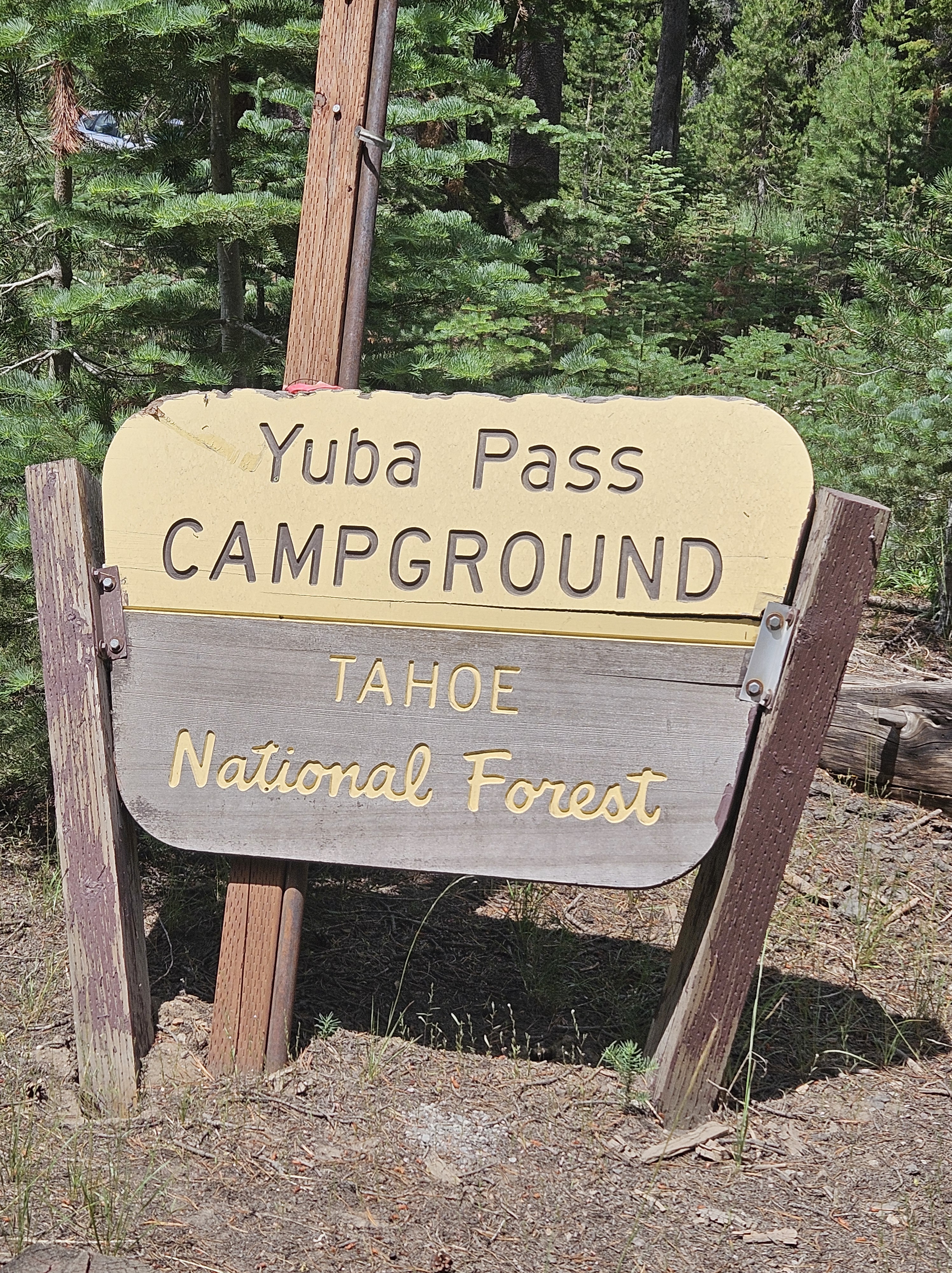
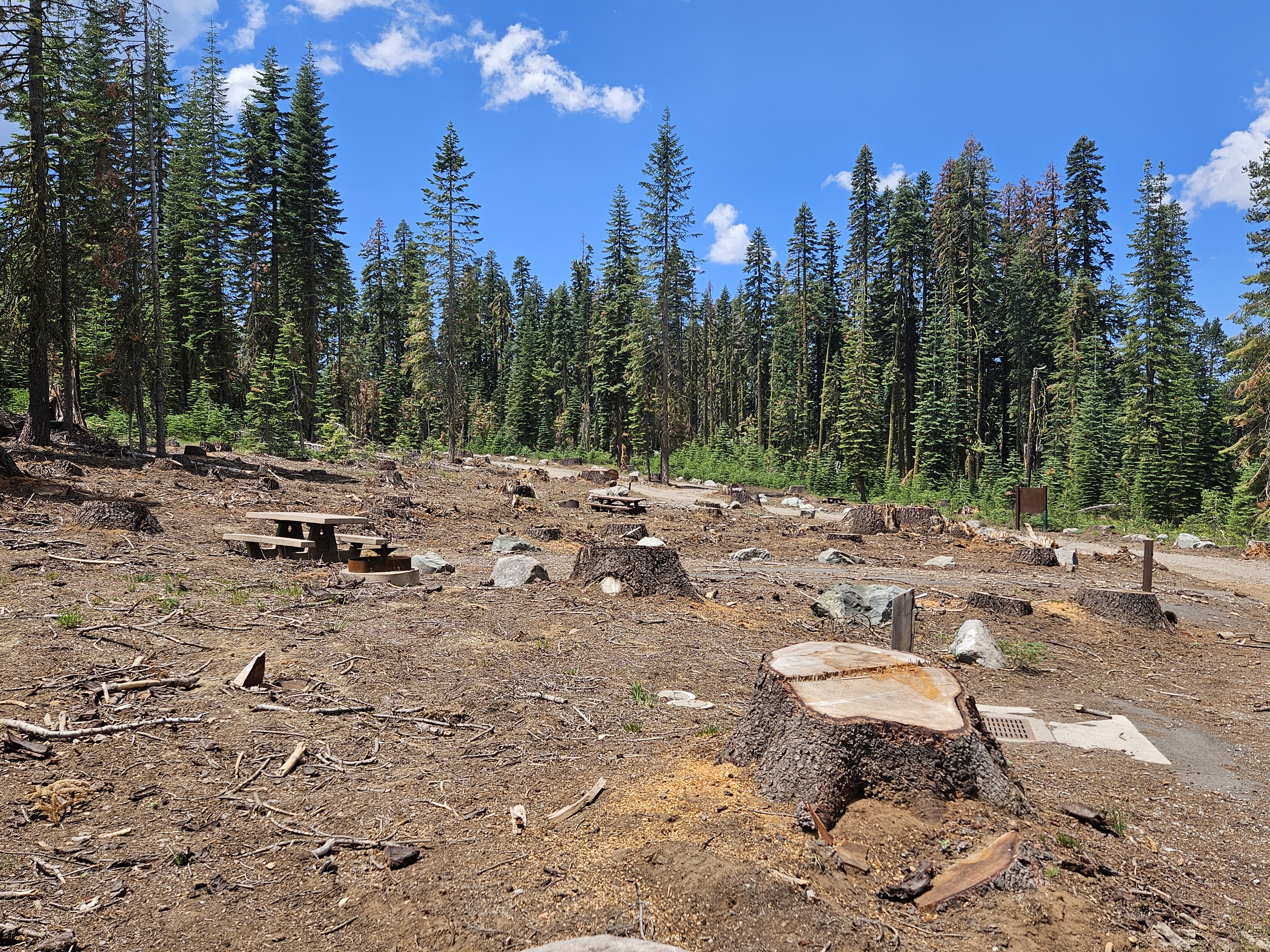
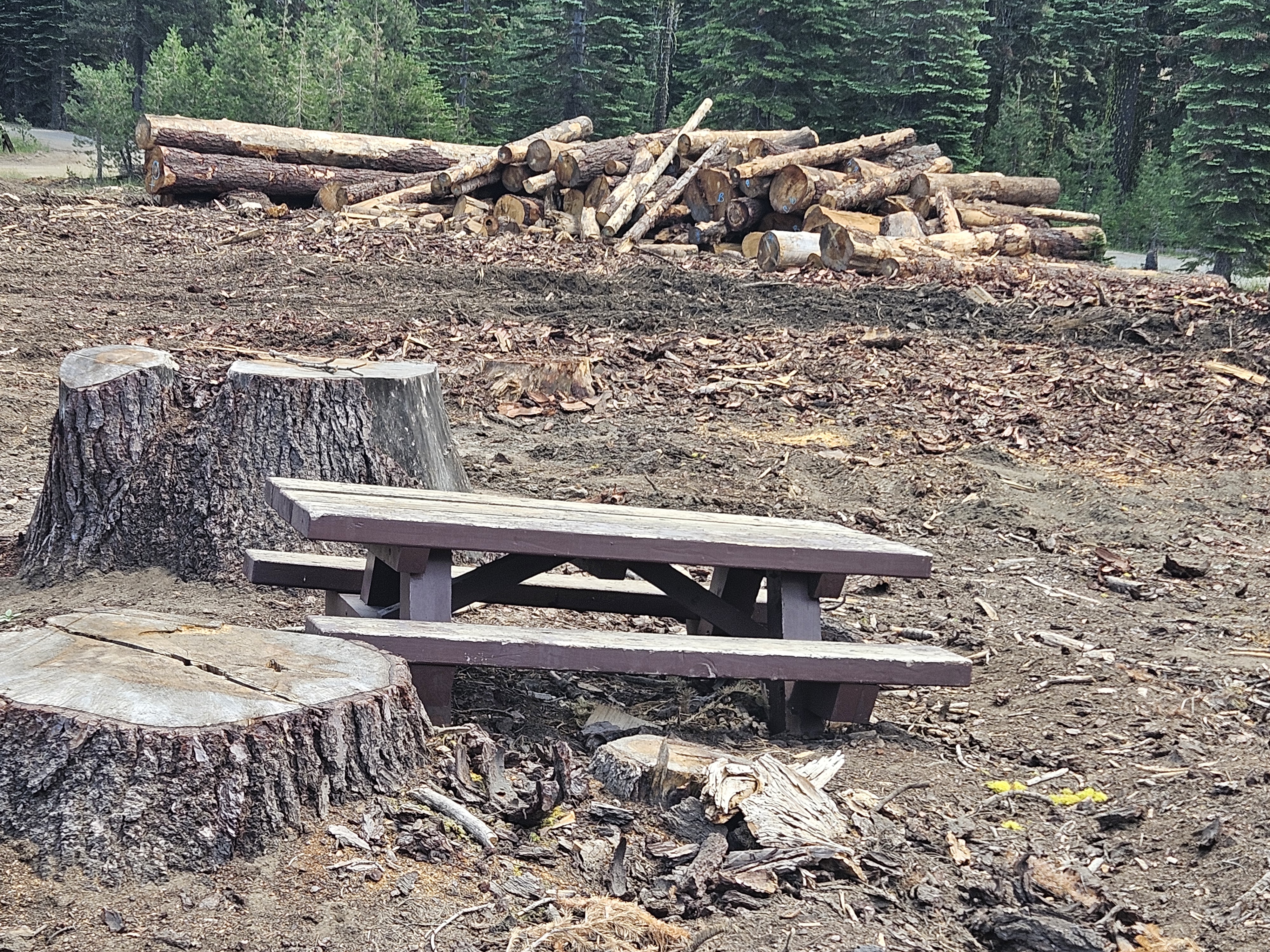
This destruction of the campground at Yuba Pass looks like a fire hazard mitigation project gone bad or a commercial logging operation at the expense of a campground at an important trail head that is used for winter cross-country skiing and summer hiking.
We visited the bar at our resort at the end of the day to get the perspective of the locals about these logging operations on Highway 49. We learned that they are controversial with the locals, but there is no vocal opposition to them in a small community of only 200 year-round residents. (The bartender said the community was more concerned about AT&T’s threats to disconnect their landline phones because the community does not have a cell phone tower.)
However, the public’s reaction to the destruction of the campground at Yuba Pass was much stronger than to the thinning of young trees. The rumor is that the contractor who clear cut the campground at Yuba Pass did not do what they were supposed to do. The Yuba Pass project is considered a rogue operation by the locals.
We also learned that the piles of logs and wood chips will eventually be hauled away to be used as biofuels to generate electricity. As the wood is burned, the carbon stored in the wood will be released into the atmosphere, contributing to greenhouse gases that cause climate change. Some of the dead wood has already been removed. Nine months after the trees were destroyed, much still remains to be removed. Meanwhile, the piles are clearly a fire hazard. Fire hazards are increased in the short term by dead wood and in the long term by contributing to global warming.
Tree Mortality
At Yuba Pass, we began to see first-hand the tree mortality in the Sierra Nevada we had been reading about in the media for years. We saw many dead red firs as well as one of the symptoms of more red fir deaths in the near future.
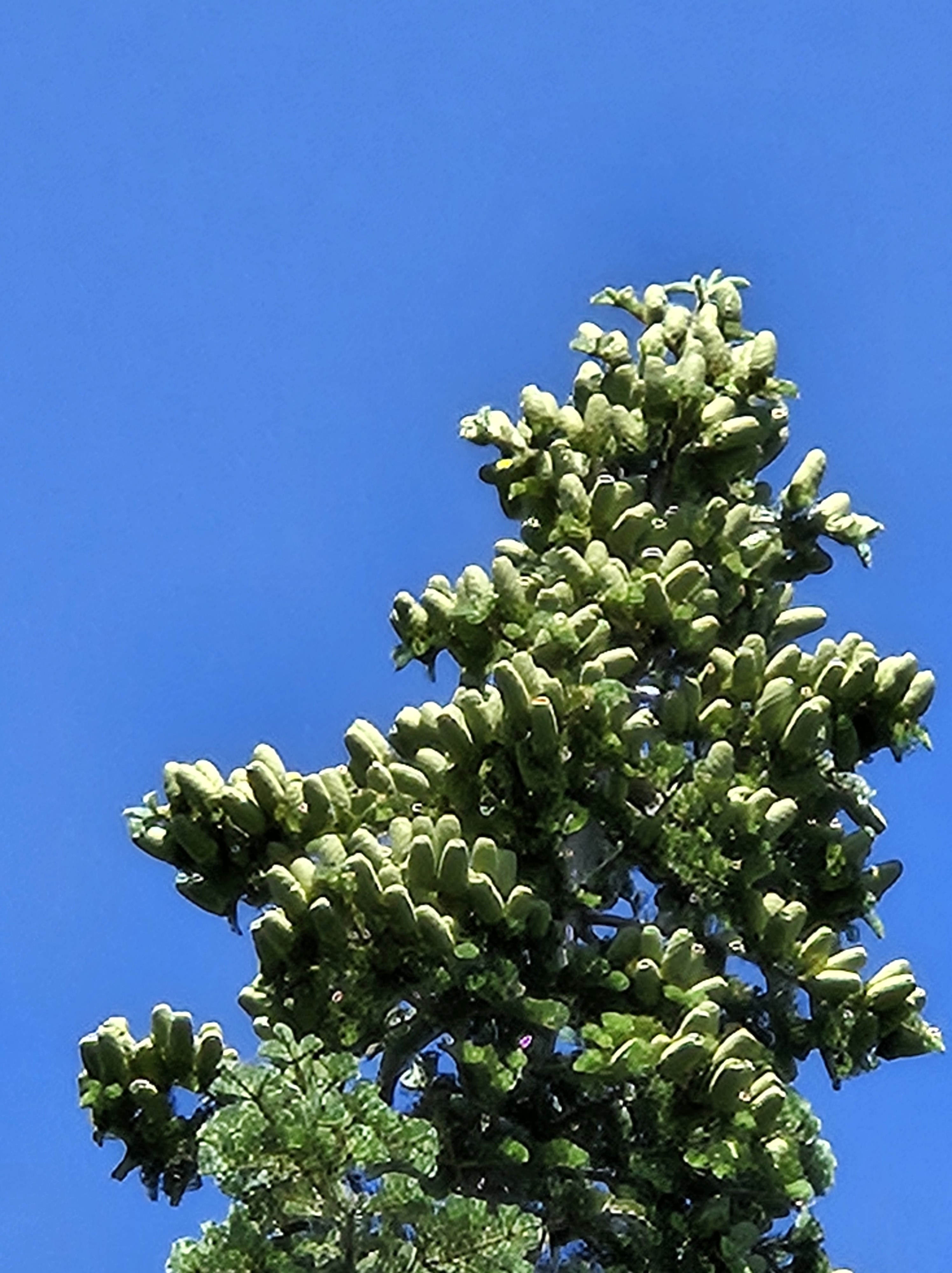
Adjacent to dead red fir trees, younger red fir trees were heavily loaded with cones, which are an indication that the tree is making a last gasp for survival of the species by trying to produce a big, new generation of trees (see above).
As we drove over the summit to the eastern side of the Sierra Nevada we could see the scale of the death of red and white firs. The eastern side of the Sierras is drier than the gently-sloping western side, which receives the moist air from the ocean. The Sierras drop steeply on the eastern side to the Great Basin, which extends into Nevada as a dry, hot desert. (see below)
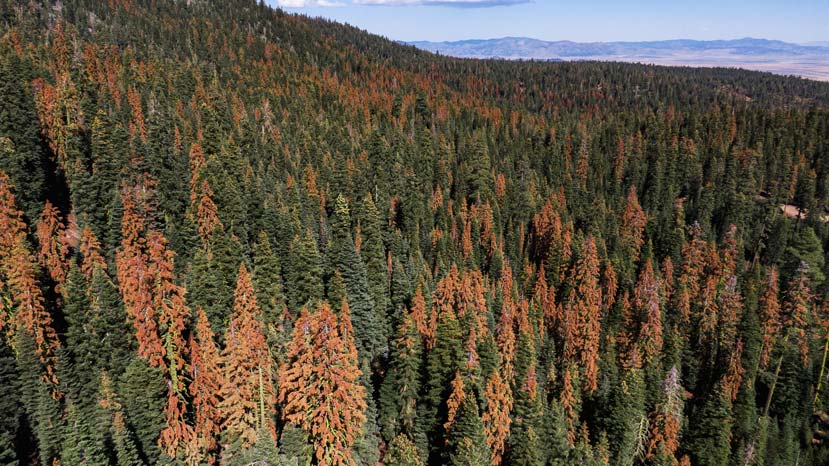
Until 2022, tree mortality in the Sierra Nevada range was confined to southern and central portions of the range and at lower elevations. An aerial survey of trees in the northern portions of the range in October 2022 found 28 million dead red and white firs at higher elevations. Red and white firs are higher elevation conifers and were therefore harder hit than lower elevation conifers in this portion of the range.*
Ecological “restorations” are never done
We visited a restoration project on the eastern side of Yuba Pass at Carmen Meadow. The project was done about 20 years ago. We wanted to see how it was progressing.
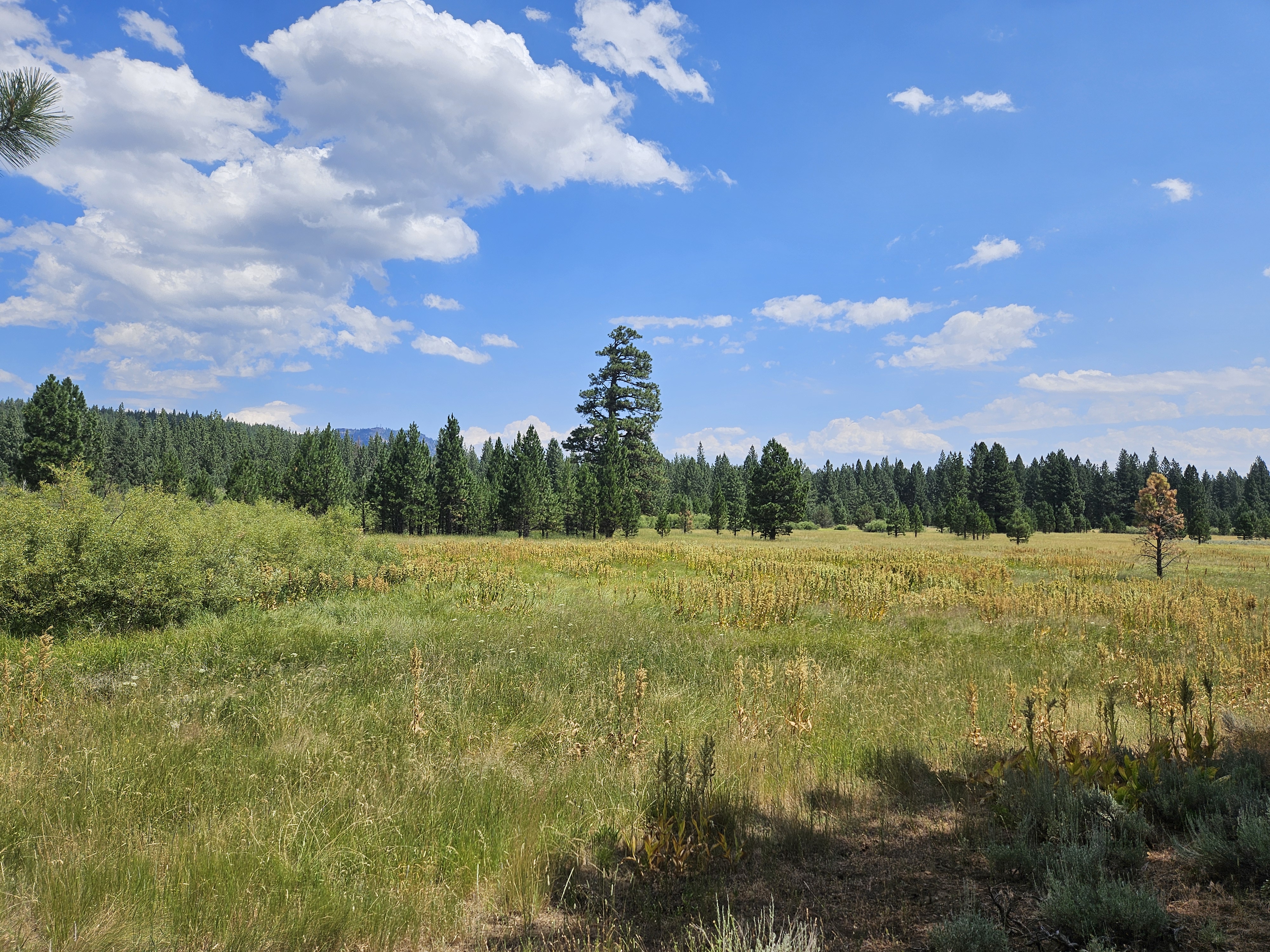
The meadow had been the home of rare willow flycatchers until it dried out, killing the willows that were home to the flycatchers. A berm had been built as the roadbed of a railroad. The berm diverted water into the creek, digging its channel lower than the meadow, draining water from the meadow into the creek. A check-dam was built to divert water channeled by the berm from the creek into the meadow, restoring water to the meadow. The flycatchers returned when the willows returned.
We had last seen Carmen Meadow over 12 years ago. Although willows remained, there were also young Jeffrey pines on the perimeter of the meadow as well as dotted throughout the meadow. Thus, natural succession from pond, to meadow, to forest is in progress. (see below) Restoration projects are never done because nature is dynamic and evolution is never done.
Must this natural succession of the Carmen Meadow be stopped? That is probably a matter of opinion. My readers know that my opinion is probably “NO.” In defense of my opinion, I offer my readers an alternative scenario.
Willow flycatchers are also rare in the Southwest, where the loss of water also caused the loss of willows that are home to the flycatchers. But, in Southwestern desert, the solution is not so easy and painless as diverting water into Carmen Meadow.
Water in the Southwest has been diverted from riparian areas for agriculture and drinking water for large and growing residential communities. As you might imagine, few are willing to divert water supporting human activities to support a rare bird.
In the Southwest, willow flycatchers solved their own problem by making the necessary transition from willows to non-native tamarisk trees that require significantly less water than willows. And in this case, native plant advocates resisted this transition by trying to eradicate tamarisk solely because they are not native trees. The birds were willing and able to transition to a non-native tree, but the nativists wouldn’t accommodate their preference.
The Message
We had a wonderful time on our brief trip to Sierra City at Yuba Pass. We hope to go again and we expect to see more changes when we do. We took these messages away with us.
- Yes, the Sierra Nevada range is changing, but it remains beautiful. We encourage you to visit and if you have, visit again because it is never the same twice.
- There is a fine line between fire hazard mitigation and commercial logging and it isn’t always clear what the objective is.
- The short-term objectives of any landscape project are sometimes at odds with the long-term objectives.
- Change is the only constant in nature.
*Sources:
https://www.sfchronicle.com/climate/article/california-tree-deaths-17770026.php
https://sierranevada.ca.gov/signs-of-a-new-tree-mortality-event-showing-up-in-the-sierra-nevada/
 Conservation Sense and Nonsense
Wonderful article!!!
Sent from my iPhone
There is a bit of melancholy in travelling through natural sites, trails and parks. I feel more like Aldo Leopold or sometimes Edward Abbey when visiting areas that I one visited many years ago. Often the changes have not always been for the better, and these silly “restorations” just make one feel so sorry for the lack of authenticity and full knowledge of ecology that’s missing in the current version of “Conservation”. A note on foresters; there are some good, some bad. Yet often the issue in the lower 48 is that its not competitive with other countries, and getting qualified labor is becoming harder and harder. Clear cutting is a good way to piss off the locals, so most places do select cutting. It too can be messy, can leave piles of branches, and piles of wood chips. It may not be pretty, but often the clearings and light create more undergrowth, and that makes for a good environment for a number of animals. I am now old enough to have watched it up and down the east coast. I hope that that hope is the same in the area you and yours tread.