When I announced my intention to quit publishing articles on Conservation Sense and Nonsense in December 2024, I invited like-minded allies to send me guest posts for publication. I also recommended several trusted sources of information about invasion biology and related issues.
I am publishing a guest article by one of those trusted sources today, with permission. Kollibri terre Sonnenblume is the author of “Speaking for the Trees, No Matter Where They’re From,” available on Substack. He introduces himself on that website: “Writer, photographer, tree-hugger, animal lover, occasional farmer, cultural dissident. Author of several books on ecology, human culture, and their intersections. Podcaster on the side.”
For readers who love all plants, both native and non-native, I recommend the Substack of Kollibri terre Sonnenblume. His articles are deeply researched, informative, and beautifully written. His knowledge of plants far exceeds anything I have learned about plants because he works directly with them as an integral part of his life and he is an astute observer.
Conservation Sense and Nonsense
What is a “native” plant in a changing world?
The term “native plant” has become a common one, and many people probably assume that the definition is clear cut. However, like many other seemingly simple designations, that’s not the case.
It was in the UK in the mid-19th century where the concept of “native” as opposed to non-native was first proposed by Hewett Coltrell Wallace, who borrowed the terms “native” and “alien” from British immigration law. His definition of “native” also included “naturalized” species, which humans had introduced but that have come to live without them unaided.
Nowadays, whether a given plant is considered “native” where it is found growing is dependent on the interpretation of the interrelation of three factors: time, place and human involvement. There is no agreed-upon global definition.
So currently in the United States, a plant is generally considered native only if it grew here before European colonization. On the East Coast, that’s the 1500s and in California, that’s 1769. Plants introduced since then, whether deliberately or by accident, are labeled “non-native,” “introduced,” “exotic,” or in some cases, “invasive.”
In the UK, though the year 1500 is often cited too, some would set the date at the end of the last glacial maximum, 16,000 years ago, others at ~8000 years ago, when rising sea levels made those landmasses islands, and still others at the Roman invasion in 43 CE. Species introduced by the Romans can also be called “archaeophytes,” which inhabits a middle ground.
Other countries have their own cut-off dates, or, like China seem to still be working it out. Some have none at all, defining “non-native” only in terms of whether the species was introduced by humans, but not when. South Africa has a designation of “native-alien” referring to species that are native to one part of the nation but not to others.
Given that the term is so unstandardized, it’s impossible to make generalized statements about “native species” at the international level.
Plants on the move
The “native range” of any plant is not a static thing. Historically, plant ranges have always been in flux, often in response to climatic shifts, a process which continues in the present day more rapidly because of climate change. Had European colonization never occurred in the Americas, the ranges of plants today would not be the same as they were in 1492, which is a fact that’s not often considered in these discussions.
Fossils and phytogenetics are two things that can show us where plants used to live and where they came from. For example, when Spanish colonists arrived in California in the 18th Century, Coast Redwoods (Sequoia sempervirens) grew in a strip nearly 500 miles long and 5-47 miles wide from what is now Monterrey County in the south to Curry County (Oregon) in the north. Since then, over 95% of them have been cut down. The grievous sin of destroying so many Redwoods in California is compounded by the fact that much of their former habitat is now so altered by land use conversion and ecological changes like erosion that it won’t be home to these grand trees for the foreseeable future.
Only 10,000 years ago—a blip in geological time—Redwoods grew as far south as Los Angeles, and five million years ago, they were found in Europe and Asia. The species has also been spread around the world by humans, including to New Zealand, where a 15 acre grove has been growing for over a century. Due to favorable differences in soil and rainfall there, the trees happen to grow faster there than on the US West Coast.
We can ask, then: how should we define the current “native range” of Redwoods? Are the degraded places where they recently grew but now won’t still part of their “native range”? What about portions of the Oregon Coast immediately north of their most recent range, which they would naturally be moving into because of climate change, both anthropogenic and natural? What about New Zealand where the tree is thriving because the conditions for the tree are so appropriate? Is a Redwood grown today within its historic range in Europe truly “alien” or is it just coming home? By the narrowest definition of “native” these questions are absurd, but of course definitions too are always in flux.
For many, the salient point is “human interference” as opposed to “natural dispersal.”
In this way of thinking, the Creosote Bush (Larrea tridentata), the dominant and emblematic plant of the US Southwest’s Mojave Desert is native even though it arrived from South America as recently as 14,000 years ago, because its means of conveyance over those many thousands of miles was non-human; possibly in the tail feathers of migrating plovers.
But this way of thinking also tends to ignore an important element: the influence of indigenous humans over history, which definitely impacted the “native ranges” of many plants and animals.
Indigenous Land Management Practices
Controlled burns by Indians on the Great Plains expanded prairies at the expense of forests, which led to the spread of Buffalo.
Similar techniques on the West Coast maintained Oak Savannah and suppressed the growth of Firs and Hemlocks.
Seeds, bulbs, corms and other plant material for propagation were collected, transplanted and traded far and wide among tribes in North America. Some species (such as certain Mariposa Lilies in the genus Calochortus) may have dwindled in number to the point of being endangered these days in part because they are no longer actively tended by humans.
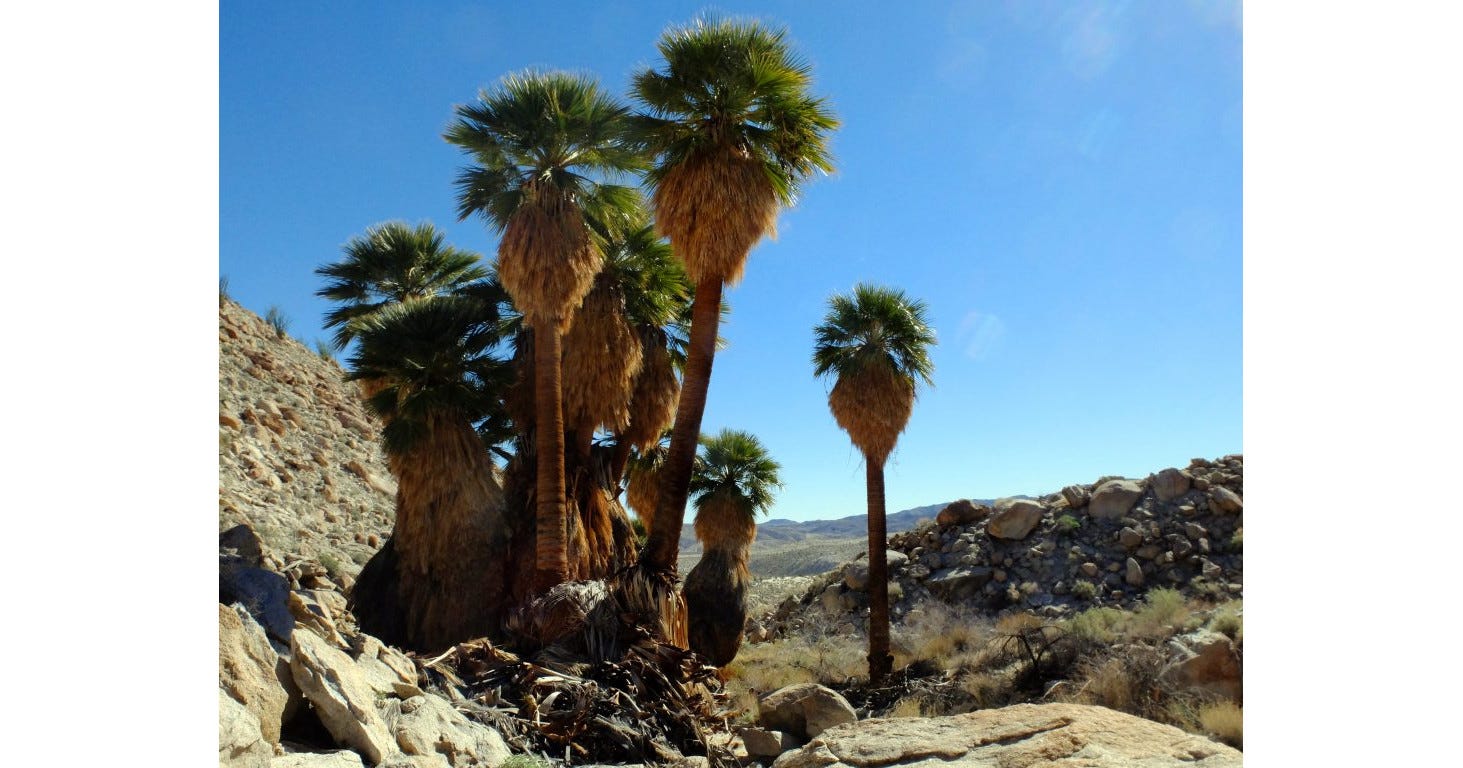
The case of the California Fan Palm is particularly intriguing. For years, it was believed that the iconic species was a millions-of-years-old relict, left over from when its current desert home in southern California was much moister. However, phytogenetic analysis proved that the species emerged quite recently, since the last glaciation period 11,000 years ago.
It’s long been known that Indians made use of Fan Palms and their groves for food, craft material, and as places to live. They planted trees and they also set fire to them to clear away the dead leaves so they would be easier to climb to collect the dates. (Fan Palms are fire tolerant.) However, it also appears that they might have been responsible for introducing them to the majority of locations within their “natural range” beyond the small area in Baja California where they originated. (See my Did Native Americans introduce Fan Palms to California?)
If this is the case, then the groves that remain are not the result of “natural dispersal” as that term is usually understood and are more akin to abandoned agricultural sites than to “wilderness.” What, then, is the best way to treat them? I mean, if we’re not going to allow tribes to maintain and use them as they did which is obviously the right answer? Burning is prohibited, as is harvesting and planting the fruits when the trees are on public land. Our current policy aims to protect the trees (which is understandable) but perhaps the actual result is neglect.
California Fan Palms are not the only trees that humans have moved around. In Asia, the “native range” of the Carpathian Walnut coincides with the route of the Silk Road. The distribution of food plants within the forests of the Amazon are anthropogenic. Polynesians brought plants with them as they made new homes on islands throughout the Pacific Ocean. In eastern North America, the “native ranges” of Black Walnut, Pawpaw, Persimmon, Chestnut, and Shellbark Hickory and other food plants are also the result of indigenous human influence. (h/t to Zach Elfers for this info.) They are all considered to be “in the right place” because that’s where they were before a particular calendar date.
Point being, ecosystems that we consider to be “wild” or plant ranges we consider to be “natural” are in many cases human-made or human-impacted. Some would go so far as to say that the very concept of “wilderness”—as in “untouched by humans”—is tantamount to indigenous erasure.
We are a plant-moving species, like many other animals. That settler-colonialism has wreaked havoc on the ecosystems of the Americas is all too clear but to conclude that all the introduced plants who live here now “don’t belong” because “we” brought them here is, I would argue, a step too far, much in need of nuanced examination. The idea that they should be eradicated purely on the basis of place of origin is not merely misguided, but dangerous, given the collateral damage that such efforts inevitably cause, such as disrupting beneficial relationships between native and non-native species that have since formed. Fortunately, the conversation does not need to be so limited.
“Novel Ecosystems” & Ecological Succession
Often, native plants are valorized and non-natives villainized in a reflexive manner that belies the facts on-the-ground. How well an introduced plant has integrated into its new setting is rarely considered by many people (though some invasion biologists do). Or the question of whether plants can become “native.”
“Novel ecosystems” are mixes of native and non-native species. Though formerly ignored by most researchers, they are now garnering more attention because it’s recognized that they operate like any other ecosystem, with their constituent species interacting and adapting and filling different roles just like happens anywhere else.
In California, approximately 1/3 of native butterfly species now use non-native plants as food sources and as egg-laying sites. The range of some of these butterflies has expanded as a result. (See: “Exotics as host plants of the California butterfly fauna“) This has been fortunate for the butterflies, since so much of the habitat that previously provided for them has been destroyed by human activity since 1769, through activities including agriculture, ranching, deforestation, mining, urban sprawl and—most recently—industrial-scale “green” energy installations. The butterflies are adapting to novel ecosystems.
Saltcedar/Tamarisk (Tamarix sp. and Russian Olive/Oleaster (Elaeagnus angustifolia) are oft-maligned as “invasive plants” that should be eradicated. But in the western United States, these two trees are now the third and fourth most frequently occurring woody riparian plants, and the second and fifth most abundant species along rivers. To kill them all would entail destroying a significant amount of healthy vegetation (with no small amount of collateral damage to other flora) and would incur an ecological cost. Their prevalence is due mostly to the thousands of dams that have disrupted most riparian areas in the West, making them less hospitable to the original natives like Cottonwoods and Willows. Novel ecosystems are emerging.
Fifty kinds of birds nest in Tamarisk, including the Southwestern Willow Flycatcher, which is endangered because of habitat loss. At least 44 kinds of birds, as well as various native mammals, eat Russian Olives as winter hardy food. Given the prevalence the introduced trees now, and the dearth of the natives, many animals are now dependent on them. Spraying the trees with herbicides has not, and will not, change the fact the dams are responsible for the altered landscape, not the trees themselves.
At some point, do we recognize that the Tamarisk and the Russian Olive are de facto “native” even if they’re not de jure? For what it’s worth, all those birds have already cast their vote. Additionally, from a taxonomic perspective, hybridization among various introduced Tamarisk species have produced fertile offspring that may be declared a new species, Tamarix americana [reference]. Since this species is found only in the US, isn’t it “native” here?
Additionally, “novel” aspects might be temporary after the process of “succession” advances. “Succession” is a common ecological process in which the dominant flora of a landscape changes over time due in part to the ways that landscape is changed by the flora itself. So, after a disturbance—such as a landslide or the building of a road—the first wave of plants (which are sometimes called “pioneer species”) are often annuals that quickly fill the space. They will produce a profusion of flower that attract pollinators and seeds that feed animals. Such pioneers can be thorny, which is nature’s way of saying, “Keep out while I fix this!” A hallmark of this stage is the rebuilding fertility in the soil.
The annuals might be followed by shrubs, including berry bushes, which attract yet more animals, including birds. The scat left by these animals enriches the soil more. The bushes provide shelter for trees to germinate, and in time, the trees shade out the berries.
There are cases where disturbed landscapes “invaded” by non-native plants have been left untouched, and the exotics have ended up doing nothing more than fulfilling the role of pioneer species, and the area has returned to “natives” over time. So, when “invasives” are constantly beaten back in a given location, it’s possible that this interference is holding back the natural process of succession and ironically working against the intended goal of bringing back natives.
Novel ecosystems demonstrate nature’s inherent resilience. What we need to do is recognize them as ecologically legitimate and work with them from there. As time goes on, we’ll certainly have more opportunities.
Climate Change
According to National Geographic, “Half of All Species Are on the Move.” This is because, as the climate changes, so do ecosystems. With temperatures rising, species are moving further north or higher in elevation. As time goes on, this means that more and more species will migrate “outside their natural range” thereby becoming “non-native” or even—to some—“invasive.”
Those that can migrate, that is. Many plants will become, as wildtending guru Finisia Medrano used to say, “refugees without legs,” unable to flee fast enough and far enough to find safe haven. If that’s the case, then we must help them, Finisia repeatedly counseled.
The biologists call this “assisted migration” and it’s a topic that coming up more frequently as time goes on. Some of the strongest arguments against it come from the anti-“invasive” crowd, but many native plant lovers are in favor.
Does It Matter?
The term “native” can have utility; it tells you that a plant was well-adapted to a given place in a given time period because of the conditions that existed there then, and this can be helpful in understanding a species or an ecosystem. But it’s not an ancient, universal concept among all humans by any means, and ultimately it’s just a label of no account whatsoever to the big mover and shaker of life, Mother Nature.
Kollibri terre Sonnenblume
 Conservation Sense and Nonsense
Thank you so much for this! I just shared on my FB page and also referred to what you’d told me about the adorable Barred and Spotted Owls, to spread the word.
Thanks, Bev Jo!
Dear Kollibri terre Sonnenblume,
Thank you so much for your wonderful article here today. It is wonderful that Million Trees has found you and got it printed here.
Charles Mann’s “1491″ book points out that the indigenous rainforest people for years planted Brazil nuts and other fruits and nuts in the rainforest in nonstraight rows thus eluding the anthropologist when he deemed the rainforest as wilderness but actually, it was for eons a giant garden with presumably traded plants brought in from outside their native area is another example of hybrid or assisted migration.
Another example I’ve read is about the dreaded invasive Bradford pear and how it will take over vast areas when actually it is just a pioneer species short-lived and soon replaced by taller longer-lived species such as oak.
It’s all nature and all-natural. But the fight to save the trees in McLaren Park here in San Francisco is fraught with non-native tree-hating dogma and we have a long way to go to influence people to think outside their norm. Your article certainly helps. I hope it can be published far and wide.
Charles Mann’s 1491 was one of the first books I read that led me to become a skeptic of invasion biology. His 1492 is equally interesting.
Thanks for your comment. I am glad you enjoyed Kollibri’s excellent article.
Yes I have read them both and they were both incredible! Actually it was 1493, his second. I wonder if he has written since then?
You’re right about the title of 1493, of course. Thanks for the correction.
I believe his most recent book is The Prophet and The Wizard. Also an interesting book about the pros and cons of modern agriculture. Here’s an article I wrote about The Prophet and The Wizard:
Thanks, Lancer! Yes I really appreciate Charles Mann’s books. The part about the Amazon was really eye-opening. In another source, I read about how some jungles in the Congo are similarly the result of earlier human activity, and aren’t the “untouched nature” that they’ve been considered up til now.
I had not heard that tidbit about the Bradford Pear, which is a species I want to know more about.
Thanks for the comment!