As we have said before in “FIRE!!! The Cover Story,” fear is a powerful motivator of public policy. The fear of fire is not the only tool in the toolbox of native plant advocates. They would also like the public to believe that non-native plants are invasive, that they will overwhelm the environment if they are not promptly eradicated. So, we will take a closer look at this claim and show that non-native trees are not invading Bay Area open spaces.
In “Vegetation Change and Fire Hazard in the San Francisco Bay Area Open Spaces,” William Russell (USGS) and Joe McBride (UC Berkeley) used aerial photos of Bay Area parks taken over a 60 year period from 1939 to 1997, to study changes in vegetation types. They studied photos of 3 parks in the East Bay (Chabot, Tilden, Redwood), 2 parks in the North Bay (Pt Reyes, Bolinas Ridge), and one on the Peninsula (Skyline).
These photos revealed that grasslands are succeeding to shrubland, dominated by native coyote brush and manzanita. Eucalyptus and Monterey pine forests actually decreased during the period of study. In those cases in which forests increased in size, they were native forests of oaks or Douglas fir. In other words, they found no evidence that non-native trees are invading native trees or shrubs.
They also studied the implications of these changes in vegetation types for fire hazard by measuring surface biomass for each vegetation type as an indicator of fuel load and by using a computer model (FARSITE) to simulate the speed of spread of a fire. They concluded,
“A significant increase in the cover of shrublands was apparent in the general analysis…The results from the fuel and fire hazard analysis suggest that the succession from grasslands to Baccharis [coyote brush] shrublands indicates dramatic increase in fire hazard for those areas. Fire line intensity, flame length, and total biomass were found to be significantly higher with the shrub dominated areas. In the context of the landscape matrix as a whole this increased hazard indicates a greater possibility of fire being spread into adjacent forested areas and residential communities.”
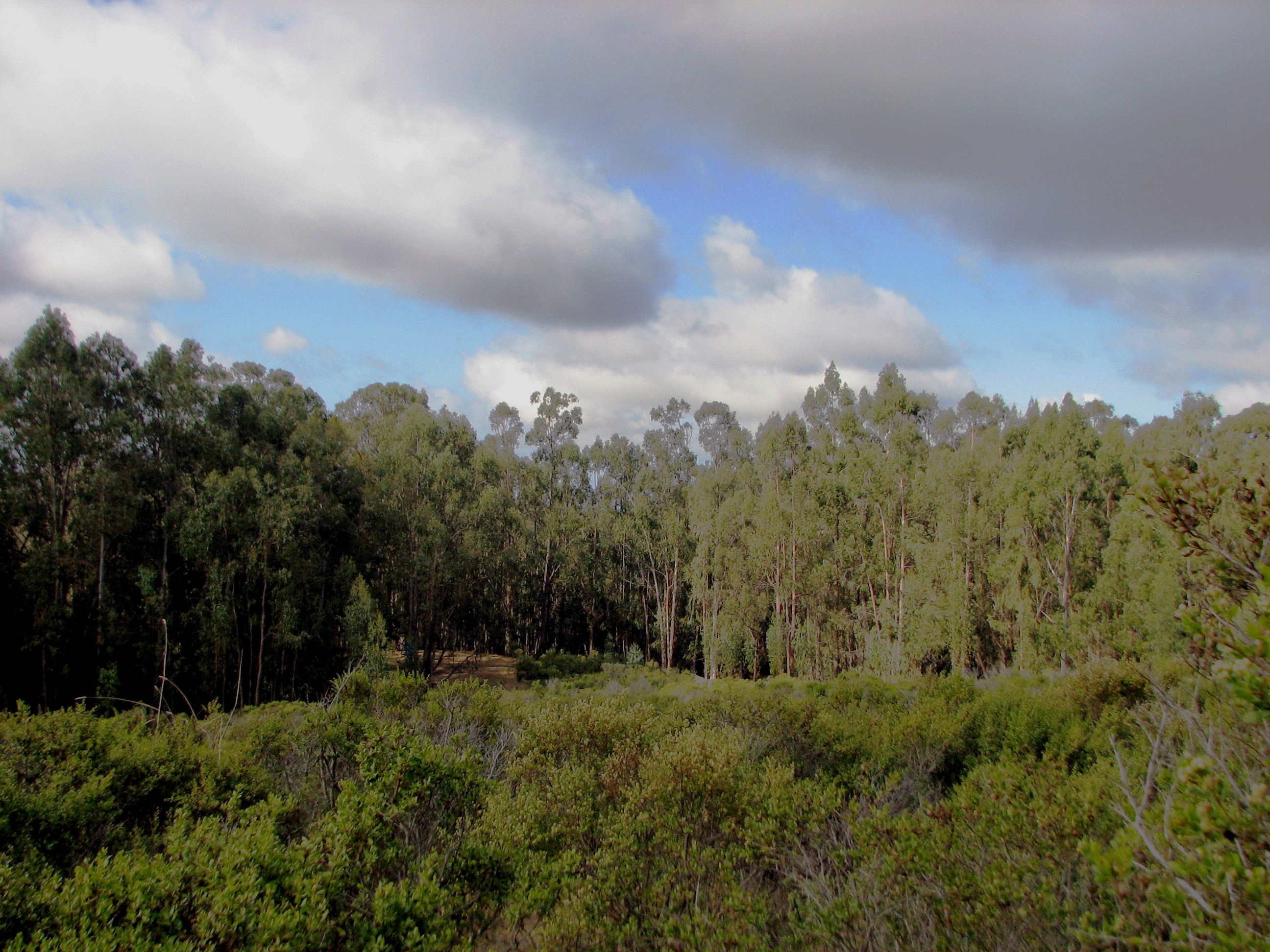
This is a view of one of the "recommended treatment areas" in the East Bay Regional Park District's "Wildfire Plan" in Anthony Chabot Park. In the foreground are many acres of coyote brush that are about six feet tall. The plan does not propose any "treatments" in these acres of highly flammable coyote brush. In the background is the eucalyptus forest that will be thinned in some places and removed in others. This is not a plan that will reduce fire risk.
This study, based on actual aerial photos, tells us that native shrublands are increasing in size while non-native forests are actually decreasing in size. It also tells us that this succession of vegetation types from grassland to native shrubland is increasing fire hazard. There is no evidence that non-native forest is invading the open spaces of the San Francisco Bay Area. The public has no reason to fear that non-native trees will overwhelm our environment.
The public is unaware of the scale of herbicide use in our parks and public lands. Nor are they aware of the toxicity of herbicides to humans and animals. We will describe just two examples of the subterfuge that is used by “restorationists” to hide the use of herbicides.
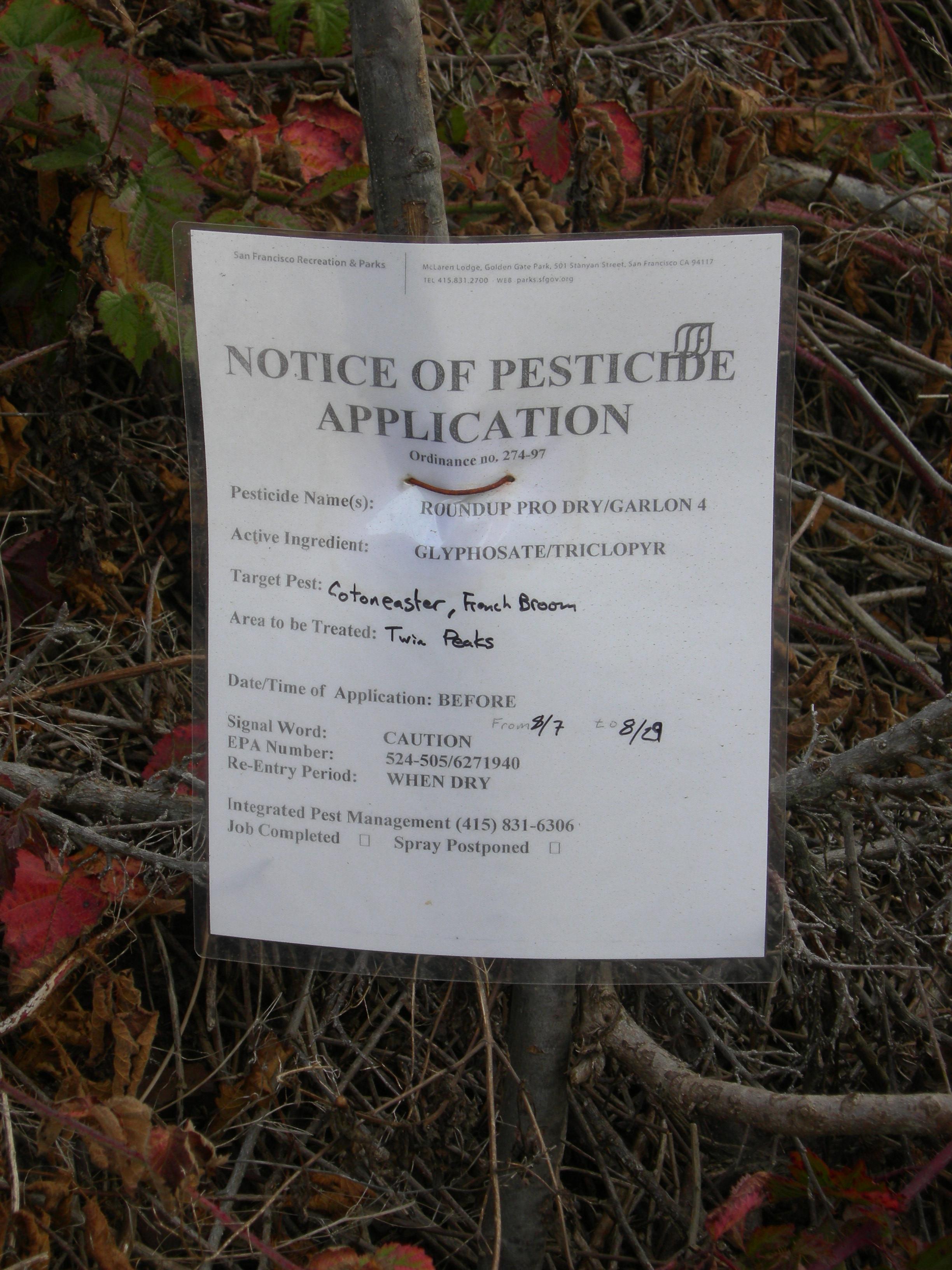
The management plan of San Francisco’s Natural Areas Program (NAP) includes a description of the NAP’s herbicide use. Table 4-2 of the plan identifies 16 species of non-native plants and trees on which herbicides (Roundup and Garlon) are used. Although the plan states specifically that herbicides are used, the Initial Study of environmental impact of the program says absolutely nothing about the use of herbicides. It does not acknowledge that herbicides are used or analyze their impact on the environment and its inhabitants.
Twin Peaks, San Francisco
The use of herbicides by a program calling itself the “Natural Areas Program” is particularly ironic in San Francisco, a city that has officially adopted the Precautionary Principle. The PP theoretically obligates the city of San Francisco to ban any substance that might harm the environment or its inhabitants, even if there is not yet scientific evidence of that harm. In the case of herbicides, there is plenty of evidence of the harmful effects on humans and other animals.
The East Bay Regional Park District is also using herbicides without acknowledging the risks in doing so. In its Wildfire Plan, EBRPD misinforms the public that the Marin Municipal Water District is using herbicides: “Using herbicides to control invasive [AKA non-native] plant species…can be an efficient and cost-effective method…Recent studies conducted by the Marin Municipal Water District (MMWD) confirm this approach; the results of their studies on the use of non-chemical control methods for the control of invasive non-native plants indicated that non-chemical alternatives are ineffective for large-scale vegetation management projects. (see Appendix H…)” (page 92) . In other words, EBRPD in its Wildfire Plan is inaccurately claiming that MMWD is using herbicides when they are not. MMWD has confirmed in writing that they have not used herbicides since 2005.
But, EBRPD doesn’t stop there. When the public pointed out to EBRPD during the public comment period on the Environmental Impact Review (EIR) that MMWD is not using herbicides, EBRPD responded (Response to Comments) as follows: “As of March 2010, MMWD’s draft reports and analyses have shown no significant risk associated with the use of the chemicals studied on human health, animals or non-target plants, and a greatly increased average annual cost for eradicating 100 acres of the 750 acres of broom without the use of herbicides…” (page 394) Whoever wrote that sentence has either not read MMWD’s risk assessment of herbicide use or is misrepresenting it. In fact, MMWD’s risk assessment is perfectly clear in describing significant harm to the environment caused by herbicide use.
No wonder the public is in the dark about the use of herbicides. Every effort is being made to keep them in the dark.
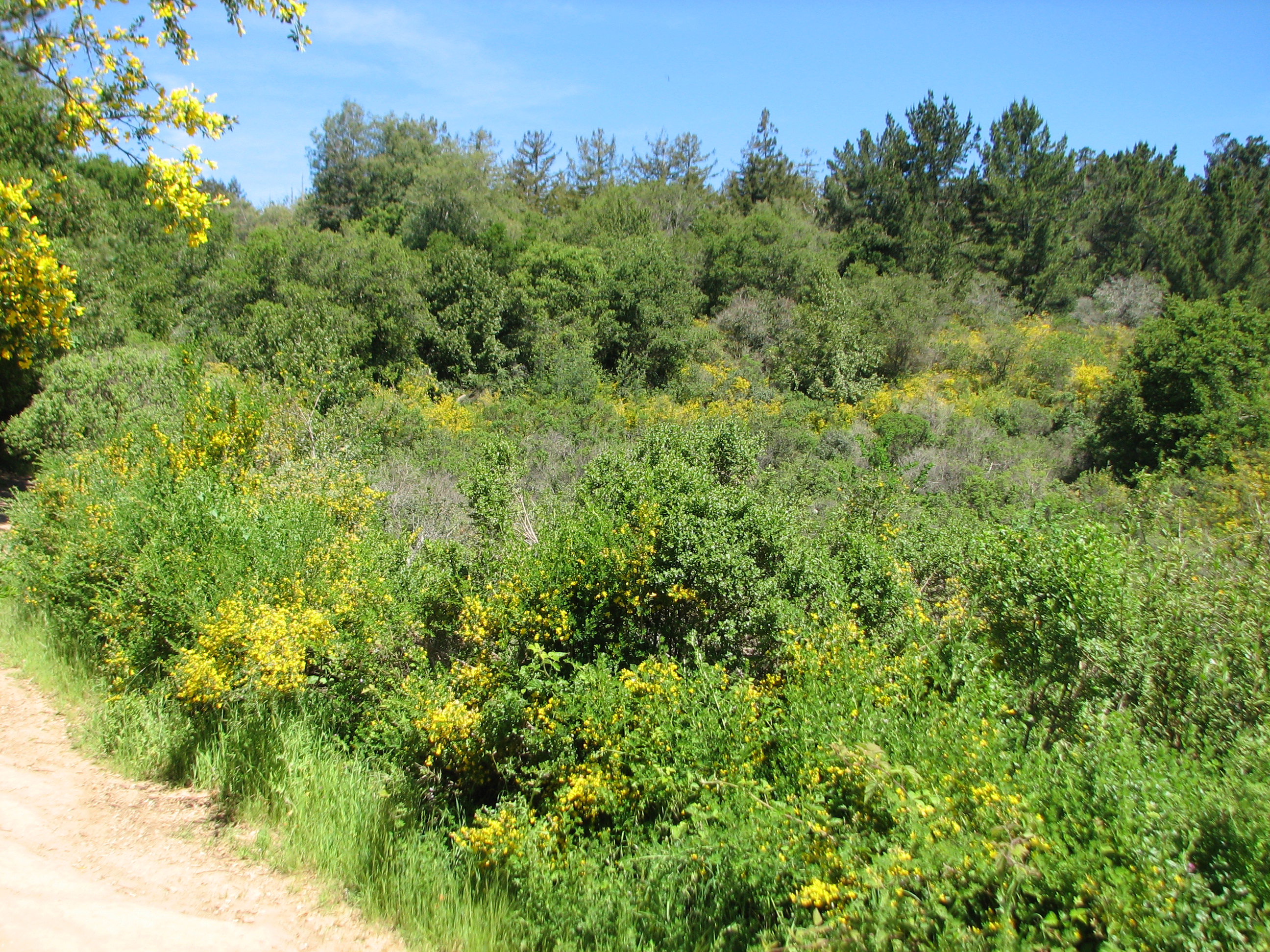
Broom is a non-native shrub frequently targeted for eradication in native plant restorations. Its seedbed lives in the ground for up to 60 years. If broom is not eradicated before every bloom cycle, that 60 year seed-cycle continues ad infinitum. Foliar spraying of glyphosate (Roundup) is the preferred method of eradication because it is the cheapest. Although trees are the main focus of A Million Trees, we will talk about broom because it illustrates two important issues: (1) The futility of trying to eradicate a completely entrenched non-native species, and (2) the largely unknown risks of using herbicides.
How much Roundup will it take to eradicate this broom?
We know that Roundup is harmful to amphibians. This fact was established by a suit brought by the Center for Biological Diversity on behalf of the Red-Legged frog (RLF), an endangered species. As a result of that suit, US Fish and Game has banned the use of Roundup in proximity of known populations of the RLF (and more recently extended to other herbicides in proximity of other endangered amphibians).
However, the Center for Biological Diversity is closely allied with the native plant movement. Therefore, when negotiating for a ban on the use of toxic herbicides in proximity of endangered amphibians, they also negotiated for an exception to the ban when the herbicides are used for the purpose of eradicating invasive plants, as defined by the California Invasive Plant Council. Broom is one of hundreds of plants deemed invasive by that council, which is dominated by native plant advocates.
Recent research has found evidence that Roundup may also be harmful to humans. Scientific American reports, “But now researchers have found that one of Roundup’s inert ingredients can kill human cells, particularly embryonic, placental and umbilical cord cells…scientists found that Roundup’s inert ingredients amplified the toxic effect on human cells—even at concentrations much more diluted than those used on farms and lawns.”
This research has implications for other pesticides and herbicides. Presently, the EPA does not require that the manufacturers of these chemicals list all the inert ingredients. If the inert ingredients in other herbicides were known to us, we would be in a better position to assess the potential danger.
Native plant advocates attempt to support their claim about the flammability of eucalypts by citing specific characteristics such as shreddy bark and volatile oils. Shreddy bark and volatile oils are characteristics of many plants, both native and non-native. They are not characteristics exclusive to eucalypts:
“The [chaparral] community has evolved over millions of years in association with fires, and in fact requires fire for proper health and vigor…Not only do chaparral plants feature adaptations that help them recover after a fire, but some characteristics of these plants, such as fibrous or ribbonlike shreds on the bark, seem to encourage fire. Other species contain volatile oils.” (page 341, A Natural History of California, Schoenherr, UC Press, 1992)
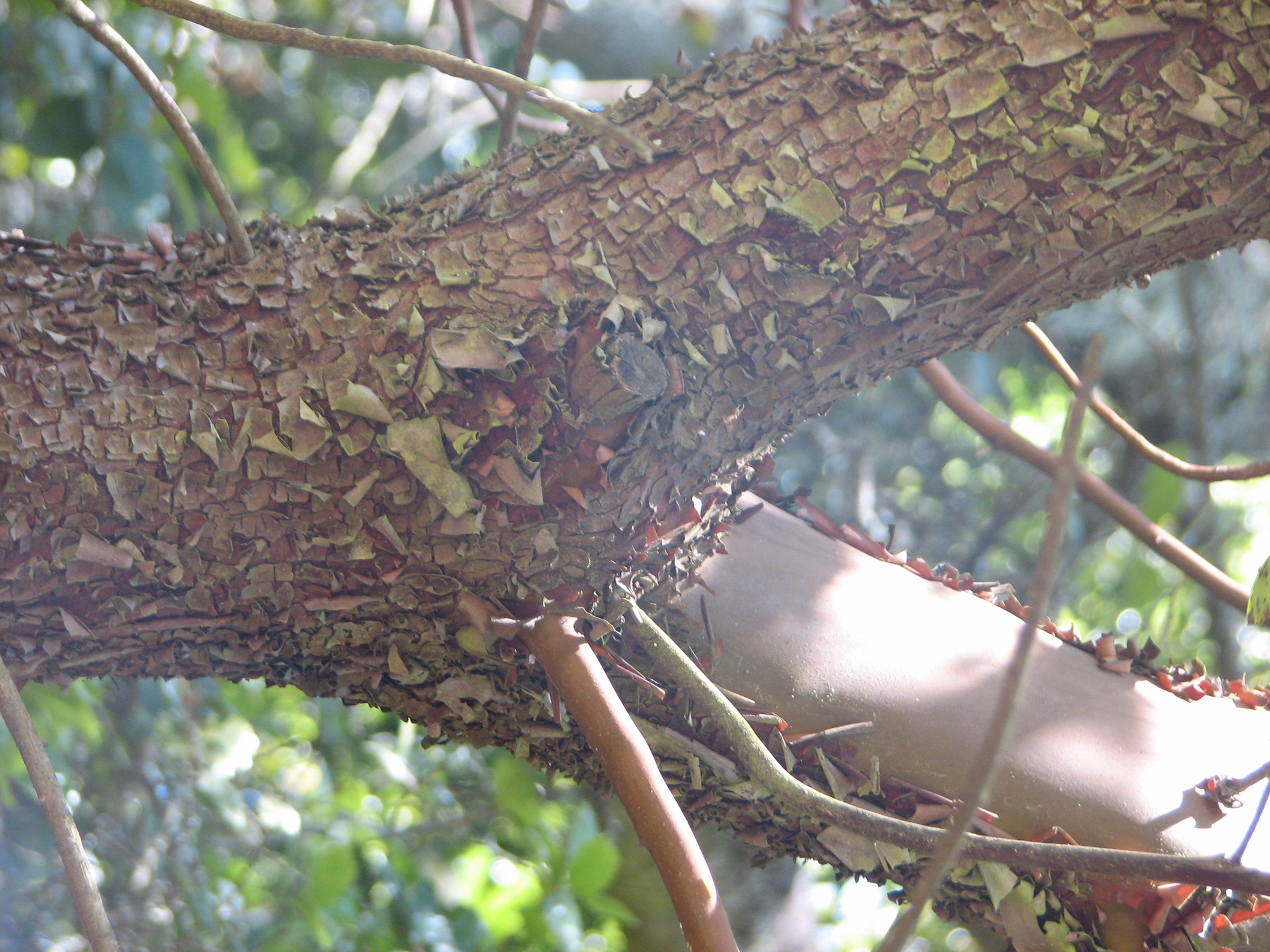
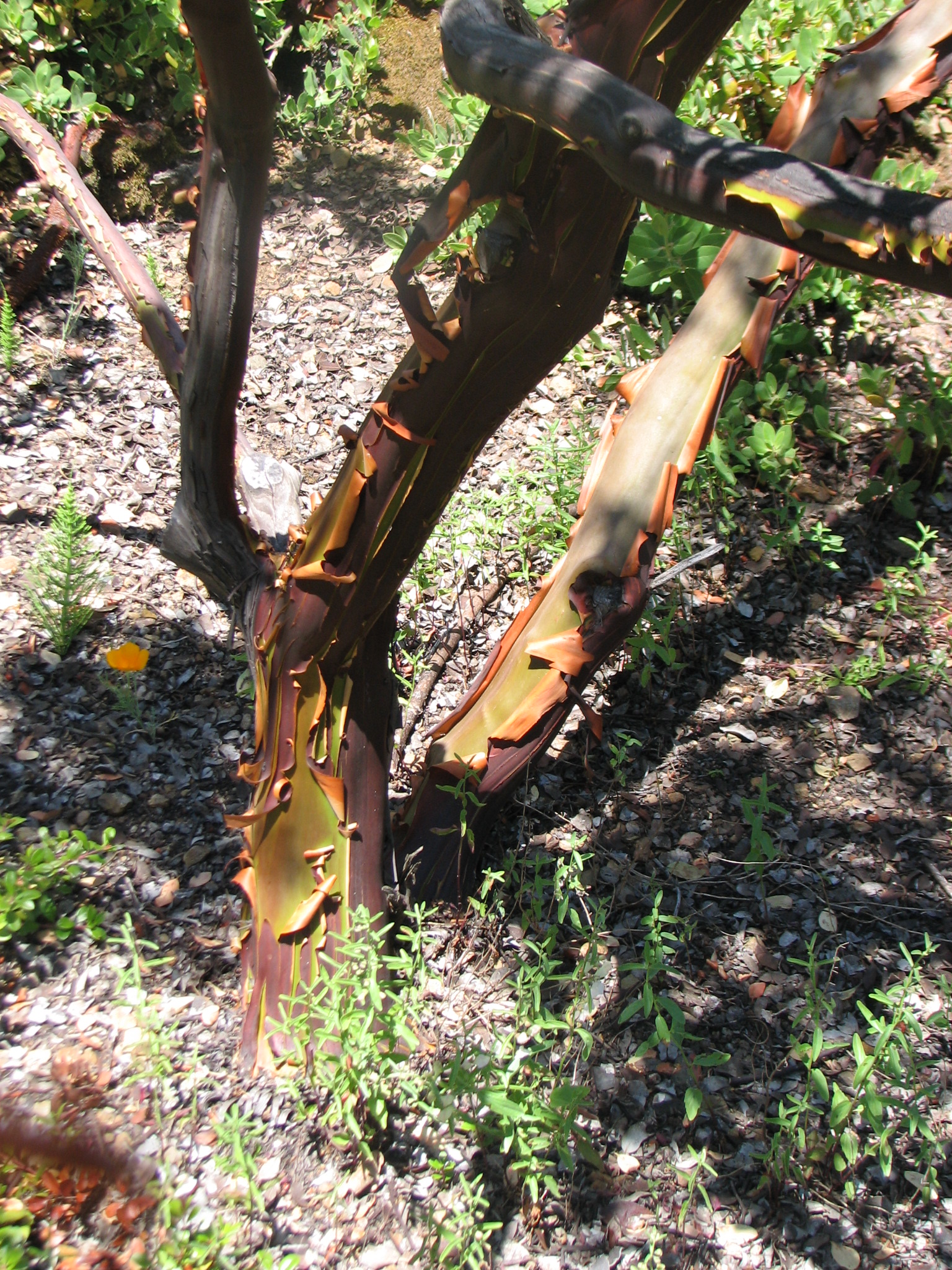
Madrone and Manzanita are examples of native plants with “ribbonlike shreds on the bark” that are highly flammable. Coyote brush and bay laurels are examples of native species which contain highly flammable oils.
Shreddy bark of Madrone
Shreddy bark of manzanita
Anyone with knowledge of the natural history of California could provide any number of such invidious comparisons between native and non-native plants with respect to their flammability. We hope the examples we have provided illustrate that flammability characteristics of plants are unrelated to whether the plants are native or non-native. The claim that non-native plants are more prone to fire than native plants is fallacious.
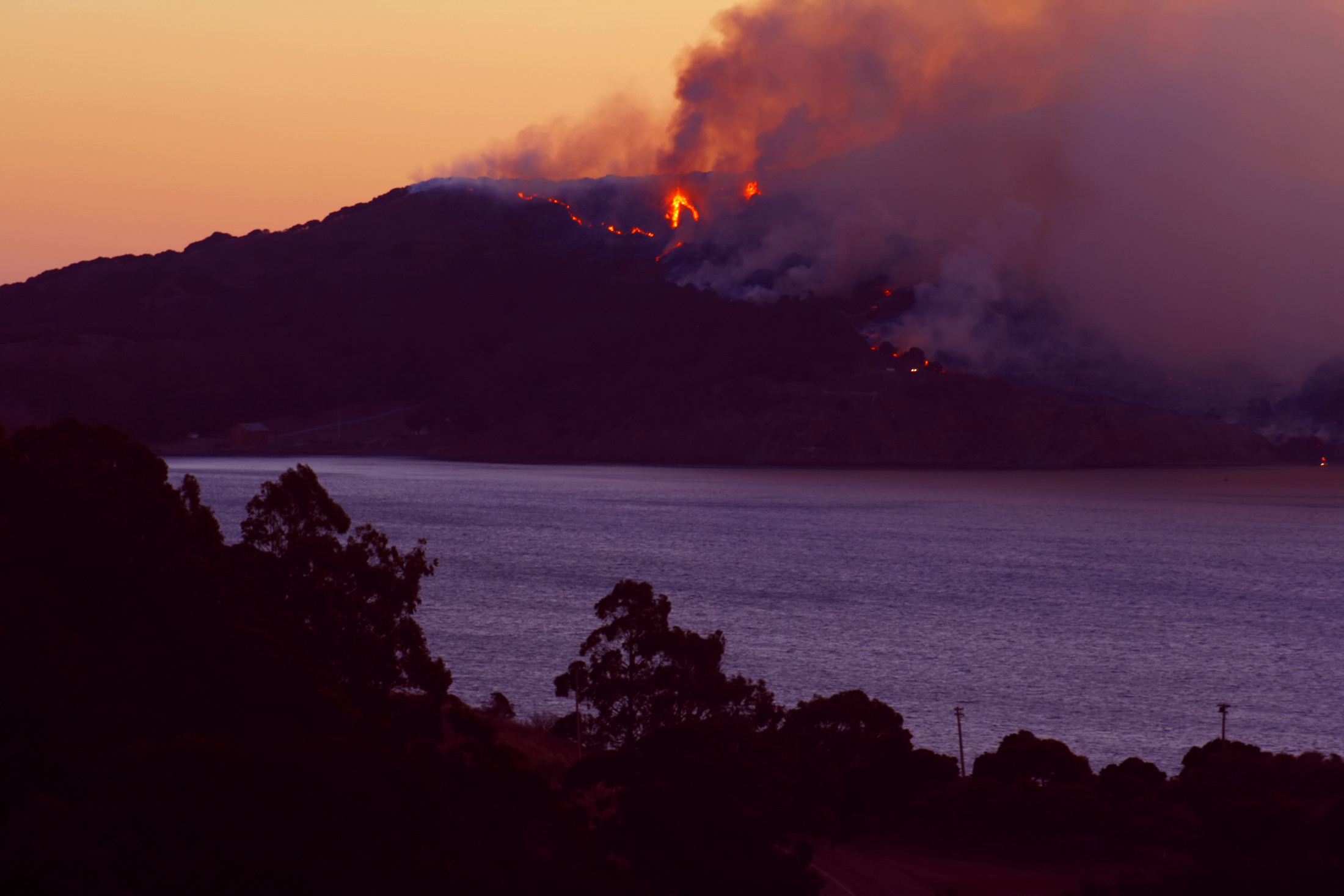
The fire on Angel Island in October 2008, is an example of the bogus claims of the flammability of eucalypts. According to an “environmental scientist” from the California state park system, 80 acres of eucalypts were removed from Angel Island over 12 years ago. Only 6 acres of eucalyptus remain. (“Rains expected to help heal Angel Island,” SF Chronicle, October 14, 2008 ). The fire that burned 400 acres of the 740 acres of Angel Island stopped at the forest edge: “At the edge of the burn belt lie strips of intact tree groves…a torched swath intercut with untouched forest.” (“After the fire, Angel Island is a park of contrasts,” SF Chronicle, October 15, 2008).
Wikimedia Commons/Mila Zinkova
The fire on Angel Island is not an isolated event. Rather it is typical of recent wildfires throughout California:
“It is estimated that no more than 3 percent of the recent 2007 fires…occurred in forests…the remaining 97 percent occurred in lower elevation shrublands and urban areas, burning native shrublands such as chaparral and sage scrub, non-native grasslands and urban fuels…” (Statement by Jon E. Keeley, USGS, before agencies of the US Senate, 2007)
A book about the 1991 wildfire in the Oakland/Berkeley hills illustrates the power of the legend that non-natives are more flammable than natives. In Firestorm: the study of the 1991 East Bay fire in Berkeley (Margaret Sullivan, 1993) the author states repeatedly that native plants and trees were involved in that fire. Every tree mentioned in the following quotes from that book is native to the Bay Area:
“…flames surging through the dry underbrush and live oaks that line the street…”
“…neighborhoods…are built into the contours of the grassy hills and live-oak-and-laurel studded canyons…”
“…hillsides covered in seasonal grasses or had overlooked ravines of oak and madrone…were devastated by the fire.”
On Vicente Road, “Two redwoods up the street caught fire like matchsticks.”
“Roble Road and… Roble Court, derive their name from the…Spanish word for the live oak tree that grows densely there…the devastation on lower Roble…was fairly complete…”
In the single mention of the role of eucalypts in the fire, the fire skips over the tree canopy: “The fire swept right over [the houses] scorching the crowns of surrounding eucalyptus trees.” And the Monterey pine—also targeted for eradication by native plant advocates—plays a similar role in a nearby location: “Across the street a grove of Monterey pines shields the white clapboard buildings of the private Bentley School…”
After presenting all this evidence about the role of native plants in the fire, the book concludes with the legend that non-natives are more flammable than natives: “Gardens of drought tolerant and fire-resistant California native plants have become symbols of the rebirth of the fire communities.” This statement is illustrated with a photo of a native plant garden.
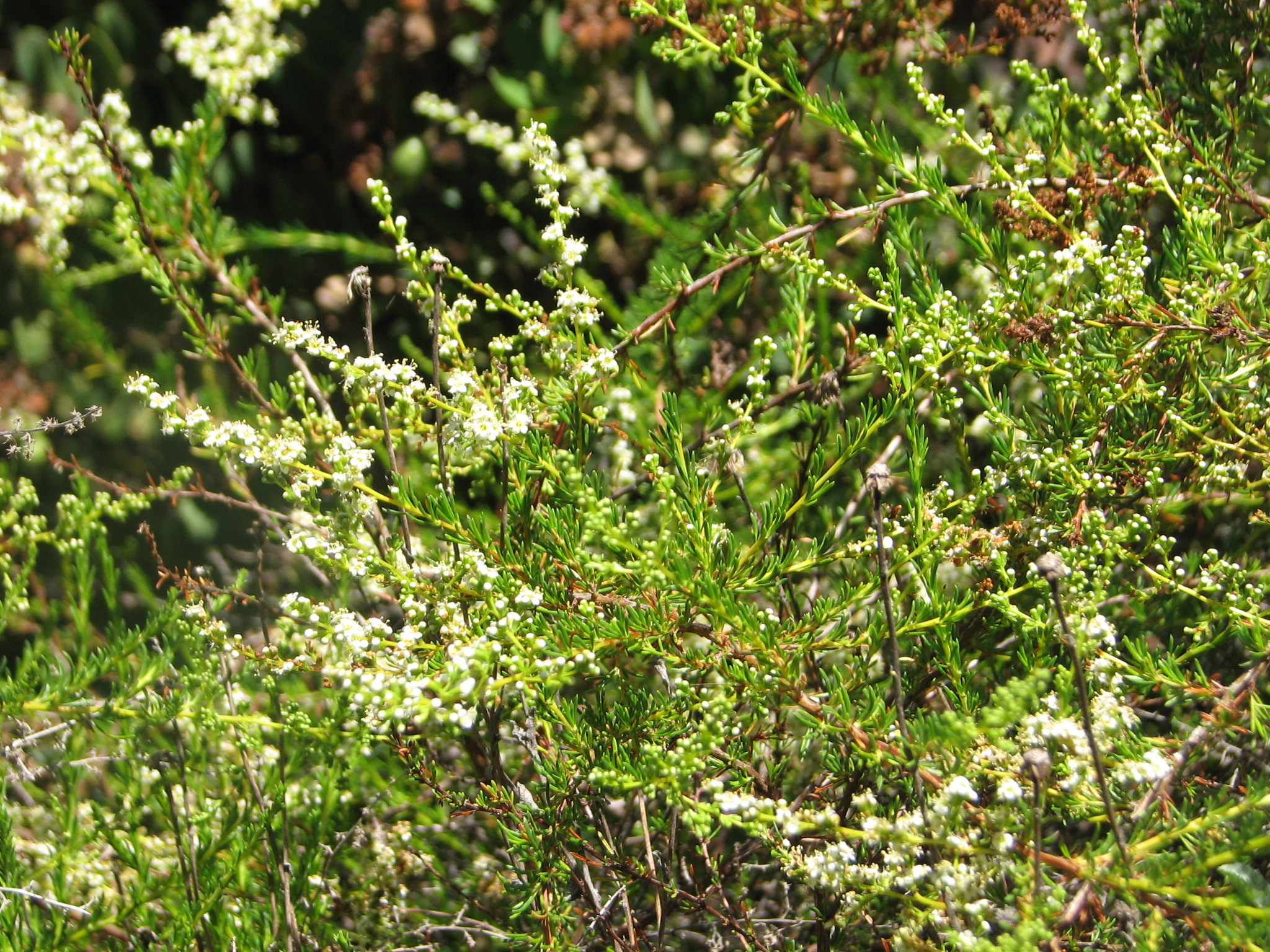
Chamise is an example of a native plant in the chaparral community that is extremely flammable.
“The relationship between fire and Chamise is illustrated by the plant’s tendency to ‘encourage’ burning. A thermometer was placed within a Chamise shrub as a fire approached, and the following changes were documented. At about 200⁰F the plant began to wilt as its temperature approached the boiling point of water. At about 400⁰F the plant began to emit combustible gases such as hydrogen, alcohol, and methane. At about 600⁰F the shrub smoldered and began to turn black. At about 800⁰F the plant burst into flames! This species must have evolved in association with frequent fires to have reached the point where it seems to encourage burning.” (A Natural History of California, Schoenherr, page 344)
Chamise, Tilden Park Botanical Garden
As Mark Twain said, “A lie can get halfway around the world while the truth is still putting its boots on.”
 Conservation Sense and Nonsense