The Sierra Club instructs FEMA

Those who are still members of the Sierra Club, but are concerned about the Club’s endorsement of projects to destroy trees and  use toxic poisons to kill their roots, might be interested in the Club’s public comment (scroll down to Appendix F “Written Comments) to Federal Emergency Management Agency (FEMA) in preparation for the Environmental Impact Study of four such projects in the East Bay hills. 

 The Chairman of the Bay Area Chapter of the Sierra Club begins by asking FEMA to ignore those who are critical of these projects:  “1. We urge FEMA to discount the views of any individual or group that uses sophomoric name calling tactics in the press or in their FEMA scoping comments to categorize people or advocacy groups as ‘nativists’ (or other similar pejorative labels)…”

Apparently the author does not consider calling someone “sophomoric” an example of “name-calling.”  Webster defines “sophomoric” as “intellectually pretentious and conceited but immature and ill-informed.”  Hmmm…that sounds pretty insulting to us.

We don’t use the word “nativist” here on Million Trees, not because we consider it an inaccurate description, but rather because we have been told that it offends native plant advocates.  Since our goal on Million Trees is to inform, rather than to offend, we stick with the clunky phrase, “native plant advocates.”

What about “other similar pejorative labels?”  Does the Club also object to the phrase “native plant advocates?”  We are at a loss to arrive at some phrase that would appease them.  For the moment, we’ll stick with “native plant advocates” to describe those who advocate for the restoration of native plants to our public lands.  After all, the Sierra Club freely admits its preference for native plants in their letter:  “We obviously prefer our local native species and plant communities when compared to…introduced species.” 

The Sierra Club also instructs FEMA to put the restoration of native plant communities on an equal footing with fire hazard mitigation:  “We also urge FEMA to ensure that natural resource protection is given equal status with fire hazard reduction work when final projects are developed.”  The letter provides a detailed description of the “natural resource protection” it has in mind.  In this context, that phrase translates to “native plant restoration.” 

Since the stated purpose of FEMA’s pre-disaster and hazard mitigation grants is to reduce fire hazard to the built environment and the humans who live in it, this doesn’t seem an appropriate request.  FEMA’s legal and fiduciary responsibility is to respond to disasters when they occur and to reduce the potential for disasters in the future.  FEMA seems to have its hands full doing just that.  FEMA’s assigned mission does not include native plant restoration.

As we observed in our post “Open Letter to the Sierra Club,” the Club tends to ignore the fact that the tree destruction for which they advocate requires the use of toxic herbicides.  However, in its public comment letter to FEMA, the Club acknowledges the use of such herbicides and endorses their use:  “We are not currently opposed to the careful use of Garlon…”  On our page about “Herbicides,” we report that the EPA classifies Garlon as “hazardous”  and we cite the laboratory research on Garlon, indicating that it is harmful to many species of animals and is mobile in soil and water.

We hope that FEMA will maintain its mandated focus on hazard mitigation, its sole responsibility to the taxpayers.   If the taxpayers wish to fund native plant restorations, they should do so by designating an appropriate fund source.  FEMA is not an appropriate fund source for native plant restorations.

FEMA sees through the smokescreen

The Federal Emergency Management Agency (FEMA) has seen through the smokescreen that native plant advocates have created as a pretext for destroying non-native trees in the San Francisco Bay Area.  Native plant advocates claim that destroying non-native trees will reduce fire hazard.  As taxpayers, and as fans of all trees, we commend FEMA for preserving their limited resources for legitimate disaster mitigation.
 
In February 2010, UC San Francisco (UCSF) announced that it had withdrawn its application for FEMA funding to destroy most of the eucalypts on 14 acres of the Sutro Forest.  When making that announcement UCSF explained that FEMA would require a comprehensive Environmental Impact Study before the grant would be awarded which would result in a two-year delay in the implementation of the project.  UCSF preferred to pay for the project with its own funds rather than delay it during the environmental review.  Therefore, UCSF withdrew its application for FEMA funding.  Since then, UCSF has proceeded with its plans, expanding them to 40 acres, and continues to claim that there is extreme fire hazard in the Sutro Forest which it claims will be mitigated by the project.

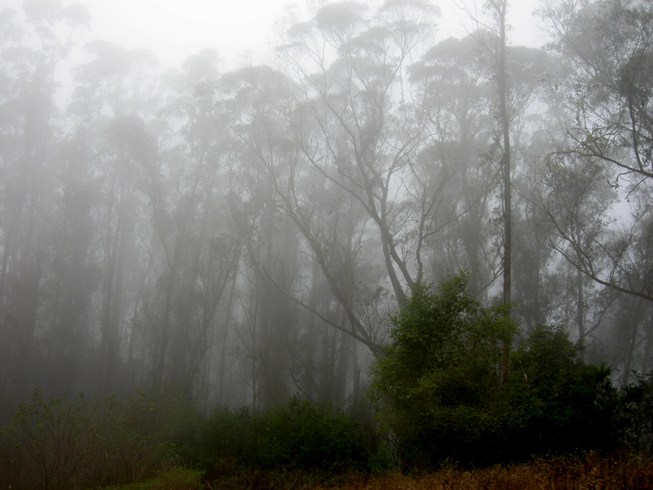
Sutro Forest on a typically foggy day in late summer. Courtesy SaveSutro.wordpress.com

We now know there is more to the story than is revealed by UCSF’s announcement.  The neighbors of the Sutro Forest who have been trying to save their forest for over a year, have since obtained correspondence from FEMA regarding UCSF’s grant applications through a public records request.    The correspondence with FEMA indicates that:

  • UCSF misrepresented and exaggerated the fire hazard on Mount Sutro by rating it as “extreme.”  FEMA confirmed with the state’s fire authority that fire hazard on Mount Sutro is moderate, CAL Fire’s lowest rating of fire hazard.  (1) 
  • FEMA asked UCSF to explain how fire hazard would be reduced by eliminating most of the existing forest, given that: (2)
    • Reducing moisture on the forest floor by eliminating the tall trees that condense the fog from the air could increase the potential for ignition, and
    • Eliminating the windbreak that the tall trees provide has the potential to enable a wind-driven fire to sweep through the forest unobstructed.
  • FEMA asked UCSF to consider alternatives to its project, which would have the potential to mitigate fire hazard to the built environment by creating defensible space around buildings, structural retrofits, and vegetation management projects. (3)

UCSF has elected to ignore this advice from FEMA, choosing instead to proceed with its project as originally designed using  its own funds at a time of extreme budgetary limitations.  Clearly this is an indication that fire hazard mitigation is not the purpose of their project.  UCSF chooses to increase fire hazard rather than reduce it, putting themselves and their neighbors at risk.

FEMA is now engaged in a comprehensive Environment Impact Study of four similar projects in the East Bay hills that propose to destroy hundreds of thousands of trees.  The applicants are UC Berkeley, the City of Oakland, and East Bay Regional Park District.  Fire hazard in the East Bay is greater than in San Francisco because the summer is hotter, the frequency of Diablo winds is greater, and there are rare deep freezes that cause some non-natives to die back, creating dead leaf litter on the forest floor.  However, the remaining issues are the same as those on Mount Sutro: 

  • The loss of tall trees will reduce moisture on the forest floor and eliminate the shade that maintains that moisture.  The remaining native landscape will be predominantly grassland studded with scrub, chaparral, and short native trees in sheltered ravines.  This will be a flammable landscape, not less flammable than the existing landscape.
  • The loss of the windbreak provided by the tall trees will enable a wind-driven fire to travel unhindered through the community.
  • The projects in the East Bay hills do not provide defensible space around homes, which would reduce fire hazard to homes and those who live in them, the stated purpose of FEMA grants.

We hope that FEMA will see the similarity between the East Bay projects and those in San Francisco and advise the applicants in the East Bay to revise their projects so that they are appropriately aimed at creating defensible space around homes.  Destroying hundreds of thousands of trees will not make us safer.  In fact, it is likely to increase the risk of wildfire.

———————————————————————————-

Sources:

(1) Excerpt from FEMA’s letter of October 1, 2009, regarding UCSF’s grant applications:

“In its response to provide a clarification of the wildfire hazard, UCSF inaccurately interprets a map, provides inadequate details regarding the history of wildfires in the Sutro Forest, and provides a simplistic and ineffective comparison of the wildfire hazard in the Sutro Forest to the hazard in other areas that have burned in the San Francisco Bay Area…The 2007 FHSZ [Fire Hazard Severity Zones] map shows the Sutro Forest to have a “Moderate” wildfire hazard in the 2007 FHSZ maps.  “Moderate” is the lowest of the three fire hazard severity zones…”

(2) Excerpt from FEMA’s letter of October 1, 2009, regarding UCSF’s grant applications:

“Commenters argue that the proposed projects would increase wildfire hazard by removing some of the material that collects fog drip and keeps the forest moist and resistant to ignition and fire, thus allowing the forest to dry out more easily and increase the relative hazard for ignition.  Can UCSF specifically address this comment and describe how overall forest moisture content will change after implementation of the proposed projects?  Please provide scientific evidence to support any claims.”

“Additionally, several of these unsolicited public comments have stated that the proposed projects could result in changed wind patterns on Mount Sutro which could also increase the wildfire hazard in the forest.  New wind patterns could reduce biomass moisture as well as reduce the effective windbreak created by the current forest.  These comments argue that the effective windbreak created by the existing forest limits the potential for wildfire spread in the forest and the immediately surrounding area.  As UCSF has stated, winds are a contributing factor in wildfires.  Provide a citable and logical defense regarding how the proposed projects, and the resulting changes in wind patterns, would not result in an increase in the wildfire hazard in the Sutro Forest.”

(3) “Assuming that UCSF has been able to establish a clear need for wildfire mitigation activities, UCSF must conduct a more thorough analysis to identify alternatives to the proposed projects that could mitigate wildfire hazard in the Sutro Forest to the vulnerable built environment.  These alternatives must be technically, economically, and legally practical and feasible and can include activities not eligible for FEMA grant funding.  As described in FEMA’s Wildfire Mitigation Policy…wildfire mitigation grants are available for defensible space, structural retrofit, and vegetation reduction projects.  It would seem reasonable that alternatives to the proposed projects could include defensible space or retrofit projects.”    (emphasis added)

Eucalyptus and Poppies

Have you visited the Oakland Museum since it reopened this summer after extensive renovation?  It looks pretty spiffy and continues to be a valuable resource for our community.

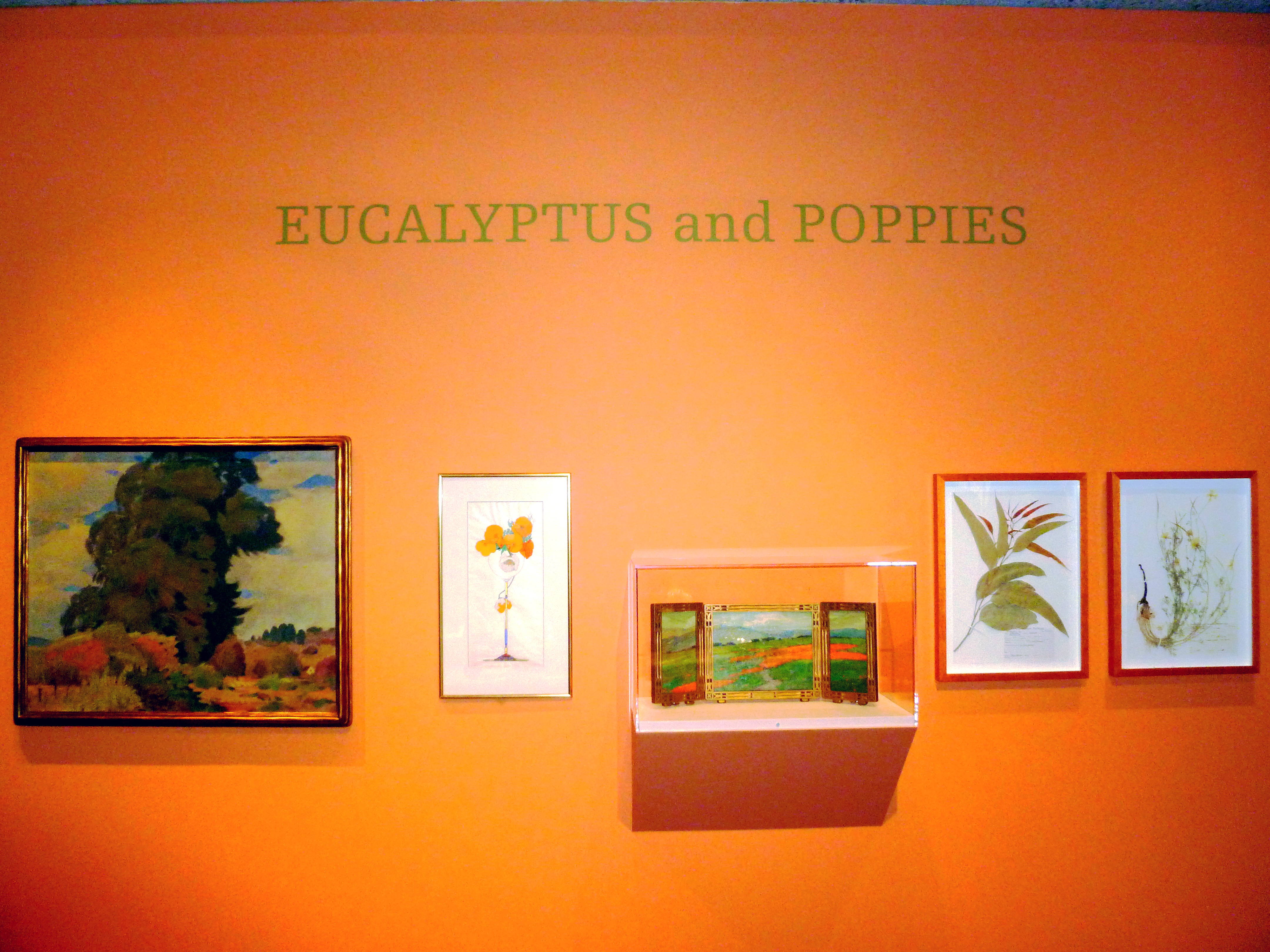
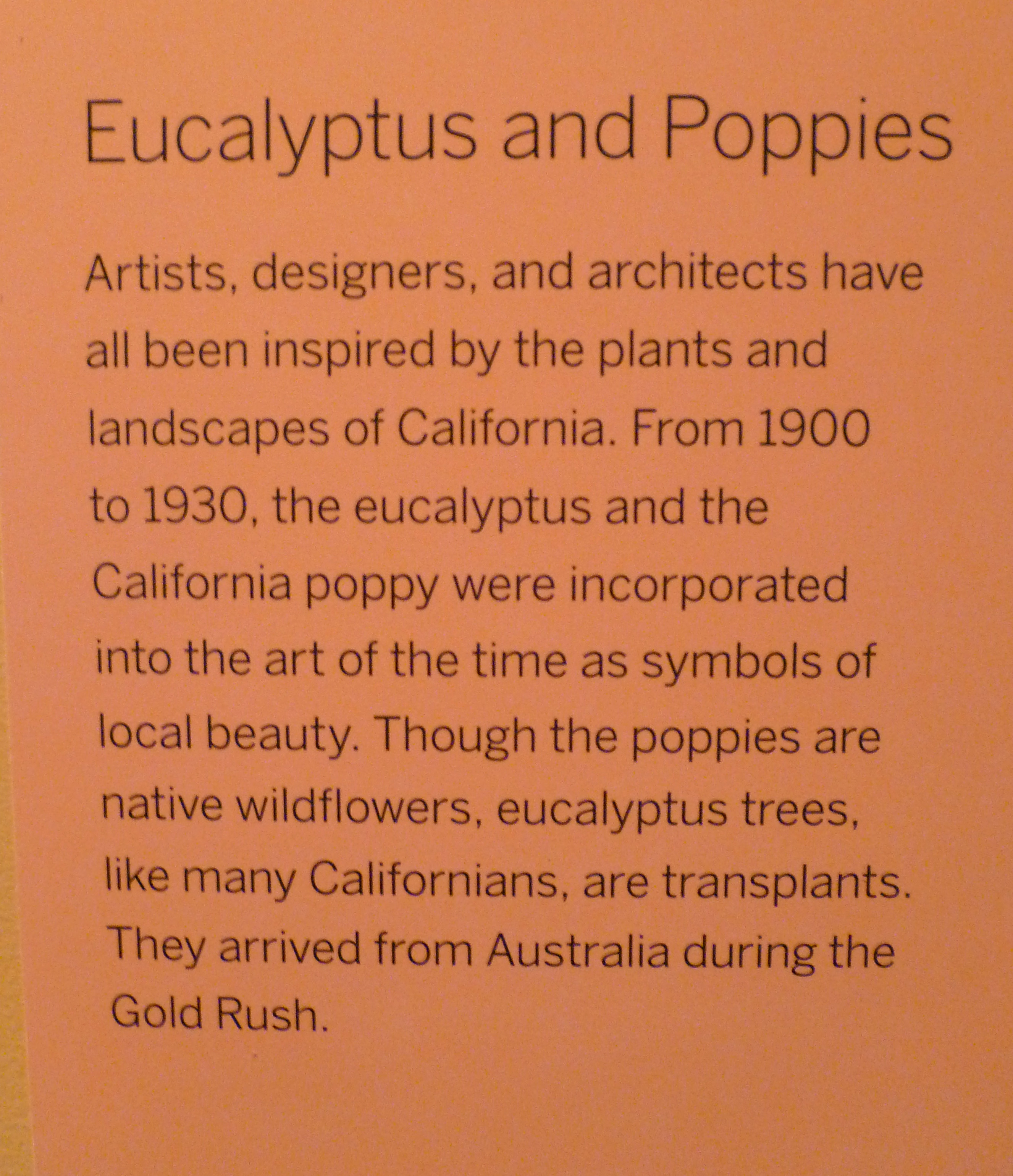
The museum’s collection of California art and design represents “the region’s creative output and its relationship to, and influences on, the nation and the world from the mid-1800 to the present,” according to its website.  And so, as we would expect, the exhibit includes a fitting tribute to one of California’s iconic landscapes, “Eucalyptus and Poppies.”

Oakland Museum
Description of exhibit

The artworks in this exhibit were created from 1916 to 1940, a period when eucalypts were popular.  They are out of fashion now, as are leisure suits and beehive hairdos.  Will they make a comeback, as did bell bottoms and hip hugger jeans?

There was a time, not so long ago, when Californians thought eucalypts fit in just fine with our native poppies.  Are they really the destructive intruders that native plant advocates make them out to be?  We don’t think so.  We believe that eucalypts are the victims of a “bad rap,” scapegoats for a fire they didn’t cause and a dwindling native landscape that is succumbing to climate change and other factors unrelated to the existence of eucalypts.

Creating Defensible Space for Fire Safety

Those who have a sincere desire to reduce fire hazards in the Bay Area would be wise to turn their attention away from the distracting and irrelevant debate about the flammability of native compared to non-native plants and trees.   California native ecology is dependent upon and adapted to fire.  The native landscape is not less flammable than non-native plants and trees.  Most firestorms in California are wind-driven fires in which everything burns, including native and non-native trees and plants as well as any buildings in the path of the fire.   

Rather, the creation of “defensible space” immediately around your home is your best defense against the loss of your home in a wildfire.  Creating defensible space means reducing fire fuels around your home by appropriate pruning and maintenance, such as limbing up trees to remove the fire ladder to the tree canopy and removing leaf litter.  Defensible space is intended to slow the progress of fire to your home.

In this post we will visit several reputable sources of information about fire safety that advise homeowners about how to protect themselves, particularly those who live in the Wildland-Urban Interface where fire hazards are greatest.   We will see that all these sources of information have in common that they do not single-out specific species of plants or trees.  Rather they emphasize that how vegetation is pruned and maintained is more important to reducing fire hazard and that materials we use in building our homes are equally important to our safety.  These sources of information are not native plant advocates.  Their advice is not based on a desire to destroy non-native plants and trees in the belief that their destruction will benefit native plants and trees.  

Firewise Communities is an internet resource provided by the National Fire Protection Association and co-sponsored by the US Forest Service and the US Department of the Interior.  This resource offers on-line courses in fire safety.  In the course on “Firewise Landscaping” these criteria are listed as the characteristics of fire-resistant plants:  low leaf litter, high water retention ability, high salt retention ability, lack of aromatic oils, low fuel volume, height and spread that fits well into the intended space.  Some native and some non-native plants fit these criteria and some do not.  For example, although the leaves of eucalyptus contain aromatic oils, so do the leaves of the native California bay laurel.   

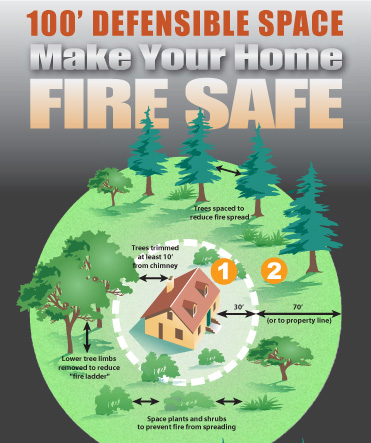
Homeowners in the Wildland-Urban Interface should focus on creating defensible space around their homes rather than on choosing particular plant or tree species. CALFire guidelines for creating defensible space do not advise for or against any particular species of plant or tree. Rather CALFire focuses on how to prune and maintain vegetation around your home and create a “defensible space” around your home with low fuel volume, as illustrated in this brochure on their website.

Creating defensible space around your home. CALFire

Likewise the UC Berkeley Fire Center in their brochure “Home Landscaping for Fire” says, “It is important to remember that given certain conditions, all plants can burn…how your plants are maintained and where they are placed is as important as the species of plants that you chooselandscape management (e.g., pruning, irrigation, and cleanup) have a greater impact on whether or not a plant ignites than does the species.” It is ironic that UC Berkeley is engaged in the destruction of every non-native tree and plant on its property, despite the advice on its own website about fire safety, which is obviously being ignored. 

The August 2010 issue of Sunset Magazine includes a comprehensive “Wildfire Survival Guide,” including advice about planting a fire-safe garden. 

The City of Oakland passed an ordinance in 2006 requiring homeowners to maintain defensible space around their homes and voters in Oakland agreed to tax themselves to pay for the enforcement of this requirement.  Unfortunately, a drive in the Oakland hills informs us that these requirements are not being enforced. 

Oakland hills

This home is particularly vulnerable because fire tends to travel up hill.  Firewise says that a 30% slope will accelerate the rate of spread of fire to twice the speed of fire on flat ground. 

Wouldn’t the people of Oakland be better served by enforcement of requirements for defensible space around homes rather than paying shared costs of $662,280 for a FEMA grant to eradicate all non-native vegetation from 325 acres of wildland? (see “Our Mission, Projects in the East Bay”)  Oakland is  flat broke and one of the most violent cities in the country.  Eighty policemen were recently laid off and 120 more are likely to be laid off if voters don’t vote to tax themselves further.  Shouldn’t homeowners be required to create defensible space around their homes where their lives and property are most at risk before “vegetation management” is extended far beyond the perimeter of homes?

Invasion or Natural Succession?

In a recent post we considered the changes in our landscape that have occurred as a result of climate change.  In this post we examine more historical sources of change in the landscape.

Native plant advocates in the Bay Area choose to replicate the “pre-settlement” landscape that existed in the late 18th century.  The arbitrary selection of this date does not take into account that Native Americans had lived in the Bay Area for approximately 10,000 years.  Throughout that period Native Americans altered the landscape by setting fires to promote food production as well as to provide materials for cultural activities such as basket weaving.  Fires were used to improve forage for the animals they hunted and visibility during the hunt, and to funnel animals into their hunts.  Fires also promoted the growth of their food sources such as acorn production.  (1)

Unlike some parts of California, fire ignition in the San Francisco Bay Area is rarely caused by lightening, making this anthropogenic (caused by man) source of fire the predominant cause of fire historically.  (2)

After the arrival of the Spanish in the late eighteenth century, cattle and sheep grazing was the predominant economic activity in California and continued to be an important activity into the early 20th century.  These early ranchers also introduced non-native grasses which had greater nutritional value for their herds.  The non-native annual grasses out-competed the native bunch grasses, resulting in California grassland that is 99% non-native today (3).

The fires set by Native Americans and the cattle grazing of the early Californians were both instrumental in preventing the natural succession of grassland to chaparral and scrub and subsequently to woodlands.  Modern land use and management policies have suppressed fire and reduced grazing in the Bay Area.  Consequently grasslands are succeeding to chaparral and scrub.  Although managers of public lands often describe these changes in the landscape as “invasions,” Jon Keeley (Ph.D. biologist, USGS) considers them a natural succession:

“These changes are commonly referred to as shrub invasion or brush encroachment of grasslands.  Alternatively, this is perhaps best viewed as a natural recolonization of grasslands that have been maintained by millennia of human disturbance.”  (4)

Serpentine Prairie restoration. East Bay Regional Park District

So, if the succession of grassland to shrubland is natural, why do managers of public lands believe it is necessary to prevent—or even reverse– this succession?  

Serpentine Prairie. 500 trees were destroyed, including many oaks.

For example, the “Wildfire Plan” of the East Bay Regional Park District is even more ambitious than halting natural progression of the landscape.  In many instances it proposes to return the landscape to an earlier version of the native landscape.  Here are a few examples of management actions in the “Wildfire Plan” that are intended to roll back biological time to sustain native landscapes from an earlier period:

  •  “[Native] Grasslands and Herbaceous Vegetation…these widely-spaced trees will not cause an active crown fire because of the discontinuity of tree crowns.  They could, however, provide a seed source for invasion of grassland habitats by woodland species and should be considered for removal to maintain desirable and declining grassland habitat.” (page 131)
  • “[Native] Maritime Chaparral…Favor chaparral community by removing oak, bay, madrone buckeye, and other trees under 8 inches diameter at breast height that are encroaching upon the maritime chaparral.”  (page 136)
  • “[Native] North Coastal Scrub…Shift species composition towards native scrub species or consider conversion to grasslands, where appropriate on historic grassland sites…” (page 140)
  • “[Native] Coyote Brush Scrub…In most treatment areas, encourage conversion to grasslands by reseeding with native grasses…after brush removal.”  (page 149)
Serpentine Prairie being weeded by hand. Mowing will be required during the restoration. Prescribed burns will be required to maintain it as prairie.

The return of the existing landscape to earlier, historical versions requires the removal of native trees and shrubs, as well as dangerous, polluting prescribed burns.  In so doing, a permanent commitment to periodic prescribed burns is made to maintain the landscape as grassland.  And what will this accomplish? If this strategy is successful the landscape would be returned to a version of the landscape in the late 18th century, even though that landscape was actually created by the Native Americans and maintained by subsequent grazing by early European settlers.

As we often do on Million Trees, we ask the managers of our public lands to explain their strategy for artificially maintaining our landscape at an arbitrarily selected point in time.  Should we run the risks of prescribed burns for the sole purpose of replicating an 18th century landscape that was created by Native Americans?  Since California grassland is now almost entirely non-native, what is the point of preventing its succession by destroying native plants?  We don’t understand what would be accomplished by such artificial manipulation of the landscape. 

(1) “The Use of Fire by Native Americans in California,” M. Kat Anderson in Sugihara, Fire in California’s Ecosystems, 2006.  

(2) “Central Coast Bioregion,” Frank Davis & Mark Borchert in Sugihara, Fire in California’s Ecosystems, 2006.

(3) Natural History of California, Schoenherr, UC Press, 1992

(4) “Fire history of the San Francisco East Bay region and implications for landscape patterns,” Jon E. Keeley, International Journal of Fire, 2005.

Sudden Oak Death

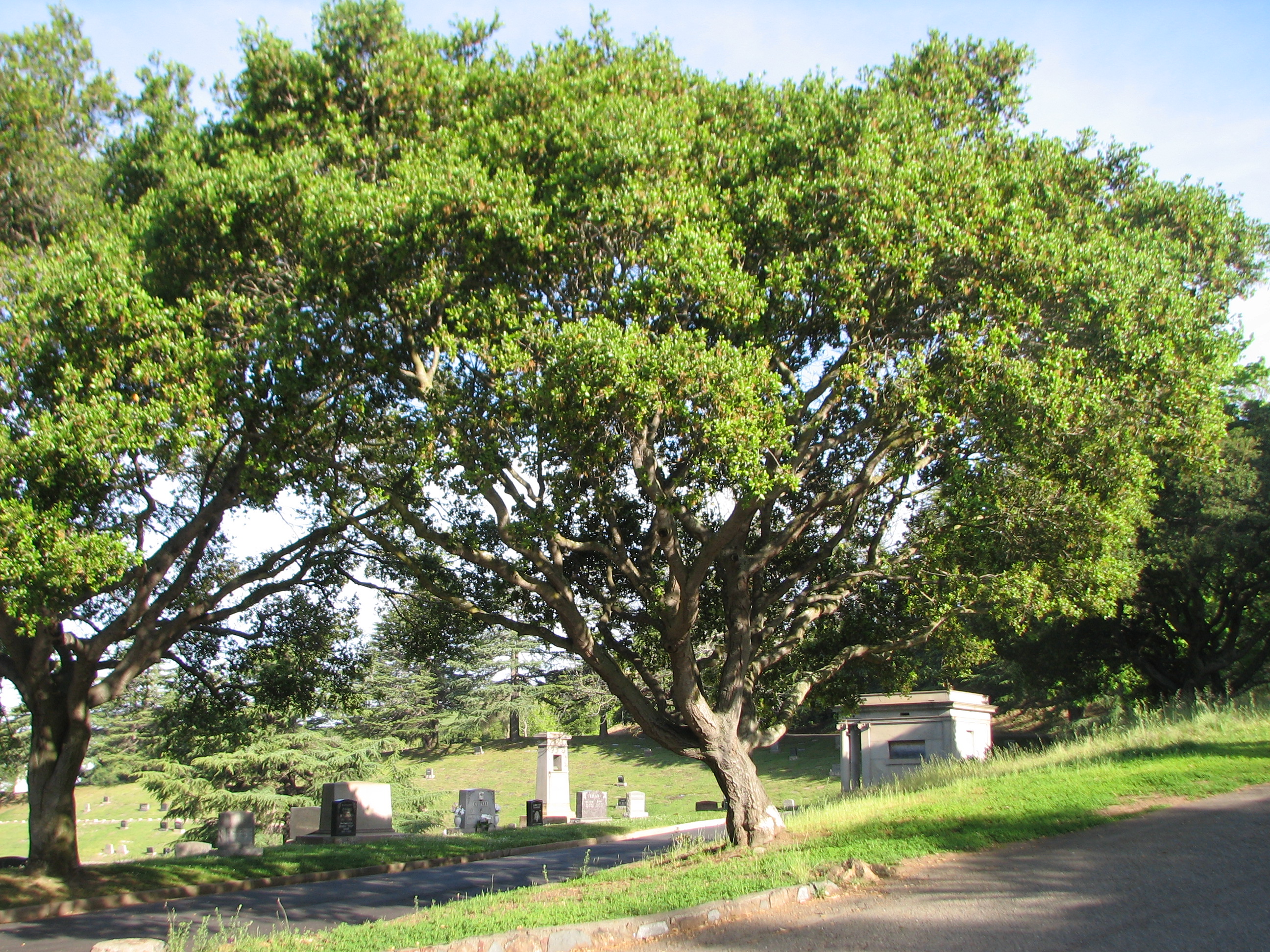
Coast live oak, Mountain View Cemetery, Oakland

The coast live oak that is native to the Bay Area is one of our favorite trees and we would be happy to see more of them.  However, the epidemic of Sudden Oak Death that is killing oaks in California and Oregon makes us question the wisdom of replacing non-native trees with oaks that may not survive that epidemic.  Since any dead tree is more flammable than any living tree, we are also skeptical about claims that restoration of the oak-studded grassland will reduce fire hazard in the Bay Area.

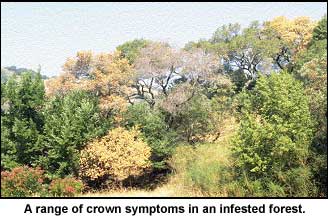
Sudden Oak Death, US Forest Service photo

 The pathogen (Phytophthora ramorum) that causes Sudden Oak Death (SOD) was reported  on the UC Berkeley campus in 2002.  At that time it also existed at the UC Botanical Garden and the researcher who identified the pathogen speculated that it probably existed throughout the East Bay.  By 2008, the SF Chronicle reported   that the infestation of SOD existed in several parks in the East Bay.  The researcher estimated that about 20% of all coast live oaks in the East Bay are infected with the pathogen that will eventually kill them.

In February 2008, the California Oak Mortality Task Force estimated  that ”millions of tanoak and coast live oak” have been killed by SOD in California.  Thirty four other species of trees and shrubs are also infected with the pathogen, including bay laurels and redwoods.  Although these species are not usually killed by the pathogen they are vectors of the disease.  The bay laurel is singled out by the scientific literature as being particularly effective at transmitting the pathogen to the oaks that are then killed.

The “Wildfire Hazard Reduction and Resource Management Plan” of the East Bay Regional Park District proposes to destroy most non-native trees on over 1,500 acres of parkland.  The “vegetation management goal” for most of these acres is the restoration of “oak-bay woodland.”  And so we ask these rhetorical questions:

  • What is the probability that coast live oak will survive the deadly SOD pathogen in the Bay Area?
  • Does the proximity of bay laurel to the local oak population increase the probability of infection?
  • If the oaks are killed by SOD will the risk of wildfire in the East Bay hills increase?
  • If the non-native trees are destroyed and the oaks are killed by SOD will the resulting landscape be entirely treeless?

We believe these are legitimate questions and when we have asked them of native plant advocates we have not heard an adequate answer.  We believe that eradicating non-native plants and trees without a clear understanding of the future of the natives, is irresponsible.

CHANGE….the only constant

The conventional wisdom amongst native plant advocates is that native plants will return to the landscape if non-native plants are eradicated.  In this post, we will examine this assumption and refute it.

Several different methods are used to eradicate non-native plants, but it doesn’t matter which method is used because the results are the same:  native plants do not return when non-native plants are removed. 

Spraying herbicides is a popular method of eradicating non-native plants because it is considered the most cost-effective method. In addition to the obvious health risks, the downside of herbicide use is that they are as likely to kill the natives as the non-natives.  This problem is illustrated by a USDA study of the effects of a one-time aerial spraying of herbicides on grassland after 16 years.  Although the herbicide is assumed to “dissipate” within a few years, the negative effect on the natives persisted 16 years later:  “…the invasive leafy spurge may have ultimately increased due to spraying.  Conversely, several desirable native herbs were still suffering the effects of the spraying,,,” 

Even when native plants are removed, non-native plants occupy the cleared ground.   Environmental scientists at UC Berkeley removed native chaparral from experimental plots in Northern California to test fuel reduction techniques using two different methods (prescribed burns and mechanical), in different seasons, over a period of several years.  In every test, the result was on average from 23% (for prescribed burns)to 61%  (for mechanical methods) non-native plants where they had not previously existed.  

Jon E. Keeley (USGS) finds the same tendency for non-natives to replace natives in forests:  “Forest fuel reduction programs have the potential for greatly enhancing forest vulnerability to alien invasions.” (1)

A scientist (2) arrived at the same conclusion after attempting to restore an oak-studded grassland on Vancouver Island.  He tried several different methods of removing invasive grasses for several years only to find that “…the decline of the native plant species accelerated…” 

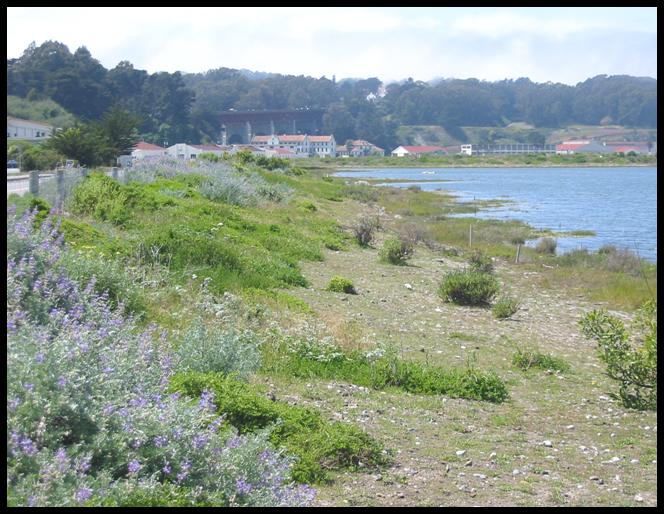
Crissy Field, NPS photo

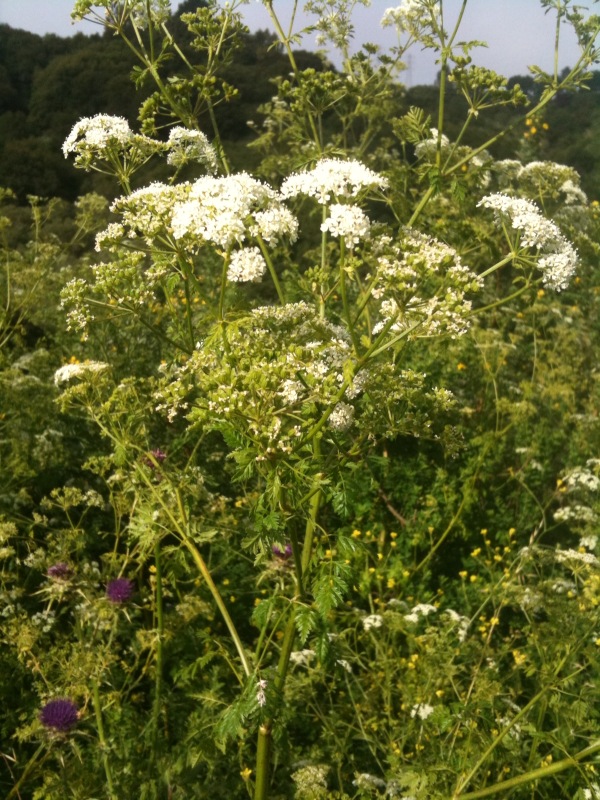
Those who observe native plant restorations in the San Francisco Bay Area aren’t surprised by these studies.  We know that native plant restorations are unsightly failures unless they are aggressively planted, irrigated for several years, and fenced.  Examples of successful restorations can be seen at Crissy Field and the summit of Mt. Sutro.  The East Bay hills provide examples of the opposite strategy.  Where UC Berkeley has clear-cut all non-native trees and vegetation, non-native weeds quickly occupied the barren ground.    After a particularly wet winter, the non-native poison hemlock in the East Bay hills is 6 feet tall along the roads. 

Poison hemlock, East Bay hills

Why are non-native plants apparently more competitive than native plants?  Because the conditions that supported native plants 250 years ago, prior to the arrival of Europeans, have changed.  The native plants are no longer well adapted to the current conditions.

Higher levels of CO2 and the associated climate change are promoting the growth of non-native plants.  A USDA “weed ecologist” (3) studied the effects of higher temperatures and CO2 on the growth of non-natives (AKA weeds) by growing identical sets of seeds in a rural setting and an urban setting with higher temperatures and CO2 levels.  Seeds grown in the urban setting produced substantially larger plants with much more pollen and therefore greater reproductive capability. 

Other scientists reach the same conclusions by studying the changing ranges of native plants and insects.  An ecologist at UC Berkeley (4) says that “California’s flora face a potential collapse…as the climate changes, many of these plants will have no place to go.”   A scientist at the California Academy of Sciences (5) predicts that redwoods will disappear from California by the end of the century.

As the plants move, so do the insects and animals that need them.    A study published in Nature magazine in December 2009 found that plants and animals must move as much as 6 miles every year from now to the end of the century to find the habitat they occupy now.  An ecologist at UC Davis (6) has been studying native butterflies for over 35 years.  He recently reported that native butterflies are moving to higher elevations, where temperatures are lower, but that ultimately, “There is nowhere else to go, except heaven.”

The local environmental organizations and public policy-makers must wake up to this reality and reorder their priorities.  Instead of demanding that all non-native plants and trees be eradicated and that native plants be restored where they are no longer sustainable, they must make climate change their highest priority.  The easiest and cheapest step to take to address this issue is to quit destroying healthy trees—just because they are non-native–that are sequestering tons of carbon.

(1) “Fire Management Impacts on Invasive Plants,” USGS, Jon E. Keeley, April 2006

(2) Andrew MacDougall, University of Guelph, Ontario, Canada, NY Times Magazine, 6/29/08

(3) Lewis Ziska, USDA, Beltsville, MD

(4) David Ackerly, UC Berkeley, Los Angeles Times, 6/25/08

(5) Healy Hamilton, Cal Academy, Center for Biodiversity Research

(6) Arthur Shapiro, UC Davis, Contra Costa Times, 1/19/10

Open Letter to the Sierra Club

In this post we are writing an open letter to the Sierra Club about an article in their recent edition of the Yodeler, the newsletter of the Bay Area Chapter of the Club.  The article is available here

——————————————————————————————-

Dear Sierra Club,

We are writing about an article in the Yodeler about the “Wildfire Hazard Reduction and Resource Management Plan” of the East Bay Regional Park District.  A charitable description of that article is that it is misleading and inaccurate.

The most important flaw in the article is that it omits the most controversial issue in the “Wildfire Plan.”  It describes the methods used to eradicate non-native plants and trees as follows:  “Methods for removal include hand removal, grazing by cattle and goats, and limited controlled burns.”

In fact, herbicides are often used by EBRPD to kill non-native plants and trees.  The failure to mention this use of herbicides in the Yodeler cannot be dismissed as ignorance of this fact since it is described in detail in the “Wildfire Plan” and was the most frequently mentioned issue in the meeting of the EBRPD Board of Directors at which the Plan was approved.  The Sierra Club was represented at this meeting and surely noticed that many speakers expressed their concern regarding the use of herbicides officially designated “hazardous chemicals” by OSHA.  The toxicity of these herbicides is reported  here and here.

The description of controlled burns required by the Plan as “limited” is debatable.  We believe that the use of controlled burns for the sole purpose of restoring native plants is dangerously irresponsible.

At the recent meeting of the Executive Committee of the Board of Directors of the EBRPD, the “fuel management” plans for 2011 were presented and approved.  These plans included prescribed burns in 5 locations, on approximately 250 acres.  These burns were described by the Assistant Fire Chief as unrelated to reduction of fuel loads, but rather for the purpose of supporting restoration of native plants to the parks.  A representative of the California Native Plant Society expressed  gratitude to East Bay Regional Park District  for conducting these burns for the benefit of native plants.

We object to the use of controlled burns for this purpose because such burns have a history of causing major wildfires (reported here).  Some of these controlled burns will occur in areas with many acres of eucalyptus and Monterey pine that both the Sierra Club and the East Bay Regional Park District claim are highly flammable.  The burns are scheduled to occur during the height of the fire season.  Such burns also reduce air quality and release carbon and particulates into the air.

It baffles us that the Sierra Club endorses the use of dangerous herbicides and prescribed fires.  However, we aren’t surprised because the Club’s comments on the Draft EIR for the “Wildfire Plan” warned us that the Sierra Club considers the restoration of native plants a higher priority than the public’s safety.  The lawyer representing the Club said on behalf of the Club, “Perhaps the most serious problem with the Plan is that it explicitly makes the preservation and enhancement of wildlife a secondary concern, with minimizing fire danger the primary concern” and concluded, “However, the over-emphasis on decreasing wildfire risks at the expense of habitat values is disturbing.”

The Club’s priorities reveal a misanthropic agenda that betrays its original ideals and its commitment to the environment on behalf of all living creatures, including humans.

Million Trees

What is natural?

The branch of San Francisco’s Recreation and Park Department dedicated to the preservation and restoration of native plants to the city’s parks calls itself the Natural Areas Program (NAP).  And the 32 parks or portions of parks within NAP’s jurisdiction are called Natural Areas.  In this post we will visit a few of these areas to ask if they are accurately described as “natural.”

Parcel 4, Balboa & Great Highway, 1868

The Natural Area known as Parcel 4 is at the corner of Balboa and the Great Highway.  A photograph taken in 1868 of that location indicates that it has been continuously built upon for nearly 150 years.  Long-term residents of San Francisco will remember it as the location of Playland by the Beach.  After Playland was closed, the city purchased the property for $3.05 million in 1993 with the intention of putting a sewer pipe under it, then restoring it to dune vegetation.  The soil was essentially building rubble, so the city had to buy $47,000 of sand and disk it down 18 inches to amend the soil in preparation for planting dune vegetation.  The sand was bulldozed into simulated dune shapes and planted in 2002.  The restoration was described in the newsletter of the Coalition of San Francisco Neighborhoods in April 2003, in an article entitled “Sand Francisco.”  Does this sound “natural” to you?

Parcel 4 under construction, 2002
Eight years later, 2010

India Basin is a Natural Area on the east side of the city, on the bay.  The east shore of the city was where most industrial development was located until industry left the city beginning in the 1960s.  Much of the soil was landfill.  Like Parcel 4, the landfill was bull-dozed into a simulated wetland, hoping to restore tidal action.  Native pickle-weed was planted several times in the mud-filled basins.  We haven’t visited this area for several years.  Perhaps they have finally been successful in that effort.  This is what we found there on our last visit:  native plants along the trail, surrounded by plastic and woodchips to discourage weeds and huge, empty, mud basins off shore.    It didn’t look natural to us.

India Basin, 2003

Many of the Natural Areas in San Francisco are less artificial than these two extreme examples.  Some of the Natural Areas weren’t built upon in the past, but had no native plants in them when they were designated as Natural Areas.  Pine Lake is an example of such a Natural Area.  Even where native plants actually existed, their populations were small and isolated in comparison to the acreage designated as a Natural Area.  Over 1,000 acres of city-managed parkland have been designated as Natural Areas, 25% of all parkland in San Francisco and 33% if Pacifica is included in the calculation.

Sculpture of “Albany Bulb Greeter”

Now we will visit the Albany Bulb for contrast.  Albany Bulb is also landfill that was for many years the Albany city dump.  When the dump was closed, the Bulb became a park.  It is a wild and wonderful place.  There are few native plants, other than the ubiquitous coyote bush that seems to thrive almost anywhere.  In the spring, Albany Bulb is a riot of color.  These are the competitive non-natives that native plant advocates wring their hands about.  They are there because they are best adapted to the current conditions in this location…the heavily amended soil, the higher levels of CO₂, the warmer climate, the use by humans and their animal companions. 

Valerian and wild mustard, Albany Bulb. Both are non-native plants.

If all of these non-native plants and trees were eradicated from the Albany Bulb, would native plants magically appear?  Based on our experience, we don’t think so.  The conditions that supported the plants that are native to the Bay Area are gone for good.  It is a fantasy that the existence of non-native plants is the only obstacle to the return of the natives.  Visiting a few places where this strategy has been tried will confirm this.  Unless the natives are aggressively planted, irrigated for several years, fenced for protection, weeded or sprayed with herbicides regularly, they do not return.  Can such intensive gardening be called “natural?”

Restoration or Destruction?

A recent trip to the Channel Islands off the coast of California inspires us to consider the pros and cons of restorations.  Islands are particularly attractive targets for restorations. They often contain endemic species that do not exist anywhere else because they have adapted to unique conditions in isolation.  And the relative isolation of islands implies that once non-native species of plants and animals are eradicated, re-introduction of those species can be prevented.

Santa Cruz Island, Wikimedia Commons

Some of the Channel Islands were inhabited by Native Americans as long as 13,000 years ago.  Ranching by Europeans began on some of the islands in the 1850s. Europeans brought sheep, cattle, pigs, mule deer, and elk to some of the islands.  Five of the eight Channel Islands were designated as a National Park about 30 years ago. 

Restoration began in earnest in the 1990s when ranching operations were ceased and tens of thousands of sheep and cattle were either removed from the islands or destroyed.  Black rats were eradicated from some islands after native mice were herded into protective enclosures so the rats could be poisoned.  Rabbits were eradicated from another island.  We don’t know how that was achieved. 

The next big effort was the eradication of about 6,000 feral pigs. When this was accomplished by sharp shooters, the first unintended consequence of this ambitious restoration was revealed.  It seems that the feral pigs had been the chief diet of a population of Golden Eagles, considered non-native to the Channel Islands.  When the pigs were removed from their menu, they turned to the rare, endemic Channel Island Fox. 

Channel Island Fox, Wikimedia Commons

The population of Channel Island Foxes plummeted.  Those that remained were captured so they could breed in protected conditions while the Golden Eagles were captured and removed to a remote location.  The Channel Island Fox is making a come-back, but the Golden Eagles are apparently gone for good. 

The eagle considered native to the Channel Island, the Bald Eagle, has been reintroduced.  It apparently lives in peace with the Channel Island Fox because it eats fish. 

Mule deer and elk are next up on the eradication agenda for fauna.  Non-native plants are also doomed.  Ice-plant and fennel are the top priorities for eradication by 2011.  Herbicides and prescribed burns are used for this purpose.   

Prescribed burn, Santa Cruz Island, NPS photo

We were surprised to see notice of herbicide application for Garlon 4 Ultra during our visit to this fragile place.  Someone dressed from head to toe in protective clothing was spraying this chemical on a steep hillside.  We have reported the toxic effects of Garlon in our post about herbicides.

This is a complex ecosystem in which simplistic solutions—such as killing all the non-natives—can result in a big mistake.  For example, do we know if there are native Anise Swallowtail Butterflies on the islands that are now dependent upon non-native fennel for their survival?  Do we know how the application of Garlon will impact the survival of the rare, endemic Island Jay?  The US Forest Service found in its risk assessment done for the EPA that the application of Garlon had a significant negative impact on the reproductive success of birds.  Are those who decided to spray Garlon aware of this study?

Herbicide application notice, Santa Cruz Island

We went to the Channel Islands with open minds.  We thought the strongest arguments could be made for restorations on islands.  However, when we learned of the thousands of animals who were sacrificed to this effort and the dangerous and toxic methods used to accomplish the restorations, we were not convinced.  We nearly lost the Channel Island Fox because of the unforeseen consequences of killing feral pigs.  Man would like to believe that he is capable of managing nature.  But can he do so without causing more harm than good?