It is my pleasure to publish (with permission) Arthur M. Shapiro’s (Professor of Ecology & Evolution Emeritus, UC Davis) review of Ecological Explosions: The History of Biological Invasion and Invasion Science, by Daniel Simberloff (Professor of Environmental Science, University of Tennessee).
Professor Simberloff is a prolific and vociferous adherent to the hypotheses of invasion biology, as well as to the related commitment to eradicating non-native plants. I heard Simberloff speak at the conference of the National Park Service, “Science for Parks, Parks for Science,” at UC Berkeley in 2015. It was a time when critics of invasion biology were emerging and becoming more vocal and visible. Simberloff called out by name Emma Marris, Peter Kareiva and others for their criticism of invasion biology.
In 2020, I heard Simberloff speak at the annual forum of the California Invasive Plant Council. His presentation was similar to his presentation in 2015 in that it was primarily focused on critics of invasion biology whom Simberloff calls “deniers.” Simberloff categorized the criticisms of invasion biology then flipped them off, one by one.
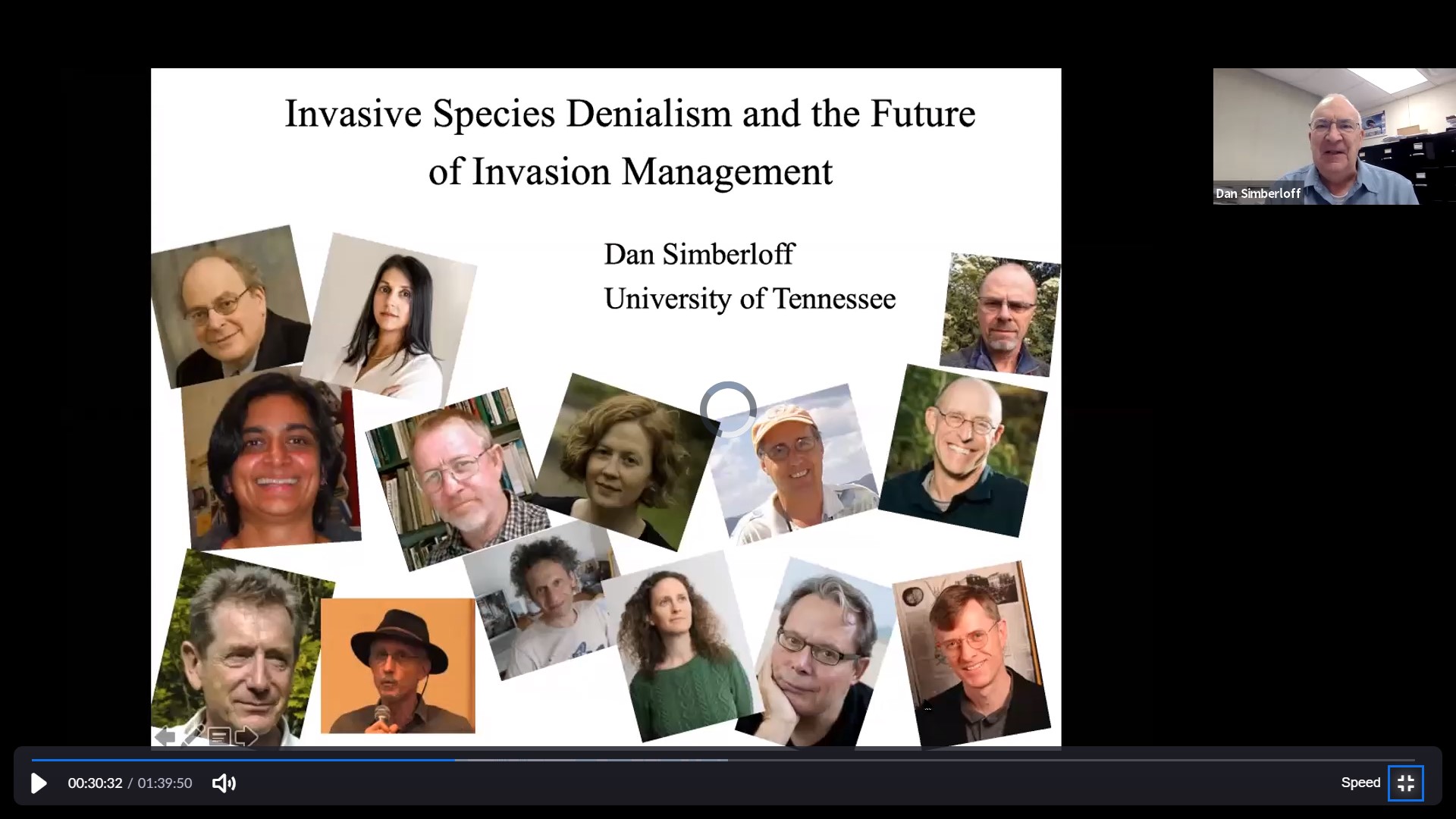
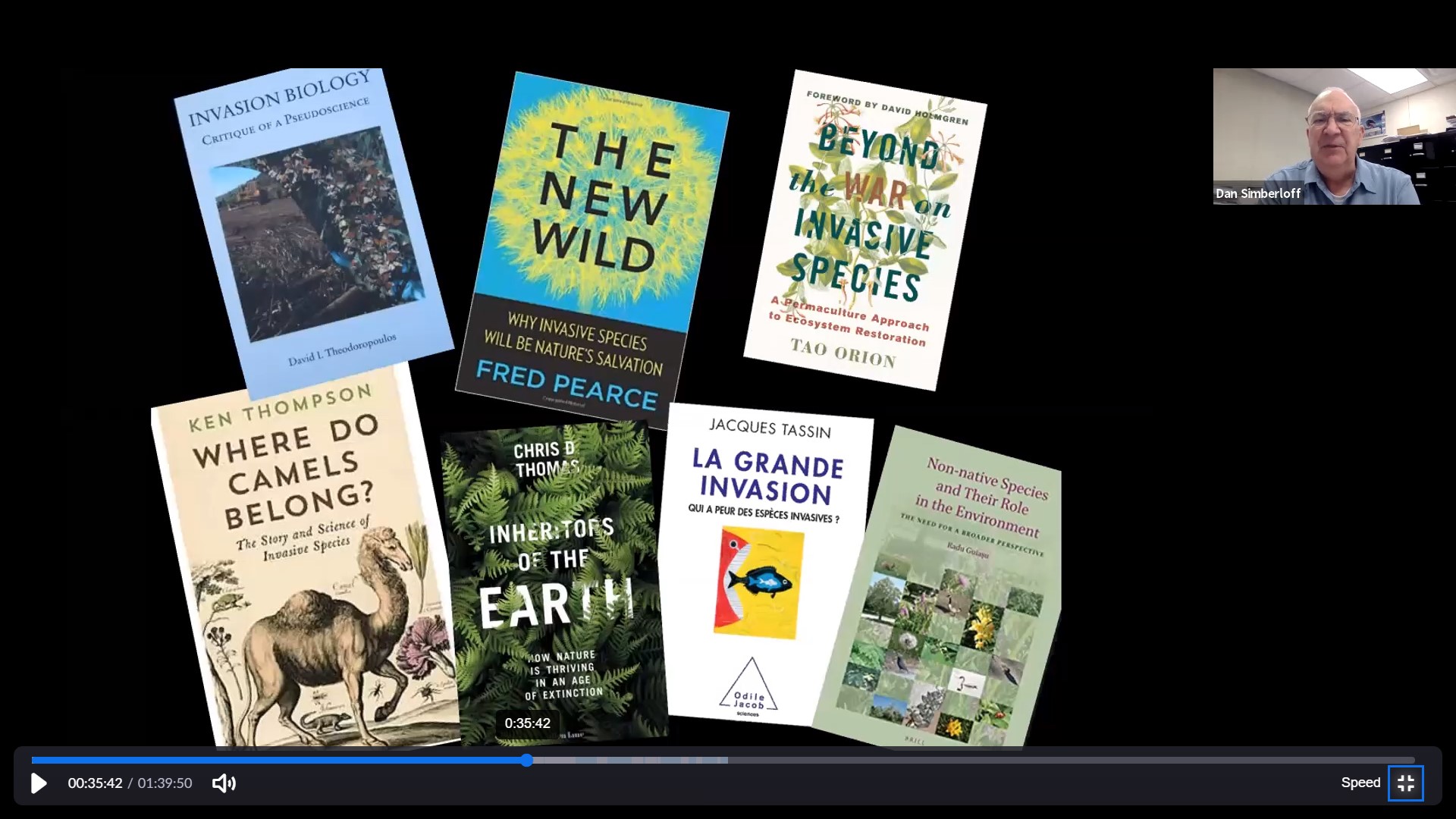
Then, Simberloff’s presentation took an unexpected turn when he was asked this question by the moderator: “Dan, you mention the “futility” argument, but what about the notion that the cost in environmental damage (e.g, pesticide use and nontarget impacts) is too high for some well-established invaders?” Simberloff’s answer to this question was surprising and encouraging to critics of pesticide use to kill non-native species:
“Absolutely, it’s a huge problem, not only on non-target species, but also the fact that evolution of resistance leads to greater use of pesticides before they are useful and leads to greater impact on non-target species. I didn’t talk about this, but yes, of course the cost both economically and ecologically might be too great even if management eradication is feasible. But that’s not what denialism is about. Denialism willfully denies that there are impacts or they confound arguments about values as if it is an argument about science.” Daniel Simberloff
Simberloff’s concern about the costs “both economically and ecologically” of eradicating non-native plants was as much a shock to the Executive Director of the California Invasive Plant Council–which actively champions the use of herbicides to eradicate non-native plants–as it was to me.
Based on that experience, I had a premonition that Simberloff’s recent publication might be another surprise and so it is, as Professor Shapiro explains in his review. Simberloff publishes this exhaustive tome at the age of 84. Perhaps it is his last word. It is a significant revision to the long crusade to eradicate every non-native plant.
One hopes Simberloff’s book will influence the “restoration” industry to be more circumspect when choosing their eradication targets and their methods. If so, it comes at a good time because every effort to reduce pesticide use in the US has been tried and failed.
Last week, the US Supreme Court overturned product liability lawsuits brought by users of glyphosate with cancer, because the Environmental Protection Agency does not consider glyphosate carcinogenic, though it indisputably is. EPA’s determination now over-rides any state determination to the contrary. Earlier, President Trump also signed an Executive Order, promoting the use of glyphosate and Robert F. Kennedy, Jr., Secretary of Health and Human Services, endorsed the Executive Order.
I am deeply grateful to Professor Shapiro for giving me this opportunity to publish his review of Professor Simberloff’s book about invasion biology. I am also grateful to Professor Simberloff for taking a closer look at the consequences of eradicating non-native plants.
Conservation Sense and Nonsense
REVIEW: ECOLOGICAL EXPLOSIONS: THE HISTORY OF BIOLOGICAL INVASIONS AND INVASION SCIENCE. Daniel Simberloff. University of Chicago Press. 2025. 729 pp.
I was fully prepared to detest this book—until I read it.
Dan Simberloff, as E.O. Wilson’s star graduate student at Harvard, was present at the creation of the theory of island biogeography, which used simple mathematical and graphical models to bring order to a vast heap of anecdotal information and in so doing radically transformed ecology—from natural history to analytical science (not everyone was thrilled). Simberloff’s subsequent career can be seen as the application of that approach to the implications of human-mediated changes in the geographic ranges of species generally. Now in his 80s, he has written this doorstop of a book as the envoi to his career. Why, I wondered, would anyone want to read it?
Simberloff and I are contemporaries. My undergrad adviser at Penn, Robert MacArthur, was Wilson’s collaborator on “The Theory of Island Biogeography,” and very much wanted me to do my Ph.D. with Wilson. MacArthur was under the illusion that I had mathematical talent, despite my best efforts to convince him otherwise. I knew it would be a bad fit, and to his frustration never even applied to Harvard. I went to Cornell for my degree, a place more in tune with a natural historian like me. I have often joked that had I gone to Harvard I would have become Dan Simberloff! Both Simberloff and I read Charles Elton’s “The Ecology of Invasions by Animals and Plants” (1958), the book that established invasion biology as a field and gave it its name. In Dan’s case reading that book shaped his entire career. It had many impacts on mine as well; I began observing and studying the adoption of naturalized host plants by native insects, mainly Lepidoptera, and it profoundly affected my teaching (community ecology, biogeography) for the next 50+ years. So it was natural that I, at least, would want to read it.
At the same time I had become disaffected with what I perceived as both the ideological and the faddish turn of invasion biology, and I was apprehensive about what I might find. I needn’t have been.
The first part of the book is a more-or-less chronological history of the development of invasion science, from the earliest observations of European weeds in New England by John Josselyn down to our own time. This is not a catalogue of case histories, but the ones selected are judiciously chosen to be representative of aspects of the field. Most were already familiar to me, but quite a few were not, even after more than five decades.
But the most important chapters for me were at the end. Chapter 18 (“Controversies Abound”) confronts head-on the conflation and entanglement of invasion biology on the one hand and xenophobia and racism on the other—exemplified by the term “native plant Nazis,” referring to those who advocate eradication of non-native species. The use of political and military metaphors (including the word “invasion” itself!) has contributed to such conflation and its undesirable resonances. The conflation has deep roots, which Simberloff explores—consider the New York socialite Madison Grant, a prominent lay conservationist, who authored the scurrilous racist tract “The Passing of the Great Race: or the racial basis of European history” (1916), by no means an isolated case. Simberloff has no patience for the blanket rejection of species solely on the basis of their “native” vs. “non-native” status. He recognizes that each case must be approached contextually and that there is no justification for eradication campaigns except in the most exigent circumstances (pathogens, parasites—the current alarm over the screwworm comes immediately to mind; invaders that pose grave risks to agriculture or to the survival of prized native species and ecosystems). Chapter 19, on the future of invasion science, elaborates on these themes in the context of a world that is changing at an ever-accelerating pace.
Do age and experience confer wisdom on us? Perhaps not inevitably. But this book convincingly demonstrates that they have done so for Dan Simberloff. If you are seriously interested in invasion biology, get and read this doorstop of an envoi: all 729 pages of it.
ARTHUR M. SHAPIRO
University of California, Davis


The thoughtful contents of your blog are always a pleasure to read, this one included. Thanks to Professor Shapiro for an excellent review – and to Dan Simberloff for a more balanced perspective!
Dan Simberloff’s publishing strategy has always consisted of attempting to control the narrative. His foreword to the 2000 reprinting of Elton’s little 1958 book told us to focus on the plethora of wryly described cases and dismiss Elton’s own acceptance that management intervention was unlikely to succeed. He assembled an encyclopedia; maybe his first “last word.” He contributed to the “What Everyone Needs to Know” series with a further last word, for nonspecialists. He annotated — sort of — yet another edition of “The Ecology of Invasions…”, perhaps to quash the possibility that others might encourage an alternative interpretation. He has played whack-a-mole with every perceived criticism coming from every direction, playing at being an expert in everything. Now this newest final word, which very selectively amends some of Dan’s previous assertions without really crediting anyone beyond the invasion biology/ecology/science inner circle for having influenced his thinking or gotten anything right. Certainly not suggesting he’d ever gotten anything wrong. Standard Simberloff. An exercise in intimidation. A doorstop indeed, but one meant to hold a door closed, not open.