The valuable functions performed by our urban forests

We are reprinting, with permission, an article on the website of the San Francisco Forest Alliance about the many ecological functions performed by our urban forests and the plans of the Natural Areas Program to destroy over 18,500 mature, healthy trees.  Please visit the website of the Forest Alliance to read about their efforts to save the urban forest in San Francisco from needless destruction.    

**************************************

Urban trees are hugely important, not just for their beauty, but for environmental reasons. The [Natural Areas Program’s] NAP’s SNRAMP plans to cut down 18,500 trees (and a whole lot more under 15 feet in height, plus whatever is lost to wind-throw when the wind-break of the other trees is gone).

Source: USDA Report, Assessing Urban Forests Effects and Values, 2007

What are these 18,500++ trees doing for us? Here are nine ways in which urban forests help us.

  • The Nature Conservancy's Carbon equivalence graphic

    Storing Carbon. Trees store carbon and keep it out of the atmosphere. The bigger the tree, the more it stores. CLICK HERE for a 3-minute video from the Nature Conservancy about the carbon stored by a red oak tree that’s 18 inches in diameter. Eucalyptus may store even more, because it grows taller than a red oak and is more dense (Eucalyptus, around 50 lbs/cu ft; red oak, about 41).

  • Providing Oxygen. Trees produce more oxygen than they use. When they’re felled, they decay and use oxygen instead of making it.
  • Trapping and removing air pollution. Tree leaves capture air pollution, and help clean our air. The trapped pollution stays on the leaves or falls to the ground – where we don’t have to breathe it.
Golden Gate Park - in the beginning (abt 1880)
  • A windbreak. In its pre-European state, San Francisco was a place of windblown sand that got into everything from railway tracks to people’s lungs. With a city and a major park atop the former dunes, we don’t have to worry about sand so much, but the wind still sweeps across our city. The eucalyptus forests and other trees act as a windbreak, and improve the micro-climates not only of the forest, but of surrounding areas.
  • Buffering noise. Trees absorb sound, in much the way that fabrics and soft materials do. Once they’re felled, everything becomes noisier. Thinning a forest lets in the sounds of the city and its traffic. When Laguna Honda Hospital felled some 200 trees in conjunction with its new building, neighbors in Forest Knolls and Midtown Terrace noticed increased noise.
  • Slowing runoff. When it rains, the roots of the trees, and the duff made by their shed leaves and the understory beneath them, soaks it up like a sponge. Then it slowly lets it out again, allowing plants and vegetation to use it over time, replenishing ground water, and fighting erosion. (If you want to see the difference – drive by Christopher, below Mount Sutro, during heavy rain – and then drive up Twin Peaks Boulevard. The latter’s like a river when it’s pouring.) [See “Rainfall Interception” data from USDA]
  • Preventing erosion. Many of these trees grow on very steep slopes, and below them are our neighborhoods. Their roots function now like a geo-textile, holding the slopes in place – particularly in forest areas, where the roots are intermeshed and intergrafted. On Twin Peaks, where the vegetation is thinner, landslips occur every season of heavy rain. In Forest Knolls, clearing of slopes below the houses has resulted in landslides requiring months of tarping to stabilize them. This is a particularly insidious problem; it may take 6-8 years for the root system to die and decay, and by then the homeowner may not even know or recall that trees once held the slope together.
  • Provide habitat. Trees provide cover, places to perch and hide, and food by way of nectar and leaves and the insects attracted to the trees. Eucalyptus, in particular, flowers in winter providing nectar for bees, butterflies, and birds – and attracting birds that prey on these insects. It’s a nesting site for owls and hawks and feral bees, and a hunting ground for birds small and large. Our city would have far fewer birds, animals, and bees without these trees.
  • Boost property values. People like trees. Homes near forested areas are valued by owners and potential buyers. Realtors often mention these settings in their listings. Some studies show mature trees nearby can add up to 30% to property values.

New Orleans: A case study in the resilience of nature

In August 2005, the city of New Orleans was hit by a devastating hurricane, dubbed Katrina, and a subsequent storm surge that destroyed much of the city and killed many of its residents.  The Lower Ninth Ward of New Orleans was one of the hardest hit areas of the city because it was the location of two breaks in the levee and is also at a lower elevation than less damaged neighborhoods.

The population of New Orleans reached its peak of 627,525 in 1960.  A year after Katrina, the city’s population had plummeted to about 200,000.  Six and one-half years later, the population is estimated to be 356,000. 

Neither the loss of population nor the return was spread evenly throughout the city.  The Lower Ninth Ward lost 75% of its population since 2000 because the damage was greatest there and its previous inhabitants did not have the resources to restore their properties.  For the same reasons, there are few services in the Lower Ninth Ward, such as a supermarket, or a police or fire station, making it a less attractive place to live.

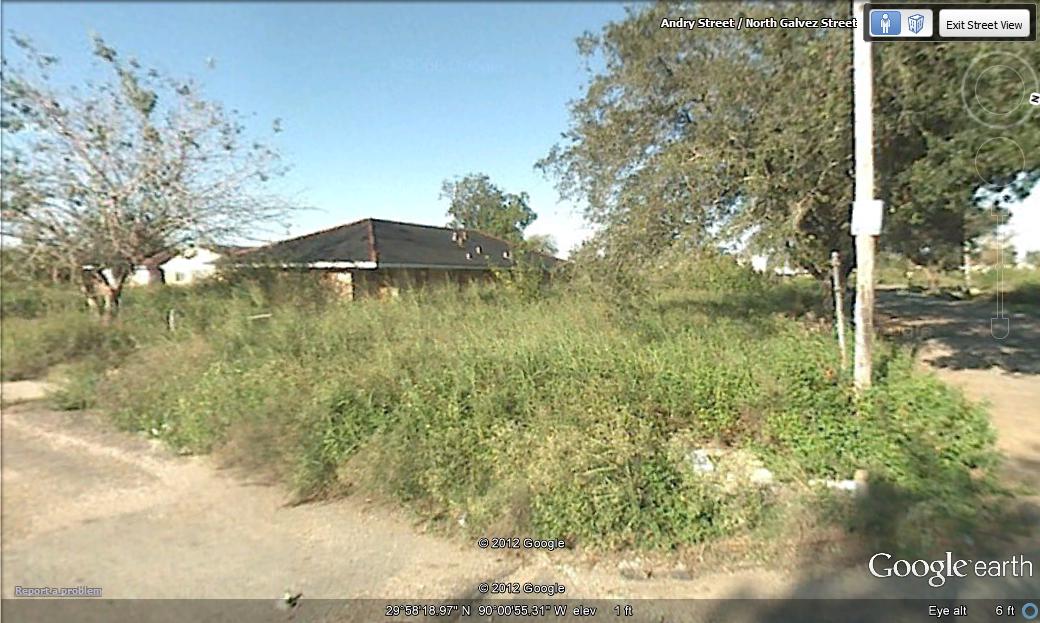
Andry St & North Galvez St, New Orleans

The New York Times Magazine recently published a feature about the Lower Ninth Ward aptly entitled, “Jungleland.”  The article reports that nature has returned to the Lower Ninth Ward of New Orleans without the help of man and now resembles a dense jungle, more heavily populated by animals than people. 

Nature returns to the Lower Ninth Ward

The Lower Ninth Ward is a case study in the resilience of nature.  It is being intensively studied by ecologists as an example of how nature recovers from natural disasters, such as the volcanic eruption of Mount St. Helens and the earthquake and tsunami in Japan one year ago.  What all these disasters have in common is that they wiped the ecological slate clean.  Everything growing and living in these places was swept away to bare ground.

The Lower Ninth Ward was built on fertile ground because it was the repository of sediment from the Mississippi River for millennia before it was protected by levees and built upon.  This is also a part of the country that enjoys a warm climate and plenty of rain.  These factors undoubtedly contributed to the robust and rapid regrowth of vegetation in the Lower Ninth Ward.

The regrowth is almost entirely non-native.   Before the land was cleared for plantations in the mid-1700s the native vegetation was reeds and brambles along the river, hardwood forest behind the river, giving way to cypress and palmetto swamp in the interior.  “Today there are few species native to the land, other than several kinds of sedge and aquatic grass.  Only a handful of palm, live oak, and bald cypress survived the storm.” * 

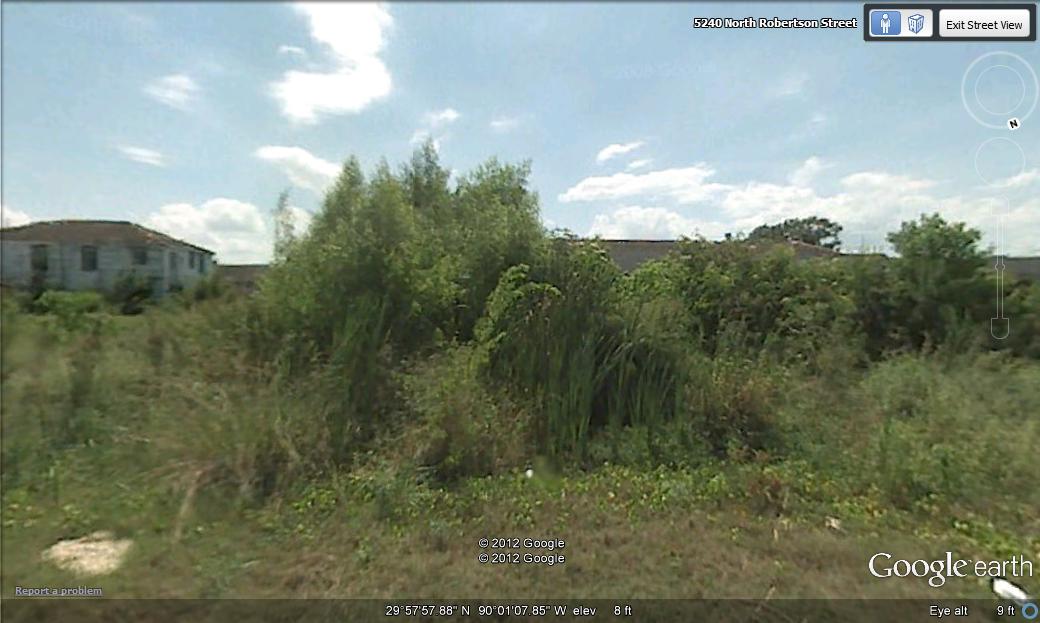
North Robertson St., New Orleans

The current vegetation is described as: “A variety of species, some exotic, have moved in, among them crepe myrtle, black willow, and golden rain trees laced with vines.  The undergrowth is a chaotic mix of weeds as high as basketball hoops, and flowering shrubs like lantana, oleander and oxalis.”     

Last fall, the city of New Orleans launched a new campaign to reclaim the Lower Ninth Ward.  The city engaged a crew to clear the vacant lots of trash and vegetation in an effort to make the neighborhood more attractive to potential homeowners and investors.  At the rate of 20 lots per day, it takes the crew three months to clear the vegetation.  Then they begin again, because within three months the vigorous vegetation has reclaimed the vacant lots.

Birds return to the Lower Ninth Ward

An ornithologist from the University of New Orleans visited the Lower Ninth Ward with the author of the Times article.  He was permitted to visit the area for the first time one month after the storm, when attempts to find residents who hadn’t survived the storm were considered complete.  At that time he reported complete silence.  There was no birdsong in the Lower Ninth Ward. 

The birds that were common before the storm, such as mourning doves and house sparrows, are slowly beginning to return in small numbers.  There was a significant increase in the population of raptors, such as hawks, falcons, and shrikes.  The ornithologist speculated that an increase in the rodent population was responsible for this increased population of raptors, which he described as “supernatural.” 

The ornithologist accompanying the journalist waded into thickets covering several vacant properties, “pishing” as birders do to attract the birds to them.  We will let the ornithologist speak for himself as he rapturously reports to the journalist the many birds he sees and hears:

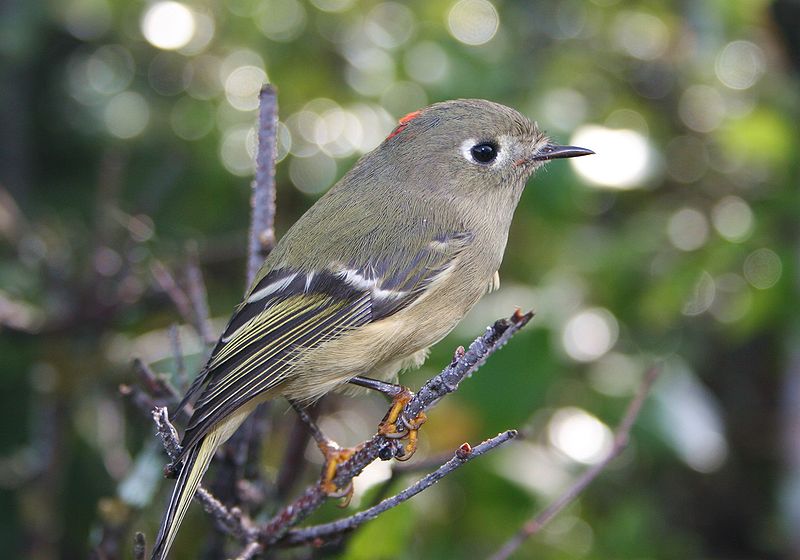
“’’I’ve gone whole winters without seeing a field sparrow in the New Orleans vicinity.  Field sparrows, swamp sparrows, simply do not winter in residential New Orleans…Orange-crowned warbler!’ He shouted back at me. ‘Ruby-crowned kinglet!’”

Ruby-crowned kinglet

The journalist following the ornithologist couldn’t keep up:  “It was no longer possible to distinguish which calls were his and which the birds’.  He walked around a stand of 15-foot Chinese tallow trees, the green and crimson leaves waving mournfully in the wind.  And then he was gone.  The wilderness just swallowed him up.”   

Lessons learned in New Orleans

The recovery of nature in New Orleans is an ecological experiment that was not fabricated by scientists. Man did not manipulate the outcome.  And this is what nature is telling us:

  • Native plants do not magically return when existing vegetation is wiped clean to bare ground
  • Birds do not care if the vegetation is native or non-native.  They will inhabit either.
  • Since the diet of many birds is predominantly insects, we should assume that the insects have also returned to the Lower Ninth Ward and that they are feeding on non-native vegetation.

These lessons are not consistent with the native plant ideology which equates the existence of non-native plants with “ecological collapse.”  Nature is thriving in New Orleans without the benefit of native vegetation.

——————————————– 

* Nathaniel Rich, “Jungleland,” New York Times Magazine, March 25, 2012.  All quotes from this article

Is there a relationship between patriotism and the preference for native plants?

Drawing from a book by Andrea Wulff (1), we recently told our readers about the enthusiasm of the British for exotic plants from all over the world, particularly American plants.  Andrea Wulff has recently published a second book (2) which informs us that while American plants made the journey to Europe, this botanical transfer was not reciprocated by early Americans. 

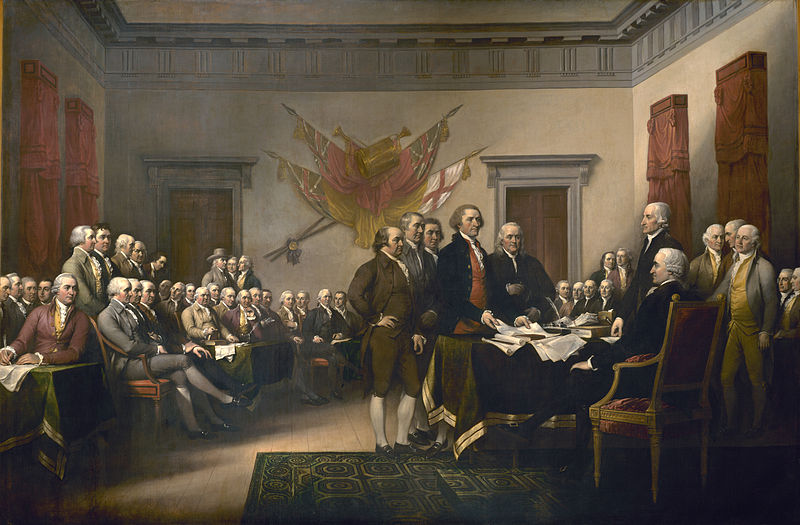
Signing of Declaration of Independence, painting by John Turnbull, 1819

Our founding fathers were reluctant politicians, but devoted gardeners and professional farmers.  Although they grew many non-native plants for food and other practical purposes, they used almost exclusively American trees and shrubs when landscaping their properties.  The historical record suggests that this was a conscious choice on their part and a reflection of their patriotism.

Although George Washington was able to visit his home at Mount Vernon only once during the eight-year Revolutionary War, his correspondence suggests that it was always much on his mind.  As the city of New York prepared for the onslaught of British troops and warships in 1776, Washington wrote to his estate manager by candlelight, “Only American natives should be used, he instructed, and all should be transplanted from the forests of Mount Vernon…Washington decided that Mount Vernon was to be an American garden where English trees were not allowed.

As a farmer, Washington was innovative and practical.  He experimented with various methods of fertilizing and crop rotation.  He imported food crops and fruit trees from all over the world.  But when landscaping for ornamental purposes, he planted exclusively American plants which “…carried a symbolic message that this new nation would be independent, self-sufficient and strong.”

Shortly after Americans won their independence from Britain, our second and third presidents, John Adams and Thomas Jefferson, went to Britain hoping to negotiate a trade treaty with their former rulers.  This was a frustrating and ultimately unsuccessful effort, but while waiting in vain for a response to their proposal, Adams and Jefferson toured many of the famous gardens of England.  They were both avid gardeners and farmers and could think of no better use of the idle time imposed upon them.  They were proud to learn that the most lavish private gardens of England were composed predominantly of American trees and shrubs.  As we reported in our earlier post, these plants had been laboriously imported to England earlier in the 18th century.

Returning home, their horticultural choices were similar to Washington’s.  They made utilitarian choices when farming, but their ornamental choices were exclusively American.

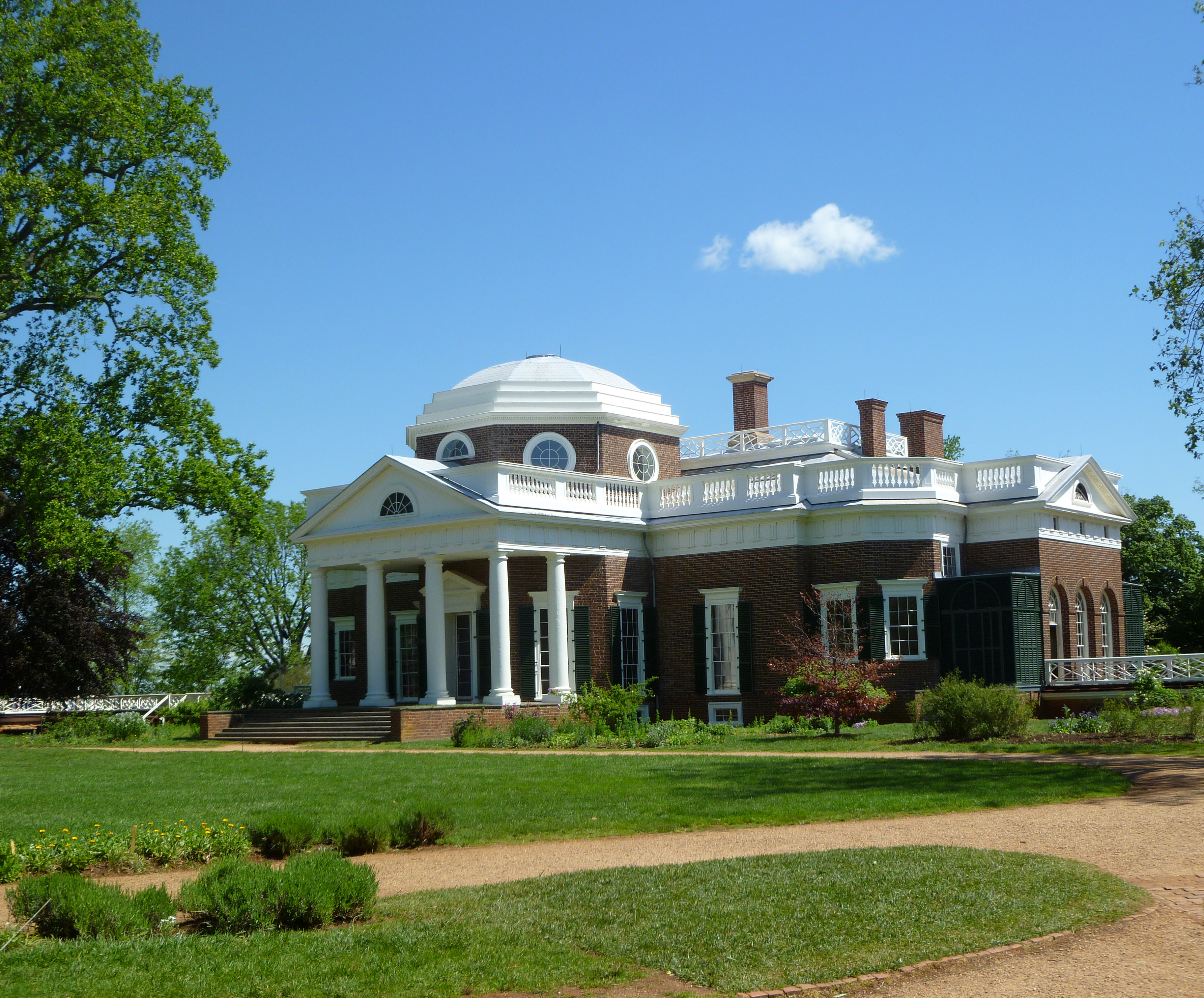
Monticello, Thomas Jefferson's home

 Jefferson brought vegetable seeds from all over the world to his vegetable garden.  He kept meticulous records which enable us to marvel at the international population of vegetables in his garden during the first year of his retirement from the presidency:  “African early peas,” “Windsor beans,” “solid pumpkin from S. America,” “long pumpkin from Malta,”, “Lettuces Marsailles,” “Chinese melon,” “Spanish melon,” “Broccoli Roman,” “Kale Malta,” “Kale Delaware.” 

As the first American president to spend his entire term in residence in the White House (actually not yet named the White House), he was responsible for designing its first landscape:  “He envisaged an all-American garden…planted  ‘exclusively with Trees, shrubs, and flowers indigenous to our native soil.’”  When returning home to Monticello, he made the same ornamental choices for his own property.

Peter Coates, a British historian, examines the historical record of American fears regarding non-native species of plants and animals in his book, American Perceptions of Immigrant and Invasive Species (3), looking for a relationship between nationalism and those fears.  Although he finds many examples of similarity in the language used to describe human and non-human immigrants, he ultimately concludes that human xenophobia is not necessarily the source of anxiety about non-native plants and animals. 

One of the episodes in the historical record which Coates reports, is a long correspondence between Charles Darwin, the British scientist and his American counterpart, Asa Gray.  They engaged in a chauvinistic rivalry about the hardiness of their native plants.  Darwin jokingly asked, “Does it hurt your Yankee pride…that we thrash you so confoundedly?  I am sure Mrs. Gray will stick up for your own weeds.  Ask her whether they are not more honest, downright good sort of weeds.”  Gray replied that his wife, “allows that our weeds give up to yours,…[they are] modest…retiring things, and no match for the intrusive, pretentious, self-asserting foreigners.”

In this exchange, Darwin and Gray are referring to a botanical conundrum:  “The asymmetry between the preeminence of Eurasian weeds in North American and the weak presence of North American weeds in Eurasia has engrossed botanists on both sides of the Atlantic since Darwin and Gray’s exchanges.”  (3)  It is an intriguing question which we have considered in earlier posts, but cannot answer. 

The historical record suggests that there is an element of patriotism in Americans’ preference for our native plants and trees.  On the other hand, maybe our plants and trees are just more handsome!  But when plants perform a function—such as feeding us—Americans revert to their utilitarian ideals, abandoning natives if introduced plants are superior. 

*********************************

 (1) Andrea Wulff, The Brother Gardeners, Alfred A. Knopf, 2008

(2) Andrea Wulff, The Founding Gardeners, Alfred A. Knopf, 2011

(3) Peter Coates, American Perception of Immigrants and Invasive Species, UC Press, 2006.

Scientists reject the notion of “Balance” in nature

"Delicate Balance of Nature" Painting by N. Robert Wagstaff, Maui, Hawaii

The recently published book by Emma Marris, Rambunctious Garden,* is getting the attention it deserves from conservationists and the managers of public lands.  If you read widely in this field, as we do, you won’t find much new in her book, but you will find a comprehensive and comprehensible overview of the emerging scientific consensus that it is time to revise the assumptions of invasion biology.

If you haven’t the time or inclination to read this book, you can take a short cut to two recent interviews with Ms. Marris, published by the American Society of Landscape Architects and the magazine of the Nature Conservancy.  The published interview by the Nature Conservancy is another indication that this prestigious organization is shifting its emphasis to embrace the realities of nature as we know it, rather than as we imagine it was in the distant past.

Ms. Marris methodically revisits the original assumptions of invasion biology and offers us the growing evidence that they have not been confirmed by the science that tested them in the field.  In a recent post, we reported that the assumptions that ecological “niches” are exclusive and therefore new species will displace former occupants, are not consistent with the fact that introduced species far outnumber the loss of native species.  In fact, there is little evidence that introduced species have resulted in extinctions. 

“Nature has no ‘Balance’ for us to keep”

Matt Ridley, in his weekly column “Mind & Matter” for the Wall Street Journal, invites us to revisit the concept of the “balance of nature” with the help of Ms. Marris’ book.  Mr. Ridley is a British scientist who has written many popular books about human genetics and evolution. 

In our interminable debate with native plant advocates, we find that the concept that nature achieves an equilibrium state that is, by definition, balanced, is central to their ideology.  Their argument is that man has disrupted this balance and that he is therefore obligated to right this wrong.  Furthermore, when this balance has been achieved, theoretically, nature sustains itself without further interference from man. 

This is a powerful narrative with much intuitive appeal.  Particularly for those who feel some guilt for the damage that man has inflicted on nature, the obligation to heal those wounds is strong.  However, the scientific evidence is mounting that there is no such thing as a “balance” of nature, as Mr. Ridley tells us in his column:

Academic ecologists have abandoned such a static way of thinking for something much more dynamic.  For a start, they now appreciate that climate has always changed, and with it, ecology.  Twenty thousand years ago the spot where I live [in the UK] was under a mile of ice.  Then it was tundra, then birch forest, then pine forest, then elder, linden, elm and ash, then most recently oak, but beech was coming.”

Mr. Ridley goes on to lament that although science tells us that a stable balance in nature cannot be achieved, particularly at a time of rapidly changing climate, the notion still dominates practical conservation management, which he describes as:  “preserve this rare species, maintain this habitat structure, freeze in time this ecological moment, return this degraded land to a particular state, whatever the weather and whatever the novel arrivals of exotic species.”  These goals sound very familiar to those of us who follow the various “restoration” projects on our public lands in the San Francisco Bay Area. 

We are grateful to Ms. Marris for bundling the recent science that dismantles the mistaken assumptions of invasion biology into a readable package that is being reported by the mainstream press.  We anticipate that the public will eventually realize that the destructive native plant “restorations” in which the managers of our public lands are engaged are unnecessary and ultimately futile. 

It’s just a matter of time!

*******************************************

“Emma Marris, Rambunctious Garden, Bloomsbury, 2011

Can the native plant ideology be defended with name-calling?

On Monday, March 26, 2012, the San Francisco Forest Alliance (SFFA) gave a presentation to a neighborhood association in San Francisco about the Natural Areas Program.   SFFA expressed its objection to the destruction of healthy non-native trees and vegetation which is useful to wildlife, the use of pesticides, and the closure of trails in the so-called “natural areas” as well as the money being spent on these destructive projects. 

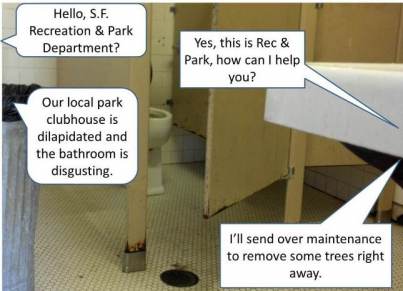
Park Bathroom Paradox. Courtesy San Francisco Forest Alliance

Jake Sigg, one of the leading proponents of native plant “restorations” in San Francisco was invited by the neighborhood association to give a rebuttal.  For some reason that remains mysterious, Mr. Sigg chose to speak exclusively about Mt. Sutro which is not owned or managed by the Natural Areas Program.  Therefore, there was a bit of a disconnect in these two presentations, with the common theme being only the destruction of non-native trees for the purpose of restoring native plants.

During his presentation, Mr. Sigg said that SFFA’s presentation was “disinformation” and/or “nonsense.”  However, he provided no specific examples of these misdeeds, so SFFA is unable to respond to these accusations.

The following day, March 27, Mr. Sigg published an exchange about the SFFA presentation with one of his fans on his internet blog, “Nature News from Jake Sigg.”  Mr. Sigg’s fan said he “…was so aghast at this evening’s display of ignorance and mendacity…”  And Mr. Sigg agreed:   “The ignorance and ill will of the Forest Alliance was on full view for anyone caring to look.  The cherry-picking of facts, the distortions and outright lies were transparent.”

The presentation by the Forest Alliance was based on public documents and nothing was said that could not be documented by the public record.  So, naturally SFFA was mystified by these accusations.  SFFA allies wanted to know if the SFFA presentation contained any factual errors, so they asked Mr. Sigg, “What were the ‘outright lies?’”

Mr. Sigg responded to the question, but not with an answer:  “I don’t have any reason for answering this, as I’m time-short…”  In addition to being busy, Mr. Sigg wasn’t really in a position to answer the question because he admitted that he hadn’t listened to the presentation:  “I listened to the presentation for the first five minutes, then decided my time was better spent tightening up my talk outline; there wasn’t enough substance to make listening worthwhile.”

The accusation of lying, and the refusal to be specific about it, is particularly ironic because of Mr. Sigg’s plea during his presentation that “demonizing the other side is not leading to accommodation or understanding.”  On this we can agree.  Calling people liars and refusing to tell them specifically what you think they are lying about, is clearly not leading to “accommodation and understanding.”

Past & Present Botanical Myths

The conventional wisdom is that human knowledge, especially scientific knowledge, moves inexorably forward.  We are sometimes amused by the misconceptions of the past and marvel at the primitive knowledge of our ancestors.  However, we rarely stop to think that our descendents will probably do the same when they consider our current state of knowledge.

Historical botanical beliefs

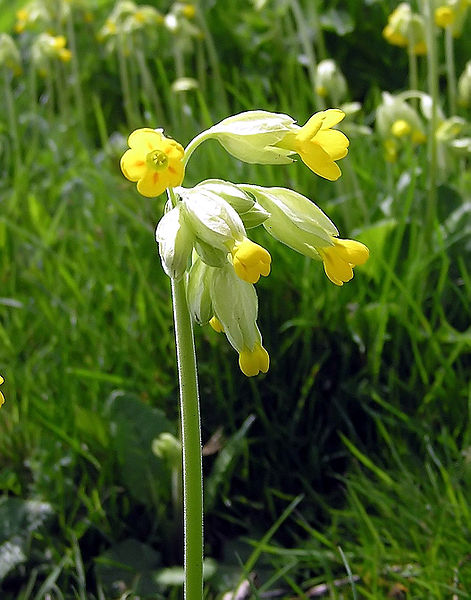
"The heads of cowslips, which trembled in the wind, were signed for Parkinson's disease, the 'shaking palsy.'" (1)

The Doctrine of Signatures seemed a logical botanical belief at a time when plants were one of man’s few medicinal tools and religion was a powerful influence in human society.  The Doctrine of Signatures, which was actively promoted by the church in 17th century Europe, was based on a belief that God had “signed” plants with certain suggestive shapes and colors to inform humans of their medicinal properties.  For example, a heart-shaped leaf was considered God’s message to us that a particular plant would be beneficial to the human heart and this message was strengthened by a flesh-colored flower. Every plant was believed to be useful in some way if man could only discern its use.  Else why would they have been created, since the Garden of Eden was created for the benefit of man?  The church encouraged man’s study of plants as a way to worship God’s creation. (1)

Many botanical myths originated from ancient Roman and Greek horticultural treatises and persisted for hundreds of years.  For example a belief in the influence of the moon on plants is first found in the writings of Pliny in first-century Rome and also found in writings as late as 1693:  “[w]hen you sow to have double Flowers, do it in the Full of the Moon.”  (2) 

The origins of many horticultural myths are unfathomable but probably began with a particular event because we often confuse coincidence with causal relationships. (2)

  • Planting bay trees and beeches near  homes will prevent lightning strikes
  • An apple tree that fruits and flowers at the same time is a bad omen
  • The parents of a child who picks red campion will die
  • A pregnant woman who steps over cyclamen will miscarry

Modern botanical beliefs

Now we will turn to the theoretical underpinnings of the native plant movement to see how they are holding up to the scrutiny of current science and ask the rhetorical question, Is it time to relegate invasion biology to the dust heap of discredited science?

The field of invasion biology upon which the modern native plant movement is based, originates with the publication in 1958 of The Ecology of Invasions for Animals and Plants by Charles Elton.  Elton postulated that every plant and animal occupies a different ecological “niche” and plays a specific role within that niche: 

“…every species will have a slightly different role, or niche, and often, he believed, every niche will be filled.  Some animals eat grass, others leaves; some plants grow on wet soil and some grow on dry; some birds nest in dead trees, others in live ones.  When new species are introduced, the theory goes, they can get a foothold and start reproducing only by finding a vacant niche or by throwing some other species out of its niche…” (3)

Elton’s corollary to the exclusivity of the niche is that the introduced species will have a competitive advantage because its predators are absent in its new home.  The predicted result of Elton’s theory was that introduced species will exterminate previous occupants, mass extinctions will occur, and the result will be a simplified ecology composed of few surviving species.

The problem with Elton’s theory is that it doesn’t correspond with reality.  More and more scientists are finding that the frequency of introductions far exceeds the frequency of extinctions.

  • In 2002 Dov Sax reported that introduced species greatly outnumbered extinctions on oceanic islands:  “In the case of plants, islands are now twice as diverse as they were before humans started moving things around.” (3)
  • In 2012, Erle Ellis, et. al., reported that “…while native losses are likely significant across at least half of Earth’s ice free land, model predictions indicate that plant species richness has increased overall in most regional landscapes, mostly because species invasions tend to exceed native losses.” (4)
  • In San Francisco, the second-most densely populated city in the US, ninety-seven percent of the 714 plant species known to exist in San Francisco in 1850 are still found there, despite the fact that most plants and trees in the city are introduced.  (5)

The dire predictions of invasion biology have not come to pass nearly 60 years after their inception.   Many scientists are clearly ready to abandon invasion biology because it does not conform to reality.  Can we finally breathe a collective sigh of relief and move on to a less gloomy view of ecology?  Some day our descendents will look upon this episode in human history and laugh, as we laugh at the 17th century Europeans who examined plants, looking for the clues from God that revealed their purpose.

************************************

(1) Richard Mabey, Weeds:  In Defense of Nature’s Most Unloved Plants, Profile Books Ltd, London, 2010, page 87-91

(2) Andrea Wulff, The Brother Gardeners, Alfred Knopf, 2008, page 11-12

(3) Emma Marris, The Rambunctious Garden, Bloomsbury, USA, 2011, page 102-104

(4) Erle C. Ellis, et. al., “All Is Not Loss:  Plant Biodiversity in the Anthropocene,” http://www.plosone.org/article/info%3Adoi%2F10.1371%2Fjournal.pone.0030535

(5) Duncan et al, “Plant traits and extinction in urban areas:  a meta-analysis of 11 cities,” Global Ecology and Biogeography, July 2011

Rush Limbaugh on “invasive species”

We have noted in previous posts the common ancestry of native plant and animal advocacy and anti-immigration sentiment.  The relationship between these sentiments goes all the way back to 1930s Germany when there was a concerted effort to rid Germany of non-native plants, as well as people perceived as alien.  We have also reported that some native plant advocates—though not all–in the San Francisco Bay Area are also strongly opposed to immigration. 

Rush Limbaugh. Creative Commons Attribution

Today we will provide another example of the connection between these two apparently related opinions.  Rush Limbaugh, the right-wing talk show host, has a track record of calling immigrants an “invasive species.”  The following Limbaugh quotes are provided by Media Matters for America, a web-based non-profit dedicated to “comprehensive monitoring, analyzing, and correcting conservative misinformation in the U.S. media.”

On April 1, 2005, Limbaugh described undocumented immigrants as an “invasive species,” saying:

LIMBAUGH: So invasive species like mollusks and spermatozoa are not good, and we’ve got a federal judge say, “You can’t bring it in here,” but invasive species in the form of illegal immigration is fine and dandy — bring ’em on, as many as possible, legalize them wherever we can, wherever they go, no matter what they clog up. So we’re going to break the bank; we’re going to bend over backwards. The federal judiciary is going to do everything it can to stop spermatozoa and mollusks from coming in, but other invasive species? We’re supposed to bend over and grab the ankles and say, “Deal with it.”

On August 15, 2011, Limbaugh said:

“[S]ome people would say we’re already under attack by aliens — not space aliens, but illegal aliens.”

Rush Limbaugh has been much in the news recently for his verbal attacks on a 30-year old female law student at Georgetown University who would like to have access to birth control.  In Limbaugh’s opinion she is a “slut,” and a “prostitute” who has “so much sex that she can barely walk.”  Women are not Limbaugh’s only target for abuse.  He routinely says equally nasty things about gay people, poor people, ethnic and racial minorities, and labor unions.

Native plant advocates who are also opposed to immigration might give some thought to the implications of their ideology.  Do they want to be associated with the likes of Rush Limbaugh?  If not, how do they explain the difference between the crusade against non-native plants and animals and the crusade against immigrants?

Open letter to Nature in the City

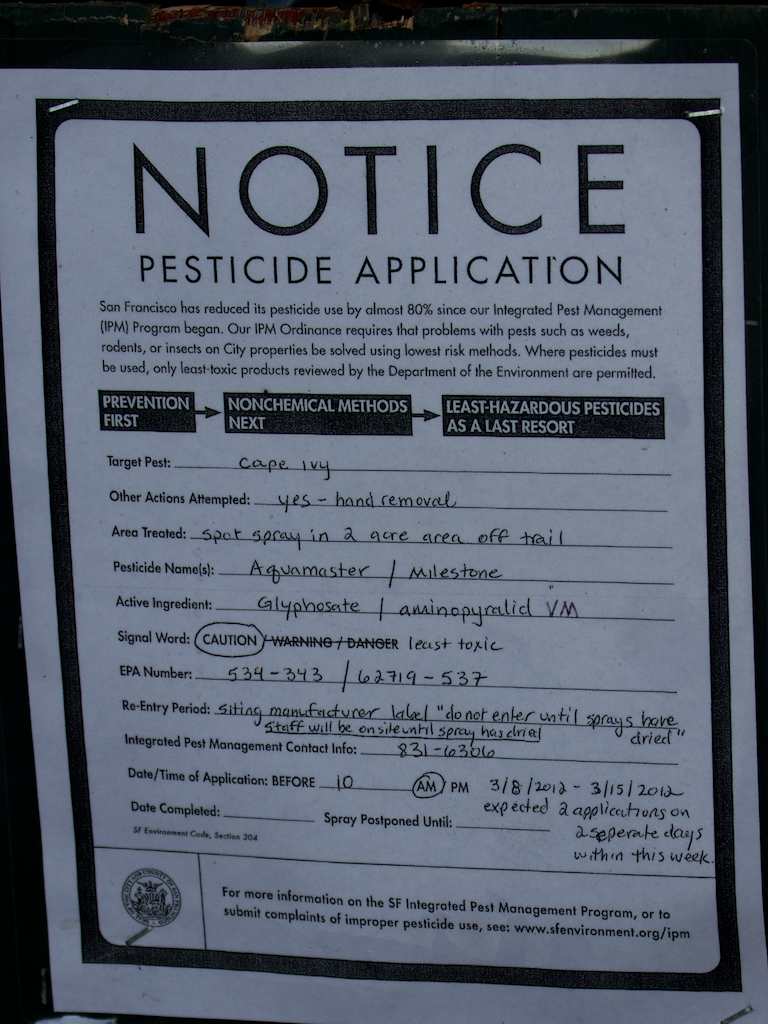
Latest Pesticide Application Notice, Glen Park, March 3, 2012

Nature in the City (NIC) is one of the non-profit organizations in San Francisco that supports native plant “restoration” projects in our public lands, especially the Natural Areas Program (NAP) in the Recreation and Park Department.  We recently published a response to a NIC newsletter which described critics of NAP as “a handful of people” and accused them of “misrepresenting” NAP’s plans for San Francisco’s parks.  In their most recent newsletter they seem to have changed their tune.  This suggests they are starting to take criticism of NAP more seriously.  But does it suggest any change in actions or plans?  With this open letter, we will ask Nature in the City for clarification.

Here is NIC’s latest attempt to communicate with NAP critics or discredit them.  We don’t know which.

Restore to 1769 or to Now?!

I often hear the question, “to what year do you restore?” Some folks are skeptical about ecological restoration since, of course, we can’t turn back the clock!

Some skeptics sardonically say, “are you going back to the ice age, pre-last glacial maximum (22,000 BP)? Well, then, Monterey Pine are native…”

In fact, the answer I give is that we restore to now. Ecological restoration, like all human activities, has a social and environmental context, which is historical indeed, but also very current. And restoration is about healing and looking toward a brighter future, not looking back into the abyss of ecological destruction. Thus, we Spring Forward, taking into account current conditions, constraints, as well as opportunities.

We document historical ecology; are blessed with knowledge of and from a recent and current indigenous cultural context; and study nearby ecological reference sites. Meanwhile, we have laws, recent history, and communities that present a unique local context in every case. Wildlife habitat now takes diverse forms, including in the human-dominated landscape.

If restoring integrity and biodiversity are always the goals, the specifics can vary widely. And this is just fine, because restoration should be a community-driven, democratic process, like every other human endeavor.
-Peter Brastow


Open Letter to Nature in the City:

We are writing to request clarification of your newsletter of March 8, 2012. 

What does it mean to “restore to now?”  If we are satisfied with our parks now, why do they need to be restored?  Isn’t that a contradiction?  If not, what—if anything—does that mean? 

Why is it necessary to “heal” a park that we don’t think is in “the abyss of destruction?”  What if we think that spraying our parks with gallons of pesticides is sending us into “the abyss of destruction?”  Is there a “brighter future” in spraying places called “natural areas” with pesticides 86 times in one year? 

What does it mean to “restore integrity and biodiversity?”  If biodiversity is the goal of the Natural Areas Program why are they eradicating non-native species, thereby reducing biodiversity?  As for “integrity,” we assume NIC means in the sense of “unimpaired.”  But we don’t consider our parks impaired, so we aren’t concerned about their “integrity.” 

Talking out of both sides of your mouth

The tone of the latest NIC newsletter is definitely an improvement over the previous accusatory tone.  However, it isn’t comprehensible, nor is it credible because it is contradicted by the words and actions of NIC.  Here are a few phrases from NIC’s public comment on the Draft Environmental Impact Review (DEIR) of the Natural Areas Program:

“…the analysis [of the DEIR] neglects to fully address the long-term impact of invasive plants from the retention of invasive weed-nurturing eucalyptus groves in the MA-3 areas.”

In other words, NIC wants all the eucalypts destroyed in all of the acres of “natural areas.”  Expanding tree removals into the lowest-priority management areas (MA-3) would increase the number of tree removals substantially.  MA-3 acres are 42% of the total acres of “natural areas.”  The management plan currently prohibits removal of healthy trees in MA-3 acres. 

The DEIR reports that the Maximum Restoration Alternative would have the most impact on the environment.  NIC says in its written public comment on the DEIR that this judgment “may be…a misinterpretation of the intent of CEQA.”  Peter Brastow, Founding Director of NIC, said during his public testimony to the Planning Commission on October 6, 2011, that the Maximum Restoration Alternative should be designated as the environmentally superior alternative in the final version of the Environmental Impact Report.  The Maximum Restoration Alternative would expand all the destructive activities of NAP into all 1,107 acres of “natural areas:” tree removals, eradication of non-native plants, reintroduction of legally protected species, recreational access restrictions, etc. 

But Mr. Brastow is not satisfied with maximizing native plant restorations in San Francisco’s parks.  In his public comment for the revision of the Recreation, Open Space Element (ROSE) of San Francisco’s General Plan, he proposes that a new agency be created to manage all public lands in San Francisco as “natural areas.”  All open space in the city, currently managed by Public Utilities, Port, and Public Works agencies as well as Recreation and Park should be “become part of a single natural resources agency.”  This new agency would “Integrate the protection and restoration of biodiversity within all open space management activities (not just natural areas), e.g., native plant landscaping in designed landscapes, wildlife management and monitoring in all parks, etc.” 

But why stop there?  Mr. Brastow also proposes in his public comment on the ROSE that these principles be extended to private yards:  “Conserve private open space, especially rear yards, as habitats and habitat connectors.” 

Is there any way to reconcile these demands to expand the empire of the Natural Areas Program into every piece of vacant property in San Francisco, both private and public, with the empty phrases of NIC’s latest newsletter?

Looking how far back into the botanical past?

Before we leave this contentious topic, we will address NIC’s opening gambit, “Restore to 1769 or Now?”  The author goes on to dismiss 1769 as the standard, preferring a more forward looking goal.  However, he is once again stuck with the written record, which establishes the pre-European landscape as the goal of the Natural Areas Program.

The management plan for the Natural Areas Program says explicitly that. “The following are the list of criteria…to determine the location of potential plant re-introductions:   Evidence of historic presence (based on Howell et al. 1958).” (page 2-6) And Howell (1958) says that “Native plant [is] present within the geographic limits of present-day San Francisco prior to the arrival of Portola expedition in 1769.” 

NIC may be prepared to welcome plants into San Francisco that arrived after 1769, but until the language in the management plan (and other similar documents such as “Assessment for Forestry Operations,” for Recreation and Park Department, June 2010.) is changed, we will continue to assume that is the standard used by the Natural Areas Program.

Making Peace

The tone of the latest NIC newsletter is welcome and we hope it is a first step toward resolving the conflict over the future of San Francisco’s parks.  If this is a sincere effort to address the objections of San Franciscans to the destructive and restrictive actions of the Natural Areas Program, the next step should be to demonstrate intentions with actions.  We therefore ask Nature in the City to join us in making the following requests of the Natural Areas Program and the Recreation and Park Department:

  • The Natural Areas Program should STOP spraying pesticides in the so-called “natural areas” NOW.
  • The Natural Areas Program should STOP expanding their native plant gardens until the Environmental Impact Report is complete and approved.
  • The Natural Areas Program should STOP destroying non-native plants and healthy trees until the Environmental Impact Report is complete and approved.

These actions would set the stage for the next step.  A lawyer and a critic of the Natural Areas Program has notified the Planning Department, the Natural Areas Program, and the City Attorney that the public comment period for the Draft Environmental Impact Report for the Natural Areas Program did not meet legal standards.  The law requires that notice of the public comment period be posted in all the natural areas and mailed to the neighbors of the natural areas.  Neither of these requirements was met.  Therefore, the lawyer requests that the public comment period be announced as required by law and repeated.

Since NIC says in its current newsletter that “restoration should be a community-driven, democratic process” NIC should agree that another properly announced public comment period is required.  The public cannot participate in this “democratic process” if they are unaware of what is planned for their parks.  

The DEIR must also be revised to accurately identify the Maintenance Alternative as the environmentally superior alternative.  And, finally, when the Planning Commission holds a hearing on the DEIR, the time of that hearing must be announced in advance and adhered to so that those who want to speak have the opportunity to do so (unlike the hearing on October 6, 2011 when the time was changed with little warning and many people were deprived of the opportunity to speak).

Actions speak louder than words!

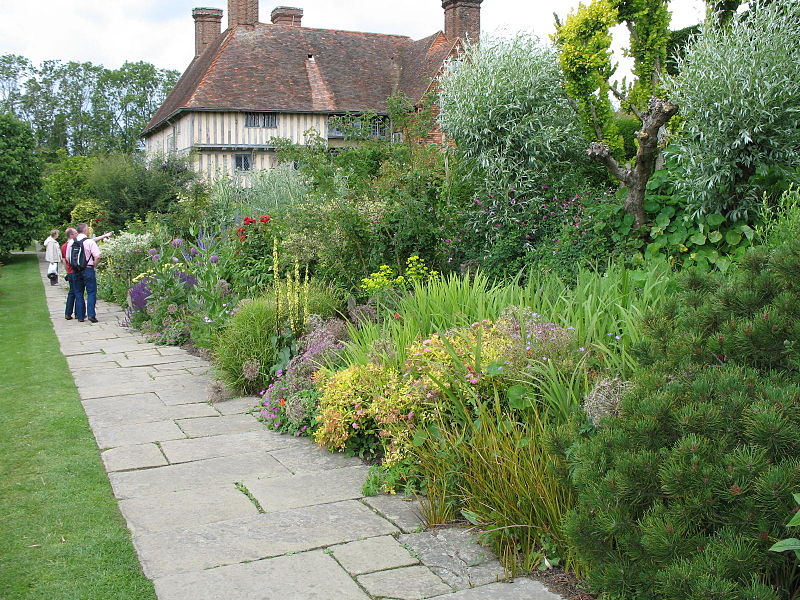
Plants from all over the world are welcome in the English garden

In a recent post about weeds in Britain, we pondered the interesting question of why there are so few plants in Britain that are considered invasive, a mere dozen compared to the nearly 200 labeled “invasive” by the California Invasive Plant Council.  The Brother Gardeners* enabled us to dismiss one possible explanation. 

The English Garden, Creative Commons

The fact that fewer plants are considered invasive in Britain is not the result of fewer non-native plants in their gardensThe Brother Gardeners informs us that the British have been enthusiastic importers of plants from all over the world for hundreds of years.  They had one of the biggest empires in the world, spanning the globe from India to Africa, Australia, New Zealand, and America, which put them in a unique position to sample the botanical riches of the world.

The Brother Gardeners was written by a German who immigrated to Britain about 10 years before writing this book.  She was immediately struck with the importance of gardening in Britain compared to her home country, and she quickly became immersed in the British obsession with gardening. 

She tells us the history of botany and gardening in Britain, going back to the 17th century.  This is no stale retelling of dry history.  This is an engaging tale of the personal relationships that reshaped the English garden, focusing on a 40-year business relationship between an English businessman and a Quaker farmer in Pennsylvania.  The American farmer supplied the Englishman with thousands of plants and seeds from the American landscape. 

The evolution of their relationship from a business relationship to a friendship is analogous to the relationship between America and Britain.  The Englishman was wealthier and more educated than the American and predictably he was condescending to the American at the beginning of their relationship.  Over the years, the American acquired both wealth and botanical knowledge, so that eventually they were on an equal footing.  But we digress.

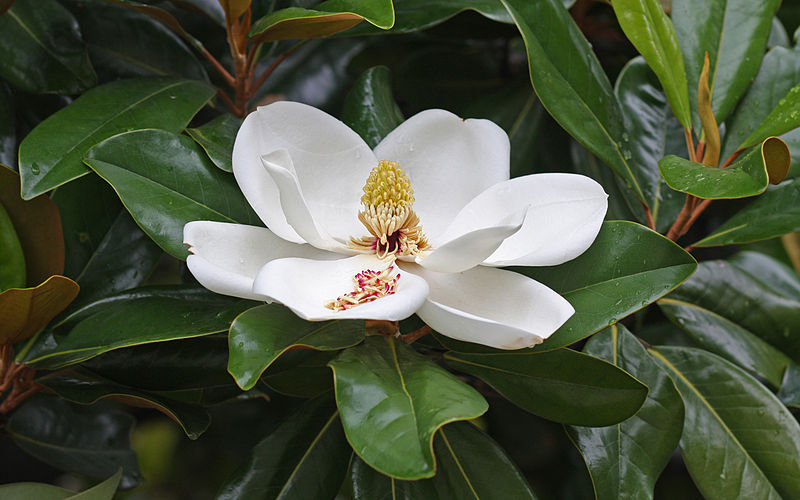
Magnolia grandiflora. Creative Commons

 Magnolias, tulip trees, wisteria, and dogwoods were early favorites in this trade from America to England, but over time thousands of different species made the trip into English gardens.  The American trees “were thoroughly naturalized, growing side by side with native trees” by 1760 and “Many of the American plants had become so common in the English landscape that gardeners needed new species to parade as rarities in their shrubberies…” 

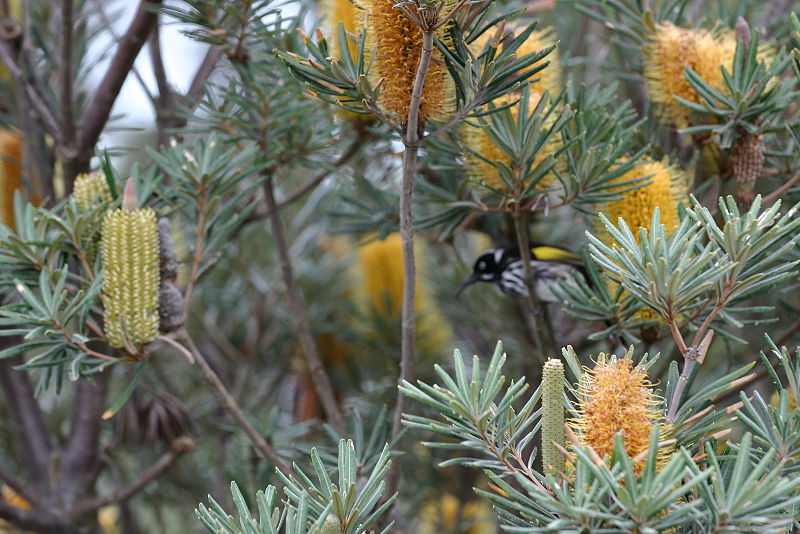
Joseph Banks, the intrepid botanical explorer, brought many new species of plants to Britain.  He joined the maiden voyage of Captain Cook into the Pacific in 1769.  His team collected plants in Brazil, Tahiti, New Zealand, and Australia on their three year voyage, bringing home specimens of 3,600 species of which 1,400 were new to Britain’s botanical knowledge.  Joseph Banks returned to become the head of the Kew Royal Botanical Garden and the Royal Academy of Science.  He continued to acquire botanical specimens from all over the world in that capacity.

Banksia, named for Joseph Banks. Creative Commons

 The crowning glory of Banks’ acquisitions was the specimen collection of Carl Linneaus, after Linneaus died in 1783. This collection was the “base reference” used by Linneaus to develop the system of categorizing all species, which is still used to this day.  The Brother Gardeners tells us the fascinating story of how the Swedish botanist, Linneaus, “sold” his system to botanists throughout the world.  It wasn’t an easy sell, particularly to the British.  They were initially scandalized by the sexual metaphors used by the system of categories which is based on counting the female (stamens) and male (pistils) parts of the plant, using explicit terms such as the “bridal bed which God adorned with such precious bedcurtains, and perfumed with so many sweet scents.”  You may have heard the saying, “No sex please. We’re British.”

The English garden is to this day an eclectic mix of species from all over the world.  It is a rich mix of color and texture that seems a mad jumble until the eye can make sense of its logic.  It is admired the world over and has influenced gardening everywhere.  It rejects the meaningless and artificial distinction between native and non-native.  Beauty is its only standard for judgment.  Whatever grows and adds color and texture is welcome in the English garden. 

++++++++++++++++++++++++++++++++++++++++

*Andrea Wulf, The Brother Gardeners, Alfred Knopf, 2008.  All quotes are from Brother Gardeners

The Globalization of Ecology by Humans

Humans have had a profound impact on our planet wherever they have lived.  Since the industrial age man’s impact on the environment has even extended beyond where he lives as atmospheric changes impact remote places such as the polar regions. Humans are a particularly restless species of animal, forever fleeing whatever conditions threaten existence or seeking a better life ahead.  Because we are an adaptable species with the capacity to alter conditions, we have a wider range of movement than other animals. 

Wherever humans have gone they have taken with them the seeds of plants, at first unwittingly and then purposefully after the advent of agriculture.  Edward Salisbury, a 19th Century British horticulturalist, reported raising 300 plants of 80 different species from the debris in his trouser cuffs despite wearing spats.(1)

The impact of Native Americans on the landscape

Native Americans arrived in North America about 13,000 years ago and slowly migrated to South America.   The megafauna that Native Americans found when they arrived disappeared soon after they arrived.  Although not all scientists agree, there is strong evidence that the megafauna, such as enormous buffalo and mastodons were hunted to extinction by the first human inhabitants of the New World.  The loss of these huge herbivores was a factor in the development of grasslands that were not adapted to heavy grazing.(2)

Native Americans setting grass fire, painting by Frederic Remington, 1908

The most profound alteration of the ecology of the New World by Native Americans was their use of fire to assist their hunting and gathering activities.  Burning grassland to the ground encourages the growth of new sprouts that improve grazing and attract the animals the Native Americans hunted.  And burning grassland funneled the animals into the hunt.  These frequent burns prevented the succession of grassland to shrubs and forest, maintaining prairies that were essentially manmade. 

The arrival of Europeans in the New World

This process of transplanting plants around the globe was greatly accelerated by the age of exploration which began in earnest in the 15th century.  When Columbus arrived in the New World in 1492, he found a land that had already been radically altered by Native Americans, though he had no way of knowing that. 

The Europeans that eventually settled the New World were ignorant of the impact of Native Americans on their new home until the advent of archaeology in the 20th century.  Their ignorance was based on their mistaken perception that the Native American population was small.(3) 

In fact, the population of Native Americans was decimated by the time the Europeans settled the New World nearly 200 years after the early explorers arrived at the end of the 15th century.  The early explorers introduced European diseases to which they were immune, but the Native Americans were not.  From just a few localized contacts with Europeans these diseases–such as measles, smallpox, and syphilis–spread quickly through Native American communities, sometimes reducing the population by as much as 90%.  These deadly epidemics were largely unwitnessed by the tiny population of early explorers.

Alfred Crosby speculates in Ecological Imperialism that Native Americans were particularly vulnerable to these diseases because they had virtually no domesticated animals.  He gives us a fascinating explanation of how Europeans developed their immunities by living in close proximity with animals for centuries.

The history of Native Americans was initially recorded by the European settlers who arrived in numbers nearly 200 years after initial contact in the 15th century.  Their perception that they found a pristine wilderness, largely untouched by human hands, has persisted to this day in the public’s mind.   It is that perception that has led native plant advocates to the conclusion that the pre-European landscape should be the goal of restorations.

The impact of Europeans on the landscape

As much impact as Native Americans had on our landscape it pales in comparison to that of Europeans.  The importation of domesticated animals—such as cattle, pigs, horses, and sheep—changed the ecology of the New World quickly.  Because the population of early settlers was small and the grazing resources vast, these animals quickly became huge herds of feral animals, roaming places such as the pampas of Argentina and the prairies of the mid-west of North America.  The native grasses were quickly replaced by the non-native grasses spread by these wandering herds. (4)

Herd of sheep, Mono County, CA. Creative Commons

Likewise, the agricultural practices of European settlers have introduced virtually everything we eat today in North America.  Nearly all of our fruits, vegetables, and cereals are not native to North America.  If non-native food were to be banished from California, we would be reduced to a diet of game, acorn mush and a few species of nuts and berries.   The diet of Europeans would be equally impoverished if they lost the potatoes, corn, tomatoes, etc. that came to them from the New World.

USDA photo

The Anthropocene:  The geologic age of humans

The Earth’s ecology is in a constant state of change.  Humans are not the source of much of that change.  The continents shift.  The climate oscillates.  Plants are moved by the wind and tide.  Animals move without the assistance of humans, often taking plants with them.  But change has been accelerated by the restless movements and activities of humans. 

Scientists have recently begun to advocate for the naming of a new geologic era, the Anthropocene.   The Anthropocene would officially acknowledge that the environment has been altered by humans.  Although the beginning of this era is still being debated by scientists, Erle Ellis (University of Maryland, Baltimore) believes that an appropriate beginning would be about 6,000 years ago, when humans domesticated animals. 

Why are we suddenly afraid of change?

Changes in the ecology of North America resulting from the movement of humans have been going on for thousands of years and have greatly accelerated in the last 500 years.  Until very recently, these changes were broadly perceived as improvements.  We enjoy a more varied diet than our ancestors and we are shielded from famine by our access to food from anywhere in the world.  We find the products of the New World useful in other ways, such as the rubber that is essential to transportation.

Suddenly, for little apparent reason, we are afraid of everything new in our environment.  The media is full of panic-stricken reports of alien “invasions.”  Most of these panic attacks eventually prove to be baseless.  The newcomers are eventually absorbed into the landscape or they disappear without a trace.  Or scientists eventually explain that the newcomers are better adapted than their predecessors to the climate, water, and soil conditions created by the activities of man. 

We asked a scientist who advises us occasionally this question:  Since new species of plants and animals have been introduced to our landscape for hundreds, if not thousands of years, why the sudden panic?  His reply was:  “It’s trendy. It’s ‘cutting edge.’ It’s ‘hot.’ It’s…fundable.”   

In the service of a scientific fad that has spread into the popular culture, introduced species of plants and animals are being needlessly destroyed.  Many of these new species are better adapted to present conditions than their predecessors.  Many are essential to our way of life and the animals with which we share the planet. 


(1) Richard Mabey, Weeds:  In Defense of Nature’s Most Unloved Plants, Harper-Collins, 2011

(2) Alfred Crosby, Ecological Imperialism. Cambridge University Press, 2004

(3) Charles Mann, 1491, Random House, 2005

(4) Crosby