"Delicate Balance of Nature" Painting by N. Robert Wagstaff, Maui, Hawaii
The recently published book by Emma Marris, Rambunctious Garden,* is getting the attention it deserves from conservationists and the managers of public lands. If you read widely in this field, as we do, you won’t find much new in her book, but you will find a comprehensive and comprehensible overview of the emerging scientific consensus that it is time to revise the assumptions of invasion biology.
If you haven’t the time or inclination to read this book, you can take a short cut to two recent interviews with Ms. Marris, published by the American Society of Landscape Architects and the magazine of the Nature Conservancy. The published interview by the Nature Conservancy is another indication that this prestigious organization is shifting its emphasis to embrace the realities of nature as we know it, rather than as we imagine it was in the distant past.
Ms. Marris methodically revisits the original assumptions of invasion biology and offers us the growing evidence that they have not been confirmed by the science that tested them in the field. In a recent post, we reported that the assumptions that ecological “niches” are exclusive and therefore new species will displace former occupants, are not consistent with the fact that introduced species far outnumber the loss of native species. In fact, there is little evidence that introduced species have resulted in extinctions.
In our interminable debate with native plant advocates, we find that the concept that nature achieves an equilibrium state that is, by definition, balanced, is central to their ideology. Their argument is that man has disrupted this balance and that he is therefore obligated to right this wrong. Furthermore, when this balance has been achieved, theoretically, nature sustains itself without further interference from man.
This is a powerful narrative with much intuitive appeal. Particularly for those who feel some guilt for the damage that man has inflicted on nature, the obligation to heal those wounds is strong. However, the scientific evidence is mounting that there is no such thing as a “balance” of nature, as Mr. Ridley tells us in his column:
“Academic ecologists have abandoned such a static way of thinking for something much more dynamic. For a start, they now appreciate that climate has always changed, and with it, ecology. Twenty thousand years ago the spot where I live [in the UK] was under a mile of ice. Then it was tundra, then birch forest, then pine forest, then elder, linden, elm and ash, then most recently oak, but beech was coming.”
Mr. Ridley goes on to lament that although science tells us that a stable balance in nature cannot be achieved, particularly at a time of rapidly changing climate, the notion still dominates practical conservation management, which he describes as: “preserve this rare species, maintain this habitat structure, freeze in time this ecological moment, return this degraded land to a particular state, whatever the weather and whatever the novel arrivals of exotic species.” These goals sound very familiar to those of us who follow the various “restoration” projects on our public lands in the San Francisco Bay Area.
We are grateful to Ms. Marris for bundling the recent science that dismantles the mistaken assumptions of invasion biology into a readable package that is being reported by the mainstream press. We anticipate that the public will eventually realize that the destructive native plant “restorations” in which the managers of our public lands are engaged are unnecessary and ultimately futile.
On Monday, March 26, 2012, the San Francisco Forest Alliance (SFFA) gave a presentation to a neighborhood association in San Francisco about the Natural Areas Program. SFFA expressed its objection to the destruction of healthy non-native trees and vegetation which is useful to wildlife, the use of pesticides, and the closure of trails in the so-called “natural areas” as well as the money being spent on these destructive projects.
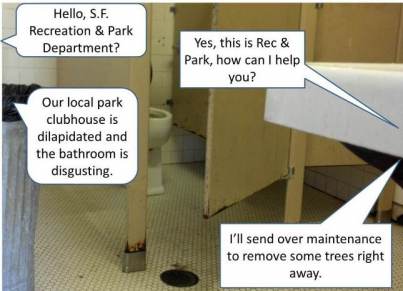
Park Bathroom Paradox. Courtesy San Francisco Forest Alliance
Jake Sigg, one of the leading proponents of native plant “restorations” in San Francisco was invited by the neighborhood association to give a rebuttal. For some reason that remains mysterious, Mr. Sigg chose to speak exclusively about Mt. Sutro which is not owned or managed by the Natural Areas Program. Therefore, there was a bit of a disconnect in these two presentations, with the common theme being only the destruction of non-native trees for the purpose of restoring native plants.
During his presentation, Mr. Sigg said that SFFA’s presentation was “disinformation” and/or “nonsense.” However, he provided no specific examples of these misdeeds, so SFFA is unable to respond to these accusations.
The following day, March 27, Mr. Sigg published an exchange about the SFFA presentation with one of his fans on his internet blog, “Nature News from Jake Sigg.” Mr. Sigg’s fan said he “…was so aghast at this evening’s display of ignorance and mendacity…” And Mr. Sigg agreed: “The ignorance and ill will of the Forest Alliance was on full view for anyone caring to look. The cherry-picking of facts, the distortions and outright lies were transparent.”
The presentation by the Forest Alliance was based on public documents and nothing was said that could not be documented by the public record. So, naturally SFFA was mystified by these accusations. SFFA allies wanted to know if the SFFA presentation contained any factual errors, so they asked Mr. Sigg, “What were the ‘outright lies?’”
Mr. Sigg responded to the question, but not with an answer: “I don’t have any reason for answering this, as I’m time-short…” In addition to being busy, Mr. Sigg wasn’t really in a position to answer the question because he admitted that he hadn’t listened to the presentation: “I listened to the presentation for the first five minutes, then decided my time was better spent tightening up my talk outline; there wasn’t enough substance to make listening worthwhile.”
The accusation of lying, and the refusal to be specific about it, is particularly ironic because of Mr. Sigg’s plea during his presentation that “demonizing the other side is not leading to accommodation or understanding.” On this we can agree. Calling people liars and refusing to tell them specifically what you think they are lying about, is clearly not leading to “accommodation and understanding.”
The conventional wisdom is that human knowledge, especially scientific knowledge, moves inexorably forward. We are sometimes amused by the misconceptions of the past and marvel at the primitive knowledge of our ancestors. However, we rarely stop to think that our descendents will probably do the same when they consider our current state of knowledge.
Historical botanical beliefs
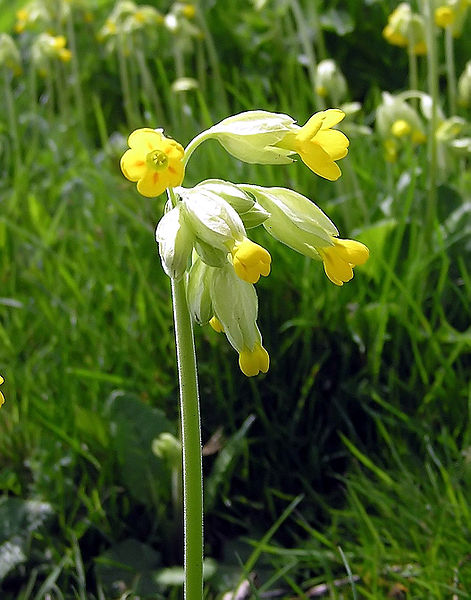
"The heads of cowslips, which trembled in the wind, were signed for Parkinson's disease, the 'shaking palsy.'" (1)
The Doctrine of Signatures seemed a logical botanical belief at a time when plants were one of man’s few medicinal tools and religion was a powerful influence in human society. The Doctrine of Signatures, which was actively promoted by the church in 17th century Europe, was based on a belief that God had “signed” plants with certain suggestive shapes and colors to inform humans of their medicinal properties. For example, a heart-shaped leaf was considered God’s message to us that a particular plant would be beneficial to the human heart and this message was strengthened by a flesh-colored flower. Every plant was believed to be useful in some way if man could only discern its use. Else why would they have been created, since the Garden of Eden was created for the benefit of man? The church encouraged man’s study of plants as a way to worship God’s creation. (1)
Many botanical myths originated from ancient Roman and Greek horticultural treatises and persisted for hundreds of years. For example a belief in the influence of the moon on plants is first found in the writings of Pliny in first-century Rome and also found in writings as late as 1693: “[w]hen you sow to have double Flowers, do it in the Full of the Moon.” (2)
The origins of many horticultural myths are unfathomable but probably began with a particular event because we often confuse coincidence with causal relationships. (2)
Planting bay trees and beeches near homes will prevent lightning strikes
An apple tree that fruits and flowers at the same time is a bad omen
The parents of a child who picks red campion will die
A pregnant woman who steps over cyclamen will miscarry
Modern botanical beliefs
Now we will turn to the theoretical underpinnings of the native plant movement to see how they are holding up to the scrutiny of current science and ask the rhetorical question, Is it time to relegate invasion biology to the dust heap of discredited science?
The field of invasion biology upon which the modern native plant movement is based, originates with the publication in 1958 of The Ecology of Invasions for Animals and Plants by Charles Elton. Elton postulated that every plant and animal occupies a different ecological “niche” and plays a specific role within that niche:
“…every species will have a slightly different role, or niche, and often, he believed, every niche will be filled. Some animals eat grass, others leaves; some plants grow on wet soil and some grow on dry; some birds nest in dead trees, others in live ones. When new species are introduced, the theory goes, they can get a foothold and start reproducing only by finding a vacant niche or by throwing some other species out of its niche…” (3)
Elton’s corollary to the exclusivity of the niche is that the introduced species will have a competitive advantage because its predators are absent in its new home. The predicted result of Elton’s theory was that introduced species will exterminate previous occupants, mass extinctions will occur, and the result will be a simplified ecology composed of few surviving species.
The problem with Elton’s theory is that it doesn’t correspond with reality. More and more scientists are finding that the frequency of introductions far exceeds the frequency of extinctions.
In 2002 Dov Sax reported that introduced species greatly outnumbered extinctions on oceanic islands: “In the case of plants, islands are now twice as diverse as they were before humans started moving things around.” (3)
In 2012, Erle Ellis, et. al., reported that “…while native losses are likely significant across at least half of Earth’s ice free land, model predictions indicate that plant species richness has increased overall in most regional landscapes, mostly because species invasions tend to exceed native losses.” (4)
In San Francisco, the second-most densely populated city in the US, ninety-seven percent of the 714 plant species known to exist in San Francisco in 1850 are still found there, despite the fact that most plants and trees in the city are introduced. (5)
The dire predictions of invasion biology have not come to pass nearly 60 years after their inception. Many scientists are clearly ready to abandon invasion biology because it does not conform to reality. Can we finally breathe a collective sigh of relief and move on to a less gloomy view of ecology? Some day our descendents will look upon this episode in human history and laugh, as we laugh at the 17th century Europeans who examined plants, looking for the clues from God that revealed their purpose.
************************************
(1) Richard Mabey, Weeds: In Defense of Nature’s Most Unloved Plants, Profile Books Ltd, London, 2010, page 87-91
(2) Andrea Wulff, The Brother Gardeners, Alfred Knopf, 2008, page 11-12
(3) Emma Marris, The Rambunctious Garden, Bloomsbury, USA, 2011, page 102-104
Today we will provide another example of the connection between these two apparently related opinions. Rush Limbaugh, the right-wing talk show host, has a track record of calling immigrants an “invasive species.” The following Limbaugh quotes are provided by Media Matters for America, a web-based non-profit dedicated to “comprehensive monitoring, analyzing, and correcting conservative misinformation in the U.S. media.”
On April 1, 2005, Limbaugh described undocumented immigrants as an “invasive species,”saying:
LIMBAUGH: So invasive species like mollusks and spermatozoa are not good, and we’ve got a federal judge say, “You can’t bring it in here,” but invasive species in the form of illegal immigration is fine and dandy — bring ’em on, as many as possible, legalize them wherever we can, wherever they go, no matter what they clog up. So we’re going to break the bank; we’re going to bend over backwards. The federal judiciary is going to do everything it can to stop spermatozoa and mollusks from coming in, but other invasive species? We’re supposed to bend over and grab the ankles and say, “Deal with it.”
“[S]ome people would say we’re already under attack by aliens — not space aliens, but illegal aliens.”
Rush Limbaugh has been much in the news recently for his verbal attacks on a 30-year old female law student at Georgetown University who would like to have access to birth control. In Limbaugh’s opinion she is a “slut,” and a “prostitute” who has “so much sex that she can barely walk.” Women are not Limbaugh’s only target for abuse. He routinely says equally nasty things about gay people, poor people, ethnic and racial minorities, and labor unions.
Native plant advocates who are also opposed to immigration might give some thought to the implications of their ideology. Do they want to be associated with the likes of Rush Limbaugh? If not, how do they explain the difference between the crusade against non-native plants and animals and the crusade against immigrants?
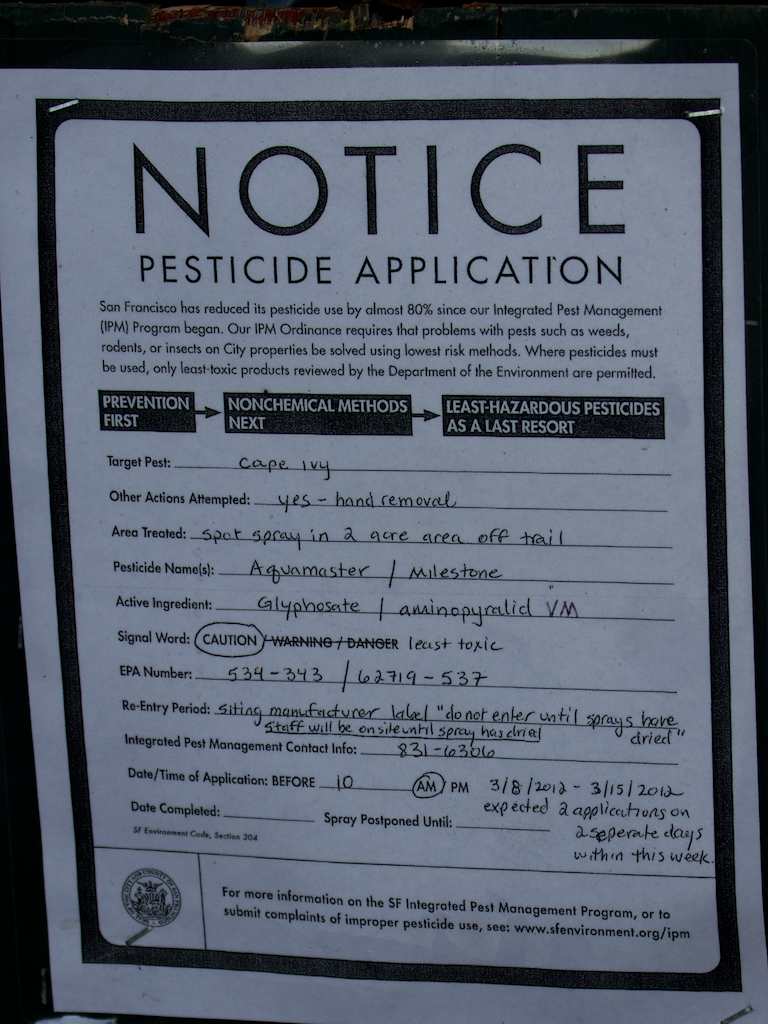
Latest Pesticide Application Notice, Glen Park, March 3, 2012
Nature in the City (NIC) is one of the non-profit organizations in San Francisco that supports native plant “restoration” projects in our public lands, especially the Natural Areas Program (NAP) in the Recreation and Park Department. We recently published a response to a NIC newsletter which described critics of NAP as “a handful of people” and accused them of “misrepresenting” NAP’s plans for San Francisco’s parks. In their most recent newsletter they seem to have changed their tune. This suggests they are starting to take criticism of NAP more seriously. But does it suggest any change in actions or plans? With this open letter, we will ask Nature in the City for clarification.
Here is NIC’s latest attempt to communicate with NAP critics or discredit them. We don’t know which.
“Restore to 1769 or to Now?!
I often hear the question, “to what year do you restore?” Some folks are skeptical about ecological restoration since, of course, we can’t turn back the clock!
Some skeptics sardonically say, “are you going back to the ice age, pre-last glacial maximum (22,000 BP)? Well, then, Monterey Pine are native…”
In fact, the answer I give is that we restore to now. Ecological restoration, like all human activities, has a social and environmental context, which is historical indeed, but also very current. And restoration is about healing and looking toward a brighter future, not looking back into the abyss of ecological destruction. Thus, we Spring Forward, taking into account current conditions, constraints, as well as opportunities.
We document historical ecology; are blessed with knowledge of and from a recent and current indigenous cultural context; and study nearby ecological reference sites. Meanwhile, we have laws, recent history, and communities that present a unique local context in every case. Wildlife habitat now takes diverse forms, including in the human-dominated landscape.
If restoring integrity and biodiversity are always the goals, the specifics can vary widely. And this is just fine, because restoration should be a community-driven, democratic process, like every other human endeavor. -Peter Brastow
Open Letter to Nature in the City:
We are writing to request clarification of your newsletter of March 8, 2012.
What does it mean to “restore to now?” If we are satisfied with our parks now, why do they need to be restored? Isn’t that a contradiction? If not, what—if anything—does that mean?
Why is it necessary to “heal” a park that we don’t think is in “the abyss of destruction?” What if we think that spraying our parks with gallons of pesticides is sending us into “the abyss of destruction?” Is there a “brighter future” in spraying places called “natural areas” with pesticides 86 times in one year?
What does it mean to “restore integrity and biodiversity?” If biodiversity is the goal of the Natural Areas Program why are they eradicating non-native species, thereby reducing biodiversity? As for “integrity,” we assume NIC means in the sense of “unimpaired.” But we don’t consider our parks impaired, so we aren’t concerned about their “integrity.”
Talking out of both sides of your mouth
The tone of the latest NIC newsletter is definitely an improvement over the previous accusatory tone. However, it isn’t comprehensible, nor is it credible because it is contradicted by the words and actions of NIC. Here are a few phrases from NIC’s public comment on the Draft Environmental Impact Review (DEIR) of the Natural Areas Program:
“…the analysis [of the DEIR] neglects to fully address the long-term impact of invasive plants from the retention of invasive weed-nurturing eucalyptus groves in the MA-3 areas.”
In other words, NIC wants all the eucalypts destroyed in all of the acres of “natural areas.” Expanding tree removals into the lowest-priority management areas (MA-3) would increase the number of tree removals substantially. MA-3 acres are 42% of the total acres of “natural areas.” The management plan currently prohibits removal of healthy trees in MA-3 acres.
The DEIR reports that the Maximum Restoration Alternative would have the most impact on the environment. NIC says in its written public comment on the DEIR that this judgment “may be…a misinterpretation of the intent of CEQA.” Peter Brastow, Founding Director of NIC, said during his public testimony to the Planning Commission on October 6, 2011, that the Maximum Restoration Alternative should be designated as the environmentally superior alternative in the final version of the Environmental Impact Report. The Maximum Restoration Alternative would expand all the destructive activities of NAP into all 1,107 acres of “natural areas:” tree removals, eradication of non-native plants, reintroduction of legally protected species, recreational access restrictions, etc.
But Mr. Brastow is not satisfied with maximizing native plant restorations in San Francisco’s parks. In his public comment for the revision of the Recreation, Open Space Element (ROSE) of San Francisco’s General Plan, he proposes that a new agency be created to manage all public lands in San Francisco as “natural areas.” All open space in the city, currently managed by Public Utilities, Port, and Public Works agencies as well as Recreation and Park should be “become part of a single natural resources agency.” This new agency would “Integrate the protection and restoration of biodiversity within all open space management activities (not just natural areas), e.g., native plant landscaping in designed landscapes, wildlife management and monitoring in all parks, etc.”
But why stop there? Mr. Brastow also proposes in his public comment on the ROSE that these principles be extended to private yards: “Conserve private open space, especially rear yards, as habitats and habitat connectors.”
Is there any way to reconcile these demands to expand the empire of the Natural Areas Program into every piece of vacant property in San Francisco, both private and public, with the empty phrases of NIC’s latest newsletter?
Looking how far back into the botanical past?
Before we leave this contentious topic, we will address NIC’s opening gambit, “Restore to 1769 or Now?” The author goes on to dismiss 1769 as the standard, preferring a more forward looking goal. However, he is once again stuck with the written record, which establishes the pre-European landscape as the goal of the Natural Areas Program.
The management plan for the Natural Areas Program says explicitly that. “The following are the list of criteria…to determine the location of potential plant re-introductions: Evidence of historic presence (based on Howell et al. 1958).” (page 2-6) And Howell (1958) says that “Native plant [is] present within the geographic limits of present-day San Francisco prior to the arrival of Portola expedition in 1769.”
NIC may be prepared to welcome plants into San Francisco that arrived after 1769, but until the language in the management plan (and other similar documents such as “Assessment for Forestry Operations,” for Recreation and Park Department, June 2010.) is changed, we will continue to assume that is the standard used by the Natural Areas Program.
Making Peace
The tone of the latest NIC newsletter is welcome and we hope it is a first step toward resolving the conflict over the future of San Francisco’s parks. If this is a sincere effort to address the objections of San Franciscans to the destructive and restrictive actions of the Natural Areas Program, the next step should be to demonstrate intentions with actions. We therefore ask Nature in the City to join us in making the following requests of the Natural Areas Program and the Recreation and Park Department:
The Natural Areas Program should STOP spraying pesticides in the so-called “natural areas” NOW.
The Natural Areas Program should STOP expanding their native plant gardens until the Environmental Impact Report is complete and approved.
The Natural Areas Program should STOP destroying non-native plants and healthy trees until the Environmental Impact Report is complete and approved.
These actions would set the stage for the next step. A lawyer and a critic of the Natural Areas Program has notified the Planning Department, the Natural Areas Program, and the City Attorney that the public comment period for the Draft Environmental Impact Report for the Natural Areas Program did not meet legal standards. The law requires that notice of the public comment period be posted in all the natural areas and mailed to the neighbors of the natural areas.Neither of these requirements was met. Therefore, the lawyer requests that the public comment period be announced as required by law and repeated.
Since NIC says in its current newsletter that “restoration should be a community-driven, democratic process” NIC should agree that another properly announced public comment period is required. The public cannot participate in this “democratic process” if they are unaware of what is planned for their parks.
In a recent post about weeds in Britain, we pondered the interesting question of why there are so few plants in Britain that are considered invasive, a mere dozen compared to the nearly 200 labeled “invasive” by the California Invasive Plant Council.The Brother Gardeners* enabled us to dismiss one possible explanation.
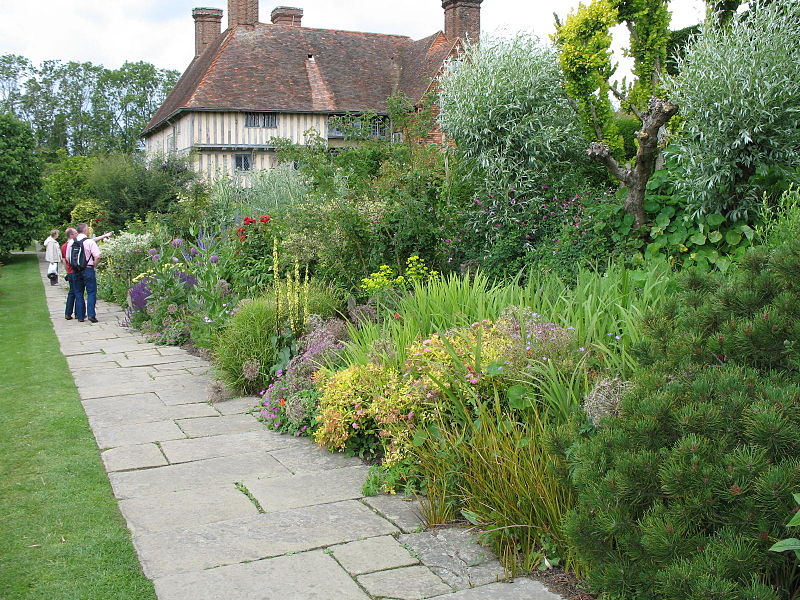
The English Garden, Creative Commons
The fact that fewer plants are considered invasive in Britain is not the result of fewer non-native plants in their gardens. The Brother Gardeners informs us that the British have been enthusiastic importers of plants from all over the world for hundreds of years. They had one of the biggest empires in the world, spanning the globe from India to Africa, Australia, New Zealand, and America, which put them in a unique position to sample the botanical riches of the world.
The Brother Gardeners was written by a German who immigrated to Britain about 10 years before writing this book. She was immediately struck with the importance of gardening in Britain compared to her home country, and she quickly became immersed in the British obsession with gardening.
She tells us the history of botany and gardening in Britain, going back to the 17th century. This is no stale retelling of dry history. This is an engaging tale of the personal relationships that reshaped the English garden, focusing on a 40-year business relationship between an English businessman and a Quaker farmer in Pennsylvania. The American farmer supplied the Englishman with thousands of plants and seeds from the American landscape.
The evolution of their relationship from a business relationship to a friendship is analogous to the relationship between America and Britain. The Englishman was wealthier and more educated than the American and predictably he was condescending to the American at the beginning of their relationship. Over the years, the American acquired both wealth and botanical knowledge, so that eventually they were on an equal footing. But we digress.
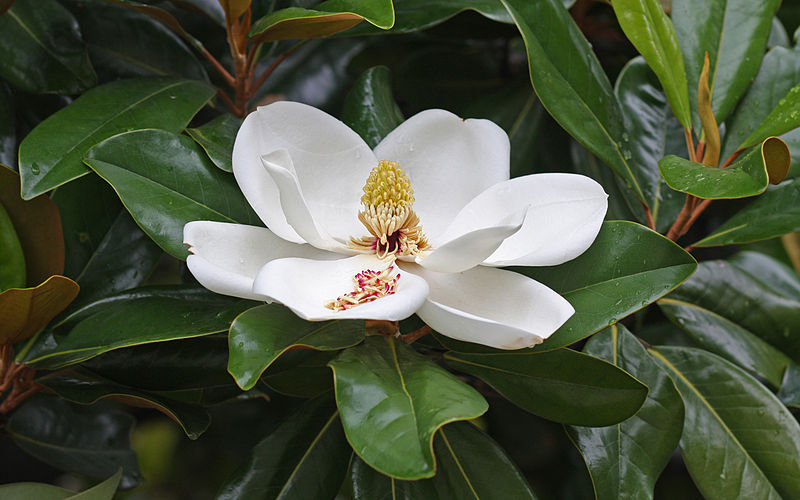
Magnolia grandiflora. Creative Commons
Magnolias, tulip trees, wisteria, and dogwoods were early favorites in this trade from America to England, but over time thousands of different species made the trip into English gardens. The American trees “were thoroughly naturalized, growing side by side with native trees” by 1760 and “Many of the American plants had become so common in the English landscape that gardeners needed new species to parade as rarities in their shrubberies…”
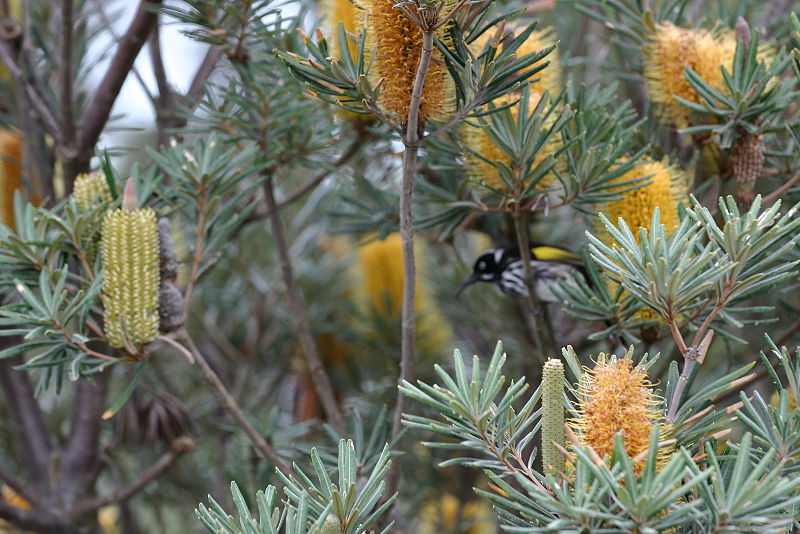
Joseph Banks, the intrepid botanical explorer, brought many new species of plants to Britain. He joined the maiden voyage of Captain Cook into the Pacific in 1769. His team collected plants in Brazil, Tahiti, New Zealand, and Australia on their three year voyage, bringing home specimens of 3,600 species of which 1,400 were new to Britain’s botanical knowledge. Joseph Banks returned to become the head of the Kew Royal Botanical Garden and the Royal Academy of Science. He continued to acquire botanical specimens from all over the world in that capacity.
Banksia, named for Joseph Banks. Creative Commons
The crowning glory of Banks’ acquisitions was the specimen collection of Carl Linneaus, after Linneaus died in 1783. This collection was the “base reference” used by Linneaus to develop the system of categorizing all species, which is still used to this day. The Brother Gardeners tells us the fascinating story of how the Swedish botanist, Linneaus, “sold” his system to botanists throughout the world. It wasn’t an easy sell, particularly to the British. They were initially scandalized by the sexual metaphors used by the system of categories which is based on counting the female (stamens) and male (pistils) parts of the plant, using explicit terms such as the “bridal bed which God adorned with such precious bedcurtains, and perfumed with so many sweet scents.” You may have heard the saying, “No sex please. We’re British.”
The English garden is to this day an eclectic mix of species from all over the world. It is a rich mix of color and texture that seems a mad jumble until the eye can make sense of its logic. It is admired the world over and has influenced gardening everywhere. It rejects the meaningless and artificial distinction between native and non-native. Beauty is its only standard for judgment. Whatever grows and adds color and texture is welcome in the English garden.
++++++++++++++++++++++++++++++++++++++++
*Andrea Wulf, The Brother Gardeners, Alfred Knopf, 2008. All quotes are from Brother Gardeners
Humans have had a profound impact on our planet wherever they have lived. Since the industrial age man’s impact on the environment has even extended beyond where he lives as atmospheric changes impact remote places such as the polar regions. Humans are a particularly restless species of animal, forever fleeing whatever conditions threaten existence or seeking a better life ahead. Because we are an adaptable species with the capacity to alter conditions, we have a wider range of movement than other animals.
Wherever humans have gone they have taken with them the seeds of plants, at first unwittingly and then purposefully after the advent of agriculture. Edward Salisbury, a 19th Century British horticulturalist, reported raising 300 plants of 80 different species from the debris in his trouser cuffs despite wearing spats.(1)
The impact of Native Americans on the landscape
Native Americans arrived in North America about 13,000 years ago and slowly migrated to South America. The megafauna that Native Americans found when they arrived disappeared soon after they arrived. Although not all scientists agree, there is strong evidence that the megafauna, such as enormous buffalo and mastodons were hunted to extinction by the first human inhabitants of the New World. The loss of these huge herbivores was a factor in the development of grasslands that were not adapted to heavy grazing.(2)
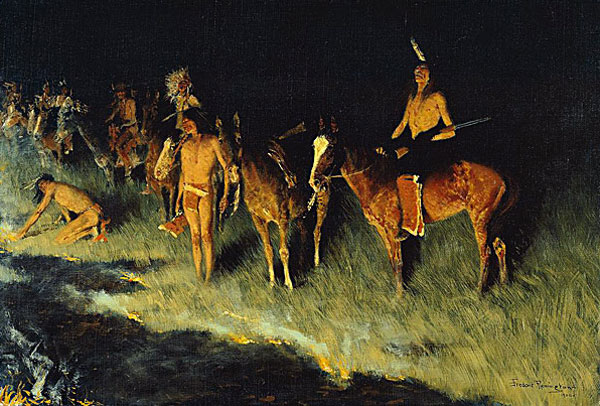
Native Americans setting grass fire, painting by Frederic Remington, 1908
The most profound alteration of the ecology of the New World by Native Americans was their use of fire to assist their hunting and gathering activities. Burning grassland to the ground encourages the growth of new sprouts that improve grazing and attract the animals the Native Americans hunted. And burning grassland funneled the animals into the hunt. These frequent burns prevented the succession of grassland to shrubs and forest, maintaining prairies that were essentially manmade.
The arrival of Europeans in the New World
This process of transplanting plants around the globe was greatly accelerated by the age of exploration which began in earnest in the 15th century. When Columbus arrived in the New World in 1492, he found a land that had already been radically altered by Native Americans, though he had no way of knowing that.
The Europeans that eventually settled the New World were ignorant of the impact of Native Americans on their new home until the advent of archaeology in the 20th century. Their ignorance was based on their mistaken perception that the Native American population was small.(3)
In fact, the population of Native Americans was decimated by the time the Europeans settled the New World nearly 200 years after the early explorers arrived at the end of the 15th century. The early explorers introduced European diseases to which they were immune, but the Native Americans were not. From just a few localized contacts with Europeans these diseases–such as measles, smallpox, and syphilis–spread quickly through Native American communities, sometimes reducing the population by as much as 90%. These deadly epidemics were largely unwitnessed by the tiny population of early explorers.
Alfred Crosby speculates in Ecological Imperialism that Native Americans were particularly vulnerable to these diseases because they had virtually no domesticated animals. He gives us a fascinating explanation of how Europeans developed their immunities by living in close proximity with animals for centuries.
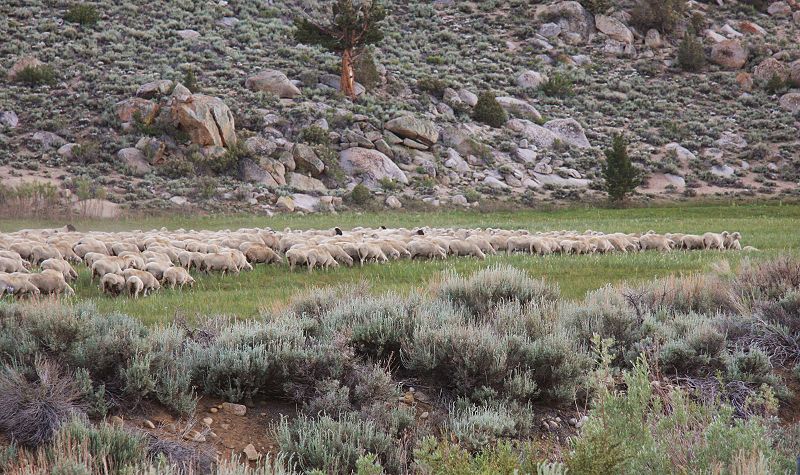
As much impact as Native Americans had on our landscape it pales in comparison to that of Europeans. The importation of domesticated animals—such as cattle, pigs, horses, and sheep—changed the ecology of the New World quickly. Because the population of early settlers was small and the grazing resources vast, these animals quickly became huge herds of feral animals, roaming places such as the pampas of Argentina and the prairies of the mid-west of North America. The native grasses were quickly replaced by the non-native grasses spread by these wandering herds. (4)
Herd of sheep, Mono County, CA. Creative Commons
Likewise, the agricultural practices of European settlers have introduced virtually everything we eat today in North America. Nearly all of our fruits, vegetables, and cereals are not native to North America. If non-native food were to be banished from California, we would be reduced to a diet of game, acorn mush and a few species of nuts and berries. The diet of Europeans would be equally impoverished if they lost the potatoes, corn, tomatoes, etc. that came to them from the New World.
Changes in the ecology of North America resulting from the movement of humans have been going on for thousands of years and have greatly accelerated in the last 500 years. Until very recently, these changes were broadly perceived as improvements. We enjoy a more varied diet than our ancestors and we are shielded from famine by our access to food from anywhere in the world. We find the products of the New World useful in other ways, such as the rubber that is essential to transportation.
We asked a scientist who advises us occasionally this question: Since new species of plants and animals have been introduced to our landscape for hundreds, if not thousands of years, why the sudden panic? His reply was: “It’s trendy. It’s ‘cutting edge.’ It’s ‘hot.’ It’s…fundable.”
In the service of a scientific fad that has spread into the popular culture, introduced species of plants and animals are being needlessly destroyed. Many of these new species are better adapted to present conditions than their predecessors. Many are essential to our way of life and the animals with which we share the planet.
(1) Richard Mabey, Weeds: In Defense of Nature’s Most Unloved Plants, Harper-Collins, 2011
(2) Alfred Crosby, Ecological Imperialism. Cambridge University Press, 2004
As our readers know, we troll the websites of supporters of the native plant movement, looking for clues about the basis for belief in that ideology. We hope that our understanding will enable us to provide the scientific information to our readers that will reveal the fallacies of nativism.
The following comment on the San Francisco Forest Alliance website alerted us to a new theme in this debate: native plant advocates seem to believe that we can and should return our urban parks to “wilderness.”
“It is interesting that your post shows the trail side covered with English ivy, and possibly a fallen eucalyptus or two. Each of these is a non-native element. Any and all exotic species present in the canyon destroy the wilderness aspect of Glen Canyon Park.
Please note the term “wilderness”. It implies natural, native flora and fauna; the wild plants and the bird and animal populations that support one another. That is what we want to have if we want a wild retreat. A morass of garden escapes and foreign invasive species is to be deplored. Let’s progress toward returning the area to a REAL wilderness. Do not let the concept that a plant’s becoming established in an area is a sign of its becoming native to the area. It remains an invasive element, a weed. It disrupts and destroys the normal habitat of native plants, animals, and insects in its surroundings.
It will be a huge and long term task, but we can restore the entire canyon to a truly wilderness state. Lets get started!”
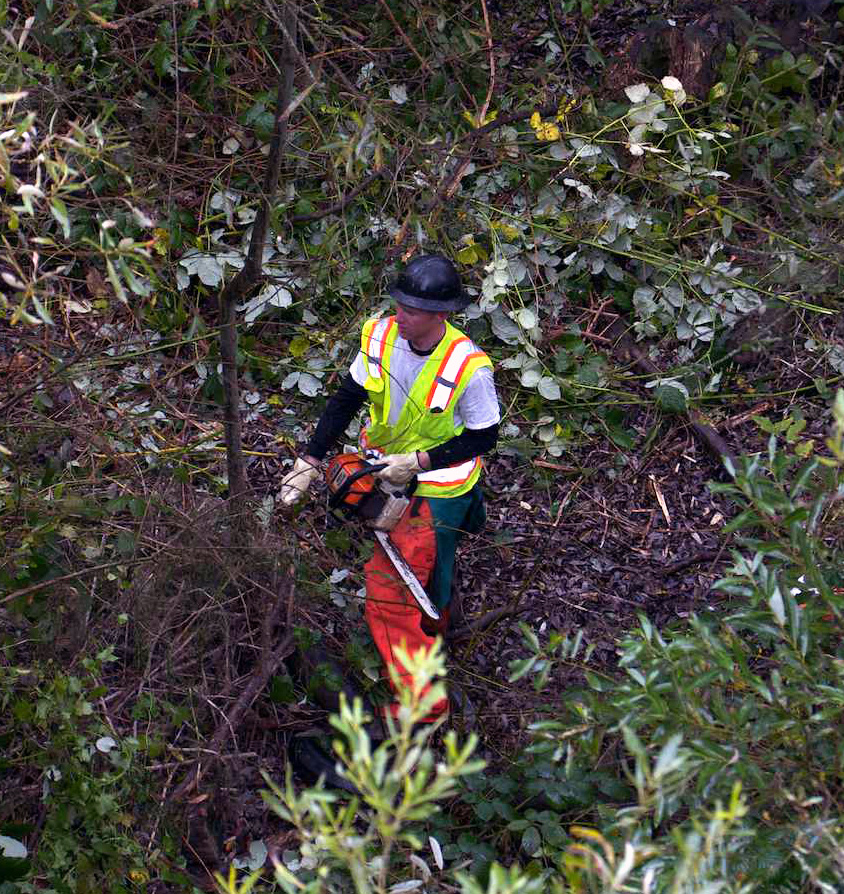
Chainsaw massacre in Glen Canyon, November 2011
In this particular native plant advocate’s view, wilderness is composed exclusively of native plants. Everything else must be eradicated. If chainsaws and pesticides must be used repeatedly in perpetuity, so be it. All this destruction is justified by the glorious goal of “wilderness.” This wilderness is apparently not disturbed by chainsaws and pesticides. Presumably they must be ignored to achieve the glorious goal.
We rarely indulge in sarcasm on Million Trees. We hope our readers recognize it when they see it.
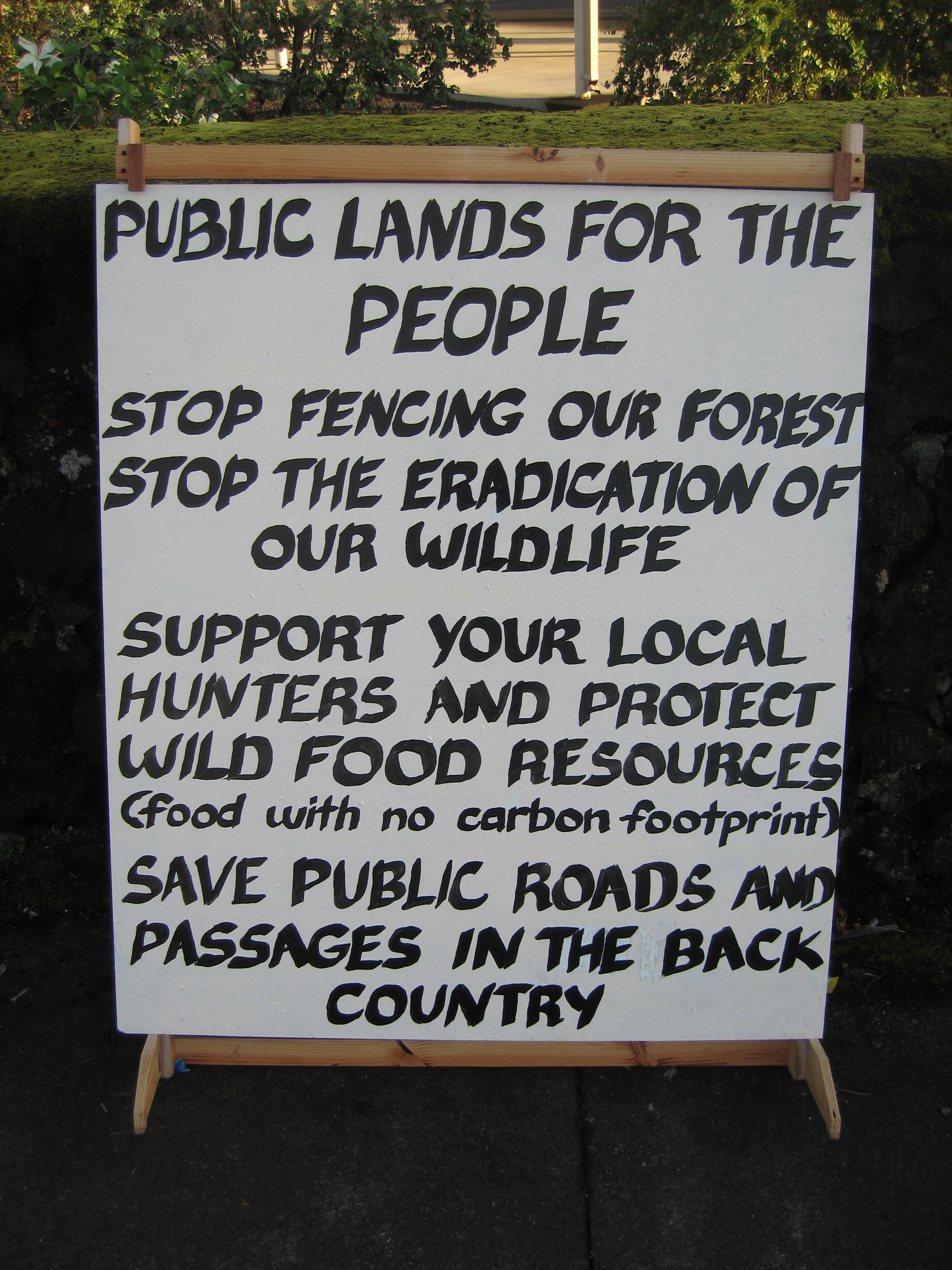
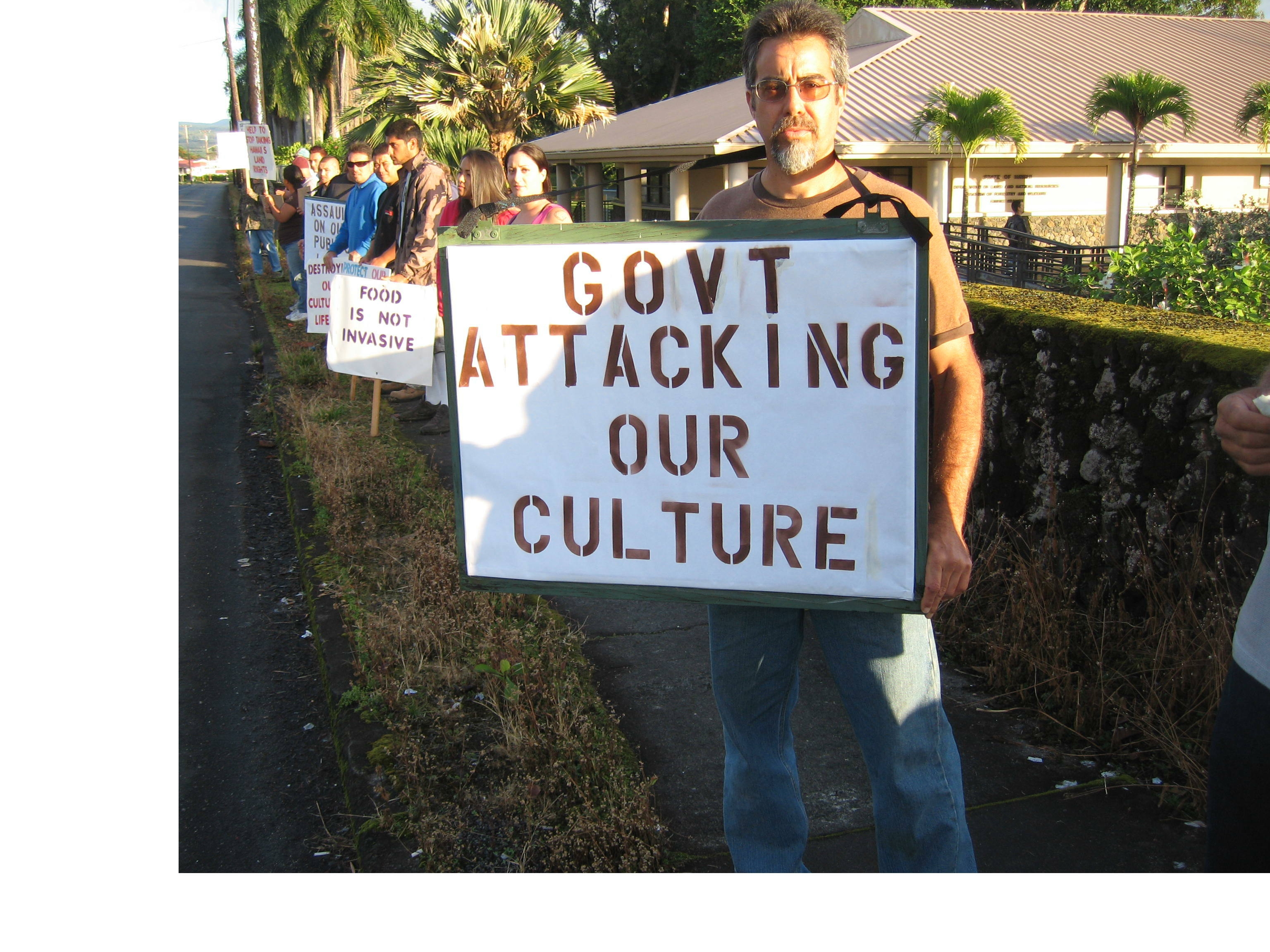
We recently told our readers about the controversial “restoration” projects in Hawaii. Now our colleagues in Hawaii have sent us photographs of a public protest in Hawaii and The Hawaii Reporter tells us why they are protesting. Hawaii’s Department of Land and Natural Resources (DLNR) is fencing the public out of another 17 square miles of prime forest on the Big Island. All the non-native animals—sheep, goats, pigs—will be exterminated and all their non-native food—strawberry guava, passion fruit, etc—will be eradicated in that fenced enclosure. The people who hunted the animals and gathered fruit in the forest are protesting the loss of this source of food.
In addition to the loss of food, the protestors also object to the loss of an activity that is central to the Hawaiian culture of foraging and hunting for food. DLNR’s response to that particular complaint is that the historical record indicates that Hawaiians didn’t hunt prior to the arrival of Europeans because they raised animals as their own.
In other words, not only does DLNR wish to stop the biological clock, they also wish to freeze-frame the Hawaiian culture to a pre-European standard. They don’t seem to have considered that the Europeans essentially confiscated the land of the Hawaiians when they arrived, which deprived the Hawaiians of the land needed to raise animals. That’s too bad. The Hawaiians are not allowed to hunt now because they didn’t hunt 250 years ago. As absurd as creating botanical museums seems to us, the suggestion that culture must also be prevented from evolving strikes us as utterly ridiculous.
Hawaiians protest loss of access to public lands
Conservation Refugees
Hawaii’s cost of living has always been one of the highest in the country because virtually all of its food must be imported. And now Hawaiians are being deprived of an important source of food by the confiscation of public lands. Will these Hawaiians join the ranks of the millions of conservation refugees all over the world who have been displaced in the name of conservation?
We were introduced to conservation refugees by Mark Dowie in 2004. He told us that the belief that wilderness is not compatible with human community originated with John Muir, who demanded that Native Americans living in Yosemite be removed from the valley. Native Americans were also removed from Yellowstone when the National Park was created. These Native Americans were the first conservation refugees, but not the last.
Dowie told us that the worldwide official protected areas—parks, reserves, wildlife sanctuaries, biodiversity corridors—had expanded from 1,000 in 1962 to 108,000 in 2004. The total number of indigenous people displaced by the creation of these protected areas is not known because most countries make no attempt to quantify the impact. In Chad an estimated 600,000 indigenous people became conservation refugees when the amount of protected areas increased from 0.1 to 9.1 percent of total national land in the 1990s. India admits to creating 1.6 million conservation refugees as a result of creating new protected areas and the Indian government estimates that 2 or 3 million more will be displaced in this decade.
Dowie visited some of the communities that have been displaced by the confiscation of their ancestral land. The loss of their land is also the loss of their way of life. Hunters/gatherers are deprived of their source of food. Likewise, farmers lose their croplands. They wander into shanty towns where they lack the skills to survive in the modern world. They create shabby squatter camps on the perimeter of their homeland where they live without sanitation or water. The fabric of their communities is shattered.
Emma Marris* observes the irony of these evictions of traditional cultures which have tended these remnants of the wilderness for generations. These places were targets for conservation because they had been preserved by traditional cultures that had learned to co-exist with nature. This is how they are rewarded for their stewardship of the land.
What is accomplished?
What is gained when Hawaiians are thrown out of their public lands, depriving them of a source of food? Are these projects successful? Are the plants and animals that existed in Hawaii several hundred years ago returning to the fenced reserves that have been created for them?
Emma Marris visited one of these projects in Hawaii. A small test plot was cleared of all non-native plants, requiring the removal of about half of all the vegetation. That process took about a week per thousand square feet and then “epic bouts of weeding thereafter.”
The theory was that the removal of all the non-natives would enable the natives to thrive without the competition for sunlight and water. Five years later, there is little evidence that native plants have benefited from the eradication of all non-native plants:
“Disappointingly, the mature native trees had grown very little. As [the project directors] put it, ‘The native trees may either be responding to the treatments very slowly and still undetectably, or they may be unable to respond at all.’”
The directors of this project also told Marris, “I think that people that are interested in protecting Hawaii’s flora and fauna have resigned themselves to it being in postage-stamp sized reserves.” Apparently Hawaii’s Department of Land and Natural Resources hasn’t gotten this message. They are now creating another 17 square mile reserve with the intention of eradicating everything non-native in it. Nothing is likely to be accomplished by all that death and destruction and some Hawaiians will also go hungry.
The slippery slope of nativism
Perhaps we should be grateful that the “restoration” projects in the San Francisco Bay Area aren’t depriving us of our homes and our livelihoods. We are just being fenced out of our public parks. We are just losing our trees. Our public parks are just being poisoned with pesticides.
But we watch these projects all over the world and we listen to the demands of local native plant advocates and we wonder where this is headed. In San Francisco, for example, native plant advocates are demanding that all of the public lands in the city be managed as “natural areas.” In addition to destroying the trees in our parks, would we lose the trees on all our public properties? We also know that native plant advocates want plant nurseries to quit selling to the public the approximately 200 plants that they have categorized as “invasive.” Will we lose the right to plant what we want in our own backyards? Given what we see happening around the world, it doesn’t seem farfetched.
* Emma Marris, Rambunctious Garden, Bloomsbury Publishing, 2011
Nature in the City (NIC) is one of many organizations that support native plant “restorations” in San Francisco as well as the principle entity which engages in them, the Natural Areas Program (NAP) of the Recreation and Park Department. NIC is consistently critical of anyone who questions the value of these restorations, but in their most recent newsletter they confront our objections directly. Although we don’t presume to represent the many constituencies which are critical of the Natural Areas Program, we are responding in this post to NIC based on our knowledge of the issues. (The NIC newsletter is in quotes and is italicized. Our response is not italicized.)
“Natural Areas in 2012
Last fall saw the the [sic] Planning Commission public meeting for the Draft Environmental Impact Report (DEIR) for the Significant Natural Resource Areas Management Plan. Some time later this year, the City will issue a Final Environmental Impact Report, which may be appealed by opponents of the Natural Areas Program.
Unfortunately, a handful of people are still propagating misinformation about the rationale, values, and intention of ecological restoration, management and stewardship, and of the City’s celebrated Natural Areas Program.”
Webmaster: Critics of the Natural Areas Program cannot be described accurately as a “handful of people.” We now have four websites(1) representing our views and there have been tens of thousands of visits to our websites. Comments on our websites are overwhelmingly supportive of our views. Our most recently created website, San Francisco Forest Alliance, lists 12 founding members. That organization alone exceeds a “handful of people.”
Our objections to the Natural Areas Program have also been reported by three major newspapers in the past month or so (San Francisco Examiner, Wall Street Journal, Sacramento Bee).
Many critics of NAP have been engaged in the effort to reduce its destructive and restrictive impacts on our parks for over 10 years. Scores of public meetings and hearings have been held to consider our complaints. We consistently outnumbered public speakers in support of NAP until 2006, when the NAP management plan was finally approved by the Recreation and Park Commission. Although we were outnumbered for the first time, there were over 80 speakers who asked the Recreation and Park Commission to revise NAP’s management plan to reduce its negative impact on our parks.
The public comments on the NAP DEIR are the most recent indicator of the relative size of the groups on opposite sides of this issue. These comments were submitted in September and October 2011. We obtained them with a public records request. The Planning Department reported receiving about 400 comments. In analyzing these comments, we chose to disregard about half of them because they were submitted as form letters, even though they were from dog owners who were protesting the loss of their off-leash privileges in the natural areas. We also leave aside the comments from golfers whose only interest is in retaining the golf course at Sharp Park. In other words, we set aside the majority of the comments critical of the NAP management plan in order to focus on those comments that demonstrate a comprehensive understanding of the impact of NAP on the city’s parks. Of the comments remaining, those critical of NAP and its deeply flawed DEIR outnumbered comments in support of the NAP DEIR about three to one. We urge NAP supporters to read these public comments to learn about the wide range of criticisms of NAP, including pesticide use, destruction of trees, recreational access restrictions, loss of wildlife habitat and more.
We will challenge NIC’s accusation that we are “propagating misinformation” within the context of their specific allegations:
“Contrary to the many myths that continue to percolate, the Natural Areas Plan and Program seek to do the following (among other worthwhile endeavors):
1. Protect and conserve our City’s natural heritage for its native wildlife and indigenous plant habitats and for the overall health of our local ecosystem;”
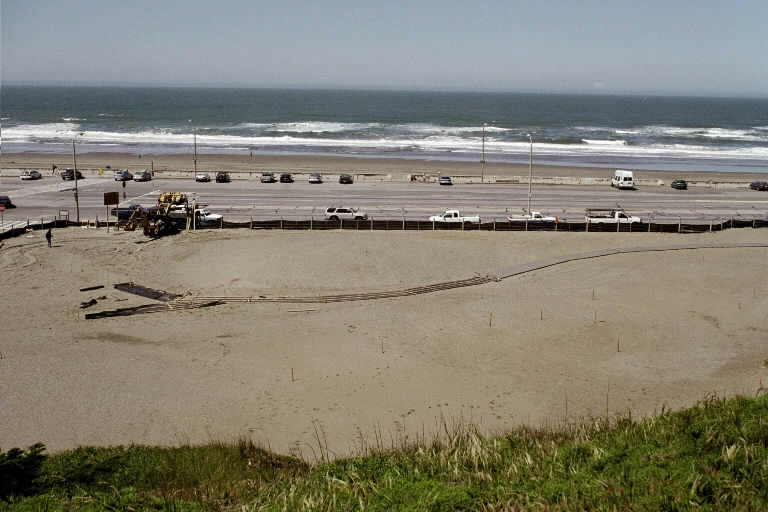
Webmaster: Since the majority of acreage claimed as natural areas by NAP 15 years ago had no native plants in them, there is little truth to the claim that NAP is protecting our “natural heritage.” The so-called “natural area” at Balboa and the Great Highway is typical of the “natural areas.” There is photographic evidence that it was built upon for about 150 years. It was the site of Playland by the Beach before it was designated a “natural area.” Sand had to be trucked onto the property and disked down 18” into the construction rubble, then shaped into dunes by bulldozers before native plants could be planted on it.
Natural Area at Balboa & Great Highway under construction
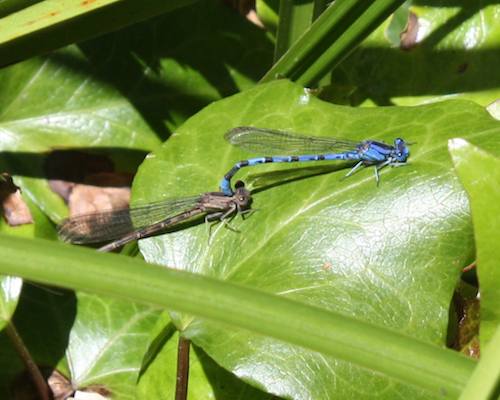
We don’t make any distinction between “native wildlife” and any other wildlife currently living in our city. We value them all. Most are making use of existing vegetation, whether it is native or non-native. They do not benefit from the loss of the blackberries that are their primary food source or the loss of the thickets or trees that are their homes. We do not believe that wildlife in San Francisco benefits from the destructive projects of the Natural Areas Program. See photos of insects, birds, and other wildlife using non-native plants in the natural areas here.
Damselflies mating on ivy, Glen Canyon Park
We do not think an ecosystem that has been sprayed with herbicides qualifies as a “healthy ecosystem.” NAP sprayed herbicides at least 86 times in 2011. Their use of herbicides has increased over 330% in the last 4 years. NAP uses herbicides that are classified as more toxic than those most used by other city departments. Last spring, 1,000 visitors to Glen Canyon Park signed a petition, asking the Natural Areas Program to stop using pesticides in their park. This petition was given to Scott Wiener, the Supervisor representing the district in which Glen Canyon Park is located.
These are statements of fact that can be easily verified by the public record.
2. “Educate our culturally diverse city about the benefits of local nature and about helping with natural areas stewardship in your neighborhood;”
And we also have had bad experiences with the volunteers who are called “stewards” by NAP, but sometimes act more like vandals. We see them spraying herbicides that they aren’t authorized to use. We see them hacking away at trees that haven’t been designated for removal. NAP is not providing the necessary guidance and supervision to the volunteers many of whom seem to consider themselves the de facto owners of the parks.
3. “Manage the City’s wildlands for public access, safety and the health of the “urban forest.””
“We hear occasional complaints about public access and tree removal. Three simple facts are thus:
1. Every single natural area in the City has at least one trail through it, where one can walk a dog on a leash;”
Webmaster: The loss of recreational access in the natural areas is real, not imagined. The following are verbatim quotes from the NAP management plan:
“Approximately 80 percent of the SFRPD off-leash acreage is located within Natural Areas.” (page 5-8). The NAP DEIR proposes to close or reduce the size of several off-leash areas. The DEIR provides no evidence that these areas have been negatively impacted by dogs. It also states that all off-leash areas in the natural areas are subject to closure in the future if it is considered necessary to protect native plants. Since NAP has offered no evidence that the proposed immediate closures are necessary, one reasonably assumes it will offer no evidence if it chooses to close the remainder of the 80% of all off-leash areas in San Francisco located in natural areas. We know from the DEIR public comments that NAP supporters demand their closure.
“Public use in all Natural Areas, unless otherwise specified, should encourage on-trail use… Additionally, interpretive and park signs should be installed or modified as appropriate to include “Please Stay on Trails” with information about why on-trail use is required.” (page 5-14) In other words, the only form of recreation allowed in the natural areas is walking on a trail. Throwing a ball or frisbee, having a picnic on the grass, flying a kite, climbing the rocks are all prohibited activities in the natural areas. And in some parks, bicycles have been prohibited on the trails by NAP.
“Finally, this plan recommends re-routing or closing 10.3 miles of trail (approximately 26 percent of total existing trails).” (page 5-14) So, the only thing visitors are allowed to do in a natural area is walk on the trails and 26% of all the trails in the natural areas will be closed to the public.
2. “The act of removing (a small subset of) non-native trees, e.g., eucalyptus, that are in natural areas has the following benefits:
a. Restores native habitat for indigenous plants and wildlife;
b. Restores health, light and space to the “urban forest,” since the trees are all crowded together and being choked by ivy;
c. Contributes to the prevention of catastrophic fire in our communities.”
Webmaster: Destroying non-native plants and trees does not restore indigenous plants and wildlife. Native plants do not magically emerge when non-native plants and trees are destroyed. Planting indigenous plants might restore them to a location if they are intensively gardened to sustain them. However, in the past 15 years we have seen little evidence that NAP is able to create and sustain successful native plant gardens. Native plants have been repeatedly planted and they have repeatedly failed.
NAP has not “restored” the health of the urban forest. They remove trees in big groups as they expand their native plant gardens. They are not thinning trees. They are creating large openings for the grassland and dune scrub that they plant in the place of the urban forest. Every tree designated for removal by the NAP management plan is clearly selected for its proximity to native plants. It is disingenuous to suggest that NAP’s tree removal plans are intended to benefit the urban forest.
3. “The overall visual landscape of the natural areas will not change since only a small subset of trees are planned to be removed over a 20-year period.”
“Please feel free to email steward@natureinthecity.org if you would like more clarification about the intention, values and rationale of natural resources management.”
Webmaster: We urge our readers to take NIC up on this offer to provide ”more clarification” of its spirited defense of the Natural Areas Program.
Do you think NIC is deluded about there being only a “handful of people” that are critical of the Natural Areas Program?
Did you notice that NIC does not acknowledge the use of herbicides by NAP? Do you think that a fair representation of criticism of NAP can omit this issue?
If you visit a park that is a natural area, do you think NAP has demonstrated in the past 15 years what NIC claims it is accomplishing?
Do you think NIC has accurately described recreational access restrictions in the natural areas?
Do you think that San Francisco’s urban forest will be improved by the destruction of 18,500 mature trees and countless young trees?
(2) “The California Department of Forestry and Fire Protection (CAL FIRE) has no record of any wildfire in San Francisco.” San Francisco Hazard Mitigation Plan, 2008, page 5-18.