Our readers will recall that California law enabled a member of the Sierra Club to send a letter to over 26,000 members of the San Francisco Bay Chapter of the Sierra Club about the chapter’s support for deforestation and pesticide use in the East Bay Hills. Today we’re reporting the result of that letter and the next step in the long, tortuous path to changing the chapter’s policy on these issues. The letter and enclosed postcard petition are available HERE and HERE: Letter to Sierra Club members and Letter to Sierra Club members – postcard petition
To date, this is the number of postcard petitions that have been received:
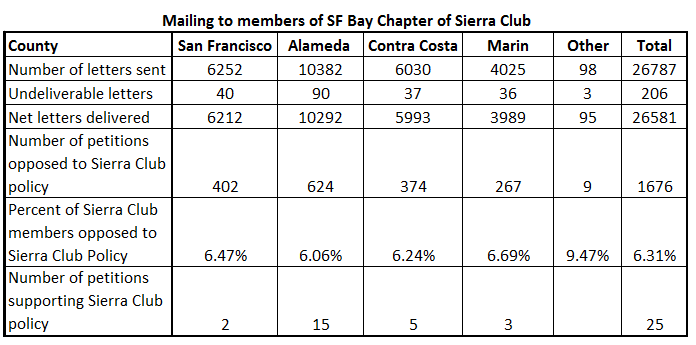
Since many couples have joint memberships, the actual number of Club members who signed the postcard petition is greater than the number of postcards. The postcard petitions represent the opposition of 1,823 members to Sierra Club policy. Many members also added written messages on the postcard petition, which are available HERE: Petition Comments
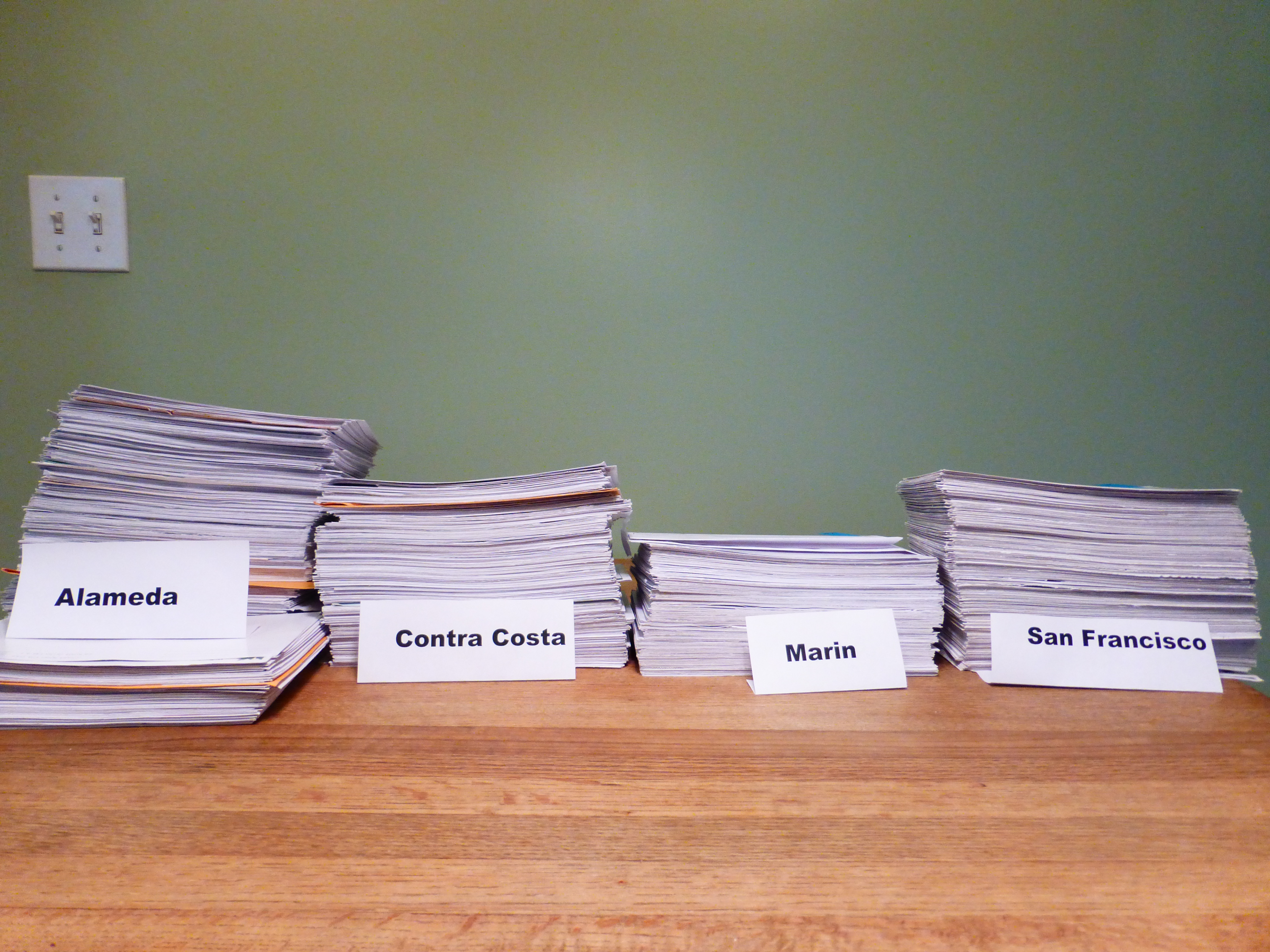
The Sierra Club is now obligated to give us a VOTE on this issue!
According to the Sierra Club bylaws, critics of the Club’s policy regarding the destruction of our urban forest and pesticide use are now entitled to a formal vote on the issues. The Sierra Club reports: “More than 45,000 members nationwide voted” in the 2016 election for the Club’s National Board of Directors. Let’s say 46,000 voted. Two percent (2%) of 46,000 is 920. Nearly twice as many (1,823) Sierra Club members have indicated their opposition to the Club’s policy regarding the destruction of our urban forest and pesticide use. Thus the results of the postcard petition now obligate the Sierra Club to conduct a formal vote on the issues:
“11.2. Except as provided in Bylaw 5.10, whenever a number of members of the Club equal at least to two percent (2%) of the number of ballots cast at the immediately preceding annual election for Directors shall request in writing that a resolution be adopted by the Club, the Board may adopt the resolution by majority vote, unless the petition specifically requests a vote of the membership or such a vote is required by law or these Bylaws; if the resolution is not so adopted, the Board shall certify it to the Secretary for a vote of the members.”
The author of the letter to Sierra Club members informed the leadership of the Sierra Club of the number of postcard petitions received and requested a formal vote on the issues, as provided by the Club’s by-laws.
How to get the attention of the Sierra Club?
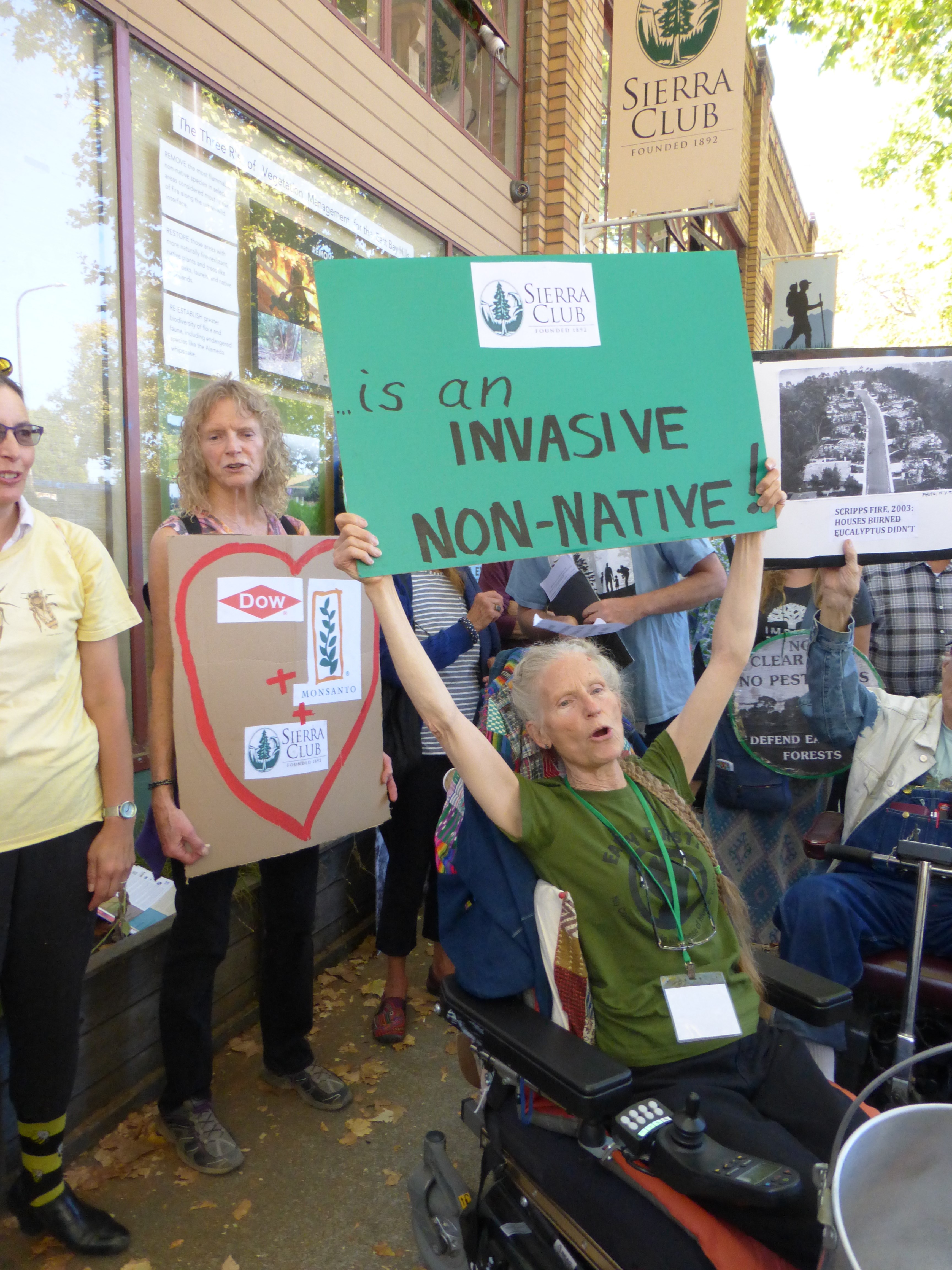
We have planned a demonstration at the national headquarters of the Sierra Club on Monday, June 13, 2016, at noon. Unless the Sierra Club agrees to conduct a formal vote on the issues before that date, we plan to tell the Sierra Club to let its members decide whether the Club should continue to support deforestation and pesticide use on public lands.
Noon 12:00 pm
Monday June 13, 2016
2100 Franklin St. (at 21st Street), Oakland
Sierra Club National Office (13th Floor)
(Close to 19th Street BART Station)
We hope that those who care about deforestation and pesticide use in the East Bay will join us for this peaceful demonstration. A leaflet that you can print and post or distribute for this demonstration is available HERE: Flyer for demonstration Please help us make the case that the bylaws of the Sierra Club obligate the club to give the membership a formal vote on these issues.
Why focus on the Sierra Club?
Opponents of the deforestation projects in the East Bay Hills may wonder why so much time and energy is spent on trying to change the policy of the Sierra Club on this matter. Sometimes, Million Trees wonders too.
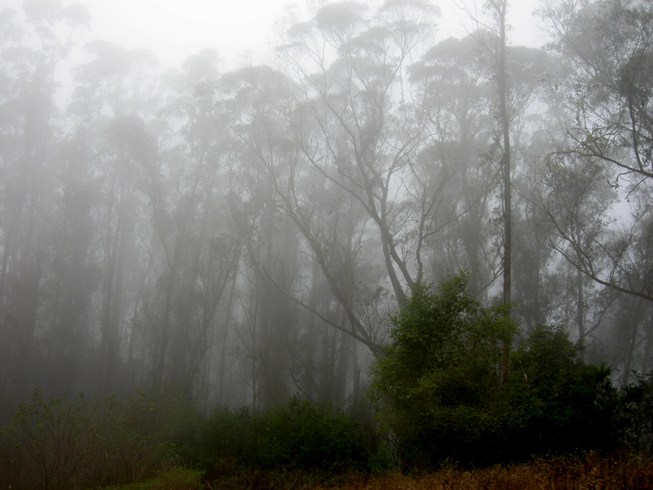
So, we will take a minute to explain that the Sierra Club has filed a lawsuit that demands immediate eradication of 100% of non-native trees on over 2,000 acres of public land. East Bay Regional Parks District (EBRPD) is the biggest of the three land owners engaged in these projects. EBRPD prefers to thin its eucalyptus forests from an average of 650 trees per acre to about 60-80 of the biggest trees per acre. Although that seems to be the destruction of too many trees, it is clearly preferable to destroying EVERY non-native tree (eucalyptus, Monterey pine, and acacia) on about 1,600 acres of park land in the East Bay, which is what the Sierra Club lawsuit demands. The other two land owners (UC Berkeley and City of Oakland) have always planned to destroy 100% of the non-native trees on about 500 acres of their land. The Club’s lawsuit demands that they do so immediately, rather than phase some of the tree removals over a period of 10 years.
Furthermore, the Sierra Club is influential with public policy makers, including elected officials. We believe that some decision-makers would be less likely to support these destructive projects if the Sierra Club would quit demanding the destruction of our urban forest. In a liberal, environmentally conscious community such as ours, the Club’s promise of endorsement (or threat of non-endorsement) of a particular candidate for elected office is a powerful tool to impose the Club’s will on our decision makers.
Finally, we believe that the policy of the local chapter of the Sierra Club that demands destruction of much of our urban forest and douses our public lands with pesticides compromises the important mission of the national Sierra Club. The national Sierra Club is appropriately focused on addressing the causes of climate change. Climate change is the environmental issue of our time and the Sierra Club is one of the most important tools we have to address that issue. Deforestation is a major cause of climate change. The policy of the local chapter is therefore a contradiction of the mission of the Sierra Club.
 Conservation Sense and Nonsense