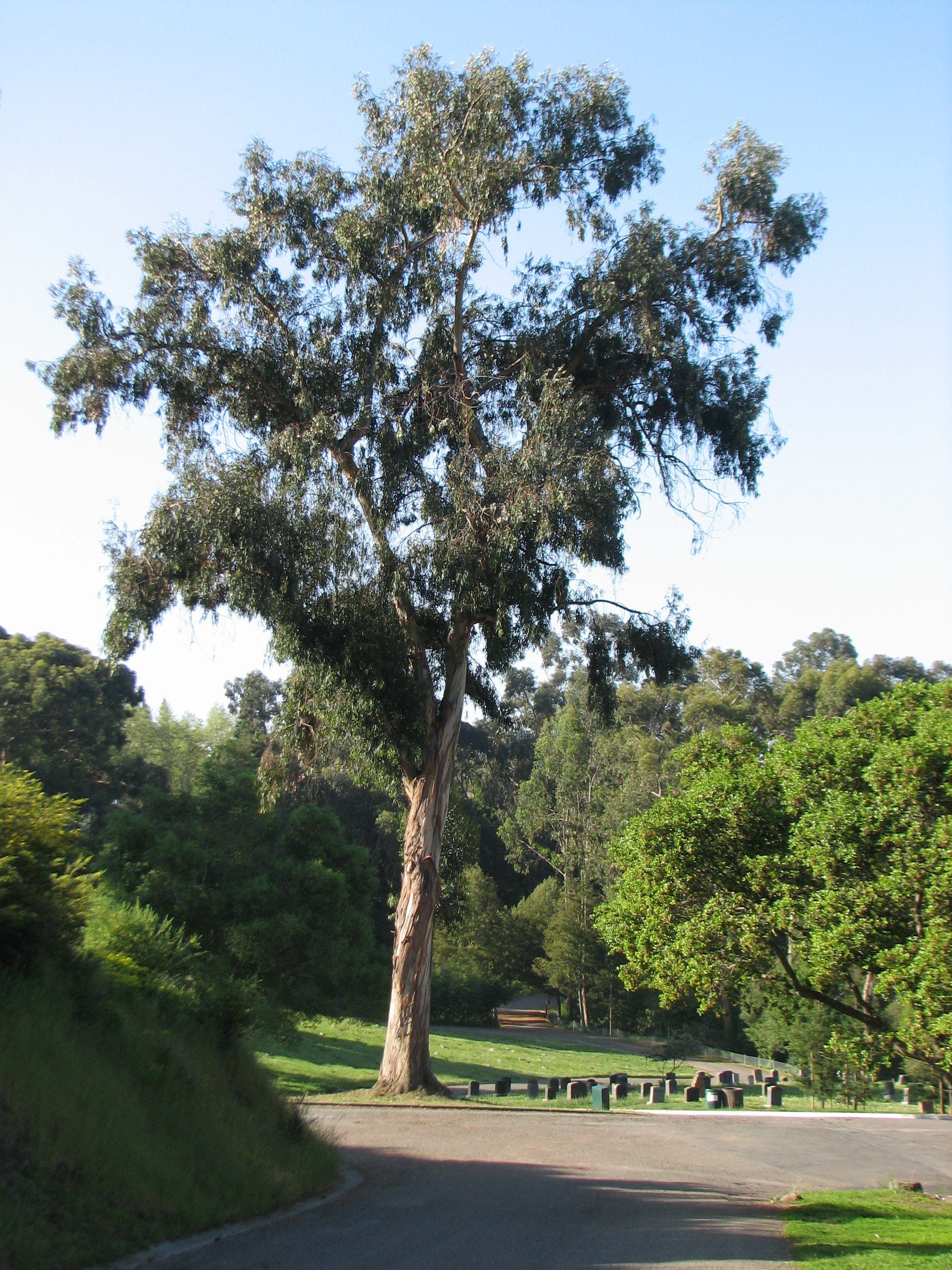
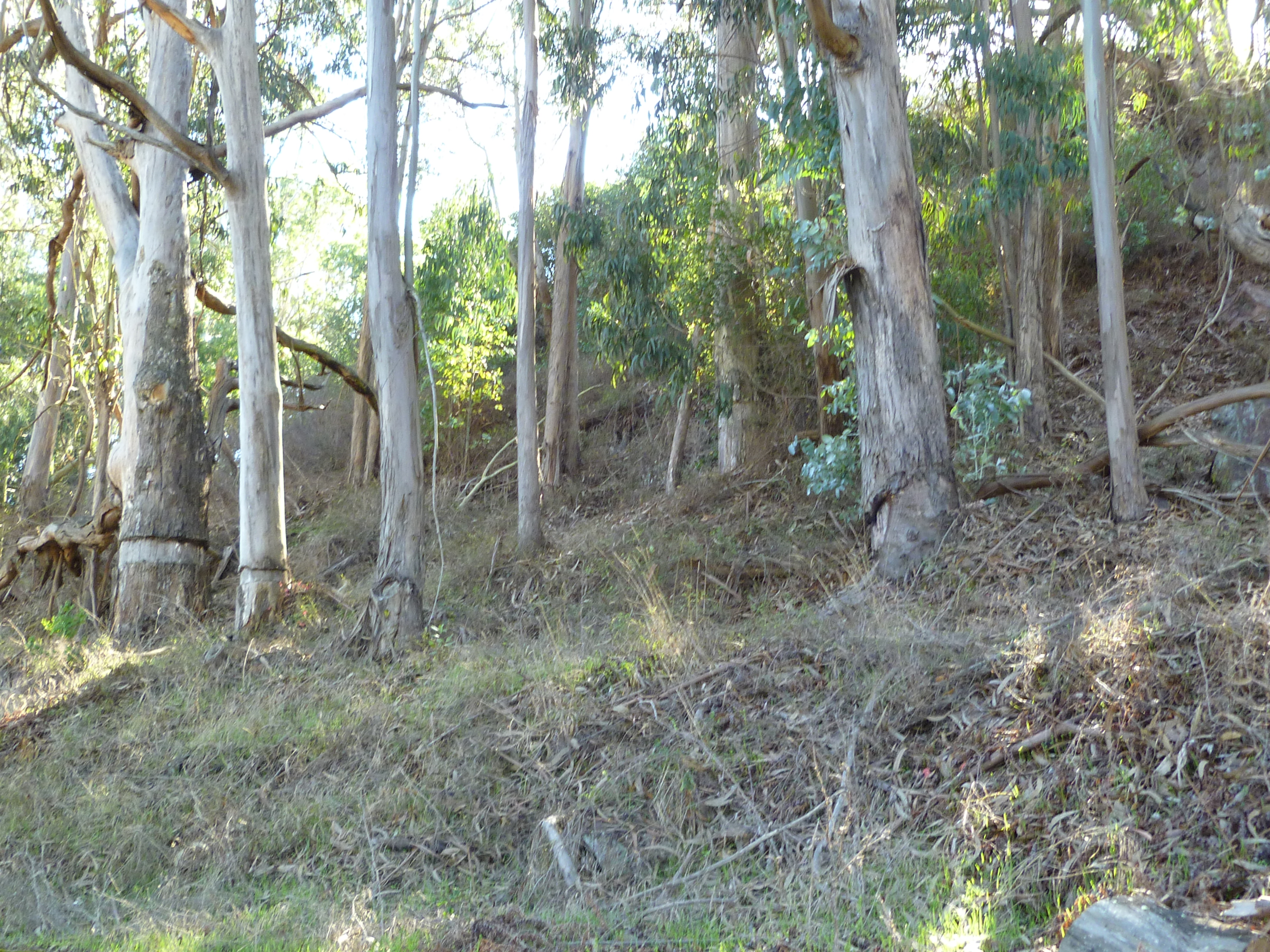
This is one of many trees in the East Bay that have already been destroyed because it is not native.
We have just received a link to a video about the FEMA projects in the East Bay hills. (Available here) The video was created by someone who attended the second public meeting on Tuesday, May 14, 2013.
We don’t agree with everything he says, but we certainly agree with his main point: VERY FEW MEMBERS OF THE PUBLIC IN THE EAST BAY KNOW ABOUT WHAT IS PLANNED FOR THEIR PUBLIC LANDS. THEY ARE NOT AWARE THAT TENS OF THOUSANDS OF NON-NATIVE TREES WILL BE DESTROYED.
We join the creator of this passionate video in urging you to attend the last public meeting about these projects which will take place on Saturday, May 18, 2013, 10:00 a.m. – 12:00 p.m., Claremont Middle School, 5750 College Avenue, Oakland, CA 94618.
For more information about these projects and other ways in which you can comment on the plans please visit this Million Trees post. Written public comments are due by June 17, 2013.
Update: The San Francisco Forest Alliance has posted a report about this hearing which is available here.
Update 2: A video of the hearing is now available here.
We believe that addressing climate change should be our highest environmental priority because it is the cause of many environmental problems. For example, a recent study found that changes in climate accounted for over half of the significant changes in vegetation all over the world in the past 30 years: “The climate governs the seasonal activity of vegetation…In humid mid-latitudes temperature is the largest influencing factor in plant growth. In predominantly dry areas, however, it is the availability of water and in the high altitudes incident solar radiation.” (1) Animals are affected by both changes in vegetation and climate, as exemplified by the shrinking home of the polar bear as Arctic ice melts.
The consensus amongst scientists is that increases in greenhouse gas emissions are the primary cause of climate change and carbon dioxide is the predominant greenhouse gas. Although the burning of fossil fuels is often considered the biggest source of greenhouse gas emissions, in fact transportation is responsible for only 10% of emissions. In contrast, deforestation is contributing 20% of greenhouse gas emissions because trees store carbon as they grow and release it into the atmosphere as carbon dioxide when the tree is destroyed. For that reason—and many others– we are opposed to the destruction of our urban forest.
Mount Sutro Forest is threatened with destruction because it is not native. Courtesy Save Sutro Forest.
Because our urban forest is predominantly non-native, native plant advocates are committed to defending the projects that are destroying the urban forest, which puts them in the awkward position of claiming that its destruction will not contribute to climate change. Here are a few of the arguments used by native plant advocates and the scientific evidence that those arguments are fallacious:
Since the native landscape in the Bay Area is grassland and scrub, native plant advocates often claim that these landscapes store more carbon than trees. In fact, trees store far more carbon than the native landscape because carbon storage is largely proportional to biomass. In other words, the bigger the plant, the more carbon it is capable of storing. (Carbon storage in plants and soils is explained in detail here.)
In the Draft Environmental Impact Report for San Francisco’s Natural Areas Program, native plant advocates claimed that destroying the forest and restoring grassland would lower ground temperatures based on a scientific study about the arctic north at latitudes above 50°. In fact, the point of that study was that snow reflects more light than trees. The Bay Area is far below 50° latitude and it doesn’t snow here, so that study is irrelevant to the Bay Area. (That study and its misuse by native plant advocates are reported here.)
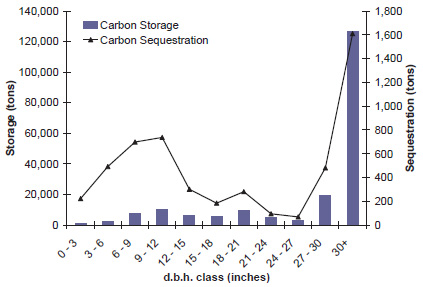
Since most of the urban forest in the Bay Area was planted over 100 years ago, native plant advocates often claim that only young trees store carbon. Since carbon storage is largely proportional to biomass, mature trees store more carbon than small young trees. That is illustrated by this graph from the US Forest Service survey of San Francisco’s urban forest.
Larger trees store more carbon at a faster rate
The claim that young trees store more carbon is often made in connection with the equally bogus claim that “restoration” projects in the Bay Area will replace non-native trees with native trees. None of the plans for these projects propose to plant native trees where non-native trees are destroyed because that wasn’t the native landscape. In any case, native trees don’t tolerate the windy, dry conditions in which non-native trees are growing. For example, a study of historic vegetation in Oakland, California reported that only 2% of pre-settlement Oakland was forested with trees. (2)
A new study about carbon storage in forests
Now that science has established the reality of climate change, most scientific inquiry has turned to how to stop it and/or mitigate it. For example, a recent study reports that planting forests where they did not exist in the past, quickly stores far more carbon in the soil than the treeless landscape. Scientists “…looked at lands previously used for surface mining and other industrial uses, former agricultural lands, and native grasslands where forests have encroached….[they] found that, in general, growing trees on formerly non-forested land increases soil carbon.” (3)
Here are their specific findings on each type of previously non-forested land:
“On a post-mining landscape, the amount of soil carbon generally doubled within 20 years and continued to double after that every decade or so.”
“The changes after cultivation of farm fields was abandoned and trees became established are much subtler, but still significant…at the end of a century’s time, the amount of soil carbon averages 15 percent higher than when the land was under cultivation…”
“In places where trees and shrubs have encroached into native grassland, soil carbon increased 31 percent after several decades…”
Mainstream environmental organizations such as the Sierra Club claim to be concerned about climate change, yet they are the driving force behind the destruction of the urban forest in the San Francisco Bay Area. When will they wake up to the fact that advocating for the destruction of the urban forest is irresponsible for an environmental organization in the age of climate change?
*******************************
(1) “A Look at the World Explains 90 Percent of Changes in Vegetation,” Science Daily, April 22, 2013.
(2) Nowak, David, “Historical vegetation change in Oakland and its implications for urban forest management,” Journal of Arboriculture, 19(5): September 1993
(3) “Soils in Newly Forested Areas Store Substantial Carbon That Could Help Offset Climate Change,” Science Daily, April 4, 2013.
Girdling a tree by cutting through the outer layer of bark into the woody trunk eventually kills the tree by interrupting the channel through which the tree receives moisture and nutrients from its roots. The bigger the tree, the longer it takes to die, but the death of a girdled tree is inevitable.
Girdled trees, Bayview Hill, San Francisco
Between about 1998 and 2003, approximately 1,200 non-native trees in San Francisco were girdled by native plant advocates, including a few who were employees of the Recreation and Park Department’s so-called Natural Areas Program. This vandalism was finally stopped after one of the native plant advocates was caught and prosecuted and the Recreation and Park Department was embarrassed by the media coverage.
In addition to killing trees by girdling them, an entomologist has published a study which reports that Australian pests of eucalypts were intentionally and illegally introduced to California for the purpose of killing non-native eucalypts. These stories are told here.
More recently, we have learned that native plant advocates are also spraying non-native vegetation in public parks in San Francisco with herbicides, in violation of San Francisco’s policy regarding pesticide use. The people who are spraying these herbicides are not authorized to do so. They are not posting notices of the application of herbicides as required by law. They are also using herbicides that are not approved for use in San Francisco’s public properties. That story is told here.
Guerilla Gardening in the East Bay
These guerilla tactics have recently spread to the East Bay. Shortly before Christmas in December 2010, the neighbors of Garber Park (Evergreen Lane) in the Oakland hills were shocked when an enormous crane pulled up to their park and began to take down several huge eucalyptus trees. The neighbors had been told nothing about their destruction and they had no idea why they were being destroyed. A little frantic investigation revealed that one of their neighbors had requested that the trees be removed and, because she was willing to pay for their removal, the City of Oakland obliged her without any further consultation with her neighbors. Needless to say, many neighbors were not pleased with this undemocratic method of altering their neighborhood landscape. That story was reported in the Hills Conservation Network newsletter which is available here.
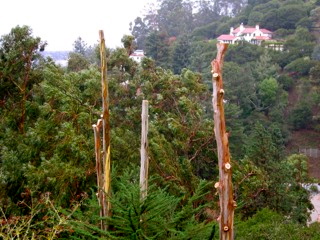
Eucalypts destroyed in Garber Park, December 2010. Photo by Michael Wallman
The removal of those trees was the first step in an ambitious project to eradicate non-native plants and trees in Garber Park and replace them with native plants. That project is described on the website of the “Garber Park Stewards.”
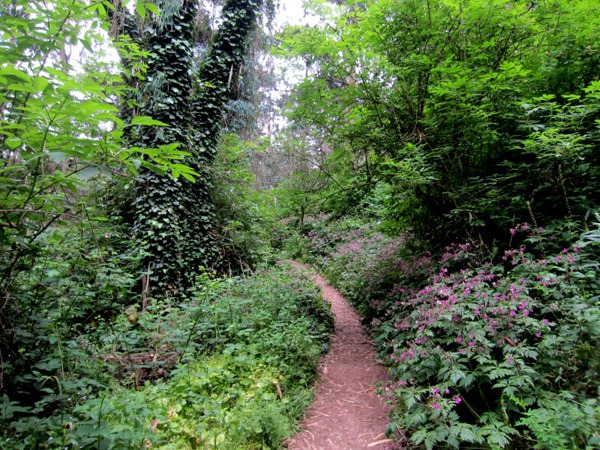
Garber Park native plant “restoration”
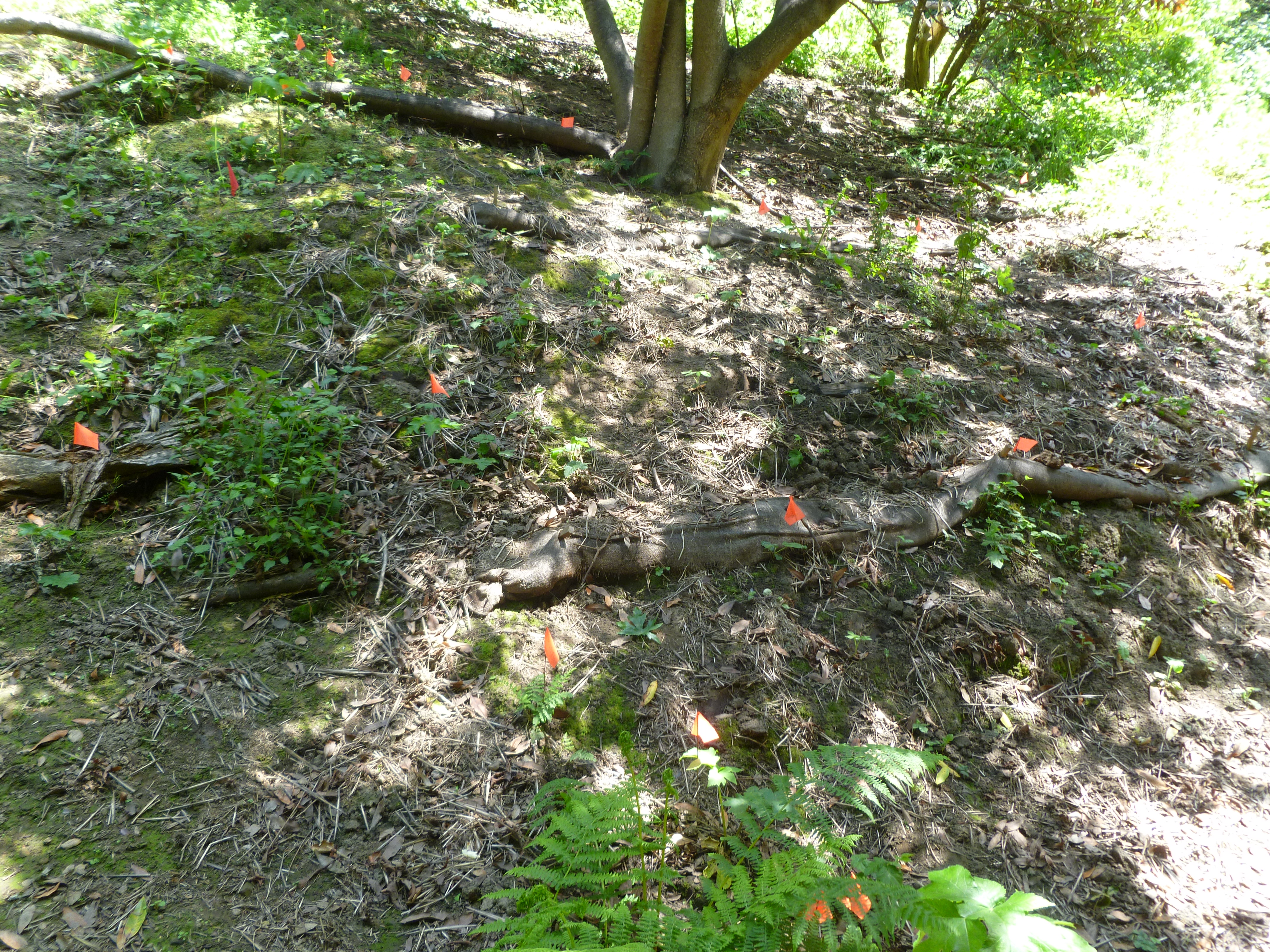
On a recent visit to this wild 13-acre park, we saw little evidence of this effort. A rough, barely passable trail meanders through the park. Most of the trees are native oaks, bays, big leaf maples, and buckeyes. The tangled understory is a mix of natives (cow parsnip, horsetail, poison oak, etc) and non-natives (annual grasses, forget-me-knots, etc). The only evidence of the work of the stewards was typical of these projects: a small patch of bare ground with colored flags.
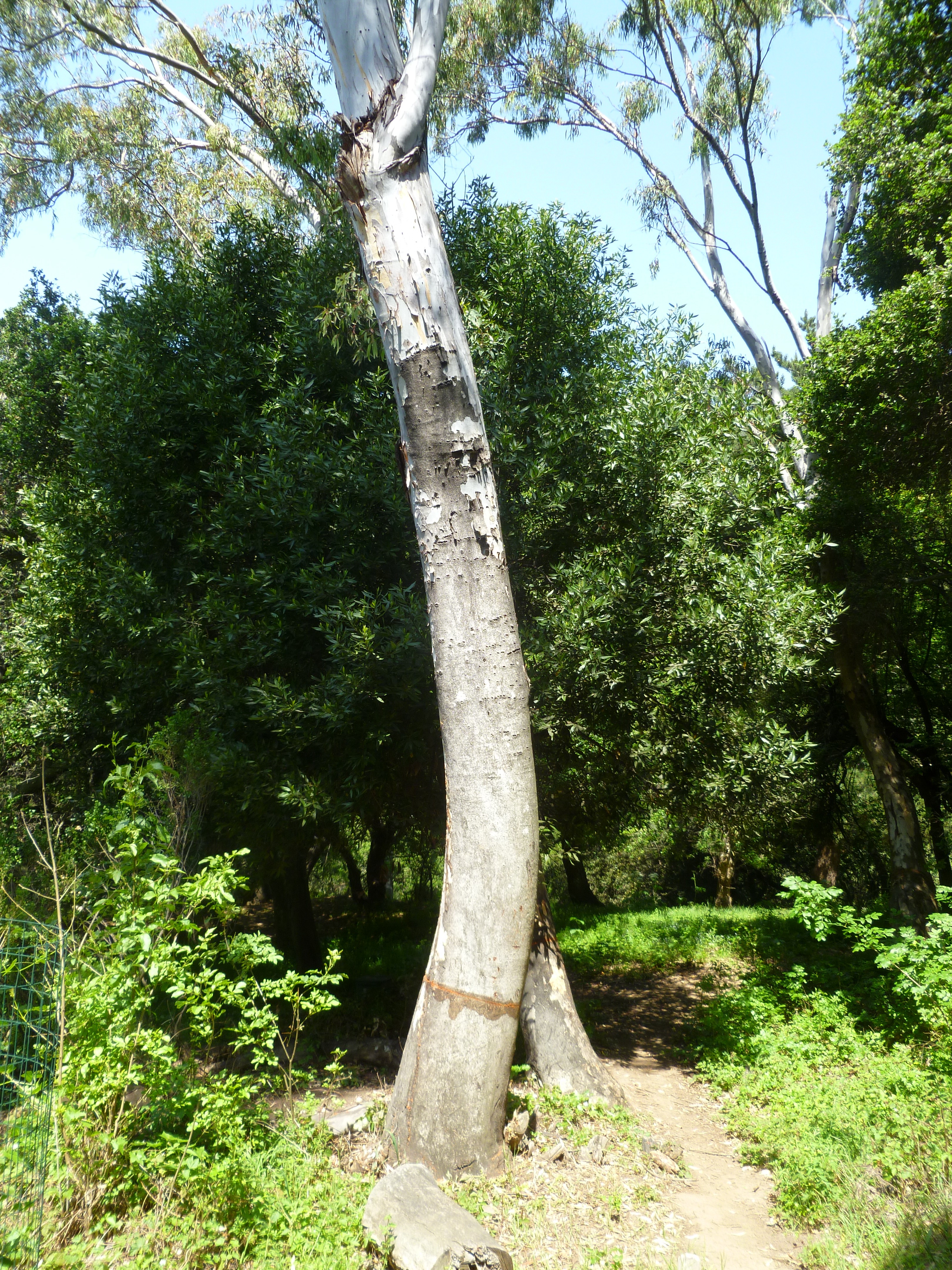
Girdled tree, Garber Park
Now more eucalypts are being destroyed in Garber Park by girdling them. A chain saw was apparently used to cut into the cambium of the tree, which is the channel that carries nutrients from the roots of the trees to its canopy. Something was painted or sprayed into the cuts which we speculate is an herbicide that will accelerate the death of the trees.
We speculate that the girdling of these trees was not authorized by the City of Oakland. The neighbors of the park say they were not informed that the trees were going to be destroyed. Therefore, we assume that this is a case of vandalism which we hope will be reported to the police as such.
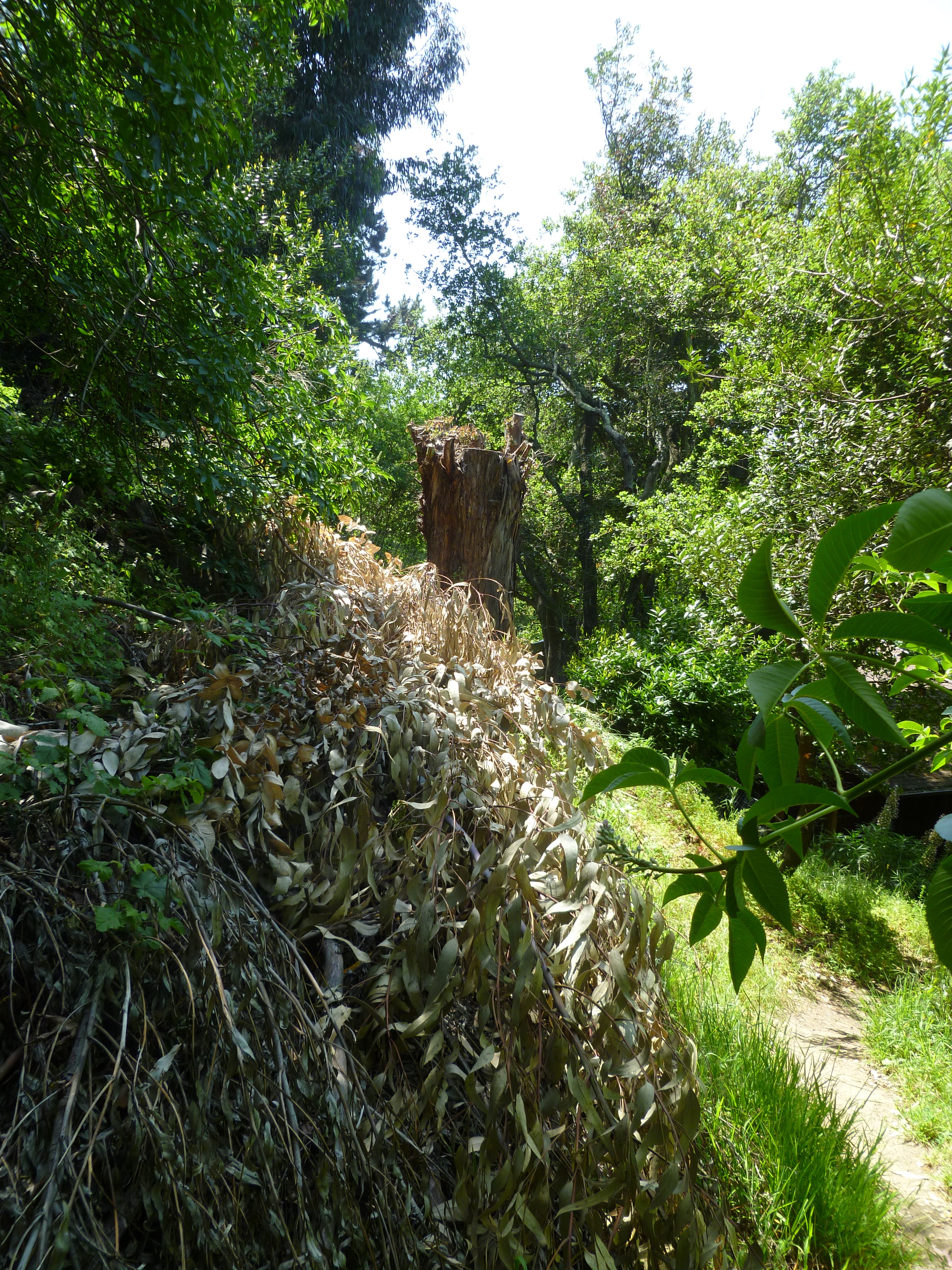
Eucalyptus stump and dead litter, Garber Park. If you were concerned about fire hazard, would you leave dead litter in the park for over 2 years?
We have no idea who girdled the trees in Garber Park. We therefore make no accusations. However, based on our experience in San Francisco, we speculate that whoever killed these trees believes their destruction will enhance the native plant restoration project. There are few eucalypts in this park. We saw only one that was not either girdled or a stump. We wonder what harm these few trees could do in this wild place. They are clearly not spreading
We repeat the Million Trees mantra
We say at every opportunity that we like native plants and trees and we encourage native plant advocates to plant them. We ask only that they stop destroying the plants and trees that have lived peacefully in the San Francisco Bay Area for over 100 years and are performing valuable ecological functions. We remind native plant advocates that we live in a democracy and that our public lands belong to all of us. If the landscape is to be permanently altered, a democratic process should be used to reach that conclusion.
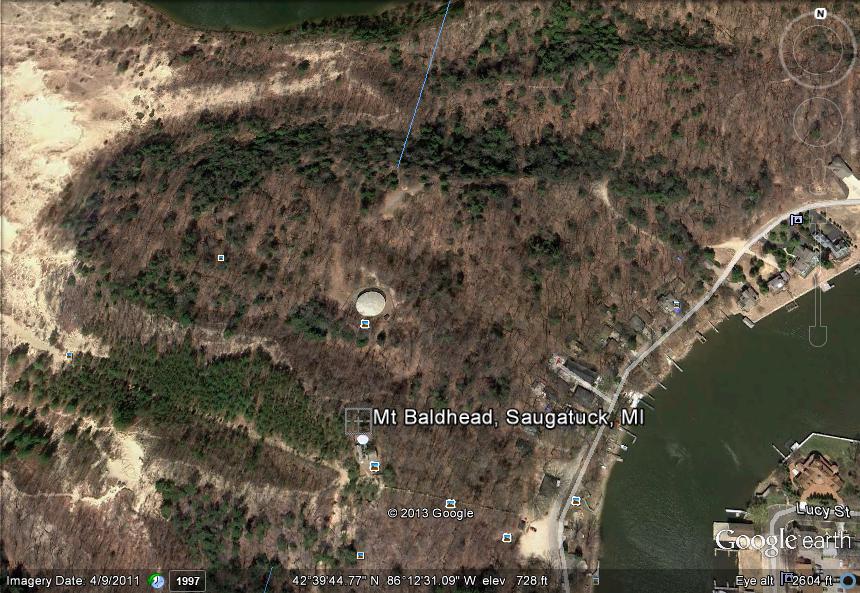
One of our readers sent us a link to an article about a “restoration” project gone awry in his neighborhood. Mount Baldhead is a city-owned park in Saugatuck, Michigan. US Fish & Wildlife funded a $700,000 federal grant to eradicate non-native plants on Mount Baldhead and several other municipal parks in the area. The grant was used to hire “certified applicators” to spray the non-native plants with imazapyr. Mount Baldhead was sprayed in summer 2010 and again in fall 2011. In spring 2012, the native oaks and maples, under which the non-native plants had grown and were sprayed, began to show signs of damage. Now a significant portion of the native forest is leafless and barren.
Mount Baldhead, Saugatuck, Michigan. A clearer view of the damage is available in the article to which we provide a link above. We were denied permission to publish that picture.
The soil on Mount Baldhead is being studied to determine how far the pesticide has seeped into areas where it was not sprayed. This information may predict the extent of the eventual damage to the native forest. The ultimate fate of the trees that have been damaged is not known. There is no antidote to the pesticide. Will the trees survive? We don’t know yet.
What does it mean to be a “certified applicator” of pesticides?
This story is of interest to us because imazapyr is being widely used in the San Francisco Bay Area and its use has increased substantially in the past year.
Because imazapyr is being used heavily, we have read the manufacturer’s label for the formulated products (Habitat and Polaris) and the federally mandated Material Safety Data Sheet.
Therefore, we know that imazapyr should not be sprayed under trees you do not want to kill. This is a product that is mobile in the soil. It is capable of traveling from the roots of the plant on which it is sprayed into the roots of adjacent plants on which it has not been sprayed, killing or damaging plants that were not the intended targets of the spraying.
These incidents make us ask what, if anything, it means to be a “certified applicator” of pesticides. Does the certification require the applicator to read the manufacturer’s label? If so, does the certification require the applicator to actually follow the directions on the manufacturer’s label? Clearly, this isn’t happening and there don’t seem to be any consequences for the “certified applicator” who kills plants and trees that he/she wasn’t hired to destroy. So, we conclude that such certification is meaningless.
The Million Trees mantra
Native plant advocates believe their projects benefit the environment. We do not see the benefit they claim. This is what we see:
• Increasing use of toxic pesticides is required to kill non-native vegetation. These pesticides are inherently hazardous and their incompetent use makes them even more hazardous.
• The wildlife that lives in our open spaces is being poisoned by these pesticides and they are losing their homes and their sources of food.
• The results of these projects do not justify these dangerous practices. The projects often look more dead than alive.
Here is a letter to the editor of the New York Review of Books, February 7, 2013:
“Dear Editor,
Tim Flannery in his review of the Biography of Rachel Carson makes one mistake and that concerns pesticide use reductions in Canada [“A Heroine in Defense of Nature,” NYR, November 22, 2012]. The first Canadian province to ban the ‘cosmetic’ use of specified pesticides and herbicides—i.e., for gardens and flowers, and not for commercial crops—was not Ontario (2009) but Quebec (2006).
This was the result of grassroots activity at the local, municipal level and it was backed by a national organization, the Campaign for Pesticide Reductions (CPR!), of which a leading sponsor (surprisingly perhaps) was the Canadian Labour Congress. The ban was backed by the Canadian Cancer Society, the first of many moves in the direction of cancer prevention, versus cancer treatment and research. Quebec’s move to ban the sale as well as the use of these products was a violation of the federal authority over commerce and it resulted in a challenge under the North American Trade Agreement (NAFTA, Chapter 13).
Some of Rachel Carson’s aims over pesticide use reduction could be achieved by a statute requiring the practice of Integrated Pest Management (IPM), which properly interpreted results in the avoidance, or use reduction, of synthetic organic chemical pesticides wherever possible. Canada, like most countries has not done this: pesticide registration or licensing is easy to get and once a pesticide is on the market, it is very difficult to prevent its proliferation or remove it from the environment. But unlike many Canadian environmental measures, the bans so far on the cosmetic use of pesticides are truly progressive.”
David Bennett
Former Director
Health, Safety and Environment
Canadian Labour Congress
Ottawa, Canada
The North American Trade Agreement is a free trade agreement between the United States, Canada, and Mexico. If you want to do business with the United States, you apparently are not allowed to ban the sale and use of pesticides.
San Francisco’s misnamed Integrated Pest Management policy
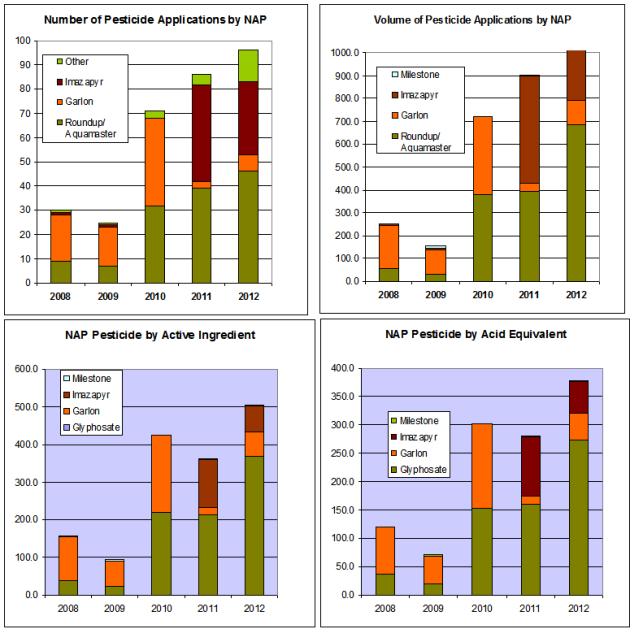
This seems a timely reminder of the difficulty of changing public policy regarding pesticide use. For the third year in a row, San Franciscans recently attended the annual hearing at which the city’s pesticide policy is renewed by the Environment Commission. Citizens reported the escalating use of toxic pesticides in San Francisco’s public parks by the so-called Natural Areas Program. They also repeated their annual request that pesticides considered “Most Hazardous” (Tier I) and “More Hazardous” (Tier II), not be sprayed in public parks.
Volume of pesticide use by San Francisco’s “Natural Areas Program.” Courtesy San Francisco Forest Alliance
Once again, the public’s request fell on deaf ears. In fact, the only changes to the city’s pesticide policy liberalized the use of pesticides by the Natural Areas Program. Milestone which had been rated “Most Hazardous” in the past has now been downgraded to Tier II. This is the pesticide that is mobile in the soil and persists in the soil for a long time. It is banned by the state of New York for sale or use because of concerns about the potential of poisoning ground water. Yet it is used in San Francisco in the watershed to Islais Creek.
Also, Garlon (Tier I) can now be sprayed without the applicator wearing a respirator, which will make it easier and more likely to be used in the future.
However, these two revisions of the city’s pesticide policy pale in comparison to the recent decision of the Recreation and Park Department with respect to promoting the use of pesticides in the city’s parks. The Recreation and Park Department recently announced that the person in charge of the Natural Areas Program is now also in charge of the Department’s pesticide use. This inappropriate decision effectively removes all pretenses that the Natural Areas Program’s use of pesticides is being monitored or supervised. The Natural Areas Program is now free to use pesticides wherever and whenever they wish.
Mr. Bennett makes a mistake in his letter to the editor. He assumes that an Integrated Pest Management policy would avoid or at least reduce pesticide use. San Francisco calls its pesticide policy an Integrated Pest Management program. That policy has obviously not reduced pesticide use in San Francisco’s parks. In fact, it seems to facilitate the use of pesticides. Pesticide use by any name is still pesticide use.
 Conservation Sense and Nonsense