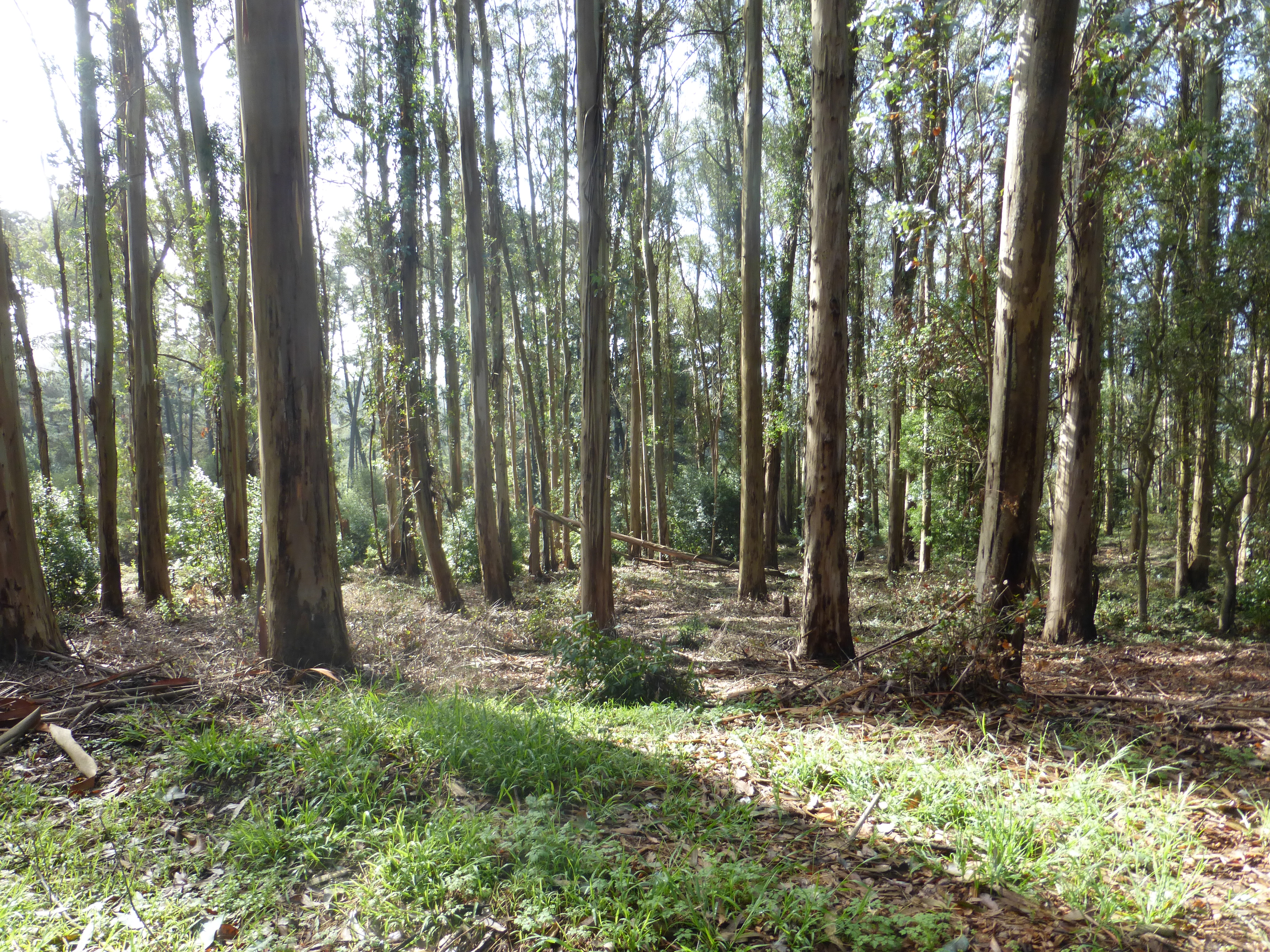
Oakland has been trying to adopt a vegetation management plan (VMP) to mitigate fire hazards since November 2016. The plan has been drafted three times in 2018, 2019, and 2020 and a draft Environmental Impact Report was also published in 2020. All three versions of the plan were acceptable to me and many others. Every version would have removed dead trees and thinned non-native trees on 2,000 acres of public land and 300 miles of roadsides in Oakland, leaving the tree canopy intact so that the forest floor would be shaded, suppressing the growth of weedy vegetation that ignites easily and keeping the forest floor moist, which retards fire ignition.
Unfortunately, none of the proposed vegetation management plans were acceptable to native plant advocates who want all non-native trees in project areas in Oakland to be destroyed and the land replanted with native plants and trees. The plan they are demanding is a native plant restoration, not a wildfire hazard mitigation plan. Since they have successfully prevented Oakland from addressing wildfire hazards for eight years, we might assume they aren’t concerned about wildfire.
A fourth version of the plan and a new Environmental Impact Report are expected to be published in September 2023 and there will be a new public comment period in October. Based on written and oral public comments at public hearings, we predict that the revised plan is likely to be far more destructive than previous drafts of the plan. Based on that prediction, I am alerting you to the need to read the revision and write a public comment. Please ask to be notified of the publication of the plan by sending an email to info@oaklandvegmanagement.org .
Update: The revised Oakland Vegetation Management Plan and revised Draft Environmental Impact Report were published on September 20, 2023. These documents are available HERE. There will be a public hearing by the Oakland Planning Commission on November 1, 2023. The deadline for public comment will be November 4, 2023. Comments can be submitted by email DEIR-comments@oaklandvegmanagement.org or by mail to Montrose Environmental, attention Ken Schwarz, 1 Kaiser Plaza, Suite 340, Oakland CA 94612.
When I have read the revised plan and its revised EIR, I will post a draft of my public comment on the draft by October 1st.
– Webmaster, Conservation Sense and Nonsense, September 20, 2023
What do opponents of previous plans want?
There is a wide range of opinions about a vegetation management plan for Oakland. I will use the public comment of the California Society of American Foresters (SAF) on the third version of the VMP as a representative opinion and the best available predictor of where the fourth revision is likely headed. The entire comment of the Society of American Foresters (SAF) is available HERE and here are some of the revisions SAF is asking for:
- “Ecological restoration should be a goal of the VMP, including the establishment of native plant species where nonnative species dominate…Thinning of dense stands of nonnative tree species should only be done as part of an overall strategy of restoration, i.e., the goal of any tree removals should always be to eventually convert these stands to native tree or vegetation cover in order to build greater ecological resiliency.”
- “In concert with the goal of ecological restoration, adaptive management in light of climate change should guide management practices and restoration plans. Adaptive management strategies that incorporate new information and changing conditions will be critical to ecosystem restoration. Annual grasslands may become more dominant, oak woodlands less so in the planning area in the future as climate changes. Management targets in many cases will have to be based on anticipated future conditions.”
- “However, if thinning is kept as the desired practice, we ask that you design each entry to be sufficiently intensive to assure that tree crowns will not close before the next thinning entry (10 years from now?) and indeed is sufficiently thinned to allow work towards establishing native vegetation in these stands.”
- “The use of prescribed fire as a vegetation maintenance tool should have been considered and included in the VMP especially on ridges where fire moving from adjacent jurisdictions might occur, or along power-line transmission corridors.”
- “The vegetation management zones along roadsides, especially along routes of egress, should be modified to extend 100 feet from roadside edges and should include any trees with underlying structural or health conditions that are tall enough to fall onto streets and roads. This may in some cases require looking outside of the 100-foot roadside clearance.”
- “It is important that the use of triclopyr herbicides is included to treat cut stumps in eucalyptus to prevent sprouting. Glyphosate herbicides will not be effective in treating eucalyptus stumps and will result in resprouts.”
- “There should be an Ecological Restoration Guide added to the appendices…This new appendix would outline the City of Oakland’s current ecological restoration efforts, identify stakeholders (e.g., city departments, Oakland Wildlands Stewards, etc.) and their roles…”
Native plant restoration, NOT wildfire hazard mitigation
The Society of American Foresters (SAF) is asking the City of Oakland to make a commitment to eradicating all non-native trees in project areas and replacing them with native plants. Such a plan would not reduce wildfire hazards in Oakland because native vegetation is not inherently less flammable than non-native vegetation. Most wildfires in California occur in native chaparral and native conifer forests.
The plan proposed by the Society of American Foresters (SAF) is a native plant restoration plan, NOT a wildfire hazard mitigation plan. Their proposal would destroy much of Oakland’s urban forest, which would not be replaced by native trees:
- Non-native trees were planted in Oakland in the 19th century because there were few native trees: “Vegetation before urbanization in Oakland was dominated by grass, shrub, and marshlands that occupied approximately 98% of the area.” (1) Non-native tree species in the East Bay are adapted to soil and microclimate conditions that are not suitable for native species.
- Grassland was the dominant vegetation type of pre-settlement Oakland partly because of the land management practices of Native Americans and the stock grazing of early settlers: “Native Americans played a major role in creation of grasslands through repeated burning and these disturbance-dependent grasslands were maintained by early European settlers through overstocking of these range lands with cattle and sheep. Twentieth century reduction in grazing, coupled with a lack of natural fires and effective suppression of anthropogenic fires, have acted in concert to favor shrubland expansion.” (2)
- Grassland in California is not native to California. Mediterranean annual grasses were brought to California in the early 19th century by the grazing herds of Spanish-Mexicans. California’s native bunch grasses are not adapted to heavy grazing by herds of domesticated animals. The grassland of California is about 99% non-native (Allan Schoenherr, A Natural History of California, UC Press, 1992). Attempts to convert annual grasslands to native bunch grass have not been successful. A team of scientists at UC Davis spent $450,000 and 8 years trying to convert 2 acres of grassland to native bunch grasses without success. Grassland that will replace our urban forest will not be native.
- Grass is easily ignited and fires move quickly through grassland, particularly in a wind-driven fire. The deadly, destructive fires in Maui, Hawaii are a case in point. When agricultural fields of sugar cane, pineapple and other tropical fruit left Maui they were quickly succeeded by non-native grass that was considered a factor in the spread of fire. (3) Dormant, dry annual grassland in the East Bay Hills will be more flammable than the living vegetation that native plant advocates want to destroy.
- A small redwood grove was the only pre-settlement exception to the otherwise treeless Oakland hills: “…for thousands of years [the Oakland hills] were treeless meadows, visited seasonally under Indigenous management…The one exception was the redwood groves of the southern Oakland Hills, a restricted forest that extended a few miles eastward from upper Dimond Canyon over the ridgetop to the outskirts of Moraga.” (4) Much of this grove still exists today because coastal redwoods are vigorous resprouters when they are burned or cut down.
- SAF also predicts a vegetation type-conversion from forest to grassland: “Annual grasslands may become more dominant, oak woodlands less so in the planning area in the future as climate changes.” Grassland will naturally succeed to shrubland without regular burning, which SAF recommends to reduce fuel loads.
- Prescribed burns in densely populated urban areas are rarely approved by Bay Area Air Quality Management District because they pollute the air and often cause uncontrolled wildfires. California law regarding liability for damage caused by prescribed burns was revised in 2022 to provide legal protections for those who manage prescribed burns. The revised law lowers the standard for liability to gross negligence from a previous standard of simple negligence. (5)
Consequences of landscape conversion to grass and shrubs
Destroying thousands of trees will increase air pollution and reduce air quality. Destroying thousands of trees will increase greenhouse gas emissions causing climate change by releasing the carbon stored by the trees that are destroyed and reducing carbon sequestration going forward because the destroyed forest will not be replaced by a forest of native trees.
There was little biodiversity in Oakland’s pre-settlement forest: “Oakland’s original species composition has increased from approximately 10 tree species to more than 350…Today [1993], only 31% of existing trees are native to Oakland, the plurality of trees (38%) are native to Australia/New Zealand.” (1) Destroying thousands of non-native trees in Oakland will reduce the biodiversity of our forest. A more diverse forest is more resilient, particularly in a changing climate, with extreme and variable weather conditions.
Increasing 300 miles of roadside clearance from 30 feet (as proposed by the 3rd version of the VMP) to 100 feet (as proposed for the 4th version of the VMP) will produce wood debris on a scale that cannot be disposed of. We know what the outcome will be because of a similar project on Claremont Ave, where eucalyptus was clear cut 100 feet from the north side of 1.1 miles of the road in fall 2020. Below are pictures of the piles of wood chips and logs that remained along that stretch of road for about 9 months while project managers tried to figure out what to do with the wood debris, which was eventually dispersed throughout the hills. UC Berkeley implemented the project with funding from Cal-Fire.
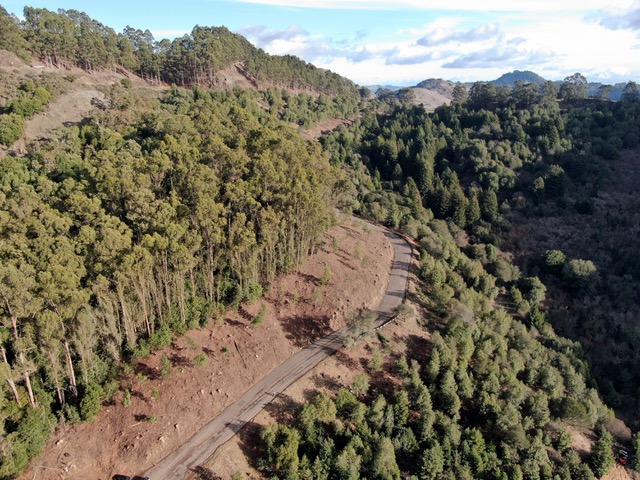
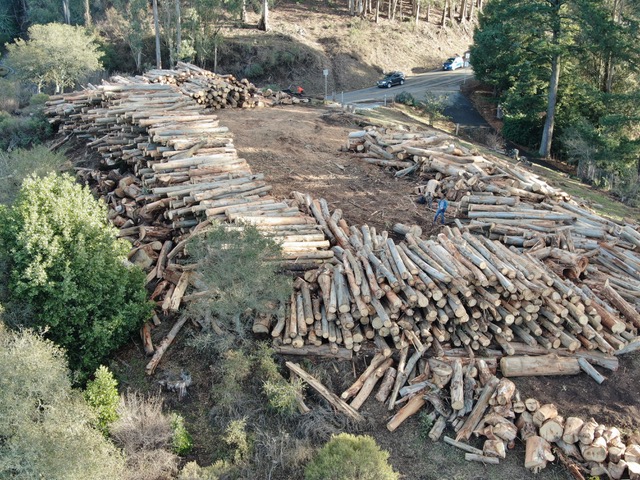
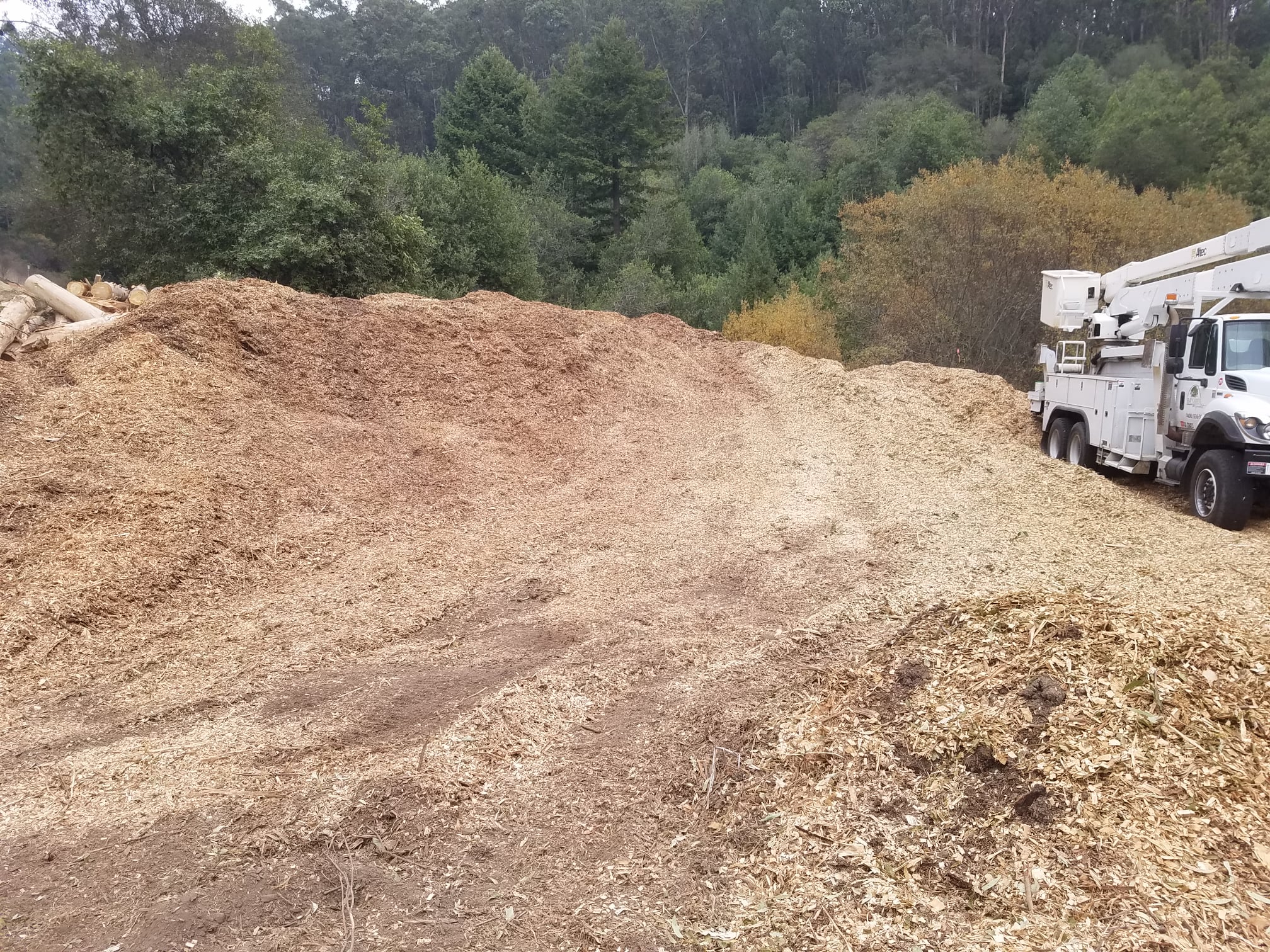
The roads in the East Bay hills are now lined with logs, preventing people from pulling off the road. No native plants or trees were planted after the trees were destroyed. Three years later, the clear cut roadside is vegetated with non-native annual grasses and coyote brush, a pioneer native shrub.
The project on the property of UC Berkeley was very small in comparison to the Oakland vegetation management plan that will clear cut 300 miles of roads, producing at least 300 times the amount of wood debris. What will Oakland do with the wood debris that is produced from the destructive VMP that native plant advocates demand? Tons of wood debris lying on the ground is far more flammable than living trees, which is another indication that the VMP that native plant advocates demand is not about mitigating fire hazards. It’s about their preference for a native landscape that is not less flammable than the landscape they demand be destroyed. Like all Mediterranean climates, our native vegetation is fire adapted and fire dependent. A significant number of our native species will not regenerate in the absence of fire. Most wildfires in California in the past 5-10 years have occurred in native chaparral and native conifer forests.

The more trees that are destroyed, the more herbicide will be required to prevent the trees from resprouting. SAF is correct in saying that tricopyr will be needed to kill the roots of the trees to prevent them from repsouting. Glyphosate will not accomplish that task. Triclopyr is more toxic than glyphosate. Triclopyr has a signal word of “warning” and glyphosate has a less toxic signal word of “caution.” Triclopyr kills the roots of woody plants by traveling from the cut stump to the roots of the plant in the soil. Triclopyr is known to kill mycorrhizal fungi in the soil, which are essential to the health of plants growing in the soil. The more herbicide that is used to kill the roots of destroyed trees, the less likely a newly planted native landscape is to survive. All the more reason to assume that the destroyed forest will not be replaced by a native landscape.
In Summary
- The landscape that native plant advocates demand for Oakland will be predominantly non-native annual grasses.
- Native trees will not replace the trees that are destroyed because they are not adapted to most places where non-native trees now live and because there is no available funding to purchase native plants, plant them on thousands of acres of public land, and irrigate them until they are established. Similar fuels management projects done by East Bay Regional Parks District, East Bay Municipal Utilities District, and UC Berkeley have not planted a native landscape to replace trees that have been destroyed.
- Non-native annual grasses will naturally succeed to shrubs in the absence of frequent fire. Shrublands are more flammable than the existing urban forest because fire travels on the ground, unless wind-driven fire ignites tree canopies. In that case everything burns, both native and non-native trees. The wind-driven fire in Oakland in 1991 spared no trees in burned areas, whether native or non-native.
- The project would produce many tons of flammable wood debris that has no commercial value and no place to be safely disposed of.
- The loss of our urban forest will increase air pollution in Oakland, contribute to greenhouse gas emissions causing climate change, and raise temperatures in a city that is already a heat-island.
- Herbicides needed to prevent the urban forest from resprouting will poison the soil and suppress the growth of a new landscape.
If you live in Oakland City Council District 4 or 6, you are likely to be directly affected by Oakland’s vegetation management plan. The most effective way to influence the VMP is to express your opinion to your representative on the City Council, as well as our at-large representative on the Council. Contact information for members of the Oakland City Council is available HERE.
(1) David Nowak, “Historical vegetation change in Oakland and its implications for urban forest management,” Journal of Arboriculture, September 1993
(2) Jon E. Keeley, “Fire history of San Francisco East Bay Region and implications for landscape patterns,” International Journal of Wildland Fire, September 2005.
(3) https://www.nytimes.com/2023/08/13/us/hawaii-wildfire-factors.html
(4) Andrew Alden, Deep Oakland: How geology shaped a city, Heyday, 2023.
(5) https://kion546.com/news/2022/01/04/new-california-law-changes-liability-for-out-of-control-prescribed-burns/

 Conservation Sense and Nonsense