Below is my letter to California Assemblymember, Ash Kalra (District 25, San Jose), asking him to consider revising Assembly Bill 2509 so that it will reduce the use of pesticides in California to eradicate harmless and useful non-native plants. Please consider making this suggestion to your elected representatives in the California Legislature. AB2509 has the potential to reduce pesticide use in California if we make an effort to revise it as needed to accomplish that goal.
Dear Assemblymember Kalra:
AB2509, your bill being considered by the California Legislature, will define “Integrated Pest Management” (IPM) and “invasive species.” The bill has the potential to reduce pesticide use in California’s parks and open spaces, but only if it is revised to accomplish that purpose. AB2509 is also an opportunity to improve the success of ecological restorations that begin by eradicating non-native plants considered “invasive,” by narrowing the target to those few species that are actually doing any harm.
In its present form (April 4, 2024), AB2509 defines invasive species, “to mean nonnative organisms that cause, or are likely to cause, economic or environmental harm, excluding humans, domestic livestock, specified domestic or domesticated species, and nonharmful nonnative organisms.”
That definition is based on Federal Executive Order 13112, which was passed 25 years ago, in 1999. We have learned a lot in the past 25 years about invasive species and the attempt to control them:
- The climate has changed a great deal since 1999, and with it the environment, including the plants and animals that live in it. The native ranges of many plants and animals have changed and will continue to change.
- We have learned that many introduced plants are often functional substitutes for native plants that are no longer adapted to the changed environment.
- We have learned that insects are capable of rapidly adapting and evolving to make use of introduced plants.
- We have learned, after trying to eradicate them for over 25 years, that most naturalized introduced plants cannot be eradicated.
- We have learned that the herbicides being used to eradicate introduced plants are doing a great deal of harm to the environment and the animals who live in it. We now know that herbicides damage the soil, making it difficult for new plants to survive in sterilized soil, devoid of beneficial microbes and fungi.
- We have learned that native plants don’t necessarily return after introduced plants have been eradicated. The damage done by eradication projects is often greater than the anticipated benefit.
- Despite dire predictions to the contrary, there is no evidence that any introduced plant species has caused the extinction of a native plant species in California.
We need a new definition of invasive species that reflects these changes and accommodates the movement of plant and animal species needed for survival. We need a definition that does not attempt to stop adaptation and evolution. Like dynamic nature, our attempts to conserve nature must constantly evolve in response. We need a definition that distinguishes between actual harm and theoretical predictions of harm. We need a definition that does not require us to poison our public lands unnecessarily.
Please consider revising the definition of “invasive species” in AB2509 to reflect what we now know about introduced plants, such as:
“AB2509 defines invasive species to mean pathogens, diseases, and insects that are known to cause harm to plants and animals, including humans.”
In its present form, AB2509 also defines Integrated Pest Management as: “’Integrated pest management’ means an ecosystem-based strategy that focuses on long-term prevention of pests or their damage through a combination of techniques such as biological control, habitat manipulation, modification of cultural practices, and use of resistant varieties. Pesticides are used only after monitoring indicates they are needed according to established guidelines, and treatments are made with the goal of removing only the target organism. Pest control materials are selected and applied in a manner that minimizes risks to human health, beneficial and nontarget organisms, and the environment.”
Integrated Pest Management (IPM) is not a new concept. Most public land managers have had IPM programs for over 25 years. Some have resulted in reduced herbicide use in developed areas, without corresponding reductions in public open space and wildlands.
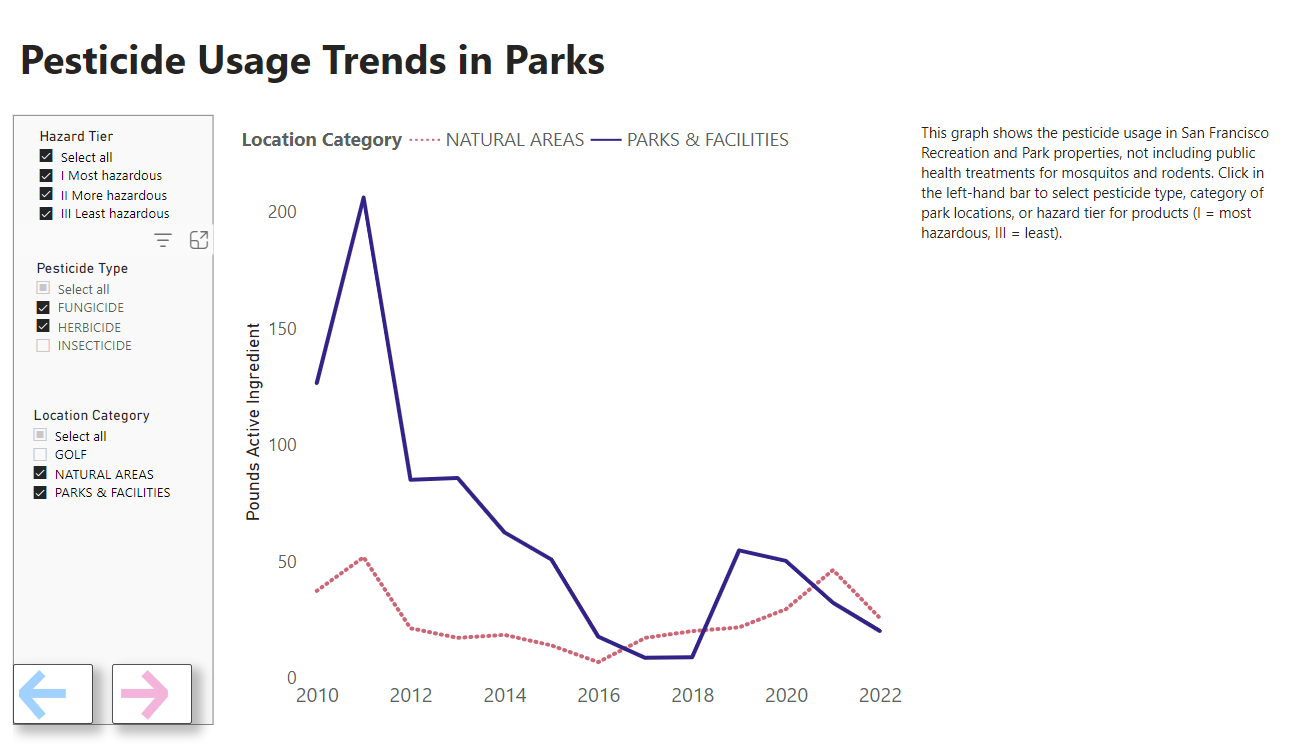
San Francisco’s IPM program has significantly reduced herbicide use on developed public land, but herbicide used to eradicate non-native plants in one-third of park acreage known as “natural areas” has changed little, as shown in this graph:
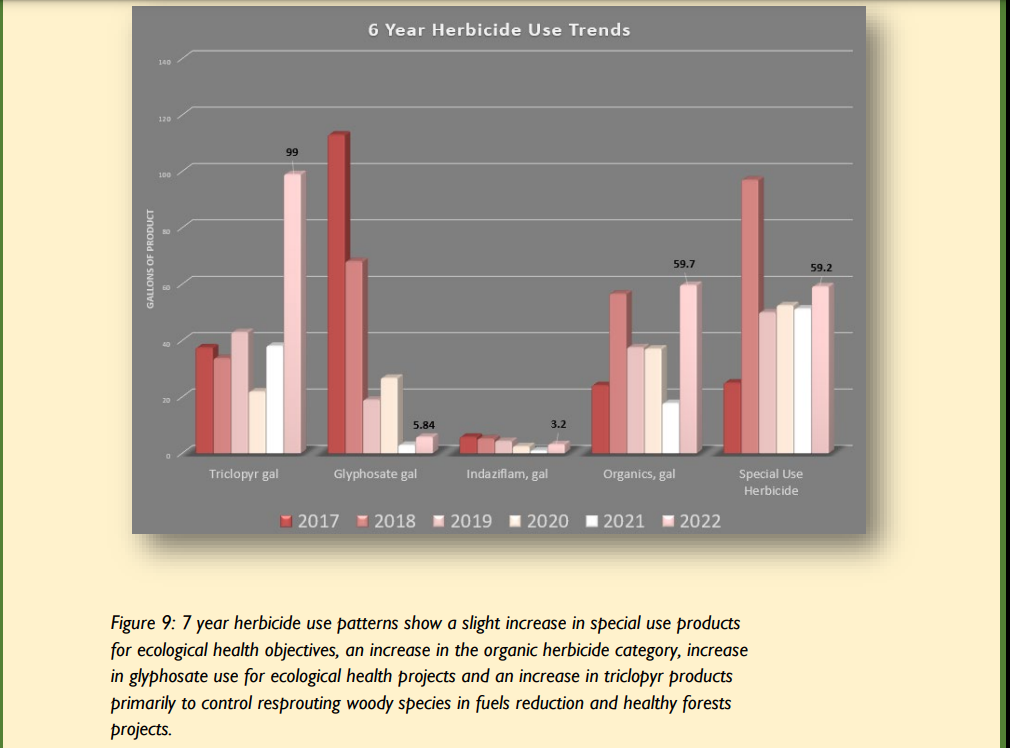
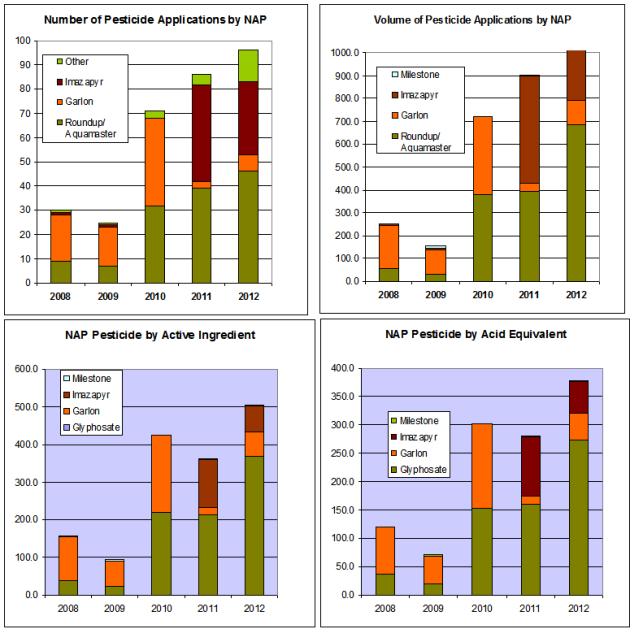
East Bay Regional Park District has also reduced its use of herbicides in developed areas of the park, such as parking lots, picnic areas, and playgrounds, without reducing their use in wildlands where non-native plants and trees are eradicated:
If we want Integrated Pesticide Management Programs to reduce the use of pesticides in our public lands, we must define IPM to achieve that purpose by:
- Changing the definition of “invasive species” to focus only on those introduced species that are known to cause actual harm. The expectation of “likely” harm without evidence of actual harm should not be used to justify pesticide use.
- Explicitly defining the “guidelines” that determine if pesticides are needed in order to prevent their use on harmless and beneficial plants.
- Avoiding the use of vague terms that can be interpreted differently from different perspectives, such as “use of resistant species.” Resistant to what? In whose opinion?
- By not making empty promises such as claiming that pesticides can be used on non-native plants without doing any damage to non-target species. Because of drift, persistence, and mobility of pesticides in the soil, it is not possible to make such assurances, which give the public the mistaken impression that herbicides can be used without unintended consequences
Please consider a revised definition of Integrated Pesticide Management that will reduce pesticide use and preserve the vegetation that is capable of growing in today’s environment, such as:
“’Integrated pest management’ means an ecosystem-based strategy that focuses on long-term prevention of pests or their damage through a combination of techniques such as biological control, habitat manipulation, and modification of cultural practices. Pesticides are used only after harm is documented, benefits of existing vegetation have been identified and weighed against harm, the health risks and environmental damage caused by herbicides is considered, and the outcome of eradication is determined to be positive, on balance.”
In conclusion, I will briefly describe my interest in invasion biology and the ecological restoration industry it spawned. My interest began over 25 years ago when my neighborhood park was designated a “natural area” by San Francisco’s Recreation and Park Department. When I moved to the East Bay, I learned that the native plant movement is equally committed to the eradication of introduced plants and the pesticides needed to accomplish that goal. I have visited many of these projects all over the Bay Area and elsewhere in California. I read the publications and attend the conferences of California Invasive Plant Council and California Native Plant Society so that I am as informed of their objectives and beliefs as I am of the academic criticism of invasion biology. I have had a website since 2010 that reports to the general public what I have learned about specific projects and the scientific evaluations of them. I invite you to visit my website to help you evaluate the advice I am sending to you today about AB2509. I can provide references for every statement I make in this letter, on request.
Thank you for your consideration and for your effort to reduce pesticide use in California.
Sincerely,
Webmaster, Conservation Sense and Nonsense
CC:
Patty Clary, Californians for Alternatives to Toxics
Damon Connolly, Assembleymember, District 12
Jay Feldman, Beyond Pesticides
Angel Garcia, Californians for Pesticide Reform
Doug Johnson, California Invasive Plant Council
Megan Kaun, Sonoma Safe, Ag Safe Schools
Melinda MacNaughton, El Granada Advocates
Margaret Reeves, Pesticide Action Network
Jane Sellen, Californians for Pesticide Reform
Nancy Skinner, Senator, District 9
Buffy Wicks, Assemblymember, District 15
Wildlife Conservation Board
Update, April 24, 2024:
The Assembly Agriculture Committee voted unanimously to pass AB2509 to the Appropriations Committee with no amendments.
Doug Johnson, Executive of Cal-IPC and Marc Landgraf, Santa Clara Valley Open Space Authority, spoke in favor of AB2509. Johnson claimed that only “small amounts of pesticide are used.” Landgraf said most plants are killed by grazing, mowing, and volunteers pulling my hand; herbicides are used only “when needed.”
Damon Connolly was the only committee member to speak. He expressed concern that AB2509 not conflict with his continuing support for AB99, which has the potential to reduce roadside spraying of herbicide by Cal Trans.
There were no speakers in opposition to AB2509. There was no acknowledgment of the public’s concern about AB2509 or of the public’s concern about herbicides being used on our public lands.
 Conservation Sense and Nonsense