Nativist propaganda: Turning the Easter Bunny into an enemy

In our last post, we reviewed Invasive and Introduced Plants and Animals:  Human Perceptions, Attitudes, and Approaches to Management. (1) The main thesis of that collection of scientific articles is that invasion biology is as much a cultural construct as it is a scientific discipline.  Here we provide a specific example of a propaganda campaign in support of an eradication project that illustrates that point.

Rabbits are not native to either Britain or Australia, but they have lived in Britain long enough that they aren’t considered invaders there.  In fact, they are romanticized in British children’s literature and cultural traditions:

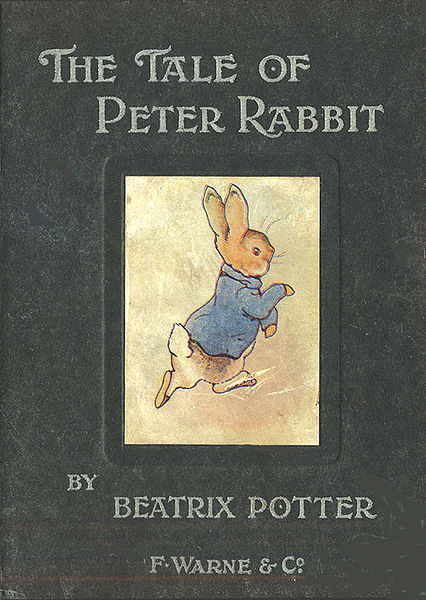
Peter Rabbit“The rabbit also is alien [to Britain] but especially following… abandonment of traditional grassland management, is vital in maintaining many species-rich wildflower pastures and hugely important as food for predators such as common buzzards.  And, of course, in 1902 Beatrix Potter gave her fictional rabbit a blue waistcoat, a trug with carrots in it, and the name Peter, and single-handedly generated a huge sentimental  cultural association between humans and rabbits, particularly from our formative experiences as readers of the genre of children’s nature literature.   This one book has sold over 45 million copies worldwide and been translated into 36 languages.  The rabbit has many friends.  Enemies of the rabbit, most especially the Anti-Rabbit Research Foundation on Australia…, return to the power of children’s literature to counter the rampant sentimentality for the British invader down under.  Aussie kids are urged (through popular primary school books) to cherish and embrace the native desert marsupial Bilby at Easter time, and to shun the more traditional (but culturally invasive) Easter Bunny.  They eat chocolate Easter Bilbies as part of scientifically sponsored cultural ecological restoration.  There may be a tendency to chuckle at this evidence. But this is serious stuff in an invaded land such as Australia.  Severing cultural ties with rabbits needs to be done at a young age, before the powerful and mentally invasive Beatrix Potter-effect can take hold!” (1)

Propaganda is no laughing matter

Here are a few examples of similar propaganda campaigns that are used in the San Francisco Bay Area to support their destructive projects:

  • Nativists claim they are “managing” the urban forest.  Do you think that word describes the project on Mount Sutro that will destroy 90% of the trees and understory on 75% of the mountain?  Doesn’t “destroying” seem a more accurate description of that project?
  • Nativists often claim they will replace all the non-native trees they destroy with native trees.  Do you think dune scrub and grassland is accurately described as a native “forest?”  Isn’t this a classic fraud of “bait-and-switch?”
  • Sometimes nativists claim that native plants will “regenerate” where non-natives are destroyed without planting anything.  Anyone who believes that has not seen the result of these projects, where weeds reign even when natives are planted.
  • Nativists claim that the eucalyptus forest is dying of old age.  The predominant species of eucalyptus in the Bay Area lives in Australia from 200-500 years.  Professional arborists tell us they are healthy.  Why should we believe the eucalyptus forest is dying?

These propaganda campaigns are often successful because the public doesn’t have time to inform themselves of the reality.  The written documents that describe these projects are often hundreds–sometimes thousands–of pages long.  If people aren’t regular visitors to the parks where these projects have been in progress for years, they don’t know that most are weedy messes.  As the projects get bigger and more land managers install them, they are more difficult to hide from the public.  That’s why the ranks of critics are growing and getting noisier.  We will eventually be heard. 

************************

Invasive & Introduced Plants and Animals:  Human Perspectives, Attitudes, and Approaches to Management, editors Ian Rotherham, Robert Lambert, Earthscan Publishing, London, Washington, DC, 2011.

Ecological “restoration” projects: Scientific or public policy decisions?

Invasive and Introduced Plants and Animals:  Human Perceptions and Approaches to Management is edited by two British academics.  It is a collection of articles written by invasion biologists as well as scientists who are critical of invasion biology.  It attempts to present the entire spectrum of opinion on the debate that is the primary subject of the Million Trees blog:  “Our intention is to stimulate the reader to question ideas and received wisdom [about invasion biology], and to try to establish the interface between objective science and subjective sociocultural fashions and values.  (1)  That is, the evaluation of invasion biology involves both science and public opinion.

Using both criteria, the authors evaluate conservation projects in their concluding chapter of the book:  “We perceive that present approaches:

  • Generally lack scientific rigour in their justification;
  • Fail to inform and engage and call upon all stakeholders…;
  • Rarely provide a holistic (for example, catchment wide) context or strategy;
  • Almost always lack financial or human resources to be long-term effective;
  • Have no realistic long-term targets, and if they do, no effective monitoring towards achievement…”   

This evaluation of ecological “restoration” projects fits perfectly with our opinion of projects in the San Francisco Bay Area.  These projects are not based on sound science. They are initiated behind the public’s back and are therefore rarely supported by the public. Most importantly, they are usually unsuccessful.  Typically, the projects are far more destructive than constructive.  We are losing the trees we value and the habitat needed by wildlife and in return we are usually left with barren, weedy messes.

Based on these shortcomings, the authors point to new approaches that address past failures. 

Acknowledge ambiguity and change

First, we must accept that the distinction between native and exotic plants is often ambiguous and the distinction between plants that are harmful and those that are not is even less clear.  Dividing up the natural world into good and bad, is a fool’s errand that does not acknowledge that such judgments are ultimately a matter of opinion. 

How many times have we heard native plant advocates say, “I hate eucalyptus”?  More often, they dress up their hatred in more valid arguments, such as eucalyptus is flammable, or they aren’t healthy, or they kill other plants or they aren’t useful to wildlife.  Those who defend eucalyptus know that these accusations are not true or equally true of some native trees.  Therefore, that argument can’t be resolved with facts because in the end there is a range of subjective opinion that can’t be changed with facts.

The Berkeley Meadow is a 72-acre native plant garden on a former garbage dump on landfill.

Secondly, we must accept that returning landscapes to prehistoric conditions is impossible.  Nature moves forward, not back.  Humans have fundamentally altered the environment and reversing those changes is not physically possible.  If we have unrealistic goals for conservation projects, we can expect failures.  When native plant gardens are installed on landfill that served as garbage dumps for decades (as they have been in the East Bay), we should not be surprised when they are unsuccessful.

Setting realistic goals

Ironically, the authors recommend larger projects rather than smaller projects.  Because ecosystems are integrated, attempts to change only a segment of an integrated system are doomed to fail.  The 1,100 acres of city-managed park land that have been designated as “natural areas” in San Francisco are chopped into 32 pieces, some as small as one-third of an acre.  When non-native plants are eradicated, these tiny plots are quickly repopulated with the same weeds from adjacent areas.  Sharp Park in Pacifica is the only “natural area” that may be capable of functioning as an ecosystem in the long-term because of its size and its relative physical isolation.

Letting the public decide

Finally, we must acknowledge that the alteration of our public lands is not a scientific decision.  It is a public policy decision.  In a democracy this means that the public must decide.  In the vast majority of cases, the public has not been given the opportunity to make the decision because the managers of our public lands have been making these decisions for us.  They do so by claiming that it is a scientific, not a public policy decision and that their expertise puts them in a position to impose their will on the public.  The authors of the book we are reviewing today challenge this claim:  “Yet in interventions conservation practice hides behind a veneer of pseudoscience and certainly challenges democratic processes.”  Hear, hear!!!  Thank you for this astute observation, which we see played out repeatedly in the San Francisco Bay Area.

The authors conclude with this advice to those who are responsible for ecological “restorations”:  “It is important to recognize the subjectivity of decision-making processes, and the cultural and historical origins of many of today’s problem species.”

*********************************

(1)    Invasive & Introduced Plants and Animals:  Human Perspectives, Attitudes, and Approaches to Management, editors Ian Rotherham, Robert Lambert, Earthscan Publishing, London, Washington, DC, 2011.

“Invasion Biology: Critique of a Pseudoscience”

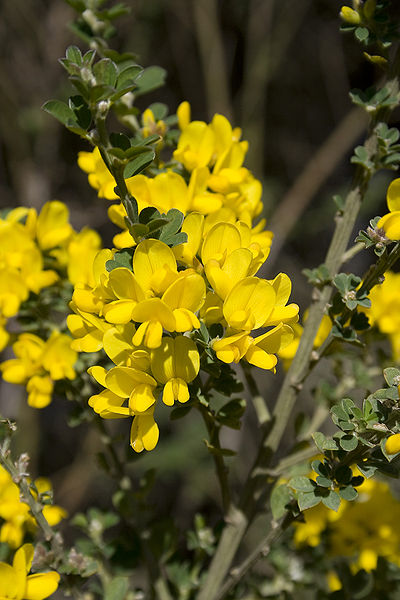
Broom is the likely occupant of East Bay public land now shaded by non-native trees that will be destroyed the FEMA projects.  Share alike.
Broom is the likely occupant of East Bay public land now shaded by non-native trees that will be destroyed by the FEMA projects. Share Alike.

Invasion Biology:  Critique of a Pseudoscience is a book by David Theodoropoulos. (1)  He explains in the preface of the book, how he arrived at the conclusion that invasion biology is a pseudoscience and why he felt compelled to explain that conclusion in his book.

Theodoropoulos was from an early age a lover of nature and he always spent much of his time outdoors, observing nature.  He recalls noticing decades before writing his book that some plant species—such as broom—tended to occupy disturbed ground such as roadsides.  He was also aware that introduced species of plants were contributing to biological diversity.  Putting those two observations together, he concluded that plants that are introduced and dispersed by the activities of man are integrating into ecosystems and increasing biodiversity.

As the hysteria about “alien invasions” began to mount in the 1990s, Theodoropoulos could not reconcile this anxiety with his observations of nature.  He read the studies that supported invasion biology and found their scientific methods and their conclusions unsatisfactory.  He concluded that the fear of introduced plants was motivated by “psychological factors” that are not supported by scientific evidence. 

As he shared his observations with others, he was subjected to abusive attacks by proponents of invasion biology, which ultimately compelled him to write his book to defend his opinion of invasion biology.  He explains why he wrote his book:

“During the past decade ‘invader’ fears have reached a fevered pitch, with  a constant barrage from the media fanning the flames, and a huge volume of literature has been published, produced by scientists with a self-interest in promoting this ideology.  Corporate and bureaucratic interests have intruded, pushing their agendas of profit and control.  Finally, the use of invader fears to justify total human control of the natural world has shown that the ideology has reached a dangerous place.”   (emphasis added)

David Theodorpoulos will be speaking in the East Bay on Sunday, July 14, 2013.  Here is the announcement of this event by its sponsor East Bay Pesticide Alert:

INVASION BIOLOGY

OR INTEGRATION BIOLOGY?

Who is behind the deforestation and pesticiding of the East Bay Hills, from Richmond to Hayward?


**Slideshow with narration, followed by discussion**

DAVID THEODOROPOULOS

Conservation Biologist and Author:

Invasion Biology: Critique of a Pseudoscience

+ Update from Save Mt. Sutro Forest


SUNDAY, JULY 14, 2013, 6:30PM (doors open 6PM)

Historic Hall, Berkeley Fellowship of Unitarian Universalists

1924 Cedar (one block east of MLK, Jr. Way)


Hear about Invasion Biology from a different perspective of non-native species, based on Evolutionary Biology, and find out about the native plant restoration movement’s connection to the pesticide industry.

**Please refrain from using scented products prior to attending **Wheelchair accessible

Co-sponsored by East Bay Pesticide Alert (dontspraycalifornia.org) (see wildfire pages) & Social Justice Committee BFUU (bfuu.org)

***********************

We have read Mr. Theodoropoulos’ book and we have heard him speak.  We can highly recommend both his book and his talk as informative and interesting.   We can also recommend the speaker about the Sutro Forest in San Francisco.  If you are not aware of how widespread the destruction of non-native plants and trees is, you will want to hear about the plans to destroy over 30,000 trees on Mount Sutro in San Francisco.  Please come to learn about the destructive consequences of projects that are attempting to convert our diverse landscape into native plant advocates’ fantasy of what it looked like 250 years ago.

Update:  A video of this presentation is now available here.

***********************

(1)    Avvar Books, 2003

Media coverage of FEMA projects: The good, the bad, and the ugly

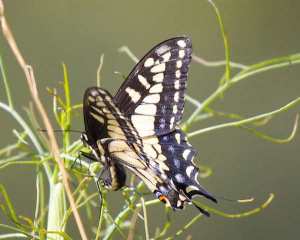
Anise Swallowtail butterfly in non-native fennel

The public comment period for the FEMA project in the East Bay that proposes to destroy nearly half a million trees will close on Monday, June 17, 2013, at midnight.  If you want to express your opinion of these projects, it’s time to do so.  Detailed information about the projects and how to comment on them is available HERE.

The projects have drawn quite a bit of media coverage, starting with Beyond the Chron blog in mid-May and quickly picked up by many other internet sources of information.  Most of those internet sources referred their readers to the Million Trees blog for more information.  In May we had over 12,000 visitors to our articles about these projects.

Both the Oakland Tribune and the San Francisco Chronicle covered the story.  The Tribune coverage was appallingly inaccurate and biased.  The Chronicle coverage was more balanced than it usually is about native plant restoration projects, which the Chronicle usually supports without reservation.

The winner of the booby prize for balanced and fair reporting of the projects goes to the Sierra Club Yodeler which expressed its unqualified support for the projects at the same time it demonstrated total ignorance of the projects (or chose to misrepresent them):

  • Sierra Club said, We want to avoid past mistakes, when agencies simply stripped off vegetation and then walked away, leaving the land clear for exotic and even more-flammable vegetation.”  This is precisely what these projects plan to do…destroy everything then walk away without planting anything.
  • Sierra Club said, The Park District is now implementing that program, and we are monitoring the progress.”  If they are monitoring that program, why don’t they know what the Park District is doing?
  • Sierra Club said, The preferred alternative involves application of the herbicide glyphosate (trade name Roundup) to the stumps to prevent re-sprouting. There is no practical way to eliminate eucalyptus infestations without herbicide, and glyphosate is relatively low in toxicity.”  The Sierra Club is simply wrong.  These projects will use Garlon (with active ingredient triclopyr) and/or Stalker (with active ingredient imazapyr)—not glyphosate (Roundup)–to prevent the trees from resprouting.  Both products are rated by the EPA as more toxic, more persistent, and more mobile in the soil than glyphosate.  Glyphosate (Roundup) will be foliar sprayed on non-native vegetation.  Recent studies report that glyphosate (Roundup) is not a benign pesticide.

There are some scathing comments on the Yodeler article from people who know enough about the project plans to inform the Club that they have run off the rails…into the weeds!!  The Club seems not to have noticed this attempt to set them straight.  When someone called them weeks later to ask about the projects, they repeated the same misinformation to the caller.

(Update:  One of our readers informed the Sierra Club of the inaccuracy of its Yodeler report about the FEMA projects in the East Bay (see comment below).  We are pleased to report that the Sierra Club has revised its Yodeler report on June 19, 2013.  It now acknowledges that native plants will not be planted by these projects.  Consistent with the Draft Environmental Impact Statement for these projects, the Yodeler now claims that native plants will be “recruited” into the areas in which non-native plants and trees will be destroyed. 

We think that is an unlikely outcome of these projects and FEMA’s environmental consultant agrees with us about that (explained here).  However, at least the Yodeler article is now consistent with the written plans for the project. 

The Yodeler also acknowledges the use of Garlon to kill the roots of the trees that will be destroyed.

Thanks to our readers for alerting the Sierra Club to the inaccuracy of their description of this project.  We are sorry that the Sierra Club continues to support the project now that they have a better understanding of the written plans. 6/19/13) 

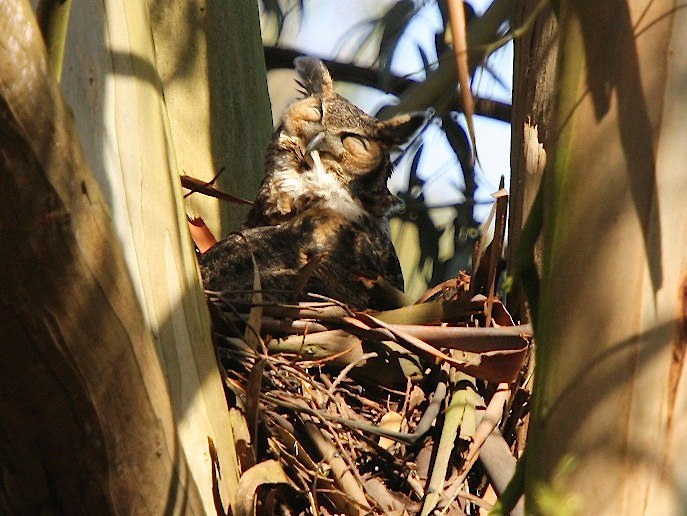
Owl nesting in eucalyptus, courtesy urbanwildness.com

On the positive side of the ledger, we commend the East Bay Express for its article about these projects.  The author deserves credit for actually reading about the projects before she wrote her report!!!  She read the letter from FEMA’s environmental consultant which we reported to our readers here.  In a nutshell, the consultant said that UC Berkeley’s project could increase fire hazards by leaving a 2-foot wood chip mulch on the ground and that conversion to a native landscape was an improbable outcome of the project since nothing will be planted.

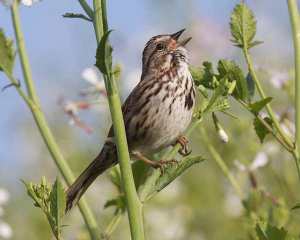
Song Sparrow in non-native wild radish

Our personal favorite for coverage of this project is Nathan J. Winograd’s article, “Biological Xenophobia:  The Environmental Movement’s War on Nature,” which was published by the Huffington Post.   Mr. Winograd is highly qualified to express his opinion of these projects.  He has devoted his personal and professional life to the welfare of animals. He is best known for his advocacy for “no-kill” shelters for our animals.  He was the lawyer for the SPCA in San Francisco when the GGNRA started to destroy non-native trees and fence the public out of their properties to protect their fragile native plant museums.  So, he has been a long-time observer of the destructive and restrictive consequences of native plant projects.  He was prompted to write this article by this latest round of destruction, that is, the FEMA projects in the East Bay.

Here are a few choice phrases from Mr. Winograd’s excellent article:

“Invasion biologists believe that certain plants and animals should be valued more than others if they were at a particular location ‘first.”  When the species that were there ‘first’ are in the same habitat with a species that came later, they assert that the latter should be eradicated.”

 “And the nativist movement is getting worse and increasingly violent, both in rhetoric (fish they don’t value are called ‘missiles with fins’) and in deeds.  At a time of climate change, in a country that needs more trees, not less, nativists in the San Francisco Bay Area are proposing the clear cutting of upwards of half a million trees on San Francisco’s Mount Sutro and in the Oakland and Berkeley hills as part of their ongoing war against the Eucalyptus.  After the trees are clear-cut thousands of gallons of toxic herbicides, will be spread throughout wildlife corridors in order to prevent resprouting.”

An authentic environmentalism would not advocate that humans seek out and destroy living things for simply obeying the dictates of the natural world, such as migration and natural selection. It would not condone the killing of those plants and animals who find themselves in parts of the world where, for whatever arbitrary reason — be they economic, commercial or aesthetic — some humans do not want them to be. An authentic environmentalism would not exacerbate suffering, call for killing and seek the destruction of natural places.”

“Indeed, “invasion biology” is a faux environmentalism, used to disguise the ugly truth about what is really motivating its adherents: an intolerance of the foreign that we have rejected in our treatment of one another, a biological xenophobia that seeks to scapegoat plants and animals for the environmental destruction caused by one species and one species alone: humans.”

There are nearly 500 comments on Mr. Winograd’s article and they are as interesting as the article itself.  They are a microcosm of this debate between nativists and those with a more cosmopolitan view of nature.  We aren’t disinterested observers, so our opinion of the comments of nativists may not be entirely objective.  However, we find many of their comments condescending and uninformed, a contradictory mix of sentiments.

We thank our readers for informing themselves about the FEMA projects and we hope that you now have the information you need to write your public comment by the deadline, June 17, 2013.  Here is where you can send your comment:

  1. Via the project website: http://ebheis.cdmims.com
  2. By email: EBH-EIS-FEMA-RIX@fema.dhs.gov
  3. By mail: P.O. Box 72379, Oakland, CA 94612-8579
  4. By fax: 510-627-7147

These public lands belong to you and the money that will be used to implement these projects is your tax dollars.  So, please tell the people who work for you what you think of these projects.

Invasion Biology: The way forward

We’re following up on our previous post in which we reported that empirical studies do not support the hypotheses of invasion biology.  In that case, six hypotheses of invasion biology were tested by empirical studies and largely failed.  Furthermore, more recent studies are less supportive than older studies, indicating declining support for the assumptions of invasion biology.

Now we are going to tell you about a new publication by another team of scientists who challenged other assumptions about invasive plants and also conducted their own original research of one of the most basic assumptions of invasion biology:  that invasions are facilitated by disturbance.

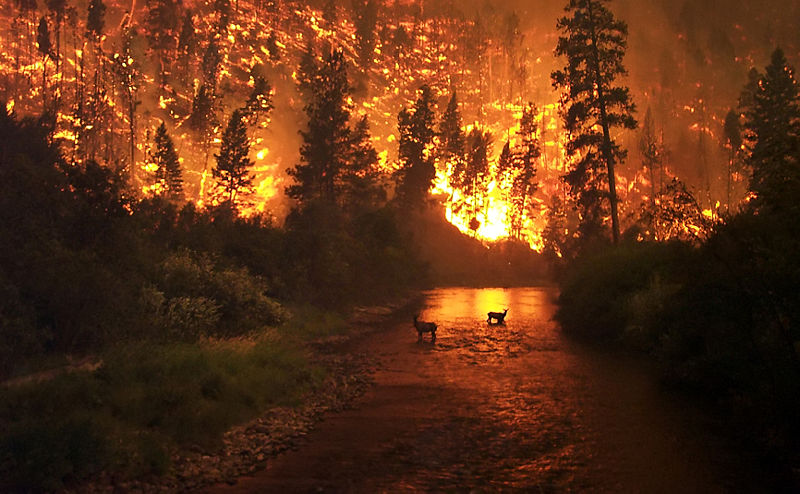
Wildfire, Bitterroot National Park, 2000. Wildfires are a type of disturbance that has increased with global warming and drought.

We introduced our readers to the leader of this research team, Professor Angela Moles, in a recent post about the mounting evidence that attempts to eradicate non-native species are futile.  Professor Moles (University of New South Wales, Australia ) gave a TED (Technology, Entertainment, Design) presentation in which she reported that introduced species have changed significantly since their introduction and that if they weren’t yet new species, they soon would be.  She proposed that non-native plants in Australia be granted citizenship.

Professor Moles collaborated with 21 scientists all over the world (Uganda, Indonesia, Mexico, USA, Australia, New Zealand, Japan, Argentina, Estonia, New Zealand) in the study that resulted in a recently published article entitled, “Invasions:  The trail behind, the path ahead, and a test of a disturbing idea.”  *

The trail of invasion biology

As the title suggests, the article begins by reporting that after 30 years and 10,000 publications, invasion biology has tested many assumptions and found inconsistent evidence to support them:

  • The search for traits of introduced plants that predict invasiveness has been a dead end:  “…it is not currently possible and will probably never be possible to predict which species are likely to become problem invaders on the basis of traits alone.  We therefore suggest that this is one area of invasion biology that merits less attention in the future.”
  • Invasion biology predicted that lack of genetic variability would hinder evolutionary adaptation in introduced species.  This assumption has not been supported by empirical studies:  “…rapid evolution has been repeatedly demonstrated in introduced populations, and the predicted reduction in genetic variance has not been observed.” 
  • Rapid evolution of introduced species has been well established by empirical studies:  “We have reached the point where additional case studies demonstrating rapid evolutionary change in introduced species are unlikely to have a major impact on our understanding of invasions.”  New research questions are needed.
  • There is little evidence to support the assumption that introduced plant species will cause extinction In native communities:  “…there are astonishingly few documented cases of native plants being driven to extinction by competition from introduced plants.  There is no evidence for any native species in the United States being driven to extinction even within a state, by competition from an introduced plant species.”

The way forward in invasion biology

Professor Moles and her team then tell us why invasion biology has not been able to prove the assumptions on which the theory is based.  The theory of invasion biology was based on untested assumptions that have been accepted as true although there is no empirical evidence to support them.  The goal for the future of invasion biology should be to identify these assumptions that have been accepted as dogma, test them, and abandon those that are not consistent with empirical facts. 

The authors of this study also, “…join a growing chorus, suggesting that our approach to invasion biology has been too simplistic.”  Studies have tended to focus on the features of introduced plants in isolation.  A more fruitful line of inquiry will consider the complex interactions between newly introduced species and their new environment:

“Rather than focusing on one factor at a time, we need to find ways (including multivariate analysis) to synthesize information about the recipient habitats/ communities, the characteristics of both resident species and the invaders, demographic processes, propagule pressure [measure of the number of species released into a region in which they are not native], the differences between current conditions and those with which the resident species evolved, evolutionary change to both native and introduced species, plasticity and feedbacks and interactions between different species and processes.”

You might say, “Phew! That sounds like a daunting task.”  And so it is, but this team of scientists takes it on with an elaborate and complex study of one of the most basic assumptions of invasion biology:  that disturbance facilitates plant invasions.

Does disturbance facilitate plant invasions?

“Disturbance is thought to facilitate invasion by simultaneously opening new ground for colonization, decreasing the competition from resident native species and releasing pulses of resources.”  The definition of “disturbance” has varied in different studies, but generally includes fire, grazing, agriculture, erosion, wind, and flood.  Empirical tests of this theory have produced mixed results.  Even when the results have been positive, they have not persisted over the long-term.

Because disturbance is a natural feature of all ecosystems, native species have adaptive features that enable them to respond to natural disturbances.  Therefore, the research team theorized that it is not disturbance per se which creates opportunity for invasions by introduced species, but rather changes in the disturbance regime.  Their research study was therefore designed to distinguish between the level of disturbance and changes in the level of disturbance.

Given the international composition of their research team, they were able to select 200 sites in eight countries.  They selected only those sites for which the natural patterns of disturbance were known.  Their research methods were statistically complex and a detailed description of them is beyond our comprehension and probably many of our readers, but we encourage those with the necessary scientific knowledge to read the article which is available on the internet.

Their analysis of these 200 sites led them to the conclusion that the change in disturbance regimes was far more predictive of the success of invasions than the level of disturbance but that both variables explained only 7% of the variation in the percent of cover or species richness contributed by introduced species.

In other words, one of the most basic assumptions of invasion biology did not pass an empirical test of its validity.  Invasions by introduced plants are largely unexplained by disturbance.

Post Katrina New Orleans. Floods are another type of disturbance that is likely to increase with climate change.

The future of invasion biology

Science is rapidly revising the assumptions of invasion biology.  We strongly believe that it is just a matter of time before science informs us that introduced species are here to stay and that this is not the terrible news we have been led to believe.  It is inevitable that this information will filter slowly from the scientific community to the community of native plant advocates.  We hope that they hear and accept this good news before our non-native trees are destroyed.

********************

*Moles, Angela, et. al., “Invasions:  The trail behind, the path ahead, and a test of a disturbing idea,” Journal of Ecology, British Ecological Society, 2012, 100, 116-`127.  All quotes are from this article

Support for hypotheses in invasion biology is uneven and declining

“Support for major hypotheses in invasion biology is uneven and declining” is the title of a paper recently published in NeoBiota* co-authored by seven scientists from all over the world (Germany, USA, Spain, Canada, Czech Republic).  The title captured our attention because it is consistent with our viewpoint.

The international team of scientists analyzed 371 empirical studies which tested six major hypotheses in invasion biology.  They found that empirical evidence for these hypotheses is uneven and declining.  The hypotheses that were tested by the studies were:

  • Invasional meltdown:  the presence of invasive species facilitates invasion and survival of additional new species.
  • Novel weapons:   invasive species with traits new to an exotic habitat have a competitive advantage over native species.
  • Enemy release:  introduced species have a competitive advantage in the exotic range because they are released from their enemies in the new environment.
  • Biotic resistance:  More biologically diverse ecosystems are more resistant to invasion.
  • Tens rule:  10% of newly introduced species escape to the wild; 10% of those naturalize in the wild; 10% of those become invasive.
  • Island susceptibility:  Invasive species are more likely to become established and have major ecological impacts on islands than on continents.

The scientists counted the number of studies that support, question/oppose, or are undecided/inconclusive about each hypothesis.  They also compared the number of supporting studies when the hypothesis was new with the number of supporting studies published recently to determine the decline in support for the hypothesis.  Here’s what they found:

Hypothesis n % of supporting studies % of decline in support
Invasional meltdown

30

77%

41%

Novel weapons

23

74%

25%

Enemy release

106

54%

10%

Biotic resistance

129

29%

5%

Tens rule

74

28%

10%

Island Susceptibility

9

11%

25%

Although support is strongest for the invasional meltdown hypothesis, recent studies are less supportive than early studies, indicating substantial decline in support.  Declining evidence of invasional meltdown is consistent with the fact that exotic species are eventually integrated into the food web which reduces their populations, stabilizing their spread. There is apparently little evidence that islands are more susceptible to invasion than continents and few studies have been done to test the hypothesis.

Declining support for scientific hypotheses has been observed in many disciplines, particularly medicine, ecology, and psychology.  The scientists who study this phenomenon theorize that the decline is attributable to some combination of these factors:

  • Over time the amount of available long-term data increases.
  • The best examples which are the strongest cases for the hypothesis are most likely to be studied first.
  • Publication bias favors new hypotheses and those for which the results are conclusive.

The NeoBiota paper also observes that the empirical evidence supporting each hypothesis varies by taxonomic group (plants, invertebrates, vertebrates) and habitat type (terrestrial, freshwater, marine).  For example:

  • The novel weapons hypothesis has been tested only for plants in terrestrial habitats.
  • Support for the invasional meltdown hypothesis is even across taxa and habitats.
  • Support for biotic resistance is strongest in marine habitats.

Where is invasion biology headed?

The authors of the NeoBiota paper are not suggesting that invasion biology be abandoned.  Rather their goal is to redirect scientists in the field to more productive efforts, such as:

  • Where a hypothesis cannot be generalized to all taxa and habitats specify exactly where it is applicable.
  • Rather than focusing on newly introduced species, focus on the interaction of a those species with their new environment. 
  • Discard those hypotheses that don’t work.

Based on our fifteen years of experience studying the native plant movement and its theoretical underpinnings in invasion biology we wholeheartedly support the advice of the authors to focus scientific efforts on the interaction of new species with their new environment.  We strongly believe that the success of newly introduced species is based largely on changes in the environment into which they are introduced.  In other words, invasions are more a result of changes in the environment than on the characteristics of the introduced species.

We also endorse the advice that scientists be more specific about the applicability of the assumptions of invasion biology.  We have seen the damage done by sweeping generalizations about how ecosystems operate in the hands of hobbyists.  Nature is complex and we do not necessarily understand all the factors operating in a given environment.  We hope that scientists will lead the way to the public’s more nuanced understanding of ecosystems. 

************************************

*Jeschke, Jonathan, et. al., “Support for major hypotheses in invasion biology is uneven and declining,” NeoBiota, 14: 1-20 (2012)

The futility of eradicating non-native species

We tend to focus on the native plant “restorations” in our neighborhood, but we should not lose track of the fact that similar efforts are taking place all over the world.  The native plant movement is international and if it loses momentum, we should expect to see loss of support for its destructive projects elsewhere.  So, today we will tell our readers about several recent developments that suggest that scientists all over the world are having second thoughts about invasion biology, which is the scientific underpinning of the native plant movement. 

Second Thoughts:  The Hawaiian Case

We have reported to our readers about the many “restoration” projects in Hawaii.  There is some logic to focusing such efforts on islands, because they are the places most vulnerable to the loss of native species attributed to introduced species and theoretically they are also the places where re-invasion should be easiest to control.

Scientists have recently published the results of a ten-year effort to return an “invaded” forest to its native origins.  They spent about 5 years clearing the forest of all non-natives.  They planted the scorched earth with natives and then they walked away from it to observe the long-term sustainability of their effort.  Five years later they report that the composition of the forest—with respect to its nativity—has essentially returned to its original state.

They tested several hypotheses while observing the changes in the forest during the second half of the project.  Conventional wisdom had been that the more densely natives occupied the ground, the less vulnerable it would be to re-invasion.  Much to their surprise, this was not the outcome of their experiment.  The more densely natives occupied the ground, the greater the population of non-natives in the final analysis.  They conclude that the same conditions which encouraged the growth of native plants were equally beneficial to the growth of non-native plants.

This study was conducted by the US Forest Service.  We hope they learned something from this experience.  Specifically, we hope that the US Forest Service now understands that native plant “restorations” are not a one-shot deal.  They are a permanent commitment to garden that restoration with the same amount of effort.  That’s why scientists—such as Professors Arthur Shapiro and Peter Del Tredici—tell us that large scale projects are not sustainable in the long term.  A small scale native plant garden as an historical illustration is a worthwhile effort.  Gardening our vast public lands is like “plowing the sea,” as Professor Shapiro told us recently.

Second Thoughts:  The New Zealand Case

New Zealand has made herculean efforts to save its native species from “invasions” by non-native species:  “New Zealand is a very weedy country.  Indigenous plant species are matched in number by naturalized exotic species and about 20 new invaders are discovered each year.  Thus, a weed eradication program has been under way for the past 10 years, but eradicating an unwanted plant species is much more difficult than it might seem.” (1)

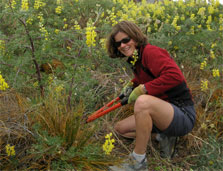
Eradicating yellow tree lupin, New Zealand Dept of Conservation

How successful have these efforts been?  According to a recent study, they have had very little success:  “The current issue of the journal Invasive Plant Science and Management assesses the progress of 111 weed eradication programs carried out by New Zealand’s Department of Conservation.  Only four of these programs have met with success, while 21 have been discontinued and the rest remain an ongoing challenge.”

The report concludes, “After a decade, New Zealand’s weed eradication strategy has yet to yield significant results.”  Anyone who has been watching similar efforts all over the San Francisco Bay Area will not be the least bit surprised by this conclusion.  With the exception of small gardens which are irrigated and intensively gardened, these projects are weedy messes, usually behind fences.

Second Thoughts:  The Australian Case

Scotia Sanctuary, Australia

Emma Marris interviewed the manager of one of many “restoration” projects in Australia for her book, Rambunctious Garden.  He told her about the 18 month process of killing all non-native animals in a 15-square mile sanctuary enclosed by a prison-like fence, “sturdy, tall, and electrified.”  (This was half of the Scotia Sanctuary)

“He was able to shoot out the goats in a matter of days.  Rabbits were harder…he put out carrot bait…the rabbits…would learn to trust the new food source…[then] the carrots would be poisoned…[He] repeated this routine three times, running through 12,500 pounds of carrots…For each fox, he learned its habits and was eventually able to find perfect places to trap or poison them.  He also trapped cats…The key to making it work, he says, was ‘perseverance, perseverance, perseverance.’” (2)

It was necessary to kill all the non-native animals before taking on the more difficult task of returning the land to native plants because of the interaction between the plants and animals.  The non-native animals are considered a continuing and permanent threat to the sanctuary.  The expectation is that this 250 acre restoration will require human intervention indefinitely into the future.

Australia is a huge place, so the prospect of this labor-intensive process being replicated on a nationwide basis is absurd.  Therefore, it seems inevitable that Australian scientists would begin to question the efficacy of such efforts. 

Just two months ago, an Australian scientist, Angela Moles, gave a TED (Technology, Entertainment, and Design) presentation suggesting that it is time to grant Australian citizenship to introduced species.  Click here to see the video.

Her reasoning is based on the relatively new understanding of the speed with which evolution occurs.  Her laboratory used the collection of a university herbarium to measure the changes in the plants that were introduced to Australia.  The herbarium had samples of the same species of plants collected over a 60 year period from the same location.  They found that the plants had changed in significant ways.  In a sense, they were becoming Australian plants in response to the biotic (other plants and animals) and abiotic (climate, soil, etc) conditions of their new home.  She predicted that if they weren’t yet genetically distinct from their ancestors, they soon would be.   In other words, they are becoming distinct, new species…..Australian species.

She showed a slide of her son who is a 2nd generation Australian.  He is considered an Australian by law and custom.  Then she showed a slide of clover which has changed significantly since its introduction.  After 130 generations, it is still not considered Australian.  After showing a few of the massive eradication projects and describing the scale and futility of those efforts, she suggested that it is long past time to accept the clover and other introduced species as Australian.

And, of course, we agree.  Let us abandon the destructive and futile war on non-native species.  The sooner we do, the less damage will be done to the environment and to the animals that live in it, including us.  

*************************

(1)    “Eradicating Weed Species in New Zealand Poses a Larger Challenge Than Expected,” Science Daily, July 21, 2012

(2)    Emma Marris, Rambunctious Garden, Bloomsbury, 2011

Permaculture takes the long view of the big picture

What is permaculture?

The primary agenda of the [permaculture] movement has been to assist people to become more self reliant through the design and development of productive and sustainable gardens and farms. The design principles which are the conceptual foundation of permaculture were derived from the science of systems ecology and study of pre-industrial examples of sustainable land use.“(1)

What does the permaculture movement have in common with the native plant movement?

Both have an interest in the preservation of native habitats and animals and both want to reduce the negative impact of human habitation on the Earth’s ecosystems.

How is the permaculture movement different from the native plant movement?

The permaculture movement has a broader view of ecology including the impact modern agriculture has on the Earth’s ecology, taking into account that modern crops are almost entirely non-native.  Permaculture considers both the costs and benefits of native plant “restorations”—such as the use of pesticides—and also puts the question of how realistic the goals of the project are into that equation.  Permaculture respects the complexity of nature and the shortened time perspective of man.  It therefore does not assume that man is capable of foreseeing the consequences of his manipulation of nature.  The humility of permaculture is a stark contrast to the sweeping generalizations and dogmatic edicts that we often hear from native plant advocates. 

What do the principles of permaculture tell us about “invasion biology?”

The principles of permaculture were eloquently expressed in a recent blog dialogue about the potential for introduced species to be invasive, in this case the kiwi vine.  The author of this comment is Toby Hemenway, who has given us permission to reprint his comment.  Mr. Hemenway is the author of a book (Gaia’s Garden:  A Guide to Home-Scale Permaculture, Chelsea Green Publishing, 2009) and a website about permacultureReading the entire comment thread in which this comment appears will help you to understand the difference between the native plant movement and the permaculture movement.   

****************************************

Hardy Kiwi. Creative Commons

“I have said several times that the shade-tolerant vines are very challenging species, so I’m not surprised to see Mr. Lautzenheiser’s report [about the kiwi vine]. And I’ll repeat that all of New England is a highly disturbed landscape…

The vines will come, and they will go. After all the alterations in the landscape Euro-Americans have made, it’s going to be centuries before we stop seeing things like these kiwi amphitheaters. We cannot predict when a species will turn rampant – next time it might be string beans – so we have two choices: never, ever introduce a new species, or accept that we are dealing with new types of ecosystems that are going to make us miserable if we keep thinking about the impact of new species as a disaster. The first is impossible.

Very relevantly, I spent last Saturday in the Beartooth Mountains with a retired local ecologist. We stopped at a disturbed site in the sagebrush above Red Lodge and he harvested two bouquets of plants, one of natives, one of exotics. The exotic bouquet had at least twice as many species in it, including a number that he was pretty upset with. He is no fan of invasive species. Later we stood in a mixed-conifer grove high in the much less disturbed mountains, and he showed the immense damage from the pine beetle, a native insect that is devastating millions of acres in the west. It seems to have burst out of control because of decades of Smoky the Bear fire suppression – our way of saving the ecosystem – that has left the forest full of crowded trees that are perfect beetle food. This is a native species that has gone rampant. This happens all the time: many thousands of acres of lodgepole pine in Idaho and eastern Washington are dying from native honey-mushroom infestation, but ecologists are starting to understand that this may be a way of returning nutrients to the soil after old-growth forests have sequestered them above ground for too long. We hate to see these forests die. And we don’t know what’s going on.

When someone asked what we can do about all this, the ecologist answered that we can preserve very small areas in special projects, but that anything beyond that is simply impossible. The impact of non-native species, he said, brought here in the massive quantities that they were and still are, combined with our alterations in the landscape of a whole continent, make any return to previous conditions out of the question. We don’t like this, he said, because it holds a mirror up to us and shows us how out of balance with the rest of nature we are. And now we’re stuck with the consequences, so we demonize the other species instead of facing what he sees as the real problem: there are too many of us, moving around far too much. Asking people not to plant species that they like is a losing game, not with a hundred million gardeners in this country shopping at nurseries.

We’re going to have to learn to live with this new landscape, as much as we don’t like it, and take it as a stunning opportunity to learn about ecosystem development, was his conclusion. It is a colossal experiment in hybridizing whole ecosystems, and to say “this species is bad, or this one” misses the point completely. We have altered a continent and there is no undoing it, no return to before. We cling to the hope of preservation and restoration because we can’t accept that we have to live with what we have done. It’s time to move on, he said, accept that these species are here, and stop interfering. We didn’t know enough to keep this from happening, and we surely don’t know enough to “fix” it. The attempted cures are doing even more harm, the way fire suppression did. Thinking it is a problem is the problem.

He struck me as a wise man, in many ways, and I learned a lot from him. I’ve been spending many days in Yellowstone this summer, and see that one simple restoration act, re-introducing the wolf, has slammed through that nearly undisturbed, enormous ecosystem in hundreds of unforeseen ways. The elk have been driven out of the valleys into the hills. The bison are exploding through the valleys, along with once-scarce pronghorns. Species mixes of all kinds are shifting in totally unforeseen ways. It was a profoundly radical act that has totally altered the landscape, all because of one management decision. And we think we know that hardy kiwi is wrong to be there? We need to stop deciding we know better than nature, even nature with kiwi in it.

Am I saying we should do nothing? Well, we can do what we want, and I’m sure we will. But it won’t make much difference at all, except where we’re able to target especially vulnerable species and habitats and freeze some of them where they are (in ways nature never does). Nature is just too big, the process too far along.

I was at a conference a while ago called “Native Plants and Permaculture” where those two groups came together to make peace and learn from each other. We did an exercise where everyone lined up where they thought they fell along a spectrum from “Only plant natives” to “Plant whatever you want.” There were 3 people in the first category, and one in the latter. Everyone else, permies and nativists, were mixed in a perfect bell curve with most right in the middle. Our differences are tiny. Let’s stop focusing on them.

Again, I think that against all the good that permaculturists are doing, it makes little sense to focus on the tiny minority of us who don’t think before we plant. That’s a minuscule drop in the bucket compared to corn, GMOs, nursery owners, developers, and all the others who alter land and plant exotics. It’s a classic case of making our firing squad in a circle, as Che claimed the Left was prone to do. The discussion of all this is very fruitful, but the accusations that permaculturists are doing significant harm, compared to all the others, don’t hold up.

Most states have invasive species lists in the several hundreds, which to me says we’re either completely doomed or there is an error in our way of thinking. In another 5 years another hardy kiwi-like enemy will appear, and then another, and another, with no one able to predict, like the native pine beetle, what it will be. You can be miserable about this if you want; I’m going to watch it and learn from it. We have no choice but to wait out the next few hundred years until this terribly unbalanced landscape finds some new, always-dynamic set of equilibriums. Meanwhile I’ll be using the best tools available (and they won’t include hardy kiwi in New England!) to create healthy designed ecosystems in the places people are settled in, and if nature chooses to use something I’ve planted for her own purposes, in a way that I don’t understand, I will accept that she knows what she is doing instead of thinking, always wrongly, that I know better.”

**************************** 

Oliver Holmgren (1997). “Weeds or Wild Nature”. Permaculture International Journal. http://www.holmgren.com.au/frameset.html?http://www.holmgren.com.au/html/Writings/weeds.html

Past & Present Botanical Myths

The conventional wisdom is that human knowledge, especially scientific knowledge, moves inexorably forward.  We are sometimes amused by the misconceptions of the past and marvel at the primitive knowledge of our ancestors.  However, we rarely stop to think that our descendents will probably do the same when they consider our current state of knowledge.

Historical botanical beliefs

"The heads of cowslips, which trembled in the wind, were signed for Parkinson's disease, the 'shaking palsy.'" (1)

The Doctrine of Signatures seemed a logical botanical belief at a time when plants were one of man’s few medicinal tools and religion was a powerful influence in human society.  The Doctrine of Signatures, which was actively promoted by the church in 17th century Europe, was based on a belief that God had “signed” plants with certain suggestive shapes and colors to inform humans of their medicinal properties.  For example, a heart-shaped leaf was considered God’s message to us that a particular plant would be beneficial to the human heart and this message was strengthened by a flesh-colored flower. Every plant was believed to be useful in some way if man could only discern its use.  Else why would they have been created, since the Garden of Eden was created for the benefit of man?  The church encouraged man’s study of plants as a way to worship God’s creation. (1)

Many botanical myths originated from ancient Roman and Greek horticultural treatises and persisted for hundreds of years.  For example a belief in the influence of the moon on plants is first found in the writings of Pliny in first-century Rome and also found in writings as late as 1693:  “[w]hen you sow to have double Flowers, do it in the Full of the Moon.”  (2) 

The origins of many horticultural myths are unfathomable but probably began with a particular event because we often confuse coincidence with causal relationships. (2)

  • Planting bay trees and beeches near  homes will prevent lightning strikes
  • An apple tree that fruits and flowers at the same time is a bad omen
  • The parents of a child who picks red campion will die
  • A pregnant woman who steps over cyclamen will miscarry

Modern botanical beliefs

Now we will turn to the theoretical underpinnings of the native plant movement to see how they are holding up to the scrutiny of current science and ask the rhetorical question, Is it time to relegate invasion biology to the dust heap of discredited science?

The field of invasion biology upon which the modern native plant movement is based, originates with the publication in 1958 of The Ecology of Invasions for Animals and Plants by Charles Elton.  Elton postulated that every plant and animal occupies a different ecological “niche” and plays a specific role within that niche: 

“…every species will have a slightly different role, or niche, and often, he believed, every niche will be filled.  Some animals eat grass, others leaves; some plants grow on wet soil and some grow on dry; some birds nest in dead trees, others in live ones.  When new species are introduced, the theory goes, they can get a foothold and start reproducing only by finding a vacant niche or by throwing some other species out of its niche…” (3)

Elton’s corollary to the exclusivity of the niche is that the introduced species will have a competitive advantage because its predators are absent in its new home.  The predicted result of Elton’s theory was that introduced species will exterminate previous occupants, mass extinctions will occur, and the result will be a simplified ecology composed of few surviving species.

The problem with Elton’s theory is that it doesn’t correspond with reality.  More and more scientists are finding that the frequency of introductions far exceeds the frequency of extinctions.

  • In 2002 Dov Sax reported that introduced species greatly outnumbered extinctions on oceanic islands:  “In the case of plants, islands are now twice as diverse as they were before humans started moving things around.” (3)
  • In 2012, Erle Ellis, et. al., reported that “…while native losses are likely significant across at least half of Earth’s ice free land, model predictions indicate that plant species richness has increased overall in most regional landscapes, mostly because species invasions tend to exceed native losses.” (4)
  • In San Francisco, the second-most densely populated city in the US, ninety-seven percent of the 714 plant species known to exist in San Francisco in 1850 are still found there, despite the fact that most plants and trees in the city are introduced.  (5)

The dire predictions of invasion biology have not come to pass nearly 60 years after their inception.   Many scientists are clearly ready to abandon invasion biology because it does not conform to reality.  Can we finally breathe a collective sigh of relief and move on to a less gloomy view of ecology?  Some day our descendents will look upon this episode in human history and laugh, as we laugh at the 17th century Europeans who examined plants, looking for the clues from God that revealed their purpose.

************************************

(1) Richard Mabey, Weeds:  In Defense of Nature’s Most Unloved Plants, Profile Books Ltd, London, 2010, page 87-91

(2) Andrea Wulff, The Brother Gardeners, Alfred Knopf, 2008, page 11-12

(3) Emma Marris, The Rambunctious Garden, Bloomsbury, USA, 2011, page 102-104

(4) Erle C. Ellis, et. al., “All Is Not Loss:  Plant Biodiversity in the Anthropocene,” http://www.plosone.org/article/info%3Adoi%2F10.1371%2Fjournal.pone.0030535

(5) Duncan et al, “Plant traits and extinction in urban areas:  a meta-analysis of 11 cities,” Global Ecology and Biogeography, July 2011

Pangaea: The first but not the last globalization of ecology

The continents have been sliding about on the Earth since it was “created”(1) approximately 4.5 billion years ago.  Although geologists tell us that the continents came together and broke apart several times prior to the formation of the supercontinent geologists call Pangaea, this is the geologic period of most interest to us because life forms were sufficiently complex by that period that we can recognize their modern counterparts.

The supercontinent Pangaea

Pangaea is said to have been assembled about 237 million years ago, during the Early Triassic Period, shortly after the great Permian extinction, the period of the most extensive extinctions of plant and animal species in the history of the Earth.   Pangaea began to break apart about 50 million years later, but the African and South American continents remained fused–into a continent dubbed Gondwana–until about 100 million years ago. (1)

During that period of nearly 160 million years, many new life forms emerged and others died out.  Cone-bearing plants replaced some spore-bearing plants before Pangaea formed and dominated the Earth during much of Pangaea’s existence.  The first true mammals, flowering plants, birds, lizards, and salamanders appeared before the break up of Pangaea was complete.

What are the implications of the development of new species of life on Earth at a time when there was a single, unified continent?  That is the question we are considering today.  Obviously, the transport of plant and animal species into new territories is facilitated by their proximity.  Seeds are more easily transported by wind and animals if they need not cross barriers such as oceans, as they must today.   As a result there was greater homogeneity of species during the geologic periods of Pangaea.  And species diversified rapidly when Pangaea broke up into the 7 continents of today. (2)  These diversified species have common ancestors. 

Even after Pangaea began to break up into separate continents, there were land bridges between some of the continents during periods of glaciations when water was locked into ice, draining the oceans.  Animals could travel over these land bridges from one continent to another, often bringing plant species with them, usually unwittingly.  That’s how the first humans in North America and ultimately South America traveled from Asia about 13,000 years ago at the time of the last ice age.

The common ancestry of many plants and animals is one of many reasons why the concept of “native” is ambiguous and is often debated.  We will consider a few examples in which the designation of a particular plant as native or non-native seems debatable.

Is the Dawn Redwood native to California?

Dawn redwood (Metasequoia glyptostroboides) is closely related to our redwood trees, Coast Redwood and Giant Sequoia.  Dawn redwood is unique in being a conifer that is also deciduous (loses its foliage in winter), unlike our redwood trees which are evergreen.  Dawn redwoods were until recently considered native to remote regions of China where they are considered “critically endangered.”

Dawn redwood in spring. Wikimedia Commons

However, scientists at the Museum of Paleontology at UC Berkeley tell us that there is fossil evidence that dawn redwoods grew in California about 40 million years ago.  Dawn redwoods now grow successfully in the Bay Area.  There is a famous specimen in front of McLaren Lodge in Golden Gate Park, headquarters of San Francisco’s Recreation and Park Department.  Every autumn, when the tree turns red, park staff receives calls from the public expressing their concern that the beautiful tree is dying.

Dawn redwoods died out in California during the last ice age because the climate was cooler than dawn redwoods could tolerate.  So, now that the climate has warmed again, and dawn redwoods are back, why not welcome them as a “return of the natives?”  That’s the kind of flexibility that makes sense to us, particularly in a time of rapidly changing climate.

Dawn redwood in autumn. Wikimedia Commons

Unfortunately, we don’t find such flexibility in the native plant ideology.  Dawn redwoods are rare both in California and in China from which it was reintroduced, and it is therefore not one of the trees that native plant advocates demand be eradicated.  Monterey pine and Monterey cypress are not so fortunate.  These are also trees for which fossil evidence suggests that they lived in San Francisco in the distant past and their native range is less than 150 miles down the coast in Monterey.  Both tree species are also considered threatened in their native range.  Yet, native plant advocates demand their eradication in San Francisco.

This is an example of the rigidity of the native plant ideology that has earned them the reputation of fanatics.

Does Rhododendron ponticum “belong” in Britain?

We told our readers in a recent post that Rhododendron ponticum is one of only about a dozen plants in Britain that are considered “invasive.”  It is a stunningly beautiful plant which is being aggressively eradicated in Britain.  Richard Mabey in Weeds:  In Defense of Nature’s Most Unloved Plants offers this explanation for why this particular plant is “invasive” in Britain:

“The next most serious weed is probably rhododendron which, unusually, has the ability to invade existing ancient woodland, especially in the west of Britain.  This may be because, if one employs a very long time scale, it is not strictly an alien.  The species that forms impenetrable thickets in western Britain is Rhododendron ponticum, whose pollen remains have been found in deposits in Ireland dating back to the last interglacial.  The species was plainly accustomed to growing in Atlantic woodland and may have retained a genetic “memory” of how to cope with this habitat and its competing species.  But it didn’t grow spontaneously in Britain for the next 30,000 years, and all the current feral colonies are regarded as originating from garden escapes.”(3)

Rhododendron ponticum. Wikimedia Commons

Once again, we wonder if “welcome home” isn’t a more appropriate response to this beautiful plant.  We find the definition of “native” as arbitrary as the definition of “invasive.”  Both seem to be terms used by people who abhor change.  And in a rapidly changing world, does such resistance to change make any sense?  We don’t think so. 


(1) The use of the word “created” implies no particular origin of the earth, merely its beginning.  https://www.usgs.gov/faqs/what-was-pangea-0?qt-news_science_products=0#qt-news_science_products

(2) Crosby,Alfred, Ecological Imperialism, 2nd Edition, Cambridge, University Press, 2004

(3) Mabey, Richard, Weeds:  In Defense of Nature’s Most Unloved Plants, Harper-Collins, 2010