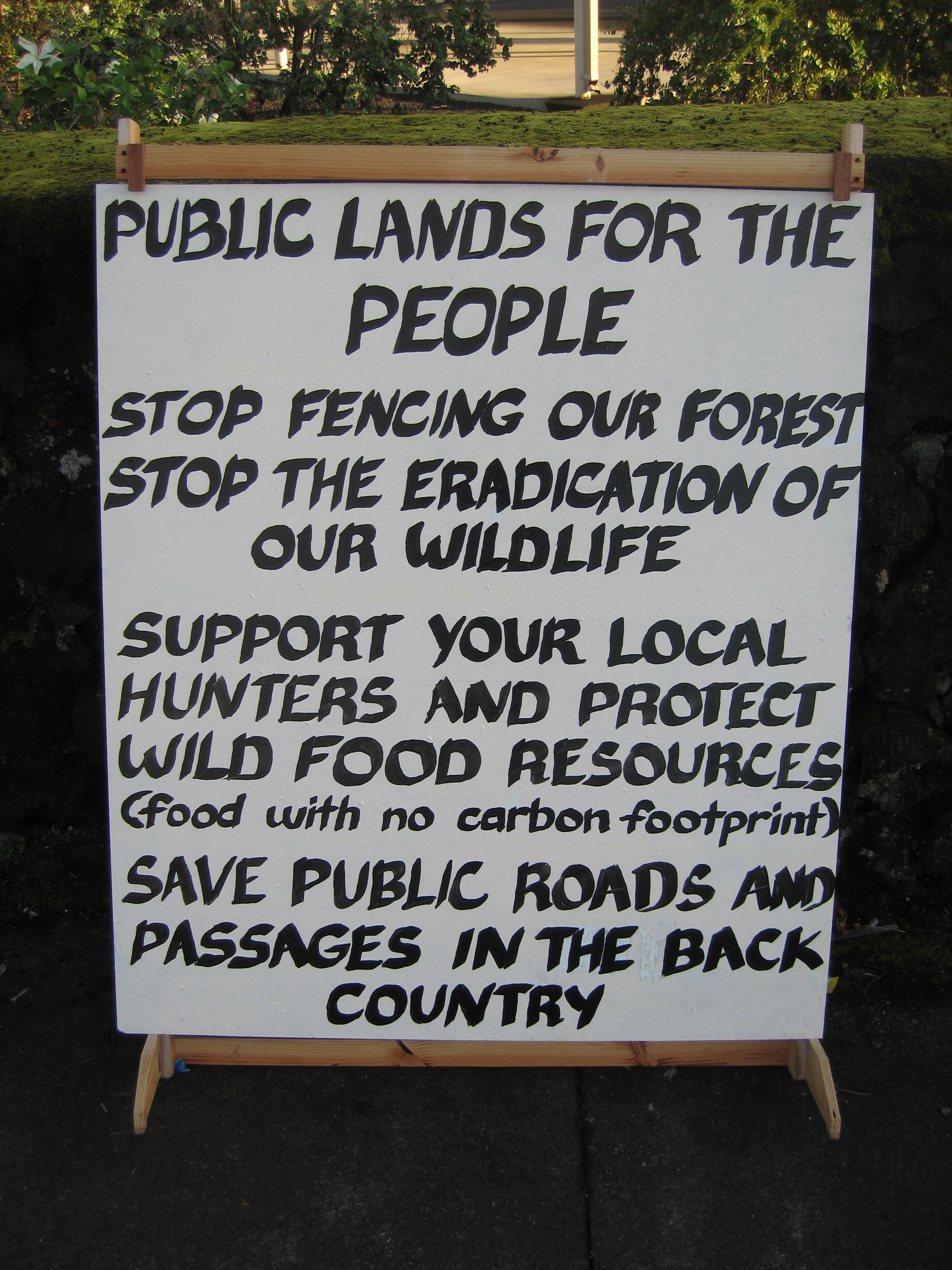
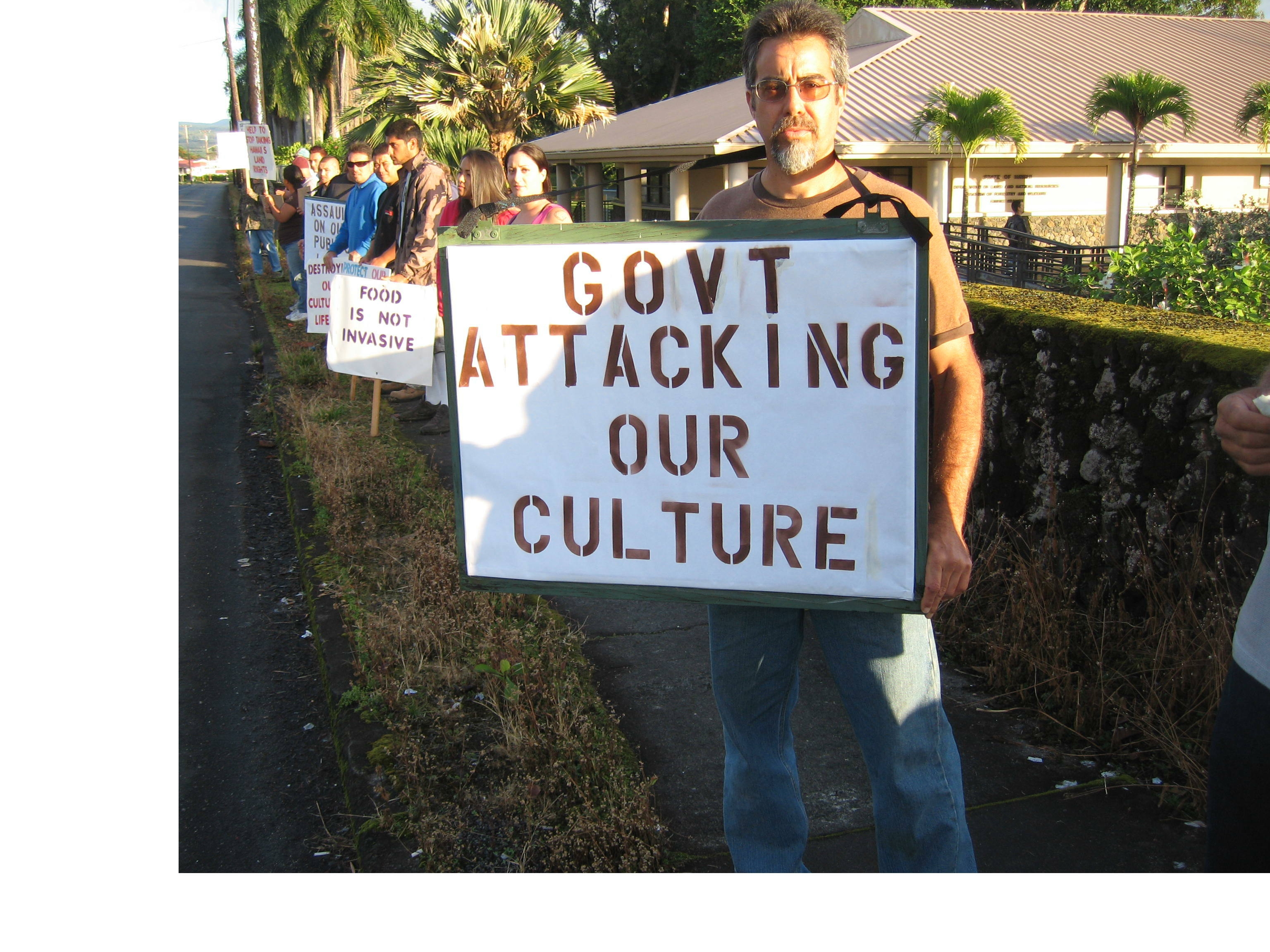
We recently told our readers about the controversial “restoration” projects in Hawaii. Now our colleagues in Hawaii have sent us photographs of a public protest in Hawaii and The Hawaii Reporter tells us why they are protesting. Hawaii’s Department of Land and Natural Resources (DLNR) is fencing the public out of another 17 square miles of prime forest on the Big Island. All the non-native animals—sheep, goats, pigs—will be exterminated and all their non-native food—strawberry guava, passion fruit, etc—will be eradicated in that fenced enclosure. The people who hunted the animals and gathered fruit in the forest are protesting the loss of this source of food.
In addition to the loss of food, the protestors also object to the loss of an activity that is central to the Hawaiian culture of foraging and hunting for food. DLNR’s response to that particular complaint is that the historical record indicates that Hawaiians didn’t hunt prior to the arrival of Europeans because they raised animals as their own.
In other words, not only does DLNR wish to stop the biological clock, they also wish to freeze-frame the Hawaiian culture to a pre-European standard. They don’t seem to have considered that the Europeans essentially confiscated the land of the Hawaiians when they arrived, which deprived the Hawaiians of the land needed to raise animals. That’s too bad. The Hawaiians are not allowed to hunt now because they didn’t hunt 250 years ago. As absurd as creating botanical museums seems to us, the suggestion that culture must also be prevented from evolving strikes us as utterly ridiculous.
Hawaiians protest loss of access to public lands
Conservation Refugees
Hawaii’s cost of living has always been one of the highest in the country because virtually all of its food must be imported. And now Hawaiians are being deprived of an important source of food by the confiscation of public lands. Will these Hawaiians join the ranks of the millions of conservation refugees all over the world who have been displaced in the name of conservation?
We were introduced to conservation refugees by Mark Dowie in 2004. He told us that the belief that wilderness is not compatible with human community originated with John Muir, who demanded that Native Americans living in Yosemite be removed from the valley. Native Americans were also removed from Yellowstone when the National Park was created. These Native Americans were the first conservation refugees, but not the last.
Dowie told us that the worldwide official protected areas—parks, reserves, wildlife sanctuaries, biodiversity corridors—had expanded from 1,000 in 1962 to 108,000 in 2004. The total number of indigenous people displaced by the creation of these protected areas is not known because most countries make no attempt to quantify the impact. In Chad an estimated 600,000 indigenous people became conservation refugees when the amount of protected areas increased from 0.1 to 9.1 percent of total national land in the 1990s. India admits to creating 1.6 million conservation refugees as a result of creating new protected areas and the Indian government estimates that 2 or 3 million more will be displaced in this decade.
Dowie visited some of the communities that have been displaced by the confiscation of their ancestral land. The loss of their land is also the loss of their way of life. Hunters/gatherers are deprived of their source of food. Likewise, farmers lose their croplands. They wander into shanty towns where they lack the skills to survive in the modern world. They create shabby squatter camps on the perimeter of their homeland where they live without sanitation or water. The fabric of their communities is shattered.
Emma Marris* observes the irony of these evictions of traditional cultures which have tended these remnants of the wilderness for generations. These places were targets for conservation because they had been preserved by traditional cultures that had learned to co-exist with nature. This is how they are rewarded for their stewardship of the land.
What is accomplished?
What is gained when Hawaiians are thrown out of their public lands, depriving them of a source of food? Are these projects successful? Are the plants and animals that existed in Hawaii several hundred years ago returning to the fenced reserves that have been created for them?
Emma Marris visited one of these projects in Hawaii. A small test plot was cleared of all non-native plants, requiring the removal of about half of all the vegetation. That process took about a week per thousand square feet and then “epic bouts of weeding thereafter.”
The theory was that the removal of all the non-natives would enable the natives to thrive without the competition for sunlight and water. Five years later, there is little evidence that native plants have benefited from the eradication of all non-native plants:
“Disappointingly, the mature native trees had grown very little. As [the project directors] put it, ‘The native trees may either be responding to the treatments very slowly and still undetectably, or they may be unable to respond at all.’”
The directors of this project also told Marris, “I think that people that are interested in protecting Hawaii’s flora and fauna have resigned themselves to it being in postage-stamp sized reserves.” Apparently Hawaii’s Department of Land and Natural Resources hasn’t gotten this message. They are now creating another 17 square mile reserve with the intention of eradicating everything non-native in it. Nothing is likely to be accomplished by all that death and destruction and some Hawaiians will also go hungry.
The slippery slope of nativism
Perhaps we should be grateful that the “restoration” projects in the San Francisco Bay Area aren’t depriving us of our homes and our livelihoods. We are just being fenced out of our public parks. We are just losing our trees. Our public parks are just being poisoned with pesticides.
But we watch these projects all over the world and we listen to the demands of local native plant advocates and we wonder where this is headed. In San Francisco, for example, native plant advocates are demanding that all of the public lands in the city be managed as “natural areas.” In addition to destroying the trees in our parks, would we lose the trees on all our public properties? We also know that native plant advocates want plant nurseries to quit selling to the public the approximately 200 plants that they have categorized as “invasive.” Will we lose the right to plant what we want in our own backyards? Given what we see happening around the world, it doesn’t seem farfetched.
* Emma Marris, Rambunctious Garden, Bloomsbury Publishing, 2011
Nature in the City (NIC) is one of many organizations that support native plant “restorations” in San Francisco as well as the principle entity which engages in them, the Natural Areas Program (NAP) of the Recreation and Park Department. NIC is consistently critical of anyone who questions the value of these restorations, but in their most recent newsletter they confront our objections directly. Although we don’t presume to represent the many constituencies which are critical of the Natural Areas Program, we are responding in this post to NIC based on our knowledge of the issues. (The NIC newsletter is in quotes and is italicized. Our response is not italicized.)
“Natural Areas in 2012
Last fall saw the the [sic] Planning Commission public meeting for the Draft Environmental Impact Report (DEIR) for the Significant Natural Resource Areas Management Plan. Some time later this year, the City will issue a Final Environmental Impact Report, which may be appealed by opponents of the Natural Areas Program.
Unfortunately, a handful of people are still propagating misinformation about the rationale, values, and intention of ecological restoration, management and stewardship, and of the City’s celebrated Natural Areas Program.”
Webmaster: Critics of the Natural Areas Program cannot be described accurately as a “handful of people.” We now have four websites(1) representing our views and there have been tens of thousands of visits to our websites. Comments on our websites are overwhelmingly supportive of our views. Our most recently created website, San Francisco Forest Alliance, lists 12 founding members. That organization alone exceeds a “handful of people.”
Our objections to the Natural Areas Program have also been reported by three major newspapers in the past month or so (San Francisco Examiner, Wall Street Journal, Sacramento Bee).
Many critics of NAP have been engaged in the effort to reduce its destructive and restrictive impacts on our parks for over 10 years. Scores of public meetings and hearings have been held to consider our complaints. We consistently outnumbered public speakers in support of NAP until 2006, when the NAP management plan was finally approved by the Recreation and Park Commission. Although we were outnumbered for the first time, there were over 80 speakers who asked the Recreation and Park Commission to revise NAP’s management plan to reduce its negative impact on our parks.
The public comments on the NAP DEIR are the most recent indicator of the relative size of the groups on opposite sides of this issue. These comments were submitted in September and October 2011. We obtained them with a public records request. The Planning Department reported receiving about 400 comments. In analyzing these comments, we chose to disregard about half of them because they were submitted as form letters, even though they were from dog owners who were protesting the loss of their off-leash privileges in the natural areas. We also leave aside the comments from golfers whose only interest is in retaining the golf course at Sharp Park. In other words, we set aside the majority of the comments critical of the NAP management plan in order to focus on those comments that demonstrate a comprehensive understanding of the impact of NAP on the city’s parks. Of the comments remaining, those critical of NAP and its deeply flawed DEIR outnumbered comments in support of the NAP DEIR about three to one. We urge NAP supporters to read these public comments to learn about the wide range of criticisms of NAP, including pesticide use, destruction of trees, recreational access restrictions, loss of wildlife habitat and more.
We will challenge NIC’s accusation that we are “propagating misinformation” within the context of their specific allegations:
“Contrary to the many myths that continue to percolate, the Natural Areas Plan and Program seek to do the following (among other worthwhile endeavors):
1. Protect and conserve our City’s natural heritage for its native wildlife and indigenous plant habitats and for the overall health of our local ecosystem;”
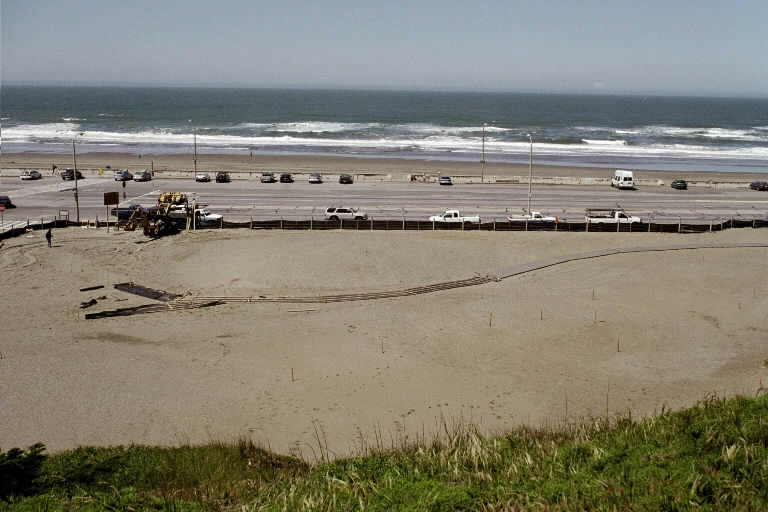
Webmaster: Since the majority of acreage claimed as natural areas by NAP 15 years ago had no native plants in them, there is little truth to the claim that NAP is protecting our “natural heritage.” The so-called “natural area” at Balboa and the Great Highway is typical of the “natural areas.” There is photographic evidence that it was built upon for about 150 years. It was the site of Playland by the Beach before it was designated a “natural area.” Sand had to be trucked onto the property and disked down 18” into the construction rubble, then shaped into dunes by bulldozers before native plants could be planted on it.
Natural Area at Balboa & Great Highway under construction
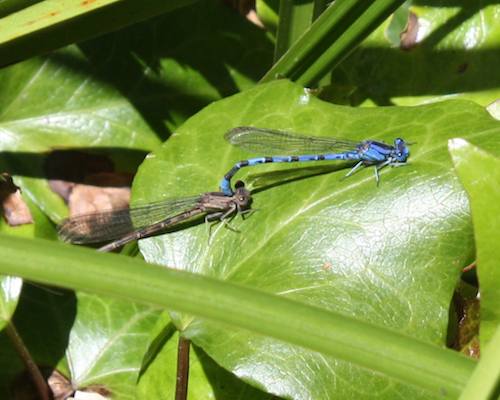
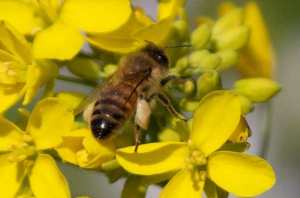
We don’t make any distinction between “native wildlife” and any other wildlife currently living in our city. We value them all. Most are making use of existing vegetation, whether it is native or non-native. They do not benefit from the loss of the blackberries that are their primary food source or the loss of the thickets or trees that are their homes. We do not believe that wildlife in San Francisco benefits from the destructive projects of the Natural Areas Program. See photos of insects, birds, and other wildlife using non-native plants in the natural areas here.
Damselflies mating on ivy, Glen Canyon Park
We do not think an ecosystem that has been sprayed with herbicides qualifies as a “healthy ecosystem.” NAP sprayed herbicides at least 86 times in 2011. Their use of herbicides has increased over 330% in the last 4 years. NAP uses herbicides that are classified as more toxic than those most used by other city departments. Last spring, 1,000 visitors to Glen Canyon Park signed a petition, asking the Natural Areas Program to stop using pesticides in their park. This petition was given to Scott Wiener, the Supervisor representing the district in which Glen Canyon Park is located.
These are statements of fact that can be easily verified by the public record.
2. “Educate our culturally diverse city about the benefits of local nature and about helping with natural areas stewardship in your neighborhood;”
And we also have had bad experiences with the volunteers who are called “stewards” by NAP, but sometimes act more like vandals. We see them spraying herbicides that they aren’t authorized to use. We see them hacking away at trees that haven’t been designated for removal. NAP is not providing the necessary guidance and supervision to the volunteers many of whom seem to consider themselves the de facto owners of the parks.
3. “Manage the City’s wildlands for public access, safety and the health of the “urban forest.””
“We hear occasional complaints about public access and tree removal. Three simple facts are thus:
1. Every single natural area in the City has at least one trail through it, where one can walk a dog on a leash;”
Webmaster: The loss of recreational access in the natural areas is real, not imagined. The following are verbatim quotes from the NAP management plan:
“Approximately 80 percent of the SFRPD off-leash acreage is located within Natural Areas.” (page 5-8). The NAP DEIR proposes to close or reduce the size of several off-leash areas. The DEIR provides no evidence that these areas have been negatively impacted by dogs. It also states that all off-leash areas in the natural areas are subject to closure in the future if it is considered necessary to protect native plants. Since NAP has offered no evidence that the proposed immediate closures are necessary, one reasonably assumes it will offer no evidence if it chooses to close the remainder of the 80% of all off-leash areas in San Francisco located in natural areas. We know from the DEIR public comments that NAP supporters demand their closure.
“Public use in all Natural Areas, unless otherwise specified, should encourage on-trail use… Additionally, interpretive and park signs should be installed or modified as appropriate to include “Please Stay on Trails” with information about why on-trail use is required.” (page 5-14) In other words, the only form of recreation allowed in the natural areas is walking on a trail. Throwing a ball or frisbee, having a picnic on the grass, flying a kite, climbing the rocks are all prohibited activities in the natural areas. And in some parks, bicycles have been prohibited on the trails by NAP.
“Finally, this plan recommends re-routing or closing 10.3 miles of trail (approximately 26 percent of total existing trails).” (page 5-14) So, the only thing visitors are allowed to do in a natural area is walk on the trails and 26% of all the trails in the natural areas will be closed to the public.
2. “The act of removing (a small subset of) non-native trees, e.g., eucalyptus, that are in natural areas has the following benefits:
a. Restores native habitat for indigenous plants and wildlife;
b. Restores health, light and space to the “urban forest,” since the trees are all crowded together and being choked by ivy;
c. Contributes to the prevention of catastrophic fire in our communities.”
Webmaster: Destroying non-native plants and trees does not restore indigenous plants and wildlife. Native plants do not magically emerge when non-native plants and trees are destroyed. Planting indigenous plants might restore them to a location if they are intensively gardened to sustain them. However, in the past 15 years we have seen little evidence that NAP is able to create and sustain successful native plant gardens. Native plants have been repeatedly planted and they have repeatedly failed.
NAP has not “restored” the health of the urban forest. They remove trees in big groups as they expand their native plant gardens. They are not thinning trees. They are creating large openings for the grassland and dune scrub that they plant in the place of the urban forest. Every tree designated for removal by the NAP management plan is clearly selected for its proximity to native plants. It is disingenuous to suggest that NAP’s tree removal plans are intended to benefit the urban forest.
3. “The overall visual landscape of the natural areas will not change since only a small subset of trees are planned to be removed over a 20-year period.”
“Please feel free to email steward@natureinthecity.org if you would like more clarification about the intention, values and rationale of natural resources management.”
Webmaster: We urge our readers to take NIC up on this offer to provide ”more clarification” of its spirited defense of the Natural Areas Program.
Do you think NIC is deluded about there being only a “handful of people” that are critical of the Natural Areas Program?
Did you notice that NIC does not acknowledge the use of herbicides by NAP? Do you think that a fair representation of criticism of NAP can omit this issue?
If you visit a park that is a natural area, do you think NAP has demonstrated in the past 15 years what NIC claims it is accomplishing?
Do you think NIC has accurately described recreational access restrictions in the natural areas?
Do you think that San Francisco’s urban forest will be improved by the destruction of 18,500 mature trees and countless young trees?
(2) “The California Department of Forestry and Fire Protection (CAL FIRE) has no record of any wildfire in San Francisco.” San Francisco Hazard Mitigation Plan, 2008, page 5-18.
The case for native plant and animal restorations is strongest on islands. They contain the most endemic species, unique to those places. More extinction has occurred on islands than on the mainland of the United States because species that evolved in isolation are more vulnerable to new competition than species that have evolved with more competition. Theoretically, if man were able to eradicate non-native species of plants and animals, it would be easier to prevent re-invasions on an island. Consequently the Hawaiian Islands are a hot-bed of nativism.
The efforts to eradicate many species of plants and animals in the Hawaiian Islands are just as controversial there as they are here in the Bay Area. Here is a sampling of the legal, environmental, and ethical questions raised by these eradication projects:
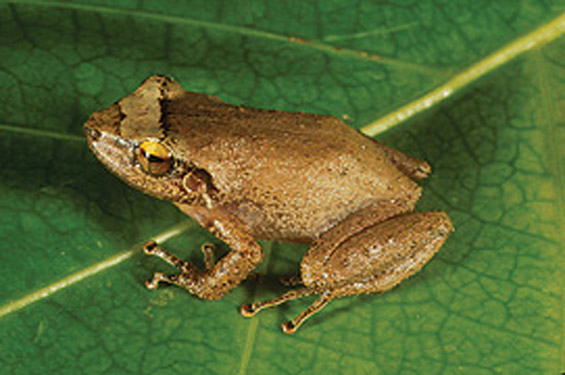
Coqui frog
The coquiis a tiny frog that was inadvertently introduced to Hawaii from Puerto Rico in the 1980s. There are no native frogs in Hawaii, so efforts to eradicate the coqui aren’t predicated on the usual claim that it will out-compete its native counterpart. In this case, those who launched this campaign claimed that the frog will eat all the insects on the islands, depriving other animals of this food source. The proposal was to spray highly concentrated caffeine in the forests occupied by the frog. No tests were conducted to determine what effect this would have on any of the plants or other animals that would be sprayed in the process.
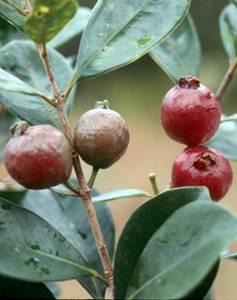
Strawberry guava, USDS
The strawberry guavawas introduced to Hawaii as a fruit tree, just as virtually every fruit tree in America was. The proposal was to eradicate the strawberry guava with biocontrol, which means an insect was introduced that would theoretically feed solely on the strawberry guava. The theory of biocontrol is more appealing than the reality, which in practice has often introduced new predators that are more difficult to control than the original target. This eradication effort was also controversial because the strawberry guava is a valuable source of food for all animals in Hawaii, including humans.
Mangroves are coastal forests that are considered valuable nurseries for marine life. In Hawaii some have been eradicated with herbicides. The skeletal remains of the mangrove are left to rot in the water, creating an eyesore and a graveyard for the animals that lived there.
Animals are caught in the middle
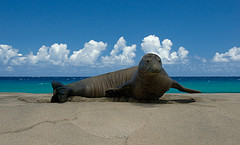
The endangered monk seal has been caught in the middle of the nativist debate in Hawaii. Because it is endangered, government biologists are obligated by law to try to prevent its extinction. The monk seal has therefore been introduced to places in the Hawaiian Islands in which it hasn’t previously lived, based on the belief that it will have less competition in these areas. This introduction of the monk seal into new territory has made it vulnerable to two diametrically opposite sides of this debate. The monk seals are being bludgeoned to death by someone who doesn’t want them there. Is it a fisherman who believes the legal protections provided for the endangered seal will threaten his fishing rights? Or is it one of the nativists who are saying that the seals “don’t belong here?”
Monk Seal, Hawaii Wikimedia Commons
Dr. Sydney Singer is a medical anthropologist who lives in Hawaii. He is in the forefront of the opposition to the eradication of non-native plants and animals, particularly the toxic methods used by the projects. He has written a tongue-in-cheek quiz for Hawaiians to get at the bottom of that vexing question about what “belongs” in Hawaii. With Dr. Singer’s permission, we share this quiz with our readers:
What belongs in Hawaii?
“A NOAA[National Oceanic and Atmospheric Administration]report released last year showed 35 percent of those surveyed at beaches and popular fishing areas on Kauai and Molokai believed the [monk] seals aren’t native to the islands.”
This raises a critical question for our legislators to consider as invasive species eradicators come to the public trough for more money to kill plants and animals that “don’t belong in Hawaii”.
How can we tell what does and doesn’t “belong” in Hawaii? Here is a quiz.
From the following list, pick the item that best matches your personal prejudice:
Any plants or animals that were brought to Hawaii by human beings, including by the Hawaiians, don’t belong here.
Any plant or animal brought by the Hawaiians is okay, but those brought by any other culture are bad and don’t belong here. However, alien biocontrol agents, such as insects and fungi which attack plants and animals that don’t belong here, do belong here.
Any plants or animals that are useful, beautiful, or in some other way make our lives better belong here, but those that are noxious or poisonous don’t belong here.
How do I know? I’m from New Jersey. I’m just glad to be alive and be living here.
This question is especially important for the invasive species committees and their army of eradicators poisoning, trapping, shooting and infesting our islands to kill species that they have decided “don’t belong.” And now, following their lead, members of the public are killing endangered Monk seals.”
The elusive “baseline”
What is Dr. Singer trying to tell us with these rhetorical questions? He is reminding us that every living creature in the Hawaiian Islands came from somewhere. When the islands emerged from the sea as volcanoes they were completely barren. They were slowly populated over millennia by plants and animals brought by the wind, by the sea, by birds and animals. Humans arrived on the islands over 1,000 years ago when Polynesians came by boat from neighboring islands. And Captain Cook and his crew were the first Europeans to arrive in the islands in 1778. Each of these “invasions” brought new creatures. Many of those creatures are now extinct. The historical food web cannot be recreated because some pieces are missing and some pieces are unknown. So, how can we arrive at a “baseline” which we now attempt to replicate? It’s a conundrum that illustrates the fundamental absurdity of the entire concept of restoring historical ecology.
Many passionate, well-informed comments were sent to San Francisco’s Planning Department about the Draft Environmental Impact Report (DEIR) for the Natural Resources Areas Management Plan (SNRAMP). Today we’re celebrating the end of the comment period by telling you about one of our favorite comments.
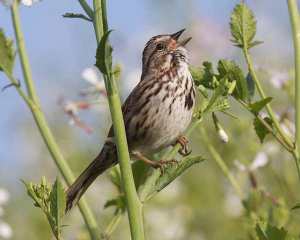
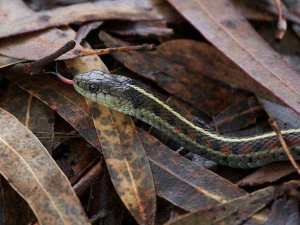
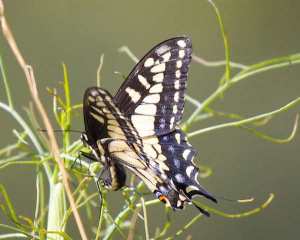
This comment was written by a talented photographer of wildlife in San Francisco’s parks who prefers to remain nameless. She has exhibited her photos in several venues around town, including San Francisco’s Main Library. She wrote her comment primarily on behalf of the wildlife that lives in our parks and she illustrated it with beautiful photographs of the birds, insects, amphibians, reptiles, and mammals that she has photographed nesting, hiding, hunting, roosting, slithering in non-native plants and trees.
Garter snake in eucalyptus leaf litter
We will share the heart of her comment with you. The soul of her comment is her photographs which were all taken in the parks of San Francisco.
“NAP is actually harming the environment by destroying trees, established habitat, and established ecosystems which include our existing wildlife. NAP wants to recreate our environment as one of native grasses which might have existed in the area in 1776 — in very delimited spaces this seems fine, but they should not be taking over our parks which have evolved on all levels since that time. The grasses were native to a sand-dune ecology, but that is no longer the case within the city, and the grasses provide no protective habitat to the animals which now occupy these spaces — animals which are not on NAP’s “specified” or “endangered” lists. There has been an alarmingly high rate of failure when “endangered” species have been introduced — this is because they are no longer suited to this environment which has evolved and changed since 1776. NAP is a political program, not a program based on science, and one which is hampering people’s enjoyment and use of their parks.”
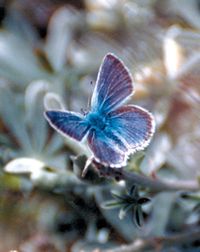
Anise Swallowtail butterfly in non-native fennel
Although we have been engaged in this debate about destructive native plant “restorations” in the Bay Area for many years, we are still shocked by some of the arguments used to defend them. Nature in the City is one of many organizations in San Francisco which considers itself an “environmental” organization. In its latest newsletter, recruiting comments in support of the Environmental Impact Report, Nature in the City characterized critics of the Natural Areas Program and the DEIR as the “anti-nature forces.” As we have said before, “environmentalism” has been stolen from us by the native plant movement, which we firmly believe is doing more harm than good to our environment.
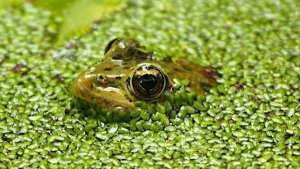
Frog hiding in pond plants
When was “nature” redefined exclusively as “native?” We didn’t get that memo. We are committed to preserving the habitat of all animals that live in San Francisco, whether the animals are native or non-native or the habitat that shelters and feeds them is native or non-native. How does that make us “anti-nature?”
As the deadline for written comments on the Draft Environmental Impact Report on the Natural Resource Areas Management Plan approaches (October 31, 2011), we are reprinting with permission a post from the Save Sutro website about the many violations of San Francisco’s pesticide policy by the Natural Areas Program.
Anyone with the time and patience to read the 600+ page EIR knows that it does not provide us with any information about the volume of pesticides used by the Natural Areas Program. Instead, it claims that the pesticides used by the Natural Areas Program will have no impact on the environment because they are following the rules; therefore, by definition there can be no negative impact on the environment. This seems a non-sequitur to us. But, even if we accepted this illogical premise, the fact is, they AREN’T following the rules. Save Sutro tells us about the many violations of the city’s pesticide policy by the so-called Natural Areas Program.
Details about how to submit your public comment by October 31 are provided at the end of this post.
*************************
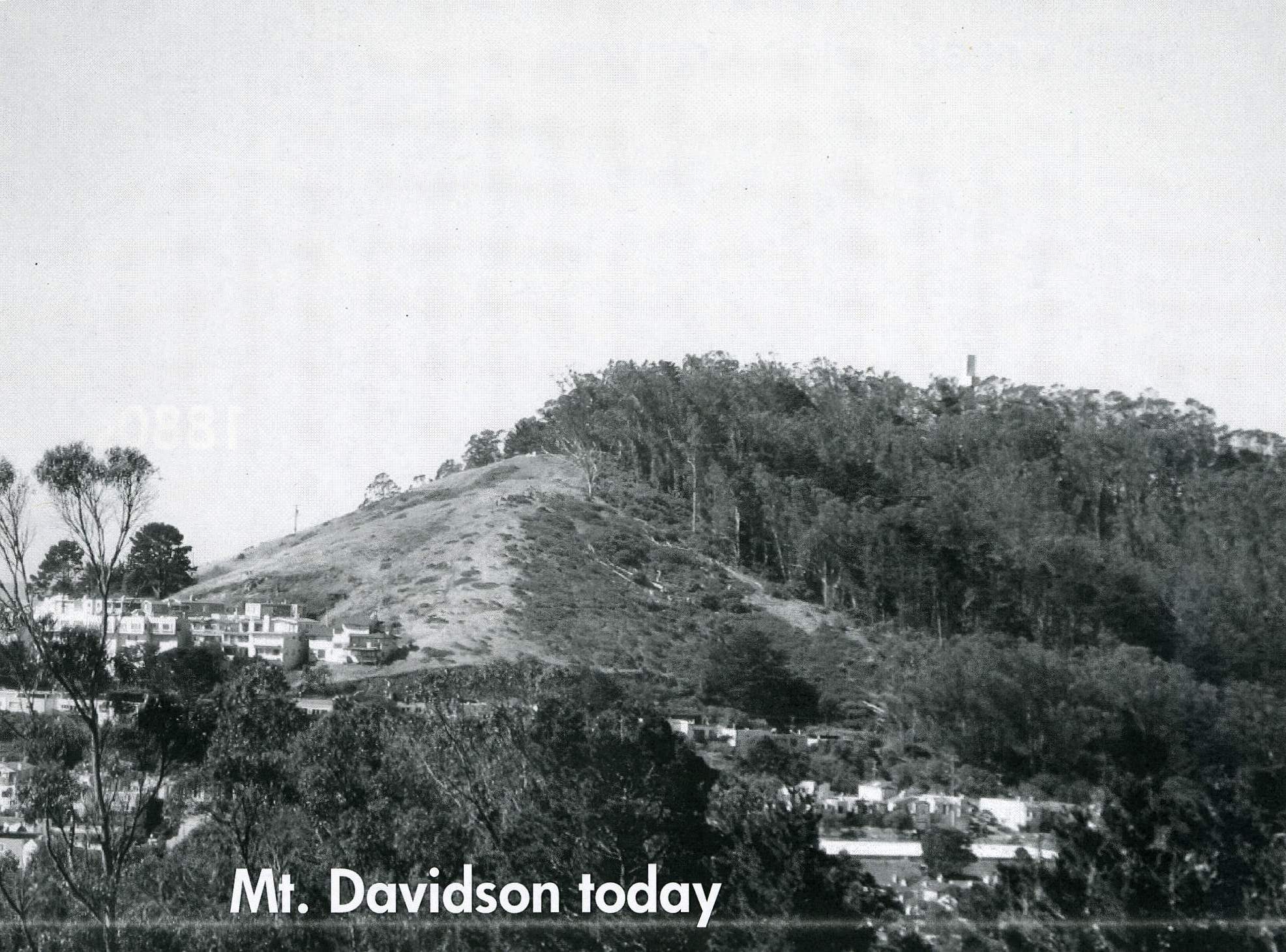
As we noted in our previous post, the San Francisco Natural Areas Program seems to be using increasing amounts of toxic pesticides. From time to time, we’ve posted information here about pesticide use in the Natural Areas Program (NAP) lands. Roundup, Garlon, Imazapyr in Glen Canyon, at Pine Lake, on Twin Peaks, Mt Davidson, in the Interior Greenbelt — usually with a photograph. (Search this site on any pesticide name to see other relevant posts.)
What our readers have pointed out to us is that many of these violate the rules of the San Francisco Department of the Environment (SF DoE). We really appreciate SF DoE regulating toxic pesticides. They’re our second line of defense, when the Environmental Protection Agency seems all too ready to approve first and question later (or not question later). But they can only be effective if their rules stick.
What do we mean, violations? Well, here are a few, all from 2009 and 2010. Were there others? We don’t know.
A BUNCH OF VIOLATIONS
Missing dates on notices. The signs for pesticide spraying are meant to warn people — both the NAP staff and the general public with their kids and pets — that toxic chemicals are in use in an area. It’s pretty well-designed; it requires the dates the application is planned, how it will be applied, and then when it’s been used and when it will be safe to go back in there. But as with every precaution from seat-belts to poison symbols, it only works if it’s used. From the time we started collecting notices (pictures, not the actual notices), we often found key data missing: the date and time of the actual application. That means it’s never clear when (or whether) the pesticides were used and whether it’s safe to re-enter.
Using pesticides before they’re approved. In 2009, when we published a photograph someone sent us of Imazapyr usage at Pine Lake in Stern Grove, other readers were surprised. How come? SF DoE hadn’t approved it for use, had it?
They hadn’t.
It’s been approved only in 2011, as a Tier II pesticide.
Using pesticides where they’re not approved. In November 2010, we saw a notice that said they were spraying Aquamaster (glyphosate, same active ingredient as Roundup) “near shoreline” of Lake Merced. The target plant was “ludwigia – aquatic weed.” Also known as water-primrose, this grows in the water and presumably that’s what they were after. Except… Lake Merced is red-legged frog habitat. Use there is restricted: “Note prohibition on use within buffer zone (generally 60 feet) around water bodies in red-legged frog habitat.” (Glyphosate is death on frogs.) This was a lot less than 60 feet.
Spraying when they shouldn’t be spraying. According to the SF DoE, here’s how Roundup should be used: “Spot application of areas inaccessible or too dangerous for hand methods, right of ways, utility access, or fire prevention…OK for renovations but must put in place weed prevention measures. Note prohibition on use within buffer zone (generally 60 feet) around water bodies in red-legged frog habitat.” But according to all the notices (and the records) they’ve been using a backpack sprayer.
Spraying Garlon without a respirator.The signs said Garlon. The SF DoE regs said that this Tier I pesticide was for “Use only for targeted treatments of high profile or highly invasive exotics via dabbing or injection. May use for targeted spraying only when dabbing or injection are not feasible, and only with use of a respirator. HIGH PRIORITY TO FIND ALTERNATIVE.” The person spraying wore a blue “space-suit” — but no respirator. (Don’t know who it was, whether a Parks employee or someone from contractor Shelterbelt. Whoever, please be careful. The regs are there for a reason.)
Poorly maintained data. Pesticide use is recorded, and again the records are pretty specific. The serial number of the use, and the date. The chemical used, its trade name and chemical name and its EPA number. Where it’s been applied, and what it’s targeting. Who applied it. Analyzing these records would give a pretty good idea of who’s using what, where and why. But… the records aren’t complete, or at least they don’t appear to be. We’ve found notices in the field with no corresponding database entry.
IMPLICATIONS FOR THE DEIR
We understand how these violations occur. We don’t attribute adverse motives to NAP; they’re not going through the books thinking, which rule shall we break today? Remembering all the restrictions, maintaining records and filling in signs is tedious, and it’s easy to forget in the press of work. Even NASA makes mistakes.
Still, the objective of the rules is to keep us all safer and reduce the use of toxins as far as possible. With good reason, we don’t think the NAP is able to comply.
As readers will be aware, the Draft Environmental Impact Report (DEIR) for the San Francisco Natural Areas Management Plan is now open for public comment. What the DEIR says is: “Pesticide and herbicide use in the Natural Areas would be in accordance with the SFRPD’s Integrated Pest Management (IPM) Program and San Francisco’s Integrated Pest Management Ordinance...”
Seriously? Can they even do it?
——————————————————————————
[Edited to add:
For readers who are interested in commenting on the DEIR:
“A public hearing on this Draft EIR and other matters has been scheduled by the City Planning Commission for October 6, 2011, in Room 400, City Hall, 1 Dr. Carlton B. Goodlett Place, beginning at 1:30 p.m. or later. (Call 558‐6422 the week of the hearing for a recorded message giving a more specific time.)”
“Public comments will be accepted from August 31, 2011 to 5:00 p.m. on October 17 31, 2011. [Please note, the deadline has been extended.] Written comments should be addressed to Bill Wycko, Environmental Review Officer, San Francisco Planning Department, 1650 Mission Street, Suite 400, San Francisco, CA 94103. Comments received at the public hearing and in writing will be responded to in a Summary of Comments and Responses document.”
“If you have any questions about the environmental review of the proposed project, please call Jessica Range at 415‐575‐9018.”]
We are reprinting with permission an article from the Save Sutro website about the pesticides being used by San Francisco’s Natural Areas Program. The Save Sutro website is a valuable source of reliable information on any topic it covers, but it is especially knowledgeable about the pesticides being used in San Francisco.
*****************************
It’s no surprise that people are beginning to associate San Francisco’s Natural Areas Program with pesticides. It’s been using them (if the city’s records are accurate) at an increasing rate.
In 2009, it applied Garlon 16 times; in 2010, it was 36 times.
It applied Roundup (or Aquamaster, also glyphosate) only 7 times in 2009, but 42 times in 2010.
The Draft Environmental Impact Report (DEIR) on the SF Natural Areas Program is rather coy about pesticides. It doesn’t say how much it’ll use, just that it will follow all the rules when using them. (They actually have a poor track record there, but we’ll go into that in another post. [Edited to Add: We did.]) Today, we want to talk about the pesticides on their list: Roundup or Aquamaster (glyphosate); Garlon (triclopyr); Polaris (imazapyr); Milestone (aminopyralid).
SF’s Dept of the Environment classifies all of these as Tier I (Most Hazardous) or Tier II (Hazardous). There’s no mention of using any Tier III (Least Hazardous) chemicals.
ROUNDUP or AQUAMASTER (Glyphosate)
We’ve talked before of Roundup, a Tier II pesticide. We hope that in view of the new research that has been surfacing, SF’s DoE will revisit that classification and consider if it deserves a Tier I rating.
heart breaking
It’s been associated with birth-defects, especially around the head, brain and neural tube — defects like microcephaly (tiny head); microphthalmia (tiny undeveloped eyes); impairment of hindbrain development; cyclopia (also called cyclocephaly – a single eye in the middle of the forehead).
Research indicates it kills beneficial soil fungi while allowing dangerous ones to grow.
It binds to the soil, and acts as a “chelating agent” – trapping elements like magnesium that plants need to grow and thus impoverishing the soil.
It’s very dangerous to frogs and other amphibians, and quite dangerous to fish.
GARLON (Triclopyr)
Classified as Tier I, Garlon is even more hazardous than Roundup. In 2010, NAP used this pesticide 36 times (sometimes in combination with Roundup, which it has said it will no longer do). We’ve written about Garlon before, Garlon in our Watershed — which has more details — and many times since then. In brief, these are the main issues:
Garlon “causes severe birth defects in rats at relatively low levels of exposure.” Baby rats were born with brains outside their skulls, or no eyelids. Exposed adult females rats also had more failed pregnancies.
Rat and dog studies showed damage to the kidneys, the liver, and the blood.
About 1-2% of Garlon falling on human skin is absorbed within a day. For rodents, it’s absorbed twelve times as fast. It’s unclear what happens to predators such as hawks that eat the affected rodents.
Dogs may be particularly vulnerable; their kidneys may not be able to handle Garlon as well as rats or humans. Dow Chemical objected when the Environmental Protection agency noted decreased red-dye excretion as an adverse effect, so now it’s just listed as an “effect.”
It very probably alters soil biology. “Garlon 4 can inhibit growth in the mycorrhizal fungi…” ( soil funguses that help plant nutrition.)
It’s particularly dangerous to aquatic creatures: fish (particularly salmon); invertebrates; and aquatic plants.
Garlon can persist in dead vegetation for up to two years.
The DEIR has said that the SF NAP’s phasing out Garlon. We have some doubts; its tree-felling program will be futile without Garlon to prevent re-sprouts.
POLARIS, HABITAT (Imazapyr)
This is a very new pesticide, and not much is known about it — except that it’s very persistent. SF’s DoE has recently approved it for use as a Tier II hazard. It not only doesn’t degrade, some plants excrete it through their roots so it travels through the environment. We’ve written about this one, too, when NAP recently started using it on Twin Peaks and Glen Canyon. (Actually, NAP had started using it prior to SF DoE’s approval , in Stern Grove and also at Lake Merced in 2009 and some unspecified NAP area in 2008.)
About its impact on people, we wrote: “it can cause irreversible damage to the eyes, and irritate the skin and mucosa. As early as 1996, the Journal of Pesticide Reform noted that a major breakdown product is quinolic acid, which is “irritating to eyes, the respiratory system and skin. It is also a neurotoxin, causing nerve lesions and symptoms similar to Huntington’s disease.”
It’s prohibited in the European Union countries, since 2002; and in Norway since December 2001.
MILESTONE (Aminopyralid)
Milestone is a Dow product that kills broadleaf plants while ignoring most grasses. While the DEIR lists this as a chemical used by the NAP, they actually used Milestone very little (twice in 2010). Fortunately. SF DoE classifies it as Tier I, Most Hazardous. This is even more problematically persistent than Imazapyr; a computer search yielded warnings of poisoned compost.
What?
It seems that this chemical is so persistent that if it’s sprayed on plants, and animals eat those plants, it still doesn’t break down. They excrete the stuff in their droppings. If those are composted — it still doesn’t break down the chemical. So now the compost’s got weedkiller in it, and it doesn’t nourish the plants fertilized with the compost, it kills them.
The manufacturer sees this as a benefit. “Because of its residual activity, control can last all season long, or into the season after application on certain weed species,” says the Dow AgroSciences FAQ sheet.
Nevertheless, after an outcry and problems, Dow AgroSciences has stopped selling Milestone in the UK until it’s figured out.
Note to NAP and SFRPD: Don’t put clippings treated with Milestone in the green bin!
PESTICIDE CONSPIRACY THEORIES
When we first started researching pesticide use in “Natural Areas” (and shocking a lot of people who’d assumed “Natural” meant natural), conspiracy theories arose: The chemicals companies were subverting the decision-makers; Pesticides were being portrayed as ecological, and the marketing machine was convincing them; Maybe there were even payoffs!
We think the explanation is much simpler: Those in charge of the Natural Areas are being asked to do the impossible. They’re given a large area, (ETA: it’s as big as Golden Gate Park but in 32 separate locations) in the middle of a city where conditions don’t even approximate those of the pre-industrial era, and asked to return it to a specific moment in time.
It doesn’t want to go.
WHY NATURAL AREAS FIGHT BACK
Someone described the effort to “restore” the “Natural Areas” to “Native plants” as a constant battle. It is, and here’s why:
Stopping natural succession. Some areas are harder than others. Grasslands want to grow shrubs, native or not. Then, in pre-industrial San Francisco, along would come grazing browsing animals, or lightning strikes, or a landslide or two, and the shrubs would lose and the grass would win. Preserving grasslands requires killing the shrubs, and in the absence of animals and fires and landslides, it’s pesticides. Repeatedly.
Battling successful plants. And then there are the plants that do want to grow there, that grow there naturally (even if, like many San Franciscans, they’re not from here). These we call invasive, and want to get rid of them. That’s more pesticides. And since the plants are good at what they do, they have to be strong pesticides. Repeatedly.
“Invaders” compete with each other. Even if the pesticides clear an area of one kind of “invasive” plant, unless the space is intensively gardened, it’ll be taken over by other “invaders.” More pesticides.
The bison in the room (it’s native, unlike the elephant) is this: Contrary to the belief that Native Plants are so adapted to a particular place that “restorations” can be achieved merely by eradicating unwanted plants — Native Plant gardens need the same kind of maintenance and care as any garden.
Without the Sutro Stewards’ volunteers working there every month or so, the Native Garden on top of Mount Sutro would revert to its natural state: a mix of native and introduced plants. (No pesticides are used in that area, or indeed anywhere on UCSF’s Mount Sutro space. It may be the last pesticide-free wild area in San Francisco.)
Is the Natural Areas Program, as it’s currently managed, worth it? We think not, because of:
the ongoing and growing need for toxic herbicides;
we think it’s an expensive misdirected effort in terms of time and treasure.
It makes sense to define small areas as Native Gardens, focus on those, and make them succeed. That can be done — as the Native Garden on Mount Sutro proves — without toxic chemicals.
With permission and in its entirety we are publishing the comment of Arthur M. Shapiro. He is Distinguished Professor of Evolution and Ecology at UC Davis and a renowned expert on the butterflies of California. We hope that you will take his credentials into consideration as you read his opinion of native plant restorations in general and the Natural Areas Program in San Francisco in particular. We hope that Professor Shapiro’s comment will inspire you to write your own comment by the deadline, which has been extended to October 31, 2011. Details about how to submit your comment are available here.
*************************
October 6, 2011
Mr. Bill Wycko
San Francisco Planning Department
Re: DRAFT EIR, NATURAL AREAS PROGRAM
Dear Mr. Wycko:
Consistent with the policy of the University of California, I wish to state at the outset that the opinions stated in this letter are my own and should not be construed as being those of the Regents, the University of California, or any administrative entity thereof. My affiliation is presented for purposes of identification only. However, my academic qualifications are relevant to what I am about to say. I am a professional ecologist (B.A. University of Pennsylvania, Ph.D. Cornell University) and have been on the faculty of U.C. Davis since 1971, where I have taught General Ecology, Evolutionary Ecology, Community Ecology, Philosophy of Biology, Biogeography, Tropical Ecology, Paleoecology, Global Change, Chemical Ecology, and Principles of Systematics. I have trained some 15 Ph.D.s, many of whom are now tenured faculty at institutions including the University of Massachusetts, University of Tennessee, University of Nevada-Reno, Texas State University, and Long Beach State University, and some of whom are now in government agencies or in private consulting or industry. I am an or the author of some 350 scientific publications and reviews. The point is that I do have the bona fides to say what I am about to say.
At a time when public funds are exceedingly scarce and strict prioritization is mandatory, I am frankly appalled that San Francisco is considering major expenditures directed toward so-called “restoration ecology.” “Restoration ecology” is a euphemism for a kind of gardening informed by an almost cultish veneration of the “native” and abhorrence of the naturalized, which is commonly characterized as “invasive.” Let me make this clear: neither “restoration” nor conservation can be mandated by science—only informed by it. The decision of what actions to take may be motivated by many things, including politics, esthetics, economics and even religion, but it cannot be science-driven.
In the case of “restoration ecology,” the goal is the creation of a simulacrum of what is believed to have been present at some (essentially arbitrary) point in the past. I say a simulacrum, because almost always there are no studies of what was actually there from a functional standpoint; usually there are no studies at all beyond the merely (and superficially) descriptive. Whatever the reason for desiring to create such a simulacrum, it must be recognized that it is just as much a garden as any home rock garden and will almost never be capable of being self-sustaining without constant maintenance; it is not going to be a “natural,” self-regulating ecosystem. The reason for that is that the ground rules today are not those that obtained when the prototype is thought to have existed. The context has changed; the climate has changed; the pool of potential colonizing species has changed, often drastically. Attempts to “restore” prairie in the upper Midwest in the face of European Blackthorn invasion have proven Sisyphean. And they are the norm, not the exception.
The creation of small, easily managed, and educational simulacra of presumed pre-European vegetation on San Francisco public lands is a thoroughly worthwhile and, to me, desirable project. Wholesale habitat conversion is not.
A significant reaction against the excesses of the “native plant movement” is setting up within the profession of ecology, and there has been a recent spate of articles arguing that hostility to “invasives” has gone too far—that many exotic species are providing valuable ecological services and that, as in cases I have studied and published on, in the altered context of our so-called “Anthropocene Epoch” such services are not merely valuable but essential. This is a letter, not a monograph, but I would be glad to expand on this point if asked to do so.
I am an evolutionary ecologist, housed in a Department of Evolution and Ecology. The two should be joined at the proverbial hip. Existing ecological communities are freeze-frames from a very long movie. They have not existed for eternity, and many have existed only a few thousand years. There is nothing intrinsically sacred about interspecific associations. Ecological change is the norm, not the exception. Species and communities come and go. The ideology (or is it faith?) that informs “restoration ecology” basically seeks to deny evolution and prohibit change. But change will happen in any case, and it is foolish to squander scarce resources in pursuit of what are ideological, not scientific, goals with no practical benefit to anyone and only psychological “benefits” to their adherents.
If that were the only argument, perhaps it could be rebutted effectively. But the proposed wholesale habitat conversion advocated here does serious harm, both locally (in terms of community enjoyment of public resources) and globally (in terms of carbon balance-urban forests sequester lots of carbon; artificial grasslands do not). At both levels, wholesale tree removal, except for reasons of public safety, is sheer folly. Aging, decrepit, unstable Monterey Pines and Monterey Cypresses are unquestionably a potential hazard. Removing them for that reason is a very different matter from removing them to actualize someone’s dream of a pristine San Francisco (that probably never existed).
Sociologists and social psychologists talk about the “idealization of the underclass,” the “noble savage” concept, and other terms referring to the guilt-driven self-hatred that infects many members of society. Feeling the moral onus of consumption and luxury, people idolize that which they conceive as pure and untainted. That may be a helpful personal catharsis. It is not a basis for public policy.
Many years ago I co-hosted John Harper, a distinguished British plant ecologist, on his visit to Davis. We took him on a field trip up I-80. On the way up several students began apologizing for the extent to which the Valley and foothill landscapes were dominated by naturalized exotic weeds, mainly Mediterranean annual grasses. Finally Harper couldn’t take it any more. “Why do you insist on treating this as a calamity, rather than a vast evolutionary opportunity?” he asked. Those of us who know the detailed history of vegetation for the past few million years—particularly since the end of Pleistocene glaciation—understand this. “Restoration ecology” is plowing the sea.
We have been debating with native plant advocates for a long time, so we’re never surprised when they repeat vague generalities to support their ideology. But when these fabricated “facts” are repeated in legal documents such as the Draft Environmental Impact Report (EIR) for the Natural Areas Program (NAP) we must admit that we’re shocked! Apparently, the highly paid professionals who write such documents don’t expect the public to actually read the references they cite to support the statements they fabricate. We will take our readers on a tour of some of the phony “science” used to defend the destruction of San Francisco’s urban forest in order to restore native grassland and scrub to San Francisco’s urban parks.
Why is carbon storage such an issue in this debate about the Natural Areas Program?
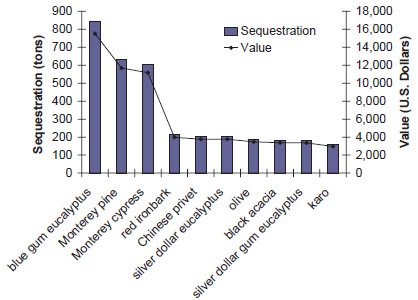
The urban forest of San Francisco stores 196,000 tons of carbon and adds to that accumulated store of carbon at an annual rate of 5,200 tons per year according to the US Forest Service survey. About 25% of the annual rate of sequestration and the accumulated storage of carbon are accomplished by the blue gum eucalyptus, the chief target for destruction by NAP’s plans. When a tree is destroyed, it releases the carbon that has accumulated throughout its lifetime into the atmosphere as Carbon Dioxide as it decays. Carbon Dioxide is the predominant greenhouse gas that is causing climate change.
Carbon storage by tree species, San Francisco. US Forest Service
Since greenhouse gases are regulated in California by a law that commits the state to reduce greenhouse gas emissions, the Environmental Impact Report (EIR) for the Natural Areas Program (NAP) goes to great lengths to make the case that destroying thousands of trees will not violate California law. Here are just a few of the “facts” fabricated by the EIR to convince the public that NAP’s plans to convert San Francisco’s urban forest into grassland and scrub will not harm the environment.
Grassland in the San Francisco Bay Area does NOT lower ground temperature
The EIR claims:
“According to a study presented at the American Geophysical Union’s meeting, grasslands above 50 degrees latitude reflect more sun than forest canopies, thereby keeping temperatures lower by an average of 0.8 degree Celsuis.” (EIR, page 457, cited source(1))
This statement in the EIR does not apply to the San Francisco Bay Area and the reference used to support it misrepresents the cited study:
The entire continental United States, including the San Francisco Bay Area, is below 50 degrees latitude. In other words, this statement—even if it were true—does not apply to the San Francisco Bay Area.
The statement is taken out of the context of the article. The entire sentence in which this statement appears actually says, “Grassland or snowfields, however, reflected more sun, keeping temperatures lower. Planting trees above 50 degrees latitude, such as in Siberia, could cover tundras normally blanketed in heat-reflecting snow.” It does not snow in the San Francisco Bay Area. Therefore, this statement does not apply to the San Francisco Bay Area.
The article being quoted by the EIR is NOT the scientific study, but rather a journalistic article in The Guardian, a newspaper in England, in which the author of the study has been misquoted and his study misrepresented.
The day after this article appeared in The Guardian (and also in the New York Times), The Guardian published an op-ed (which also appeared in the New York Times) by the author of the scientific study, Ken Caldeira in which he objected to the misrepresentation of his study:
“I was aghast to see our study reported under the headline “Planting trees to save planet is pointless, say ecologists.” (December 15). Indeed, our study found that preserving and restoring tropical forests is doubly important, as they cool the earth both by removing the greenhouse gas carbon dioxide from the atmosphere and by helping produce cooling clouds. We did find that preserving and restoring forests outside the tropics does little or nothing to help slow climate change, but nevertheless these forests are a critical component of Earth’s biosphere and great urgency should be placed on preserving them.”(2) (emphasis added)
As if this misrepresentation of the facts weren’t bad enough, we find in Appendix A of the EIR that this isn’t the first time that someone has informed the authors of the EIR that this statement is not accurate. One of the public comments submitted in 2009 in response to the Initial Study quotes Ken Caldeira’s op-ed in the New York Times. Yet, two years later, the author of the EIR persists in repeating this misrepresentation of Professor Caldeira’s (Stanford University) research. One wonders if the public comments were even read, judging by the repetition of the pseudoscience in the Initial Study that the public commented on in the first round. It seems that the “public process” is merely going through the motions.
Grassland does NOT store more carbon than forests
The EIR also claims:
“Research studies have concluded that grassland and scrub habitat could act as a significant carbon sink.” (page 457, cited studies(3))
Once again, the cited study does not support the statement in the EIR:
Again, the statement has been taken out of context. The entire sentence reads, “We conclude that grasslands can act as a significant carbon sink with the implementation of improved management.” This sentence appears in the abstract for the publication.(4)
One wonders if the authors of the EIR read the entire article or just the abstract. The point of the study is that land management techniques such as fertilization, irrigation, introduction of earthworms, plowing and fallow techniques, etc., can improve the sequestration of carbon in the soil of croplands and pastures. This study is obviously irrelevant to the Natural Areas Program, which is not engaged in agriculture or pasturage and will not use any of these techniques.
However, the study is relevant in one regard. It reports that when forest is converted to grassland, no amount of “management techniques” compensates for the loss of the carbon in the trees that are destroyed:
“Though more than half of the rain forest conversion studies (60%) resulted in increased soil Carbon content, net ecosystem Carbon balance…decreased substantially due to the loss of large amounts of biomass carbon.”
The second study cited in support of the claim about carbon storage in grassland reports that increased levels of Carbon Dioxide in the air increases carbon accumulation in the soil. This study tells us nothing about the relative merits of grassland and forests with respect to carbon storage. Another study reports a similar relationship between global warming and carbon storage in trees: “…warmer temperatures stimulate the gain of carbon stored in trees as woody tissue, partially offsetting the soil carbon loss to the atmosphere.” (5)
A pointless debate that misses the point
The misuse of these studies illustrates one of the fundamental issues with this pointless debate about the relative merits of grassland and forests. Even if grassland were superior to forests with respect to carbon storage—and it’s NOT—it would never compensate for the loss of carbon associated with destroying a forest that is storing hundreds of thousands of tons of carbon. The merits of planting trees where none presently exist is a fundamentally different argument than the merits of destroying trees. The trees are here now. No amount of grassland will compensate for the loss of the carbon presently stored by the forest that native plant advocates demand be destroyed.
If there is a sound argument for destroying trees, this isn’t it. Grassland does not store more carbon than trees and will never compensate for the loss of the tons of carbon released into the atmosphere when trees are destroyed. (Please visit our post “Facts about carbon storage do not support assumptions of native plant advocates”) Native plant advocates would be wise to abandon this particular line of unreasoning.
Although we are not scientists, we read the work of scientists. The studies conducted by scientists are not theoretical speculations about the benefits of one plant compared to another. Rather they report the results of controlled experiments, such as actually measuring the amount of carbon in the plant and/or soil and reporting the results of those experiments. Native plant advocates would be wise to spend less time trading baseless generalizations amongst themselves and spend more time reading the scientific reports of actual evidence.
Please comment on the Draft Environmental Impact Report for the Natural Areas Program
Please keep in mind that the public will have an opportunity to comment on the proposal to remove thousands of trees in the city’s parks. There will be a public hearing on October 6, 2011, and the deadline for submitting a written comment is October 17, 2011*. Here are the details about the public’s opportunities to comment on the EIR for the Natural Areas Program:
“A public hearing on this Draft EIR and other matters has been scheduled by the City Planning Commission for October 6, 2011, in Room 400, City Hall, 1 Dr. Carlton B. Goodlett Place, beginning at 1:30 p.m. or later. (Call 558‐6422 the week of the hearing for a recorded message giving a more specific time.)”
“Public comments will be accepted from August 31, 2011 to 5:00 p.m. on October 17, 2011*. Written comments should be addressed to Bill Wycko, Environmental Review Officer, San Francisco Planning Department, 1650 Mission Street, Suite 400, San Francisco, CA 94103. Comments received at the public hearing and in writing will be responded to in a Summary of Comments and Responses document.”
*[ETA: The deadline for written comments has been extended to October 31, 2011 at the request of the Planning Commission.]
“If you have any questions about the environmental review of the proposed project, please call Jessica Range at 415‐575‐9018.”
(1) Jha, Alok. The Guardian. “Planting Trees to Save Planet is Pointless, Say Ecologists.” Friday, December 15, 2006.
(2) Caldeira, Ken, “Planting trees is far from pointless.” The Guardian, December 16, 2006.
(3) Conant, L., Paustian K, and Elliot E. 2001. “Grassland Management and Conversion into Grassland Effects on Soil Carbon.” Natural Resource Ecology Laboratory. Colorado State University. Fort Collins, USA. Sponsor: US Environmental Protection Agency, Ruminant Livestock Efficiency Program. 2001, and
Hu, S., Chapin, Firestone, Field, Chiariello. 2001. “Nitrogen limitation of microbial decomposition in a grassland under elevated C02,” Nature 409: 188-191.
(4) Conant, Paustian, Elliott, “Grassland Management and Conversion into Grassland Effects on Soil Carbon,” Ecological Applications, 11 (2) 2001, 341-355.
(5) Melillo, J., Butler, S., Johnson, J., Mohan, J., Steudler, P., Lux, H., Burrows, E., Bowles, F., Smith, R., Scott, L., Vario, C., Hill, T., Burton, A., Zhouj, Y, and Tang, J. Soil warming carbon-nitrogen interactions and carbon-nitrogen budgets. PNAS, May 23, 2011
The EIR says on page 2 in the Summary that the “Maximum Restoration Alternative” is the “Environmentally Superior Alternative.” The statement on page 2 is WRONG! The “Maintenance Alternative” is the “Environmentally Superior Alternative,” as explained on page 525-526 of the EIR.
When we first informed our readers of the publication of the Environmental Impact Report (EIR) for the Natural Areas Program (NAP) on September 9, 2011, we also announced that the EIR considers the “Maximum Restoration Alternative” the “Environmentally Superior Alternative.” The “Maximum Restoration Alternative” proposes an aggressive expansion of the NAP that will destroy more trees, require more herbicide use, close more trails and other recreational access, and permit NAP to plant more legally protected species that could require more restrictions in the future. When we announced this proposed expansion of the program, we were reporting what the EIR says on page 2 in the Summary of the EIR.
So, we repeat, the statement on page 2 is wrong. The “Maximum Restoration Alternative” is NOT the “Environmentally Superior Alternative.” The “Environmentally Superior Alternative” is the “Maintenance Alternative.” The correct statement does not appear in the EIR until the very end of the document:
“The Maximum Recreation and Maintenance Alternatives are the environmentally superior alternatives because they have fewer unmitigated significant impacts than either the proposed project or the Maximum Restoration Alternative. Between the Maximum Recreation Alternative and the Maintenance Alternative, the Maintenance Alternative would be the environmentally superior alternative for two reasons. While the two alternatives have the same number of significant and unavoidable impacts under CEQA, the Maintenance Alternative has fewer potential environmental effects than the Maximum Recreation Alternative. First, the Maintenance Alternative would not create new trails, the construction of which could result in impacts to sensitive habitats and other biological resources. Second, over time the Maximum Recreation Alternative would result in Natural Areas with less native plant and animal habitat and a greater amount of nonnative urban forest coverage. The Maintenance Alternative, on the other hand, would preserve the existing distribution and extent of biological resources, including sensitive habitats. For these reasons, the Maintenance Alternative is the environmentally superior alternative.” (EIR, page 525-526) (emphasis added)
The contradiction between what appears on page 2 of the EIR and page 526 was pointed out to the staff of the Planning Department responsible for managing the public comment period and certification of the EIR. That staff member confirmed that the statement on page 2 is wrong and the statement on page 526 is correct. However, she refused to correct the error until the public comment period is over and the Final Environmental Impact Report is published.
Unfortunately, this mistake and the refusal to correct it before the public comment period is complete will jeopardize the fairness of the process. Native plant advocates are already recruiting their speakers for the public hearing by the Planning Commission on October 6, 2011, and the written comments which are due on October 17, 2011*. They are urging their supporters to advocate for the “Maximum Restoration Alternative” and they are incorrectly informing them that this is the “Environmentally Superior Alternative.” We have no reason to believe that they are aware of the mistake on page 2 of the EIR. They are probably sincere in their belief that the “Maximum Restoration Alternative” is the “Environmentally Superior Alternative.” Few readers are likely to read the entire EIR and will therefore be unaware of the mistake on page 2.
This mistake will mislead the public into supporting the “Maximum Restoration Alternative” that expands the destructive and restrictive aspects of the Natural Areas Program. Furthermore, and perhaps more importantly, this expansion is NOT legal because it violates the requirements of the California Environmental Quality Act (CEQA), which requires that the “Environmentally Superior Alternative” have the least negative impact on the environment of all proposed alternatives:
Ҥ21002. APPROVAL OF PROJECTS; FEASIBLE ALTERNATIVE OR MITIGATION MEASURES
The Legislature finds and declares that it is the policy of the state that public agencies should not approve projects as proposed if there are feasible alternatives or feasible mitigation measures available which would substantially lessen the significant environmental effects of such projects, and that the procedures required by this division are intended to assist public agencies in systematically identifying both the significant effects of proposed projects and the feasible alternatives or feasible mitigation measures which will avoid or substantially lessen such significant effects.” CEQA Guidelines, page 2 (emphasis added)
Pardon our paranoia….
This is a huge mistake which could profoundly prejudice the public to support the “Maximum Restoration Alternative” which proposes an expansion of the Natural Areas Program. We ask these rhetorical questions:
Who wrote page 2 of the EIR, which incorrectly identifies the “Maximum Restoration Alternative” as the “Environmentally Superior Alternative” and why?
Why does the Planning Department refuse to correct this error before the public comment is complete?
If you attend the public hearing on October 6, 2011, please inform the Planning Commission of this error and write by the deadline of October 17, 2011*, in support of the “Maintenance Alternative” which will do less damage to the environment than the proposed project and the other proposed alternatives. Here are the details about the opportunities for public comment:
“A public hearing on this Draft EIR and other matters has been scheduled by the City Planning Commission for October 6, 2011, in Room 400, City Hall, 1 Dr. Carlton B. Goodlett Place, beginning at 1:30 p.m. or later. (Call 558‐6422 the week of the hearing for a recorded message giving a more specific time.)”
“Public comments will be accepted from August 31, 2011 to 5:00 p.m. on October 17, 2011^. Written comments should be addressed to Bill Wycko, Environmental Review Officer, San Francisco Planning Department, 1650 Mission Street, Suite 400, San Francisco, CA 94103. Comments received at the public hearing and in writing will be responded to in a Summary of Comments and Responses document.”
*[ETA: The deadline for written comments has been extended to October 31, 2011, at the request of the Planning Commission.]