Here is a letter to the editor of the New York Review of Books, February 7, 2013:
“Dear Editor,
Tim Flannery in his review of the Biography of Rachel Carson makes one mistake and that concerns pesticide use reductions in Canada [“A Heroine in Defense of Nature,” NYR, November 22, 2012]. The first Canadian province to ban the ‘cosmetic’ use of specified pesticides and herbicides—i.e., for gardens and flowers, and not for commercial crops—was not Ontario (2009) but Quebec (2006).
This was the result of grassroots activity at the local, municipal level and it was backed by a national organization, the Campaign for Pesticide Reductions (CPR!), of which a leading sponsor (surprisingly perhaps) was the Canadian Labour Congress. The ban was backed by the Canadian Cancer Society, the first of many moves in the direction of cancer prevention, versus cancer treatment and research. Quebec’s move to ban the sale as well as the use of these products was a violation of the federal authority over commerce and it resulted in a challenge under the North American Trade Agreement (NAFTA, Chapter 13).
Some of Rachel Carson’s aims over pesticide use reduction could be achieved by a statute requiring the practice of Integrated Pest Management (IPM), which properly interpreted results in the avoidance, or use reduction, of synthetic organic chemical pesticides wherever possible. Canada, like most countries has not done this: pesticide registration or licensing is easy to get and once a pesticide is on the market, it is very difficult to prevent its proliferation or remove it from the environment. But unlike many Canadian environmental measures, the bans so far on the cosmetic use of pesticides are truly progressive.”
David Bennett
Former Director
Health, Safety and Environment
Canadian Labour Congress
Ottawa, Canada
The North American Trade Agreement is a free trade agreement between the United States, Canada, and Mexico. If you want to do business with the United States, you apparently are not allowed to ban the sale and use of pesticides.
San Francisco’s misnamed Integrated Pest Management policy
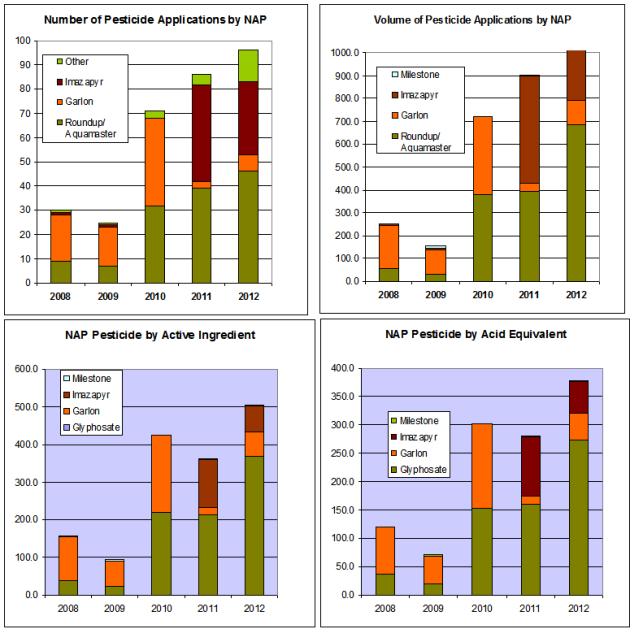
This seems a timely reminder of the difficulty of changing public policy regarding pesticide use. For the third year in a row, San Franciscans recently attended the annual hearing at which the city’s pesticide policy is renewed by the Environment Commission. Citizens reported the escalating use of toxic pesticides in San Francisco’s public parks by the so-called Natural Areas Program. They also repeated their annual request that pesticides considered “Most Hazardous” (Tier I) and “More Hazardous” (Tier II), not be sprayed in public parks.
Volume of pesticide use by San Francisco’s “Natural Areas Program.” Courtesy San Francisco Forest Alliance
Once again, the public’s request fell on deaf ears. In fact, the only changes to the city’s pesticide policy liberalized the use of pesticides by the Natural Areas Program. Milestone which had been rated “Most Hazardous” in the past has now been downgraded to Tier II. This is the pesticide that is mobile in the soil and persists in the soil for a long time. It is banned by the state of New York for sale or use because of concerns about the potential of poisoning ground water. Yet it is used in San Francisco in the watershed to Islais Creek.
Also, Garlon (Tier I) can now be sprayed without the applicator wearing a respirator, which will make it easier and more likely to be used in the future.
However, these two revisions of the city’s pesticide policy pale in comparison to the recent decision of the Recreation and Park Department with respect to promoting the use of pesticides in the city’s parks. The Recreation and Park Department recently announced that the person in charge of the Natural Areas Program is now also in charge of the Department’s pesticide use. This inappropriate decision effectively removes all pretenses that the Natural Areas Program’s use of pesticides is being monitored or supervised. The Natural Areas Program is now free to use pesticides wherever and whenever they wish.
Mr. Bennett makes a mistake in his letter to the editor. He assumes that an Integrated Pest Management policy would avoid or at least reduce pesticide use. San Francisco calls its pesticide policy an Integrated Pest Management program. That policy has obviously not reduced pesticide use in San Francisco’s parks. In fact, it seems to facilitate the use of pesticides. Pesticide use by any name is still pesticide use.
The San Francisco Forest Alliance has made considerable progress in informing the public of the destructive projects of San Francisco’s Natural Areas Program (NAP). NAP and its supporters have taken notice of the growing opposition to their plans to transform our public parks into native plant museums. They are cranking up their public relations effort to confuse the public.
The Recreation and Park Department of the City of San Francisco is the sponsor of the Natural Areas Program. They have recently created a cynical video about NAP which misrepresents the reality of what NAP has done to our parks and what they plan to do in the future. The San Francisco Forest Alliance has produced a rebuttal to this video which is available here. Because the Recreation and Park Department disabled the ability to post comments to their video, we call the rebuttal the “Free Speech Version.”
The Sierra Club has also published an article about the Natural Areas Program in their newsletter, The Yodeler. This article is also chock full of misinformation both about NAP and about its critics. This is our rebuttal to this article. These are issues that we have covered in the past, so we’re not providing much detail here, but we’ve included links to previous Million Trees posts. (The Yodeler article is italicized and in quotes and our rebuttal is not italicized.)
“San Francisco Natural Areas Management Plan in peril”
“In San Francisco, where nearly everyone claims to be an environmentalist, how can there be opposition to certifying environmental review for the city’s Significant Natural Resource Areas Management Plan (SNRAMP) to guide the care of the city’s natural areas?
The plan covers all aspects of preservation for the city’s natural areas, which include many of the most vital remnants of the city’s original ecosystems, including a diverse array of landscapes and habitat types.”
Webmaster: There is no opposition to an environmental review of the Natural Areas Program. Rather there is opposition to the Draft EIR because it is a white wash. The Draft EIR fabricates a plan which is easy to defend but bears little relationship to the written plan (SNRAMP) that it is legally obligated to evaluate.
Most of the natural areas had no native plants in them when they were designated as natural areas. The claim that the natural areas are “remnants of original ecosystems” is bogus. Some were essentially building rubble from the constructions of former occupants of the land.
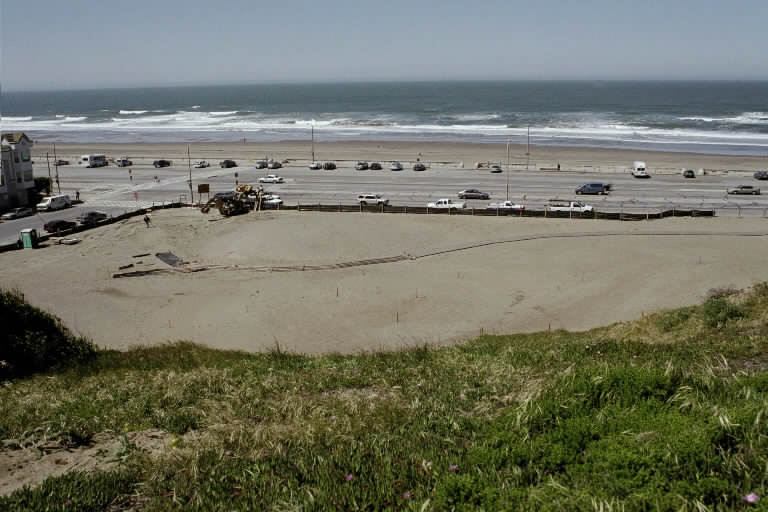
Balboa Natural Area under construction
“Much of the conflict surrounding the plan has to do with concerns about tree removal. Most of the trees in the designated natural areas will remain where they are. The vast majority of lands—including almost all the lands within the less critical MA-2 and MA-3 management subareas—will remain forested.”
Webmaster: Native plant advocates killed approximately 1,200 trees by girdling them before they were caught and stopped. Since then NAP has destroyed hundreds of trees in many natural areas. Their written plans (SNRAMP) state that they plan to destroy 18,500 trees over 15 feet tall and countless smaller trees which they choose not to define as trees.
“However, many trees are in sorry shape, suffering from old age, disease, beetle infestations, and cumulative damage from years of neglect.”
Webmaster: The trees that NAP plans to remove are not hazardous or unhealthy. They have been selected for removal solely because they are shading native plants or areas where NAP wishes to expand existing native plant gardens. Most of the plants that are native to San Francisco require full sun. The written plan makes this reason for tree removals perfectly clear. Those who claim that the trees are unhealthy have either not read the written plan or they willfully misrepresent it.
Critics of NAP are not opposed to the removal of hazardous trees. The City of San Francisco has the right and the obligation to identify hazardous trees and remove them. Neither a written management plan for NAP nor an Environmental Impact Report is required to remove hazardous trees.
“Some trees are the wrong species in the wrong places, displacing habitat needed by native birds, pollinators, and other critters. A stand of planted blue gum or Monterey cypress may be large and “majestic”, but take up space needed for native habitat (grassland, dune-scrub, oak woodlands, etc.)”
Webmaster: This is the heart of the controversy. Most of the trees will be destroyed only because they are the “wrong species,” not because they are hazardous. Those who know both the science of ecology and the reality of wildlife in San Francisco do not believe that wildlife benefits from the destruction of existing trees and vegetation. Animals have long ago adapted to the existing landscape which has been here for over 150 years. We also make no distinction between native and non-native wildlife. Both are equally valuable to us and we find the distinction distasteful, just as we find racial prejudice distasteful.
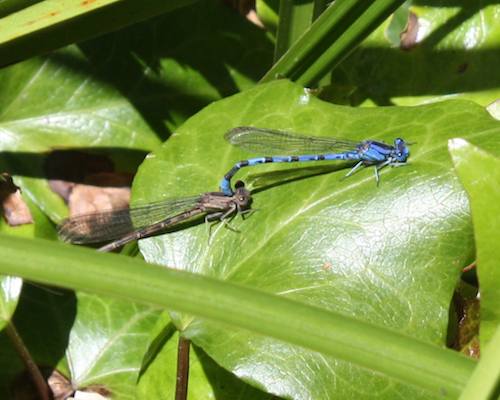
Damselflies mating on ivy in Glen Canyon Park
“The SNRAMP is designed to strike a balance, making the most of the ecological value of existing forested areas while in certain critical areas (such as small patches on Mount Davidson), the plan calls for limited tree removal.”
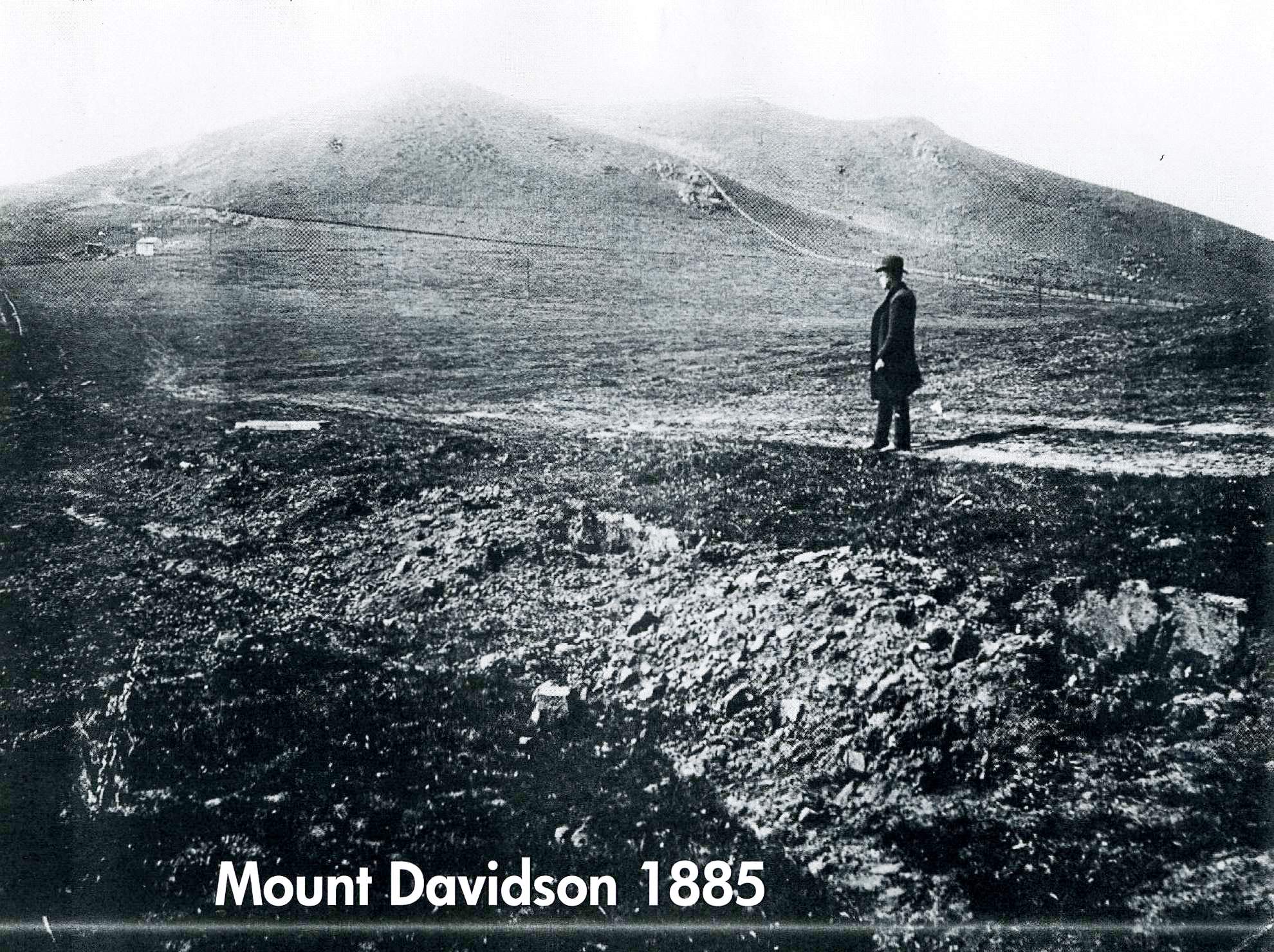
Webmaster: Mt. Davidson will lose 1,600 trees over 15 feet tall when SNRAMP is implemented in addition to about 200 trees that have already been destroyed by NAP or its supporters. Most of the trees on 10.2 acres of Mt. Davidson will be destroyed. This is not a “small patch.”
“Unfortunately, a small but vocal group of “tree advocates” has been campaigning loudly against any tree removal in any park, anywhere in the city. They have exaggerated the envisioned amounts of tree-removal, and promulgated disinformation about the scope and objectives of the plan, wildly accusing advocates of ecological restoration of wanting to revert the entire park system to its former “wasteland” of dunes and scrub.”
Webmaster: Critics of NAP are not a “small group.” Several thousand people have signed the petitions of the San Francisco Forest Alliance, asking the City’s policy-makers to stop the destruction in San Francisco’s parks.
Here is a quote from the management plan for NAP which clearly states its objectives: “Prior to colonization and the stabilization of dunes and introduction of invasive species, trees were not a dominant feature of the San Francisco peninsula…Much of the area probably resembled the coastal scrub habitats of San Bruno Mountain or the grassland scrub mosaics of the Marin Headlands…The long-term goal of urban management in MA-1 and MA-2 areas…is to slowly convert those areas to native scrub and grassland.”
It is not necessary to exaggerate the objectives of NAP for the 1,100 acres of park land they have claimed as natural areas. Their objectives are clearly stated in their management plan.
“Contention has also come from segments of the well-organized off-leash-dog advocates. Partly because of continuing disagreements with the Golden Gate National Recreation Area over management of Crissy Field and Fort Funston (see September-October 2005, page 23). Some oppose any environmental restriction on dogs, and some seem to object to any fencing anywhere or any attempt to route pedestrian and canine traffic into well-defined paths—even to protect erosion-prone areas or sensitive plantings. We don’t believe that these represent the majority of responsible dog-owners, but they have been the most vocal.”
Webmaster:People who visit San Francisco’s parks with their dogs are impacted by NAP because NAP has claimed 80% of all off-leash areas as “natural areas. Only 118 acres of park land in San Francisco have been designated for off-leash areas. In other words, there are 1,100 acres of “natural areas” but only 118 acres of off-leash areas and NAP has claimed 80% of those 118 acres. (SNRAMP 5-8)
The Draft Environmental Impact Report (DEIR) for NAP proposes to close or reduce the size of several off-leash areas. The DEIR offers no evidence that these areas have been negatively impacted by dogs. It also states that all off-leash areas in the natural areas are subject to closure in the future if it is deemed necessary to protect native plants. Since NAP has offered no evidence that the proposed immediate closures are necessary, one reasonably assumes it will offer no evidence if it chooses to close the remainder of the 80% of all off-leash areas in San Francisco located in natural areas. We know from the DEIR public comments that NAP supporters demand their closure.
Given these facts, no one should be surprised that people who wish to walk their dog in the parks have reacted to the Natural Areas Program and the restrictions it has proposed. The Sierra Club’s representation of dog owners as being unreasonable is unfair and misrepresents the nature of their opposition.
“Some feral-cat advocates have objected to reductions in large feral-cat colonies on park lands. There are also some people who object to the use of any herbicide. Then there are those who argue against the plan from a posture of ecological nihilism. They maintain that under the new conditions informing evolution in the “anthropocene” era, it makes little sense to spend money and resources trying to save native ecosystems which are inevitably doomed to extinction. Rather, they suggest, we should embrace the “rambunctious” exuberance of weeds gone wild.”
Webmaster: The Sierra Club finally acknowledges that NAP uses herbicides. What a breakthrough! However, it tells us nothing about NAP’s herbicide use, which would explain why park visitors object. NAP’s herbicide use has increased over 300% in the past three years. It used herbicides 86 times in 2011and it has sprayed 87 times in the first 9 months of 2012. Most of the herbicides it uses are classified by the City’s Integrated Pest Management Program (IPM) as “Most Hazardous” and “More Hazardous.”
The Draft Environmental Impact Report (DEIR) for NAP says next to nothing about NAP’s pesticide use. It does not report either the volume of pesticide use or the types of pesticide used. This is one of the conspicuous omissions in the DEIR for which it is criticized. If that omission is not corrected in the final version, you can be sure that the public will object.
In naming a new geologic era the Anthropocene, scientists are merely acknowledging man’s pervasive impact on the Earth. Acknowledging this fact does not “give up” on the Earth. Rather it offers us the opportunity to adopt more realistic goals of what we can accomplish while making a commitment to stop damaging the environment further with the pesticides and prescribed burns that are used by the restoration industry and its sponsors in the chemical industry.
“All these concerns have already been addressed in the planning process leading up to the issuance and approval of the management plan, during countless public meetings. The purpose of environmental review is to assess the environmental impacts of the plan. The current Draft Environmental Impact Report (EIR) does this in a reasonable fashion, and to that extent—at least for the San Francisco portions of the plan—it is adequate and complete. It is beyond the scope of an EIR to resolve all the underlying conflicts”
Webmaster: There were three public meetings prior to the approval of the management plan in 2006. The Recreation and Park Commission held one public hearing (in two sessions) when they approved the management plan. All other public hearings were demanded by critics of NAP in a fruitless attempt to convince the Recreation and Park Department to revise its plans so that NAP would be less destructive.
“The final draft of the SNRAMP was published in 2006, but the environmental review process has been continuously delayed. As a result, a whole new cast of characters has come into play, including new planning commissioners, new staff, and new voices among the advocacy groups. These each have had to be brought up to speed, inevitably some protest that their voices were not heard, and the whole process gets delayed even more.”
There is new opposition to NAP because the public has had six more years of experience with NAP. They have watched the plans being implemented in their parks even though there is still no approved Environmental Impact Report and they don’t like what they see.
Critics of NAP do not need to be “brought up to speed.” We can see with our own eyes the destruction of our parks and the conflict caused by the extremist vision of recreating wilderness in the second most densely populated city in the country.
No amount of smoke can obscure the reality of the Natural Areas Program.
Update: US Fish & Wildlife published the final rule designating critical habitat for Franciscan manzanita on December 20, 2013. 230.2 acres of land in San Francisco have been designated as critical habitat: 46.6 acres of federal land, 172.8 acres of parks owned by San Francisco’s Recreation and Parks Department, and 10.8 acres of private land. The complete document is available here. The document responds to public comments and explains any differences between the proposed designation and the final rule. It makes interesting reading.
In addition to the conferral of endangered status, US Fish & Wildlife has designated 318 acres of land in San Francisco as critical habitat for the Franciscan manzanita. Critical habitats are places where the endangered plant is either known to have existed in the past or they are places that provide what the plant needs to survive.
Five of the eleven places in San Francisco designated as critical habitat are on federal land in the Presidio. (Details about all the critical habitats are available here.) Forty of the 318 acres are on private land. Six of the critical habitats are in 196 acres of San Francisco’s city parks:
Corona Heights
Twin Peaks
Mount Davidson
Glen Canyon Park (erroneously called Diamond Heights by US Fish & Wildlife)
Bernal Hill Park (erroneously called Bernal Heights by US Fish & Wildlife)
Bayview Hill Park
The taxonomy of manzanita is ambiguous
There are 96 species of manzanita in California (1). The ranges of most of these species are extremely small because the manzanita hybridizes freely and therefore adaptive radiation has resulted in a multitude of species, sub-species, and varieties that are adapted to micro-climates. Many of these species are locally rare, which is consistent with the fact that 6 species of manzanita have already been designated as endangered, two of which are limited to the San Francisco peninsula: Raven’s manzanita and Franciscan manzanita.
The genetic relationship between these two species of manzanita is ambiguous, which is reflected in the constantly shifting opinions of biologists about the taxonomy (species classification) of manzanita. The 2003 Recovery Plan for Raven’s manzanita recounted the long history of these shifting views. For some time, Raven’s and Franciscan manzanitas were considered the same species. Then, for an equally long time, they were considered sub-species of the same species, Arctostaphylos hookeri. It was not until 2007, that Raven’s was reclassified as a sub-species of Arctostaphylos montana. Presently, Franciscan manzanita is classified as its own species, Arctostaphylos franciscana.
Clearly, this history of the biological opinion regarding these two species of manzanitas suggests they are closely related and morphologically (AKA anatomically) similar. The Recovery Plan concludes, “The idea of ‘pure’ species in Arctostaphylos, with its many poorly defined taxa and prevalent hybridization has often been difficult to apply over the history of taxonomic work in the genus.”
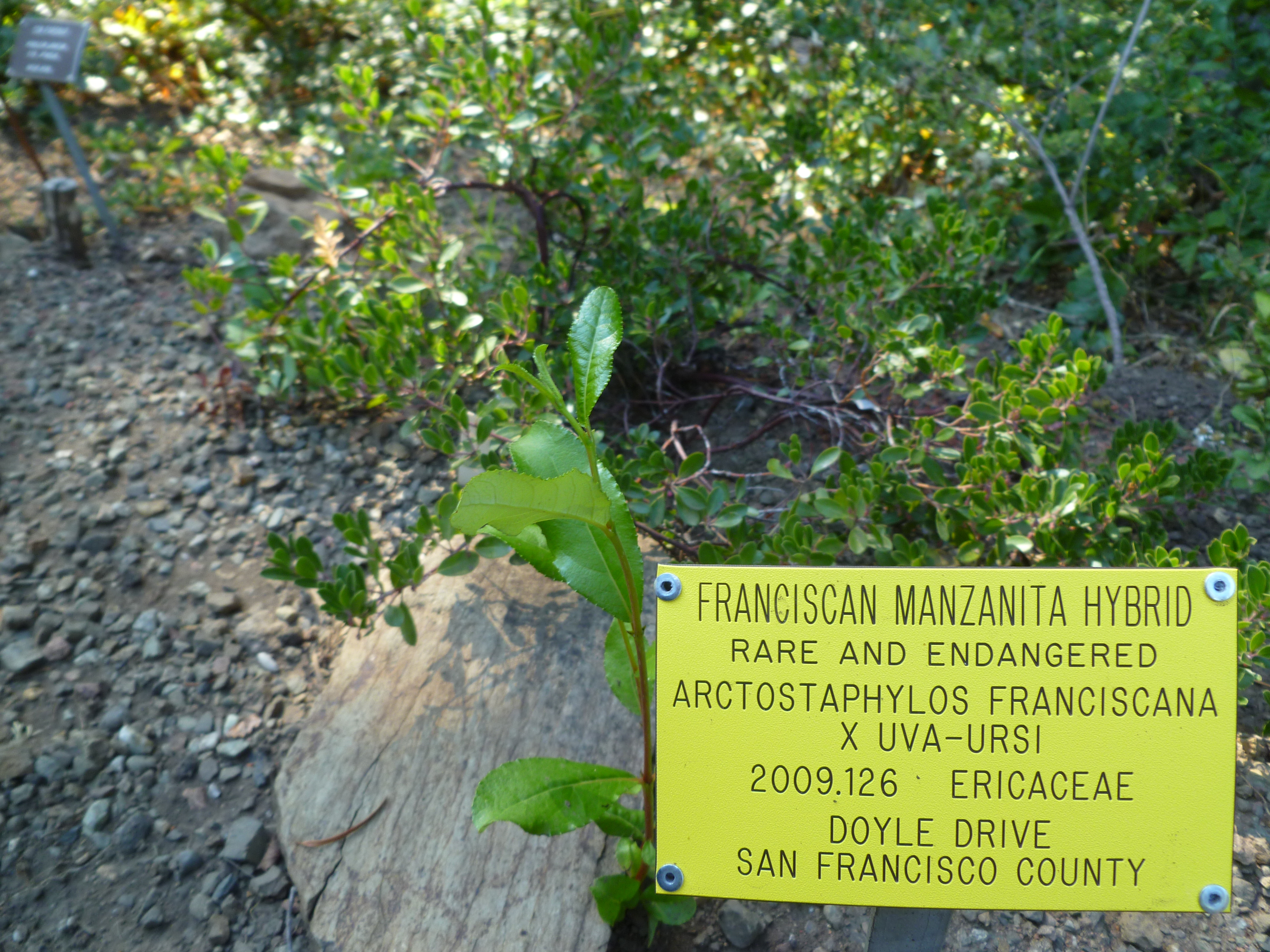
To add to the confusion regarding the provenance of Franciscan manzanita, some biologists are of the opinion that the individual plant that was discovered on Doyle Drive is actually a hybrid, not a pure-bred Franciscan manzanita. The East Bay Regional Park District botanical garden in Tilden Park has planted a clone of the individual plant from Doyle Drive. It is labeled as a hybrid of Arctostaphylos uva-ursi, which is one of the few species of manzanita with a wide range.
This is the label on the “Doyle Drive” manzanita in Tilden Park Botanical Garden, indicating that it is a hybrid.
The park ranger who led us to this plant in the Tilden garden, pointed out that the plant is morphologically distinct from the Franciscan manzanita that has been resident in that garden for about 50 years. He expressed his opinion that the Doyle Drive manzanita was properly labeled as a hybrid.
In what sense is the Franciscan manzanita “endangered?”
Franciscan manzanita has been available for purchase in nurseries for about 50 years. It has been propagated by taking cuttings and therefore they are presumed to be genetically identical clones. However, given that this plant has been sold to the public for a long time, we have no way of knowing exactly where they have been planted or if some have successfully reproduced by germinating seeds. For all we know, this plant is thriving somewhere, perhaps even in a place we might call “wild.” Perhaps the plant found on Doyle Drive was purchased in a nursery!
The individual plant found on Doyle Drive has been defined by USFWS as Franciscan manzanita despite the fact that some biologists consider it a hybrid of another species. We understand that the motivation for designating this individual as an endangered species and providing it with critical habitat is based on an assumption that it is genetically different from the Franciscan manzanita that can be purchased in nurseries and that the chances of survival of the species may be improved by cross-fertilization of these two plants such that greater genetic diversity results from their union.
Yet we are offered no evidence of the genetic composition of the Doyle Drive individual or Franciscan manzanita sold in nurseries. Nor are we provided any evidence that the Doyle Drive individual is even a genetically “pure” Franciscan manzanita rather than a hybrid of another species altogether.
If we weren’t being asked to devote 318 acres of land to the propagation of a plant with such ambiguous taxonomy, we might not question how little information we have been provided. The technology of mapping the genome of this plant is available to us. Why aren’t we making use of this technology to resolve these ambiguities? The cost of planting 318 acres with this endangered plant far exceeds the cost of such genetic analysis.
We aren’t told what it will cost to plant 318 acres with this endangered plant, but we know that the cost of the recovery plan for Raven’s manzanita and lessingia was estimated as $23,432,500 in 2003. Presumably that is an indication that the proposal for Franciscan manzanita will be a multi-million dollar effort. The cost of transplanting the single plant from Doyle Drive to the Presidio was reported as over $200,000. (1)
Thirty years of endangered status for Raven’s manzanita has not saved this plant
We have already made the point that Raven’s and Franciscan manzanitas are closely related. In its proposal for the designation of critical habitat for Franciscan, USFWS confirms this close relationship by referring us to the Recovery Plan for Raven’s. In other words, the characteristics and horticultural requirements of these two species are so similar that a separate Recovery Plan for Franciscan is not necessary. The Recovery Plan for Raven’s is applicable to Franciscan.
Therefore, we should assume that the fate of the recovery effort for Franciscan will be similar to that for the Raven’s. Raven’s was designated as endangered in 1979. Its first recovery plan was published in 1984 and the second in 2003. Many 5-year reviews of its endangered status have been done during this 33 year period. The most recent 5-year review was published in June 2012; that is, very recently.
So what does USFWS have to show for 33 years of effort to save Raven’s manzanita from extinction? Almost nothing:
Clones of the single plant in the wild exist in several botanical gardens. These clones are genetically identical and their growth in maintained gardens does not meet ESA standards for recovery.
“The wild plant has been observed to set seed although no natural seedling establishment is known to have occurred.” (6)
The plant has been the victim of twig blight several times, but the fungus cannot be treated because it would damage the mycorrhizal fungi in the soil upon which the plant is dependent.
The seeds depend upon animal predators for dispersal which are largely absent in an urban area.
The pollinators of manzanita have not been identified and therefore there is no assurance that they still exist in this location.
The 5-year review concludes that: “…recovery sufficient to warrant full delisting is not projected in the foreseeable future for [Raven’s manzanita] and may not be possible.”
We can’t appreciate the significance of the utter failure of this effort without some mention of the extreme methods used to overcome these obstacles.
The seed of manzanita is germinated by fire. However, the exact relationship between fire and germination is not known. Therefore, many complex experiments have been conducted on the few viable seeds produced by the Raven’s manzanita in a futile effort to determine the winning combination. These experiments are described in detail in an article in Fremontia (1). In short, various combinations of fire, heat, cold, smoke, liquid smoke, etc., were tried and failed to determine exactly what triggers germination of manzanita seeds.
We should remind our readers of the legal definition of “recovery” according to the Endangered Species Act. According to the 5-year review for Raven’s manzanita, here are two of the criteria for recovery toward which there has been no progress in 33 years:
“At least five spontaneously reproducing variable populations are established in reserves…in San Francisco…”
“At least two sexually reproduced generations are established within the Presidio.”
Frankly, it is no longer credible to expect the recovery of Raven’s manzanita and this failure implies the same fate for Franciscan manzanita.
Can the public parks of San Francisco meet the horticultural requirements of Franciscan manzanita?
The public parks of the City of San Francisco cannot meet the horticultural requirements of the Franciscan manzanita because it requires fire to germinate its seeds.
All of the critical habitats proposed by USFWS in San Francisco’s public parks are designated “natural areas.” According to the DRAFT Environmental Impact Report of the “Significant Natural Resource Areas Management Plan,” prescribed burns are prohibited in the natural areas. Therefore, unless there are unplanned wildfires in the six public parks proposed as critical habitat, it will not be physically possible to “spontaneously reproduce” this plant, as required by the Endangered Species Act.
Granted, the City of San Francisco could revise its management plan for the natural areas to allow—or even require—prescribed burns in the six parks proposed as critical habitat. In that case, the citizens of San Francisco would be subjected to air pollution and risk of causing an uncontrolled wildfire in surrounding residential communities. The Natural Areas Program would be subject to even more criticism than it already endures.
The Natural Areas Program is extremely controversial in the City of San Francisco because it destroys healthy non-native trees, it sprays pesticides on non-native vegetation in public areas, it destroys the habitat of wildlife, and it limits the public’s recreational access to trails which are often fenced. Subjecting the natural areas to prescribed burns is surely the bridge too far for the public which would jeopardize the future of the entire program. Why would the City of San Francisco be willing to push the public over the edge by requiring prescribed burns in six urban parks in densely populated residential communities?
Furthermore, some of the proposed critical habitat is in heavily forested areas, which are not compatible with the requirement of manzanita for full sun. As they were on behalf of Raven’s manzanita, these trees would be destroyed. The City of San Francisco is already planning to destroy 18,500 trees over 15 feet tall to accommodate its desire to reintroduce native plants to forested areas. (3) How many more trees would need to be destroyed to accommodate Franciscan manzanita? How much more carbon dioxide would be released into the atmosphere by the destroyed trees?
Bayview Hill is one of the proposed critical habitats which are heavily forested. According to SNRAMP (3), 17.16 acres of Bayview Hill is forested. Given that Bayview Hill is the only proposed critical habitat which is outside the known historic range of Franciscan manzanita, the loss of 17 acres of trees does not seem a fair trade for a plant with few prospects for survival.
The proposed critical habitat in Glen Canyon Park (inaccurately called Diamond Heights by the proposal) is also forested in a portion of the 34 proposed acres of critical habitat. This is a park in which the destruction of trees is being hotly contested. The community in this park does not need the additional controversy of tree destruction for the sole purpose of planting an endangered species.
Proposed critical habitat in other city parks is likely to be controversial for other reasons, primarily because additional restrictions on recreational access will undoubtedly be required to protect this endangered plant. Bernal Hill is an example of a city park with a huge community of visitors who will undoubtedly be enraged by further loss of recreational access. They have already been squeezed by the restrictions imposed by the Natural Areas Program.
This proposal for critical habitat is not good public relations for the Endangered Species Act
The City of San Francisco is the second most densely populated city in the country. It is comprised of only 29,888 acres. There are only 3,317 acres of City-managed parks in the city. (2) The proposed critical habitat in City-managed parks is 196 acres, 6% of total City-managed park land in San Francisco.
Please ask yourself these questions:
Does it make sense for 6% of all City-managed park land to be permanently committed to planting an endangered plant which can be purchased in nurseries?
Does it make sense to confiscate 6% of all public parks for a plant the identity of which we are not certain?
Does it make sense to throw the public out of 6% of all public parks on behalf of a plant that will never be able to spontaneously reproduce unless there is an accidental wildfire?
We think the answers to these questions are no, no, and no. This is an ill-advised proposal which makes a mockery of the Endangered Species Act. This is an important law that is trivialized by a proposal that will be physically impossible to implement without endangering the public and damaging the environment.
Comments on the proposed critical habitats will be accepted until November 5, 2012. Comments may be submitted online at the Federal eRulemaking Portal at http://www.regulations.gov (Docket Number FWS–R8–ES–2012–0067) or by U.S. mail to:
Public Comments Processing
Attn: FWS–R8–ES–2012–0067
Division of Policy and Directives Management
U.S. Fish and Wildlife Service
4401 N. Fairfax Drive, MS 2042-PDM
Arlington, VA 22203.
*********************************
Bibliography
(1) Gluesenkamp, Michael, et al., “Back from the Brink: A Second Chance at Discovery and Conservation of the Franciscan Manzanita,” Fremontia, V37:4/38:1, 2009-2010
(2) Harnik, Peter, Inside City Parks, Trust for Public Land, 2000
(3) San Francisco Recreation and Park Department, “Significant Natural Research Area Management Plan (SNRAMP),” 2006
(4) San Francisco Recreation and Park Department, “DRAFT Environmental Impact Report for SNRAMP,” 2011
(5) USFWS, “Designation of Critical Habitat for Franciscan Manzanita,” September 5, 2012
(6) USFWS, “5-Year Review of Endangered Status of Raven’s Manzanita,” June 2012
(7) USFWS, “Recovery Plan for Coastal Plants of the Northern San Francisco Peninsula,” 2003
Conservation biology is being revised so rapidly that we are struggling to keep up with it. In our previous post, we introduced our readers to Professor Scott Carroll’s proposal that a more realistic approach to conservation would accommodate non-native species because they are often better adapted to present conditions than their native predecessors. He calls his approach Conciliation Biology.
Today, we are introducing our readers to another proposal to redefine wilderness to a new standard which acknowledges that the environment has been radically altered by man. The author of this proposal is Nigel Dudley, a practicing British conservationist. He calls his new standard “authenticity,” which he defines as follows:
“An authentic ecosystem is a resilient ecosystem with the level of biodiversity and range of ecological interactions that can be predicted as a result of the combination of historic, geographic and climatic conditions in a particular location.”*
Let’s focus for a moment on this portion of that definition: “…historic, geographic and climatic conditions in a particular location.” Mr. Dudley explains this particular parameter of his definition of authenticity: “…some ecosystems have unusually high levels of diversity…through being isolated or undisturbed for exceptionally long periods. Other ecosystems have already been hugely changed and in some cases impoverished…it will not always be possible either to recover lost elements or to remove additions. What an ecosystem is likely to contain in the future needs to be based on current realities…”
Clearly places like the Berkeley Meadow are not candidates for “authenticity.” This particular native plant museum was the former garbage dump for the city of Berkeley, built on landfill. This seems an extreme example of denial of current realities.
The Berkeley Meadow, a 72-acre fenced pen for native plants on the former city garbage dump
Choosing candidates for authenticity
Dudley’s point in proposing this new standard is to focus conservation efforts where they are most likely to be fruitful. Our interest in this new standard is in the stark contrast it provides to the local projects which fail by every measure introduced by Mr. Dudley in his book about authenticity.
Natural species composition: Virtually all predators and grazing animals are gone from the urbanized San Francisco Bay Area. San Francisco’s Natural Areas Program claims to have designated only “remnants of native vegetation” as natural areas. In fact, vegetation cover in the 1,105 acres of natural areas is on average only 46% native. Some of the 31 natural areas are populated by as little as 11% native vegetation.
Migrant composition: Some bird migrations are intact, but others have been changed by existing vegetation such as the tall, non-native trees of which there were few in the native landscape. Migrations of ungulates are long gone.
Invasive species: Non-native plants and trees outnumber native species throughout the Bay Area.
Chemical composition: Air, water, and soil composition are vastly different than they were 200 years ago.
Functioning food web: The food web has been radically altered by the loss of top predators and ungulates and cannot be recreated in a densely populated urban environment. Bears may be welcome in the zoo, but are not wandering our streets looking for their next meal.
Functioning ecological processes: Funneling most creeks into underground culverts is an example of a lost ecological process in the urban environment.
Regeneration process: Fire is a regeneration process that is lost in the urban environment. Prescribed burns are allowed by some managers of public land in the Bay Area, but San Francisco’s Natural Areas Program has reluctantly agreed not to conduct prescribed burns.
Resilience: Although the original goal of San Francisco’s Natural Areas Program was that once “restored” the natural areas would be self-sustaining, fifteen years later, NAP concedes that on-going maintenance will be required to sustain the natural areas. Dudley says, “Ideally, authentic ecosystems should also be self-sustaining: they should not need constant and often expensive manipulation to maintain their values.” Clearly, the “natural areas” in San Francisco’s parks do not meet this criterion for authenticity.
Area: Most of the restoration projects in the Bay Area are too small to be sustainable. The average size of San Francisco’s 31 natural areas is only 35 acres. The smallest is only one-third of an acre. Size is a proxy for the ability to isolate a restored site from repeated re-invasion. The natural areas are small and are surrounded by non-native vegetation which will quickly return.
Connectivity: Virtually every restoration project in urbanized Bay Area is physically isolated.
It may be possible to compensate for these bad odds of a sustainable, authentic restoration project in the urbanized San Francisco Bay Area. If so, it will be extremely costly, which is undoubtedly why most projects have not been successful. The National Park Service has had some success with its projects because they seem to have greater resources than other managers of public land. But is this the top priority of taxpayers? As the presidential election season heats up and the debate rages about raising taxes and cutting federal spending, one wonders why these projects are not in the budget-cutting cross-hairs.
Looking on the bright side
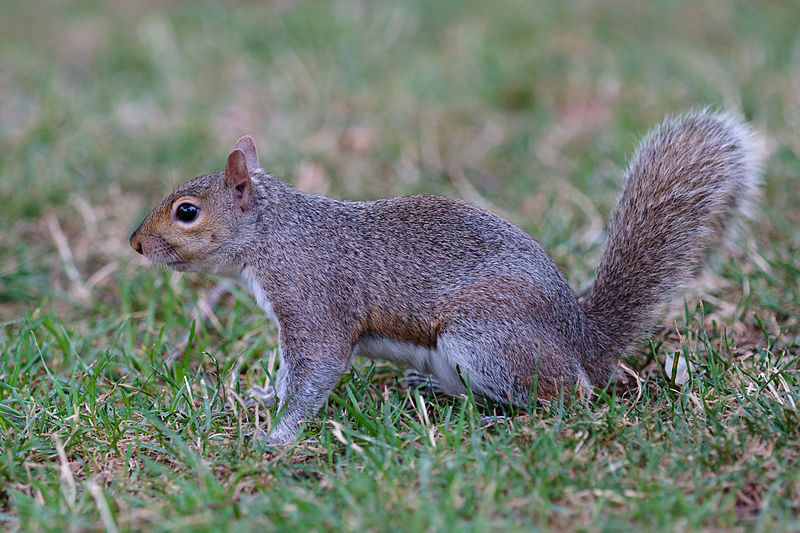
Grey squirrel. Creative Commons
We make every effort to end each story with a positive outlook. In this case, we turn to Mr. Dudley to remind our readers that the environment is not necessarily destroyed by the mere existence of non-native species. Being British, he uses British examples to make his point. The North American grey squirrel is considered an invasive species in Britain and the native red squirrel is now rare. While the British are not happy about the loss of their native squirrel, Mr. Dudley reminds them that the non-native grey squirrel is performing the same ecological functions as its native predecessor. There is apparently no evidence that the environment has been harmed by this substitution.
We don’t like change. But is change actually doing any harm? If not, let’s accept it, because fighting against it is costly and probably futile. That is the definition of wisdom: that we accept what we cannot change.
************************
*Nigel Dudley, Authenticity in Nature. Earthscan, 2011
In 2010, Timothy Paine, an entomologist at University of California, Riverside, published an article (1) about the introduction of Australian insect predators of eucalyptus into California. Eucalyptus is native to Australia. It was introduced to California in about 1850 and was virtually pest free until 1983. Since then 15 insect predators of the eucalyptus have been found in isolated locations in California.
Professor Paine observes that, “The spatial and temporal patterns of introductions [of these insect pests] do not seem to be random, particularly when taken in perspective of the geographic distribution of the insects in Australia.” For these and other reasons explained in his publication, Professor Paine speculates that “…with no definitive proof, we suggest that the multiple patterns may be nonrandom; instead they suggest the possibility of intentional introductions.”
In a recent interview Professor Paine explains, “We took all of the available information we had on the introduction of eucalyptus pests into California and the conclusion we drew is that there is a very high probability that someone was intentionally introducing [the insect pests of eucalyptus]…There is likely intentional movement of insect pests of eucalyptus into the state. The patterns suggest that.”
Professor Paine agonized about publishing his study. Responsible people are appropriately reluctant to make accusations in the absence of proof. He decided to publish because of the implications of his findings:
“Intentional introductions of insect herbivores onto crop plants, or organisms pathogenic to plants or domestic animals, represent an insidious threat that could severely damage the national agricultural economy, endanger a safe and abundant food supply, threaten water quality or quantity, increase the risk of wild fires, or degrade environmental quality across massive areas.”
Professor Paine has had some success with finding biological controls of these insect pests of the eucalyptus. However, as fast as he can find an effective antidote species of insect, a new pest arrives to attack the eucalyptus. His research is controversial because the native plant advocates who despise eucalyptus and demand its eradication are opposed to any attempt to control the insect infestation. Jake Sigg, our local, prominent native plant advocate is quoted as saying, “I think the University ought not to be going ahead with this research without considering all of the ramifications and hearing from all parties.”
Jake Sigg is a big fan of biological controls to eradicate non-native plants, so we find it ironic—even hypocritical–that he is opposed to research needed to save the eucalyptus from its insect predators. In his Nature News of February 18, 2011, he said, “On this scale, biological control offers the most promise, and–take note–would obviate the need for herbicides. Unfortunately, it is inadequately funded. The beauty of biocontrol is that if the necessary rigorous (and expensive) research is successful the problem of that plant is taken care of for all time–which means it is really inexpensive in the long run.”
So apparently biological controls are highly desirable if they are used to eradicate non-native plants and trees. If they are used to save non-native trees, they are verboten, in Mr. Sigg’s opinion.
The long track record of vandalism by native plant advocates
We can’t prove that Australian insects were intentionally imported to California to kill eucalypts. However, if they were it would not be the first time that native plant advocates have used vandalism to eradicate our eucalypts.
The historical record of vandalism of non-native trees in San Francisco goes back nearly 20 years. In 1994, the Sacramento Bee published an article (2) about non-native Monterey pines and eucalyptus being cut down in public parks by a native plant advocate by the name of Greg Gaar. According to the Sacramento Bee, Mr. Gaar had planted these trees and then changed his mind some 20 years later. (For the record, we note that we don’t approve of such unauthorized plantings any more than unauthorized destruction.)
The California Native Plant Society apparently convinced Mr. Gaar that the trees were a threat to San Francisco’s “natural heritage.” He cut down trees on Mount Davidson and Tank Hill in San Francisco and was sent a bill for $10,996.27 by the Recreation and Park Department. The Bee reported that Mr. Gaar was unemployed and had no intention of paying the bill. Getting caught was apparently the end of that particular method of destroying non-native trees.
Native plant advocates then found a more surreptitious method of destroying the trees. They began girdling the trees in the public parks of San Francisco. Girdling is a method of killing a tree slowly. A band of bark is hacked off the circumference of the trunk with an axe or chainsaw. This prevents water and nutrients from traveling from the roots of the tree into the tree. The tree slowly starves to death. The bigger the tree, the longer it takes to die.
Girdled trees, Bayview Hill, San Francisco
After girdling the tree, native plant advocates stacked up vegetation around the scar so that it was not visible to the public. Even if the public noticed the scar, they didn’t know what it meant until the tree began to die. By the time the trees started to die several years after the girdling began, about 1,200 trees had been girdled in the parks of San Francisco. Most of them were on Bayview Hill, and many are still visible on Mount Davidson.
According to an article in The Independent, some of the girdling was done by city employees of the Natural Areas Program in the Recreation and Park Department, but much of it was done by native plant advocates, described as “volunteers” by their supporters and “vandals” by their critics. The Independent quotes the head of the urban forestry division of the Recreation and Park Department as saying that trees were also being killed by dousing them with pesticides.
There was a noisy outcry when the public figured out what they were doing. The native plant advocates paid a public relations price for their vandalism and they quit doing it. They are no less dedicated to destroying all of our eucalypts. Perhaps they have moved on to even more nefarious methods such as introducing deadly insects.
We wouldn’t be at all surprised. One of our more memorable debates with a prominent local nativist was about the plan of the Natural Areas Program to reintroduce a legally protected native turtle to a local park that is heavily forested with eucalypts. We knew that rare turtle requires unshaded nesting habitat within 500 feet of its water source. Providing that habitat to this legally protected turtle would have required the destruction of all the trees in that park.
When we objected to the reintroduction of that turtle, the nativist smirked and said, “You know nothing can stop us from putting that turtle in that park whenever we want. And the law provides the same legal protection to that turtle whether it is found there naturally or put there by man.”
Some of these people will stop at nothing. They are appropriately called eco-terrorists.
———————————————————————————
(1) Timothy Paine, et. al., “Accumulation of Pest Insects on Eucalyptus in California: Random Process or Smoking Gun,” Journal of Economic Entomology, 103(6): 1943-1949, 2010
(2) “San Francisco garden guerrillas axing alien plants in San Francisco,” Sacramento Bee, February 19, 1994. This article is not available free on-line. However, it can be purchased inexpensively from Sacramento Bee Archives.
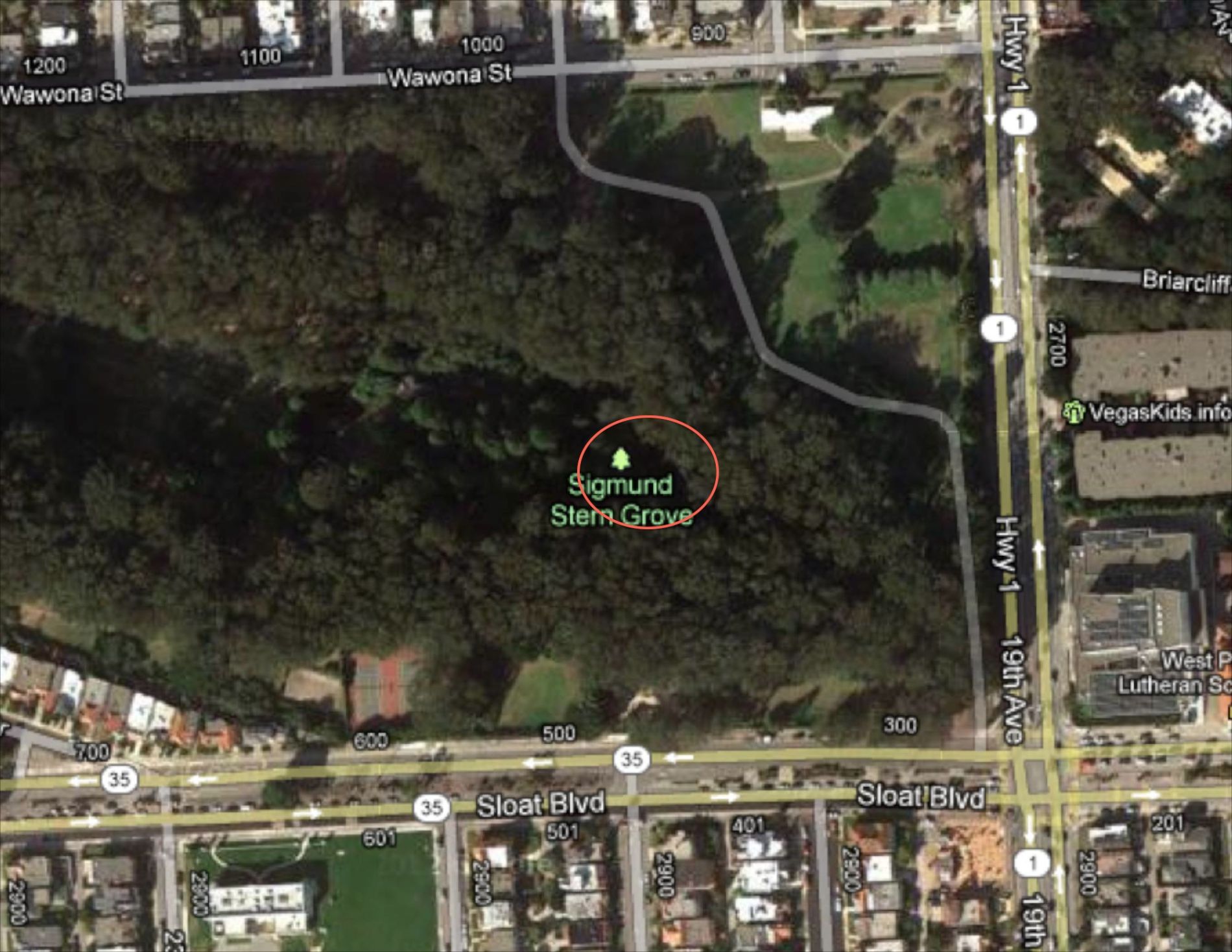
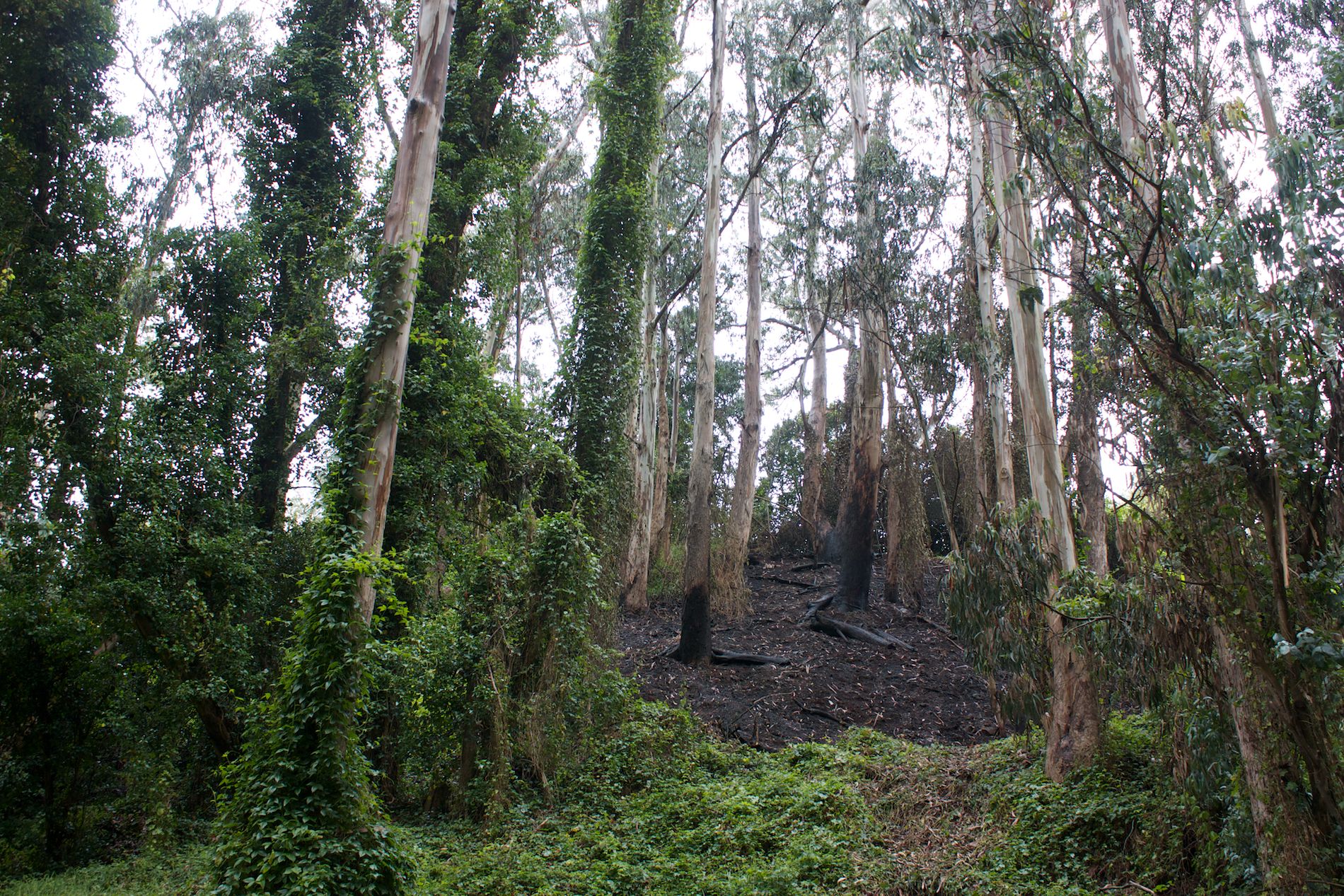
The fire in Stern Grove was reported by a local television station. You can view photos and videos of the fire on their website. They report that the fire was started by homeless campers. Nearly 40 firefighters battled the blaze which they described as challenging because it was the middle of the night and visibility was low. The fire moved up a steep hill which has a tendency to accelerate the spread of fire.
This fire in Stern Grove was a particularly rigorous test of the flammability of eucalypts because many of them are shrouded in ivy. The ivy creates a fire ladder to the canopy of the tree, which increases the risk that the tree will ignite. But they did not ignite. The understory of the trees was completely engulfed in flames. The trunks of the trees were badly scorched by the fire in the understory. The fire did not travel up the trees and ignite the canopy.
Aftermath of fire in Stern Grove
Let’s talk about ivy
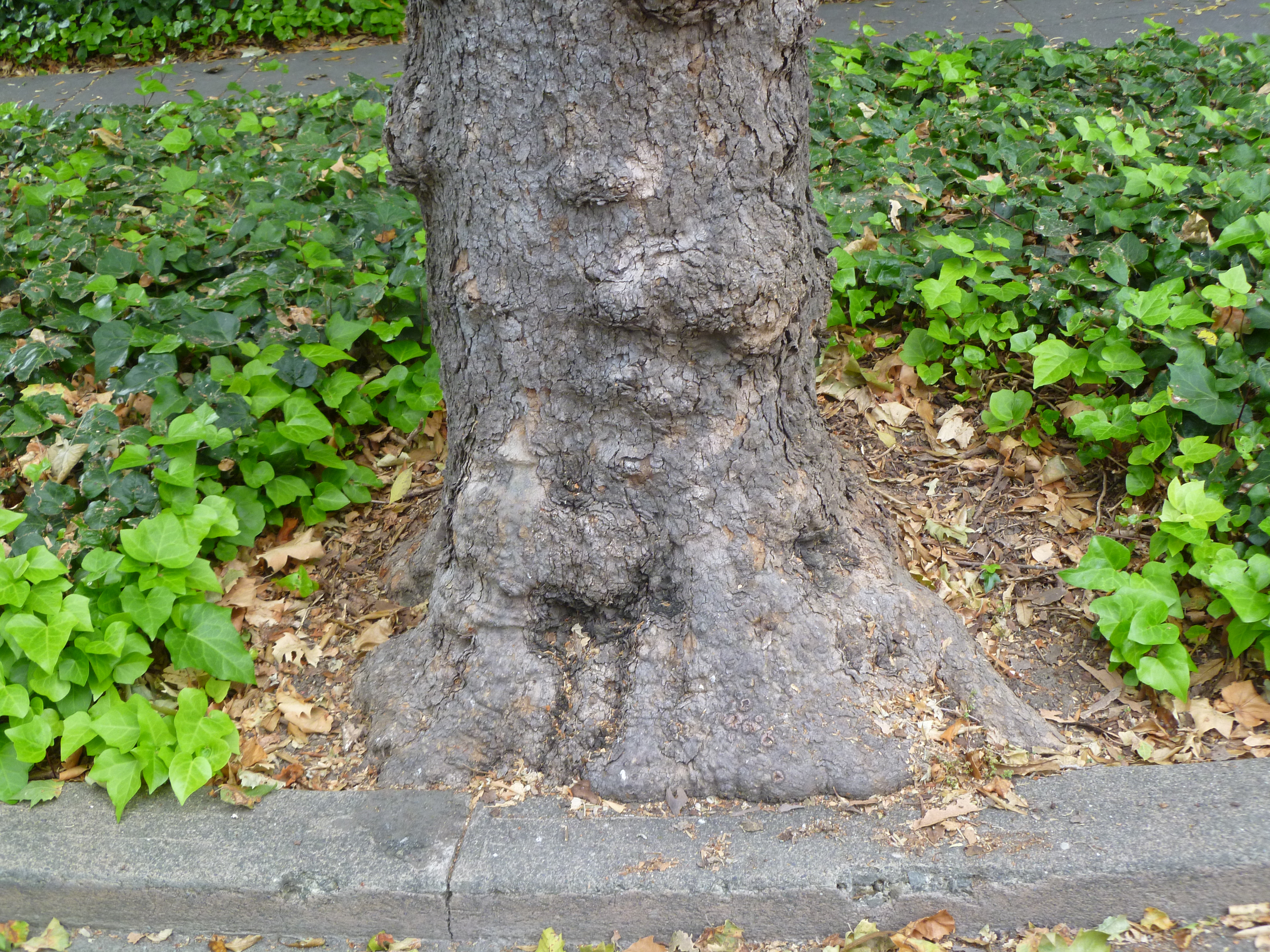
This is an opportunity to talk about the ivy that we find growing up the trunks of the trees in San Francisco. The ivy was planted at some time in the past and in fact, the Recreation & Park Department is still planting ivy when it renovates the parks, believe it or not. It’s a popular groundcover because it thrives with no care and it grows almost anywhere.
Another absurd argument that nativists use to advocate for the destruction of eucalypts in San Francisco is that they are covered in ivy. This seems an extreme case of cutting off your nose to spite your face. Why kill the tree when it’s the ivy that is the problem? It’s not the tree’s fault that it’s covered in ivy. It’s the fault of the Recreation and Park Department that it provides so little maintenance in the parks that the ivy grows out of the control. How does destroying the tree solve the problem? The ivy will overwhelm anything that grows there. Trees aren’t the exclusive target of ivy.
Our personal experience with ivy
We know from personal experience that it’s not that difficult to control ivy. We’ve never planted ivy but we have inherited it in our gardens from previous owners. My spouse complained bitterly about the ivy. But as the primary gardener in the household, I knew we did not have the fortitude to eliminate it. We don’t use pesticides in our garden so without the physical stamina or the resolve to eliminate it, our only option was to manage it. It wasn’t that hard to do. With an annual “haircut” our ivy was never out of control.
Ivy management in Dracena Park, Piedmont, CA
We have also had the experience of watching ivy being successfully managed in a public park. In the City of Piedmont’s beautiful parks, ivy is the predominate ground cover. It doesn’t crawl up trees or overwhelm shrubs because it is managed.
Another case of eucalyptus being scapegoated
The eucalypts in San Francisco’s parks are shrouded in ivy because the Recreation and Park Department does almost no maintenance in our parks. Watering and mowing the lawns is about the limit of their maintenance. Why would we expect maintenance to improve just because the trees are destroyed? We certainly haven’t seen any evidence of improved maintenance in the 1,100 acres of “natural areas” in which non-native plants and trees are repeatedly destroyed, native plants are planted and are quickly overwhelmed by foxtails and other non-native weeds.
The money being wasted on these unsuccessful “restorations” would be much better spent maintaining the landscape that exists. It would certainly be less destructive.
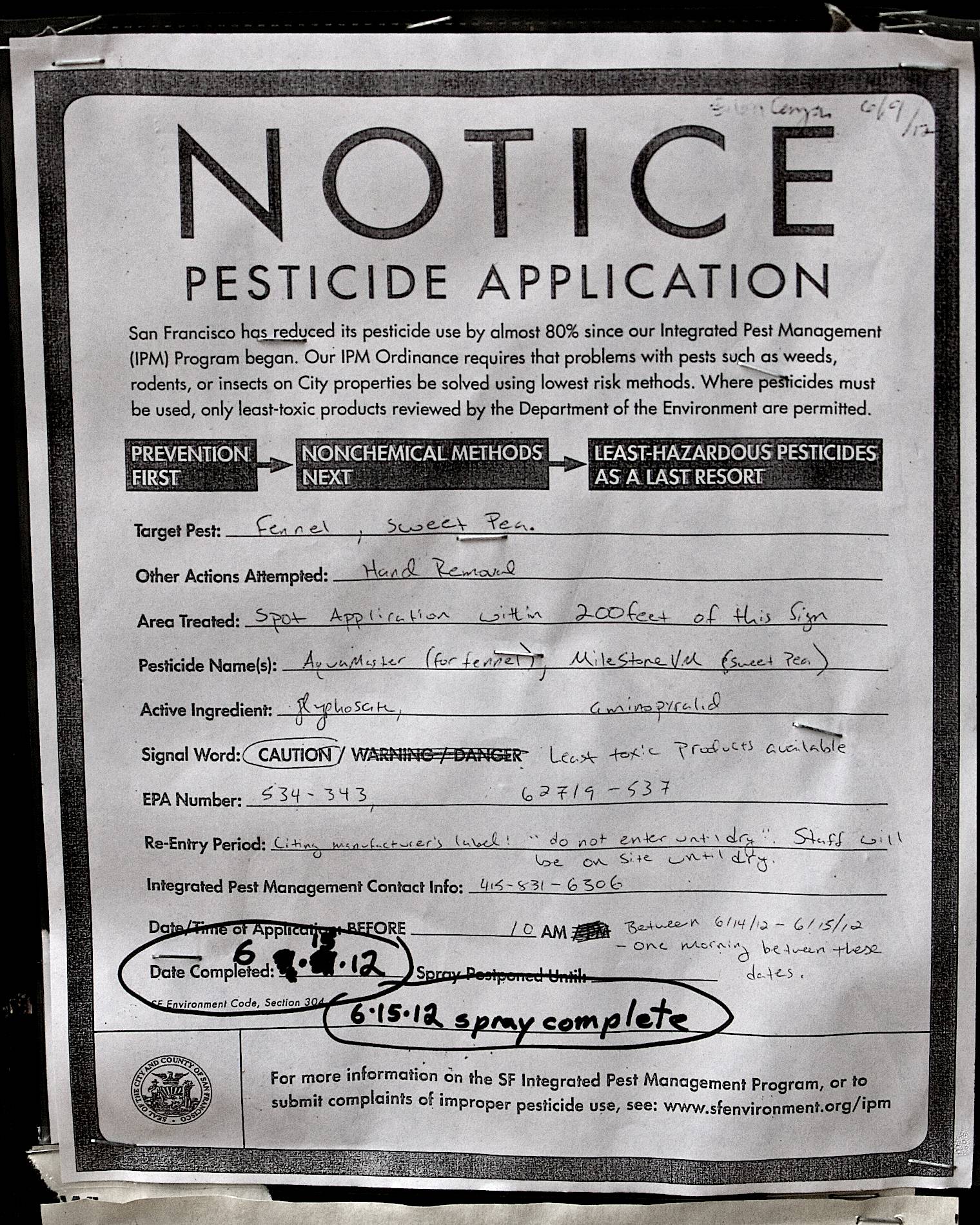
Recently visitors to Glen Canyon Park in San Francisco spotted a Pesticide Application Notice in their park, which states that Milestone herbicide was used on “sweet pea.” Sweet pea is not classified as an invasive plant by the California Invasive Plant Council. Milestone herbicide is classified as Tier I “Most Hazardous” pesticide by San Francisco’s IPM program because it persists in the ground for a long time. The City’s IPM policy states that it is approved for use on “invasive species.” Since sweet pea is not an invasive plant, we assume this pesticide application violated San Francisco’s IPM policy.
The federally mandated Material Safety Data Sheet (MSDS) for Milestone advises users to, “Prevent [Milestone] from entering into soil, ditches, sewers, waterways and/or groundwater.” The MSDS also says that Milestone “is not readily biodegradable according to OECD/EEC guidelines.”
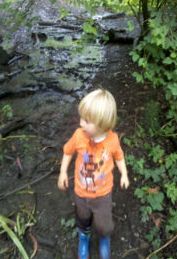
Kid playing in Glen Canyon Park. Courtesy San Francisco Forest Alliance
Since Glen Canyon is a watershed to Islais Creek, we believe it is irresponsible to use Milestone in that park. And clearly there is no justification for using this persistent herbicide on a plant as benign as sweet peas. Since Glen Canyon park is the home of a year-round day care center as well as a summer camp which leads children throughout the park, it is outrageous that these pointless risks were taken there.
We have learned nothing….
As we celebrate the 50th anniversary of Rachel Carson’s ground-breaking book, Silent Spring, there is renewed media interest in this issue. We welcome this reminder that Rachel Carson informed the public in 1962 that DDT was having a devastating impact on wildlife. DDT had been used for about 20 years, but it took that long for us to notice that some species of birds had been poisoned nearly to extinction. And it took another 10 years for DDT to finally be banned in 1972.
Forty years after DDT was banned in the United States we have a local example of the persistence of this dangerous chemical in our environment. From 1947 to 1966, several companies on the harbor in Richmond, California formulated, packaged, and shipped pesticides, including DDT. The site was designated a State Superfund site in 1982, and in 1990 the EPA placed the site on a national priorities list for clean up. “Remedial actions took place on the site from 1990 to 1999.” Twelve years later, the EPA tells us, “Although actions were taken to reduce the risk from the pesticides found on site…sediments and the water [in that location] are still contaminated with pesticides, primarily DDT and dieldrin.”
In other words, we fouled our water with dangerous pesticides; we then spent many years and probably a lot of money trying to clean up after ourselves, and 40 years later we are still living with the consequences of our foolishness.
What have we learned from that experience? Now we are using a very persistent chemical (Milestone) on a benign plant (sweet pea) in our public parks. We have learned nothing. And those who have some economic gain from poisoning our parks—or are clueless about the risks they are taking—are defending the use of pesticides and trying to shut us up, just as they tried to shut Rachel Carson up 50 years ago. We are proud to be in her company and we are inspired by her leadership.
Some people have learned
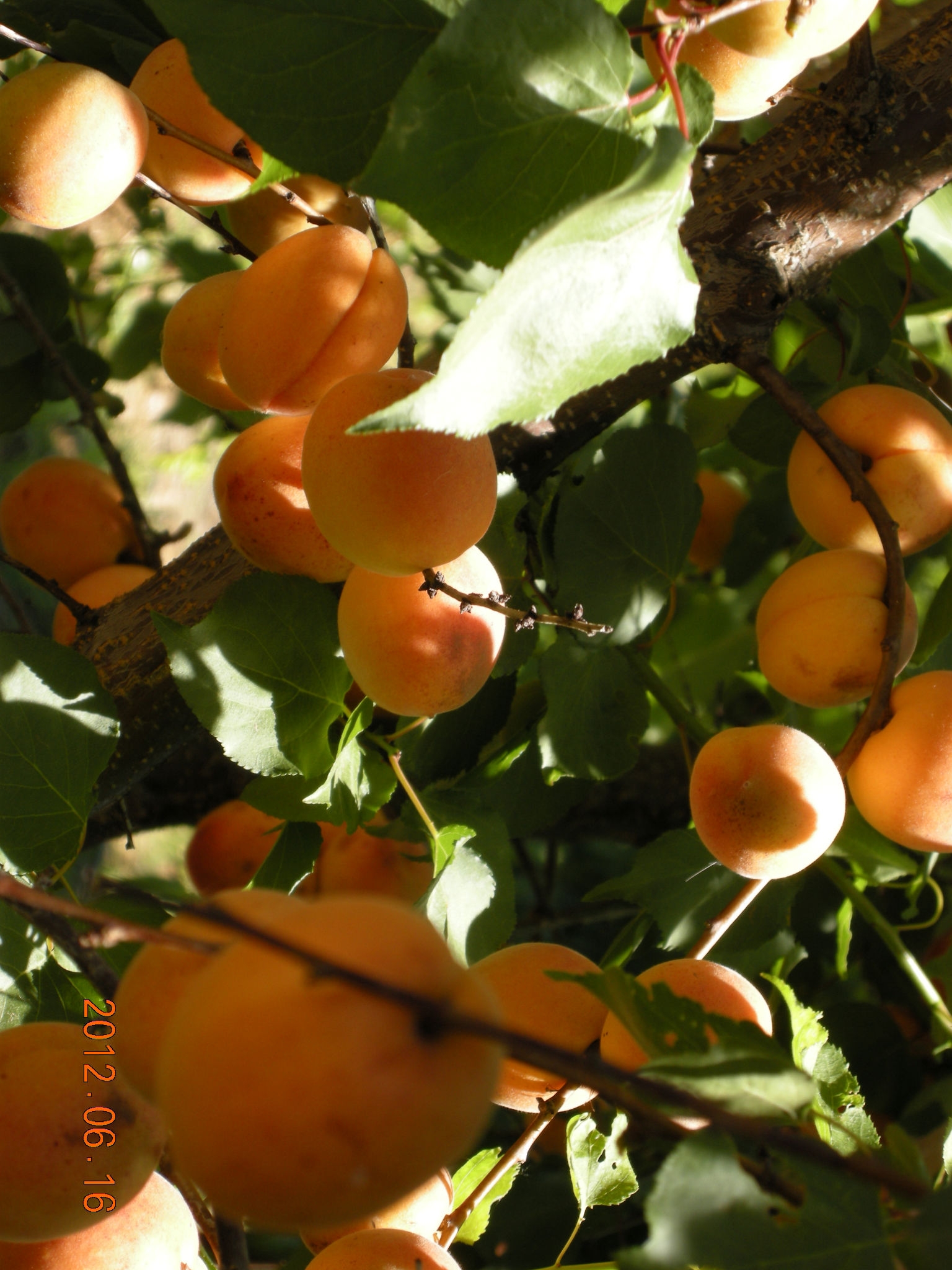
Peaches at “Organic U-Pick” Courtesy Arnita Bowman
We prefer to end our stories on a positive note when we can, so we turn to a book we read recently about a fruit farmer in California’s Central Valley. David Mas Masumoto wrote Epitaph for a Peach to tell us about his transition from the traditional farming methods used by his father to organic methods. He has abandoned rigorous weed and pest control and he is learning to live in harmony with his orchards rather than fighting against nature. He tells us about the difficult decision to quit using pesticides:
“I am reminded that in some valley wells they have found traces of a chemical called DBCP in ground water aquifers. DBCP was linked to sterility in males and is now banned in the United States. My dad used some DBCP years ago…No one knew it would contaminate drinking water. Neighboring city folks are angry with farmers for damaging their water supply. ‘How could you farmers poison the water?’ they ask. My dad didn’t choose to pollute the water table. He did nothing illegal. He simply trusted the chemical company and the governmental regulatory agencies. “
Mr. Masumoto has learned from bitter experience. What we know about pesticides today is not necessarily what we will learn about them tomorrow. We often look back on our use of pesticides with regret. So, shouldn’t we at least avoid using them when we don’t need to—such as on flowers just because they aren’t native—or in places where the risks are great—such as public parks occupied by children?
Let’s turn that rhetorical question into the affirmative statement that it deserves to be: We should not be using pesticides in our public parks or on plants that aren’t doing any harm. We will live to regret it when we do. And let’s express our gratitude to Rachel Carson for inspiring us to keep informing the public of the needless risks that are being taken in their parks.
The “Recovery Action Plan for the Mission Blue Butterfly at Twin Peaks Natural Area” acknowledges the difficulty of this undertaking. It cites a study of 226 attempts to reintroduce butterflies where they have been extirpated (locally extinct). These attempts lasted an average of 15 years. Only 29 of the attempts were ultimately successful. So what are the odds of success on Twin Peaks?
Identified obstacles to success
The federal Endangered Species Act requires that a recovery plan be written for each endangered species. These recovery plans are a valuable source of information about each endangered species, the factors that resulted in their endangered status, and the plans to promote the recovery of the population. From the recovery plan for the Mission Blue, we learn of several issues that make its reintroduction problematic at best:
The Mission Blue is dependent upon just 3 species of lupine for its development. Two of these exist on Twin Peaks, but the predominant species is infected with a fungal pathogen which flares up during warmer, wetter weather. The small population of Mission Blues on Twin Peaks crashed in 1998 when the fungal pathogen killed many of the lupines.
The lupine is crowded out by scrub species if natural disturbances such as fire do not prevent natural succession from grassland to scrub such as native coyote brush.
Non-native species of plants are also competitors of the native lupines and their growth is encouraged by higher levels of nitrogen in the soil found in urban environments as a result of the burning of fossil fuels.
The Natural Areas Program cannot control these factors:
There is no known cure for the fungal pathogen that is killing lupine. In wetter years, it is likely to kill some of the lupine on Twin Peaks again, as it has in the past.
The Draft Environmental Impact Report for the Natural Areas Programs says that prescribed burns will not be conducted in the “natural areas.” Prescribed burns are conducted by the State parks department periodically on San Bruno Mountain, where a viable population of Mission Blue butterflies exists. This method of preventing natural succession to scrub in order to maintain a population of the butterfly’s host plant will not be an option on Twin Peaks.
We should probably assume that existing automobile traffic in San Francisco will continue to contribute to nitrogen in the soil for the foreseeable future. Higher levels of nitrogen will promote the growth of the non-native vegetation that competes with the native lupine upon which the Mission Blue depends.
Unidentified obstacles to success
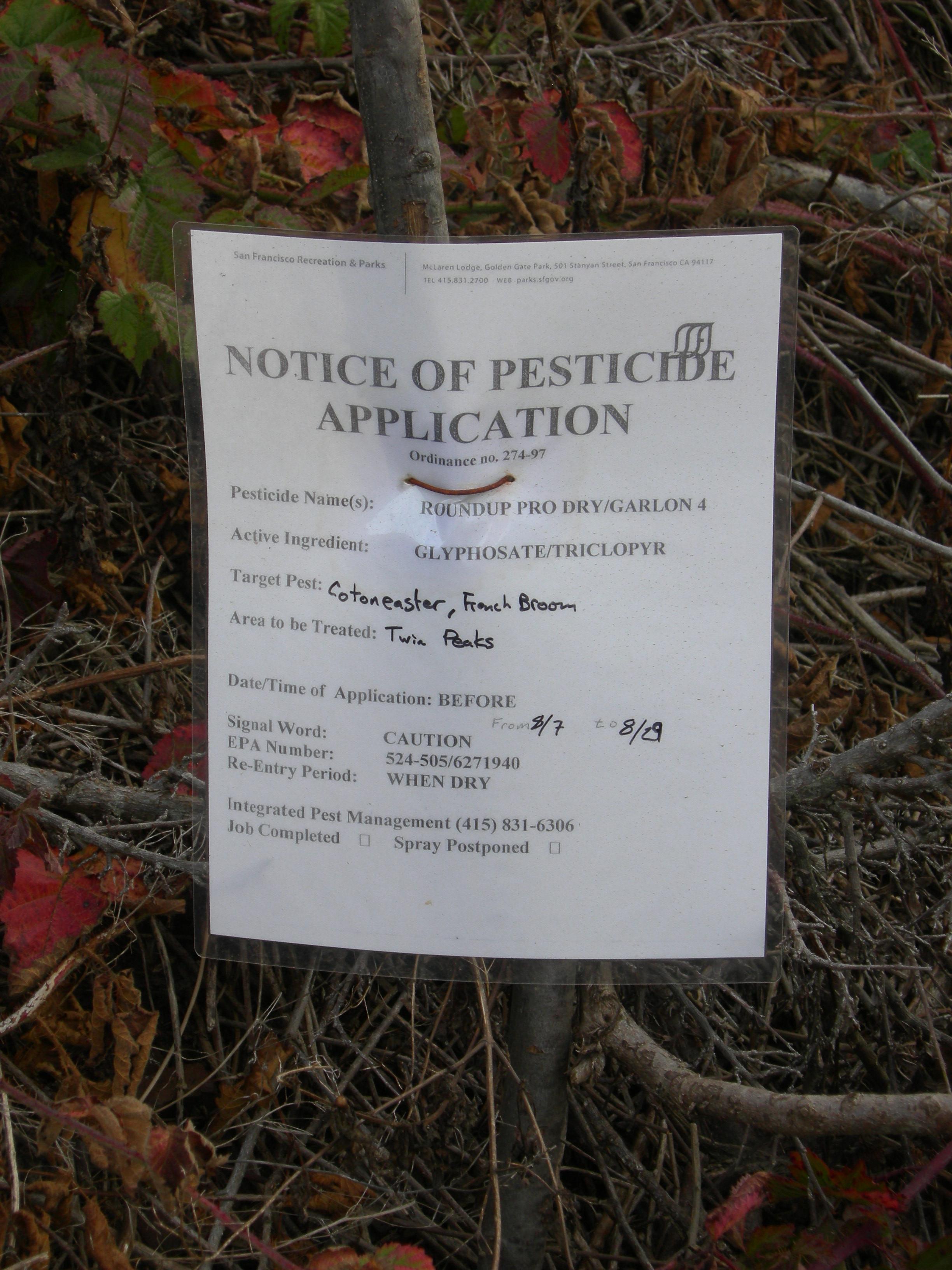
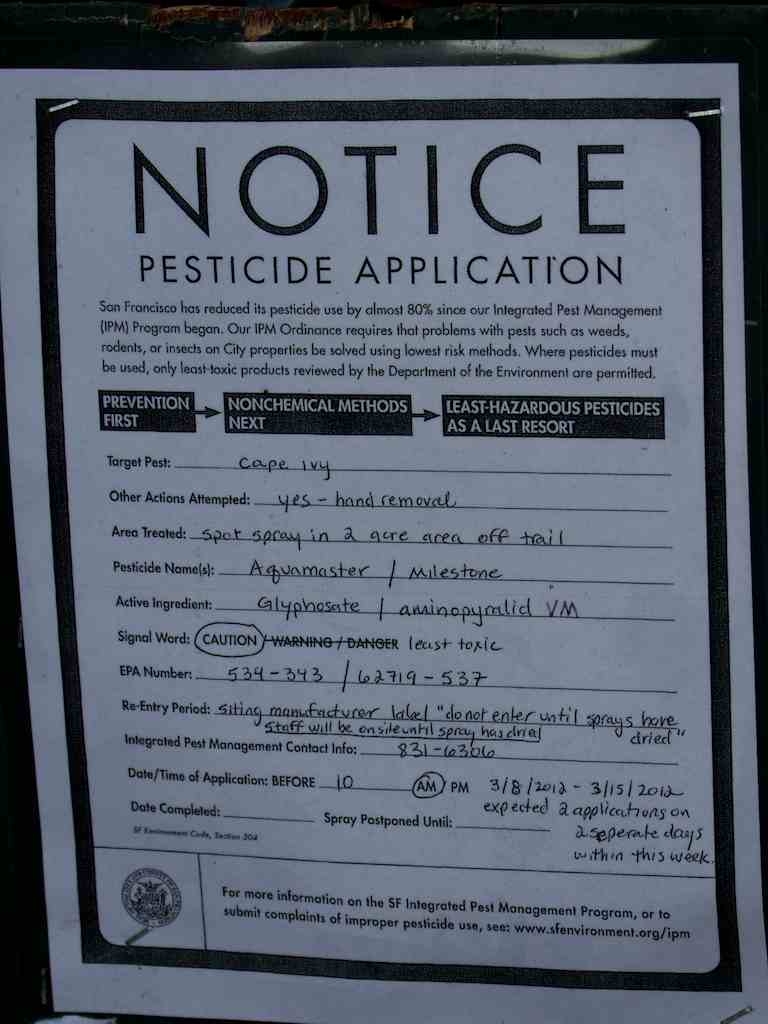
Pesticide Application Notice, Twin Peaks
In addition to the issues that have been identified by federal and local recovery plans, the Natural Areas Program has introduced a new threat to the Mission Blue. Herbicides are being used on Twin Peaks to control non-native vegetation. Twin Peaks was sprayed with herbicides 16 times in 2010 and 19 times in 2011. Are these herbicides a factor in the limited reproductive success of the Mission Blues that have been reintroduced to Twin Peaks?
A recently published study reports that the reproductive success of the Behr’s metalmark butterfly was significantly reduced (24-36%) by herbicides used to control non-native vegetation. Two of those pesticides are used on Twin Peaks, imazapyr and triclopyr. Triclopyr was used most often on Twin Peaks in 2010 and imazapyr in 2011.
The study does not explain how this harm occurs. It observes that the three herbicides that were studied work in different ways. It therefore speculates that the harm to the butterfly larva may be from the inactive ingredients of the pesticides which they have in common, or that the harm comes to the larva from the plant which is altered in some way by the herbicide application. Either theory is potentially applicable to the herbicides used on Twin Peaks and consequently harmful to the Mission Blue.
Native plant advocates would like us to believe that the herbicides used to eradicate non-native plants are not harmful to animals, including humans. In fact, they don’t know that. The truth is that no one knows if herbicides are harmful to animals because there is almost no research that would answer this question. The tests required by law by the Environmental Protection Agency to put new chemicals on the market are very limited. The honeybee is the only insect on which the EPA is required to test chemicals before they are put on the market. No tests are required for butterflies or any other insect.
US Fish & Wildlife funded the research on the Behr’s metalmark butterfly which suggests that herbicides are harmful to butterflies. US Fish & Wildlife is also the co-sponsor and co-funder of the reintroduction of the Mission Blue butterfly on Twin Peaks. Will US Fish & Wildlife advise the Natural Areas Program that herbicide use on Twin Peaks should be stopped?
In a more perfect world we would have the wisdom to stop using pesticides until we had some scientific evidence that they are not harmful to us and the animals with which we share the planet.
It’s spring. Have you noticed that the birds are singing? This is the time of year when they are most vocal. They are staking out their nesting sites and attracting their mates with their songs. They are quieter when they have laid their eggs as they try to avoid detection. Migratory birds are also passing through, on their way to their breeding homes. The food they find along the way is important to their survival on their long and physically challenging journeys from their winter to their summer homes.
Subscribers to Wildcare recently received an email newsletter reminding them that pruning trees and shrubs at this time of year is dangerous for the birds that are hiding their nests in them. Wildcare is a local organization which treats sick or injured animals and educates the public about “how to live peacefully with wildlife.”
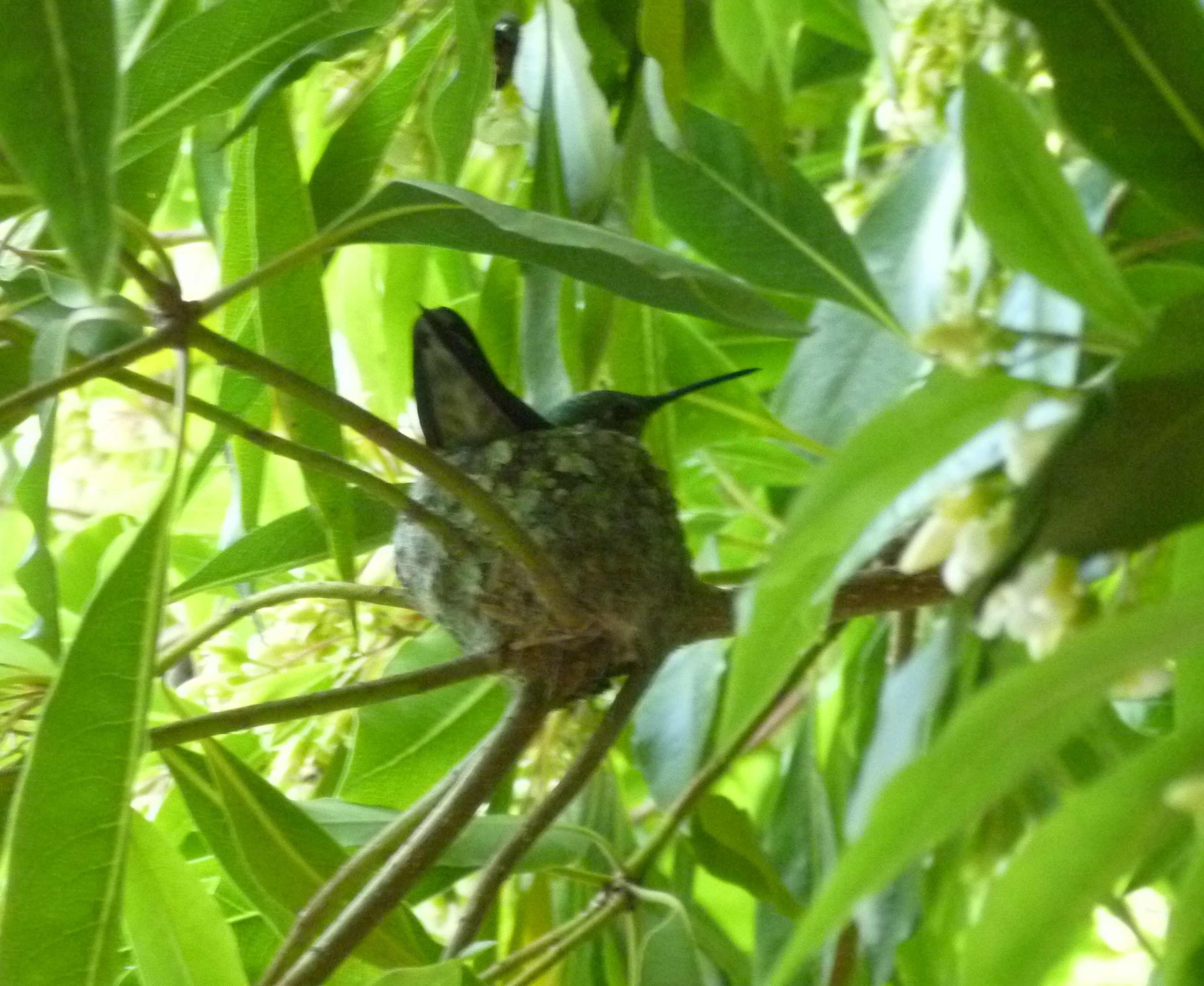
Hummingbird nest in Pittosporum, March 2012
We were recently reminded of the vulnerability of birds at this time of year in our own yard when a hummingbird selected our flowering, non-native Victorian Box tree (Pittosporum undulatum) to build her nest. Her nest was completely invisible to us, but we spotted her darting in and out of it as she built her nest. We were able to take this picture of her sitting on her nest by crawling into the understory of the tree.
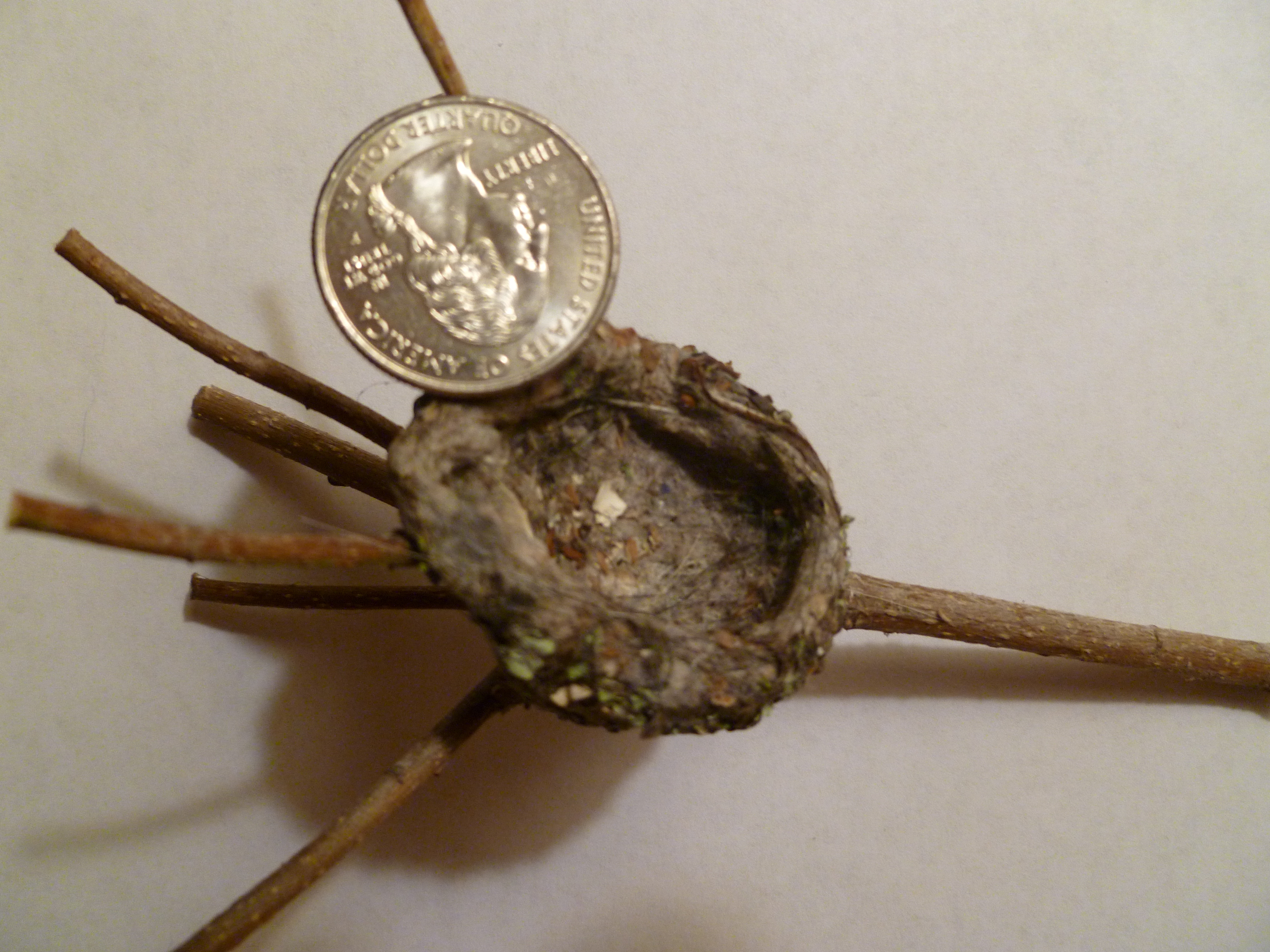
Hummingbird nest is not much bigger than a quarter!
Then disaster struck. An early spring storm tore a huge branch from the tree and sent her nest tumbling to the ground. We watched with heavy hearts while the hummingbird made anxious, noisy flights into the fallen branch. When she gave up, we carefully lifted the fallen branch to find her tiny, empty nest. As sad as this event was in our lives and hers, at least we knew that the failure of her nest was no fault of ours. San Francisco’s Natural Areas Program cannot say the same of their destructive project in Glen Canyon Park.
The Natural Areas Program violates their Streambed Alteration Permit
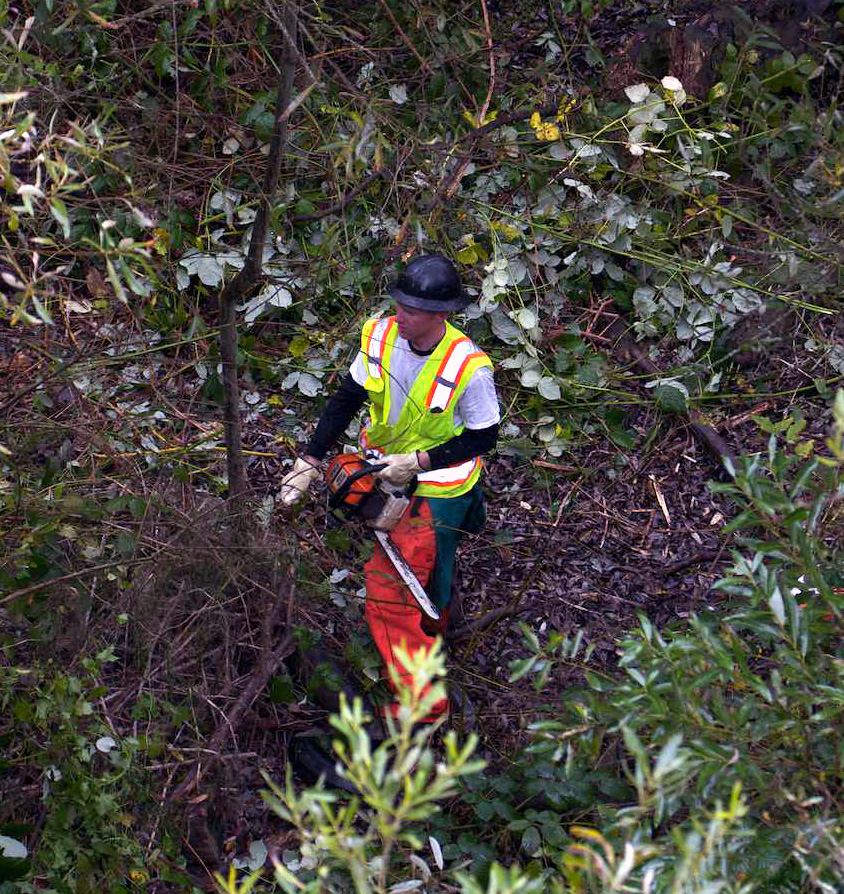
Destroying vegetation with chainsaws in Glen Canyon Park, November 2011
The Natural Areas Program began to destroy the non-native vegetation in Glen Canyon Park in San Francisco in November 2011. In addition to destroying valuable habitat with chainsaws, they also sprayed herbicides. The San Francisco Forest Alliance (SFFA) protested this destructive project many times but it has continued unabated to as recently as April 27, 2012, when they pruned trees and sprayed herbicides.
Earlier in April, SFFA learned from a public records request that this project violated a legal commitment to the California Department of Fish & Game. The Natural Areas Program made the following commitment to mitigate harm to wildlife in Glen Canyon Park in its Streambed Alteration Permit:
“It is the policy of RPD’s Natural Areas Program that no new projects will begin during the breeding season (December to May). Follow up work in previously cleared areas may be done during the breeding season, however, because areas will have been cleared previously. Wildlife will not likely be using these areas for breeding. This protocol has been effective in reducing impacts to breeding wildlife.”
SFFA brought this violation of its commitment to the attention of the General Manager of the Recreation and Park Department immediately. The head of the Natural Areas Program said that the violation was necessary because the grant funding for the project was about to expire. To avoid losing the funding for the project, the birds and animals of Glen Canyon Park were subjected to this destructive project during their breeding and nesting season.
SFFA has brought this violation to the attention of the California Department of Fish & Game. Their regulations require them to enforce the terms of the Streambed Alteration Permit, including the mitigation of potential harm to wildlife. Violations of the terms of the permit are subject to “civil penalties” according to the regulations: “A person who violates this chapter is subject to a civil penalty of not more than twenty-five thousand dollars ($25,000) for each violation.”
One month after SFFA informed California Department of Fish & Game of the violation, nothing seems to be done about it. In fact, weeks after SFFA sent this information to Fish & Game, another episode of destruction occurred in Glen Canyon Park on April 27, 2012.
The consequences of native plant “restorations” to wildlife
We will never know how many birds and animals were harmed by the destruction in Glen Canyon Park. The management plan for the Natural Areas Program tells us (Appendix D) there are 18 species of birds that are found in and/or breed in Glen Canyon Park that are considered “Species of Local Concern.” That is, the Audubon Society considers them rare in San Francisco.
We also know that migratory birds will find less food in Glen Canyon Park this year than they have found in the past as they pass through San Francisco on their way to their breeding homes. Many of the flowering and berry producing non-native plants that have thrived in Glen Canyon Park in the past have been destroyed by this destructive project, which is described by the Natural Areas Program in its Streambed Alteration Permit application as “…the ‘Scorched Earth’ method, in which all above-ground vegetation including natives, are removed.”
Ironically, this project was partially funded by a grant program of the State of California entitled “Habitat Conservation Fund.” We believe this project was a grotesque misuse of this fund. The wildlife of Glen Canyon Park did not benefit from this project. In fact, we believe they have been harmed by it.
We are reprinting, with permission, an article on the website of the San Francisco Forest Alliance about the many ecological functions performed by our urban forests and the plans of the Natural Areas Program to destroy over 18,500 mature, healthy trees. Please visit the website of the Forest Alliance to read about their efforts to save the urban forest in San Francisco from needless destruction.
**************************************
Urban trees are hugely important, not just for their beauty, but for environmental reasons. The [Natural Areas Program’s] NAP’s SNRAMP plans to cut down 18,500 trees (and a whole lot more under 15 feet in height, plus whatever is lost to wind-throw when the wind-break of the other trees is gone).
Source: USDA Report, Assessing Urban Forests Effects and Values, 2007
What are these 18,500++ trees doing for us? Here are nine ways in which urban forests help us.
The Nature Conservancy's Carbon equivalence graphic
Storing Carbon. Trees store carbon and keep it out of the atmosphere. The bigger the tree, the more it stores. CLICK HERE for a 3-minute video from the Nature Conservancy about the carbon stored by a red oak tree that’s 18 inches in diameter. Eucalyptus may store even more, because it grows taller than a red oak and is more dense (Eucalyptus, around 50 lbs/cu ft; red oak, about 41).
Providing Oxygen. Trees produce more oxygen than they use. When they’re felled, they decay and use oxygen instead of making it.
Trapping and removing air pollution. Tree leaves capture air pollution, and help clean our air. The trapped pollution stays on the leaves or falls to the ground – where we don’t have to breathe it.
Golden Gate Park - in the beginning (abt 1880)
A windbreak. In its pre-European state, San Francisco was a place of windblown sand that got into everything from railway tracks to people’s lungs. With a city and a major park atop the former dunes, we don’t have to worry about sand so much, but the wind still sweeps across our city. The eucalyptus forests and other trees act as a windbreak, and improve the micro-climates not only of the forest, but of surrounding areas.
Buffering noise. Trees absorb sound, in much the way that fabrics and soft materials do. Once they’re felled, everything becomes noisier. Thinning a forest lets in the sounds of the city and its traffic. When Laguna Honda Hospital felled some 200 trees in conjunction with its new building, neighbors in Forest Knolls and Midtown Terrace noticed increased noise.
Slowing runoff. When it rains, the roots of the trees, and the duff made by their shed leaves and the understory beneath them, soaks it up like a sponge. Then it slowly lets it out again, allowing plants and vegetation to use it over time, replenishing ground water, and fighting erosion. (If you want to see the difference – drive by Christopher, below Mount Sutro, during heavy rain – and then drive up Twin Peaks Boulevard. The latter’s like a river when it’s pouring.) [See “Rainfall Interception” data from USDA]
Preventing erosion. Many of these trees grow on very steep slopes, and below them are our neighborhoods. Their roots function now like a geo-textile, holding the slopes in place – particularly in forest areas, where the roots are intermeshed and intergrafted. On Twin Peaks, where the vegetation is thinner, landslips occur every season of heavy rain. In Forest Knolls, clearing of slopes below the houses has resulted in landslides requiring months of tarping to stabilize them. This is a particularly insidious problem; it may take 6-8 years for the root system to die and decay, and by then the homeowner may not even know or recall that trees once held the slope together.
Provide habitat. Trees provide cover, places to perch and hide, and food by way of nectar and leaves and the insects attracted to the trees. Eucalyptus, in particular, flowers in winter providing nectar for bees, butterflies, and birds – and attracting birds that prey on these insects. It’s a nesting site for owls and hawks and feral bees, and a hunting ground for birds small and large. Our city would have far fewer birds, animals, and bees without these trees.
Boost property values. People like trees. Homes near forested areas are valued by owners and potential buyers. Realtors often mention these settings in their listings. Some studies show mature trees nearby can add up to 30% to property values.



 Preventing erosion. Many of these trees grow on very steep slopes, and below them are our neighborhoods. Their roots function now like a geo-textile, holding the slopes in place – particularly in forest areas, where the roots are

 Conservation Sense and Nonsense