Calaveras Big Trees State Park: To burn or not to burn?

Coast redwoods (Sequoia sempervirens) and sierra redwoods, often called giant sequoias (Sequoiadendron giganteum), are members of the Sequoioideae family, a sub-family of the Cypress family.  Both are native to California.  Dawn redwood (Metasequoia) is the third genus in the small Sequoioideae family.  Although there is fossil evidence that dawn redwoods lived in California some 40 million years ago they are now native only to a small region in China. 

Coast and sierra redwoods have a common ancestor that is now extinct.  They evolved into different genera in response to the creation of microclimates by geologic changes that isolated their gene pools and gradually drifted apart in directions adapted to their respective regions. (1)

Coast redwoods live in wetter climates than sierra redwoods and they are heavily dependent on coastal fog that maintains a moist environment when interior regions of California are hot and dry.  As our climate continues to change, the future of coast redwoods will depend on whether or not our coastal fog persists.  In turn, the fog depends on the coolness of the ocean relative to the warmth of the land.  The greater that difference in temperature, the more fog is created as water in warm air condenses when it meets cold ocean air.

Sierra redwoods tolerate a much drier climate than coast redwoods, but they have been tested by our prolonged drought.  They are also threatened by wildfires that have ravaged California during our long drought.  Only about 70 small, isolated groves of sierra redwoods still exist on the western slope of the Sierra Nevada.  In 2020 and 2021, wildfires killed 13 percent to 19 percent of the world’s giant sequoias, according to the U.S. Forest Service. (2) The Mariposa Grove of giant sequoias in Yosemite National Park burned in 2022, but none of the sequoias were killed. 

Public land managers are under intense pressure to do whatever is necessary to save our sierra redwoods.  Extreme measures have been taken, such as wrapping their huge trunks in fire resistant foil, spraying trunks with water and canopies with gel when fires approach.  (3)

The prevailing opinion about conserving sierra redwoods is that prescribed burns will reduce fuel loads and therefore fire hazards as well as kill shrubby understory that can carry fire from the ground into tree canopies. The understory is also considered competition for moisture in the soil. Kevin McCarthy, the speaker of the US House of Representatives, has introduced a bill titled Save our Sequoias Act (SOSA) that would enable logging to reduce fuel loads in giant sequoia groves without requiring environmental impact reviews. Many experts disagree about that strategy.  We visited the sierra redwood grove in Calaveras Big Trees State Park at the end of May to see for ourselves and consider the pros and cons of the strategy that is being used there to save the big trees.

Calaveras Big Trees State Park

Calaveras Big Trees State Park is located near the town of Arnold at an elevation of about 4,700 feet.  It is near the northern end of the narrow range of giant sequoias.  The southern end of the range is near the city of Visalia in Sequoia National Park at about 6,000 feet elevation.  Most of the big trees that were destroyed by recent wildfires are at the southern edge of the native range.  Recent wildfires have not reached Calaveras Big Trees, but several giant sequoias in the park were badly damaged by prescribed burns and may not survive.  These damaged trees are a testament to the risks of prescribed burns.

Below is a picture of one of the areas that was intentionally burned in 2022 to reduce fuel loads:
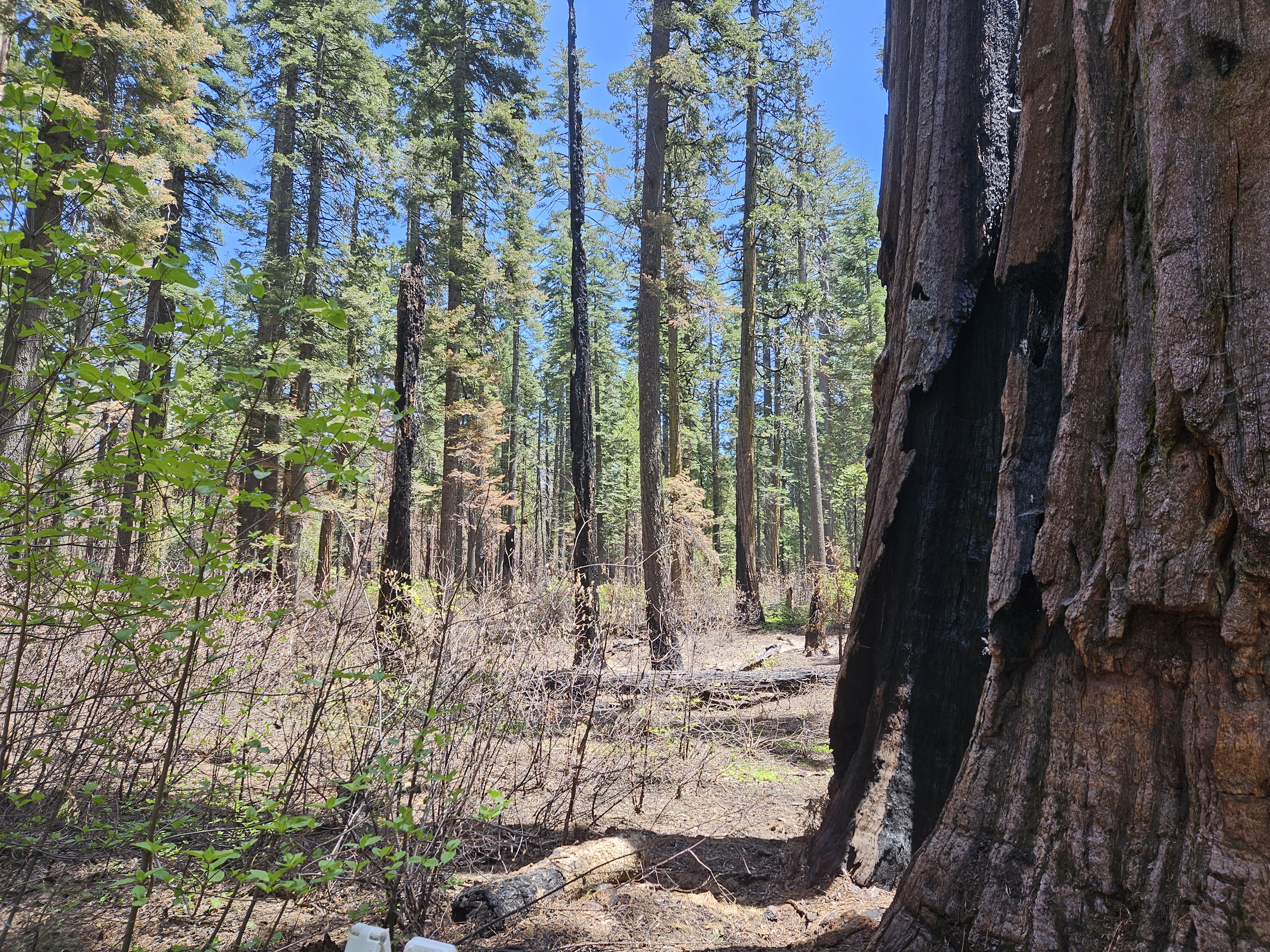
Calaveras Big Trees State Park, May 25, 2023

Below is a picture of a giant sequoia that was scorched by that fire. The right-hand side of the tree looks seriously damaged, suggesting that the tree may not survive:
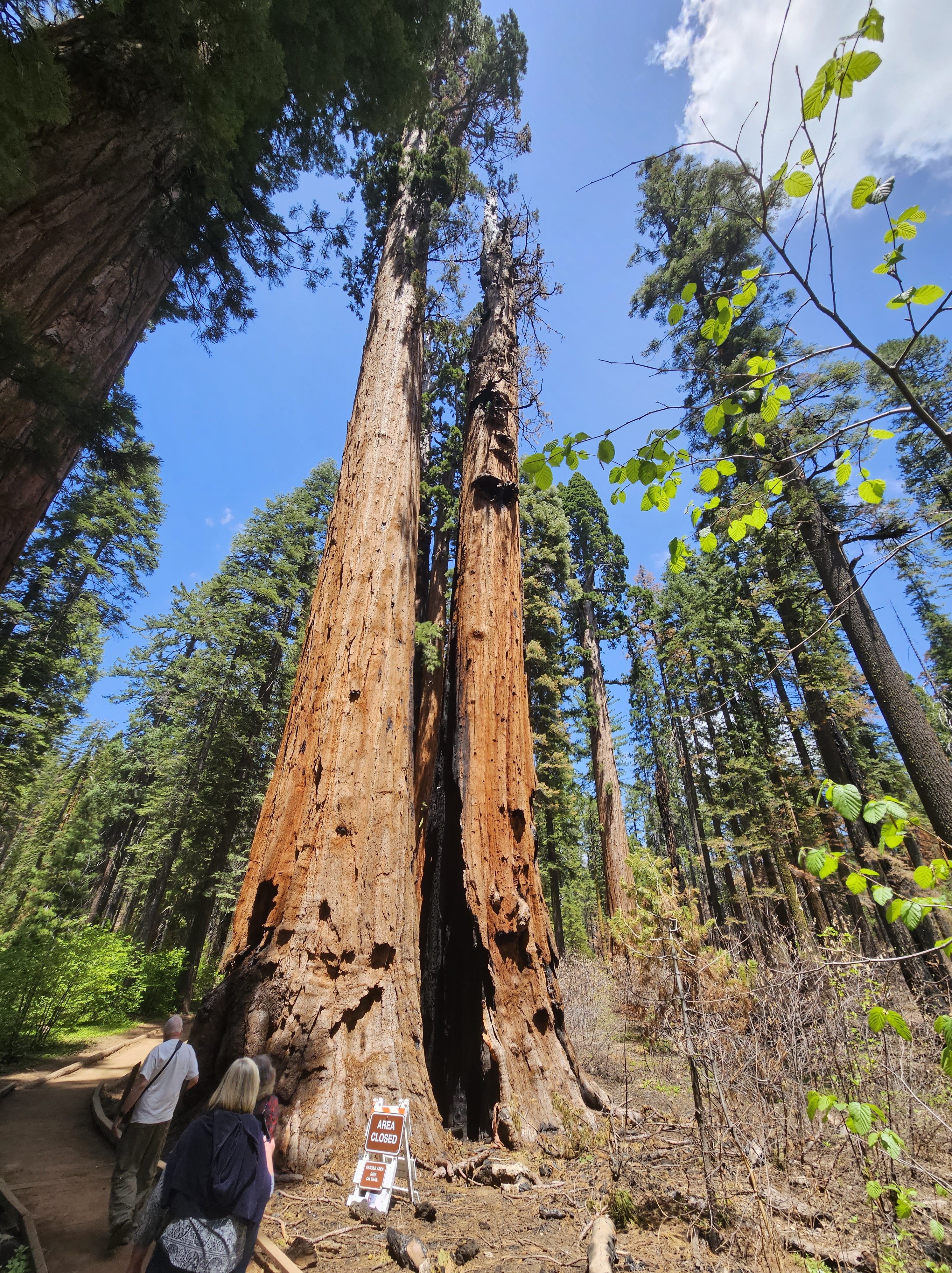
Calaveras Big Trees State Park, May 25, 2023

Larger prescribed burns were also conducted on the northern edge of the park, where there are few sequoias.  Below is a picture of one of several large areas of the park that were intentionally burned:
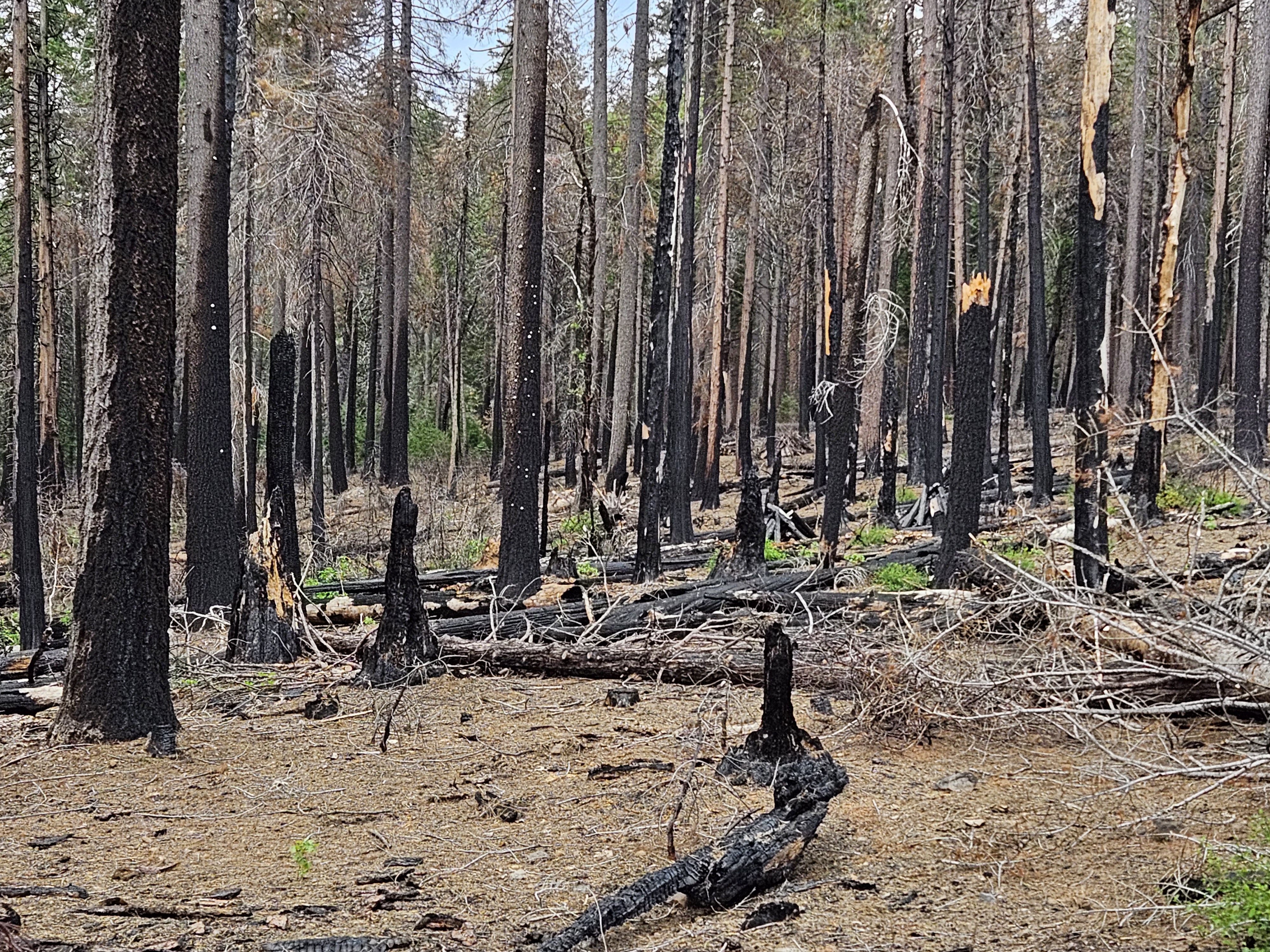
Calaveras Big Trees State Park, May 25, 2023

There are only two sequoias in this part of the park, named the Orphans because of their isolation from other sequoias in the park.  The Orphans were severely burned by this fire. (see below) It isn’t clear if the Orphans will survive.
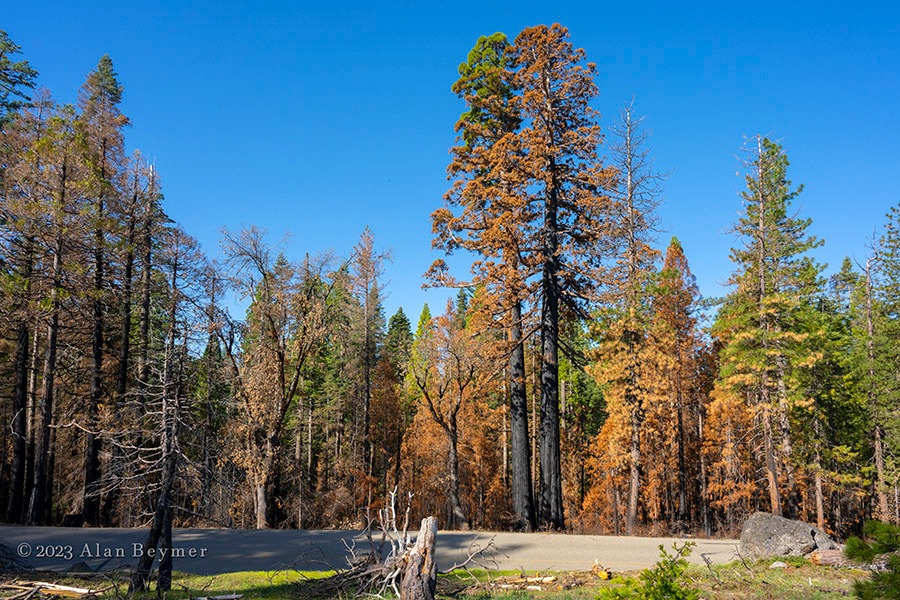
The Orphans, Calaveras Big Trees State Park. Photo by Alan Beymer with permission.

Land management or mismanagement?

The potential loss of a few giant sequoias at Calaveras Big Trees may seem trivial, but their loss must be put in the context of the small and shrinking population of giant sequoias as well as their very long lifespan of roughly 3,000 years.  The survival of the species is threatened by these unintentional deaths that could have been avoided. 

Many major wildfires have been started when burn crews lost control of prescribed burns. In April 2022, the US Forest Service conducted two prescribed burns in the Santa Fe National Forest in New Mexico that merged and became a major wildfire that burned for months, ultimately destroying over 341,000 acres of forest.  Although it was one of the most destructive of wildfires started by a prescribed burn, it is only one of many. 

Logging to thin the forest is another strategy used by public land managers to reduce fuel loads, but we did not see any evidence of logging at Calaveras Big Trees. The giant sequoias in Calaveras County reside in a mixed conifer forest of ponderosa pine, incense cedar, white fir, and sugar pine.  These tree species are valuable timber and therefore vulnerable to pressure from the logging industry.  It seems likely that the Save our Sequoias Act sponsored by Republicans is a gift to the logging industry, rather than to the sequoias.

In 2017, the National Academy of Sciences published an evaluation of fuels management projects in the US.  The authors of this publication reported that managing forest fuels has been ineffective:  “Mechanical fuels treatments on the US federal lands over the last 15 years totaled almost 7 million hectares, but the annual area burned has continued to set records.  Regionally, the area treated has little relationship to trends in the area burned, which is influenced primarily by patterns of drought and warming.”  Where fuels treatment was done, wildfires subsequently occurred:“10% of the total number of US Forest Service forest fuels treatments completed in the 2004-2013 period in the western United States subsequently burned in the 2005-2014 period.”  This suggests that “most treatments have little influence on wildfire.” In any case, only 40% of wildfires occurred in forests since 1984, with most fires burning grasslands and shrublands. 

The authors of the study published by the National Academy of Sciences, recommend a new approach to forest management.  Whereas past policies were designed to maintain forest conditions to historical conditions, this is no longer considered a realistic goal.  The recommended goal is now “supporting species compositions and fuel structure that are better adapted to a warming, drying climate with more wildfire.” 

The other, equally important new goal is to reduce the vulnerability of communities to wildfire by “changing building codes to make structures more fire-resistant…and providing incentives, education, and resources to reduce vulnerability to future wildfire.”  The only tree removals that make sense to the authors are those immediately around residential communities, “strategically located to protect homes and the surrounding vegetation.”  That is the principle of creating “defensible space” immediately around structures:  “fuels management for home and community protection will be most effective closest to homes…where ignition probabilities are likely to be high.”  The strategies used in Calaveras Big Trees to protect giant sequoias may not be the best strategies for surrounding residential communities. 

Land managers who conduct prescribed burns in sequoia groves also believe they are assisting forest regeneration because the heat of fires is said to release the seed-carrying female cones from the tree canopy and open the cones to release their seeds.  The track record on forest regeneration after wildfires depends partly on the severity of fire, but the results of studies are mixed. (4)

The purpose of prescribed burns is to reduce fuel loads with low-severity fire in order to prevent more destructive high-severity fires.  However, in the case of giant sequoias, high-severity fires may be necessary for long-term survival of the species:  “High-severity fires create robust seedling establishment and survival. For example, in a report on sequoia ecology, NPS researcher Nate Stephenson concluded: ‘Before the arrival of European settlers, successful recruitment of mature sequoias depended on fires intense enough to kill the forest canopy in small areas. Thus, sequoia is a pioneer species, and this conclusion has specific management implications.’” (5)

We saw an example of forest regeneration after a severe wildfire in the sequoia grove in Calaveras Big Trees.  Below is a photo of the Mother of the Forest that was burned by a wildfire in 1908.  That tree was particularly vulnerable to wildfire because the thick, spongy bark layer that protects sequoias from fire (as well as insects and disease) had been removed by entrepreneurs (more accurately called vandals) who reassembled the bark as a tree replica for display and profit.
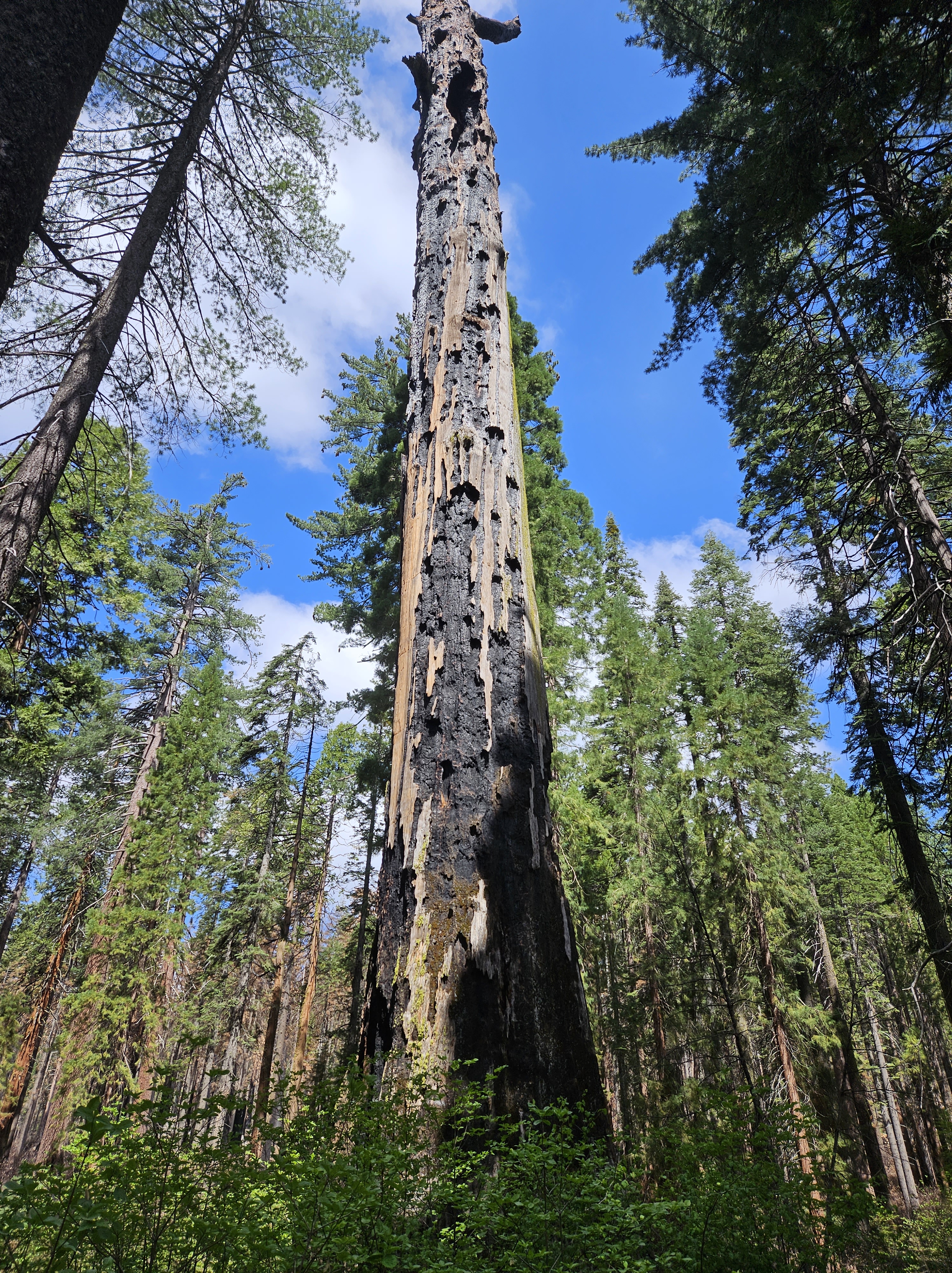
Calaveras Big Trees State Park, May 25, 2023

The Mother of the Forest is surrounded by a young forest of trees, including many giant sequoias.  (See below. Trees with reddish bark are young giant sequoias.)  “The [1908] fire created ideal growing conditions for giant sequoia seedlings and today there is a healthy stand of young sequoias there.  Many of these trees are the result of natural regeneration that happens after a fire, while others were planted during the 1930s by members of the Civilian Conservation Corps.” (6)
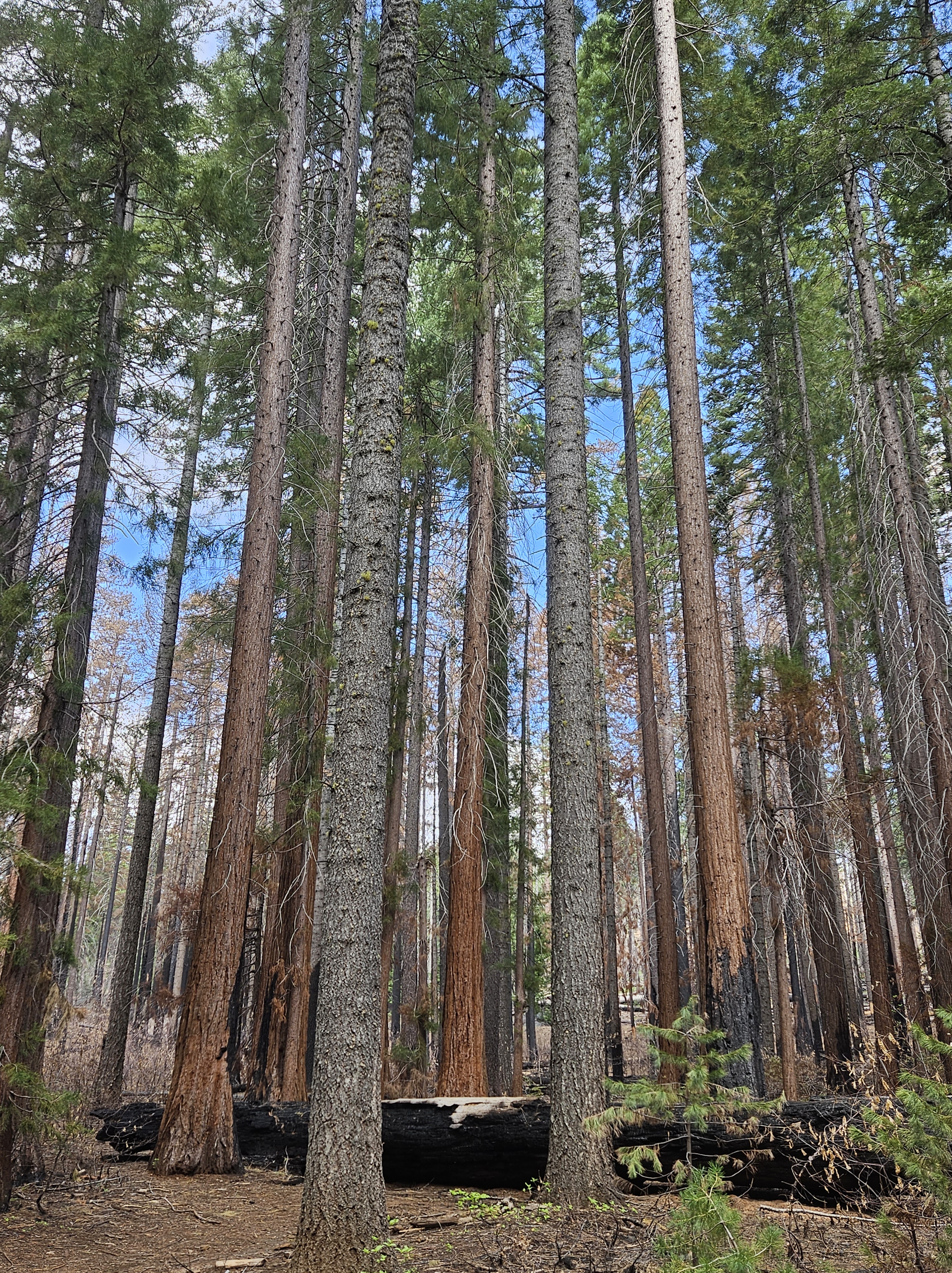
Calaveras Big Trees State Park, May 25, 2023

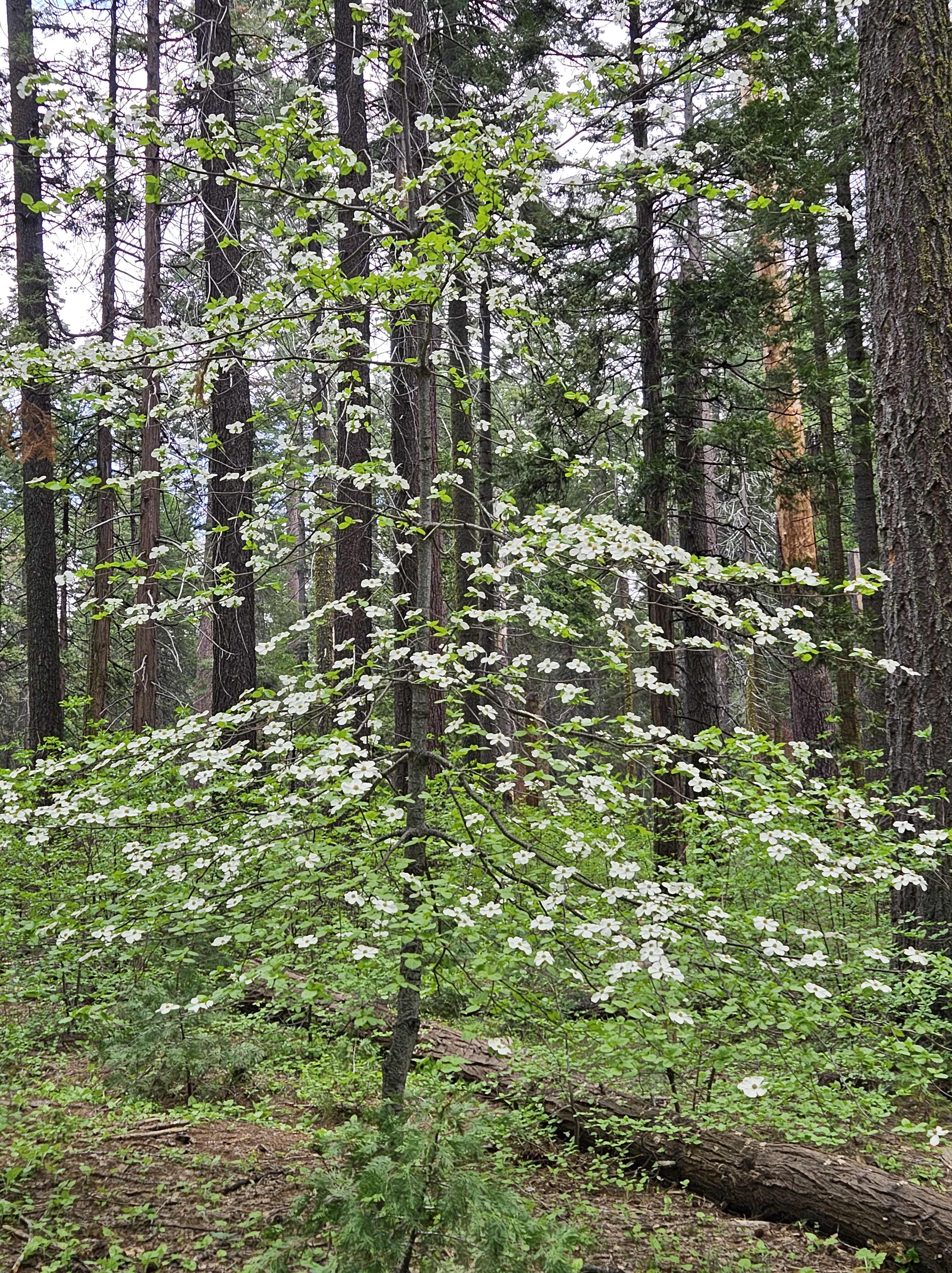
Mountain dogwood (Cornus nuttalli) and hazelnut (Corylus cornuta) are the predominant understory shrubs in the forest of Calaveras Big Trees.  After an unusually long, cold winter most weren’t blooming yet at the end of May.  A few dogwoods were blooming where sunshine penetrated the tree canopy.  (see below)
Calaveras Big Trees State Park, May 25, 2023

Unfortunately, these lovely small trees are seen as competitors of the giant sequoias for available water and nutrients in the soil.  Therefore, destroying the understory in Calaveras Big Trees is one of the management goals.  According to the Calaveras Big Trees Association, most of the dogwoods were chopped down by park staff about 9 years ago.  Dogwoods are vigorous resprouters, so they quickly grew back more densely than their taller predecessors.  Pesticides (including herbicides) aren’t used in Calaveras Big Trees, so resprouting was inevitable.  I wonder if those who destroyed the dogwoods understood that would be the outcome of their effort. 

Management strategies of the timber industry are based on an assumption of competition.  When clear-cut harvests are done by the timber industry they are typically sprayed with herbicides from helicopters to destroy the understory that they assume competes with the tree seedlings they plant for the next timber crop.  Public land managers often use the same strategy.

The research of Suzanne Simard has informed us that there is more cooperation in the forest than there is competition.  A lifetime of observing healthy forests taught her that the soil is occupied by vast networks of fungi that connect the plants and trees.  These mycorrhizal fungi transfer moisture and nutrients from the soil to the trees and plants, to their benefit.  She speculated that the destruction of all vegetation in clear cuts was eliminating that support structure and she designed experiments to test her hypothesis. 

The specifics of fungal associations between tree species varies, which requires that we describe a specific relationship.  Simard’s original studies focused on the fungal associations between Douglas fir and birch trees in the understory.  Birch trees were destroyed in the clear cuts that were then planted with Douglas fir seedlings that were not doing well.  Simard’s experiments eventually revealed that birch trees and firs mutually benefit one another through their fungal networks.  Carbon stored and the sugar produced by photosynthesis by firs are shared with deciduous birch during winter months while they are leafless.  In summer months when birch are foliated, they store more carbon that is shared with firs.  Birch is resistant to a root pathogen to which firs are susceptible.  In a sharing fungal relationship between birch and firs, birch confers some of that resistance to the root pathogen onto their fir neighbors.  Is there a similar relationship between dogwoods and sequoias and other conifers in the forest at Big Trees? 

The understory also shades the forest floor, which retains moisture in the soil that would otherwise evaporate in the absence of shade. The canopy of giant sequoias is near the top of mature trees and doesn’t cast much shade.  In other words, the shaded forest floor provides more moisture for all members of the plant community in sequoia groves.  Furthermore, a shaded forest floor is less likely to ignite a fire because of the moisture it retains. 

More questions than answers

I don’t know the answers to the questions I have raised about management strategies in Calaveras Big Trees:

  • Is there a mutually beneficial relationship between dogwood and hazelnut and giant sequoia?  Is it necessary or beneficial to destroy the understory in the sequoia groves of Calaveras Big Trees?
  • Are there more risks than rewards in conducting prescribed burns in Calaveras Big Trees?
  • Would thinning the trees in sequoia groves benefit the timber industry more than the sequoias?
  • Are severe fires more effective than low-severity fires to germinate the seeds of giant sequoias and regenerate the forest after fires?

However, I am sure that when there is uncertainty and great risk, there must be caution.  I also know that Calaveras Big Trees State Park is a treasure.  If you haven’t visited, I suggest you put it on your bucket-list.


  1. Gary D. Lowe, “Geologic History of Giant Sequoia and the Coast Redwood,” North America Research Group, Beaverton, Oregon, 2013-2014.
  2. Twilight Greenaway, “In California, a race to save the world’s largest trees from megafires,” Inside Climate News, September 23, 2022.
  3. “‘It could be a big tree in 1,000 years’:  tiny seedlings of giant sequoias rise from ashes of wildfire,” The Guardian, November 1, 2021
  4. Kristen Shive, et.al., “2021 Fire Season Impact in Giant Sequoias, National Park Service.
  5. George Wuerthner, “Save Our Sequoias Act:  A Stealth Attack on NEPA-EAS and Our Sequoia Groves,”  Wildlife News, May 21, 2023.
  6. “A Guide to the Calaveras North Grove Trail,” Calaveras Big Trees State Park.  Much of the information in this article comes from this trail guide. 
What does “restoration” mean?

I welcome comments on my website because I often learn from them.  This comment on a recent post inspired me to think about why I often put the word “restoration” in quotation marks when describing projects that are more destructive than constructive:

Oh my, we are back to putting quotes around words we don’t like. An excerpt from this article:

“Many ecological studies and associated “restoration” projects adopt the same viewpoint that destruction is a justifiable method of studying and “restoring” ecosystems. “Restoration” projects often begin by killing all non-native plants with herbicides before attempting to create a native landscape.”

Often? We do a fair amount of underburning around here, primarily to “restore” ecosystem structure and function in mixed conifer. Of the burns I have been involved with, not one involved herbicides and pesticides. I think you put the lie to your own article by this one exaggeration. I suspect if I bothered to look I would find many others.

This is my reply to this comment:

When the word restoration is used appropriately, it is a powerful, positive word.  There is a multitude of potential projects in California that would be restorative.  Here is a brief list:

Superfund Sites in California

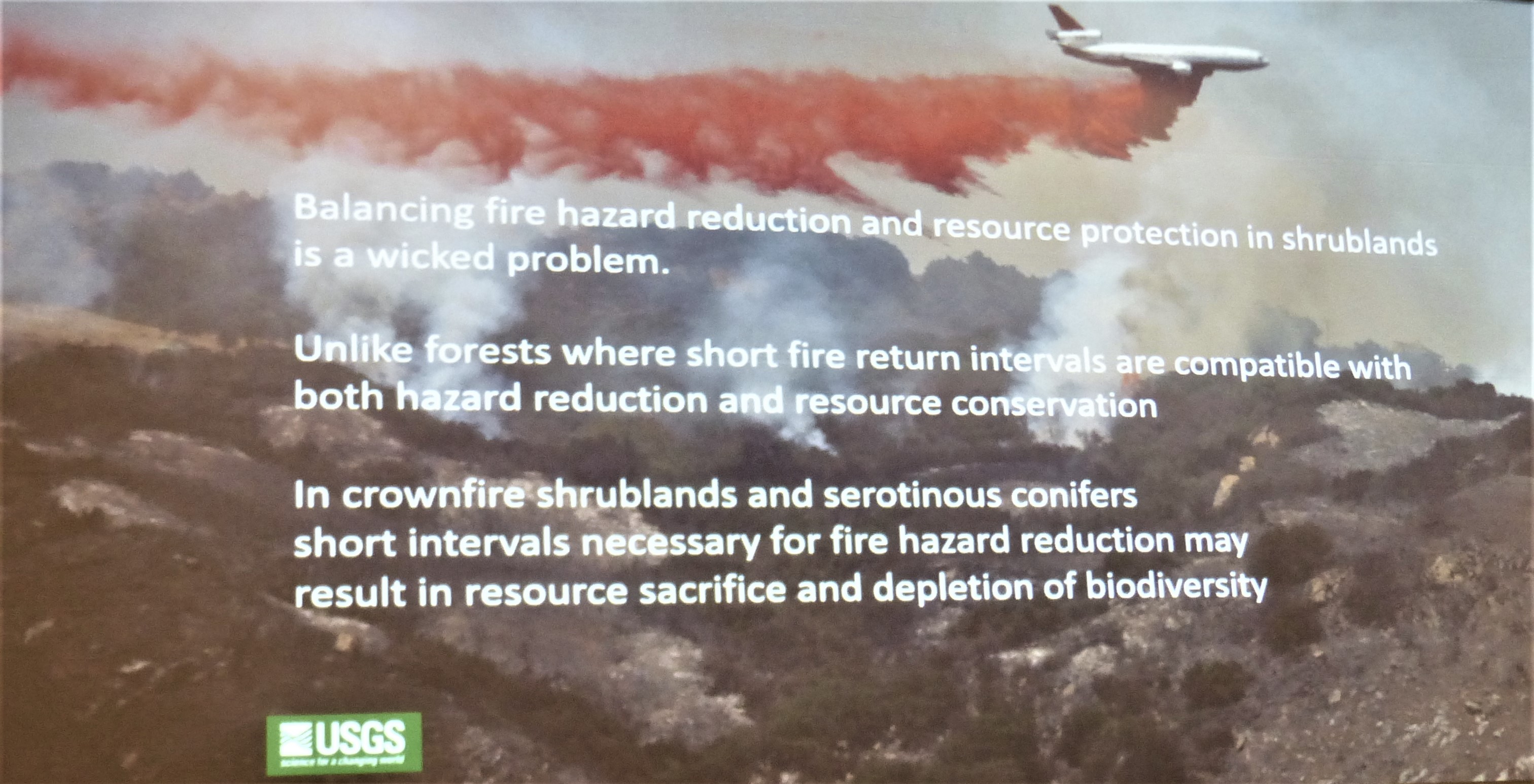
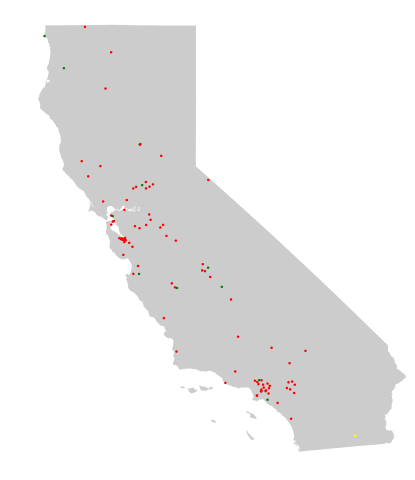
Prescribed burns are currently popular and some don’t use herbicides before burning, but they are NOT a panacea.  Many prescribed burns have become destructive wildfires.  Here are two presentations made at the October conference of the California Native Plant Society that were critical of the over-reliance on prescribed burns:

Source: Jon F. Keeley, CNPS Conference, October 2022
  • Dr. Jon Keeley is a respected fire scientist with US Geological Service with expertise in chaparral ecosystems.  He explained that 60% of native chaparral species (notably manzanita and ceanothus) are obligate seeders that do not resprout after fire and therefore depend on their dormant seed bank for regeneration.  In recent decades the fire interval in chaparral has decreased due to climate change and associated drought.  In many places the fire interval has become too short to establish the seed bank needed for regeneration.  In those places Dr. Keeley has observed vegetation type conversion to non-native annual grasses.  Dr. Keeley Is concerned that vegetation type conversion from forests in some cases and shrublands in others to non-native annual grassland may be the result of shortening fire intervals further “because of the upsurge in state and federal programs to utilize prescription burning to reduce fire hazard.” 
  • Another presentation about a 20-year effort to convert non-native annual grassland to native grassland using prescribed burns at the Santa Rosa Plateau Ecological Reserve reported their failure: “Non-native grass cover significantly decreased after prescribed fire but recovered to pre-fire cover or higher one year after fire.  Native grass cover decreased after prescribed fire then recovered to pre-burn levels within five years, but never increased over time.  The response of native grass to fire (wild and prescribed) was different across time and within management units, but overall native grass declined.” The audience was audibly unhappy with this presentation.  One person asked if the speaker was aware of other places where non-native grass was successfully converted to native grass.  The speaker chuckled and emphatically said, “NO.  I am not aware of any place where native grasses were successfully reintroduced.” 

When describing projects that are more destructive than constructive, I put the word “restoration” in quotes.  I stand by that choice.

Projects that are truly restorative

Days after responding to this comment, the New York Times published an article about the successful effort to clean up the New York City harbor that deserves to be called a restoration:

“Fifty years ago, Congress voted to override President Richard Nixon’s veto of the Clean Water Act. It has proved to be one of the most transformative environmental laws ever enacted.

“At the time of the law’s passage, hundreds of millions of gallons of raw sewage was dumped by New York City into the Hudson River every day. This filth was compounded by industrial contaminants emptied into the river along much of its length. The catch basin for all of this was New York Harbor, which resembled an open sewer. At its worst, 10 feet of raw human waste blanketed portions of the harbor bottom, and certain reaches held little or no oxygen to sustain the life of its fishery. Trash floated among oil slicks.

“Health advisories against eating fish from the Hudson remain, but its ecology has largely recovered, thanks to the law, which imposed strict regulations on what could be discharged into the water by sewage treatment plants, factories and other sources of pollution….”

The NYT article also describes how many animal species benefitted from the reduction in pollution in New York City’s harbor.

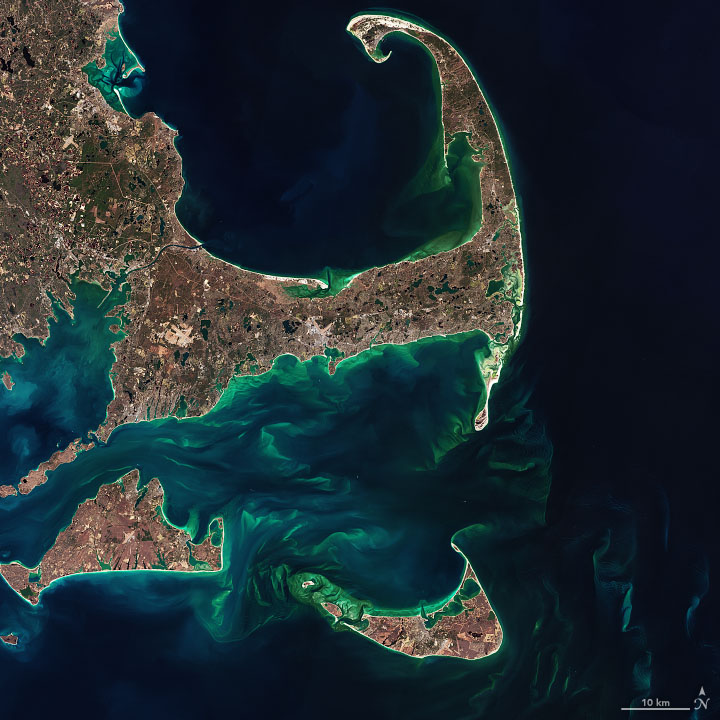
NYT also published an article about the pollution of the water surrounding Cape Cod that is destroying that ecosystem. 

“The algal explosion is fueled by warming waters, combined with rising levels of nitrogen that come from the antiquated septic systems that most of the Cape still uses. A population boom over the past half-century has meant more human waste flushed into toilets, which finds its way into waterways.

“More waste also means more phosphorus entering the Cape’s freshwater ponds, where it feeds cyanobacteria, commonly known as blue-green algae, which can cause vomiting, diarrhea and liver damage, among other health effects. It can also kill pets.

“The result: Expanding aquatic dead zones and shrinking shellfish harvests. The collapse of vegetation like eelgrass, a buffer against worsening storms. In the ponds, water too dangerous to touch. And a smell that Ms. Fisher characterizes, charitably, as “earthy.”

“Together, the changes threaten the natural features that define Cape Cod and have made it a cherished destination for generations.”

Cape Cod. Source: NASA

This an example of the many missed opportunities to restore the environment.  Instead of addressing the sources of pollution, such as leaky septic tanks and sewage systems, we invest in projects that contribute to pollution by spraying harmless vegetation with herbicides, killing harmless animals with pesticides and contributing to air pollution by burning vegetation. 

Closer to home, the recent torrential rain soaking California is a reminder of our inadequate sewer systems now overflowing from storm drains into city streets and being dumped into the ocean when the drainage gets that far.   San Francisco’s antiquated sewage system is an extreme case.  When it was built, it funneled storm runoff from city streets into the city’s sewer system, combining residential sewage waste with storm water runoff.  When it rains heavily, San Francisco’s sewage system is not capable of treating the increased flow. Such systems have been illegal for decades, but San Francisco has not made the necessary improvements to its sewer system.  As the SF Chronicle reports, city streets are now flooded with a toxic mix of rain water and human sewage. 

“Restoration” is not a dirty word when used to describe projects that reduce pollution.  When projects contribute to pollution they cannot legitimately be called “restorations.” 

Nearly a HALF MILLION trees will be destroyed if these East Bay projects are approved

This is a revision of an article that was published on May 5, 2013.  In our haste to inform our readers of these projects during the public comment period, we published before we had read the entire Environmental Impact Study.  We are forced to revise our estimates based on further reading of the document.  We apologize for the confusion and thank you for your patience.

On May 29, 2013, we found an error in the number of trees that will be removed at Frowning Ridge.  We show our corrections so as not to mislead our readers.  Again, our apologies.

*******************************

The Federal Emergency Management Agency (FEMA) has been considering grant applications for “fire hazard mitigation” in the East Bay since 2005, when the first of these applications was submitted. After years of debate about whether or not the projects achieve the stated purpose and at what cost to the taxpayers and the environment, FEMA finally agreed to resolve the controversial issues by mandating an environmental impact review, which began in 2010. Although FEMA paid for the environmental review, the grant applicants conducted it and it represents their opinions of their projects.

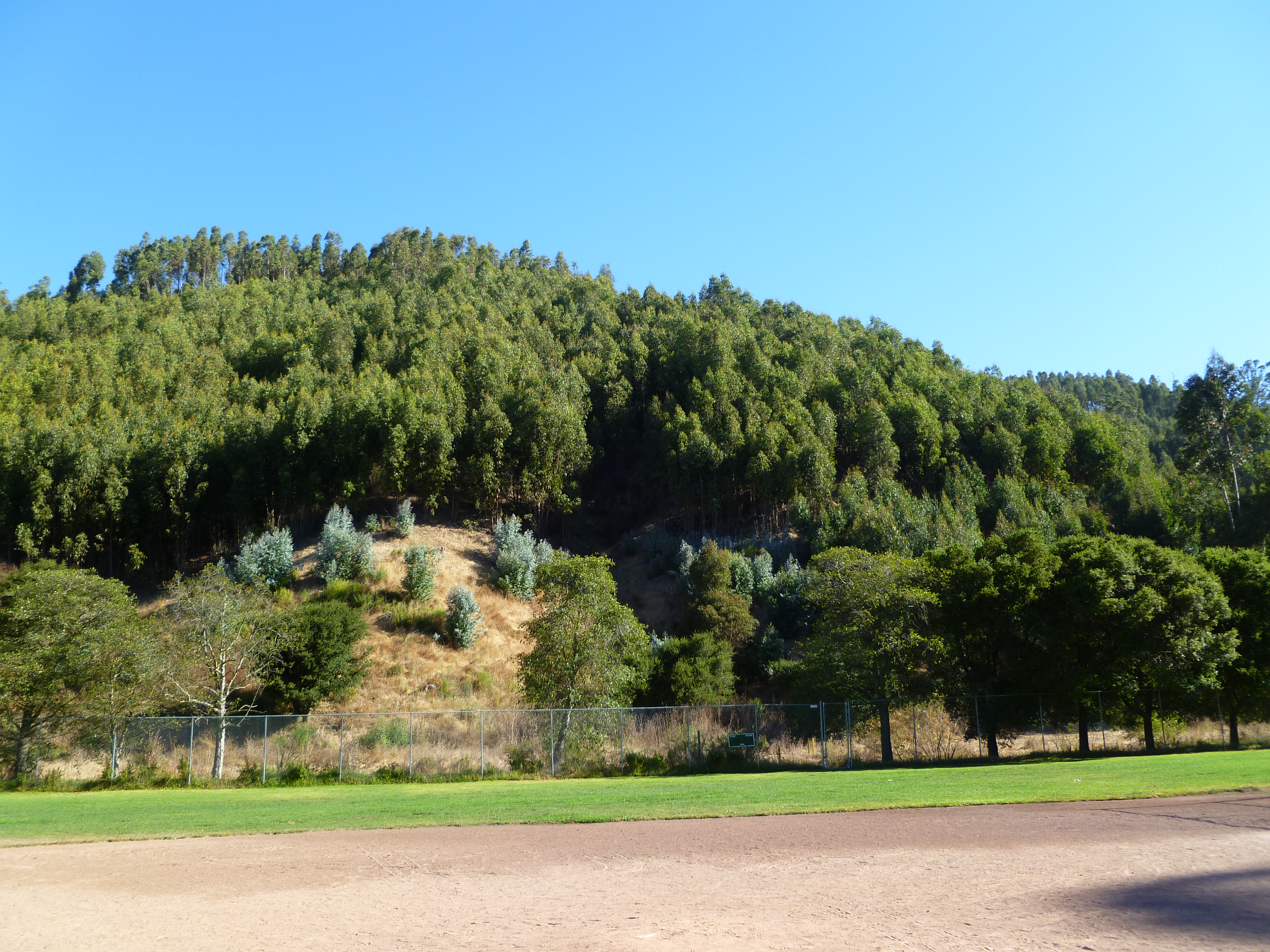
This eucalyptus forest at the North Oakland Sports Facility will be entirely destroyed.

These are the projects for which the Million Trees blog was created and for which it was named. Our opinion of these projects is unchanged by the environmental impact review. These projects will not achieve their stated objectives. Instead they will damage the environment and endanger the public.

The Draft Environmental Impact Statement (DEIS) for these projects was published by FEMA on April 25, 2013. It is available here. This is a brief description of the projects, our initial assessment of the DEIS, and information about how you can participate in the decision-making process which will ultimately determine the fate of these projects.

Description of the projects in the East Bay

Three different owners of public land have applied for these grants: University of California at Berkeley (UCB), City of Oakland, and East Bay Regional Park District (EBRPD). The projects of UCB and Oakland are similar and they are different from the projects of EBRPD, so we will describe them separately. These are the locations of the projects of UCB and Oakland, their acreage, and the estimated number of trees that will be removed by these projects:

Project Area

Project Acreage

Estimated Tree Removals*

UCB
  Strawberry Canyon

56.3

22,000

  Claremont

42.8

  Frowning Ridge (in Oakland)

185.2

38,000 32,000

Sub-Total

284.3

60,000 54,000

Oakland
  North Hills Skyline

68.3

  Caldecott Tunnel

53.6

Sub-Total

121.9

25,735 23,161

TOTAL

406.2

85,735 77,161

*UCB estimated tree removals are provided by the DEIS; Oakland estimated tree removals are extrapolated assuming the same number of trees per acre (60,000 54,000 ÷ 284.3 = 211 190 trees per acre X 121.9 acres = 25,735 23,161 trees removed by the projects of the City of Oakland)

UCB and Oakland plan to remove all non-native trees (eucalyptus, Monterey pine, acacia, etc.) and vegetation from the project area. All non-native trees up to approximately 24 inches in diameter at breast height (DBH) will be cut into wood chips and scattered on the ground of the project area. They estimate that 20% of the project area will be covered with wood chips to a depth of 24 inches. The DEIS estimates that the wood chips will take from 5 to 10 years to decompose. Larger trees will be cut up and scattered on the site.

Although UCB and Oakland do not intend to plant the project areas (unless erosion subsequent to tree removals demands seeding of native grasses and herbaceous plants), they predict that the project area will eventually become native grassland, scrub, and forest of coast live oak, California bay laurel, big-leaf maple, California buckeye, and California hazelnut. They predict that this conversion from non-native to native vegetation will be accomplished by “recruitment” from areas where these plants exist, into the areas where non-native plants and trees will be removed.

The stumps of eucalypts and acacia will be sprayed with an herbicide (Garlon with the active ingredient triclopyr) soon after the trees are cut down to prevent resprouting. An estimated 1 – 2 ounces of formulated herbicide will be required for each stump. Based on an experiment conducted by East Bay Regional Park District, an estimated 5% of the trees will require retreatment of subsequent resprouts. They are therefore predicting that between 703 633 and 1,407 1,266 gallons of herbicide will be required to prevent resprouting if only 5% of the stumps require retreatment as they claim. Monterey pines will not require herbicide treatment which reduces this estimate proportionately, although we are not provided with enough information to make this calculation. Herbicide (Roundup with active ingredient glyphosate) will also be sprayed to control non-native vegetation, but no estimates of quantities required for that purpose are provided by the DEIS.

The fire hazard mitigation projects of the East Bay Regional Park District were described in detail in its “Wildfire Hazard Reduction and Resource Management Plan” of 2009. EBRPD has applied for FEMA funding for about one-third of the “recommended treatment areas” in that plan. The FEMA DEIS considers all recommended treatment areas on EBRPD property, including those for which FEMA funding has not been requested. The recommended treatment areas for which FEMA funding has not been requested are called “Connected Action Acres.” The “Connected Action Acres” have undergone environmental review under California law (CEQA) and are therefore approved for implementation, which has already begun.

Project Area

Project Acres

Connected Action Acres

Total Acres

Estimated Tree Removals*

EBRPD
Sobrante Ridge

4.1

0

Wildcat Canyon

65.6

46.6

Tilden Park

132

194.2

Claremont Canyon

35.3

130.4

Sibley Volcanic

47.5

118.4

Huckleberry

17.8

.3

Redwood Park

58.4

92.8

Leona Canyon

4.6

0

Anthony Chabot

200

478.2

Lake Chabot

4.8

0

Miller-Knox

22.2

0

TOTAL

592.3

1,060.7

1,653

400,602 409,176

*Estimated Tree Removals: Neither the DEIS nor EBRPD’s “Wildfire Plan” provides an estimate of the number of trees they plan to destroy. Furthermore their plans for tree removals are complex and variable. All non-native trees (eucalypts, Monterey pines, acacia) will be removed in some recommended treatment areas, but in most they will be thinned to spacing of 25 to 30 feet. The final Environmental Impact Report for the “Wildfire Plan” provides an estimate of the existing tree density of existing eucalypts on EBRPD property (page 392). Acres of eucalypts in the entire project area are provided by the DEIS (page 4.2-6).  Our estimate of tree removals is based on those figures (1).

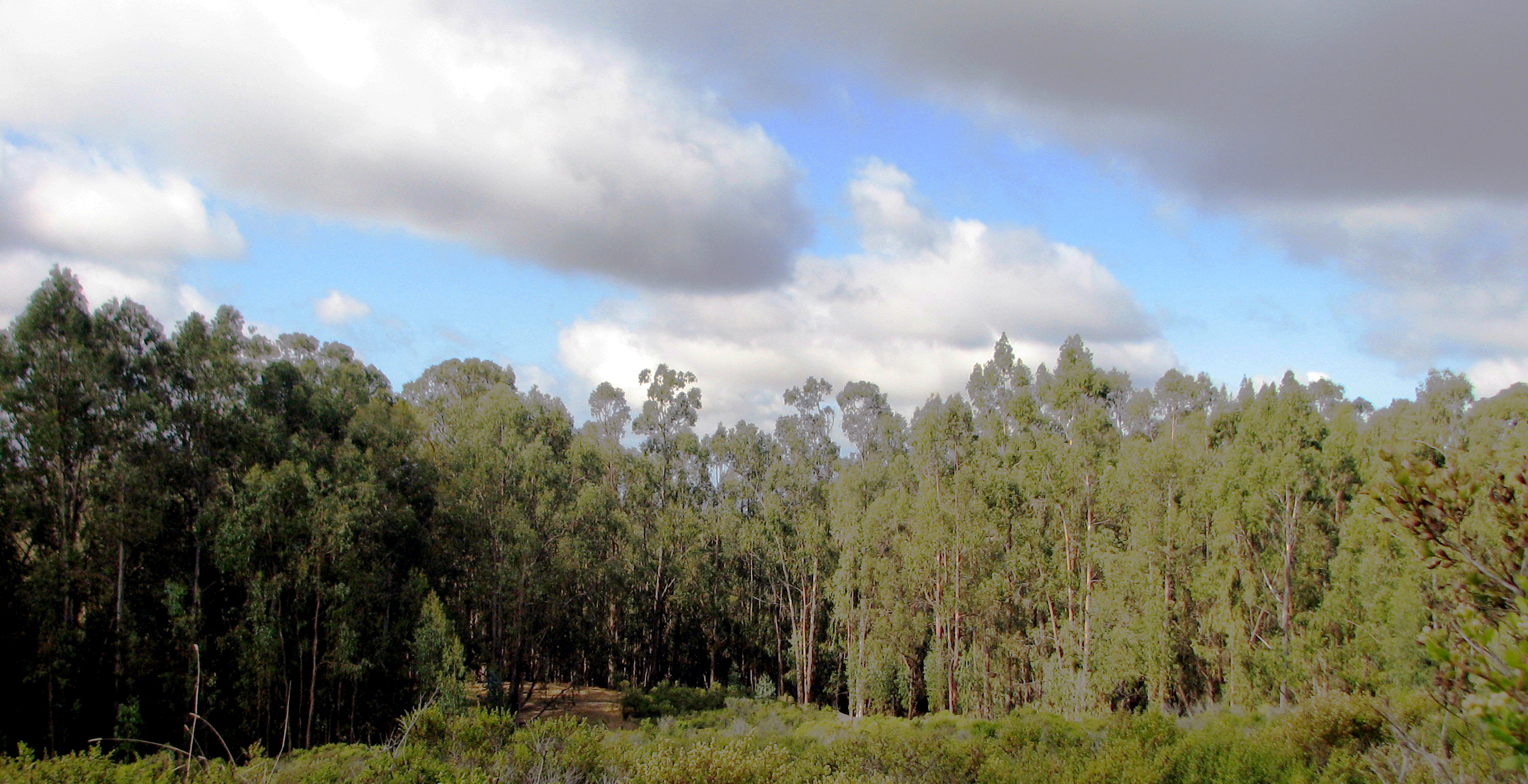
This eucalyptus forest at Chabot Park will be thinned to about 60 trees per acre.

This estimate does not include the Monterey pines and acacia that will be removed by EBRPD, for which inadequate information is available to provide an estimate.

EBPRD plans to cut the trees into wood chips which will be scattered to cover 20% of the project to maximum depth of 4-6 inches. The remainder of the wood will be burned in piles. Other non-native vegetation will be destroyed with herbicides and/or prescribed burns. These prescribed burns will not be funded by FEMA.

EBRPD’s plans to convert the project area to native vegetation are similar to the plans of both UCB and Oakland. EBRPD also does not plan to plant project areas with native vegetation. EBRPD also plans to use herbicides on the stumps of eucalypts and acacia which we estimate will require a mind-boggling 3,286 3,356 to 6,572 6,713 gallons of herbicide.

Million Trees’ assessment of these projects

We have surely exhausted your patience with the mind-numbing detail needed to describe these projects accurately. Therefore, we will provide only a brief outline of our assessment of these projects:

*  These projects are more likely to increase the risk of wildfires than to reduce that risk.

By distributing tons of dead wood onto bare ground

By eliminating shade and fog drip which moistens the forest floor, making ignition more likely

By destroying the windbreak that is a barrier to wind driven fires typical of wildfires in California

By expanding the oak-bay woodland being killed by Sudden Oak Death, thereby adding more dead wood

*  These projects will damage the environment by releasing hundreds of thousands of tons of carbon dioxide into the atmosphere from the destroyed trees, thereby contributing to climate change.

*  These projects will endanger the public by dousing our public lands with thousands of gallons of toxic herbicides.

Erosion is likely on steep slopes when the trees are destroyed and their roots are killed with herbicides.

Non-native vegetation such as broom, thistle, and hemlock are more likely occupants of the unshaded, bared ground than native vegetation which will not be planted by these projects.

Prescribed burns will pollute the air and contribute to the risk of wildfire, endangering lives and property.

*  These projects are an inappropriate use of the limited resources of the Federal Emergency Management Agency which are for the expressed purpose of restoring communities destroyed by disasters such as floods and other catastrophic events and preparing communities for anticipated catastrophic events. Most of the proposed projects in the East Bay are miles away from any residences.

Update:  Please visit THIS post for the current status of these projects.  In summary:  East Bay Regional Park District is implementing its original plans.  City of Oakland is developing a new “Vegetation Management Plan.”  UC Berkeley is suing to re-instate its FEMA grant funding so that it can implement its original plans.

How to participate in this decision-making process

The Hills Conservation Network has created a petition to oppose these projects. It is available HERE.

You can also participate in this decision. FEMA will host three public meetings in May 2013:

Tuesday, May 14, 2013, 2:00 p.m. – 4:00 p.m., Richard C. Trudeau Center, 11500 Skyline Boulevard Oakland, CA 94619

Tuesday, May 14, 2013, 6:00 p.m. – 8:00 p.m., Richard C. Trudeau Center, 11500 Skyline Boulevard Oakland, CA 94619

Saturday, May 18, 2013, 10:00 a.m. – 12:00 p.m., Claremont Middle School, 5750 College Avenue Oakland, CA 94618

Comments on this document must be submitted by June 17, 2013. You may submit written comments in several ways:

  1. Via the project website: http://ebheis.cdmims.com
  2. At the public meetings listed above
  3. By email: EBH-EIS-FEMA-RIX@fema.dhs.gov
  4. By mail: P.O. Box 72379, Oakland, CA 94612-8579
  5. By fax: 510-627-7147

These public lands belong to you and the money that will be used to implement these projects is your tax dollars. So, please tell the people who work for you what you think of these projects.

*********************************

(1)           Calculation of estimated tree removals by East Bay Regional Park District,  Update:  We understand the weakness of this estimate.  Unfortunately, the DEIS does not provide sufficient information to improve its accuracy.  Again, our apologies.

Existing average density of eucalypts 650 trees per acre
minus Planned average density of eucalypts 60 trees per acre
equals Number of eucalypts removed 590 trees per acre
times Total acres of eucalypts in project areas 824.3
equals Total number of eucalypts removed 486,337
minus Trees removed by UCB & Oakland 85,735 77,161
equals Eucalypts removed by EBRPD 400,602 409,176

(UN)controlled Burns

Today’s SF Chronicle reports that yet another “controlled” (AKA “prescribed”) burn is responsible for a wildfire in California.  This fire in the Santa Cruz Mountains burned 485 acres in October 2009, injuring 4 of the 1,700 firefighters who fought it at a cost of $4 million.  That cost doesn’t include the claims for damages of the property owners who lost their homes.

This isn’t the only controlled burn that has caused major wildfires in California and elsewhere.  For historical perspective, let’s start with the Bandelier Monument Fire in New Mexico.  This fire, began in May 2000 as a prescribed burn and eventually burned over 45,000 acres, threatened the Los Alamos National Laboratory and destroyed 235 structures.  The Department of the Interior suspended all prescribed burns while an inquiry was conducted and policy was revised to theoretically prevent similar accidents.

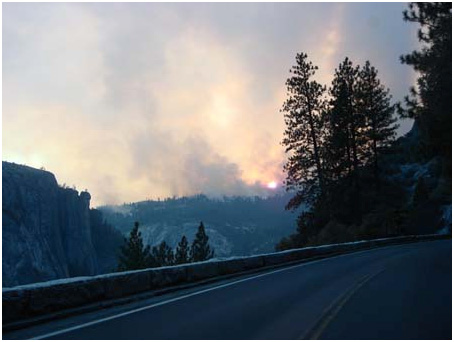
Did revision of policy stop so-called controlled burns from causing wildfires in our national parks?  No, it did not.  In October 2009, the Big Meadow Fire in Yosemite began as a prescribed burn and eventually burned 7,425 acres.  NPS apparently hadn’t learned much from their bad experience 9 years earlier at the Bandelier Monument.

Yosemite Big Meadow Fire, NPS photo

The National Park Service isn’t the only manager of public land that has had bad luck with controlled burns.  In 2003, the California State Park Department was responsible for starting a fire on San Bruno Mountain in South San Francisco intended to burn 6 acres that eventually burned 72 acres and came perilously close to homes, according to the SF Chronicle.

We should not be surprised by the unpredictable results of prescribed burns.  Fire scientists at UC Berkeley conducted a series of experimental prescribed burns in chaparral in Northern California, hoping to arrive at a model of fire behavior that would improve the predictability of such burns.  They arrived at the conclusion that “…it is extremely difficult to predict with certainty where the fire will spread…For more than half of the transects installed, the flaming front did not traverse the transects as predicted…” (1)

You might ask, “If these prescribed burns keep causing major wildfires, why do we continue starting them?”  Good question, and we are going to answer that.  The conventional wisdom is that because fires have been suppressed in the past century or so, fuel has built up that has become extremely dangerous.  Theoretically, we must restore the “natural” fire cycle to prevent this dangerous build up of fuel that will inevitably cause a huge wildfire if we don’t reduce the fuel load with smaller (hopefully) fires.  Sounds like a good argument, but is it true?  Some scientists say it isn’t.

Jon E. Keeley, Ph.D. (Biologist, US Geological Service) says in “Fire Management in the California Shrublands,”

“Fire management of California shrublands has been heavily influenced by policies designed for coniferous forests, however, fire suppression has not effectively excluded fire from chaparral and coastal sage scrub landscapes and catastrophic wildfires are not the result of unnatural fuel accumulation. There is no evidence that prescribed burning in these shrublands provides any resource benefit and in some areas may negatively impact shrublands by increasing fire frequency. Therefore, fire hazard reduction is the primary justification for prescription burning, but it is doubtful that rotational burning to create landscape age mosaics is a cost effective method of controlling catastrophic wildfires.”

Obviously, there isn’t scientific consensus that prescribed burns reduce fire hazard, so perhaps there is another reason why we pursue this dangerous course.  Yes, there is, and once again we turn to the native plant movement to explain why we are harming our environment and posing unnecessary dangers to animals, including humans.

The scientific literature is rampant with evidence that periodic fire is essential to the health of native plants.  Here is an example from a renowned academic book about California’s ecology that has the status of a standard textbook:

“The [chaparral] community has evolved over millions of years in association with fires, and in fact requires fire for proper health and vigor.  Thus it is not surprising that most chaparral plants exhibit adaptations enabling them to recover after a burn.  Many species are sprouters; the aboveground parts may be killed, but new growth arises from roots or buds at the base of the stem…Other species have seeds that require fire in order to break dormancy; they will not germinate unless they have been heated.  The cones of some chaparral conifers open only after they have been heated.  Some herbaceous species will not germinate unless there is ash on the ground when it rains…In the absence of fire, a mature chaparral stand may become senile, in which case growth and reproduction are reduced.”  (Schoenherr, A Natural History of California, 1992, UC Press)

This is also an opportunity to show how the native plant agenda has been adopted by local managers of our public lands. The “Wildfire Hazard Reduction and Resource Management Plan” of the East Bay Regional Park District announces its intention to conduct prescribe burns for the following purposes:

  • “Grassland and Herbaceous Vegetation…broadcast burns in the summer or early fall [fire season] are known to favor native plants.” (page 128)
  • “Maritime Chaparral…This [native] vegetation type and the Manzanita it supports are also fire dependent. Without disturbance by fire the Manzanita does not reproduce, becomes decadent, and is replaced by shade tolerant species.” (page 132)
  • “North Coastal Scrub…This plant community [of native plants] is adapted to natural fire cycles, and most species found within this plant community resprout easily to rejuvenate individual specimens after fire, or require fire to trigger germination.”  (page 139)
  • “[Native] Coyote Brush Scrub…is adapted to natural fire cycles.  Most species resprout easily to rejuvenate individual specimens after fire, or requires fire to trigger germination.” (page 149)

Are any of these purposes related to reducing fire hazard?  You be the judge.

The management plan of San Francisco’s Natural Areas Program also announces its intention to use prescribed burns in the Initial Study (the first stage of environmental review under CEQA) of the program, but offers no information about the effect of these burns on the environment.  In a city such as San Francisco, in which there is no history of wildfire, we must assume that the sole purpose of these burns will be to benefit native plants.

Clearly controlled burns frequently cause major wildfires.  Fires, whether intentional or not, also release harmful particulates into the air and reduce air quality.  There is no evidence that controlled burns prevent wildfires.  Yet, there is considerable evidence that they benefit native plants.  We conclude that the primary purpose of controlled burns is to benefit native plants. 


(1) Scott Stephens, et. al., “Measuring the rate of spread of chaparral prescribed fires in Northern California,” Fire Ecology, Vol. 4, No. 1, 2008