Defining “Success” so “Success” can be achieved

I always attend the conferences of the California Invasive Plant Council (Cal-IPC) and the California Native Plant Society because I feel obligated to understand their viewpoint so I can accurately report on the controversies of invasion biology.  Ironically, the more I learn about the native plant movement and the “restoration” industry it spawned, the less sense it makes.  The October 2024 Symposium of the California Invasive Plant Council has provided more evidence that attempts to eradicate well-established non-native landscapes and replace them with native plants are futile.

Tricks of the “restoration” trade

Every Cal-IPC Symposium has wrestled with the question of whether or not it’s possible to convert non-native grassland to native grassland. A study of 37 grassland “restorations” in coastal California addresses that question. (1)  It’s really quite simple.  All you need to do is define success as 25% native plants after “restoration” and limit post-project monitoring to 5 years or less:  “Monitoring is done ≤5 years after project-implementation, if at all, and rarely assesses the effects of management practice on project success.” 

It also helps if public land managers in charge of the projects won’t allow the academic researcher to enter the land to conduct a survey of the results.  43% of the projects that were studied were “statutory,” i.e., they were mandated by laws such as county general plans or legally required mitigation for projects elsewhere that Environmental Impact Reports determined were harmful to the environment.  30% of the managers of the statutory projects would not allow the academic researcher to survey their projects. 

It is also easier to achieve success if the project goal is downgraded mid-project as were many of the statutory projects because they weren’t able to meet the original goal.

Project managers can also reduce their risks of failure by planting a small number of native species that are particularly easy to grow:  “Ninety-two percent of restoration managers preferentially use one or more of the same seven [native] species.”  Seven projects planted only one native species. 

According to the study, the result of planting only a few hardy native plants is “biotic homogenization.”  Call it what you will, but this risk-averse strategy is inconsistent with claims that the goal of native plant restorations is to increase biodiversity. 

The study did not ask project managers about the methods they used to eradicate non-native plants or plant native plants.  The study tells us nothing about the methods that were used or whether or not some methods were more effective than others.  Since results of the projects were all very similar, should we assume that the methods that were used didn’t matter? 

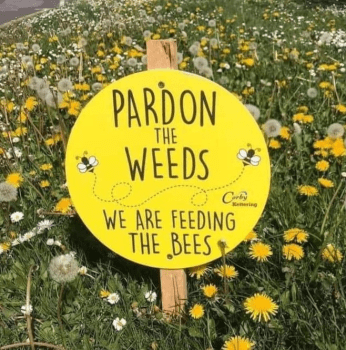
The presentation of this study concluded with this happy-face slide. (see below) It looks like a cartoonish marketing ad to me:

Harmless aquatic plants being pointlessly eradicated

A USDA research ecologist stationed at UC Davis made a presentation about the most effective way to kill an aquatic plant with herbicides, but that wasn’t the message I came away with. 

Jens Beets told us about a species of aquatic plant that is native to the East and Gulf coasts of the US, but is considered a “noxious weed” in California, solely because it isn’t native.  He said the plant is considered very useful where it is native.  (see below)
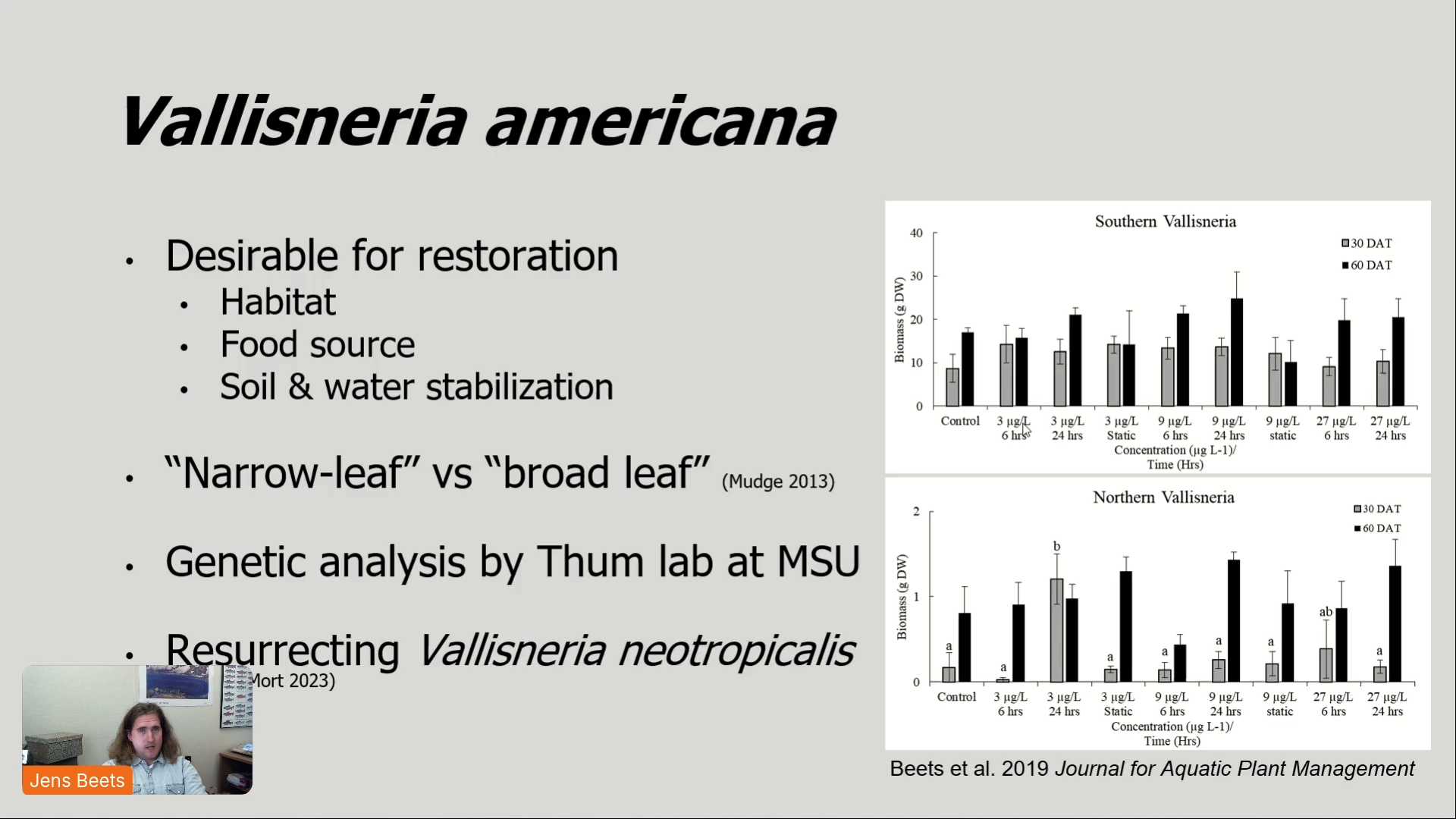
Where Vallisneria americana is native, it is considered a valuable plant for habitat restoration because it is habitat for vertebrates and invertebrates and it stabilizes soil and water levels.  The canvasback duck is named for this plant species because it is preferred habitat for the native duck that is found in California during the winter.

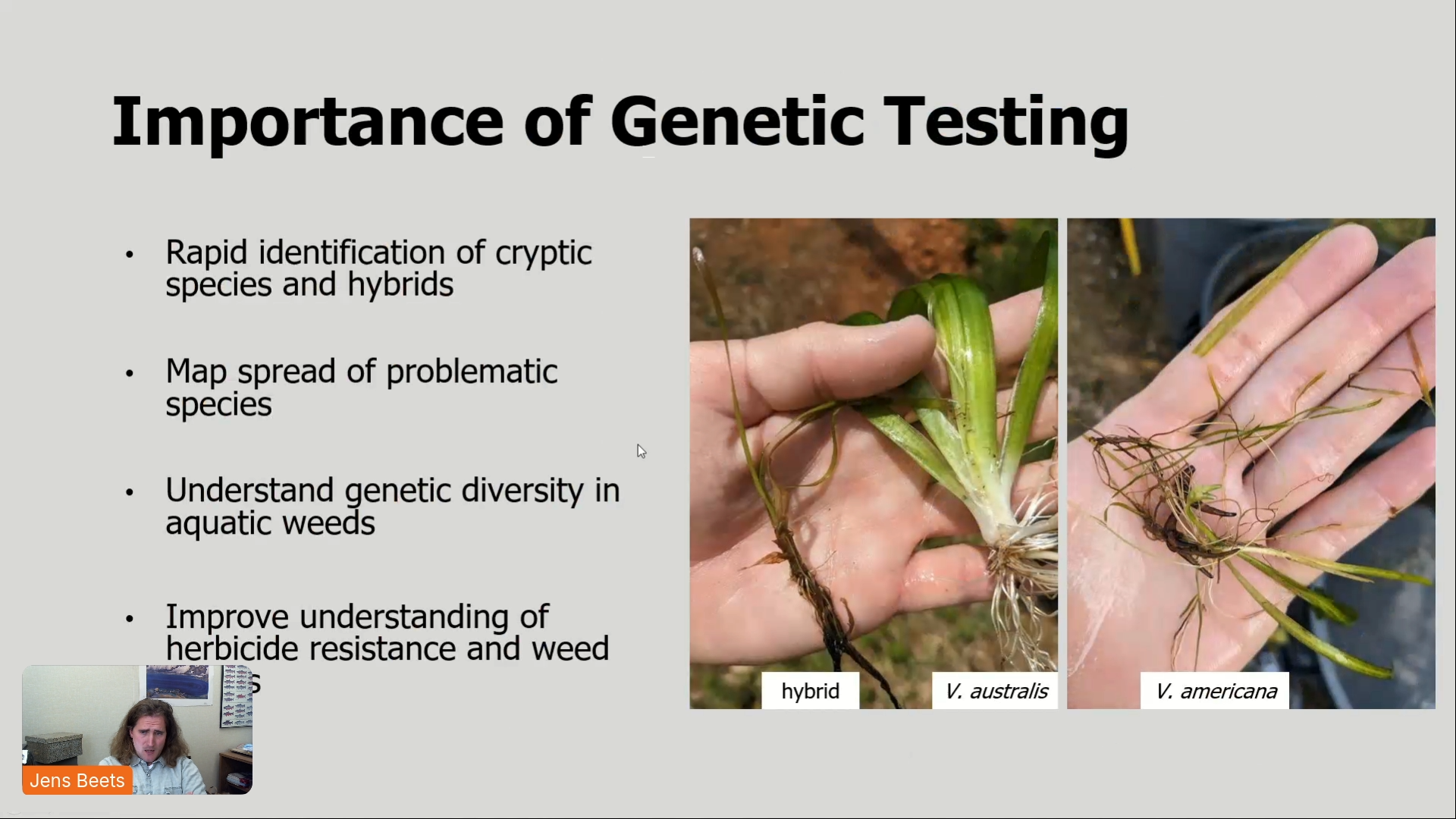
 Vallisneria americana looks very similar to other species in the genus considered native in California.  For that reason, native species of Vallisneria have been mistakenly killed with herbicide because applicators didn’t accurately identify the target plant as native.  Jens Beets recommended that genetic tests be performed before plants in this genus are sprayed with herbicide.
This story probably sounds familiar to regular readers of Conservation Sense and Nonsense.  The story is identical to the pointless and futile effort to eradicate non-native species of Spartina marsh grass in the San Francisco Bay.  The species being eradicated in California is native to the East and Gulf coasts, where it protects the coasts from extreme storm surges and provides valuable habitat for a genus of bird that is plentiful on the East Coast, but endangered in California.  The 20-year effort to eradicate non-native Spartina has killed over 50% of the endangered bird species in the San Francisco Bay. 

Throwing good money after bad

Because the hybrid is indistinguishable from the native species of Spartina on the West Coast, 7,200 genetic tests have been performed in the past 12 years before hybrid Spartina was sprayed with herbicide. Taxpayers have spent $50 million to eradicate Spartina over 20 years.  Recently, California state grants of $6.7 million were awarded to continue the project for another 10 years.  A portion of these grants is given to the California Invasive Plant Council to administer the grants.

Plants are sprayed with herbicide because they aren’t native, not because they are harmful.  Even if the target species is needed by birds and other animals, it is still killed and animals along with it.  The target species looks the same as the native species and only genetic testing can identify it is as a non-native.  The non-native is the functional equivalent of the native.  It is only genetically different because natural selection has adapted it to the conditions of a specific location. 

Pesticide regulation in the US is a hit or miss proposition

The final session of the symposium was a carefully orchestrated apologia for herbicides, a defensive tirade that suggested Cal-IPC believes its primary tool is in jeopardy.  Two presentations were made by employees of regulatory agencies.  Their assignment was to reassure the public that pesticides are safe because they are regulated by government agencies. 

The fact that many countries have banned pesticides that are routinely used in the US does not speak well for our regulatory system.  America’s pesticide regulators rarely deny market access to new pesticides.  A recent change in policies of California’s Department of Pesticide Regulation made a commitment to the continued use of pesticides for another 25 years. 

In 1996, Congress ordered the U.S. Environmental Protection Agency (EPA) to test all pesticides, used on food, for endocrine disruption by 1999. The EPA still doesn’t do this today. Twenty-five years later, the EPA has not implemented the program, nor has it begun testing on 96% of registered pesticides.  In 2022, an organization that represents farm workers sued the EPA to conduct the legally mandated evaluation of chemicals for endocrine disruption.   The lawsuit has forced the EPA to make a commitment to conduct these evaluations of chemicals for hormone disruption.   

The Cal-IPC presenters got some badly needed push back from attendees.   One attendee informed the audience that all the testing of herbicides is bought by the manufacturers, not the regulators who don’t do any testing.  Another attendee pointed out that herbicides have not been evaluated for the damage they are doing to the soil, damage that makes it difficult to grow native plants in the dead soil.  The “pesticide regulator” agreed with those observations.

Fire safety or native plant restoration?

The Interim Deputy Director of the Laguna Canyon Foundation was the final presenter for the Symposium, speaking on a Friday afternoon at 4:30 pm, when there were less than 100 attendees left of the 690 registrants.  His presentation was about the blow back that his organization gets from the public about herbicide applications.  Criticism of herbicides escalated after a wet year that increased vegetation considered a fire hazard.  This photo (below) is an example of the visible effects of fuels management by Laguna Canyon Foundation using herbicides.
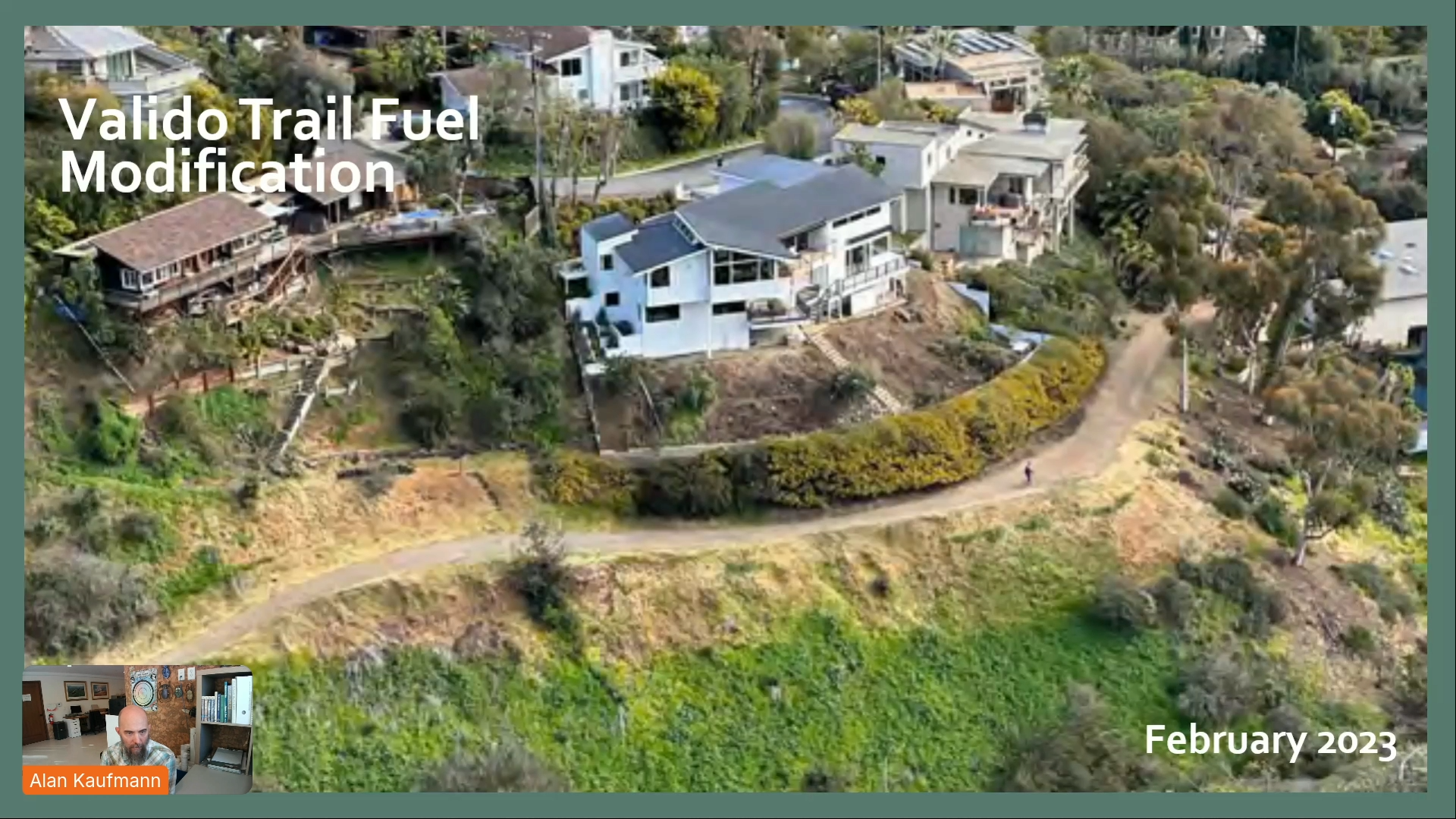
It seems likely that a fuels management project was selected for this presentation because it’s easier to justify herbicide use for fuels management than for eradicating harmless plants solely because they aren’t native. 

I recently supported Oakland’s Vegetation Management Plan that will use herbicides for the first time on 300 miles of roadsides and 2,000 acres of public parks and open space in Oakland.  Previously, herbicide applications were only allowed on medians in Oakland.  I tracked the development of the Vegetation Management Plan for 7 years through 4 revisions to avoid nativist versions of fuels management such as leaving dead thatch after herbicide applications on grassland or destroying non-native trees, while leaving highly flammable bay laurel trees behind or destroying broom, while leaving more flammable coyote brush behind.

However, using herbicides for the sole purpose of killing non-native plants is much harder to justify.  The irrational preference for native species has put us on the pesticide treadmill. Every plant species now targeted for eradication with herbicides should be re-evaluated, taking into consideration the following criteria:

  • Is it futile to attempt to eradicate a plant species that has naturalized in an ecosystem?
  • Will the attempt to eradicate the plant species do more harm than good?
  • Is the targeted plant species better adapted to current environmental and climate conditions?
  • Is the targeted non-native plant making valuable contributions to the ecosystem and its animal inhabitants?

If these questions cannot be satisfactorily answered, the bulls-eye on the targeted plant should be removed. Limiting the number of plants now being sprayed with herbicide is the only way to reduce pesticide use. If the plant isn’t a problem, there is no legitimate reason to spray it with herbicide.

Pot calls kettle black

The Cal-IPC presentation was a detailed criticism of the public’s complaints about herbicides used in their community.  The intention of the presentation was to arm herbicide applicators with defenses against the public’s complaints.  Herbicide applicators were encouraged to recognize these arguments (below) and participate in the “education” of the public about the righteousness of their task.
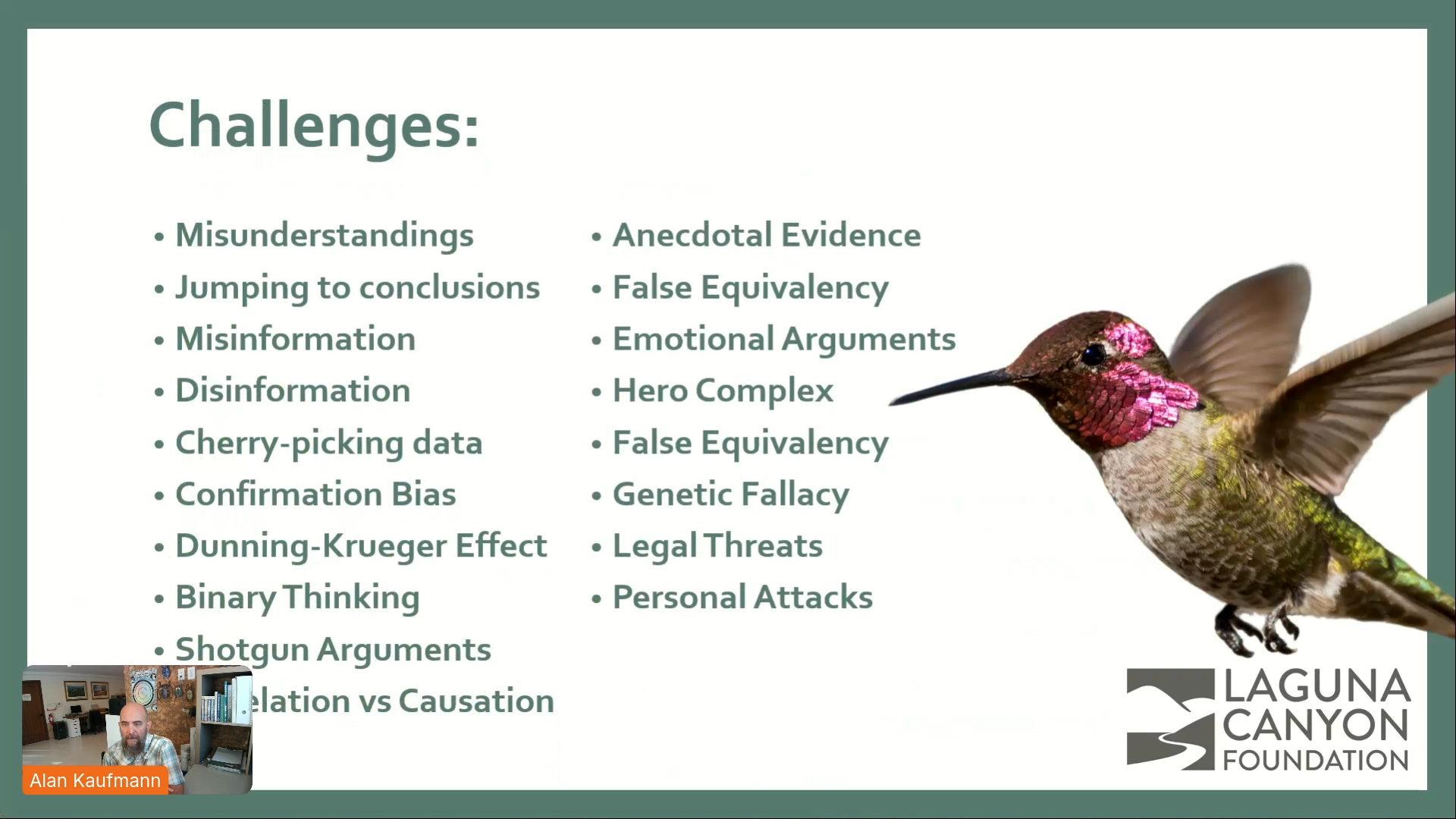
The presenter then showed a series of slides making specific accusations, such as these:  (see below)
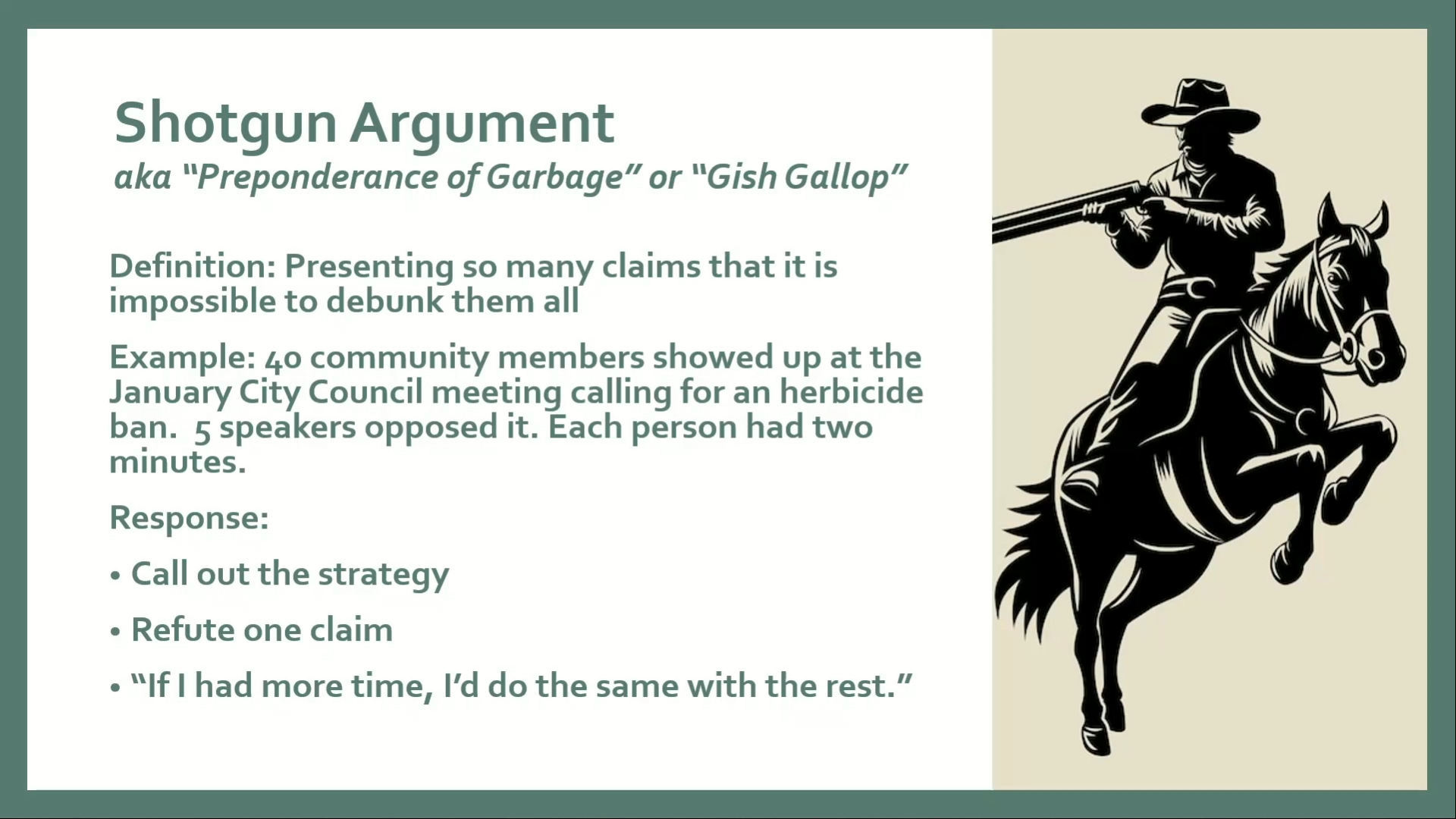
Those who object to the pointless destruction of nature can also cite distortions and misrepresentations of facts (AKA lies) by those who engage in these destructive projects;

  • Nativists fabricated a myth that eucalyptus kills birds to support their demand that eucalyptus in California be destroyed.  There is no evidence that myth is true. 
  • Nativists also fabricated a myth that burning eucalyptus in the 1991 firestorm in the East Bay cast embers that started spot fires 12 miles away from the fire front.  There is no evidence that myth is true.
  • Nativists exaggerate the success of their projects by setting a low bar for success, conducting no post-project monitoring, and restricting access to their completed projects.  
  • The EPA justified the dumping of rodenticides on off-shore islands by inaccurately claiming that the rodenticides do not end up in the water, killing marine animals.  There is ample evidence that island eradications have killed many marine animals because rodenticide lands in the water when applied by helicopters. 
  • USFWS justified the killing of 500,000 barred owls in western forests by claiming they are an “invasive species.”  In fact, barred owls migrated from the East to the West Coasts via the boreal forests of Canada.  These forests were not planted by humans and have existed since the end of the last Ice Age, some 10,000 years ago.  The arrival of barred owls on the West Coast was a natural phenomenon.  Barred owls are therefore not “invasive species.” In a rapidly changing climate, many animals must move to survive.
  • Nativists claim that most insects are “specialists” that require native plants.  That claim is a gross exaggeration of the dependence of insects on native plants, which are sometimes confined to a family of plants containing thousands of both native and non-native species. 
  • Pesticide applicators also complain about “personal attacks.”  They are not alone.  I (and others) have been called “nature haters,” “chemophobes,” and “climate change deniers.”  Pesticide applicators feel abused.  So do I. 

I could go on.  The list of bogus claims of the superiority of native plants and animals is long and getting longer as more and more public money is available to conduct misnamed “restorations.”  Suffice to say, there is plenty of misinformation floating around invasion biology and most of it is used to defend destructive “restoration” projects.  The war on nature is also a war of words. 


(1) ­Justin Luong, et.al., “Lessons learned from an interdisciplinary evaluation of long-term restoration outcomes on 37 coastal grasslands in California.” Biological Conservation, February 2022.

The program for the Cal-IPC 2024 Symposium is available HERE.  Abstracts and presentation slides have not yet been posted to the website, but they will eventually be available to the general public. 

Defining “Success” So That “Success” Can Be Achieved

I always attend the conferences of the California Invasive Plant Council (Cal-IPC) and the California Native Plant Society because I feel obligated to understand their viewpoint so I can accurately report on the controversies of invasion biology.  Ironically, the more I learn about the native plant movement and the “restoration” industry it spawned, the less … Continue reading “Defining “Success” So That “Success” Can Be Achieved”

I always attend the conferences of the California Invasive Plant Council (Cal-IPC) and the California Native Plant Society because I feel obligated to understand their viewpoint so I can accurately report on the controversies of invasion biology.  Ironically, the more I learn about the native plant movement and the “restoration” industry it spawned, the less sense it makes.  The October 2024 Symposium of the California Invasive Plant Council has provided yet more evidence that attempts to eradicate well-established non-native landscapes and replace them with native plants are futile.

Tricks of the “Restoration” Trade

Every Cal-IPC Symposium has wrestled with the question of how to convert non-native grassland to native grassland. A study of 37 grassland “restorations” in coastal California answers that question. (1)  It’s really quite simple.  All you need to do is define success as 25% native plants after “restoration” and limit post-project monitoring to 5 years or less:  “Monitoring is done ≤5 years after project-implementation, if at all, and rarely assesses the effects of management practice on project success.” 

It also helps if public land managers in charge of the projects won’t allow the academic researcher to enter the land to conduct a survey of the results.  43% of the projects that were studied were “statutory,” i.e., they were mandated by laws such as county general plans or legally required mitigation for projects elsewhere that Environment Impact Reports determined were harmful to the environment.  30% of the managers of the statutory projects would not allow the academic researcher to survey their projects. 

It is also easier to achieve success if the project goal is downgraded mid-project as were many of the statutory projects because they weren’t able to meet the original goal.

Project managers can also reduce their risks of failure by planting a small number of native species that are particularly easy to grow:  “Ninety-two percent of restoration managers preferentially use one or more of the same seven [native] species.”  Seven projects planted only one native species. 

According to the study, the result of planting only a few hardy native plants is “biotic homogenization.”  Call it what you will, but this risk-averse strategy is inconsistent with claims that the goal of native plant restorations is to increase biodiversity. 

The study did not ask project managers about the methods they used to eradicate non-native plants or plant native plants.  The study tells us nothing about the methods that were used or whether or not some methods were more effective than others.  Since results of the projects were all very similar, should we assume that the methods that were used didn’t matter? 

The presentation of this study concluded with this happy-face slide. (see below) It looks like a cartoonish marketing ad to me:

Harmless aquatic plants being pointlessly eradicated

A USDA research ecologist stationed at UC Davis made a presentation about the most effective way to kill an aquatic plant with herbicides, but that wasn’t the message I came away with. 

Jens Beets told us about a species of aquatic plant that is native to the East and Gulf coasts of the US, but is considered a “noxious weed” in California, solely because it isn’t native.  He said the plant is considered very useful where it is native.  (see below)

Where Vallisneria americana is native, it is considered a valuable plant for habitat restoration because it is habitat for vertebrates and invertebrates and it stabilizes soil and water levels.  The canvasback duck is named for this plant species because it is preferred habitat for the native duck that is found in California during the winter.

 Vallisneria americana looks very similar to other species in the genus considered native in California.  For that reason, native species of Vallisneria have been mistakenly killed with herbicide because applicators didn’t accurately identify the target plant as native.  Jens Beets recommended that genetic tests be performed before plants in this genus are sprayed with herbicide.

This story probably sounds familiar to regular readers of Conservation Sense and Nonsense.  The story is identical to the pointless and futile effort to eradicate non-native species of Spartina marsh grass in the San Francisco Bay.  The species being eradicated in California is native to the East and Gulf coasts, where it protects the coasts from extreme storm surges and provides valuable habitat for a genus of bird that is plentiful on the East Coast, but endangered in California.  The 20-year effort to eradicate non-native Spartina has killed over 50% of the endangered bird species in the San Francisco Bay. 

Throwing good money after bad

Because the hybrid is indistinguishable from the native species of Spartina on the West Coast. 7,200 genetic tests have been performed in the past 12 years before hybrid Spartina was sprayed with herbicide. Taxpayers have spent $50 million to eradicate Spartina over 20 years.  Recently, California state grants of $6.7 million were awarded to continue the project for another 10 years.  A portion of these grants are given to the California Invasive Plant Council to administer the grants.

Plants are sprayed with herbicide because they aren’t native, not because they are harmful.  Even if the target species is needed by birds and other animals, it is still killed and animals along with it.  The target species looks the same as the native species and only genetic testing can identify it is as a non-native.  The non-native is the functional equivalent of the native.  It is only genetically different because natural selection has adapted it to the conditions of a specific location. 

Pesticide regulation in the US is a hit or miss proposition

The final session of the symposium was a carefully orchestrated apologia for herbicides, a defensive tirade that suggested Cal-IPC believes its primary tool is in jeopardy.  Two presentations were made by employees of regulatory agencies.  Their assignment was to reassure the public that pesticides are safe because they are regulated by government agencies. 

The fact that many countries have banned pesticides that are routinely used in the US does not speak well for our regulatory system.  America’s pesticide regulators rarely deny market access to new pesticides.  A recent change in policies of California’s Department of Pesticide Regulation made a commitment to the continued use of pesticides for another 25 years. 

In 1996, Congress ordered the U.S. Environmental Protection Agency (EPA) to test all pesticides used on food for endocrine disruption by 1999. The EPA still doesn’t do this today. Twenty-five years later, the EPA has not implemented the program, nor has it begun testing on 96% of registered pesticides.  In 2022, an organization that represents farm workers sued the EPA to conduct the legally mandated evaluation of chemicals.   The lawsuit has forced the EPA to make a commitment to conduct these evaluations of chemicals for hormone disruption.   

The Cal-IPC presenters got some badly needed push back from attendees.   One attendee informed the audience that all the testing of herbicides is bought by the manufacturers, not the regulators who don’t do any testing.  Another attendee pointed out that herbicides have not been evaluated for the damage they are doing to the soil, damage that makes it difficult to grow native plants in the dead soil.  The “pesticide regulator” agreed with those observations.

Fire safety or native plant restoration?

The Interim Deputy Director of the Laguna Canyon Foundation was the final presenter for the Symposium, speaking on a Friday afternoon at 4:30 pm, when there were less than 100 attendees left of the 690 registrants.  His presentation was about the blow back that his organization gets from the public about herbicide applications.  Criticism of herbicides escalated after a wet year that increased vegetation considered a fire hazard.  This photo (below) is an example of the visible effects of fuels management by Laguna Canyon Foundation using herbicides.

It seems likely that a fuels management project was selected for this presentation because it’s easier to justify herbicide use for fuels management than for eradicating harmless plants solely because they aren’t native. 

I recently supported Oakland’s Vegetation Management Plan that will use herbicides for the first time on 300 miles of roadsides and 2,000 acres of public parks and open space in Oakland.  Previously, herbicide applications were only allowed on medians in Oakland.  I tracked the development of the Vegetation Management Plan for 7 years through 4 revisions to avoid nativist versions of fuels management such as leaving dead thatch after herbicide applications on grassland or destroying non-native trees, while leaving highly flammable bay laurel trees behind or destroying broom, while leaving more flammable coyote brush behind.

However, using herbicides for the sole purpose of killing non-native plants is much harder to justify.  The irrational preference for native species has put us on the pesticide treadmill. Every plant species now targeted for eradication with herbicides should be re-evaluated, taking into consideration the following criteria:

  • Is it futile to attempt to eradicate a plant species that is deeply entrenched in plant communities?
  • Will the attempt to eradicate the plant species do more harm than good?
  • Is the targeted plant species better adapted to current environmental and climate conditions?
  • Is the targeted non-native plant making valuable contributions to the ecosystem and its animal inhabitants?

If these questions cannot be satisfactorily answered, the bulls-eye on the targeted plant should be removed. Limiting the number of plants now being sprayed with herbicide is the only way to reduce pesticide use. If the plant isn’t a problem, there is no legitimate reason to spray it with herbicide.

Pot calls kettle black

The Cal-IPC presentation was a detailed criticism of the public’s complaints about herbicides used in their community.  The intention of the presentation was to arm herbicide applicators with defenses against the public’s complaints.  Herbicide applicators were encouraged to recognize these arguments (below) and participate in the “education” of the public about the righteousness of their task.

The presenter then showed a series of slides making specific accusations, such as these:  (see below)
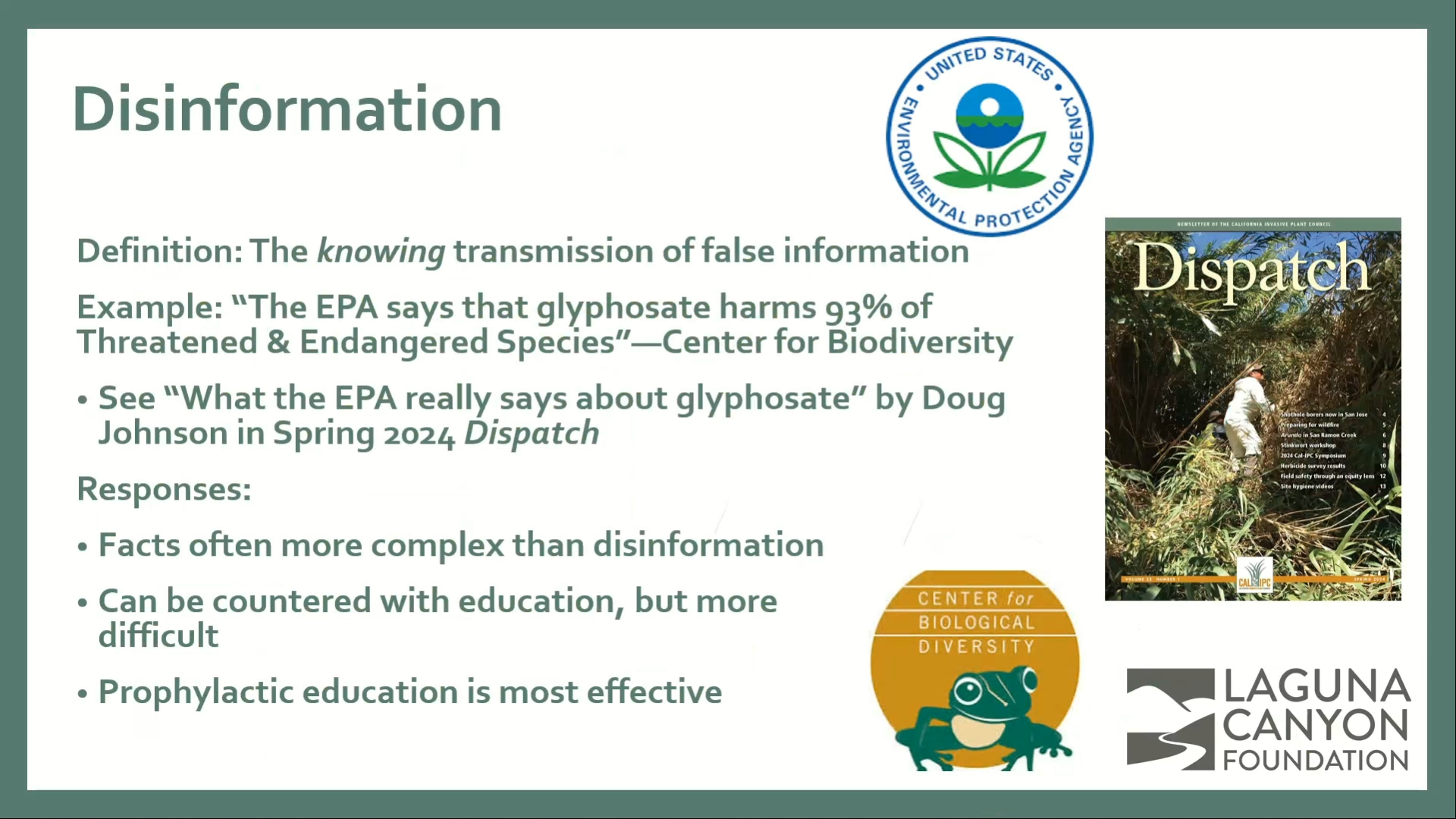
Those who object to the pointless destruction of nature can also cite similar distortions and misrepresentations of facts (AKA lies) by those who engage in these destructive projects;

  • Nativists fabricated a myth that eucalyptus kills birds to support their demand that eucalyptus in California be destroyed.  There is no evidence that myth is true
  • Nativists also fabricated a myth that burning eucalyptus in the 1991 firestorm in the East Bay cast embers that started spot fires 12 miles away from the fire front.  There is no evidence that myth is true.
  • Nativists exaggerate the success of their projects by setting a low bar for success, conducting no post-project monitoring, and restricting access to their completed projects.  
  • The EPA justified the dumping of rodenticides on off-shore islands by inaccurately claiming that the rodenticides do not end up in the water, killing marine animals.  There is ample evidence that island eradications have killed many marine animals because rodenticide lands in the water when applied by helicopters. 
  • USFWS justified the killing of 500,000 barred owls in western forests by claiming they are an “invasive species.”  In fact, barred owls migrated from the East to the West Coasts via the boreal forests of Canada.  These forests were not planted by humans and have existed since the end of the last Ice Age, some 10,000 years ago.  The arrival of barred owls on the West Coast was a natural phenomenon.  Barred owls are therefore not “invasive species.” In a rapidly changing climate, many animals must move to survive.
  • Nativists claim that most insects are “specialists” that require native plants.  That claim is a gross exaggeration of the dependence of insects on native plants, which are sometimes confined to a family of plants containing thousands of both native and non-native species. 
  • Pesticide applicators also complain about “personal attacks.”  They are not alone.  I (and others) have been called “nature haters,” “chemophobes,” and “climate change deniers.”  Pesticide applicators feel abused.  So do I. 

I could go on.  The list of bogus claims of the superiority of native plants and animals is long and getting longer as more and more public money is available to conduct misnamed “restorations.”  Suffice to say, there is plenty of misinformation floating around invasion biology and most of it is used to defend destructive “restoration” projects.  The war on nature is also a war of words. 


(1) ­Justin Luong, et.al., “Lessons learned from an interdisciplinary evaluation of long-term restoration outcomes on 37 coastal grasslands in California.” Biological Conservation, February 2022.

What does “restoration” mean?

I welcome comments on my website because I often learn from them.  This comment on a recent post inspired me to think about why I often put the word “restoration” in quotation marks when describing projects that are more destructive than constructive:

Oh my, we are back to putting quotes around words we don’t like. An excerpt from this article:

“Many ecological studies and associated “restoration” projects adopt the same viewpoint that destruction is a justifiable method of studying and “restoring” ecosystems. “Restoration” projects often begin by killing all non-native plants with herbicides before attempting to create a native landscape.”

Often? We do a fair amount of underburning around here, primarily to “restore” ecosystem structure and function in mixed conifer. Of the burns I have been involved with, not one involved herbicides and pesticides. I think you put the lie to your own article by this one exaggeration. I suspect if I bothered to look I would find many others.

This is my reply to this comment:

When the word restoration is used appropriately, it is a powerful, positive word.  There is a multitude of potential projects in California that would be restorative.  Here is a brief list:

Superfund Sites in California

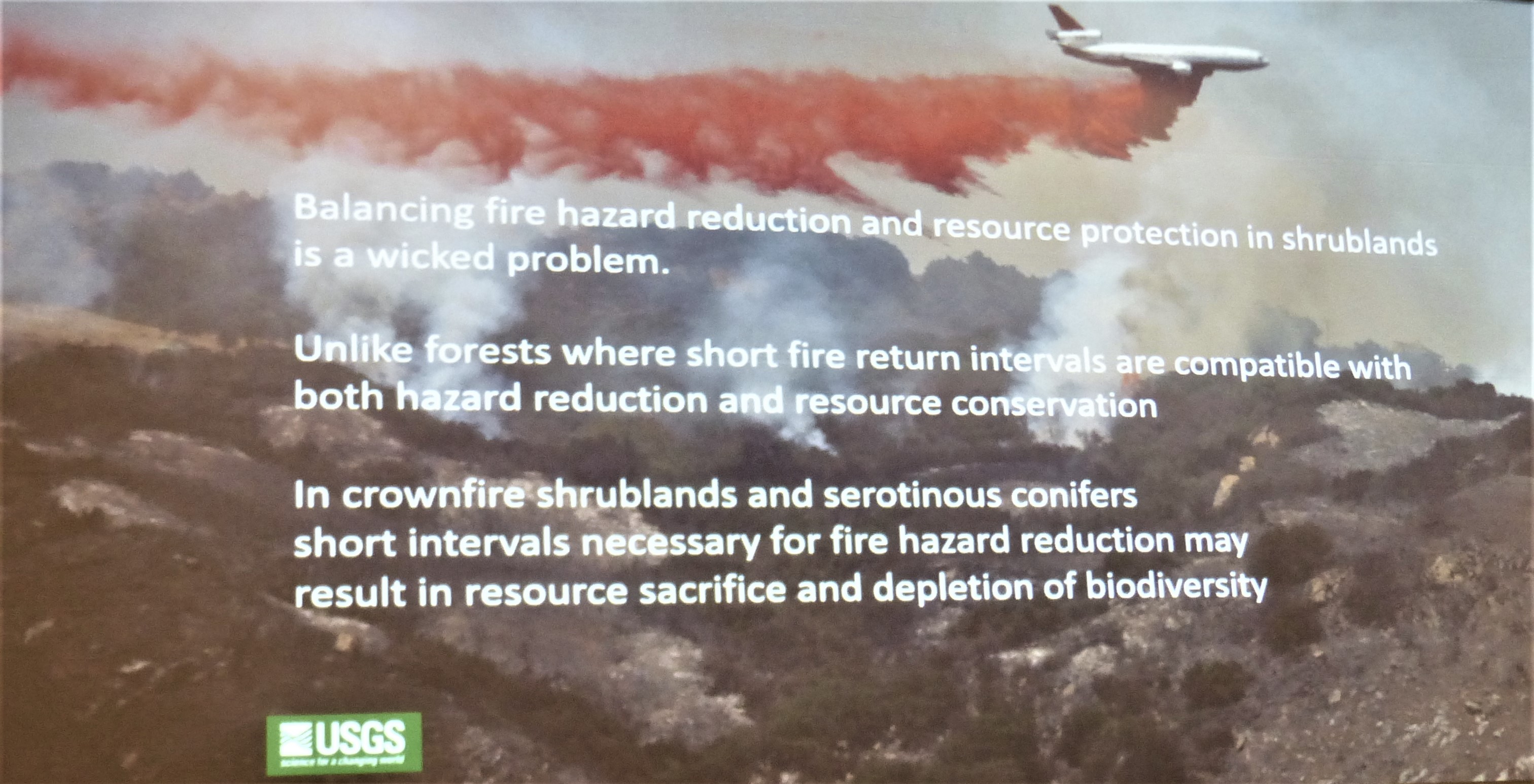
Prescribed burns are currently popular and some don’t use herbicides before burning, but they are NOT a panacea.  Many prescribed burns have become destructive wildfires.  Here are two presentations made at the October conference of the California Native Plant Society that were critical of the over-reliance on prescribed burns:

Source: Jon F. Keeley, CNPS Conference, October 2022
  • Dr. Jon Keeley is a respected fire scientist with US Geological Service with expertise in chaparral ecosystems.  He explained that 60% of native chaparral species (notably manzanita and ceanothus) are obligate seeders that do not resprout after fire and therefore depend on their dormant seed bank for regeneration.  In recent decades the fire interval in chaparral has decreased due to climate change and associated drought.  In many places the fire interval has become too short to establish the seed bank needed for regeneration.  In those places Dr. Keeley has observed vegetation type conversion to non-native annual grasses.  Dr. Keeley Is concerned that vegetation type conversion from forests in some cases and shrublands in others to non-native annual grassland may be the result of shortening fire intervals further “because of the upsurge in state and federal programs to utilize prescription burning to reduce fire hazard.” 
  • Another presentation about a 20-year effort to convert non-native annual grassland to native grassland using prescribed burns at the Santa Rosa Plateau Ecological Reserve reported their failure: “Non-native grass cover significantly decreased after prescribed fire but recovered to pre-fire cover or higher one year after fire.  Native grass cover decreased after prescribed fire then recovered to pre-burn levels within five years, but never increased over time.  The response of native grass to fire (wild and prescribed) was different across time and within management units, but overall native grass declined.” The audience was audibly unhappy with this presentation.  One person asked if the speaker was aware of other places where non-native grass was successfully converted to native grass.  The speaker chuckled and emphatically said, “NO.  I am not aware of any place where native grasses were successfully reintroduced.” 

When describing projects that are more destructive than constructive, I put the word “restoration” in quotes.  I stand by that choice.

Projects that are truly restorative

Days after responding to this comment, the New York Times published an article about the successful effort to clean up the New York City harbor that deserves to be called a restoration:

“Fifty years ago, Congress voted to override President Richard Nixon’s veto of the Clean Water Act. It has proved to be one of the most transformative environmental laws ever enacted.

“At the time of the law’s passage, hundreds of millions of gallons of raw sewage was dumped by New York City into the Hudson River every day. This filth was compounded by industrial contaminants emptied into the river along much of its length. The catch basin for all of this was New York Harbor, which resembled an open sewer. At its worst, 10 feet of raw human waste blanketed portions of the harbor bottom, and certain reaches held little or no oxygen to sustain the life of its fishery. Trash floated among oil slicks.

“Health advisories against eating fish from the Hudson remain, but its ecology has largely recovered, thanks to the law, which imposed strict regulations on what could be discharged into the water by sewage treatment plants, factories and other sources of pollution….”

The NYT article also describes how many animal species benefitted from the reduction in pollution in New York City’s harbor.

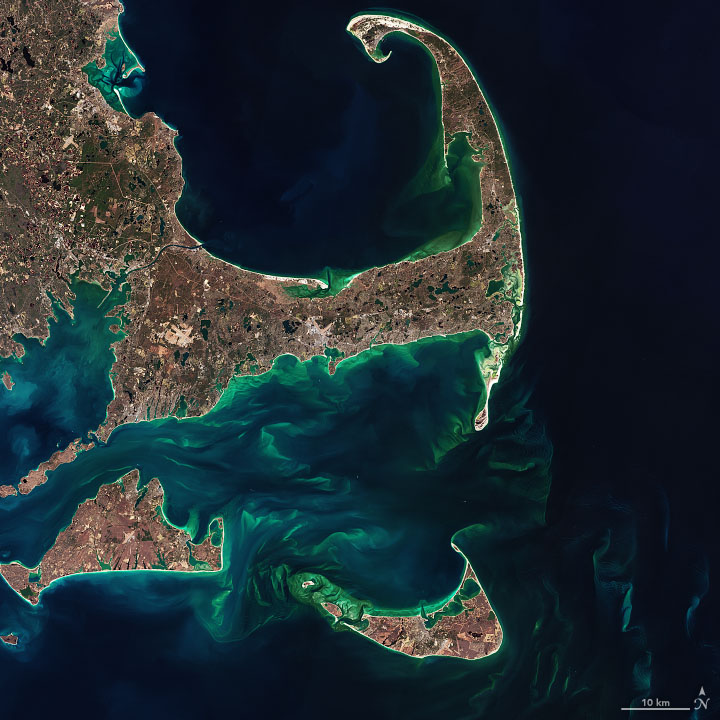
NYT also published an article about the pollution of the water surrounding Cape Cod that is destroying that ecosystem. 

“The algal explosion is fueled by warming waters, combined with rising levels of nitrogen that come from the antiquated septic systems that most of the Cape still uses. A population boom over the past half-century has meant more human waste flushed into toilets, which finds its way into waterways.

“More waste also means more phosphorus entering the Cape’s freshwater ponds, where it feeds cyanobacteria, commonly known as blue-green algae, which can cause vomiting, diarrhea and liver damage, among other health effects. It can also kill pets.

“The result: Expanding aquatic dead zones and shrinking shellfish harvests. The collapse of vegetation like eelgrass, a buffer against worsening storms. In the ponds, water too dangerous to touch. And a smell that Ms. Fisher characterizes, charitably, as “earthy.”

“Together, the changes threaten the natural features that define Cape Cod and have made it a cherished destination for generations.”

Cape Cod. Source: NASA

This an example of the many missed opportunities to restore the environment.  Instead of addressing the sources of pollution, such as leaky septic tanks and sewage systems, we invest in projects that contribute to pollution by spraying harmless vegetation with herbicides, killing harmless animals with pesticides and contributing to air pollution by burning vegetation. 

Closer to home, the recent torrential rain soaking California is a reminder of our inadequate sewer systems now overflowing from storm drains into city streets and being dumped into the ocean when the drainage gets that far.   San Francisco’s antiquated sewage system is an extreme case.  When it was built, it funneled storm runoff from city streets into the city’s sewer system, combining residential sewage waste with storm water runoff.  When it rains heavily, San Francisco’s sewage system is not capable of treating the increased flow. Such systems have been illegal for decades, but San Francisco has not made the necessary improvements to its sewer system.  As the SF Chronicle reports, city streets are now flooded with a toxic mix of rain water and human sewage. 

“Restoration” is not a dirty word when used to describe projects that reduce pollution.  When projects contribute to pollution they cannot legitimately be called “restorations.” 

Invasion Biology vs. The “Restoration” Industry

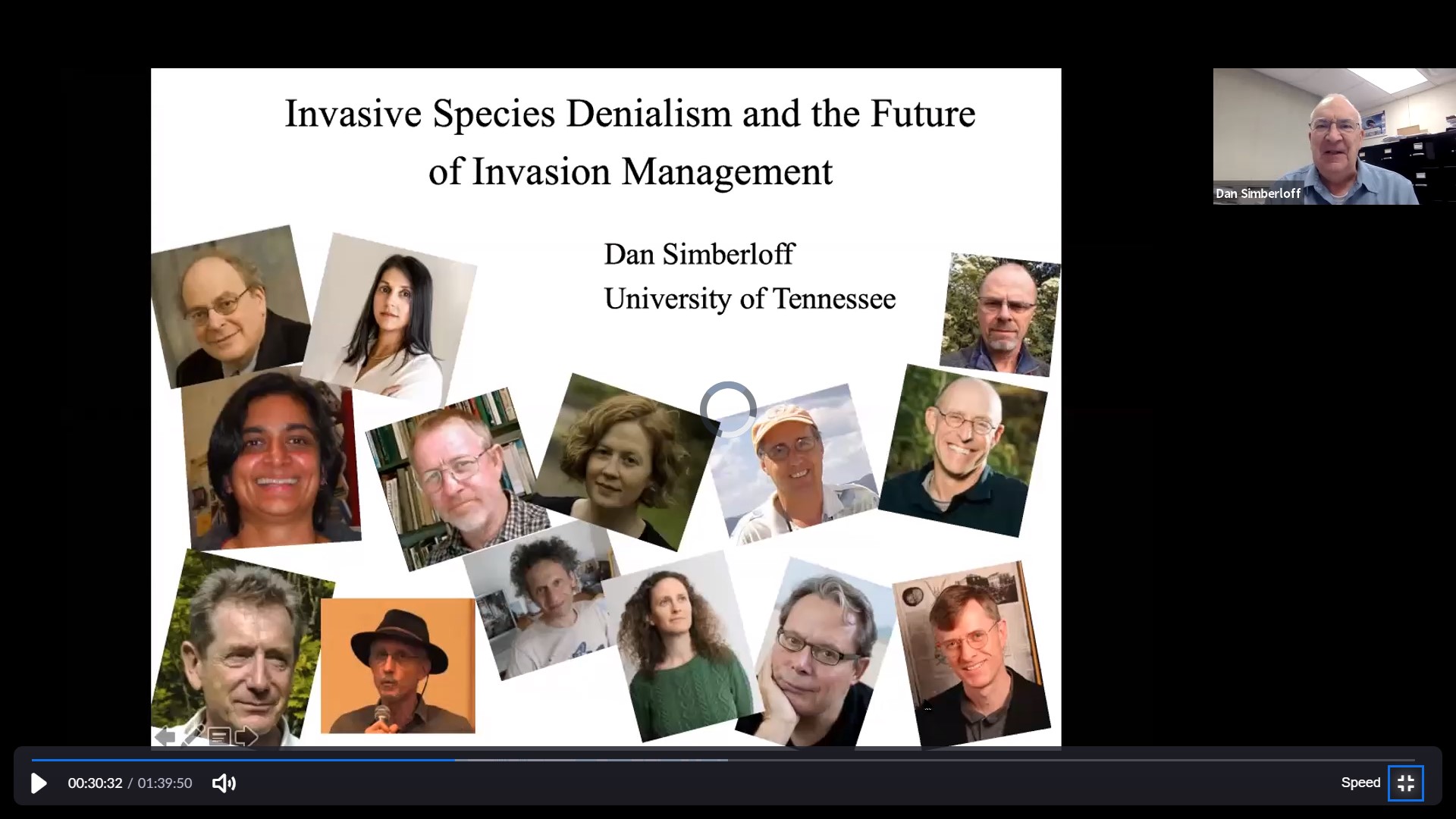
Daniel Simberloff gave the keynote address to the symposium of the California Invasive Plant Council (Cal-IPC), entitled “Invasive Species Denialism and the Future of Invasion Management.”  Simberloff is the most vocal academic defender of invasion biology.  His presentation to Cal-IPC contains interesting clues about more effective strategies for the critics of invasion biology, of which I am one.  In a nutshell, Simberloff dismisses critics easily with a few waves of his hand, but he stumbles when faced with the economic and ecological costs of the methods used to eradicate so-called “invasive species.”  He can defend the theoretical hypotheses of invasion biology, but he finds it difficult to defend the “restoration” industry that invasion biology spawned, specifically the use of pesticides.

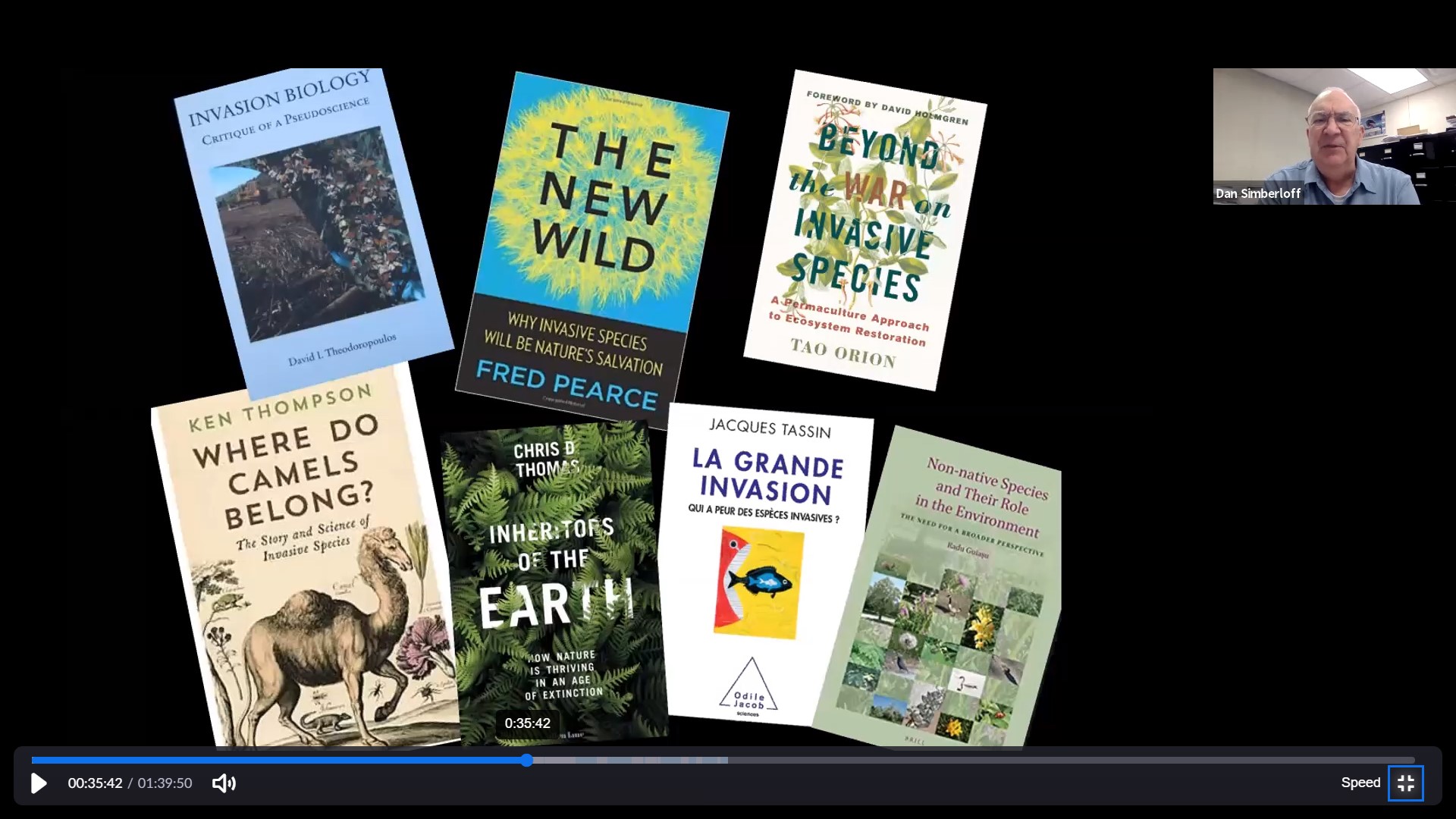
Simberloff opened his presentation with this rogue’s gallery of the critics of invasion biology.  Some readers will recognize some of these “deniers.”  If not, you might recognize some of the many books the “deniers” have published.

Simberloff categorized the criticisms of invasion biology then flipped them off, one by one.  Keep in mind as you read Simberloff’s summary that it does not do justice to the actual criticisms of invasion biology.

  • Critics say that most non-native species aren’t harmful.
    • Simberloff says we don’t know how harmful non-native species are because few are studied, their impacts are often subtle, and there is often a time lag before they become harmful. He believes that all non-native plants are potentially harmful to ecosystems.
  • Critics say that some non-native species are beneficial.
    • Simberloff says that critics only report the benefits, while ignoring the negative impacts of non-native species.  (Actually, most critics are proposing a cost/benefit analysis that acknowledges both positive and negative impacts.)
  • Critics say that invasion biology is xenophobic.
    • Simberloff says that if you’re looking for xenophobia, you often see it. He calls this the “law of instrument” or if your instrument is a hammer, everything looks like a nail.  (Frankly, I didn’t understand the point he was trying to make, but I have tried to describe it accurately based on what he said.)
  • Critics say that trying to eradicate non-native species is futile.
    • Simberloff says this argument ignores the progress that has been made in the technology of eradication methods. He used the “early detection and rapid response” strategy as an example of progress in eradicating non-native plants.  That strategy focuses on small populations of non-native plants, basically acknowledging the futility of trying to eradicate large areas of well-established non-native plants.
    • Much of Simberloff’s presentation was devoted to describing many developments in genetic engineering, such as CRISPR to drive species to extinction and gene silencing. All of the examples of such developments were aimed at killing insects (such as mosquitoes) and animals (such as rats and mice), with one exception. He was particularly enthusiastic about island eradications of which there are hundreds, and hundreds more on the drawing boards.  Only one gene-editing project on plants is trying to develop a genetic method to eradicate phragmites.

Things finally became interesting, when Simberloff took questions:  “Dan, you mention the “futility” argument, but what about the notion that the cost in environmental damage (e.g, pesticide use and nontarget impacts) is too high for some well-established invaders?”  Simberloff’s answer to this question was surprising and encouraging to critics of pesticide use to kill non-native species:

“Absolutely, it’s a huge problem, not only on non-target species, but also the fact that evolution of resistance leads to greater use of pesticides before they are useful and leads to greater impact on non-target species.  I didn’t talk about this, but yes, of course the cost both economically and ecologically might be too great even if management eradication is feasible.  But that’s not what denialism is about.  Denialism willfully denies that there are impacts or they confound arguments about values as if it is an argument about science.”

The Executive Director of Cal-IPC recognized the dangers of Simberloff’s answer because pesticides are the primary tool used by the “restoration” industry and much of the conference was devoted to telling over 650 employees of the “restoration” industry about new developments in pesticide use.  Those new developments are not good news to those who are concerned about the dangers of pesticides.  For example, a new “drizzle” technique increases the concentration of the active ingredient and lowers the volume of the application, increasing toxicity of the application.  Another alarming presentation described the use of drones to spray herbicides on hundreds of acres of phragmites in the Suisun Marsh.

The absence of good alternatives to pesticide use in eradication projects is another source of pressure on the “restoration” industry and therefore on Cal-IPC:

  • Jon Keeley’s presentation about the interaction of fire, fire prevention, and plant invasions included the observation that using prescribed burns to eradicate non-native plants results in more non-native plants, not more native plants.
  • A land manager in Southern California acknowledged that pressures to reduce pesticide use threaten the future of his project: “Natural herbicides result in more time intensive and costly weed control, with less confidence of success. Where herbicide application is completely restricted, other weed control methods like hand weeding or mowing can be implemented successfully, but they often fall short of herbicide in effectiveness. This resulting reduction in effective weed control must be taken into account in future plans for habitat restoration and management, and our existing programs will have to reevaluate the proposed efforts, cost of those efforts, and expectations for success, both short and long term.” (Scott McMillan, abstract)
  • Finally, with the exception of a few timid questions from participants, no mention was made about the threat of climate change on the future of native ecosystems. Simberloff likened critics of invasion biology to “climate change deniers.”  In fact, it’s fair to say that those who demand that we replicate native ranges existing 250-500 years ago are more accurately called climate change deniers.

The Executive Director of Cal-IPC tried to save the day by portraying those who oppose pesticides as extremists, based on what he considers “unscientific” studies.  But Simberloff wouldn’t take the bait.  He wasn’t willing to dismiss the concerns about pesticides.  Instead, Simberloff passed the buck:

“I’ll beg off on answering that question on grounds that I’m not a social scientist or psychologist.  This is not my area of expertise.  There is some reason for the extremists because Monsanto has sometimes lied to us and there have been problems associated with pesticides.  I leave this question to policy scientists.”

Simberloff reveals the flaw in the “restoration” industry

As a critic of invasion biology and the use of pesticides, I have always been frustrated that critics of invasion biology do not use the damage done by eradications as a reason for their criticism.  With the exception of Tao Orion’s Beyond the War on Invasive Species, none of the books written by critics have used this argument.  It is a missed opportunity and Simberloff’s presentation to Cal-IPC is an indication that it is the strongest argument against eradication projects that are inspired by invasion biology.

Invasion biology is a theoretical construct.  It does no harm to ecosystems until it justifies the use of harmful methods to eradicate non-native species.  I humbly ask that critics of invasion biology wake up to this opportunity.  Pesticides are a winning argument against “restoration” projects that eradicate non-native plants.  Any cost/benefit analysis of new eradication projects should include the ecological and economic costs of pesticides in the equation.

Beyond Pesticides points the way forward

I try not to leave the field without offering a compromise because opposition without solutions is not constructive.  I offer this sage advice from Beyond Pesticides about case-by-case evaluations of weed invasions that will reduce damage to ecosystems.  Beyond Pesticides responded to this question:  “I’m working on a pesticide policy in my community and am interested in how you might suggest we deal with “invasive” species. Can you point us in the right direction? Martin, Boston, MA.”  This is BP’s thoughtful answer:

“It’s Beyond Pesticides position that invasives, or opportunistic species, should be dealt with on a case-by-case basis, with established priorities and a plan. With any unwanted species, there needs to be an understanding of the ecological context. We need to be asking the right questions: What role is the plant currently playing in a landscape—what niche is it currently filling? If we remove this plant, what will fill that niche? Will we be replanting the right native species to fill that niche? What are the detrimental impacts of letting it spread? Is there a way we can isolate it to stop its spread? Can we ever remove this plant altogether, or will we be working at control indefinitely? These are important questions that we need to be asking before we even consider management methods. Regarding policy, requiring an individualized invasive species management plan seems to be the right answer, though unfortunately many pesticide reform policies sidestep the issue and simply exempt invasives to avoid opposition. Just like all organic approaches, we’ll want to place a focus on prevention and working with ecological systems, rather than against them, making even least-toxic pesticide use a last resort. There is a strong potential to undermine the stability of an ecosystem if we simply go in and immediately break out the strongest tools in the toolbox without a plant replacement strategy. On a turf system with common weeds a simple answer is grass plants. But, in forested areas already subject to intrusion (from construction/logging, etc.), rights-of-way, and urban areas, the focus is on alternative vegetation or ground cover. Sometimes, little should be done except simple mechanical cutting to keep these species in balance. This is an interesting and, at times, contentious issue that environmentalists grapple with, so there is certainly room for fresh ideas on how to approach opportunistic species without the use of toxic pesticides. For more information, we encourage you to watch the talk given at Beyond Pesticides 37th National Pesticide Forum in New York City by Peter Del Tredici, PhD, senior research scientist at Harvard’s Arnold Arboretum (www.bp-dc.org/ invasives).”