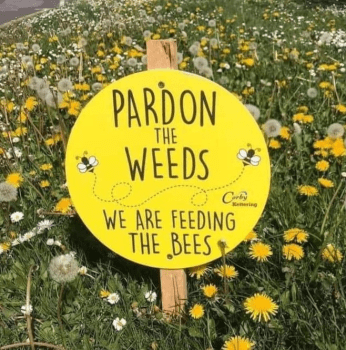
Who are the climate change deniers?

The FEMA projects in the East Bay Hills, which will destroy hundreds of thousands of trees if and when they are implemented, are not unprecedented. Many similar projects have been implemented by UC Berkeley and East Bay Regional Park District.  UC Berkeley destroyed at least 18,000 trees over 10 years ago and another 600 trees in August 2014.  Our experience with those projects is one of the reasons why we are opposed to more tree destruction on an even bigger scale.  Although land managers have attempted to reassure us about the implementation of the FEMA grant projects, we know from experience that their assurances are contradicted by the reality of their actual practices, which have been photographed by hikers in the Hills. Signpost 29 - November 2010 This photo was taken in November 2010 at signpost 29 on Claremont Blvd, which is one of the places where UC Berkeley destroyed all the non-native trees about 10 years ago and the Claremont Canyon Conservancy has been actively engaged in an effort to restore native vegetation. The truck belongs to Expert Tree Company, which is the contractor that removed the trees and sprayed herbicides.   There is a big tank of herbicide on the truck bed from which a hose extends. At the end of that hose someone is spraying herbicides on the weeds that colonize the unshaded ground when the tree canopy is destroyed.  No notice of pesticide* application is posted, as required by California law. (1) Signpost 29 - April 2012 This photo was taken in April 2012 on the opposite side of the road from signpost 29 on Claremont Blvd. This is one of the FEMA project areas where UC Berkeley intends to destroy all non-native trees.  The same truck, with the same tank of herbicide is parked beside the road and someone is spraying herbicide along the road. Again, no notice of pesticide application is posted, as required by California law. When the draft Environmental Impact Statement for the FEMA projects was published in May 2013, the public was told that all pesticide applications would be posted in advance, as required by California law.
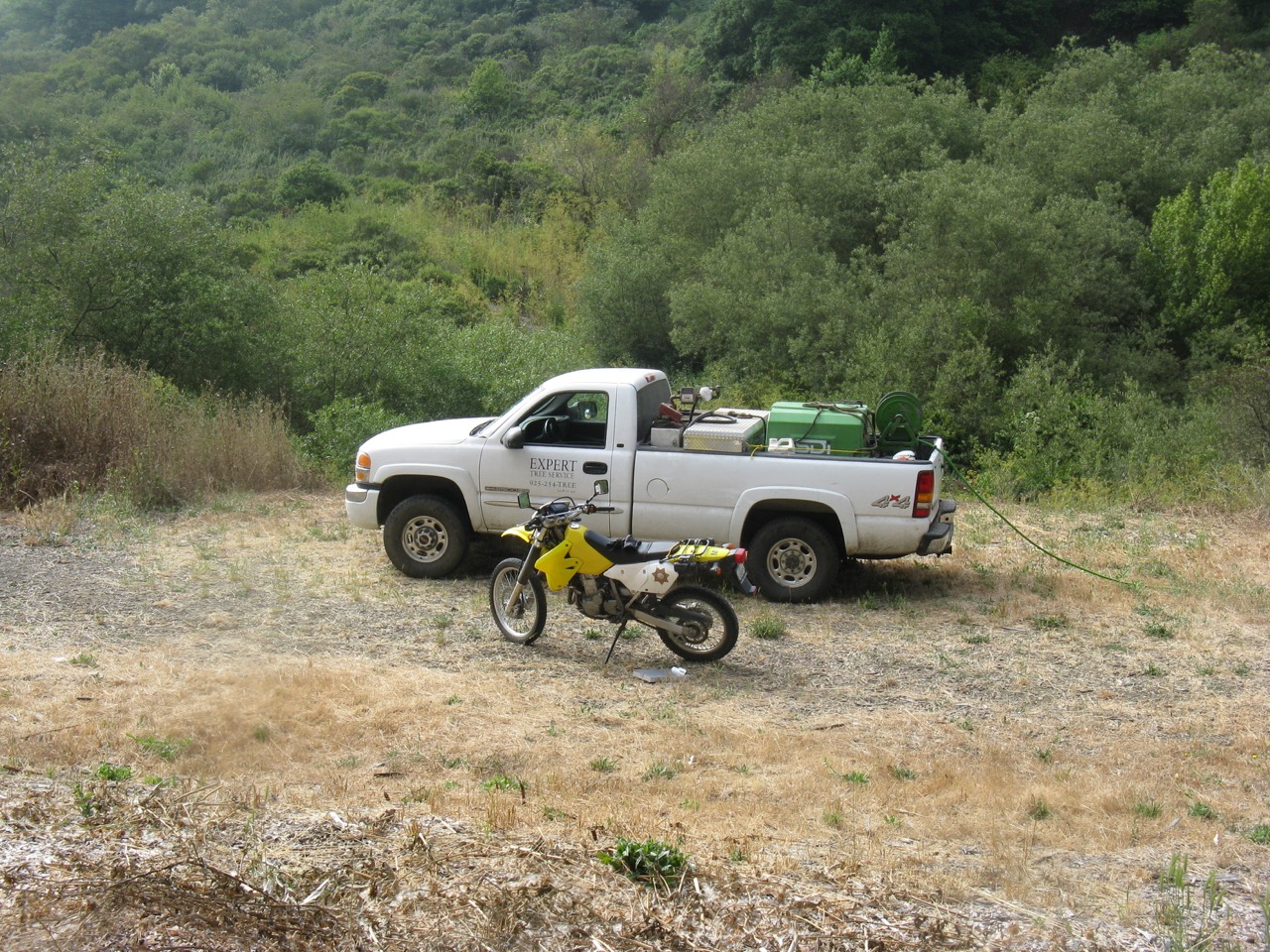
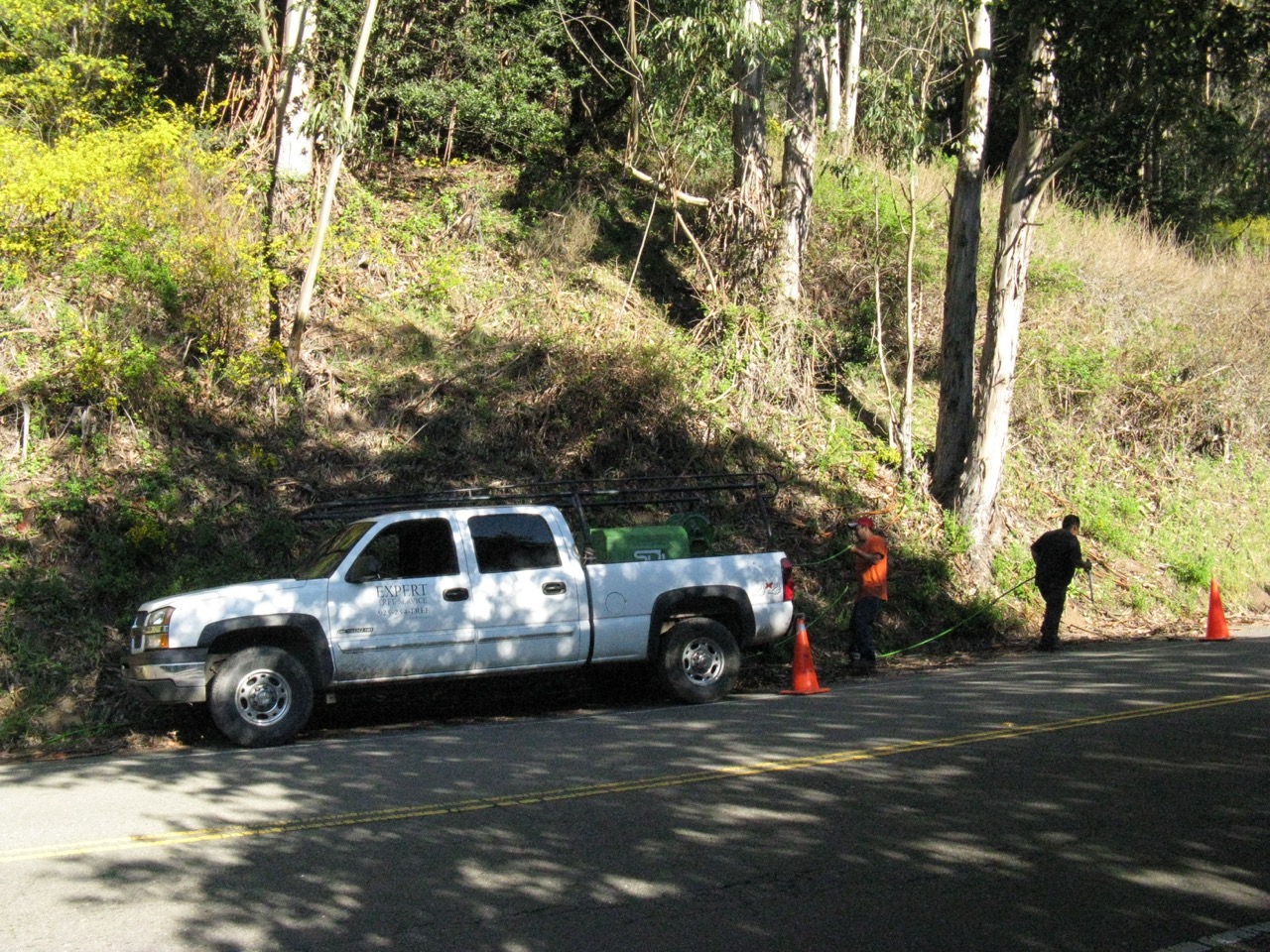
So, the pesticide applications immortalized by these photographs are a record of violations of State law as well as broken commitments made in the Environmental Impact Statement for the FEMA projects.  But they are much more than that.  They are also a photographic record that large quantities of pesticides are being sprayed.  The truck is carrying a big tank of herbicide to which a hose is attached and from which herbicide is being sprayed.  This is obviously irrefutable evidence that claims of supporters of the FEMA projects that “minimal” amounts of herbicide are being used are untrue.  

These incidents were reported to FEMA because they violated the law as well as the commitments made by the Environmental Impact Statement. FEMA followed up on that incident.  They reported the incident to the California Office of Emergency Services, which in turn notified UC Berkeley of the violation of the law.  UC Berkeley defended its actions and several supporters of the FEMA project also came to UC’s defense, including the Claremont Canyon Conservancy and the Sierra Club. Here’s the letter that the Sierra Club sent to FEMA about this incident: sierra-club-letter dec 17 2014 arrow
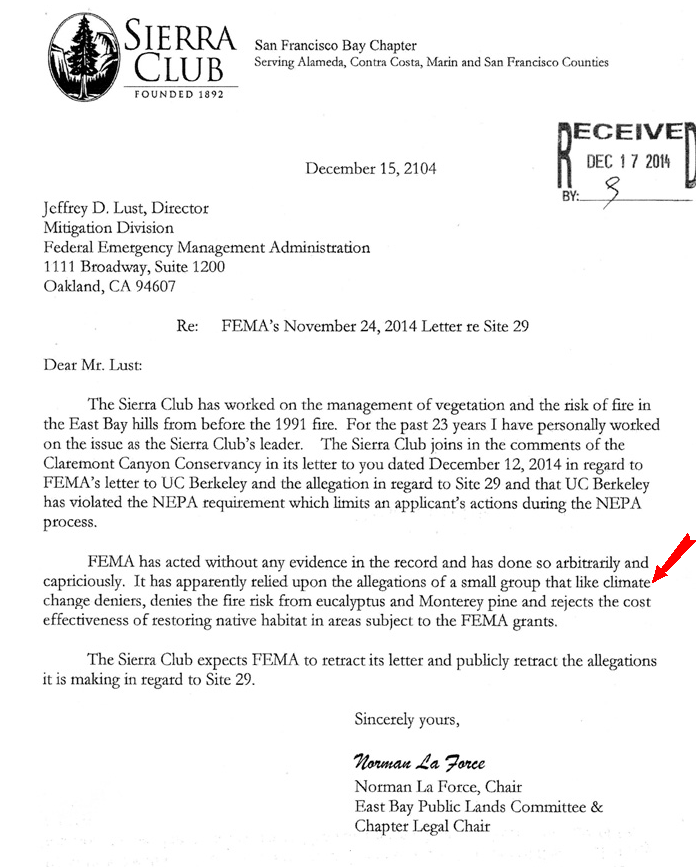
Sierra Club likens us to climate change deniers

We won’t waste your time justifying the complaint that UC Berkeley violated the law regarding pesticide applications. The fact that there was no pesticide application notice posted where pesticides were being sprayed is prima facie evidence that the law was violated. Our focus in this post is on the accusation of the Sierra Club (in their letter above) that those who oppose this destructive project are “like climate change deniers.”  This accusation was repeated more recently by the author of this letter, Norman LaForce, in an interview on KPFA in which he used the same phrase to describe the opposition to the destruction of our urban forest (available HERE at 33:44).  

Since the Sierra Club refuses to discuss the issues directly with those who oppose this project, perhaps they are unaware of the absurdity of this description. In fact, our opposition to this project is partially based on our concerns regarding climate change. The trees that will be destroyed by this project are storing millions of tons of carbon that will be released into the atmosphere, contributing to climate change.  Most of the trees that will be destroyed are expected to live at least another 200 years, so destroying them prematurely will needlessly exacerbate climate change.

Supporters of the FEMA projects are climate change deniers

The irony of the Sierra Club’s accusation is that the description fits them perfectly. Their support for the destruction of our urban forest is a demonstration of their denial of the realities of climate change.

The ranges of native plants and animals have already changed in response to changes in the climate. In the Northern Hemisphere native ranges have moved north and to higher altitudes.  Scientists predict more changes in the climate in the future.  Therefore, they predict that native ranges will continue to change for the foreseeable future. The United Nations’ Intergovernmental Panel on Climate Change has published the following graphic illustration of the range changes that will be required for various types of plants and animals in the future if they are to survive:
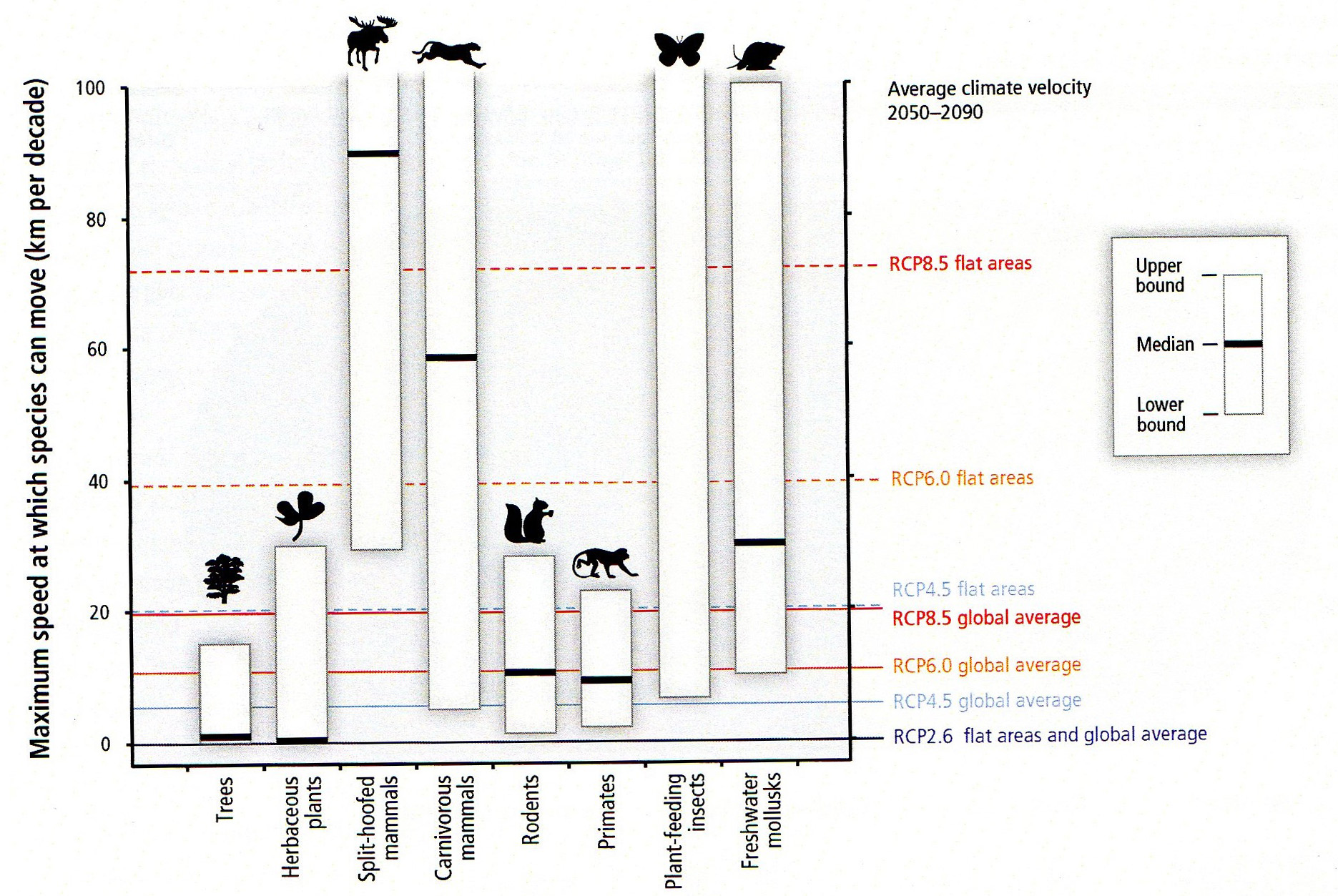
Adaptation to Climate Change. IPCC

On the vertical axis, the graph depicts the ability of plants and animals to move, measured in kilometers per decade.  The horizontal lines depict the need of plants and animals to move in response to various scenarios of climate change, i.e., the greater the change in the climate, the further ranges must move.  The bars depict the ability of plants and animals to move and the height of each bar informs us of the variable ability of plants and animals to move.  Trees are the least able to move, unless we have the wisdom to plant them outside their native ranges—at higher latitudes or elevations–where they are more likely to survive in the future.

Supporters of the deforestation of the East Bay Hills do not acknowledge that the ranges of native plants have changed and will continue to change. They demand that we “restore” a landscape that existed in the San Francisco Bay Area 250 years ago, a landscape that is no longer adapted to the existing environment and will become progressively less well adapted in the future.

Climate change has killed millions of trees in California

The Los Angeles Times joined a scientist with the Carnegie Institution for Science, Greg Asner, in a flight over the native forests of California. The scientist is using spectrometry to measure the amount of moisture in the trees, which is a proxy for the health of trees, ranging from dead to stressed to healthy.  These measurements suggest that 120 million trees in California are dead or likely to die soon, which is about 20% of the state’s forests. Especially trees in lower elevations are in “big trouble.”  Asner predicts that oak forests in the Sierra foothills are likely to be treeless grassland in the near future.  He tells us that nearly 6 billion trees in the West died from 1997 to 2010 because of drought and bark beetle. As forests convert to grassland and scrub, the landscape releases stored carbon and its ability to store carbon in the future is greatly reduced because carbon storage is largely a function of above-ground biomass.
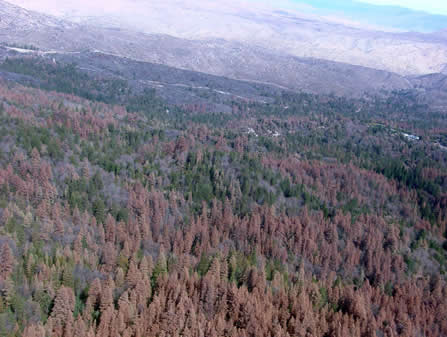
Dead trees in San Bernardino County, California

Contrast this actual scenario with the fantasy of native plant advocates who predict that when hundreds of thousands of trees are destroyed in the East Bay Hills, native plants and trees will magically emerge from 2 feet of wood chips to colonize the bare ground without being planted. One would be tempted to laugh at such an unlikely outcome if the reality were not so alarming.  Native plants and trees that lived in the San Francisco Bay Area 250 years ago are unlikely to survive here even if planted and irrigated.  To expect them to return without being planted is a bad joke.

Tree loss exacerbates drought

In addition to the loss of stored carbon, the loss of our tree canopy will also contribute to drought. Deforestation causes droughts because trees have an essential role in the water cycle that returns moisture to the atmosphere, then returns the moisture to the earth as precipitation. This cycle is not perfectly understood and so we are grateful to the NY Times for publishing an excellent article entitled, “Deforestation and Drought, Cutting down trees leads to climate change,” which explains “Trees take up moisture from the soil and transpire it, lifting it into the atmosphere. A fully grown tree releases 1,000 liters of water vapor a day into the atmosphere…The water vapor creates clouds, which are seeded with volatile gases…emitted by the trees to form rain.” Deforestation in the Amazon is expected to have an impact on the climate in places as far away as California. A climate scientist says, “reducing deforestation and replanting forests should be priorities not just in Brazil but in North America and beyond for many reasons, including the health of climate systems.”

When we discuss this issue with the supporters of deforestation in the Bay Area, they always pooh-pooh our concerns, saying that their projects are too small to have any effect on the climate. What they don’t seem to understand, or prefer to ignore, is that such projects are going on all over the country. Here in California, eucalyptus and Monterey pine have been destroyed in San Diego, Los Angeles, Santa Cruz, San Luis Obispo, Monterey, Sonoma, Bolinas and probably many places of which we are not aware. And we hear about new projects all the time. These intentional projects to destroy trees are in addition to the millions of native trees that have died in the past few years because of the drought and millions of native trees that were destroyed by wildfires this summer. It is unconscionable that we are voluntarily destroying hundreds of thousands of healthy trees at such a time.

And so we ask you, “Who are the climate change deniers”? We think the supporters of the FEMA projects in the East Bay Hills—including the Sierra Club—are the climate change deniers.


*Herbicides are pesticides. Pesticide is a global term which covers a multitude of specific pesticides aimed at a variety of targets.  Herbicides are the pesticides designed to kill plants.  Other pesticides include insecticides, fungicides, rodenticides, etc.  We provide this definition, because many native plant advocates do not seem to understand the definition of the word “pesticide.”  Many mistakenly believe that herbicides are not accurately called pesticides.

(1) “Pesticide Use Compliance Guide for Employers and Businesses,” Department of Pesticide Regulation, October 2010.  California Code of Regulations, Title 3, Division 6, Number 6618 (3CCR 6618)
Sierra Club cannot hide behind its smokescreen

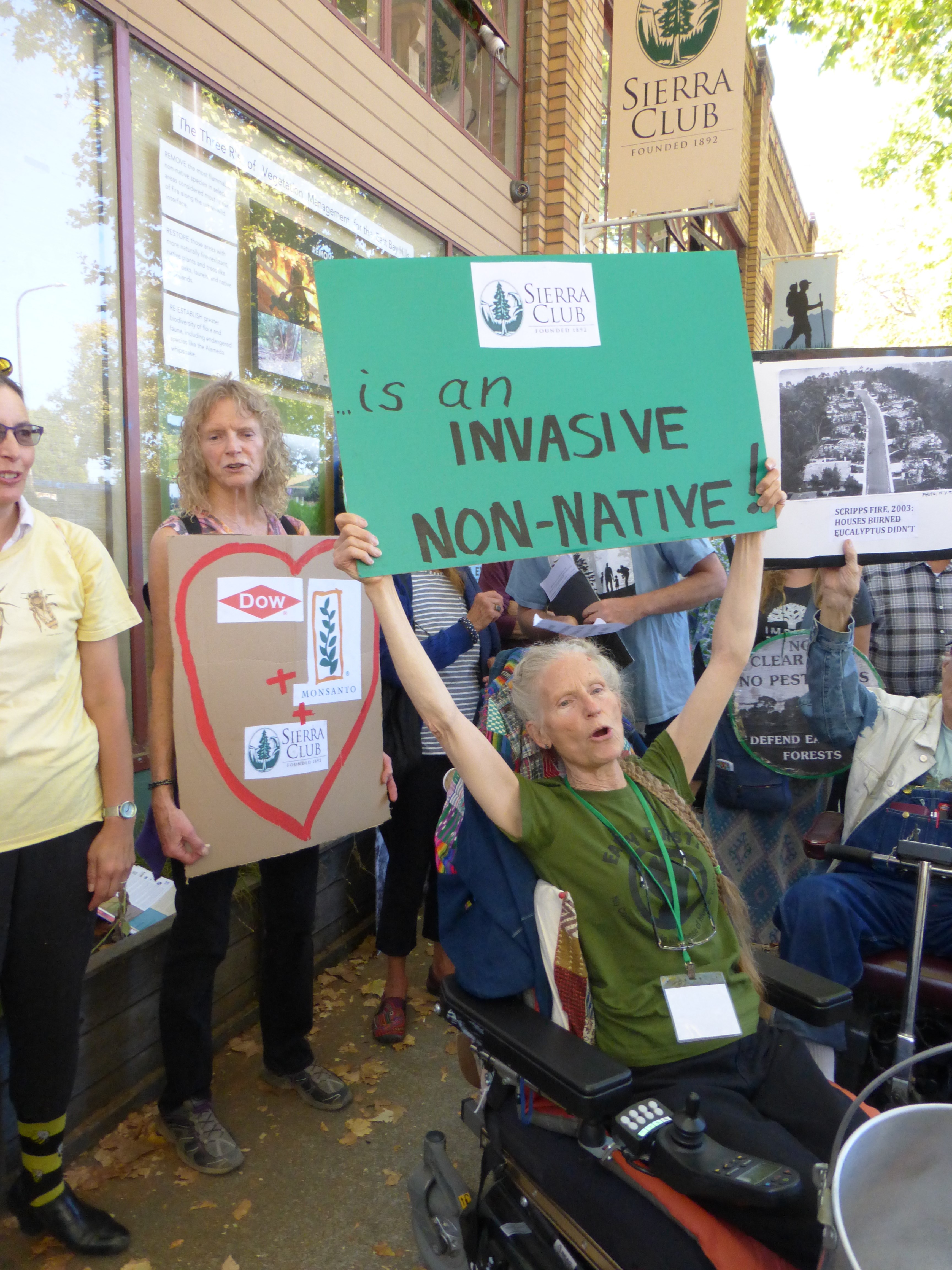
On August 25, 2015, opponents of the projects in the East Bay Hills which will destroy hundreds of thousands of trees staged a protest at the headquarters of the Bay Area chapter of the Sierra Club and delivered a petition.  The petition (available HERE) asks the Sierra Club to quit advocating for deforestation and pesticide use in the San Francisco Bay Area and to drop its lawsuit which demands eradication of 100% of all non-native trees on 2,059 acres of public land in the East Bay.  The protest was successful as measured by the size of the crowd and the even-handed media coverage of the protest.

Sierra Club protest, August 25, 2015. About 80 people attended the peaceful protest.

Update:  HERE is a 14 minute video of the demonstration at Sierra Club headquarters on August 25, 2015.  The video includes an attempt to discuss the issue with a Sierra Club staff member.  Note the factual rebuttals to some of the claims the staff member makes in that conversation.  Also, note the final rallying cry, “Poll your membership on this issue.”  We will report soon on the follow up to that request.  Please stay tuned.  

However, although the protest has produced a flurry of defensive propaganda from the Sierra Club, it has not created new opportunities for dialogue with them.  We tried to get the issue on the agenda of the Conservation Committee following the protest and once again our request was denied. We were also denied the opportunity to publish a rebuttal to articles in their newsletter about the projects. It is still not possible to post comments on the on-line version of the Yodeler, although each article dishonestly invites readers to “leave a comment.”

And so, open letters to the Sierra Club are the only means of communication available to us.  Here are our replies to the latest round of propaganda published in the Yodeler on September 16, 2015 (available HERE).  Excerpts from the Sierra Club article are in italics and our replies follow.


“The preferred strategy for vegetation management in the East Bay hills entails removing the most  highly flammable, ember-generating trees like eucalyptus in phases — only in select areas considered most at risk for fire along the urban-wild interface.”

Preferred by whom?  Neither fire experts nor the public think this project is a good idea, let alone the Sierra Club’s more extreme version of the project demanded by its suit.  Over 13,000 public comments on the Environmental Impact Statement were sent to FEMA, of which 90% were opposed to this project according to FEMA.  More recently, a petition in opposition to this project has over 64,000 signatures on it.  This project is NOT the “preferred strategy for vegetation management in the East Bay hills.”

Eucalyptus is not more flammable than many other trees, including native trees: 

  • A study by scientists in Tasmania found that the leaves of blue gum eucalypts were more resistant to ignition than other species of Tasmanian vegetation tested. The study credits the “hard cuticle” of the leaf for its ability to resist ignition. (1)
  • The National Park Service, which has destroyed tens of thousands of eucalypts and other non-native trees, states that eucalyptus leaves did not ignite during a major fire on Mount Tam.  (2)
  • The leaves of native bay laurel trees contain twice as much oil as eucalyptus leaves (3)  and the fuel ladder to their crowns is much lower than eucalyptus, increasing the risk of crown fires. The “Wildfire Hazard Reduction and Resource Management Plan” of the East Bay Regional Park District states explicitly that bay laurel is very flammable and recommends selective removal.
  • Eucalyptus contributed more fuel to the 1991 fire in Oakland because a deep and prolonged freeze the winter before the fire caused eucalyptus and other exotic vegetation to die back. The dead leaf litter was not cleaned up, which contributed to the fire hazard.  Such deep freezes are rare in the Bay Area.  There has not been such a freeze for 25 years and another is unlikely in the warming climate.

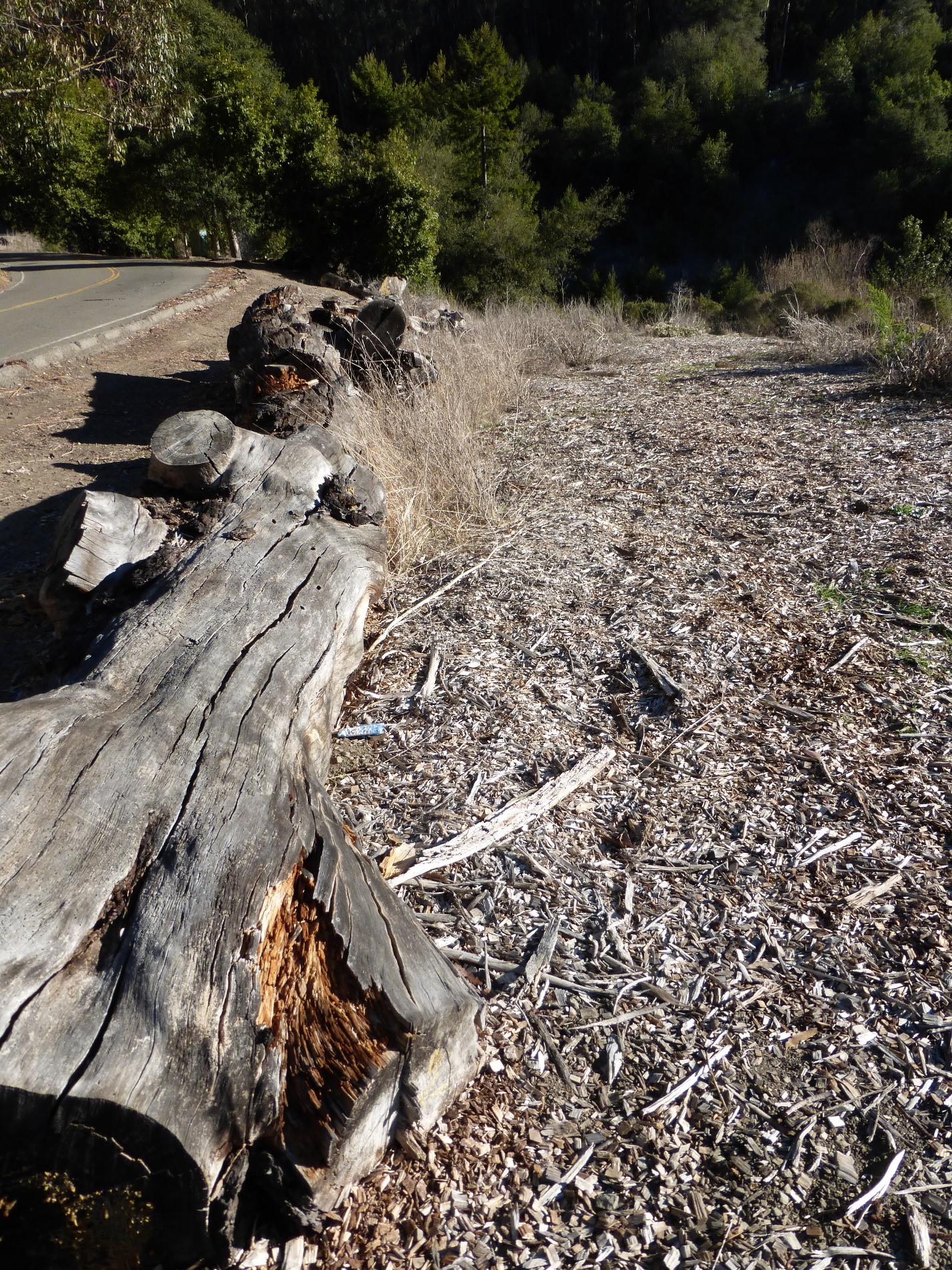
    Eucalyptus logs line the roads where UC Berkeley has destroyed trees. Do they look less flammable than living trees?
    Eucalyptus logs line the roads where UC Berkeley has destroyed trees. Do they look less flammable than living trees?
  • Ordinarily, eucalyptus does not contribute more fuel to the forest floor than native oak-bay woodland. This is confirmed by the National Park Service, which includes logs in the calculation of fuel loads. (2) Logs are extremely difficult to ignite.  The so-called “fire hazard mitigation projects” are leaving all the eucalyptus logs on the ground when the trees are destroyed, suggesting that they aren’t considered a fire hazard.  The National Park Service also separates the fuel loads of oaks and bays, which when combined are equal to the fuel load of eucalyptus.  Since our native woodland in the East Bay is a mixture of oaks and bays, it is appropriate to combine them when comparing their fuel loads to eucalyptus.
  • Eucalypts are sometimes blamed for casting more embers than native trees because they are taller than the oak-bay woodland. However, redwoods are as tall, if not taller, and they were also observed burning in the 1991 fire:  On Vicente Road, “Two redwoods up the street caught fire like matchsticks.” (4)  Yet, the Sierra Club is not suggesting that redwoods be destroyed to eliminate the risk of casting embers.

The Sierra Club now says the trees will be removed “in phases,” yet in its suit against the FEMA grants it objects to the phasing of tree removals.  The main focus of their suit is opposition to the “unified methodology” which proposes to remove trees over the 10 year period of the grant on only 29 acres of the total project acreage of 2,059.  To those who objected to this project, that small concession is little consolation, but for the Sierra Club it was a deal-breaker.  Their suit demands that all non-native trees be removed immediately on all project acres. 

If the Sierra Club withdraws its suit against the FEMA projects, it is free to tell another story, as it attempts to do in its Yodeler article.  As long as that suit remains in play, the Sierra Club is stuck with that version of reality.

“Once the flammable non-native trees are removed, less flammable native species can reclaim those areas and provide for a rebound of biodiversity. This model of fire prevention can summarized as the the [sic] “Three R’s”:

REMOVE the most flammable non-native trees in select areas most at risk for fire;

RESTORE those areas with more naturally fire-resistant native trees and plants; and

RE-ESTABLISH greater biodiversity of flora and fauna, including endangered species like the Alameda whipsnake.”

This is a stunning display of ignorance of the project as well as the natural history of the San Francisco Bay Area:

  • The FEMA projects do not provide for any planting or funding for planting after the trees are removed. FEMA’s mission is fire hazard mitigation, not landscape transformation.  The scientists who evaluated the FEMA projects said that a native landscape is not the likely result of the project:  “However, we question the assumption that the types of vegetation recolonizing the area would be native.  Based on conditions observed during site visits in April 2009, current understory species such as English ivy, acacia, vinca sp., French broom, and Himalayan blackberry would likely be the first to recover and recolonize newly disturbed areas once the eucalyptus removal is complete.  These understory species are aggressive exotics, and in the absence of proactive removal there is no evidence to suggest that they would cease to thrive in the area, especially the French broom which would be the only understory plant capable of surviving inundation by a 2-foot-deep layer of eucalyptus chips.” (5)
  • The US Forest Service evaluation of the FEMA projects stated that the resulting landscape would be more flammable than the existing landscape: “Removal of the eucalyptus overstory would reduce the amount of shading on surface fuels, increase the wind speeds to the forest floor, reduce the relative humidity at the forest floor, increase the fuel temperature, and reduce fuel moisture.  These factors may increase the probability of ignition over current conditions.” (6)
  • The US Forest Service evaluation predicts that the resulting landscape will be “a combination of native and non-native herbaceous and chaparral communities.” Despite the overwhelming evidence that wildfires in California start and spread rapidly in herbaceous vegetation such as dry grass, the myth persists that all non-native trees must be destroyed to reduce fire hazards.  An analyst at CAL FIRE has explained to the Center for Investigative Reporting that the reason why wildfires were so extreme this summer is because of the heavy rains in December 2014, which grew a huge crop of grass:  “The moisture did little to hydrate trees and shrubs. But it did prompt widespread growth of wild grasses, which quickly dry out without rain.  ‘They set seed, they turn yellow and they are done,’ said Tim Chavez, a battalion chief and fire behavior analyst with CAL FIRE. ‘All that does is provide kindling for the bigger fuels.’” (7) We know that more dry grass starts more wildfires, yet the Sierra Club demands that we destroy the tree canopy that shades the forest floor and produces leaf litter, which together suppress the growth of the grasses in which fires ignite. 
  • The claim that native plants are “naturally fire resistant” is ridiculous. Native vegetation in California—like all Mediterranean climates—is fire adapted and fire dependent. The wildfires all over the west this summer occurred in native vegetation.  There are over 200 species of native plants in California that will not germinate in the absence of fire and persist for only 3-5 years after a fire. (8) Although all native vegetation is not equally flammable, many species are considered very flammable, such as coyote brush, bay laurel, and chamise.  To say otherwise is to display an appalling ignorance of our natural history.

    When did "environmentalism" devolve into demonizing trees?
    When did “environmentalism” devolve into demonizing trees?
  • There is no evidence that the destruction of our urban forest will result in greater “biodiversity.” There are many empirical, scientific studies that find equal biodiversity in eucalyptus forest compared to native forests.  There are no studies that say otherwise, yet the Sierra Club and their nativist friends continue to make this claim without citing any authority other than their own opinions.  (9, 10, 11)  Bees, hummingbirds, and monarch butterflies require eucalyptus trees during the winter months when there are few other sources of nectar. Raptors nest in our tall “non-native” trees and an empirical study finds that their nesting success is greater in those trees than in native trees.

The Sierra Club’s 3Rs can best be summarized as “repeat, repeat, repeat.”  Their 3Rs are based on 3 Myths:  (1) eucalyptus trees are the most serious fire hazard; (2) “native” vegetation is categorically less flammable than “non-native” vegetation, and (3) native vegetation will magically return to the hills when trees are clearcut and the hills are poisoned with herbicide.  All available evidence informs us that these are fictions that exist only in the minds of the Sierra Club leadership and their nativist friends.

 “The Sierra Club’s approach does NOT call for clearcutting. Under “Remove, Restore, Re-establish” thousands of acres of eucalyptus and other non-natives will remain in the East Bay hills. Our proposal only covers areas near homes and businesses where a fire would be most costly to lives and property. In fact, removing monoculture eucalyptus groves and providing for the return of native ecosystems will create a much richer landscape than the alternative — thinning — which requires regularly scraping away the forest floor to remove flammable debris.”

The Sierra Club’s suit against FEMA demands that all eucalyptus and Monterey pine be removed from 2,059 acres of public property.  While it is true that the project acres are not 100% of all land in the East Bay, with respect to the project acres, it is accurate to describe the Sierra Club’s suit as a demand for an immediate clearcut of all non-native trees.

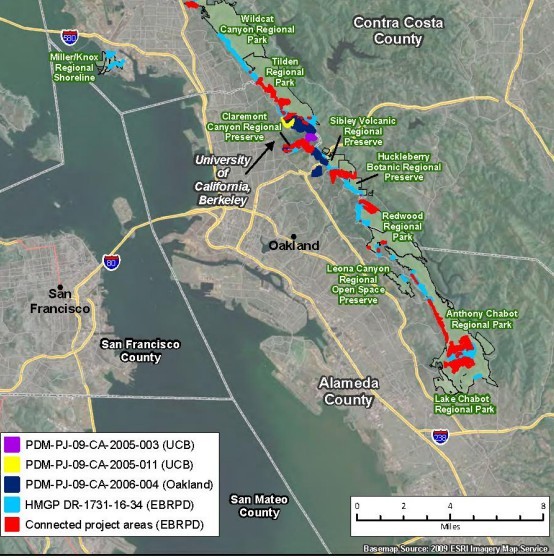
FEMA Project Areas
FEMA Project Areas

Most of the project acres are nowhere near homes and buildings.  They are in parks and open spaces with few structures of any kind.  CAL FIRE defines “defensible space” required around buildings to reduce property loss in wildfires.  CAL FIRE requires property owners to clear flammable vegetation and fuel within 100 feet of structures.  Using that legal standard, the FEMA project should not require the removal of all trees from project acres.

As we said earlier, Sierra Club’s description of the landscape that will result from the removal of the tree canopy is contradicted by scientists who evaluated the FEMA project.  And their prediction that “thinning” would “require regularly scraping away the forest floor to remove flammable debris” is not consistent with the predictions of those scientists who have advised that the loss of shade and moisture resulting from the complete loss of the tree canopy will encourage the growth of flammable vegetation and require more maintenance than the existing landscape.

“Our preferred approach does NOT focus on eucalyptus merely because they are non-natives. Rather, it is because they pose a far higher fire risk than native landscapes. Eucalyptus shed ten to fifty times more debris per acre than grasslands, native live oak groves, or bay forests — and that debris, in the form of branches, leaves, and long strips of bark, ends up draped in piles that are a near-optimal mixture of oxygen and fuel for fire. Eucalyptus trees ignite easily and have a tendency to dramatically explode when on fire. Also, eucalyptus embers stay lit longer than embers from other vegetation; coming off trees that can grow above 120 feet tall, those embers can stay lit as the wind carries them for miles.”

The Sierra Club’s suit demands the eradication of Monterey pine as well as eucalyptus.  The scientists who evaluated the FEMA projects stated that there is no evidence that Monterey pine is particularly flammable and they questioned why they were targeted for eradication:  “The UC inaccurately characterizes the fire hazard risk posed by the two species however…Monterey pine and acacia trees in the treatment area only pose a substantial fire danger when growing within an eucalyptus forest [where they provide fire ladders to the eucalyptus canopy].  In the absence of the eucalyptus overstory, they do not pose a substantial fire hazard.”  (5)  It is not credible that the Sierra Club’s demand that these tree species be entirely eradicated has nothing to do with the fact that they are not native to the Bay Area.  If flammability were truly their only criterion, they would demand the eradication of native bay laurel trees.  If fear of lofting embers from tall trees were their only concern, they would demand the eradication of redwoods.

As we said earlier, redwoods looked as though they were exploding when they ignited in the 1991 fire.  And we are seeing wildfires all over the west this fire season in which native trees look as though they are exploding when they ignite.  That’s what a crown fire looks like, regardless of the species.

It defies reason to think that an ember is capable of traveling miles and still be in flames on arrival.  In fact, Sierra Club’s suit says “non-native trees can cast off burning embers capable of being carried up to 2,000 feet in distance.”  That’s a fraction of the distance the Sierra Club now claims in its hyperbolic description of the issues in the Yodeler.  Surely we can all use a little common sense to consider how unlikely it is that a fragment of a tree small enough to be carried in the wind could travel miles while remaining on fire.  Likewise, we must ask why fragments of eucalyptus trees are likely to burn longer than any other ember of equal size.  We are not provided with any reference in support of these fanciful claims other than the opinions of the authors.

“Any herbicide use to prevent the regrowth of eucalyptus once they’ve been cut down (they quickly sprout suckers otherwise) would be hand applied in minimal amounts under strict controls. Any herbicide application must undergo a full environmental review to prevent impacts on humans, wildlife, and habitat. There are also methods other than herbicide that can be used to prevent regrowth, and the Sierra Club encourages the agencies that manage the land where fire mitigation occurs to explore these alternatives to find the most sustainable, responsible option.”

Once again, the Sierra Club is stuck with the public record which describes the FEMA projects:

  • East Bay Regional Park District has stated in the Environmental Impact Statement for the FEMA project that it intends to use 2,250 gallons of herbicide to prevent the regrowth of eucalyptus.  (12)  This estimate does not include the herbicides that will be used by UC Berkeley or the City of Oakland.  Nor does it include the herbicides that will be needed to kill flammable non-native vegetation such as fennel, hemlock, broom, radish, mustard, etc.  Surely, we can all agree that thousands of gallons of herbicide cannot be accurately described as “minimal.”
  • The Sierra Club now seems to be suggesting that further environmental review will be required for herbicide use by this project. They are mistaken in that belief.  The Environmental Impact Statement for this project is completed and it admits that the project will have “unavoidable adverse impacts” on “human health and safety” and that there will be “potential adverse health effects of herbicides on vegetation management workers, nearby residents, and users of parks and open space.”  The Sierra Club’s smoke screen cannot hide that conclusion.
  • The FEMA grants have been awarded to the three public land owners and they explicitly provide for the use of herbicides to prevent eucalyptus and acacia from re-sprouting. There is nothing in the Environmental Impact Statement that indicates that “methods other than herbicide can be used to prevent regrowth,” as the Sierra Club now belatedly opines in its latest propaganda.  If the Sierra Club wants other methods to be considered, we could reasonably expect they would make such a demand in their suit against FEMA, along with all their other demands.  They do not make such a demand in their suit.  Therefore, claims that other methods are being explored are not credible.
  • Sierra Club’s claim that herbicides will be applied “with strict controls” is not credible because there is no oversight of pesticide application or enforcement of the minimal regulations that exist in the United States. After 25 years of working for the EPA, E.G. Vallianatos wrote in 2014 of his experience with pesticide regulation in Poison Spring:  “…the EPA offered me the documentary evidence to show the dangerous disregard for human health and the environment in the United States’ government and in the industries it is sworn to oversee…powerful economic interests have worked tirelessly to handcuff government oversight.”

The Sierra Club has also explicitly endorsed the use of herbicides in the public comments they have submitted on these projects and in other articles in the Yodeler:

  • Sierra Club’s written public comment on Scoping for the FEMA EIS: “We are not currently opposed to the careful use of Garlon as a stump treatment on eucalyptus or even broom when applied by a licensed applicator that will prevent spread into adjacent soils or waters.”  Norman La Force (on Sierra Club letterhead), September 12, 2010
  • “There is no practical way to eliminate eucalyptus re-sprouting without careful use of herbicides.” Yodeler, May 25, 2013

Obfuscation and insincere backpedaling

The latest Yodeler article about the FEMA projects is a lot of hot air.  It makes claims about the issues for which it provides no evidence and for which considerable contradictory evidence exists.  It contradicts previous statements the Sierra Club has made.  Most importantly, as long as Sierra Club’s suit remains in play, the demands the Sierra Club makes in that public document cannot be denied.  If the Sierra Club wishes to back away from its previous positions, it must start by withdrawing its suit, which demands that 100% of all non-native trees in the FEMA project areas be destroyed immediately.  Withdrawal of the suit would be a most welcome start on the long healing process that is required to mend the damage the Sierra Club has done to its reputation as an environmental organization in the San Francisco Bay Area.  However, the Sierra Club will not be able to reclaim its status as an environmental organization without renouncing all pesticide use on our public lands. 

The Sierra Club has isolated itself from reality.  Its leadership refuses to speak with anyone with whom they disagree.  They have become the victims of incestuous amplification.  They apparently do not read the documents they use to support their opinions.  For example, the Sierra Club suit claims the California Invasive Plant Council (Cal-IPC) has classified blue gum eucalyptus as “moderately” invasive.  In fact, Cal-IPC’s rating of blue gum eucalyptus is “limited.”  This reflects the fact that a study of aerial photographs of Bay Area parks and open spaces, taken over a 60 year period find that eucalyptus and Monterey Pine forests were smaller in the 1990s than they were in the 1930s.  (13)

We will send our petition soon to the national leadership of the Sierra Club.  If you have not yet signed our petition, we hope you will consider doing so now. 


  1. Dickinson, K.J.M. and Kirkpatrick, J.B., “The flammability and energy content of some important plant species and fuel components in the forests of southeastern Tasmania,” Journal of Biogeography, 1985, 12: 121-134.
  2. “The live foliage proved fire resistant, so a potentially catastrophic crown fire was avoided.” http://www.nps.gov/pore/learn/management/upload/firemanagement_fireeducation_newsletter_eucalyptus.pdf
  3. Ron Buttery et. al., “California Bay Oil. I. Constituents, Odor Properties,” Journal Agriculture Food Chemistry, Vol. 22, No 5, 1974.
  4. Margaret Sullivan, Firestorm: the study of the 1991 East Bay fire in Berkeley, 1993
  5. URS evaluation of UCB and Oakland FEMA projects
  6. FEMA DEIS – evaluation of US Forest Service
  7. https://www.revealnews.org/article/rampant-california-wildfires-can-be-blamed-on-last-decembers-rain/?utm_source=Reveal%20Newsletters&utm_campaign=2d4c52ebf5-The_Weekly_Reveal_09_24_159_23_2015&utm_medium=email&utm_term=0_c38de7c444-2d4c52ebf5-229876797
  8. Jon Keeley, Fire in Mediterranean Ecosystems, Cambridge University Press, 2012
  9. https://milliontrees.me/2011/02/04/biodiversity-another-myth-busted-2/
  10. https://milliontrees.me/2013/04/09/biodiversity-of-the-eucalyptus-forest/
  11. https://milliontrees.me/2013/11/22/invertebrates-such-as-insects-are-plentiful-in-the-eucalyptus-forest/
  12. See Table 2.1 in Appendix F: http://www.fema.gov/media-library-data/1416861356241-0d76d1d9da1fa83521e82acf903ec866/Final%20EIS%20Appendices%20A-F_508.pdf
  13. William Russell and Joe McBride, “Vegetation Change and Fire Hazard in the San Francisco Bay Area Open Spaces,” Landscape and Urban Planning, 2003

The Sierra Club must STOP advocating for deforestation and pesticide use in San Francisco Bay Area

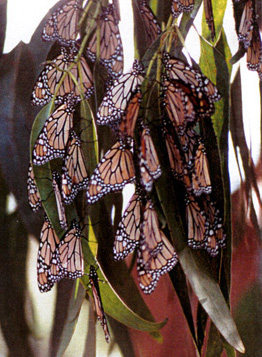
Monarch butterflies over-winter in California's eucalyptus groves
Monarch butterflies over-winter in California’s eucalyptus groves

Million Trees is sponsoring a petition to the national leadership of the Sierra Club in collaboration with San Francisco Forest Alliance.  The petition asks the Sierra Club to quit advocating for the destruction of the urban forest and the use of pesticides in the San Francisco Bay Area.  It also asks the Sierra Club to withdraw its suit against FEMA, which demands the destruction of 100% of all “non-native” trees (eucalyptus, Monterey pine, acacia).  This is an on-line petition which can be signed HERE.  If you are signing this petition and you are a present or former member of the Sierra Club, please mention it in your comments.

sign petition to sierra club

There will be a demonstration by supporters of this petition at the headquarters of the San Francisco Bay Area Chapter of the Sierra Club on Tuesday, August 25, 2015, at 4 pm, 2530 San Pablo Ave, Suite I, Berkeley, CA.  Please join us if you can.

If you are a regular reader of Million Trees, you probably understand why we are making this request of the Sierra Club.  For the benefit of newer readers, we recap the long history of trying to convince the San Francisco Bay Area Chapter of the Sierra Club that its support for the destruction of our urban forest, as well as the pesticides used to prevent its return, contradicts the mission of the Sierra Club as a protector of the environment.

  • This “open letter” was sent to the leadership of the local chapter of the Sierra Club. It informs the Sierra Club of many misstatements of fact in the chapter’s newsletter about the “Wildfire Hazard Reduction and Resource Management Plan” of the East Bay Regional Park District.
  • This article is about the Sierra Club’s public comment on the “Wildfire Hazard Reduction and Resource Management Plan” of the East Bay Regional Park District. The Sierra Club instructs EBRPD to put the “restoration of native plant communities” on an equal footing with fire hazard reduction.  It also specifically endorses the use of pesticides for this project.  In other words, native plants are more important than public safety in the opinion of the Sierra Club. 
  • This “open letter” is about misstatements of fact in the chapter newsletter about San Francisco’s Natural Areas Program. We wrote that “open letter” because the newsletter refused to publish our letter to the editor.
  • This article is about misstatements of fact in the chapter newsletter about the FEMA projects in the East Bay Hills. This incident occurred during the brief period of time when the on-line version of the newsletter was accepting on-line comments.  That opportunity to communicate with the chapter enabled a correction of inaccurate statements in the newsletter.

Sierra Club’s suit against FEMA, which demands the destruction of 100% of all “non-native” trees in the East Bay Hills was the proverbial straw that broke the camel’s back.  Chronic annoyance at the club’s endorsement of destructive and poisonous projects was suddenly elevated to outrage.  HERE is the Club’s description of its suit, which is available in its on-line newsletter.  Attempts to communicate our outrage to the Club by posting comments on that article failed.  That is, the Club is no longer publishing comments it doesn’t like, thereby cutting off any means of communicating with them.  Our petition is the only means of communication left to us.  The text of the petition follows and it can be signed HERE.  Please distribute this petition to your friends and neighbors who share our concern about the destruction and poisoning of our public lands in the San Francisco Bay Area.


Title:     Sierra Club must STOP advocating for deforestation and pesticide use in San Francisco Bay Area

Petition by:        Million Trees and San Francisco Forest Alliance

To be delivered to:
Michael Brune, Executive Director, Sierra Club, michaelbrune@sierraclub.org
Aaron Mair, President, Board of Directors, Sierra Club, aaronmair@gmail.com

We are environmentalists who ask the Sierra Club to quit advocating for the destruction of the urban forest and the use of pesticides in the San Francisco Bay Area.  We also ask that the Sierra Club withdraw its suit against FEMA, which demands the destruction of 100% of all “non-native” trees (eucalyptus, Monterey pine, acacia).  If you are signing this petition and you are a present or former member of the Sierra Club, please mention it in your comments.

Over the past 15 years, tens of thousands of trees have been destroyed on public lands in the San Francisco Bay Area.  Now hundreds of thousands of trees in the East Bay are in jeopardy of being destroyed by a FEMA grant to three public land managers.  The Bay Area Chapter of the Sierra Club has actively supported all of these projects and now it has sued FEMA to demand the destruction of 100% of all “non-native” trees.

These projects have already used hundreds of gallons of herbicide to prevent the trees from resprouting and to kill the weeds that grow when the shade of the canopy is destroyed.  Now, the FEMA project intends to use thousands of gallons of herbicide for the same purpose.  These herbicides (glyphosate, triclopyr, imazapyr) are known to be harmful to wildlife, pets, and humans.

This environmental disaster will release tons of carbon into the atmosphere, thereby contributing to climate change.  It will destroy valuable habitat for wildlife, introduce poisons into our watershed, cause erosion, and eliminate our windbreak.  We call on the national leadership of the Sierra Club to prevent the active participation of the Bay Area Chapter of the Sierra Club in this environmental disaster.

Petition background:

The San Francisco Bay Area was virtually treeless prior to the arrival of Europeans.  The landscape was predominantly grassland, scrub, and chaparral.  Trees grew only in ravines where they were sheltered from the wind and water was funneled to them.  The trees that were brought from other areas of California and from other countries were chosen because they are the species that are best adapted to our local conditions.  John Muir, the Founder of the Sierra Club, also planted these tree species around his home in Martinez and was as fond of those trees as many of us are still today.

The Sierra Club has now turned its back on this cosmopolitan view of nature in favor of returning our landscape to the pre-settlement landscape of grassland, scrub, and chaparral.  This approach has led to the destruction of tens of thousands of trees and the use of herbicides to prevent them from resprouting.

In the East Bay, native plant advocates have also falsely claimed that “non-native” trees are more flammable than native plants.  Although fire hazard reduction was the stated purpose of the FEMA grants, fire hazards will be increased by the clear-cuts of our urban forest for the following reasons:

  • Tons of dead, dry wood chips will be scattered on the ground to a depth of 24 inches.
  • The fog drip which is condensed by the tall trees moistens the ground and will be lost when the canopy is destroyed. The ground vegetation will therefore be drier and more likely to ignite.
  • The tall trees provide a windbreak which has been demonstrated repeatedly to be capable of stopping a wind-driven fire, which is typical of California wildfires.
  • The project does not intend to plant any replacement plants or trees. Therefore, the most likely colonizers of the bare ground are annual grasses which ignite easily during the dry season and in which most fires in California start and spread.
Hummingbird in eucalyptus flower.  Courtesy Melanie Hoffman
Hummingbird in eucalyptus flower. Courtesy Melanie Hoffman

Many empirical studies document the rich biodiversity of our urban forest today.  Bees, hummingbirds, and monarch butterflies require eucalyptus trees during the winter months when there are few other sources of nectar.  Raptors nest in our tall “non-native” trees and an empirical study finds that their nesting success is greater in those trees than in native trees.

In short, the Bay Area Chapter of the Sierra Club is promoting an environmental disaster that is adamantly opposed by tens of thousands of people.  FEMA received over 13,000 public comments on its draft Environmental Impact Statement, over 90% in opposition to this project, according to FEMA’s own estimate.  The signers of this petition are also opposed to this project as presently described by FEMA grant applications and its Environmental Impact Statement.

Environmentalists in the San Francisco Bay Area have been denied due process by the local chapter of the Sierra Club.  The Bay Area Chapter has blocked every effort to communicate with them:  they ignore our emails, block our comments on their blog, refuse our letters to the editor of their newsletter, and do not answer our phone calls.  We believe that the national leadership has an obligation to consider our complaint because the actions of the local chapter are inconsistent with the mission of the Sierra Club.  The local chapter is actively contributing to climate change and endorsing the use of toxic pesticides in our environment.

“Gardening for Climate Change”

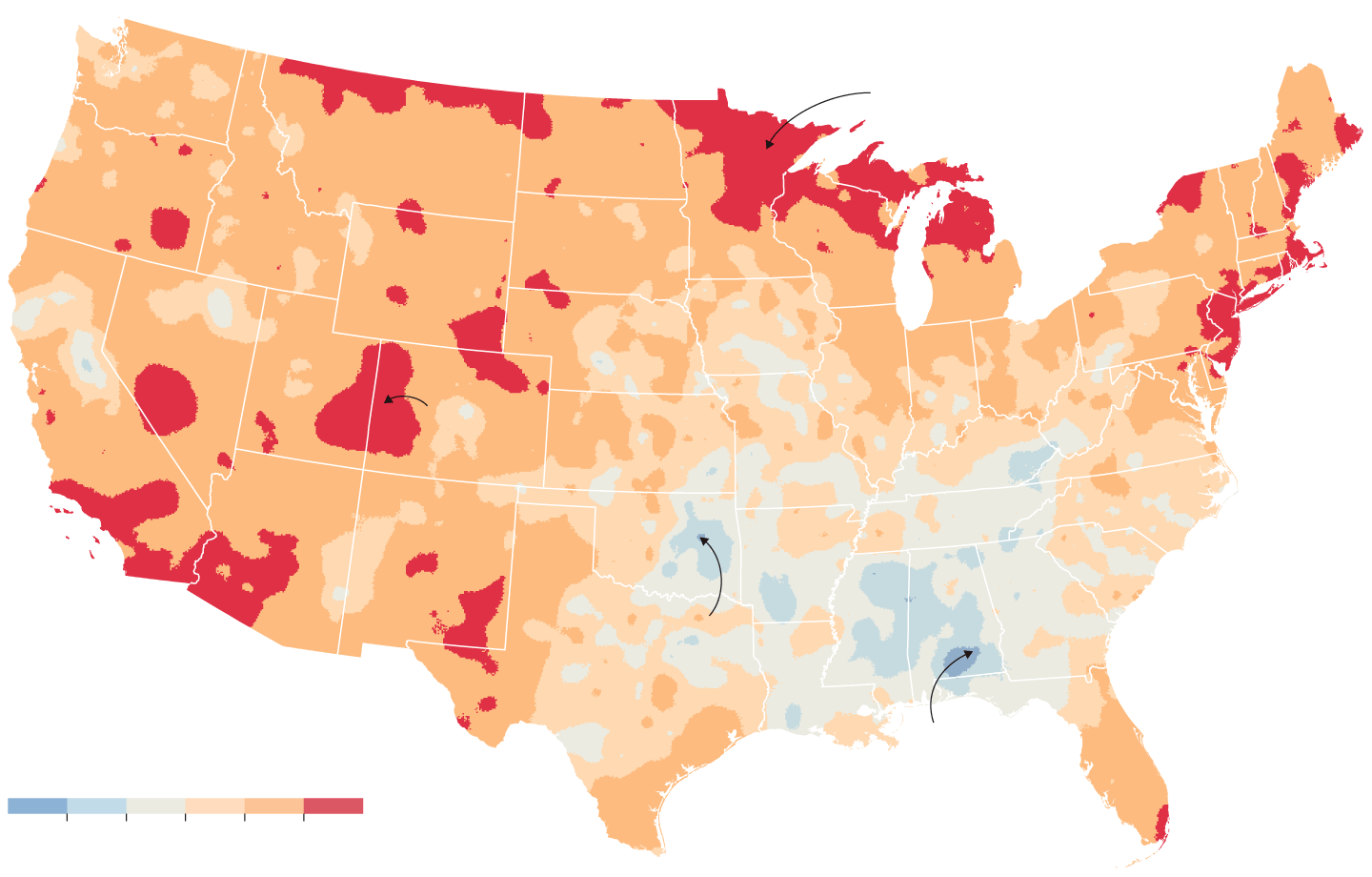
The White House recently released the National Climate Assessment which was prepared by a panel of scientists convened by the federal government.  This report informed us that average temperature increase of only 2° Fahrenheit over the entire country in the past century has produced these changes in the environment:

  • “Summers are longer and hotter, and extended periods of unusual heat last longer than any living American has ever experienced.”
  • “Winters are generally shorter and warmer.”
  • “Rain comes in heavier downpours.”

If greenhouse gas emissions continue to increase at the same pace, the report predicts an increase in average temperature of as much as 10 degrees by the end of the century.  If an increase of only 2 degrees is capable of producing the extreme weather we are experiencing, it is difficult to imagine what we can expect if the temperature increases 10 degrees.

Climate Change Map
Climate Change Map

President Obama announced the report“This is not some distant problem of the future.  This is a problem that is affecting Americans right now.  Whether it means increased flooding, greater vulnerability to drought, more severe wildfires—all these things are having an impact on Americans as we speak.”

The impact of climate change on plant life (1)

Henry David Thoreau recorded the arrival of spring at Walden Pond in Concord, Massachusetts in the 1850s.  His data has been incorporated into the records of his successors, creating a continuous record across 160 years.  Spring arrives in Concord, Massachusetts about three weeks earlier than it did in the 1850s.  This pattern mirrors the changes occurring around the planet according to field studies and satellite images taken from space. 

The response of plants to this change in seasons has varied, according to a study published recently by the Proceedings of the National Academy of Sciences.  Some species of plants reach their flowering peak earlier in the year, while other species are extending their flowering into later in the fall.

Another study speculates that increased temperature isn’t the only factor influencing these changes in flowering patterns.  Increased levels of carbon dioxide also may be affecting plants.  Earlier snow melt may be another trigger for changes in timing of flowering.  The availability of pollinators at the time of flowering is assumed to influence the long term survival of flowering plants.  In other words, the affects of climate change on plants are complex and imperfectly understood.

The implications for gardeners who care about wildlife

The New York Times recently published an op-ed which offered an answer to this question:  “How do we garden in a time of climate change?”  There are probably many answers to that question, so we should understand the perspective of the author of the op-ed, James Barilla.  He describes his background on his website“… James Barilla held a variety of posts in wildlife research and management, crossing paths with wolves and mountain lions in remote wilderness and promoting “mini-beast” habitat in urban schoolyards. He first became intrigued by backyard wildlife while working in England for a land trust, where his job was to create wildlife habitat on the outskirts of a city.”  He has a Master’s Degree in Environmental Science from University of Montana and a Ph.D. in English from UC Davis.  He now teaches creative and environmental writing at University of South Carolina.  He has written a book about gardening to support urban wildlife and articles published by Atlantic and National Geographic Magazine. 

One of Mr. Barilla’s goals as a gardener is to provide habitat for wildlife.  Million Trees is therefore very interested in his answer to the question, “How do we garden in a time of climate change?”  because we are always responding to the perception of native plant advocates that the eradication of non-native plants will benefit wildlife.  Mr. Barilla shares our view that, particularly at a time of a rapidly changing climate, it no longer makes sense to limit ourselves to native plants if we are to provide useful habitat to wildlife:

“In [the] microclimate [of our backyards], extreme gardening means making the yard hospitable for as many species as possible, without worrying so much about whether they originally belonged here or not.  I used to think that tearing out turf and making room for native species like purple coneflower and switchgrass was the best thing I could do.  But things aren’t that simple anymore.  It doesn’t make sense to think in terms of native and nonnative when the local weather vacillates so abruptly.  A resilient garden is a diverse garden.”  (emphasis added)

Mr. Barilla also acknowledges the changing ranges of plants and animals in response to climate change and the need to accommodate those changes if species are to survive:  “…species are disappearing across their native range but flourishing outside it…This phenomenon of species movement and adaptation is likely to become commonplace as the climate changes.”

Monarch butterflies roosting in eucalyptus tree.

Finally, Mr. Barilla appeals to us on moral grounds:  “we humans are responsible for the current changes.  So we must also be responsible for helping other species survive them.”  He uses the needs of the monarch butterfly as an example of a species that has been particularly hard hit by both climate change and the agricultural practices of humans.  He urges gardeners to plant milkweed—the host plant of monarchs—in their yards.

Scientists in Ohio have concluded that episodes of extreme heat have reduced the population of native butterflies.   Here in California, we can help monarchs by stopping the many projects that are destroying eucalyptus because monarchs use eucalyptus in several hundred locations along the coast of California as their overwintering roost.   

Native plant advocates are putting their heads in the sand

We (and thousands of people with whom we have collaborated in the past 15 years) have made every effort to inform native plant advocates that they are mistaken in their assumption that native plants provide habitat superior to non-native plants.  We have provided them with the many empirical studies that prove otherwise, including one cited by Mr. Barilla in his op-ed:  “One study in Davis, California, found that 29 of 32 native butterflies in that city breed on nonnative plants.  Thirteen of these butterfly species have no native host plants in the city; they persist there because nonnative plants support them.”  This study by Professor Arthur Shapiro and his graduate student was published over 10 years ago.  (1)  It is only one of 5 local studies that report similar findings for every taxon of wildlife:  benthic microorganisms, insects, amphibians, reptiles, birds, mammals.

Anise Swallowtail butterfly in non-native fennel

There are similar studies elsewhere in the country and around the world that also find equal numbers of insects in native and non-native vegetation.  The British Royal Horticultural Society is conducting a 4-year study of insect use of plants.  Their preliminary findings are that insects are equally likely to use native and non-native plants.  Even Doug Tallamy was unable to find evidence to support his mistaken assumption that more insects use native plants than non-native plants.

Yet, native plant advocates refuse to consider the damage they are doing to both the environment and wildlife that is struggling to survive the destruction of their habitat.  They demand the destruction of thousands of healthy trees, storing millions of tons of carbon dioxide that is released into the atmosphere when the trees are destroyed, thereby contributing to climate change.  They demand that herbicides be used to eradicate non-native vegetation and kill the roots of the trees that are destroyed to prevent them from resprouting.

Here are a few specific examples of native plant advocates– and the environmental organizations that support them– refusing to consider the damage being done to the environment and wildlife:

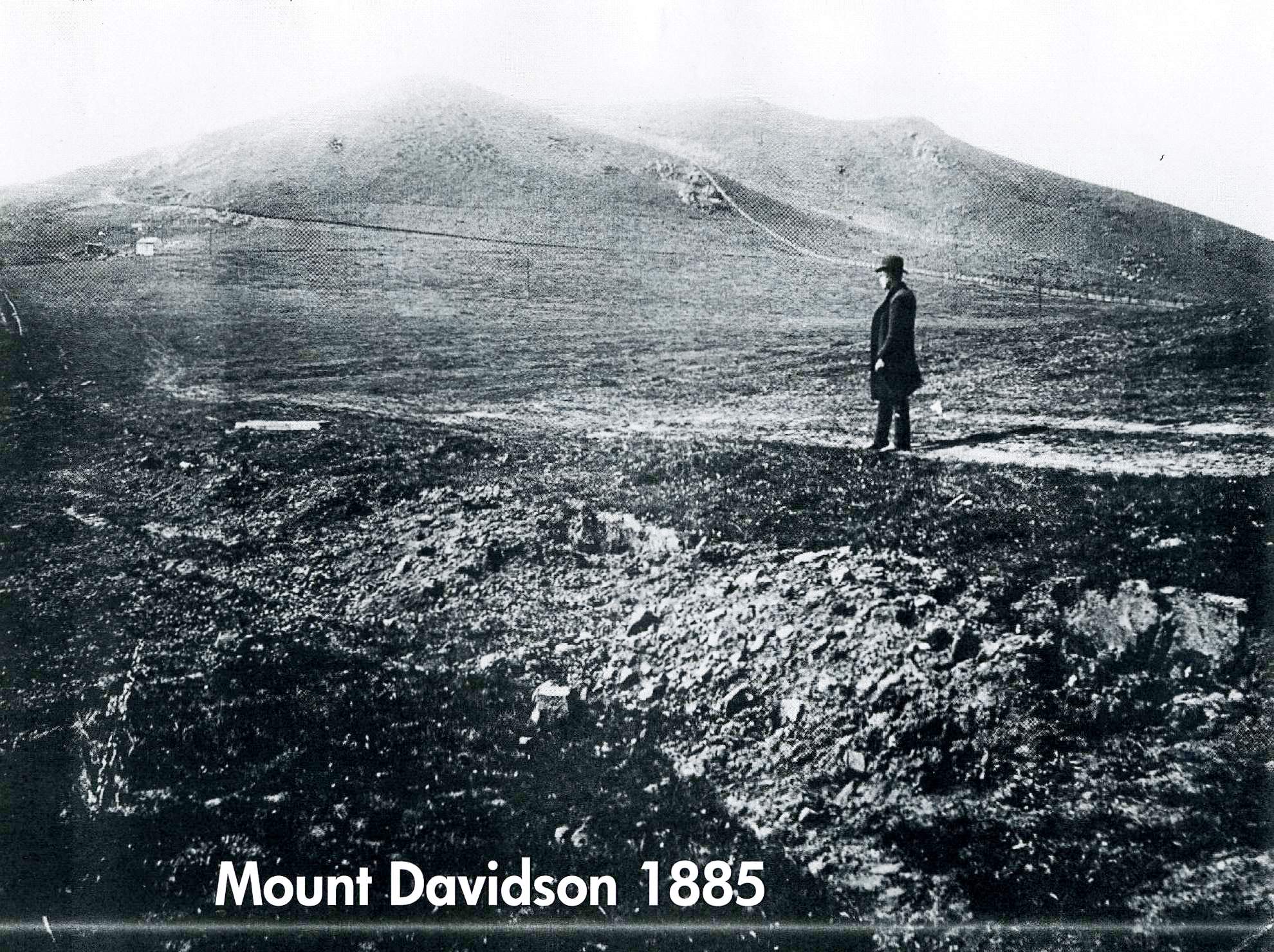
  • Neighbors of Mount Davidson in San Francisco have been trying for several years to discuss plans of the Natural Areas Program to destroy 1,600 trees on Mount Davidson with the Bay Area Chapter of the Sierra Club, which supports those plans.  The Chapter Sierra Club leadership has repeatedly refused to even discuss the issue with the neighbors who are members of the Sierra Club.  The final response came from the Sierra Club Executive Director, Michael Brune who supports the refusal of Chapter leadership to discuss the issue with Club members.
  • The Sierra Club recently announced in its newsletter, The Yodeler, that it has asked the East Bay Regional Park District to destroy 100% of all eucalyptus trees on over 1,200 acres of park land.  East Bay Regional Park District has estimated the average density of the eucalyptus forest on their properties at 650 trees per acre, which means that the Sierra Club is demanding that over 780,000 trees be destroyed in the East Bay.
  • The Sierra Club recently announced that it has asked UC San Francisco to implement its original plan to destroy over 30,000 trees on Mount Sutro in San Francisco.  In making this request, they claim that such destruction will benefit native plants, although the original plan did not propose to plant any native plants.  (These plans are presently on hold, although UCSF is now in the process of destroying about 180 trees they consider hazardous, in the height of nesting season.)
  • San Francisco’s Department of the Environment has submitted an application for funding to create a Biodiversity and Ecology Master Plan which proposes to treat all open space in San Francisco as “natural areas” using the Natural Areas Program as its model.  The Natural Areas Program is presently restricted to 1,100 acres of city-managed park land.  If implemented, this plan could eradicate non-native plants on all city-owned open space as well as private backyards.

The changing climate requires that we reconsider the commitment to native plants in historic ranges because they are probably no longer adapted to those ranges.  They must move if they are to survive and we must accommodate that movement if we want them to survive.  Likewise, we must reconsider everything we are doing to contribute to climate change, including our use of fossil fuels and deforestation.

Taking action

If you are a member of the Sierra Club, please tell them your opinion of their recent demands to destroy more trees in San Francisco and the East Bay than is presently planned by the owners of those properties.  Also, urge them to listen to the concerns of their members regarding the plans for tree removals by San Francisco’s Natural Areas Program.  Their address is:  San Francisco Bay Chapter Sierra Club, 2530 San Pablo Ave. Suite I, Berkeley, CA 94702-2000

If you live in San Francisco and don’t want all open space in the city to be treated as native plant museums, please write to Polly Escovedo (who is considering the grant application to create a Biodiversity and Ecology Master Plan) by May 14, 2014:  polly.escovedo@resources.ca.gov


(1)    This section is from:  Carl Zimmer, “Springing Forward, and Its Consequences,” New York Times, April 23, 2014

(2)    SD Graves and AM Shapiro, “Exotics as host plants of the California butterfly fauna,” Biological Conservation, 110 (2003) 413-433

Media coverage of FEMA projects: The good, the bad, and the ugly

Anise Swallowtail butterfly in non-native fennel

The public comment period for the FEMA project in the East Bay that proposes to destroy nearly half a million trees will close on Monday, June 17, 2013, at midnight.  If you want to express your opinion of these projects, it’s time to do so.  Detailed information about the projects and how to comment on them is available HERE.

The projects have drawn quite a bit of media coverage, starting with Beyond the Chron blog in mid-May and quickly picked up by many other internet sources of information.  Most of those internet sources referred their readers to the Million Trees blog for more information.  In May we had over 12,000 visitors to our articles about these projects.

Both the Oakland Tribune and the San Francisco Chronicle covered the story.  The Tribune coverage was appallingly inaccurate and biased.  The Chronicle coverage was more balanced than it usually is about native plant restoration projects, which the Chronicle usually supports without reservation.

The winner of the booby prize for balanced and fair reporting of the projects goes to the Sierra Club Yodeler which expressed its unqualified support for the projects at the same time it demonstrated total ignorance of the projects (or chose to misrepresent them):

  • Sierra Club said, We want to avoid past mistakes, when agencies simply stripped off vegetation and then walked away, leaving the land clear for exotic and even more-flammable vegetation.”  This is precisely what these projects plan to do…destroy everything then walk away without planting anything.
  • Sierra Club said, The Park District is now implementing that program, and we are monitoring the progress.”  If they are monitoring that program, why don’t they know what the Park District is doing?
  • Sierra Club said, The preferred alternative involves application of the herbicide glyphosate (trade name Roundup) to the stumps to prevent re-sprouting. There is no practical way to eliminate eucalyptus infestations without herbicide, and glyphosate is relatively low in toxicity.”  The Sierra Club is simply wrong.  These projects will use Garlon (with active ingredient triclopyr) and/or Stalker (with active ingredient imazapyr)—not glyphosate (Roundup)–to prevent the trees from resprouting.  Both products are rated by the EPA as more toxic, more persistent, and more mobile in the soil than glyphosate.  Glyphosate (Roundup) will be foliar sprayed on non-native vegetation.  Recent studies report that glyphosate (Roundup) is not a benign pesticide.

There are some scathing comments on the Yodeler article from people who know enough about the project plans to inform the Club that they have run off the rails…into the weeds!!  The Club seems not to have noticed this attempt to set them straight.  When someone called them weeks later to ask about the projects, they repeated the same misinformation to the caller.

(Update:  One of our readers informed the Sierra Club of the inaccuracy of its Yodeler report about the FEMA projects in the East Bay (see comment below).  We are pleased to report that the Sierra Club has revised its Yodeler report on June 19, 2013.  It now acknowledges that native plants will not be planted by these projects.  Consistent with the Draft Environmental Impact Statement for these projects, the Yodeler now claims that native plants will be “recruited” into the areas in which non-native plants and trees will be destroyed. 

We think that is an unlikely outcome of these projects and FEMA’s environmental consultant agrees with us about that (explained here).  However, at least the Yodeler article is now consistent with the written plans for the project. 

The Yodeler also acknowledges the use of Garlon to kill the roots of the trees that will be destroyed.

Thanks to our readers for alerting the Sierra Club to the inaccuracy of their description of this project.  We are sorry that the Sierra Club continues to support the project now that they have a better understanding of the written plans. 6/19/13) 

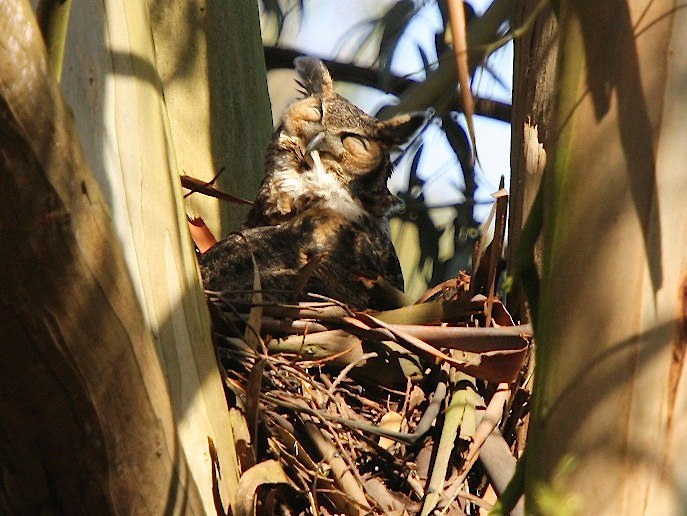
Owl nesting in eucalyptus, courtesy urbanwildness.com

On the positive side of the ledger, we commend the East Bay Express for its article about these projects.  The author deserves credit for actually reading about the projects before she wrote her report!!!  She read the letter from FEMA’s environmental consultant which we reported to our readers here.  In a nutshell, the consultant said that UC Berkeley’s project could increase fire hazards by leaving a 2-foot wood chip mulch on the ground and that conversion to a native landscape was an improbable outcome of the project since nothing will be planted.

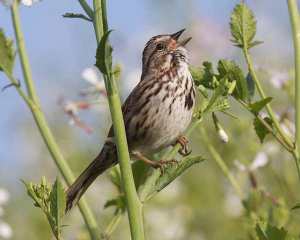
Song Sparrow in non-native wild radish

Our personal favorite for coverage of this project is Nathan J. Winograd’s article, “Biological Xenophobia:  The Environmental Movement’s War on Nature,” which was published by the Huffington Post.   Mr. Winograd is highly qualified to express his opinion of these projects.  He has devoted his personal and professional life to the welfare of animals. He is best known for his advocacy for “no-kill” shelters for our animals.  He was the lawyer for the SPCA in San Francisco when the GGNRA started to destroy non-native trees and fence the public out of their properties to protect their fragile native plant museums.  So, he has been a long-time observer of the destructive and restrictive consequences of native plant projects.  He was prompted to write this article by this latest round of destruction, that is, the FEMA projects in the East Bay.

Here are a few choice phrases from Mr. Winograd’s excellent article:

“Invasion biologists believe that certain plants and animals should be valued more than others if they were at a particular location ‘first.”  When the species that were there ‘first’ are in the same habitat with a species that came later, they assert that the latter should be eradicated.”

 “And the nativist movement is getting worse and increasingly violent, both in rhetoric (fish they don’t value are called ‘missiles with fins’) and in deeds.  At a time of climate change, in a country that needs more trees, not less, nativists in the San Francisco Bay Area are proposing the clear cutting of upwards of half a million trees on San Francisco’s Mount Sutro and in the Oakland and Berkeley hills as part of their ongoing war against the Eucalyptus.  After the trees are clear-cut thousands of gallons of toxic herbicides, will be spread throughout wildlife corridors in order to prevent resprouting.”

An authentic environmentalism would not advocate that humans seek out and destroy living things for simply obeying the dictates of the natural world, such as migration and natural selection. It would not condone the killing of those plants and animals who find themselves in parts of the world where, for whatever arbitrary reason — be they economic, commercial or aesthetic — some humans do not want them to be. An authentic environmentalism would not exacerbate suffering, call for killing and seek the destruction of natural places.”

“Indeed, “invasion biology” is a faux environmentalism, used to disguise the ugly truth about what is really motivating its adherents: an intolerance of the foreign that we have rejected in our treatment of one another, a biological xenophobia that seeks to scapegoat plants and animals for the environmental destruction caused by one species and one species alone: humans.”

There are nearly 500 comments on Mr. Winograd’s article and they are as interesting as the article itself.  They are a microcosm of this debate between nativists and those with a more cosmopolitan view of nature.  We aren’t disinterested observers, so our opinion of the comments of nativists may not be entirely objective.  However, we find many of their comments condescending and uninformed, a contradictory mix of sentiments.

We thank our readers for informing themselves about the FEMA projects and we hope that you now have the information you need to write your public comment by the deadline, June 17, 2013.  Here is where you can send your comment:

  1. Via the project website: http://ebheis.cdmims.com
  2. By email: EBH-EIS-FEMA-RIX@fema.dhs.gov
  3. By mail: P.O. Box 72379, Oakland, CA 94612-8579
  4. By fax: 510-627-7147

These public lands belong to you and the money that will be used to implement these projects is your tax dollars.  So, please tell the people who work for you what you think of these projects.

Sierra Club cranks up the smoke machine

The San Francisco Forest Alliance has made considerable progress in informing the public of the destructive projects of San Francisco’s Natural Areas Program (NAP).  NAP and its supporters have taken notice of the growing opposition to their plans to transform our public parks into native plant museums.  They are cranking up their public relations effort to confuse the public.

The Recreation and Park Department of the City of San Francisco is the sponsor of the Natural Areas Program.  They have recently created a cynical video about NAP which misrepresents the reality of what NAP has done to our parks and what they plan to do in the future.  The San Francisco Forest Alliance has produced a rebuttal to this video which is available here.  Because the Recreation and Park Department disabled the ability to post comments to their video, we call the  rebuttal the “Free Speech Version.”

The Sierra Club has also published an article about the Natural Areas Program in their newsletter, The Yodeler.  This article is also chock full of misinformation both about NAP and about its critics.  This is our rebuttal to this article.  These are issues that we have covered in the past, so we’re not providing much detail here, but we’ve included links to previous Million Trees posts.  (The Yodeler article is italicized and in quotes and our rebuttal is not italicized.)

[Edited to add:  The SF Forest Alliance has posted a letter written by a Sierra Club member which the Yodeler Editor has refused to print. ]

********************************

“San Francisco Natural Areas Management Plan in peril”

“In San Francisco, where nearly everyone claims to be an environmentalist, how can there be opposition to certifying environmental review for the city’s Significant Natural Resource Areas Management Plan (SNRAMP) to guide the care of the city’s natural areas?

The plan covers all aspects of preservation for the city’s natural areas, which include many of the most vital remnants of the city’s original ecosystems, including a diverse array of landscapes and habitat types.”

Webmaster:  There is no opposition to an environmental review of the Natural Areas Program.  Rather there is opposition to the Draft EIR because it is a white wash.  The Draft EIR fabricates a plan which is easy to defend but bears little relationship to the written plan (SNRAMP) that it is legally obligated to evaluate.

Most of the natural areas had no native plants in them when they were designated as natural areas.  The claim that the natural areas are “remnants of original ecosystems” is bogus.  Some were essentially building rubble from the constructions of former occupants of the land.

Balboa Natural Area under construction

“Much of the conflict surrounding the plan has to do with concerns about tree removal. Most of the trees in the designated natural areas will remain where they are. The vast majority of lands—including almost all the lands within the less critical MA-2 and MA-3 management subareas—will remain forested.”

Webmaster:  Native plant advocates killed approximately 1,200 trees by girdling them before they were caught and stopped.  Since then NAP has destroyed hundreds of trees in many natural areas.  Their written plans (SNRAMP) state that they plan to destroy 18,500 trees over 15 feet tall and countless smaller trees which they choose not to define as trees.

“However, many trees are in sorry shape, suffering from old age, disease, beetle infestations, and cumulative damage from years of neglect.”

Webmaster:  The trees that NAP plans to remove are not hazardous or unhealthy.  They have been selected for removal solely because they are shading native plants or areas where NAP wishes to expand existing native plant gardens.  Most of the plants that are native to San Francisco require full sun.  The written plan makes this reason for tree removals perfectly clear.  Those who claim that the trees are unhealthy have either not read the written plan or they willfully misrepresent it.

Critics of NAP are not opposed to the removal of hazardous trees.  The City of San Francisco has the right and the obligation to identify hazardous trees and remove them.  Neither a written management plan for NAP nor an Environmental Impact Report is required to remove hazardous trees.

“Some trees are the wrong species in the wrong places, displacing habitat needed by native birds, pollinators, and other critters. A stand of planted blue gum or Monterey cypress may be large and “majestic”, but take up space needed for native habitat (grassland, dune-scrub, oak woodlands, etc.)”

Webmaster:  This is the heart of the controversy.  Most of the trees will be destroyed only because they are the “wrong species,” not because they are hazardous.  Those who know both the science of ecology and the reality of wildlife in San Francisco do not believe that wildlife benefits from the destruction of existing trees and vegetation.  Animals have long ago adapted to the existing landscape which has been here for over 150 years.  We also make no distinction between native and non-native wildlife.  Both are equally valuable to us and we find the distinction distasteful, just as we find racial prejudice distasteful.

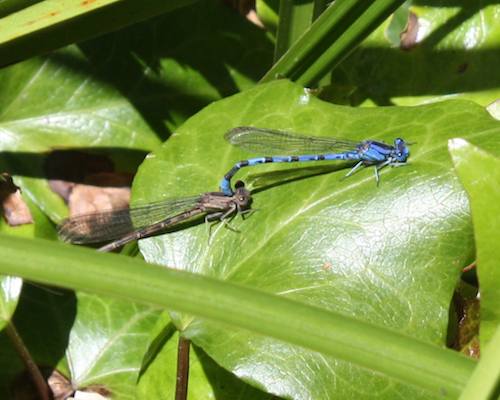
Damselflies mating on ivy in Glen Canyon Park

“The SNRAMP is designed to strike a balance, making the most of the ecological value of existing forested areas while in certain critical areas (such as small patches on Mount Davidson), the plan calls for limited tree removal.”

Webmaster:  Mt. Davidson will lose 1,600 trees over 15 feet tall when SNRAMP is implemented in addition to about 200 trees that have already been destroyed by NAP or its supporters.  Most of the trees on 10.2 acres of Mt. Davidson will be destroyed.  This is not a “small patch.”

“Unfortunately, a small but vocal group of “tree advocates” has been campaigning loudly against any tree removal in any park, anywhere in the city. They have exaggerated the envisioned amounts of tree-removal, and promulgated disinformation about the scope and objectives of the plan, wildly accusing advocates of ecological restoration of wanting to revert the entire park system to its former “wasteland” of dunes and scrub.”

Webmaster:  Critics of NAP are not a “small group.”  Several thousand people have signed the petitions of the San Francisco Forest Alliance, asking the City’s policy-makers to stop the destruction in San Francisco’s parks.

Here is a quote from the management plan for NAP which clearly states its objectives:  “Prior to colonization and the stabilization of dunes and introduction of invasive species, trees were not a dominant feature of the San Francisco peninsula…Much of the area probably resembled the coastal scrub habitats of San Bruno Mountain or the grassland scrub mosaics of the Marin Headlands…The long-term goal of urban management in MA-1 and MA-2 areas…is to slowly convert those areas to native scrub and grassland.

It is not necessary to exaggerate the objectives of NAP for the 1,100 acres of park land they have claimed as natural areas.  Their objectives are clearly stated in their management plan.

“Contention has also come from segments of the well-organized off-leash-dog advocates. Partly because of continuing disagreements with the Golden Gate National Recreation Area over management of Crissy Field and Fort Funston (see September-October 2005, page 23). Some oppose any environmental restriction on dogs, and some seem to object to any fencing anywhere or any attempt to route pedestrian and canine traffic into well-defined paths—even to protect erosion-prone areas or sensitive plantings. We don’t believe that these represent the majority of responsible dog-owners, but they have been the most vocal.”

Webmaster:  People who visit San Francisco’s parks with their dogs are impacted by NAP because NAP has claimed 80% of all off-leash areas as “natural areas.  Only 118 acres of park land in San Francisco have been designated for off-leash areas.  In other words, there are 1,100 acres of “natural areas” but only 118 acres of off-leash areas and NAP has claimed 80% of those 118 acres. (SNRAMP 5-8)

The Draft Environmental Impact Report (DEIR) for NAP proposes to close or reduce the size of several off-leash areas.  The DEIR offers no evidence that these areas have been negatively impacted by dogs.  It also states that all off-leash areas in the natural areas are subject to closure in the future if it is deemed necessary to protect native plants.  Since NAP has offered no evidence that the proposed immediate closures are necessary, one reasonably assumes it will offer no evidence if it chooses to close the remainder of the 80% of all off-leash areas in San Francisco located in natural areas.  We know from the DEIR public comments that NAP supporters demand their closure.

Given these facts, no one should be surprised that people who wish to walk their dog in the parks have reacted to the Natural Areas Program and the restrictions it has proposed.  The Sierra Club’s representation of dog owners as being unreasonable is unfair and misrepresents the nature of their opposition.

“Some feral-cat advocates have objected to reductions in large feral-cat colonies on park lands. There are also some people who object to the use of any herbicide. Then there are those who argue against the plan from a posture of ecological nihilism. They maintain that under the new conditions informing evolution in the “anthropocene” era, it makes little sense to spend money and resources trying to save native ecosystems which are inevitably doomed to extinction. Rather, they suggest, we should embrace the “rambunctious” exuberance of weeds gone wild.”

Webmaster:  The Sierra Club finally acknowledges that NAP uses herbicides.  What a breakthrough!  However, it tells us nothing about NAP’s herbicide use, which would explain why park visitors object.  NAP’s herbicide use has increased over 300% in the past three years.  It used herbicides 86 times in 2011 and it has sprayed 87 times in the first 9 months of 2012.  Most of the herbicides it uses are classified by the City’s Integrated Pest Management Program (IPM) as “Most Hazardous” and “More Hazardous.”

In addition to NAP’s herbicide use, volunteers have been seen and photographed spraying herbicides in Glen Park without posting as required by the City’s IPM policy.

The Draft Environmental Impact Report (DEIR) for NAP says next to nothing about NAP’s pesticide use.  It does not report either the volume of pesticide use or the types of pesticide used.  This is one of the conspicuous omissions in the DEIR for which it is criticized.  If that omission is not corrected in the final version, you can be sure that the public will object.

In naming a new geologic era the Anthropocene, scientists are merely acknowledging man’s pervasive impact on the Earth.  Acknowledging this fact does not “give up” on the Earth.  Rather it offers us the opportunity to adopt more realistic goals of what we can accomplish while making a commitment to stop damaging the environment further with the pesticides and prescribed burns that are used by the restoration industry and its sponsors in the chemical industry.

“All these concerns have already been addressed in the planning process leading up to the issuance and approval of the management plan, during countless public meetings. The purpose of environmental review is to assess the environmental impacts of the plan. The current Draft Environmental Impact Report (EIR) does this in a reasonable fashion, and to that extent—at least for the San Francisco portions of the plan—it is adequate and complete. It is beyond the scope of an EIR to resolve all the underlying conflicts”

Webmaster:  There were three public meetings prior to the approval of the management plan in 2006.  The Recreation and Park Commission held one public hearing (in two sessions) when they approved the management plan.  All other public hearings were demanded by critics of NAP in a fruitless attempt to convince the Recreation and Park Department to revise its plans so that NAP would be less destructive.

“The final draft of the SNRAMP was published in 2006, but the environmental review process has been continuously delayed. As a result, a whole new cast of characters has come into play, including new planning commissioners, new staff, and new voices among the advocacy groups. These each have had to be brought up to speed, inevitably some protest that their voices were not heard, and the whole process gets delayed even more.”

Webmaster:  Any delays in the environmental review process were not caused by critics of NAP.  They were caused by supporters of NAP who want an even more extreme version of NAP and are suing to get it. 

There is new opposition to NAP because the public has had six more years of experience with NAP.  They have watched the plans being implemented in their parks even though there is still no approved Environmental Impact Report and they don’t like what they see.

Critics of NAP do not need to be “brought up to speed.”  We can see with our own eyes the destruction of our parks and the conflict caused by the extremist vision of recreating wilderness in the second most densely populated city in the country.

No amount of smoke can obscure the reality of the Natural Areas Program.

Bowling Alone with the Sierra Club

In 2000 Robert Putnam’s (Harvard University) masterpiece of American social science, Bowling Alone* was published.  He reported the significant decline of all forms of civic participation in American society and politics from the P.T.A. to voting.  Religious participation is the notable exception to this trend. 

We are deeply concerned about the increasing isolation of Americans from one another and we believe that the polarization of viewpoints, particularly in politics, is one of the consequences of this trend.  Only the highly motivated extremes of opinion are still engaged in the civic dialogue.  The middle ground is no longer represented in the debate.  However, we will focus on the topic that is relevant to Million Trees, that is, the implications for the environmental movement. 

Bowling Alone. Attribution: Xiaphias

Membership in environmental organizations reached its peak in 1995, according to Bowling Alone after decades of enormous growth since the 1960s.  This peak was consistent with public opinion regarding environmentalism.  In 1990 three-quarters of Americans considered themselves “environmentalists.”  By the end of the decade, that percentage had dropped to only 50%. 

The growth in membership was achieved by the use of a new marketing tool known as direct mail.  Think about it.  How many invitations do you receive in the mail from non-profit organizations, asking you to contribute to a wide-range of worthy causes?   Typically these organizations spend between 20-30% of their budgets on such fund raising and the rate of return on these solicitations is only 1-3% of the cost depending upon the quality of the mailing list.  Using this technique, Greenpeace tripled its membership between 1985 and 1990 to 2.35 million.

What does “membership” mean?

After tripling its membership, Greenpeace lost 85% of its members in the next 8 years.  The drop-out rate after the first year is typically 30% in these organizations.  

In fact, most contributors to these organizations don’t even consider themselves “members” in the usual sense of that word.  The commitment to the organization doesn’t extend far beyond writing a check.  Only 8% of contributors to the Environmental Defense Fund, for example, described themselves as “active” in the organization. 

These organizations are therefore distinctly different from their historical antecedents.  Participants in the civil rights movement frequently put their lives on the line.  The social lives of Rotary Club members revolved around the Rotary lodge. 

Since few people are active participants in environmental organizations, they have become “bureaucratized,” meaning they are run by and for paid professionals.  Most members have little idea what policies the professional staff has adopted on their behalf. 

The Sierra Club

In 1989, a survey of Sierra Club members determined that only 13% of its members had attended even one meeting of the Sierra ClubThe Bay Area Chapter of the Sierra Club claims to have 10,000 members, but chapter leadership of a group (the chapter is broken into many geographical groups, such as the San Francisco Group)was elected by as few as 59 votes.  The top vote-getter in the Club’s most recent election received 327 votes in a Chapter-wide race, but only one chapter group (Northern Alameda County) had more candidates than there were available seats.  In other words, there was no competition for most of the leadership seats. 

Yet, the incumbents in these leadership positions are free to determine the local policies of the Sierra Club.  Here are a few recent examples of positions taken by the Bay Area Chapter of the Sierra Club:

The opinion of the membership is not asked when these policy positions are taken by the leadership.  However, if members read the chapter’s quarterly newsletter (The Yodeler) they have the opportunity to learn about them after the fact.

The influence of the Sierra Club

We believe that the influence of the Sierra Club exceeds the size of its membership.  The Sierra Club endorses candidates for political office.  These endorsements are highly sought after because politicians believe that the endorsement confers the votes of its membership.  This belief was recently tested in the race for mayor of San Francisco. 

State Senator Leland Yee sought and received the endorsement of the Sierra Club in his bid for mayor of San Francisco.  In the past, he had been critical of the Natural Areas Program.  His stated reason for that criticism was that the veneration of native plants was offensive to his roots as an immigrant.  In particular, the Chinese community suffered horrendous discrimination in California in the 19th Century.  The rhetoric of the native plant movement is reminiscent of the xenophobia from which the Chinese community has suffered historically. 

It seems unlikely that Senator Yee’s emotional reaction to nativism changed when he sought the endorsement of the Sierra Club, but he had to disavow that opinion in order to receive the Club’s endorsement.  He did so because he believed that the votes of Sierra Club members would help him to be elected mayor of San Francisco.  His bet did not pay off.  He did not win.  In fact, he came in fourth. 

We hope that political candidates in the future will heed this warning.  The Sierra Club may have many “members” but that membership does not necessarily confer votes.  The vast majority of “members” have no commitment to the policy positions taken by the Club.

An appeal to Sierra Club members

There were over 4,000 public comments on the Environmental Impact Study for the Dog Management Plan of the Golden Gate National Recreation Area (GGNRA).  The Dog Management Plan proposes to eliminate about 80% of existing off-leash areas, which are now only 1% of the 74,000 acres of GGNRA property.  The Sierra Club supports that plan.  There were thousands of comments from people with dogs who are presently enjoying the small areas now available to them for off-leash recreation.  Sixty-four of those people said they are Sierra Club members.  That’s enough members to elect someone to a leadership position in the Club.

If you are a member of the Sierra Club, here’s what you can do to influence the Club’s policies:

  • Inform yourself of the policies of the Sierra Club. 
  • If you don’t agree with those policies, we urge you to vote in the election of officers to the leadership positions in the Sierra Club.
  •  If you don’t know the policies of the candidates, ask them. 
  •  If there are no candidates that represent your viewpoint, find candidates who do.
  • If you can’t find a candidate you can support, it’s time to vote with your feet.
  • If you leave the Club tell them why. 

Quit Bowling Alone!

Attribution: GNU Free Documentation

*Putnam, Robert, Bowling Alone:  The Collapse and Revival of American Community, Simon & Schuster, New York, 2000.  All quotes in this post are from Bowling Alone unless otherwise noted.

The Sierra Club redefines “recreation”

In the current edition of the newsletter of the local chapter of the Sierra Club, the Club explains why it doesn’t like the revised Recreation and Open Space Element (ROSE) of San Francisco’s General Plan.  The Club has a long list of complaints about the new ROSE, but the one that caught our eye was this particular criticism:

“The draft ROSE talks about the benefits of open space for physical fitness through exercise and recreation, but these one can do on city streets and in gyms.”

–          The Yodeler, June 29, 2011

In the same article, the Sierra Club redefines “recreation” as follows:

“…the draft [ROSE] neglects the values of respite, quiet contemplation, and undisturbed wildlife viewing… The document does not talk about the one thing that only parks can provide, the experience of nature.”  Ibid.

In other words, in the opinion of the Sierra Club, public parks are for the benefit of plants and animals.  The public is welcome to look at the plants and animals, so long as they do not disturb them in doing so.  However, if the public seeks more active forms of recreation, such as playing ball, hiking, or riding a bike, the Club invites them to take to the streets or join a gym.

Having debated park issues with the leadership of the Sierra Club many times and observing their advocacy closely, we are well aware of their rather narrow view of the purpose of parks.  However, we think it is unlikely that most Sierra Club members realize that their organization is actively trying to prevent all traditional forms of recreation in their parks.  We therefore shine a bright light on the role that the Sierra Club plays in turning urban parks into native plant museums.  In “Fortress Conservation:  The loss of recreational access” we described three specific examples of parks in the San Francisco Bay Area in which recreational access has been restricted as the result of advocacy and lawsuits by the Sierra Club and other organizations which share their view.

“Active” vs “Passive” Recreation

We were originally introduced to the Sierra Club’s objectives for our urban parks in the Bay Area with the terms, “active” and “passive” recreation.  The Sierra Club advocates for “passive” recreation, which it defined in its article about the ROSE as “respite, quiet contemplation, and undisturbed wildlife viewing.”

The Berkeley Meadow

We visited a park today which is an example of what the Sierra Club has in mind.  The 72-acre Berkeley Meadow at the foot of University Ave in Berkeley is one of many parks in the Bay Area that reflects the wishes of the Sierra Club.  The Berkeley Meadow is part of the Eastshore State Park that is owned by the State of California, but operated by East Bay Regional Park District.  The Berkeley Meadow was at one time part of the San Francisco Bay, until it was created with landfill and used as a city dump until the 1960s.  The East Bay Regional Park District “restored” the meadow over a period of 5 years at a cost of $6 million.  It is now a huge fenced pen with a fenced trail running diagonally through it.  Bicycles and dogs on leash are both prohibited from using this fenced path.  One wonders what harm could come to the plants and animals that reside on the other side of the fence.  The meadow is predominantly non-native annual grassland, with willows in wetter portions of the meadow and some coyote bush scrub in the grassland.  (see video cartoon about the Berkeley Meadow:  “Grandpa takes the kids to the plant zoo.”)

The Berkeley Meadow

Cesar Chavez Park due west of the Berkeley Meadow provides a multiuse contrast.  Cesar Chavez Park is a Berkeley city park, NOT a park owned by East Bay Regional Park District.  This 90-acre park provides a wide variety of recreational opportunities, including a popular kite-flying area, an off-leash dog park, a restricted “natural area” (predominantly non-native plants), and a fenced area in which burrowing owls nest half of the year.  The unfenced paths are used by bicycles, joggers, people walking, some with dogs on leash.  Cesar Chavez is a successful park, enjoyed by a wide variety of visitors every day.  The Sierra Club made every effort to prevent this multi-use park from accommodating all forms of “active” recreation.

Multiuse recreation at Cesar Chavez Park: a panda flying a kite

Environmentalism has been hijacked by extremists

Let us be perfectly clear about our opinion of “active” vs “passive” recreation.  We do not object to parks such as the Berkeley Meadow in which human access is severely restricted.  What we object to is that the Sierra Club wishes to turn all parks in the Bay Area into native plant and animal reserves in which humans are not welcome, except as passive observers.  This is an example of the extremism that has earned environmentalists the reputation of being unreasonable.

In 2004, the authors of the controversial paper entitled, “Death of Environmentalism” reported that “The number of Americans who agreed that, ‘Most of the people actively involved in environmental groups are extremists, not reasonable people,’ leapt from 32 percent in 1996 to 41 percent in 2000.”  Peter Kareiva, Chief Scientist of the Nature Conservancy, in his recent talk in San Francisco sponsored by the Long Now Foundation (a summary of this talk is available on the Save Sutro website), reported that over half of those surveyed in 2011 now agree that “environmental groups are extremists, not reasonable people.”  This loss of support for environmentalism is a great tragedy, for there is much legitimate work to be done by environmental organizations which are now distracted by tangential issues such as creating native plant museums in our urban parks.

The Sierra Club instructs FEMA

Those who are still members of the Sierra Club, but are concerned about the Club’s endorsement of projects to destroy trees and  use toxic poisons to kill their roots, might be interested in the Club’s public comment (scroll down to Appendix F “Written Comments) to Federal Emergency Management Agency (FEMA) in preparation for the Environmental Impact Study of four such projects in the East Bay hills. 

 The Chairman of the Bay Area Chapter of the Sierra Club begins by asking FEMA to ignore those who are critical of these projects:  “1. We urge FEMA to discount the views of any individual or group that uses sophomoric name calling tactics in the press or in their FEMA scoping comments to categorize people or advocacy groups as ‘nativists’ (or other similar pejorative labels)…”

Apparently the author does not consider calling someone “sophomoric” an example of “name-calling.”  Webster defines “sophomoric” as “intellectually pretentious and conceited but immature and ill-informed.”  Hmmm…that sounds pretty insulting to us.

We don’t use the word “nativist” here on Million Trees, not because we consider it an inaccurate description, but rather because we have been told that it offends native plant advocates.  Since our goal on Million Trees is to inform, rather than to offend, we stick with the clunky phrase, “native plant advocates.”

What about “other similar pejorative labels?”  Does the Club also object to the phrase “native plant advocates?”  We are at a loss to arrive at some phrase that would appease them.  For the moment, we’ll stick with “native plant advocates” to describe those who advocate for the restoration of native plants to our public lands.  After all, the Sierra Club freely admits its preference for native plants in their letter:  “We obviously prefer our local native species and plant communities when compared to…introduced species.” 

The Sierra Club also instructs FEMA to put the restoration of native plant communities on an equal footing with fire hazard mitigation:  “We also urge FEMA to ensure that natural resource protection is given equal status with fire hazard reduction work when final projects are developed.”  The letter provides a detailed description of the “natural resource protection” it has in mind.  In this context, that phrase translates to “native plant restoration.” 

Since the stated purpose of FEMA’s pre-disaster and hazard mitigation grants is to reduce fire hazard to the built environment and the humans who live in it, this doesn’t seem an appropriate request.  FEMA’s legal and fiduciary responsibility is to respond to disasters when they occur and to reduce the potential for disasters in the future.  FEMA seems to have its hands full doing just that.  FEMA’s assigned mission does not include native plant restoration.

As we observed in our post “Open Letter to the Sierra Club,” the Club tends to ignore the fact that the tree destruction for which they advocate requires the use of toxic herbicides.  However, in its public comment letter to FEMA, the Club acknowledges the use of such herbicides and endorses their use:  “We are not currently opposed to the careful use of Garlon…”  On our page about “Herbicides,” we report that the EPA classifies Garlon as “hazardous”  and we cite the laboratory research on Garlon, indicating that it is harmful to many species of animals and is mobile in soil and water.

We hope that FEMA will maintain its mandated focus on hazard mitigation, its sole responsibility to the taxpayers.   If the taxpayers wish to fund native plant restorations, they should do so by designating an appropriate fund source.  FEMA is not an appropriate fund source for native plant restorations.

Open Letter to the Sierra Club

In this post we are writing an open letter to the Sierra Club about an article in their recent edition of the Yodeler, the newsletter of the Bay Area Chapter of the Club.  The article is available here

——————————————————————————————-

Dear Sierra Club,

We are writing about an article in the Yodeler about the “Wildfire Hazard Reduction and Resource Management Plan” of the East Bay Regional Park District.  A charitable description of that article is that it is misleading and inaccurate.

The most important flaw in the article is that it omits the most controversial issue in the “Wildfire Plan.”  It describes the methods used to eradicate non-native plants and trees as follows:  “Methods for removal include hand removal, grazing by cattle and goats, and limited controlled burns.”

In fact, herbicides are often used by EBRPD to kill non-native plants and trees.  The failure to mention this use of herbicides in the Yodeler cannot be dismissed as ignorance of this fact since it is described in detail in the “Wildfire Plan” and was the most frequently mentioned issue in the meeting of the EBRPD Board of Directors at which the Plan was approved.  The Sierra Club was represented at this meeting and surely noticed that many speakers expressed their concern regarding the use of herbicides officially designated “hazardous chemicals” by OSHA.  The toxicity of these herbicides is reported  here and here.

The description of controlled burns required by the Plan as “limited” is debatable.  We believe that the use of controlled burns for the sole purpose of restoring native plants is dangerously irresponsible.

At the recent meeting of the Executive Committee of the Board of Directors of the EBRPD, the “fuel management” plans for 2011 were presented and approved.  These plans included prescribed burns in 5 locations, on approximately 250 acres.  These burns were described by the Assistant Fire Chief as unrelated to reduction of fuel loads, but rather for the purpose of supporting restoration of native plants to the parks.  A representative of the California Native Plant Society expressed  gratitude to East Bay Regional Park District  for conducting these burns for the benefit of native plants.

We object to the use of controlled burns for this purpose because such burns have a history of causing major wildfires (reported here).  Some of these controlled burns will occur in areas with many acres of eucalyptus and Monterey pine that both the Sierra Club and the East Bay Regional Park District claim are highly flammable.  The burns are scheduled to occur during the height of the fire season.  Such burns also reduce air quality and release carbon and particulates into the air.

It baffles us that the Sierra Club endorses the use of dangerous herbicides and prescribed fires.  However, we aren’t surprised because the Club’s comments on the Draft EIR for the “Wildfire Plan” warned us that the Sierra Club considers the restoration of native plants a higher priority than the public’s safety.  The lawyer representing the Club said on behalf of the Club, “Perhaps the most serious problem with the Plan is that it explicitly makes the preservation and enhancement of wildlife a secondary concern, with minimizing fire danger the primary concern” and concluded, “However, the over-emphasis on decreasing wildfire risks at the expense of habitat values is disturbing.”

The Club’s priorities reveal a misanthropic agenda that betrays its original ideals and its commitment to the environment on behalf of all living creatures, including humans.

Million Trees